How Were the Filton 4 Sentenced for Terrorism When They Weren’t Convicted of Terrorism?
18.6.26

Please click on either of the ‘Donate’ or ‘Buy’ buttons below (via PayPal or Stripe) to make a donation towards the $2,500 (£2,000) I’m trying to raise to support my work as a reader-funded investigative journalist, commentator and activist over the next three months. To get links to all my work in your inbox, please also consider taking out a free or paid subscription to my new Substack newsletter.
This is the last of three articles about the recent concerted assault on the direct action group Palestine Action in the UK courts. The first, “Punitive sentencing in the UK for Filton 4 activists on behalf of Israel”, focused on the sentencing of the Filton 4 last Friday, which I posted on Facebook here, where it has had over 330,000 views (although it also attracted an open sewer of deeply unpleasant trolls), and also on Substack, where I also sent it to my subscribers. Feel free to join me. The second, “The Renewed Ban on Palestine Action Confirms Legal Overreach in the Designation of Terrorism”, about the Court of Appeal’s unwise reinstatement of the proscription of Palestine Action as a terrorist organization, in which I examined the root problems of “serious damage to property” having been designated as terrorism in the Terrorism Act 2000, was posted here on my website, and this third article revisits the Filton 4 sentencing to provide detailed analysis about how the biased judge, Mr. Justice Johnson, was able to sentence the four activists for terrorism, when they weren’t convicted of terrorism by the jury in their retrial.
POSTSCRIPT: On June 24, I joined Chris Cook for his Gorilla Radio show in western Canada to discuss the fall of Keir Starmer (see my Substack post here), and the devious judicial efforts to secure terrorism-enhanced sentences for the Filton activists. Listen to the one-hour show on Substack here. I’m in the second half; Yves Engler in the first half.
Since the sentencing, last Friday, of the Filton 4 — activists with Palestine Action, who undertook direct action to damage drones intended for use in Gaza at a facility owned by Elbit Systems, Israel’s biggest arms company — observers of justice, in the UK and around the world, have been reeling at the imposition by the judge of punitive sentences.
As I explained in my first article, Charlotte Head and Leona Kamio were given six-year sentences, minus 45 days for time served since the conviction, Fatema Zainab Rajwani was given a sentence of five years and eight months, minus 45 days, while Samuel Corner was given a sentence of eight years and eight months.
This latter sentence was longer than the other three, because the jury convicted Corner of GBH (grievous bodily harm), for attacking a police sergeant, Kate Evans, with a sledgehammer, causing a small fracture to one of her vertebrae, with no lasting damage, and not, as the trolls allege in what appears to be coordinated misinformation, “breaking her spine.”
Recognizing that Corner, who is autistic, was disorientated after being pepper-sprayed, and had panicked when he attacked Sgt. Evans, fearing that one of his fellow activists was being “seriously hurt”, the jury refused to convict him of GBH “with intent”, but on the lesser charge of GBH “without intent”; in other words, they recognized that he hadn’t undertaken the action planning or intending to inflict violence on anyone.
The reason for the shock is not because of their conviction for criminal damage, because that was decided by a jury at a retrial last month (after an earlier trial had proved inconclusive), but because the judge augmented those charges, at the sentencing phase, with a “terrorism connection” that was not disclosed to the jury, and that is, legally, profoundly contentious.
Because of this, all four will not be eligible for early release, despite them being first-time offenders, until they have served at least two-thirds of their sentences, and will also be tarred for life as terrorists, with severe restrictions imposed on their freedom for at least 15 years after their release.
The frankly disgraceful legal subterfuge required to sentence defendants for terrorism when they were not convicted of terrorism wasn’t dreamt up by the judge, Mr. Justice Johnson, a man who, nevertheless, has a long history of slavishly defending the British establishment, and who was evidently specifically chosen for the Filton trial because he was ideologically committed to the Starmer government’s obsession with protecting Israel’s ability to continue its genocide in Gaza — and to maintaining the profits of Elbit Systems.
It was, instead, the first use of a clause in the Counter-Terrorism and Sentencing Act 2021, legislation driven by one of modern Britain’s most authoritarian home secretaries, Priti Patel.
Noticeably hostile towards immigrants and protestors, Patel declared war on refugees and asylum seekers through the Nationality and Borders Act 2022, and also sought to outlaw protest via the Police, Crime, Sentencing and Courts Act 2022. She took aim at the UK’s travelling community of Gypsies and Travellers, seeking to criminalize their entire way of life, dreamt up the cruel scheme to deport asylum seekers to Rwanda, and authorized the extradition of WikiLeaks’ founder Julian Assange to the US.
In her efforts to suppress protest, Patel took particular aim at the disruption caused to traffic by the activists of Extinction Rebellion, and the Black Lives Matter activists who toppled a long-hated statue of the slave owner Edward Colston into Bristol Harbour in June 2020. When parts of her Police, Crime, Sentencing and Courts Bill were stripped out prior to the legislation being passed, she immediately reintroduced the offending draconian sections in what became the Public Order Act 2023, under her successor Suella Braverman, who also introduced further draconian legislation aimed at refugees and asylum seekers through the Illegal Migration Bill 2023, which sought to criminalize the very existence of refugees.
The Counter-Terrorism and Sentencing Act 2021 received far less scrutiny than other legislation passed on Priti Patel’s watch, but it contained a monstrous seed of grotesque legal overreach that became evident last Friday when the Filton 4 were sentenced, in what, as the BBC described it gingerly, was “believed to be the first time that convictions for criminal damage have been classified as being connected to terrorism.”
The monstrous seed of injustice in the Counter-Terrorism and Sentencing Act was the very first clause — Clause 1 — of the bill, which allows any offence that carries a maximum penalty of more than two years’ imprisonment to be subject to an aggravated sentence if it is determined to have a terrorist connection.
As the government described it in a sentencing factsheet, this sweeping new definition of aggravated sentencing “closes a loophole in existing legislation by expressly requiring the Courts, in cases where it appears that any non-terrorism offence with a maximum penalty of more than two years was committed in the course of an act of terrorism, or for the purposes of terrorism, to actively consider whether the offence was committed with a terrorist connection and should be aggravated as such.”
The factsheet added that, “Currently, the Courts are only expressly required to consider this in relation to a defined list of non-terrorism offences”, which sounds innocuous enough, but, as Lord Marks of Henley-on-Thames, a barrister and a Liberal Democrat peer, explained as he sought to add a crucial amendment to the bill in the House of Lords on March 3, 2021, it was anything but innocuous.
Lord Marks’ prescience regarding the dangers of aggravated sentencing for terrorism, as wielded by Mr. Justice Johnson
Lord Marks was seeking, unsuccessfully, to introduce an amendment which “would require a trial of the issue as to whether or not there is a terrorist connection in relation to an aggravated offence”, and, in explaining why, he laid out all the alarming problems that emerged last Friday during the sentencing of the Filton 4.
As he stated, he had argued at the Committee stage that Clause 1 “should not stand as part of the Bill because it would create a whole raft of new aggravated offences, for which offenders would be sentenced on the basis that the offences had a terrorist connection without the question of whether they had such a connection ever having been tried by a jury or a judge or even tried on the basis of admissible evidence.”
He added that, “For the purpose of Section 69 of the Sentencing Act, which is to be amended by this clause, an offence has a terrorist connection if it is, or takes place in the course of, an act of terrorism or is committed for the purposes of terrorism.”
In Committee, he explained, the principal point that he made “was that the decision that the offence had a terrorist connection was not made by the jury before the offender was convicted but was reserved to the judge at the sentencing stage.”
Explaining more, he stated, “A defendant might be convicted by a jury of the basic offence, for which the appropriate penalty might be a short term of imprisonment, but sentenced on the basis of a decision taken by a judge alone, without hearing any evidence, that the offence had a terrorist connection and merited a sentence of a long term of imprisonment.”
He added, “I said then and repeat now that that feature would cut across the principle of our criminal law that no one should be convicted of an offence except upon admissible evidence, open to challenge in a trial and, if in the Crown Court, heard by a jury.”
He also explained why that supposedly innocuous expansion of non-terrorism offences that could trigger the imposition of an aggravated sentence, delivered solely by a judge, was so troubling.
As he described it, “Prior to this Bill, offences with a terrorist connection that would act as an aggravating factor in sentencing comprised a relatively limited range of very serious offences which might often be expected to have a terrorist connection, such as murder, a number of explosives offences, hijacking, hostage-taking and serious aviation offences. They were listed in Schedule 2 to the Counter-Terrorism Act 2008 and would all normally merit long terms of imprisonment.”
Now, however, the government’s updated bill “broadens the range of offences that may be treated as aggravated by a terrorist connection to include any offence that carries a sentence of imprisonment of more than two years.”
As he added, “An offence of assault occasioning actual bodily harm, for example, carries a maximum sentence of seven years’ imprisonment, even though the violence involved can be relatively minor and the harm caused can be restricted to bruising or pulled muscles. The basic offence might merit a fine or a short term of imprisonment, but the offence committed with a terrorist connection might attract the maximum sentence. While the offender’s guilt of the basic offence would be determined by a jury, the terrorist connection would be a matter for the judge alone at the sentencing stage.”
As he also explained, “The finding that an offence has a terrorist connection does not simply increase the likely sentence; it also has the effect of activating the notification requirements for terrorist offences, thus classing the offender as a terrorist, with lifelong consequences, and the further effect of activating a number of forfeiture provisions. In addition, the increased sentence is subject to the restriction on early release under the so-called TORA Act, the Terrorist Offenders (Restriction of Early Release) Act 2020 that we passed as emergency legislation last year. Not only would the sentence be longer, but the proportion served in custody would be greater. In short, the consequences of a finding of a terrorist connection are devastating for the offender.”
A truly bleak day for British justice
So there you have it. Lord Marks’ critically valid objections to Clause 1 of the Counter-Terrorism and Sentencing Act were ignored, even though he recognized that it would allow a judge to augment any sentence with a “terrorism connection”, so long as the non-terrorist crime for which a defendant was convicted carried a two-year sentence, and that this would, fundamentally, “cut across the principle of our criminal law that no one should be convicted of an offence except upon admissible evidence, open to challenge in a trial and, if in the Crown Court, heard by a jury.”

Deviously, Mr. Justice Johnson not only hid from the jury his intention of adding an augmented, terrorism-related sentence to the Filton 4’s conviction; he also arranged for there to be a gagging order on the media, so that it couldn’t be reported until the defendants had been safely convicted of criminal damage.
With additional deviousness, the trial was also marred by the suppression of crucial evidence, and by an obsession on the judge’s part with preventing the defendants from explaining to the jury why they undertook the actions they did. In a ruling during the retrial on April 21, as the Guardian explained, he said that the defendants could not provide any explanation for their motivation, including “their reasons for joining Palestine Action, their beliefs about Elbit’s supply of weapons to Israel for use in the war in Gaza, their views about the actions of Israel in Gaza or its legality, or their purpose in causing damage to property at the factory, beyond an intention to destroy it, or any other evidence which is irrelevant to the issues which the jury are required to determine.”
He was also obsessed with hiding from the jurors the fact that, as juries are always empowered to do under the principle of “jury equity” — particularly relevant in cases involving damage to weapons to prevent illegal wars or to prevent a genocide — they were, if they wished, able to acquit the defendants on the basis of their consciences, as has happened on several occasions over the last three decades, and as I explained in an article last year, Why We Are All Palestine Action, and Why Direct Action to Prevent Genocide Is the Opposite of Terrorism, when Palestine Action was first proscribed as a terrorist organization.
So obsessed was Mr. Justice Johnson that, after the Filton 4’s lead barrister, Rajiv Menon KC, in his closing speech at their original trial in January, told the jurors about their unassailable right to acquit, citing a landmark case from 1670, the judge — in another dispiriting legal first — referred him for contempt of court, a case that, although it was dismissed, sent shockwaves of disbelief through the legal profession.
He also — grotesquely, as I hope you’ll agree — decided, based solely on his own opinion, that the “terrorism connection” that he regarded as the aggravating factor in the sentencing focused in particular on “the defendants’ desire to prevent Israel killing Palestinian civilians as an aggravating — rather than mitigating — feature”, as Novara Media described it.
As the Guardian noted, when Mr. Justice Johnson first mentioned what he regarded as the “appearance” of a “terrorism connection” in March 2025, he accepted that one purpose of the action was to damage weapons and save lives, but pointed out that that “does not mean that another purpose was not to damage property to be made available to the Israeli government and thereby influence the Israeli government.”
Priti Patel, a resolute Zionist — so resolute that, in 2017, she was obliged to resign as the International Development Secretary after holding unauthorized meetings with Israeli officials — was no doubt delighted by this use of the clause in her legislation, even though she had, presumably, initially hoped only that it might be applicable to her pet hates at the time — climate activists and campaigners against Britain’s whitewashing of its colonial history.
In addition to the dubious sentencing, as Lord Marks also recognized, the Filton 4 have, via Mr. Justice Johnson’s shameful augmented sentencing, ended up in a position where they will not only not be eligible for any kind of early release, despite not posing a threat to anyone, but will also suffer the “lifelong consequences” of having been designated as terrorists.
As Nandini Naira Archer explained in an article for openDemocracy, they “may be recorded as terrorists for life”, and “would have to register any new device, bank account, telephone number, email address, vehicle, relationship and overseas travel plans with the police for the rest of their lives.”
“Failing to comply with these rules, or making a mistake in how they comply”, Archer added, “could mean they are returned to prison.”
Unless this entire system of augmented terrorist convictions is thoroughly repudiated, it’s not unreasonable to suggest that, as well being used to target others taking direct action to prevent Israel’s genocide in Gaza, it will also, as Priti Patel originally intended, be applied to any other group or individuals who, through their actions, arouse the most punitive instincts of authoritarian ministers and compliant members of the judiciary.
Who knows who will be next?
* * * * *
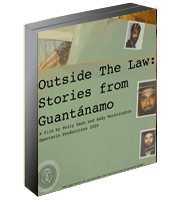
 Andy Worthington is a freelance investigative journalist, activist, author, photographer (of a photo-journalism project, ‘The State of London’, which ran from 2012 to 2023), film-maker and singer-songwriter (the lead singer and main songwriter for the London-based band The Four Fathers, whose music is available via Bandcamp). He is the co-founder of the Close Guantánamo campaign (see the ongoing photo campaign here) and the successful We Stand With Shaker campaign of 2014-15, and the author of The Guantánamo Files: The Stories of the 774 Detainees in America’s Illegal Prison and of two other books: Stonehenge: Celebration and Subversion and The Battle of the Beanfield. He is also the co-director (with Polly Nash) of the documentary film, “Outside the Law: Stories from Guantánamo”, which you can watch on YouTube here.
In 2017, Andy became very involved in housing issues. He is the narrator of the documentary film, ‘Concrete Soldiers UK’, about the destruction of council estates, and the inspiring resistance of residents, he wrote a song ‘Grenfell’, in the aftermath of the entirely preventable fire in June 2017 that killed over 70 people, and, in 2018, he was part of the occupation of the Old Tidemill Wildlife Garden in Deptford, to try to prevent its destruction — and that of 16 structurally sound council flats next door — by Lewisham Council and Peabody.
Since 2019, Andy has become increasingly involved in environmental activism, recognizing that climate change poses an unprecedented threat to life on earth, and that the window for change — requiring a severe reduction in the emission of all greenhouse gases, and the dismantling of our suicidal global capitalist system — is rapidly shrinking, as tipping points are reached that are occurring much quicker than even pessimistic climate scientists expected. You can read his articles about the climate crisis here. He has also, since, October 2023, been sickened and appalled by Israel’s genocide in Gaza, and you can read his detailed coverage here.
To receive new articles in your inbox, please subscribe to Andy’s new Substack account, set up in November 2024, where he’ll be sending out a weekly newsletter, or his RSS feed — and he can also be found on Facebook (and here), Twitter and YouTube. Also see the six-part definitive Guantánamo prisoner list, The Complete Guantánamo Files, the definitive Guantánamo habeas list, and the full military commissions list.
Please also consider joining the Close Guantánamo campaign, and, if you appreciate Andy’s work, feel free to make a donation via PayPal or via Stripe.











 Who's still at Guantánamo?

2 Responses
Andy Worthington says...
When I posted this on Facebook, I wrote:
In the last of three articles (two here, and one on Substack), about the recent concerted assault on the direct action group Palestine Action in the UK courts, I follow up on my first article, about the sentencing of the Filton 4 last Friday, with a detailed analysis of how the judge, Mr. Justice Johnson, was able to sentence the four activists for terrorism, when they weren’t convicted of terrorism by the jury in their retrial.
As with the proscription of Palestine Action as a terrorist organization, which was upheld by the Court of Appeal on Monday, and which drew extensively on the shameful redefining of terrorism as including “serious damage to property” in the Terrorism Act 2000, Mr. Justice Johnson’s legal subterfuge also involved focusing on deeply contentious legislation; in this case, Priti Patel’s Counter-Terrorism and Sentencing Act 2021.
Prior to the passage of the 2021 Act, judges were empowered, after a conviction by a jury, to deliver an aggravated sentence if the crimes for which defendants were convicted were determined to have a terrorist connection.
That specifically meant crimes that included murder, a number of explosives offences, hijacking, hostage-taking and serious aviation offences, but in the 2021 Act Priti Patel arranged for it to be expanded to include any offence that carries a maximum penalty of more than two years’ imprisonment, and this was what was used by Mr. Justice Johnson, the biased judge in the case of the Filton 4, to augment their sentences after they were only convicted of criminal damage.
The big question now, for anyone concerned with justice in the UK, is how we get Priti Patel’s absurd expansion of judicial powers involving augmented sentencing removed before another group of people who are not terrorists, and haven’t been convicted of terrorism, meet the same twisted judicial fate.
...on June 18th, 2026 at 12:53 pm
Andy Worthington says...
Please join me on Substack where I welcome new subscribers, paid or free, although the former (at $8/month or $80 a year) are essential to continue my work. Sign up and get links to all my work in your inbox.
Here’s my new post, promoting the article above: https://andyworthington.substack.com/p/the-filton-4-sentenced-for-terrorism
...on June 18th, 2026 at 12:55 pm