The Guantánamo Document That Changed My Life 20 Years Ago Today
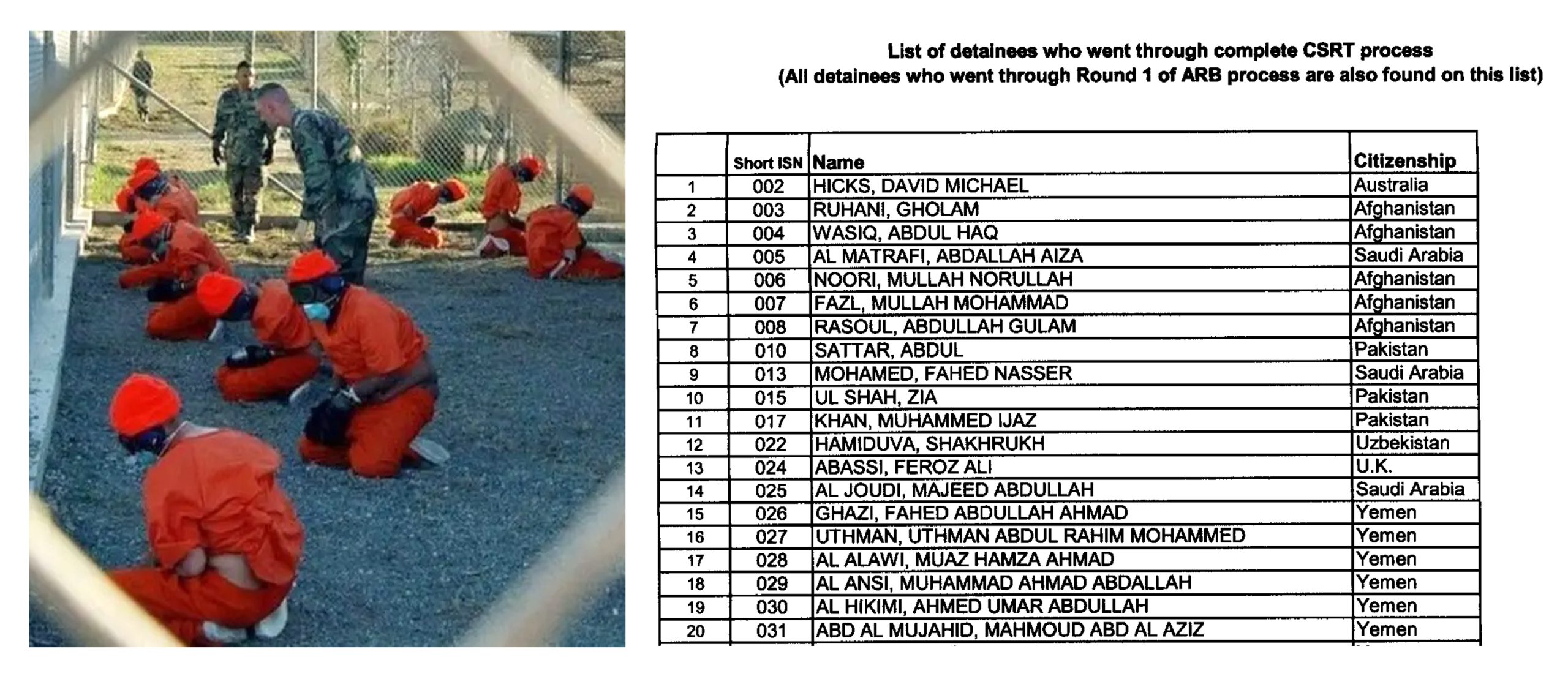
A photo taken at Guantánamo on January 11, 2002, the day the prison opened, and an excerpt from the first ever prisoner list released by the Pentagon, on April 20, 2006, featuring the names and nationalities of 558 prisoners, out of the 759 prisoners who had been held in the first four years and three months of the prison’s existence.

Please click on either of the ‘Donate’ or ‘Buy’ buttons below (via PayPal or Stripe) to make a donation towards the $2,500 (£2,000) I’m trying to raise to support my work on Guantánamo and on other related topics over the next three months. To get links to all my work in your inbox, please also consider taking out a free or paid subscription to my new Substack newsletter.


20 years ago today, on April 20, 2006, a document was released by the Pentagon that changed my life, launching me on what has become the defining struggle (or jihad, in Arabic) of my time here on earth as an independent journalist and human rights activist: exposing the horrific injustice of the US’s “war on terror” prison at Guantánamo Bay, telling the stories of the 779 menand boys — held there by the US military, and calling for the prison’s closure.

The document in question was a list of 558 prisoners held at Guantánamo at the time (see here or here), unwillingly released by the Pentagon through Freedom of Information legislation.

It was the first ever list of prisoners released by the US government, which, for four years and three months, since Guantánamo first opened on January 11, 2002 — to hold prisoners seized in connection with the global “war on terror” declared by the Bush administration after the terrorist attacks of September 11, 2001 — had sought to shroud the prison and those held there in a veil of the utmost secrecy, behind which it could completely disregard all international and domestic laws and treaties concerning the treatment of those deprived of their liberty.

With the release of this document, it was suddenly possible, by cross-referencing with other documents unwillingly released by the Pentagon, and other available reports, to tell the stories of those held at Guantánamo, and to fatally puncture the Bush administration’s lies that those held were “the worst of the worst”, “terrorists” who were “seized on the battlefield”, and who were all hell-bent on inflicting the maximum amount of damage imaginable on the so-called “Land of the Free.”

Inventing a category of prisoner without any rights whatsoever

For those regarded as having committed crimes or for those detained in wartime, only two courses of action are legally applicable for depriving people of their liberty in countries that, like the US, claim to respect the rule of law. Those detained are either charged with a crime, and swiftly put on trial, or are held as prisoners of war under the Geneva Conventions.

Under George W. Bush, however, the US government decided that those held at Guantánamo were “unlawful enemy combatants”, who could be held indefinitely without charge or trial, and who, fundamentally, had no rights whatsoever.

For the very small number of men who were to be charged with crimes relating to terrorism, the venue chosen for their intended prosecution was not the federal courts on the US mainland, but at Guantánamo itself, in military commission trials that had been unwisely dredged up from past military conflicts, and which, shockingly, were conceived, initially, as a method for swiftly executing alleged “terrorists” after brief capital trials in which information derived through the use of torture would be allowed.

For the first two and half years of their imprisonment, the anonymous victims of the “war on terror” were so thoroughly cut off from the world that, when it came to Guantánamo, the only valid comparison for the US under George W. Bush was with a full-blown dictatorship.

However, most of the US, from its politicians to its mainstream media and far too many of its citizens, didn’t care, as a permanent state of grief, fear and vengeance was cultivated and maintained by the government, by Congress and by the mainstream media.

Although brave lawyers began challenging Bush’s dictatorial regime almost immediately, it wasn’t until June 2004 that the Supreme Court ruled on a case, Rasul v. Bush, named after a British prisoner, Shafiq Rasul, that had been making its way through the courts for the previous two years.

The prisoners briefly secure habeas corpus rights

In Rasul, the Supreme Court ruled that, because the prisoners had no way of challenging the basis of their imprisonment, even if they declared that they were completely innocent and had been seized by mistake, they had habeas corpus rights; in other words, the right to challenge the government’s supposed evidence against them before an impartial judge.

It was a sign of how grotesquely the Bush administration had deliberately blurred the distinctions between alleged criminal behavior and the actions of foot soldiers in wartime that this ruling was required. Normally, there was no need to grant habeas corpus rights to people seized in wartime, because the Geneva Conventions applied, allowing them to be held unmolested until the end of hostilities. In the “war on terror”, however, the government had compelled the Court to act by failing to review the prisoners’ cases close to the time of place and capture, to ascertain whether or not they were combatants or civilians seized by mistake.

Historically, this was achieved by convening “competent tribunals” under the Geneva Conventions, at which those who claimed to be civilians caught by mistake could call witnesses to verify their claims. In the first Gulf War, around 1,200 “competent tribunals” were held, and, in around three-quarters of the cases, the US military recognized that they had made mistakes, and the wrongly-detained civilians were released. At Guantánamo, in contrast, the position taken by the Bush administration, primarily through Vice President Dick Cheney’s legal counsel David Addington, was that no mistakes were made, and that everyone detained was an “unlawful enemy combatant”, without any right to have those evidence-free assertions reviewed.

Crucially, the ruling in Rasul v. Bush allowed attorneys into Guantánamo to begin representing the men held on a pro bono basis, but while the arrival of lawyers brought the most blatant torture and abuse at the prison to an end, which had relied on the veil of total secrecy to keep it hidden, most of the prisoners who accepted representation by US attorneys, having overcome their initial concerns that they were secretly working for the government, didn’t have their cases publicized, to prevent any contamination of their planned hearings, and also to prevent what might otherwise have been a torrent of black propaganda emanating from the Bush administration and lapped up by compliant media.

In those early years, the only reports that emerged from Guantánamo were via the accounts of released prisoners, initially in brief comments made largely by released Afghan and Pakistani prisoners, who made up the bulk of the 200 or so prisoners released from 2002 to 2004, and particularly, from 2004 onwards, when European citizens were freed after belated pressure was exerted by their home governments, and when they began relating their accounts to generally sympathetic mainstream media outlets with a wide reach.

Convening unfair tribunals at Guantánamo

However, despite the importance of Rasul, Congress was subsequently prevailed upon by the Bush administration to pass laws aimed at stripping the prisoners of their newly-granted habeas rights, and the Bush administration, in a further snub to the Supreme Court, convened administrative military tribunals at Guantánamo — the Combatant Status Review Tribunals (CSRTs) and, later, the Administrative Review Boards (ARBs) — which were designed not to provide justice, but, shamefully, to rubber-stamp their designation, on capture, as “unlawful enemy combatants” who could be held indefinitely without rights, continuing the prison’s fundamental lawlessness.

Fundamentally, the CSRTs and ARBs echoed the “competent tribunals” that should have taken place when the prisoners were first seized, but they were deliberately worthless in the context of Guantánamo, far from the time and place of capture, when witnesses were unobtainable.

Although I had been aware of the disturbing lawlessness of Guantánamo from the day it opened, I spent the first four years of its existence working in another field entirely: writing two books, Stonehenge: Celebration and Subversion and The Battle of the Beanfield (both still in print) about the contested landscape of Stonehenge, the great sun temple in southern England, the anarchic pagan free festivals that flourished there every summer from 1974 to 1984, and the vile police assault on those seeking to make their way to Stonehenge in 1985, at what has become known as the Battle of the Beanfield.

Because this research exposed me to profound questions about the nature and extent of civil liberties and human rights, and, eventually, the rule of law, as the UK’s highest court ruled that a military-style exclusion zone imposed at Stonehenge every summer for 15 years was illegal, paving the way for public access on the summer solstice to be restored, everything was in place for me to end the summer of 2005, which I had spent in idyllic circumstances, traveling with my family from festival to festival in the English countryside to promote my Beanfield book, by becoming ensnared in the far graver story of Guantánamo.

After attending a law event discussing the British prisoners still held in September 2005, I became appalled by the Bush administration’s continuing secrecy about who it was holding at the prison, and began conducting detailed research on the internet, also drawing on two speculative lists of the prisoners held, compiled by the British NGO Cageprisoners (now CAGE International) and the Washington Post.

The significance of the release of the prisoner list

It was not until March 2006, however, that the US’s obsessive secrecy first began to be decisively prised open publicly. In response to a Freedom of Information lawsuit filed by the Associated Press, the Pentagon was obliged to release, on March 3, 2006, over 5,000 pages of documents from Guantánamo; primarily, unclassified allegations against the prisoners, and transcripts from their CSRTs, with the names of a number of the prisoners included. An earlier lawsuit has led to the release of 2,000 pages of documents, in May 2005, although all identifying information had been redacted.

Although some of those in the files released in March 2006 were identified by their names, rather than just their prison numbers (their ISNs, or Internment Serial Numbers), it was not until the list of 558 prisoners was released on April 20, 2006, providing the names and nationalities of the 558 prisoners who had gone through the CSRT process, and the first round of the subsequent ARB process, that it was possible for investigative journalists and researchers to finally establish who the prisoners dismissed by Donald Rumsfeld as “the worst of the worst” really were, through cross-referencing the CSRT documents and unclassified allegations with the names on the prisoner list.

I immediately began working around the clock to create plausible biographies of the prisoners, based on whatever glimpses emerged of them through the transcripts of the tribunals, and to establish the important context of where and when they were seized, which was essential in ascertaining whether or not they had been foot soldiers with the Taliban, for example, or civilians seized by mistake. At no point, crucially, was it apparent that any more than a handful of these individuals had any meaningful association with Al-Qaeda or any other group connected to any kind of terrorism.

A second list, released on May 15, 2006 (see here and here), provided even more context — the names, nationalities and dates of birth of all 759 prisoners held from the date the prison opened. As I continued my research, I kept expecting to hear of similar efforts undertaken by mainstream media outlets or NGOs, but it turned out that I was alone, and became the sole independent custodian of the prisoners’ stories.

The first page of the list of all 759 prisoners held at Guantánamo as of May 15, 2006, as released by the Pentagon under Freedom of Information legislation.

Writing The Guantánamo Files

I pitched a proposal for a book to the tenacious left-wing publisher Pluto Press, which was accepted, and then spent over a year engaged in an obsessive quest for the truth, which resulted in my book The Guantánamo Files, accurately described as “the first book to tell the story of every man trapped in Guantánamo”, which I submitted in May 2007, and which was published four months later.

Crucially, what my research revealed was that the majority of the prisoners were not “seized on the battlefield”, as the US alleged, but had been seized elsewhere, confirming reports that most had been handed over by their Afghan and Pakistani allies, and that substantial bounty payments were involved.

I was able to establish that a number of men had been seized in Afghanistan in the early months of the US-led invasion, and that most of these men had either survived a massacre in a prison, or massacres in containers as they were transported from one location to another. I was also able to establish that the largest group of prisoners — hundreds in total — had not been seized in Afghanistan, but in Pakistan, after crossing from Afghanistan in December 2001.

These men were all portrayed as Al-Qaeda fighters who had been involved in the Battle of Tora Bora, but in all likelihood they consisted of a mix of foot soldiers, missionaries, aid workers and economic migrants, mainly from Europe and the Middle East, who had been attracted by the notion that the Taliban had created a “pure Islamic state” in Afghanistan, or who had simply been drawn by its affordability, compared to their home countries or their experiences as marginalized migrants in Europe.

I also established that numerous prisoners, who had not even set foot in Afghanistan, had been seized in house raids in Pakistan, largely between January and July 2002, which were noteworthy for the general incompetence of the military intelligence involved, and that around 40 men had been transferred to Guantánamo after spending time in the CIA’s network of “black site” torture prisons, or in proxy prisons operated by US allies in the Middle East.

The largest group of prisoners sent to Guantánamo were Afghans — many reluctant Taliban conscripts, or men betrayed by their rivals in Afghanistan itself — who continued to be sent to Guantánamo in significant numbers until November 2003, when their transfers ceased, and Bagram prison in Afghanistan took over as the primary prison for Afghans and others seized during the US’s ongoing occupation.

A group of ten or so “medium-value detainees” arrived from the CIA “black sites” in September 2004, while 14 more men, the so-called “high-value detainees”, arrived from the CIA “black sites” in September 2006, and six more in 2007 and 2008.

The transfer in September 2006 marked the first time that it was feasible to suggest that at least some of these men fitted the almost non-existent description of those held at Guantánamo being anyone at all who could meaningfully be described as having been involved in Al-Qaeda and acts of international terrorism, including the 9/11 attacks.

Locating the time and location of the prisoners’ capture helped me to interpret which of the competing narratives exposed in the US government’s files — the US’s own accounts, and those of the prisoners themselves — was the most credible, and I believe that the passage of time has confirmed most of my assessments that, to put it bluntly, almost no one held at Guantánamo had any significant involvement with terrorism, and that they were, instead, overwhelmingly either insignificant foot soldiers, or civilians seized by mistake.

After I submitted the manuscript of The Guantánamo Files to Pluto Press, I almost immediately began writing regularly about Guantánamo on my website, telling stories untold in the mainstream media, or following up on mainstream media reporting that provided information, but lacked the crucial context of always pointing out that the very basis of Guantánamo, and everything to do with it, represented the most colossal failure imaginable of international law and of basic human standards of decency.

Please support my work if you can

I’ll post another article soon telling the story of my relentless independent journalism and activism over the last 19 years, but for now, if you’ve enjoyed the account above, please do consider, if you can, making a donation to support my work.

Although I have worked, at various times, with the UN, WikiLeaks, Cageprisoners (now CAGE International), Reprieve, the Center for Constitutional Rights and members of the European Parliament, and have written articles for the New York Times, the Guardian and Al Jazeera, I have undertaken most of my work over these two defining decades of my life — over 2,600 articles about Guantánamo, numerous personal appearances and media appearances, as well as specific campaigns and activism — on the basis that it needed doing, and that, as a truly independent writer, largely excluded from the mainstream media, with its inbuilt biases, or its often paralyzing obsession with “objectivity”, I would need to be reliant on the financial support of my readers to enable me to continue this work.

If you can help out at all, you can take out a paid subscription to my Substack, which I established 18 months ago, and which also means that you’ll be notified about all my work in your inbox, for $80 a year, or $8 a month, or you can donate any amount you wish to make via PayPal, with an option of making regular monthly payments, or via Stripe, where I recently set up an account.

Any financial support you can provide will be very greatly appreciated.

* * * * *

Andy Worthington is a freelance investigative journalist, activist, author, photographer (of a photo-journalism project, ‘The State of London’, which ran from 2012 to 2023), film-maker and singer-songwriter (the lead singer and main songwriter for the London-based band The Four Fathers, whose music is available via Bandcamp). He is the co-founder of the Close Guantánamo campaign (see the ongoing photo campaign here) and the successful We Stand With Shaker campaign of 2014-15, and the author of The Guantánamo Files: The Stories of the 774 Detainees in America’s Illegal Prison and of two other books: Stonehenge: Celebration and Subversion and The Battle of the Beanfield. He is also the co-director (with Polly Nash) of the documentary film, “Outside the Law: Stories from Guantánamo”, which you can watch on YouTube here.

In 2017, Andy became very involved in housing issues. He is the narrator of the documentary film, ‘Concrete Soldiers UK’, about the destruction of council estates, and the inspiring resistance of residents, he wrote a song ‘Grenfell’, in the aftermath of the entirely preventable fire in June 2017 that killed over 70 people, and, in 2018, he was part of the occupation of the Old Tidemill Wildlife Garden in Deptford, to try to prevent its destruction — and that of 16 structurally sound council flats next door — by Lewisham Council and Peabody.

Since 2019, Andy has become increasingly involved in environmental activism, recognizing that climate change poses an unprecedented threat to life on earth, and that the window for change — requiring a severe reduction in the emission of all greenhouse gases, and the dismantling of our suicidal global capitalist system — is rapidly shrinking, as tipping points are reached that are occurring much quicker than even pessimistic climate scientists expected. You can read his articles about the climate crisis here. He has also, since, October 2023, been sickened and appalled by Israel’s genocide in Gaza, and you can read his detailed coverage here.

To receive new articles in your inbox, please subscribe to Andy’s new Substack account, set up in November 2024, where he’ll be sending out a weekly newsletter, or his RSS feed — and he can also be found on Facebook (and here), Twitter and YouTube. Also see the six-part definitive Guantánamo prisoner list, The Complete Guantánamo Files, the definitive Guantánamo habeas list, and the full military commissions list.

Please also consider joining the Close Guantánamo campaign, and, if you appreciate Andy’s work, feel free to make a donation via PayPal or via Stripe.

Death by AI: My Interview About the Horrors of Automated Genocide with Chuck Mertz on “This Is Hell!”
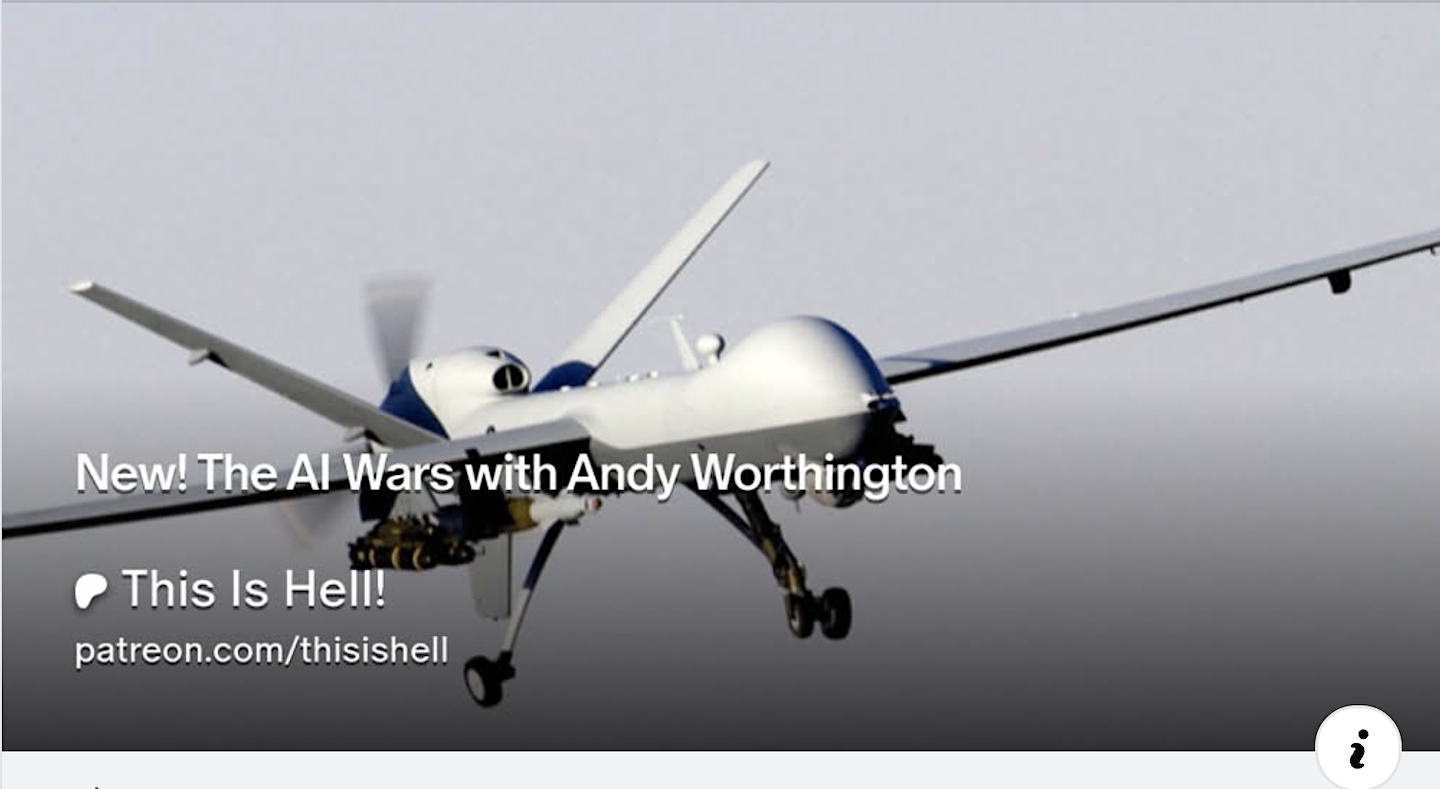
An image produced for “The AI Wars”, my interview with Chuck Mertz for “This Is Hell!”

Please click on either of the ‘Donate’ or ‘Buy’ buttons below (via PayPal or Stripe) to make a donation towards the $2,500 (£2,000) I’m trying to raise to support my work as a reader-funded investigative journalist, commentator and activist over the next three months. To get links to all my work in your inbox, please also consider taking out a free or paid subscription to my new Substack newsletter.


Many thanks to Chuck Mertz for having me as the featured guest on this week’s “This Is Hell!”, now in its 30th year, a Chicago-based “long-form political interview program”, broadcast live every Wednesday morning, and then made available as a podcast.

You can find my hour-long interview on the “This is Hell!” website here, the full show on the website here, and on Patreon, where you can also make a donation to support the show, if you’d like to contradict Chuck’s assertion that it is “broadcast without the virtue of money or the vice of political agenda.”

I’ve also embedded it via Soundcloud below, and I very much hope that you have time to listen to it.

This Is Hell! · Death by AI / Andy Worthington

Read the rest of this entry »

Updates on Trump’s Deportation Obsession and His Open Warfare on the US Courts, and My Interview on Gorilla Radio with Chris Cook

A horrific photo of stripped and dehumanized prisoners, on an industrial scale, in the CECOT mega-prison in El Salvador, made available by El Salvador’s presidential press office on March 15, 2025, when the first planeloads of migrants arrived from the US.

Please support my work as a reader-funded investigative journalist, commentator and activist. If you can help, please click on the button below to donate via PayPal. Please also consider taking out a free or paid subscription to my new Substack newsletter.


Many thanks to Chris Cook in western Canada for having me on his weekly Gorilla Radio show on Wednesday to discuss the latest developments in the horrendous “war on migrants” that Donald Trump initiated when he took office three months ago. The interview is available here, on Gorilla Radio’s Substack, taking up the first half of the hour-long show, with Canadian author Ray McGinnis in the second half.

Chris and I last spoke in February, just after Donald Trump had started using Guantánamo to hold migrants — the majority of whom were Venezuelans, who were accused, without evidence, of being members of the Tren de Aragua gang. I wrote about the use of Guantánamo for migrants in a series of articles here, here, here, here, here and here, with a summary on the Close Guantánamo website on March 21.

By that point, Trump had begun shifting his focus to an even more alarming location than Guantánamo, sending 238 Venezuelan migrants and 23 Salvadorians — all, again, accused of being gang members, without any evidence being provided — on a one-way trip to El Salvador’s notorious CECOT prison (the Centro de Confinamiento del Terrorismo, or, in English, the Terrorism Confinement Center) on March 15.

Read the rest of this entry »

Video: “Guantánamo at 23”, My New America Event with Tom Wilner and Karen Greenberg, and My One-Hour Podcast Interview with Margaret Flowers

A screenshot from “Guantánamo at Twenty-Three”, the New America online discussion that took place on Tuesday January 14. See below for the video.

Please support my work as a reader-funded journalist! I’m currently trying to raise $2500 (£2000) to support my writing and campaigning on Guantánamo and related issues over the next three months. If you can help, please click on the button below to donate via PayPal. Please also consider taking out a free or paid subscription to my new Substack newsletter.


On the last day of Joe Biden’s presidency, it seems appropriate to be posting a video and an audio recording marking the 23rd anniversary of the prison’s opening, on January 11, and appraising the pros and cons of Biden’s tenure in relation to Guantánamo, even though the news today is, understandably, dominated by the extraordinarily welcome news that, after 470 days of the most monstrous and persistent genocidal assault imaginable, a ceasefire has begun today in the Gaza Strip.

This has finally allowed the Palestinians, for the first time since the brief six-day “pause” in hostilities for the exchange of hostages that took place at the end of November 2023, to stop having to live in permanent fear of losing their lives from Israeli bombing, snipers, drones and armed quadcopters.

The sense of relief is, frankly, unimaginable for those of us who have been obliged to watch the atrocities unfold from afar, but many Palestinians, long displaced from their homes, are, for the first time, realizing the unprecedented extent of Israel’s destruction of almost the entire built environment, as they make their way through what appears to be a post-apocalyptic hellscape, in search of the remains of their homes, and of the remains of their lost and murdered loved ones.

Read the rest of this entry »

Photos and Report: Close Guantánamo Vigils Marking the 23rd Anniversary of the Prison’s Opening, January 11, 2025

Photos from the vigils for the closure of Guantánamo on January 11, 2025, the 23rd anniversary of the opening of the prison. Clockwise from top left: Washington, D.C., London, Cobleskill, NY and San Francisco.

Please support my work as a reader-funded journalist! I’m currently trying to raise $2500 (£2000) to support my writing and campaigning on Guantánamo and related issues over the next three months. If you can help, please click on the button below to donate via PayPal. Please also consider taking out a free or paid subscription to my new Substack newsletter.


Saturday January 11 marked another gruesome and unforgivable milestone in the US’s ongoing long war on law and fundamental human decency — the 23rd anniversary of the opening of the “war on terror” prison at Guantánamo Bay, where, despite recent positive developments (the release of 15 men), another 15 are still held in varying states of lawlessness.

To mark the occasion, groups across the US and around the world, who have been admirably and diligently taking part in monthly coordinated “First Wednesday” vigils for the last two years calling for the prison’s closure, shifted the dates of their vigils to the anniversary — although normal service will be resumed next month, on Wednesday February 5.

Below are photos of the vigils in Washington, D.C., London, New York, San Francisco, Cobleskill, NY and Detroit. A planned vigil in Los Angeles had to be called off because of the wildfires, and other groups held vigils on other days — Portland, OR on January 1, and Mexico City on January 8 — with the vigil outside the European Parliament in Brussels taking place this coming Thursday, January 16. Groups involved include various Amnesty International groups, Witness Against Torture, the World Can’t Wait, Close Guantánamo, the National Religious Campaign Against Torture, the UK Guantánamo Network, and many other groups, with other organizations also supporting the vigils on an ongoing basis.

Read the rest of this entry »

Video: I Discuss Guantánamo Past, Present and Future with David Swanson on Talk World Radio

A screenshot of Andy Worthington’s interview with David Swanson for Talk World Radio in January 2025.

Please support my work as a reader-funded journalist! I’m currently trying to raise $2500 (£2000) to support my writing and campaigning on Guantánamo and related issues over the next three months. If you can help, please click on the button below to donate via PayPal. Please also consider taking out a free or paid subscription to my new Substack newsletter.


I’m delighted to be making available below the video of a half-hour interview that I undertook on Sunday with the great peace activist David Swanson, of World BEYOND War, for his Talk World Radio show, which is syndicated by the Pacifica Network throughout the US.

David and I have know each other for a long time, since my earliest visits to the US at the end of the Bush administration, and the start of the Obama presidency, although we haven’t seen each other for many years, and I haven’t before had the pleasure of being interviewed by him for his show, which he helpfully entitled, “Close Guantánamo While Its Victims Are Still Alive.”

Half an hour was a helpful amount of time to discuss a complicated story like Guantánamo with the attention to detail that it deserves, and I was more than happy to discuss the prison from its earliest days, as a facility designed to hold human beings without and rights whatsoever, and to torture them when the largely hapless individuals rounded up or bought in Afghanistan and Pakistan failed to provide the “intelligence” that those in charge of the “war on terror” demanded.

Read the rest of this entry »

Podcast: I Discuss the Shameful State of the World, and Resistance and Hope in 2025 with Andy Bungay for Riverside Radio

A screenshot from Andy Worthington’s latest monthly interview with Andy Bungay for his Riverside Radio show in London.

Please support my work as a reader-funded investigative journalist, commentator and activist. If you can help, please click on the button below to donate via PayPal. Please also consider taking out a free or paid subscription to my new Substack newsletter.


If you have the time and the inclination, please check out my latest interview with my colleague Andy Bungay, posted below as a YouTube podcast, and originally broadcast, as the latest in an ongoing series of monthly interviews, during Andy’s shows last Saturday and Sunday on Riverside Radio, a community radio station in Wandsworth, in south west London, and subsequently made available on his Mixcloud page here and here. I’m pleased to note that Andy also played the latest live recordings by my band The Four Fathers, as well as ‘They Don’t Care’, the latest online single by my son Tyler, the beatboxer and singer known as The Wiz-RD.

In a freewheeling 80-minute discussion, we focused on some of the many profoundly dispiriting events dominating our lives as 2024 draws to a close — the imminent return as the US president of Donald Trump, the ongoing genocidal carnage being inflicted by Israel on the trapped Palestinian civilian population of the Gaza Strip, and the growing menace of catastrophic climate change.

All are thoroughly depressing topics, of course, but unlike last month, when my discussion with Andy, available here as ‘World on Fire: Gaza, Climate Collapse and the Collective Derangement of Western Politicians’, was rather dark (almost certainly because of the intensity of Israel’s “genocide within a genocide” in northern Gaza), this month’s conversation was threaded through with resistance and hope.

Read the rest of this entry »

Please Support My Guantánamo Work With a Donation, or Subscribe to My New Substack Newsletter

My new Substack account, where I welcome supporters who want to be informed about my work by subscribing to my weekly newsletter.

Please click on the ‘Donate’ button below to make a donation towards the $2,500 (£2,000) I’m trying to raise to support my work on Guantánamo over the next three months.


Dear friends, fans, followers and supporters,

For nearly two decades, I’ve devoted most of my working life — and much of my waking, non-working life — to the largely thankless task of exposing the truth about the prison at Guantánamo Bay, telling the stories of the men and boys held there, revealing how most of them were not “the worst of the worst”, and had nothing to do with Al-Qaeda or terrorism, railing against the abhorrent lawlessness and brutality of the prison, and campaigning assiduously to try and get it closed.

Throughout this time, I have been reliant on you, my readers, to support me in my work as the prison’s foremost independent opponent, a reader-funded independent journalist and activist, free of the lamentable indifference or amnesia of most of the mainstream media, and able to articulate freely and persistently why it is so important not to allow the victims of Guantánamo to be dehumanized, and why the prison is, and has been consistently, a legal, moral and ethical abomination.

As a result of my regular quarterly appeals for support, many of you have, over the years, made one-off donations, or, in some cases, have becoming subscribers, donating a regular amount every month — all of which is essential to allow me to continue to work towards Guantánamo’s eventual closure.

Read the rest of this entry »

Free the Guantánamo 16! Two Letters to President Biden; Signatories Include Former Prisoners, Ex-US Government Officials, UK Parliamentarians

Andy Worthington holds up a poster showing the 16 men still held at Guantánamo, who have long been approved for release, and a second poster, updated every month, showing how long these men have been waiting to be freed since those decisions were taken.

Please support my work as a reader-funded journalist! I’m currently trying to raise $2500 (£2000) to support my writing and campaigning on Guantánamo and related issues over the next three months. If you can help, please click on the button below to donate via PayPal.


100 Former Guantánamo Prisoners, Ex-US Government Officials, Lawyers, Academics, Psychologists, Public Figures and Rights Organizations Send Letter to President Biden Urging Him to Free the 16 Men Still Held at Guantánamo Who Have Long Been Approved for Release; Second Letter is Sent by 40 British MPs and Peers, Academics and CEOs of UK Rights Organizations

Today, December 6, 2024, 100 individuals and organizations — including 36 former Guantánamo prisoners, 36 ex-US government officials, lawyers, academics, psychologists and public figures, and 28 rights organizations — have written to President Biden, with a second letter sent simultaneously by 40 British MPs and peers, academics and the CEOs of UK rights organizations, to urge him to take urgent action to free 16 men still held in the prison at Guantánamo Bay (out of 30 in total) who have long been approved for release.

These decisions, which were unanimously agreed through robust, high-level US government review processes, took place many years ago — between two and four years ago, and in three outlying cases nearly 15 years ago.

The former prisoners signing the US and international letter include the authors Mansoor Adayfi and Mohamedou Ould Slahi, and the supporters include Larry Wilkerson, the former chief of staff to Secretary of State Colin Powell, and the musician and activist Roger Waters.

The UK letter includes 20 Parliamentarians, the Chief Executive of Amnesty International UK, and the film director Kevin Macdonald (‘The Mauritanian’).

Read the rest of this entry »

Audio: I Discuss ‘Life at Guantánamo: Writing Behind Bars’ with Mohamedou Ould Slahi and Mansoor Adayfi at Amnesty International’s London HQ in June 2023

A photo of ‘Life at Guantánamo: Writing Behind Bars’, the panel discussion at Amnesty International’s London headquarters on Wednesday June 28, 2023.

Please support my work as a reader-funded journalist! I’m currently trying to raise $2500 (£2000) to support my writing and campaigning on Guantánamo and related issues over the next three months. If you can help, please click on the button below to donate via PayPal.


It’s taken a long time to make this available, but I hope that you’ll have the time to listen to the audio recording of a powerful and moving event that took place at Amnesty International’s London headquarters on Wednesday June 28, 2023.

‘Life at Guantánamo: Writing Behind Bars’ featured Mohamedou Ould Slahi, as the author of the best-selling Guantanamo Diary, and, from Serbia, via Zoom, Mansoor Adayfi, the author of Don’t Forget Us Here: Lost and Found at Guantánamo, which was published in 2021. Mansoor was supposed to be with us in person, but had not been given a visa in time, although he has subsequently managed to successfully visit the UK on several occasions, including a memorable visit to the Houses of Parliament last October, which I wrote about here.

I was the moderator for the event, and Sara Birch, the Convenor of the UK Guantánamo Network, was also on the panel, and it was, I think it’s fair to say, a resounding success, with, in particular, a powerful rapport between Mohamedou, Mansoor and myself.

Read the rest of this entry »

Back to home page

Andy Worthington

Investigative journalist, author, campaigner, commentator and public speaker. Recognized as an authority on Guantánamo and the “war on terror.” Co-founder, Close Guantánamo and We Stand With Shaker, singer/songwriter (The Four Fathers).
Email Andy Worthington

CD: Love and War

The Four Fathers on Bandcamp

The Guantánamo Files book cover

The Guantánamo Files

The Battle of the Beanfield book cover

The Battle of the Beanfield

Stonehenge: Celebration & Subversion book cover

Stonehenge: Celebration & Subversion

Outside The Law DVD cover

Outside the Law: Stories from Guantánamo

RSS

Posts & Comments

World Wide Web Consortium

XHTML & CSS

WordPress

Powered by WordPress

Designed by Josh King-Farlow

Please support Andy Worthington, independent journalist:

Archives

In Touch

Follow me on Facebook

Become a fan on Facebook

Subscribe to me on YouTubeSubscribe to me on YouTube

The State of London

The State of London. 16 photos of London

Andy's Flickr photos

Campaigns

Categories

Tag Cloud

Abu Zubaydah Al-Qaeda Andy Worthington British prisoners Center for Constitutional Rights CIA torture prisons Close Guantanamo Donald Trump Four Fathers Guantanamo Housing crisis Hunger strikes London Military Commissions NHS NHS privatisation Periodic Review Boards Photos President Obama Reprieve Shaker Aamer The Four Fathers Torture UK austerity UK protest US courts Video We Stand With Shaker WikiLeaks Yemenis in Guantanamo