1.6.25
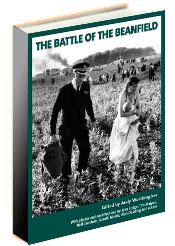
Marking the 40th anniversary, today, of the Battle of the Beanfield, the largest and most violent peacetime assault on civilians in modern British history, when a convoy of of 140 vehicles, home to around 500 individuals and families, was attacked with astonishing ferocity by around 1,400 paramilitarized police drawn from six countries and the MoD, as they tried to make their way to Stonehenge to set up what would have been the 12th annual Stonehenge Free Festival. To mark the occasion, I run through the history of the free festival movement, the year-long persecution that preceded the violence of the Beanfield, its context as part of a broader assault on Thatcher’s perceived “enemies within”, who also included the striking miners, and the ways in which new forms of dissent arose in the wake of the Beanfield, most notably via the rave scene and the road protest movement. Nevertheless, the increasingly authoritarian laws passed after the Beanfield, and after the last major unlicensed gathering at Castlemorton in 1992, attacking the way of life of Gypsies and travellers, and severely curtailing our right to gather freely, have paved the way for recent legislation targeting environmental protestors, which is so draconian that a single campaigner stepping into the road to slow down traffic can be immediately arrested, and many dozens of climate activists are serving excessively long prison sentences for non-violent protest. Sadly, what has been revealed in particular over the last 40 years is how increasing authoritarianism is cumulative; once imposed, draconian laws are rarely, if ever repealed.
21.6.24
To mark the summer solstice at Stonehenge, I recollect my experiences at the last Stonehenge Free Festival, before its violent suppression at the Battle of the Beanfield in 1985, when I visited the stones after staying up all night. My experiences of the festival and the stones left a deep impression on me, which, in the ’90s, encouraged me to undertake several long-distance walks through southern England’s ancient landscape, for a book that, eventually, materialised instead as ’Stonehenge: Celebration and Subversion’, my unique social history of Stonehenge, published 20 years ago, and still in print. I also reflect on the militarised exclusion zone that existed on the summer solstice at Stonehenge until 2000, when a court ruling led to the reopening of the stones for what is unromantically called ‘Managed Open Access’, when crowds are allowed in for 12 hours, and I also reflect on the latest example of conflict at Stonehenge: a truly absurd comparison between Just Stop Oil and ISIS, after JSO activists sprayed harmless cornstarch-based paint on the stones two days ago.
1.6.24
My annual article marking the anniversary of the Battle of the Beanfield, 39 years ago today, when 1,400 police violently attacked and “decommissioned” a convoy of travellers heading to Stonehenge to establish what would have been the 12th annual Stonehenge Free Festival. Lamenting the demise of the festival as the last great, weeks-long unlicensed autonomous gathering in the UK, and the violence of Beanfield as a significant marker in the ongoing assault on civil liberties in the UK, I also include my memories of the festival, an account of the various forms of dissent that have continued ever since, and the various ways in which successive governments have sought to suppress that dissent, and I end by noting how, despite all these efforts, dissent cannot be eliminated, especially as so many horrors currently exist that must be fought against with all our might, most noticeably, right now, Israel’s western-backed genocide in Gaza, and, of course, the unparalleled threat posed by accelerating climate collapse.
1.6.23
My review of four decades of repressive public order legislation by the Tories, marking the 38th anniversary of the Battle the Beanfield, running from the 1986 Public Order Act to the 1994 Criminal Justice Act, and on to the 2022 Police, Crime Sentencing and Court Act and the latest version of the Public Order Act. Aimed at criminalising the way of life of Gypsies and Travellers, the legislation is also aimed at criminalising any form of even mildly disruptive protest, of the kind currently being undertaken by climate protestors, whose actions would chime with the beleaguered travellers, festival-goers and environmental activists of 38 years ago.
19.4.23
The second of four articles marking my 60th birthday, looking at how awareness of the climate crisis has developed, and been supported, ignored or resisted over the last 60 years. This article focuses on the 1980s, when I went from school in Hull and university in Oxford to living in London under the ravages of Thatcherism, which largely drowned out the growing awareness of the climate crisis through the emission of greenhouse gases in the US, where NASA scientist James Hansen finally secured widespread media coverage and public interest after a Congressional hearing in 1988. I also look at the impact Bill McKibben’s book ‘The End of Nature’ had on me when it was published in 1989.
21.6.22
As crowds return to Stonehenge for the summer solstice, I look back on the days of the Stonehenge Free Festival, which last took place 38 years ago, and wonder how both Stonehenge’s builders, and the travellers and festival-goers of the ’70s and ’80s, would react to the currently unfolding environmental catastrophe of our own making, whose roots were sown when dissent was so brutally suppressed in the ’80s and ’90s, and the unfettered neo-liberal exploitation of everyone and everything took over.
1.6.22
Marking the 37th anniversary of the Battle of the Beanfield, on June 1, 1985, when the police, under Margaret Thatcher, violently assaulted a convoy of travellers en route to Stonehenge to establish what would have been the 12th annual Stonehenge Free Festival, with commentary about how, today, Gypsies and travellers face a threat to their very way of life via legislation introduced by our dangerous and bigoted home secretary, Priti Patel.
21.6.21
My thoughts on the summer solstice, 37 years after the last Stonehenge Free Festival, as ‘Managed Open Access’, in place since the 15-year exclusion zone came to an end in 2000, was cancelled for the second year running because of Covid (although some revellers turned up anyway). Also included: the video of last year’s ‘Virtual Stonehenge Free Festival’, organised by Neil Goodwin, in which videos of musicians who performed online last year during lockdown are interspersed with footage of the Stonehenge Free Festival, travellers and the Beanfield.
1.6.21
Today marks the 36th anniversary of the Battle of the Beanfield, when the police, under Margaret Thatcher, destroyed, with unprecedented violence, a convoy of vehicles containing men, women and children, as they tried to make their way to Stonehenge to set up what would have been the 12th annual Stonehenge Free Festival. Despite the trauma caused that day, the Tories continued to persecute Travellers, passing punitive legislation in 1986 and 1994, and now, under Priti Patel, are seeking to outlaw the entire nomadic way of life through a draconian clampdown on “trespass” in the new Police, Crime, Sentencing and Courts Bill.
14.3.21
My response to the police violence at the peaceful vigil for Sara Everard on Clapham Common, and its curious timing, coinciding with the second reading of home secretary Priti Patel’s horribly authoritarian Police, Crime, Sentencing and Courts Bill 2021, which seeks to legislate meaningful protest out of existence.
Investigative journalist, author, campaigner, commentator and public speaker. Recognized as an authority on Guantánamo and the “war on terror.” Co-founder, Close Guantánamo and We Stand With Shaker, singer/songwriter (The Four Fathers).
Email Andy Worthington
Please support Andy Worthington, independent journalist: