Archive for June, 2026
How Were the Filton 4 Sentenced for Terrorism When They Weren’t Convicted of Terrorism?

Please click on either of the ‘Donate’ or ‘Buy’ buttons below (via PayPal or Stripe) to make a donation towards the $2,500 (£2,000) I’m trying to raise to support my work as a reader-funded investigative journalist, commentator and activist over the next three months. To get links to all my work in your inbox, please also consider taking out a free or paid subscription to my new Substack newsletter.
This is the last of three articles about the recent concerted assault on the direct action group Palestine Action in the UK courts. The first, “Punitive sentencing in the UK for Filton 4 activists on behalf of Israel”, focused on the sentencing of the Filton 4 last Friday, which I posted on Facebook here, where it has had over 330,000 views (although it also attracted an open sewer of deeply unpleasant trolls), and also on Substack, where I also sent it to my subscribers. Feel free to join me. The second, “The Renewed Ban on Palestine Action Confirms Legal Overreach in the Designation of Terrorism”, about the Court of Appeal’s unwise reinstatement of the proscription of Palestine Action as a terrorist organization, in which I examined the root problems of “serious damage to property” having been designated as terrorism in the Terrorism Act 2000, was posted here on my website, and this third article revisits the Filton 4 sentencing to provide detailed analysis about how the biased judge, Mr. Justice Johnson, was able to sentence the four activists for terrorism, when they weren’t convicted of terrorism by the jury in their retrial.
POSTSCRIPT: On June 24, I joined Chris Cook for his Gorilla Radio show in western Canada to discuss the fall of Keir Starmer (see my Substack post here), and the devious judicial efforts to secure terrorism-enhanced sentences for the Filton activists. Listen to the one-hour show on Substack here. I’m in the second half; Yves Engler in the first half.
Since the sentencing, last Friday, of the Filton 4 — activists with Palestine Action, who undertook direct action to damage drones intended for use in Gaza at a facility owned by Elbit Systems, Israel’s biggest arms company — observers of justice, in the UK and around the world, have been reeling at the imposition by the judge of punitive sentences.
As I explained in my first article, Charlotte Head and Leona Kamio were given six-year sentences, minus 45 days for time served since the conviction, Fatema Zainab Rajwani was given a sentence of five years and eight months, minus 45 days, while Samuel Corner was given a sentence of eight years and eight months.
The Renewed Ban on Palestine Action Confirms Legal Overreach in the Designation of Terrorism
Please click on either of the ‘Donate’ or ‘Buy’ buttons below (via PayPal or Stripe) to make a donation towards the $2,500 (£2,000) I’m trying to raise to support my work as a reader-funded investigative journalist, commentator and activist over the next three months. To get links to all my work in your inbox, please also consider taking out a free or paid subscription to my new Substack newsletter.
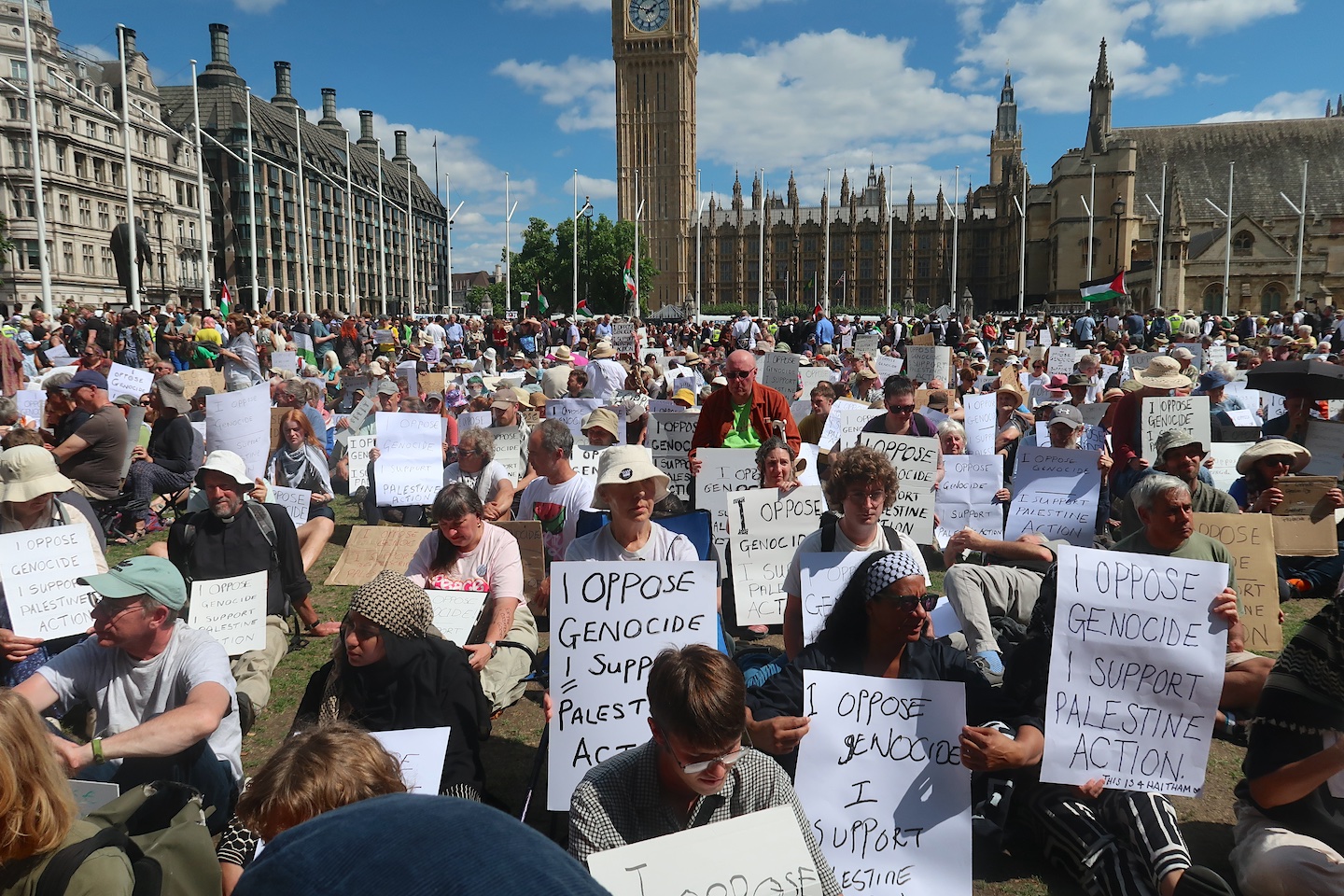
In a dispiriting ruling yesterday, the Court of Appeal in London overturned a ruling in February, by the High Court, that the government’s proscription of the direct action group Palestine Action as a terrorist organization, which was passed by Parliament last July, was unlawful.
The High Court’s ruling, in response to a judicial review submitted by Huda Ammori, one of Palestine Action’s two co-founders, repudiated the two counts on which the High Court had ruled the proscription unlawful.
Garden Court Chambers, whose barristers represented Huda Ammori at the judicial review in February, explained that these two counts were, firstly, that the Court “upheld the Claimant’s challenge that the Home Secretary failed to comply with her own policy when making the decision to proscribe Palestine Action”, and, secondly, that “proscription breached the rights of Freedom of Expression and Assembly as protected under Articles 10 and 11 of the European Convention on Human Rights.”
The Persistence of Memory: The 41st Monthly Global Vigils for the Closure of Guantánamo, June 3, 2026
Please click on either of the ‘Donate’ or ‘Buy’ buttons below (via PayPal or Stripe) to make a donation towards the $2,500 (£2,000) I’m trying to raise to support my work on Guantánamo and on other related topics over the next three months. To get links to all my work in your inbox, please also consider taking out a free or paid subscription to my new Substack newsletter.
In a variation on a famous quote, “In a time of universal deceit, telling the truth is a revolutionary act”, which is widely but apparently incorrectly attributed to George Orwell, I recently came up with a phrase that, on an ongoing basis, I’ll be using to describe those of us who continue to try to remind the world of the existence of the “war on terror” prison at Guantánamo Bay, and of the 15 men still held there in varying states of fundamental lawlessness:
“In a time of universal deceit, even the act of remembering is a revolutionary act.”
Guantánamo has long been engulfed in a kind of collective amnesia, barely mentioned by US lawmakers, and largely ignored by the mainstream media, which is why our monthly “First Wednesday” vigils, though small in number, continue to be important. If a grave and ongoing injustice isn’t even mentioned, or marked with people in orange jumpsuits bearing witness to it as an internationally significant ongoing crime scene, how is anyone supposed to even remember that it still exists?
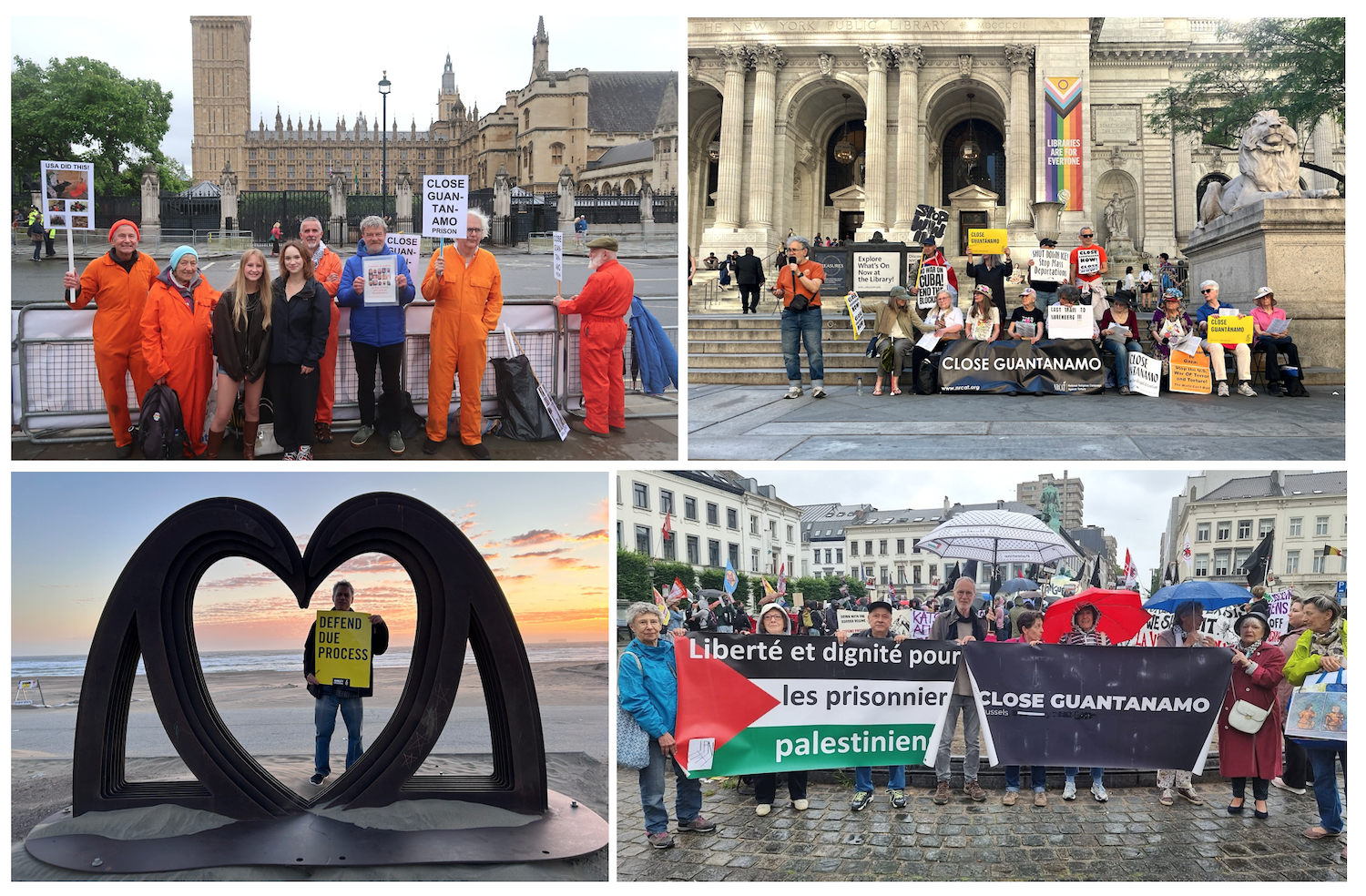
This month, nine vigils took place across the US and around the world — in London, New York, Brussels, Mexico City, Detroit, Los Angeles, San Francisco, Innsbruck, Austria, and Cobleskill, NY. Our most politically resonant campaigners — at the heart of the dysfunctional warmongering beast, outside the White House, in Washington, D.C. — were largely unable to join us this month, with only one stalwart, longtime Close Guantánamo supporter Steve Lane, attending, and without any photos being taken, but they’ll be back next month, and individual campaigners also sent photos from Oakland, CA and Liège in Belgium.
The 41st Anniversary of the Battle of the Beanfield: Still No Accountability for a Monstrous Crime of State Violence
Please click on either of the ‘Donate’ or ‘Buy’ buttons below (via PayPal or Stripe) to make a donation towards the $2,500 (£2,000) I’m trying to raise to support my work as a reader-funded investigative journalist, commentator and activist over the next three months. To get links to all my work in your inbox, please also consider taking out a free or paid subscription to my new Substack newsletter.
Somewhere south of Savernake Forest, and just to the north of the A303, in Wiltshire, is a crime scene that has never been examined by the British authorities.
It was in a field here that, 41 years ago today, on June 1, 1985, the British state undertook the most savage assault on unarmed civilians in modern British history.
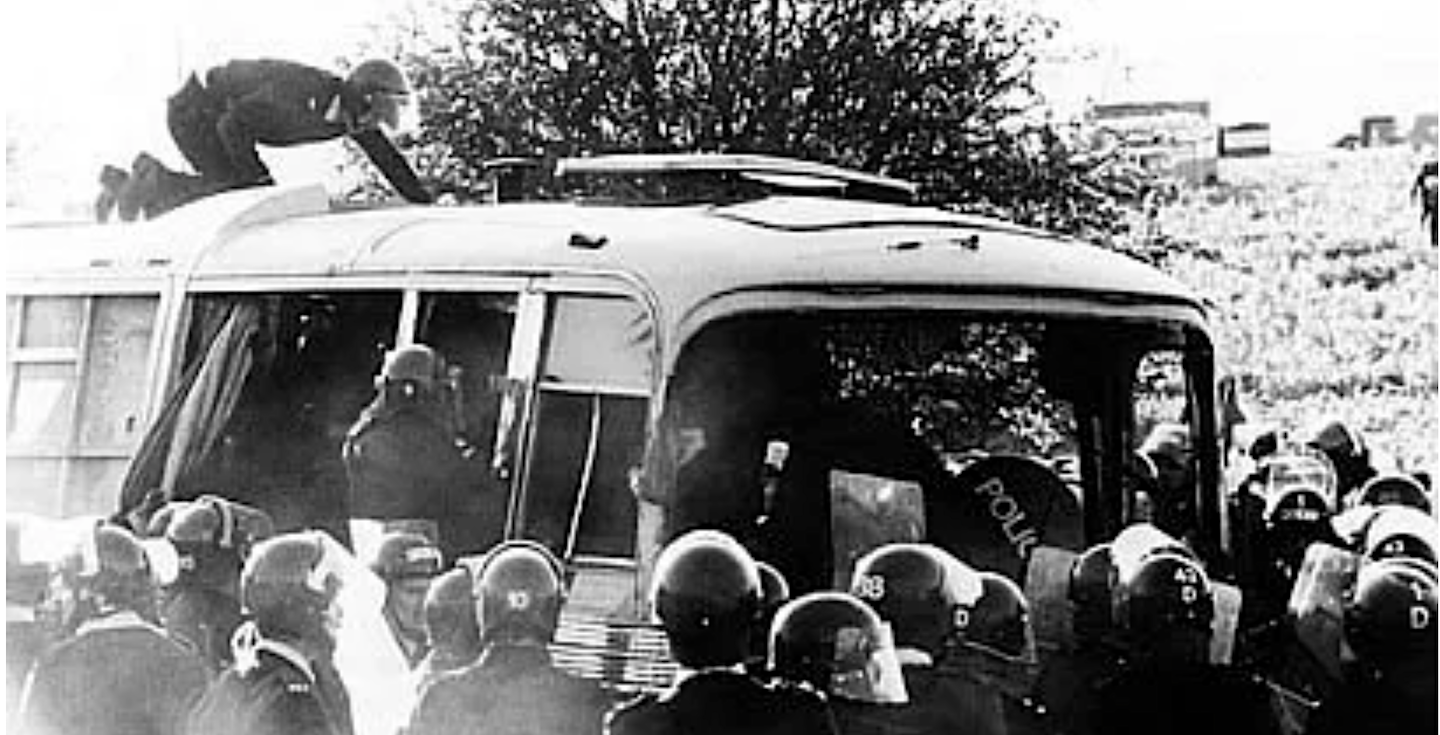
This has become known as the Battle of the Beanfield, although, in reality, it was a one-sided rout of heartbreaking brutality, as riot police from six counties cornered a vastly-outnumbered convoy of vehicles seeking to make their way to establish what would have been the 12th annual Stonehenge Free Festival, in fields around the ancient sun temple on Salisbury Plain, and “decommissioned” them with extreme violence, brutally assaulting the men and women of the convoy, terrorizing their children, destroying their live-in vehicles, and making 537 arrests in total.
The events of that day dealt a crippling blow to a growing counter-cultural movement of modern-day nomads, known as the new travellers, or new age travellers, who travelled around the country in old coaches, buses, vans, trucks and even decommissioned military vehicles.










 Who's still at Guantánamo?
