A Mockery of Justice: Torture Victim to Face Trial at Guantánamo After 25 Years

Please click on either of the ‘Donate’ or ‘Buy’ buttons below (via PayPal or Stripe) to make a donation towards the $2,500 (£2,000) I’m trying to raise to support my work on Guantánamo and on other related topics over the next three months. To get links to all my work in your inbox, please also consider taking out a free or paid subscription to my new Substack newsletter.
In the long, dark farce of Guantánamo’s military commissions, the recently announced and almost entirely ignored decision by the Pentagon to turn down a plea deal for Abd Al-Rahim Al-Nashiri, a prominent CIA torture victim and the alleged architect of the Al-Qaeda attack on the USS Cole in October 2000, and to proceed, instead, with an unwinnable trial, is just the latest manifestation of a refusal by successive US administrations to reckon with the corrosive effects of the use of torture.
With this decision, the Trump administration has now embraced a sickening and enduring bi-partisan consensus that, when it comes to those accused of the gravest crimes at Guantánamo — including the terrorist attacks on September 11, 2001 — it is preferable to cling to an unworkable belief in vengeance, through a fantastical belief in successful prosecutions that involve the death penalty, than to admit that the use of torture on the defendants has thoroughly undermined that possibility.
The reality, which every administration has denied — from Bush to Obama, and from Biden to Trump — is that torture, undertaken over many years in the CIA’s global network of “black site” torture prisons, is so fundamentally incompatible with justice that the only viable way forward is to agree to plea deals that take the death penalty off the table in exchange for lifelong imprisonment at Guantánamo and full and frank confessions that bring some measure of “closure.”
UK Government Makes “Substantial” Payment to Guantánamo Prisoner Abu Zubaydah for Complicity in His Torture in CIA “Black Sites”
Please click on either of the ‘Donate’ or ‘Buy’ buttons below (via PayPal or Stripe) to make a donation towards the $2,500 (£2,000) I’m trying to raise to support my work on Guantánamo and on other related topics over the next three months. To get links to all my work in your inbox, please also consider taking out a free or paid subscription to my new Substack newsletter.
In what amounts to an extraordinary admission of guilt regarding their historic complicity in the US’s post-9/11 torture program, it was announced on January 11, the 24th anniversary of the opening of the “war on terror” prison at Guantánamo Bay, that the British government has reached a “substantial” out-of-court settlement with Abu Zubaydah.
Abu Zubaydah, whose real name is Zain al-Abidin Muhammad Husayn, was the first and most notorious victim of torture in the CIA’s post-9/11 program of extraordinary rendition and torture, which involved the establishment of secret torture facilities in pliant countries around the world — Thailand, Poland, Romania, Lithuania and Morocco — as well as in US facilities in Afghanistan.
He was held and tortured in all of these CIA “black sites” for three years and five months from April 2002 until his transfer, in September 2006, to Guantánamo, where he has been held ever since without charge or trial.
Radio: Dick Cheney – Gone But Not Forgiven

Please click on either of the ‘Donate’ or ‘Buy’ buttons below (via PayPal or Stripe) to make a donation towards the $2,500 (£2,000) I’m trying to raise to support my work on Guantánamo and on other related topics over the next three months. To get links to all my work in your inbox, please also consider taking out a free or paid subscription to my new Substack newsletter.
It’s over two weeks since Dick Cheney, the former US Vice President, died at the age of 84, and, after a brief flurry of mainstream media activity, in which the immensity of his war crimes and crimes against humanity (for which he was never indicted) was largely whitewashed through mentions of how, although he was a “divisive” figure, he was also a towering presence in US politics, the media moved on, only waking up again yesterday when his funeral service was held in Washington, D.C., at which former presidents and vice presidents, lawmakers and Supreme Court Justices all ignored the horrors of his legacy.
Former Presidents George W. Bush and Joe Biden attended, as did former Vice Presidents Kamala Harris, Al Gore, Dan Quayle and Mike Pence. Also present were the Republican Senators Lindsey Graham and Mitch McConnell, Democratic Senator Nancy Pelosi. former House Speaker John Boehner, former national security advisor John Bolton, and Supreme Court Justices John Roberts, Clarence Thomas, Brett Kavanaugh and Elena Kagan.
Biden’s attendance struck me as particularly grimly appropriate, because his “ironclad” support for Israel’s genocide in Gaza, in which he referred to the attacks of October 7, 2023 as Israel’s 9/11, has always struck me as nothing less than a transfer of Cheney’s lawless and violent post-9/11 policies of vengeance from the US itself to Israel, a parallel made all the more alarming because, of course, Israel is a foreign country, even though Biden’s actions did more than any previous president to foster the illusion that, actually, the US is nothing more than a colony of Israel.
“More Horrific Than Abu Ghraib and Guantánamo”: The Unsalvageable Depravity of Israel’s Prisons for Palestinians

Please click on either of the ‘Donate’ or ‘Buy’ buttons below (via PayPal or Stripe) to make a donation towards the $2,500 (£2,000) I’m trying to raise to support my work as a reader-funded investigative journalist, commentator and activist over the next three months. To get links to all my work in your inbox, please also consider taking out a free or paid subscription to my new Substack newsletter.
On June 19, 2024, Khaled Mahajneh, a Palestinian citizen of Israel, became the first lawyer to visit a notorious detention facility for Palestinians from the Gaza Strip, located inside the Sde Teiman military base in the Negev Desert, one of several detention facilities established after October 7, 2023 to hold Palestinians seized in Gaza.
Speaking to +972 Magazine a week after his visit, Mahanjeh drew a pertinent comparison with the treatment of Muslim prisoners in the US’s post-9/11 “war on terror”, but concluded that Israel’s behavior was even worse.
“The situation there is more horrific than anything we’ve heard about Abu Ghraib and Guantánamo”, he said, adding, “I have been visiting political and security detainees and prisoners in Israeli jails for years, including since October 7. I know that the conditions of detention have become much harsher, and that the prisoners are abused on a daily basis. But Sde Teiman was unlike anything I’ve seen or heard before.”
Is Hope Still Alive on the Anniversaries of the Genocide and Torture Conventions, and the Universal Declaration of Human Rights?

Please support my work as a reader-funded investigative journalist, commentator and activist. If you can help, please click on the button below to donate via PayPal. Please also consider taking out a free or paid subscription to my new Substack newsletter.
For anyone concerned with human rights and international humanitarian law, two dates in 1948 — December 9 and December 10 — are of crucial importance, as these are the dates when the recently-formed United Nations, via its General Assembly, idealistically and optimistically adopted, on December 9, the Convention on the Prevention and Punishment of the Crime of Genocide (the Genocide Convention), and, the day after, adopted and proclaimed the Universal Declaration of Human Rights (UDHR), which established, for the first time, fundamental human rights to be universally protected, and which, as the UN explains, “inspired, and paved the way for, the adoption of more than seventy human rights treaties.” Ever since, December 10 — today — has been known and celebrated as Human Rights Day, while December 9 is marked as the International Day of Commemoration and Dignity of the Victims of the Crime of Genocide and of the Prevention of this Crime.
One of those subsequent treaties is the Convention against Torture and Other Cruel, Inhuman or Degrading Treatment or Punishment (the Torture Convention), which, after decades of wrangling, was finally adopted by the General Assembly on December 10, 1984, the 36th anniversary of the UDHR, expanding on Article 5 of the Declaration, which states, unequivocally, “No one shall be subjected to torture or to cruel, inhuman or degrading treatment or punishment.”
The Genocide Convention, and the long quest for accountability
The Genocide Convention, drawing on the work of the Polish Jewish lawyer Raphael Lemkin, who first coined the term during the Second World War, defines genocide as “any of the following acts committed with intent to destroy, in whole or in part, a national, ethnical, racial or religious group” — “killing members of the group”, “causing serious bodily or mental harm to members of the group”, “deliberately inflicting on the group conditions of life calculated to bring about its physical destruction in whole or in part”, “imposing measures intended to prevent births within the group”, and “forcibly transferring children of the group to another group.”
Military Judge at Guantánamo Restores 9/11 Plea Deals, Rules Lloyd Austin Had No Right to Withdraw Them Three Months Ago

Please support my work as a reader-funded journalist! I’m currently trying to raise $2500 (£2000) to support my writing and campaigning on Guantánamo and related issues over the next three months. If you can help, please click on the button below to donate via PayPal.
On July 31 this year, a truly historic event took place at Guantánamo — in the military commissions, the trial system established to prosecute prisoners charged with acts of terrorism.
After two and a half years of negotiations between three of the men charged in connection with the terrorist attacks of September 11, 2001, their prosecutors and their defense teams, the Convening Authority for the Commissions, retired US Army Brigadier General Susan K. Escallier (who was previously the Chief Judge in the US Army Court of Criminal Appeals), entered into three separate pretrial agreements (PTAs) with Khalid Shaykh Mohammad (KSM), the alleged architect of the 9/11 attacks, and two of his alleged accomplices, Walid bin Attash, and Mustafa Al-Hawsawi. Of the five men originally charged in connection with the 9/11 attacks, one other man, Ammar al-Baluchi, is still involved in negotiations regarding his case, while the fifth, Ramzi bin al-Shibh, was ruled “unfit to stand trial” by a DoD Sanity Board last year.
Two days after the plea deals were announced, however, they were rescinded by the defense secretary, Lloyd Austin, in a decision that, shamefully, demonstrated a commitment to undying vengeance in defiance of reality on the government’s part, coupled with fear of even greater reality-defying vengefulness from Republicans.
Ex-Guantánamo Prisoner Abdul Rahim Rabbani Dies After 20 Years of Medical Neglect by the US and Inadequate Care Since His Release

Please support my work as a reader-funded journalist! I’m currently trying to raise $2500 (£2000) to support my writing and campaigning on Guantánamo and related issues over the next three months. If you can help, please click on the button below to donate via PayPal.
Sad news from Pakistan, where, on Friday November 1, former Guantánamo prisoner Abdul Rahim Ghulam Rabbani (ISN 1460) died at just 57 years of age. Abdul Rahim is on the right in the photo, with former Pakistani Senator Mushtaq Ahmad Khan in the center and Abdul Rahim’s younger brother Ahmed on the left.
Rohingya Muslims from Myanmar, the brothers had lived in Saudi Arabia, where their uncle was the imam of a mosque in Medina, and held Pakistani passports, but they were seized in Karachi during a number of house raids on September 11, 2002, and were then held and tortured in CIA “black sites” for a year and a half before arriving at Guantánamo in September 2004, where they were held without charge or trial for 18 and a half years until their release in February 2023.
The US authorities liked to claim that the brothers were “Al-Qaeda facilitators”, but they clearly had no evidence, as neither man was ever charged in the prison’s court system, the military commissions, and it seemed much more probable that they were, as they attested, a chef and a taxi driver. Nevertheless, they were repeatedly recommended for ongoing imprisonment without charge or trial by various high-level government review processes until May 2021, when Abdul Rahim was recommended for release by a Periodic Review Board, with a similar recommendation for Ahmed following in October 2021.
Lloyd Austin Cynically Revokes 9/11 Plea Deals, Which Correctly Concluded That the Use of Torture Is Incompatible With the Pursuit of Justice

Please support my work as a reader-funded journalist! I’m currently trying to raise $2500 (£2000) to support my writing and campaigning on Guantánamo and related issues over the next three months. If you can help, please click on the button below to donate via PayPal.
I wrote the following article for the “Close Guantánamo” website, which I established in January 2012, on the 10th anniversary of the opening of Guantánamo, with the US attorney Tom Wilner. Please join us — just an email address is required to be counted amongst those opposed to the ongoing existence of Guantánamo, and to receive updates of our activities by email.
In depressing but sadly predictable news regarding the prison at Guantánamo Bay and its fundamentally broken military commission trial system, the US defense secretary, Lloyd Austin, has stepped in to torpedo plea deal agreements with three of the men allegedly involved in planning and executing the terrorist attacks on September 11, 2001, which were announced just 48 hours before in a press release by his own department, the Department of Defense.
The three men in question are Khalid Shaikh Mohammad (KSM), the alleged mastermind of the attacks, Walid Bin Attash and Mustafa al-Hawsawi, and, although the full details of the plea deals were not made publicly available, prosecutors who spoke about them after the DoD’s press release was issued confirmed that the three men had “agreed to plead guilty to conspiracy and murder charges in exchange for a life sentence rather than a death-penalty trial.”
The plea deals, approved by the Convening Authority for the military commissions, Army Brig. Gen. Susan Escallier, who was previously the Chief Judge in the US Army Court of Criminal Appeals, would finally have brought to an end the embarrassing and seemingly interminable efforts to prosecute the three men, which began sixteen and a half years ago, and have provided nothing but humiliation for four successive US administrations — those led by George W. Bush, Barack Obama, Donald Trump and Joe Biden.
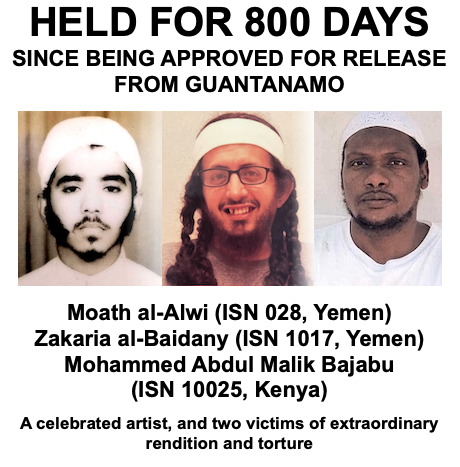
Held for 800 Days Since Being Approved for Release from Guantánamo: Moath Al-Alwi, Zakaria Al-Baidany and Mohammed Abdul Malik Bajabu
Please support my work as a reader-funded journalist! I’m currently trying to raise $2500 (£2000) to support my writing and campaigning on Guantánamo and related issues over the next three months. If you can help, please click on the button below to donate via PayPal.
This is the fifth in a new series of ten articles, alternately posted here and on the Close Guantánamo website, telling the stories of the 16 men still held at Guantánamo (out of 30 men in total), who have long been approved for release from the prison by high-level US government review processes, but have no idea of when, if ever, they will actually be freed. The first four articles are here, here, here and here.
Shamefully, these men are still held because the reviews were purely administrative, meaning that no legal mechanism exists to compel the US government to free them, if, as is apparent, senior officials are unwilling to prioritize their release.
To be fair, most of these men cannot be repatriated, because of US laws preventing the return of men from Guantánamo to countries including Yemen, where most of the men are from, but if senior officials — especially President Biden and Antony Blinken — cared enough, these men would already have been freed, and the suspicion, sadly, must be that they are failing to do anything because the they don’t want to upset the handful of Republican lawmakers who are fanatical in their support for Guantánamo’s continued existence, while they seek the GOP’s cooperation in funding military support for Israel and Ukraine.
Held for 5,150 Days Since Being Approved for Release from Guantánamo: Toffiq Al-Bihani and Two “Ghosts,” Ridah Al-Yazidi and Muieen Abd Al-Sattar

Please support my work as a reader-funded journalist! I’m currently trying to raise $2500 (£2000) to support my writing and campaigning on Guantánamo and related issues over the next three months. If you can help, please click on the button below to donate via PayPal.
Three weeks ago, I began a new Guantánamo project, telling the stories of the 16 men who have been approved for release from the prison, in an effort to humanize them, to remind the world of their existence, and to highlight the disgracefully long amount of time that they have been held since being approved for release.
I’m alternating publication of the articles here and on the Close Guantánamo website, tying them in to noteworthy dates relating to how long they have been held since the US authorities first decided that they no longer wanted to hold them. The first article focused on the case of Uthman Abd Al-Rahim Muhammad Uthman, a Yemeni who, on February 7, had been held for 1,000 days since being approved for release, and the second focused on Hani Saleh Rashid Abdullah, another Yemeni, who, on February 11, had been held for 1,200 days since being approved for release. For the fourth article, about Abdulsalam Al-Hela and Sharqawi Al-Hajj, see here.
The reason these men have been held for so long without being freed is, sadly, because the decisions taken to release them — via Periodic Review Boards, a parole-type review process established by President Obama in 2013 — were purely administrative, meaning that the US government has no legal obligation to free them, and they cannot, for example, appeal to a judge to order their release if, as has become sadly apparent, the government has failed to prioritize their release.












 Who's still at Guantánamo?
