How Were the Filton 4 Sentenced for Terrorism When They Weren’t Convicted of Terrorism?

Please click on either of the ‘Donate’ or ‘Buy’ buttons below (via PayPal or Stripe) to make a donation towards the $2,500 (£2,000) I’m trying to raise to support my work as a reader-funded investigative journalist, commentator and activist over the next three months. To get links to all my work in your inbox, please also consider taking out a free or paid subscription to my new Substack newsletter.
This is the last of three articles about the recent concerted assault on the direct action group Palestine Action in the UK courts. The first, “Punitive sentencing in the UK for Filton 4 activists on behalf of Israel”, focused on the sentencing of the Filton 4 last Friday, which I posted on Facebook here, where it has had over 330,000 views (although it also attracted an open sewer of deeply unpleasant trolls), and also on Substack, where I also sent it to my subscribers. Feel free to join me. The second, “The Renewed Ban on Palestine Action Confirms Legal Overreach in the Designation of Terrorism”, about the Court of Appeal’s unwise reinstatement of the proscription of Palestine Action as a terrorist organization, in which I examined the root problems of “serious damage to property” having been designated as terrorism in the Terrorism Act 2000, was posted here on my website, and this third article revisits the Filton 4 sentencing to provide detailed analysis about how the biased judge, Mr. Justice Johnson, was able to sentence the four activists for terrorism, when they weren’t convicted of terrorism by the jury in their retrial.
POSTSCRIPT: On June 24, I joined Chris Cook for his Gorilla Radio show in western Canada to discuss the fall of Keir Starmer (see my Substack post here), and the devious judicial efforts to secure terrorism-enhanced sentences for the Filton activists. Listen to the one-hour show on Substack here. I’m in the second half; Yves Engler in the first half.
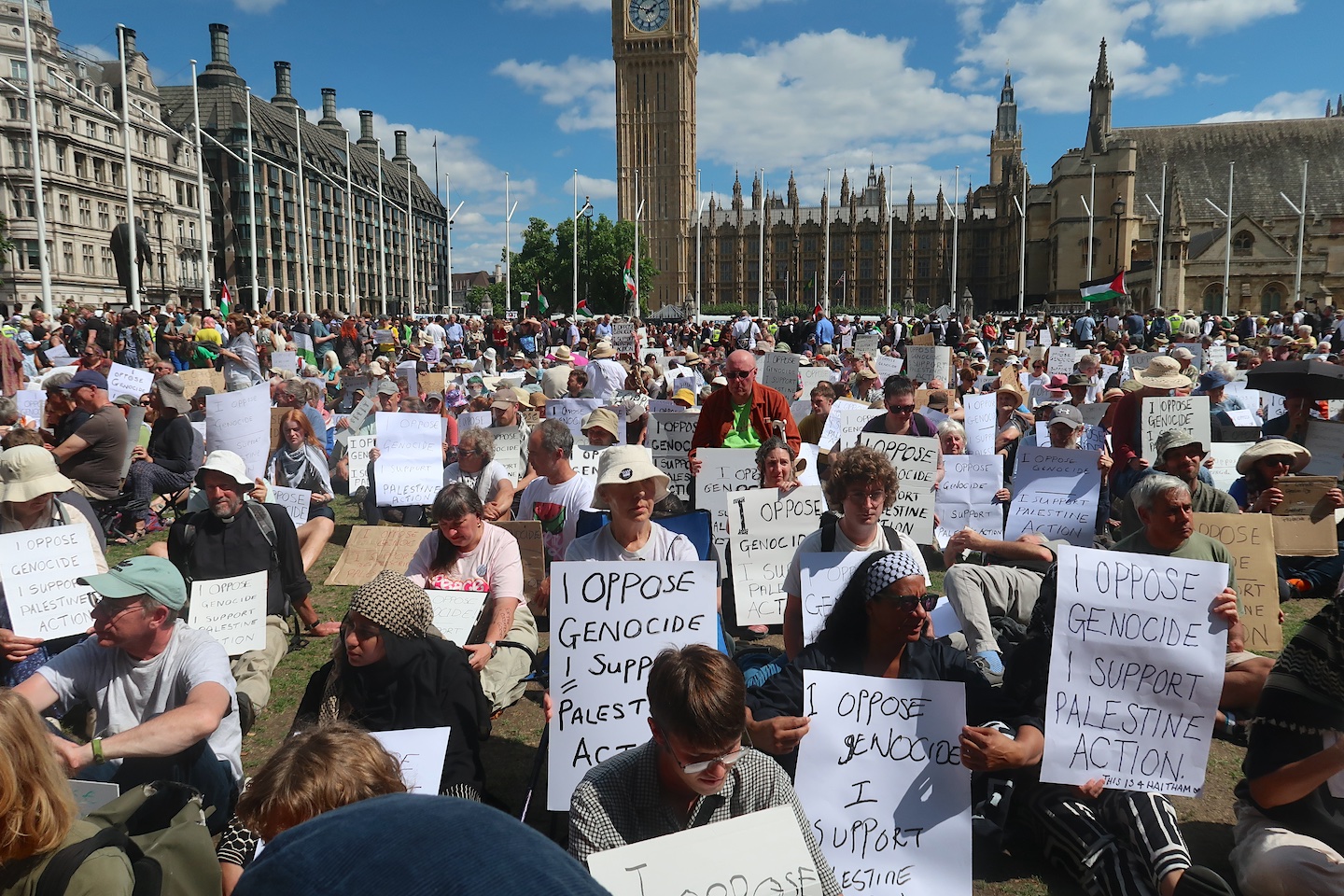
Since the sentencing, last Friday, of the Filton 4 — activists with Palestine Action, who undertook direct action to damage drones intended for use in Gaza at a facility owned by Elbit Systems, Israel’s biggest arms company — observers of justice, in the UK and around the world, have been reeling at the imposition by the judge of punitive sentences.
As I explained in my first article, Charlotte Head and Leona Kamio were given six-year sentences, minus 45 days for time served since the conviction, Fatema Zainab Rajwani was given a sentence of five years and eight months, minus 45 days, while Samuel Corner was given a sentence of eight years and eight months.
The Renewed Ban on Palestine Action Confirms Legal Overreach in the Designation of Terrorism
Please click on either of the ‘Donate’ or ‘Buy’ buttons below (via PayPal or Stripe) to make a donation towards the $2,500 (£2,000) I’m trying to raise to support my work as a reader-funded investigative journalist, commentator and activist over the next three months. To get links to all my work in your inbox, please also consider taking out a free or paid subscription to my new Substack newsletter.
In a dispiriting ruling yesterday, the Court of Appeal in London overturned a ruling in February, by the High Court, that the government’s proscription of the direct action group Palestine Action as a terrorist organization, which was passed by Parliament last July, was unlawful.
The High Court’s ruling, in response to a judicial review submitted by Huda Ammori, one of Palestine Action’s two co-founders, repudiated the two counts on which the High Court had ruled the proscription unlawful.
Garden Court Chambers, whose barristers represented Huda Ammori at the judicial review in February, explained that these two counts were, firstly, that the Court “upheld the Claimant’s challenge that the Home Secretary failed to comply with her own policy when making the decision to proscribe Palestine Action”, and, secondly, that “proscription breached the rights of Freedom of Expression and Assembly as protected under Articles 10 and 11 of the European Convention on Human Rights.”
Video: I Discuss the Guantánamo Files Released by WikiLeaks and Julian Assange’s Extradition Hearing with Action4Assange and Juan Passarelli

Please support my work as a reader-funded journalist! I’m currently trying to raise $2500 (£2000) to support my writing and campaigning on Guantánamo and related issues over the next three months of the Trump administration. If you can help, please click on the button below to donate via PayPal.
On Saturday, I was delighted to take part in a wide-ranging discussion about my role as a witness in the hearings regarding WikiLeaks founder Julian Assange’s proposed extradition to the US, and the classified military files from Guantánamo that were released in 2011, on which I worked as a media partner.
The show — for the campaigning organization Action4Assange — was hosted by Steve Poikonen and Kendra Christian, and my fellow guest was Juan Passarelli, the filmmaker whose recent, 38-minute film about Assange, The War on Journalism: The Case of Julian Assange, I promoted in an article last week.
The show was streamed live, and recorded for YouTube. It starts around 12 and a half minutes in, and runs for nearly two hours, and you can check it out below.
Video: The War on Journalism – The Case of Julian Assange

Please support my work as a reader-funded journalist! I’m currently trying to raise $2500 (£2000) to support my writing and campaigning on Guantánamo and related issues over the next three months of the Trump administration. If you can help, please click on the button below to donate via PayPal.
In a prison cell in HMP Belmarsh, in south east London, which is supposedly reserved for the most violent convicted criminals in the UK, Julian Assange, the founder of WikiLeaks and a non-violent individual who has not been convicted of a crime, awaits a ruling regarding his proposed extradition to the United States, to face disgracefully inappropriate espionage charges related to his work as a publisher of classified US documents that were leaked by US soldier Chelsea Manning.
The first stage of hearings regarding Julian’s extradition took place in February, and were supposed to continue in May, but were derailed by the arrival of Covid-19. In February, I had submitted as evidence a statement in support of Julian, based on having worked with him as a media partner on the release of classified military files from Guantánamo in 2011. I expected to be questioned about my evidence in May, but, in the end, it wasn’t until September that the hearings resumed.
To coincide with the resumption of the hearings, a 38-minute film was released, “The War on Journalism: The Case of Julian Assange,” directed by filmmaker Juan Passarelli, for which I was interviewed, in the esteemed company of of John Pilger, UN torture rapporteur Nils Melzer, lawyers Jennifer Robinson and Renata Avila, Julian’s wife Stella Moris, journalists Barton Gellman, Margaret Sullivan, Iain Overton, Max Blumenthal and Matt Kennard, WikiLeaks’ editor in chief Kristin Hrafnsson, and Conservative MP David Davies.
Judge Orders Chelsea Manning’s Release From Jail for Not Cooperating With WikiLeaks Grand Jury, But Won’t Waive $256,000 Fines

Please support my work as a reader-funded journalist! I’m currently trying to raise $2500 (£2000) to support my writing and campaigning on Guantánamo and related issues over the next three months of the Trump administration. If you can help, please click on the button below to donate via PayPal.
Good news from the United States District Court for the Eastern District of Virginia, where, on Thursday (March 12), District Judge Anthony J. Trenga ordered the immediate release from jail of whistleblower Chelsea Manning (formerly Pfc. Bradley Manning), who has been imprisoned since last March for refusing to cooperate with a Grand Jury investigation into WikiLeaks and its founder Julian Assange.
While serving as an Army intelligence analyst in 2009, Manning was responsible for the largest leak of military and diplomatic documents in US history, and received a 35-year sentence — described by Charlie Savage in the New York Times as “the longest sentence by far in an American leak case” — in August 2013.
After her conviction, as Savage also explained, “she changed her name to Chelsea and announced that she wanted to undergo gender transition, but was housed in a male military prison and twice tried to commit suicide in 2016.” After these bleak experiences, it came as an extremely pleasant surprise when, just before leaving office in January 2017, President Obama commuted most of her sentence, as I explained in an article at the time, entitled, Obama Commutes Chelsea Manning’s 35-Year Sentence; Whistleblower Who Leaked Hugely Important Guantánamo Files Will Be Freed in May 2017, Not 2045.
As a Frail and Confused Julian Assange Appears in Court, It’s Time For the UK to Stop His Proposed Extradition to the US

Please support my work as a reader-funded journalist! I’m currently trying to raise $2500 (£2000) to support my writing and campaigning on Guantánamo and related issues over the next three months of the Trump administration. If you can help, please click on the button below to donate via PayPal.
I wrote the following article for the “Close Guantánamo” website, which I established in January 2012, on the 10th anniversary of the opening of Guantánamo, with the US attorney Tom Wilner. Please join us — just an email address is required to be counted amongst those opposed to the ongoing existence of Guantánamo, and to receive updates of our activities by email.
On Monday, at Westminster Magistrates’ Court, Julian Assange, the founder of WikiLeaks, looked frail and, at times, appeared confused as his lawyers sought a delay to a hearing regarding his proposed extradition to the US to face dubious — and potentially punitive — espionage charges relating to WikiLeaks’ work as a publisher of classified US government information; in particular, “Collateral Murder,” a “classified US military video depicting the indiscriminate slaying of over a dozen people in the Iraqi suburb of New Baghdad — including two Reuters news staff,” war logs from the Afghan and Iraq wars, a vast number of US diplomatic cables from around the world, and, in 2011, classified military files relating to Guantánamo, on which I worked as media partner, along with the Washington Post, McClatchy, the Daily Telegraph and others.
Assange has been imprisoned in the maximum-security Belmarsh prison in south east London since April, when the government of Ecuador, in whose embassy he had been living for nearly seven years, revoked the political asylum granted to him by the country’s former president, the democratic socialist Rafael Correa, who called his replacement, the right-winger Lenin Moreno, “[t]he greatest traitor in Ecuadorian and Latin American history” for his betrayal of Assange, declaring, “Moreno is a corrupt man, but what he has done is a crime that humanity will never forget.”
In May, a British court sought to justify Assange’s imprisonment with a 50-week sentence for having broken his bail conditions back in 2012, when he first sought asylum in the Ecuadorian embassy, fearing that he would be extradited to Sweden to face unsubstantiated sexual assault allegations, and would then be handed over to the US.
As Lewisham Council Spend £1m Guarding the Old Tidemill Wildlife Garden from the People of Deptford, Who Will Be Their Tree-Killers?
 Please support my work as a reader-funded investigative journalist, commentator and activist. If you can help, please click on the button below to donate via PayPal.
A week last Friday, the Save Reginald Save Tidemill campaign — which I’m part of, and which is trying to save a community garden and a block of council flats in Deptford, in south east London from the wrecking ball of the cynical ‘regeneration’ industry — received some unwelcome, but not entirely unexpected news.
In the High Court, the court of appeals upheld an earlier decision not to accept a judicial review of the ‘regeneration’ plans, which centred on issues relating to the right to light of tenants in a block of flats next to the proposed building site.
In a statement for the Save Reginald Save Tidemill campaign, I responded by saying, “This is a disappointment, of course, but it doesn’t affect the campaign against the proposed destruction of the Old Tidemill Wildlife Garden and Reginald House. We continue to insist that the garden is too important as a barrier to pollution, and as a communal green space, to be destroyed, and that there is no acceptable reason for a structurally sound block of council flats to be knocked down for new housing that purports to be ‘social housing’ but will actually be at ‘London Affordable Rent’, which, in Lewisham, is 63% higher than social rents.” Read the rest of this entry »
As the Stansted 15 Avoid Jail, The “Hostile Environment” Continues with Disgraceful New Windrush Flight to Jamaica
 Please support my work as a reader-funded journalist! I’m currently trying to raise $2500 (£2000) to support my writing and campaigning on Guantánamo and related issues over the next three months of the Trump administration. If you can help, please click on the button below to donate via PayPal.
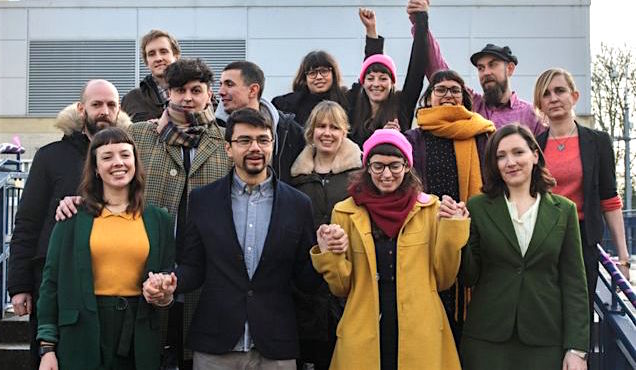
So there was good news on Wednesday, as the Stansted 15 — activists who prevented a deportation flight from leaving Stansted Airport for west Africa in March 2017 — avoided jail. Three received suspended sentences (with two also receiving 250 hours of community service, with 100 hours for the third), eleven others were given 100 hours of community service, while the 15th “received a 12-month community order with 20 days of rehabilitation”, as the Guardian described it.
However, two troubling aspects of the story remain significant. The first is that the protestors were convicted on charges of terrorism, and, alarmingly, that conviction still stands. As Ash Sardar wrote for the Independent, “Rather than being convicted of aggravated trespass, as other protesters who committed similar offences had been in 2016, the Stansted 15 had an initial trespass charge changed four months into their bail to a charge of ‘endangering safety at aerodromes’ – a scheduled terrorist offence, which potentially carries a life sentence.” The 2016 protest, at Heathrow Airport, against proposals for the airport’s expansion, involved three protestors who were part of the later actions at Stansted — the three who received the suspended sentences.
Continuing with her analysis of the sentencing in the Independent, Ash Sardar added, “This particular bit of legislation – from the Aviation and Maritime Security Act 1990, if anyone’s interested – was brought in after the Lockerbie bombing of 1988. Its application in a protest case is completely unprecedented in English courts. You might not agree with the actions of the Stansted 15, but this punitive and misguided use of legislation to criminalise protesters should have you worried regardless.” Read the rest of this entry »
Why the Conviction of the Stansted 15, on Terrorism-Related Charges, Must Be Overturned
 Please support my work as a reader-funded investigative journalist, commentator and activist. If you can help, please click on the button below to donate via PayPal.
As someone who has spent the last 13 years working to end imprisonment without charge or trial at Guantánamo, it has always been chilling to see these institutional crimes echoed in the UK. Under Tony Blair, foreign-born, alleged terror suspects were held without charge or trial on the basis of secret evidence, while other foreign nationals, and British nationals too, also regarded as terror suspects, were subjected to a form of house arrest, also on the basis of secret evidence, under what were known as “control orders.”
Unfortunately, throughout this period, the use of immigration detention was also on the rise. As the Guardian explained in an article in October based on a survey of its history, “The power to detain was created in the 1971 Immigration Act – however, it was not until the Labour government under Tony Blair that the detention estate expanded to become what it is today. In 2000, detention centres could hold 475 people, with another 200 or so held under immigration powers in prisons. Capacity has now expanded to about 3,500 spaces.”
The Guardian article noted that “[m]ore than 27,000 people were detained in 2017, according to the most recent figures”, adding, “Detention is now a significant part of the UK’s immigration enforcement efforts, but locking up immigrants without a time limit is a relatively recent phenomenon.” Read the rest of this entry »
30 Days into the Occupation of Deptford’s Old Tidemill Garden, Campaigners Celebrate Court Ruling Delaying Eviction Until Oct. 24
 Yesterday marked 30 days since campaigners — myself included — occupied the Old Tidemill Wildlife Garden, a much-loved community garden in Deptford, and it was a day of celebration, as we secured a court ruling allowing our occupation to last for at least another month.
Campaigners have been occupying the garden since August 29, to prevent Lewisham Council from boarding it up prior to its planned destruction as part of a housing project with the developer Peabody.
Lewisham Council sought to evict the campaigners at Bromley County Court, but although the judge confirmed the council’s right to possession of the garden, he ruled that it cannot take place until seven days after a High Court judge holds an oral hearing at which campaigners will seek permission to proceed to a judicial review of the legality of the council’s plans. This oral hearing will take place on October 17 (and please, if you can, make a donation to our crowdfunder for our legal fees).
Andrea Carey, a member of the Save Reginald Save Tidemill campaign, said:
This is great news, as it was clearly unacceptable for the council to seek possession of the garden while a legal challenge to the legality of its plans was in progress. We urge the council, and the developers Peabody, to take this opportunity to do what they have persistently failed to do: to go back to the drawing board, and to work with the community to come up with new plans for the old Tidemill school site that spare the garden and the 16 structurally sound council flats next door, in Reginald House, and that deliver new homes at social rent.











 Who's still at Guantánamo?
