Just Stop Oil Return and Block Parliament Square; Can You Blame Them?
Please click on either of the ‘Donate’ or ‘Buy’ buttons below (via PayPal or Stripe) to make a donation towards the $2,500 (£2,000) I’m trying to raise to support my work as a reader-funded investigative journalist, commentator and activist over the next three months. To get links to all my work in your inbox, please also consider taking out a free or paid subscription to my new Substack newsletter.
On Wednesday, as I cycled to Parliament Square for the 44th successive monthly vigil for the closure of the “war on terror” prison at Guantánamo Bay (part of monthly vigils that take place across the US and around the world), I suddenly felt that I had stepped back in time.
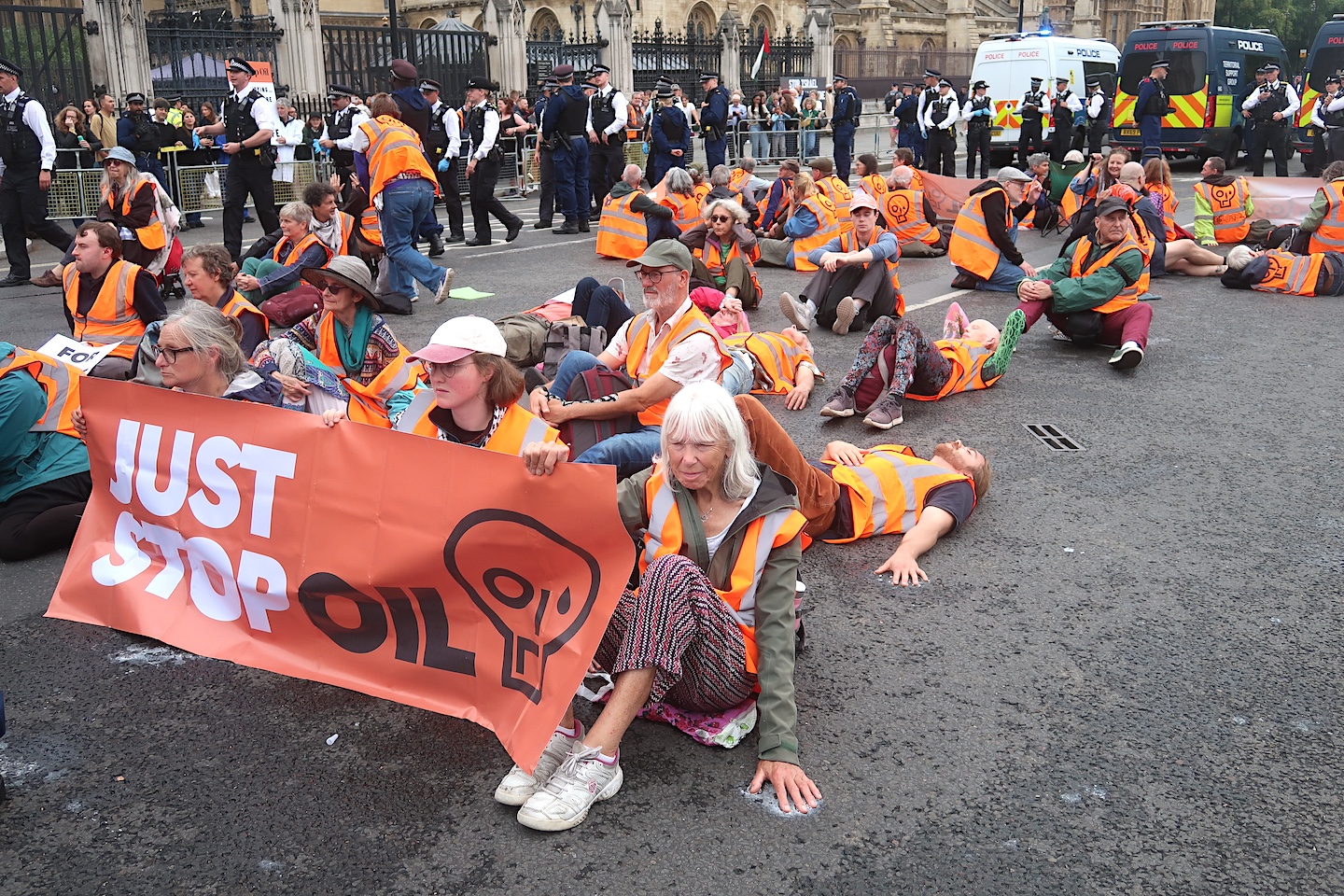
Like a phoenix reborn from the ashes of political repression, 60 Just Stop Oil activists, in hi-vis jackets bearing the climate action group’s distinctive logo, were sitting in the road outside the Houses of Parliament, having brought traffic to a halt.
The occasion for Just Stop Oil’s revival was the first PMQs (Prime Minister’s Questions) of Andy Burnham, Britain’s new and unelected Prime Minister, anointed by the Labour Party’s Zionist elite to try to undo the electoral armageddon augured by his failed predecessor, Keir Starmer, less animated and less convincing than a packet of lard, but a Zionist of such formidable enthusiasm that, despite having been a human rights lawyer, he told LBC in October 2023 that Israel had the right to cut off water and fuel to an entire civilian population.
How Were the Filton 4 Sentenced for Terrorism When They Weren’t Convicted of Terrorism?

Please click on either of the ‘Donate’ or ‘Buy’ buttons below (via PayPal or Stripe) to make a donation towards the $2,500 (£2,000) I’m trying to raise to support my work as a reader-funded investigative journalist, commentator and activist over the next three months. To get links to all my work in your inbox, please also consider taking out a free or paid subscription to my new Substack newsletter.
This is the last of three articles about the recent concerted assault on the direct action group Palestine Action in the UK courts. The first, “Punitive sentencing in the UK for Filton 4 activists on behalf of Israel”, focused on the sentencing of the Filton 4 last Friday, which I posted on Facebook here, where it has had over 330,000 views (although it also attracted an open sewer of deeply unpleasant trolls), and also on Substack, where I also sent it to my subscribers. Feel free to join me. The second, “The Renewed Ban on Palestine Action Confirms Legal Overreach in the Designation of Terrorism”, about the Court of Appeal’s unwise reinstatement of the proscription of Palestine Action as a terrorist organization, in which I examined the root problems of “serious damage to property” having been designated as terrorism in the Terrorism Act 2000, was posted here on my website, and this third article revisits the Filton 4 sentencing to provide detailed analysis about how the biased judge, Mr. Justice Johnson, was able to sentence the four activists for terrorism, when they weren’t convicted of terrorism by the jury in their retrial.
POSTSCRIPT: On June 24, I joined Chris Cook for his Gorilla Radio show in western Canada to discuss the fall of Keir Starmer (see my Substack post here), and the devious judicial efforts to secure terrorism-enhanced sentences for the Filton activists. Listen to the one-hour show on Substack here. I’m in the second half; Yves Engler in the first half.
Since the sentencing, last Friday, of the Filton 4 — activists with Palestine Action, who undertook direct action to damage drones intended for use in Gaza at a facility owned by Elbit Systems, Israel’s biggest arms company — observers of justice, in the UK and around the world, have been reeling at the imposition by the judge of punitive sentences.
As I explained in my first article, Charlotte Head and Leona Kamio were given six-year sentences, minus 45 days for time served since the conviction, Fatema Zainab Rajwani was given a sentence of five years and eight months, minus 45 days, while Samuel Corner was given a sentence of eight years and eight months.
Why We Are All Palestine Action, and Why Direct Action to Prevent Genocide Is the Opposite of Terrorism

Please click on either of the ‘Donate’ buttons below (via PayPal or Stripe) to make a donation towards the $2,500 (£2,000) I’m trying to raise to support my work as a reader-funded investigative journalist, commentator and activist over the next three months. To get links to all my work in your inbox, please also consider taking out a free or paid subscription to my new Substack newsletter.
UPDATE: Please free free to check out my one-hour interview with Chris Cook of Gorilla Radio, recorded on August 13, in which we discussed the self-inflicted problems created by the British government following its proscription of Palestine Action as a terrorist organization, as well as the targeted murder of Anas Al-Sharif and his colleagues, Israel’s war on journalists, and its persistent lies.
Today, July 2, is a truly bleak day for fundamental human rights in the UK, as MPs have voted, by 385 votes to 26, to uphold legislation introduced on Monday by the home secretary, Yvette Cooper, to proscribe Palestine Action, a direct action group, as a terrorist organization, along with two international neo-Nazi groups, the Maniacs Murder Cult (MMC) and the Russian Imperial Movement (RIM). Under the legislation, it is now a criminal offence, punishable by up to 14 years in prison, for anyone to become a member of, or even to support the direct action of Palestine Action.
This article, for example, may get the police knocking on my door, but I’m not going to be deterred, because this is very clearly a cynical and illegitimate piece of legislation that, horrifically, is designed primarily to allow Israeli arms companies — and allied British interests — to continue supporting Israel’s genocide in Gaza.
Dan Jarvis, the Home Office minister tasked with explaining the move, declared, in a presentation dripping with startling hyperbole, that, “By implementing this measure, we will remove Palestine Action’s veil of legitimacy, tackle its financial support and degrade its efforts to recruit and radicalize people into committing terrorist activity in its name.”
Britain’s Racist Far-Right Riots, Brexit and the Shameful Responsibility of Politicians and the Mainstream Media

Please support my work as a reader-funded investigative journalist, commentator and activist. If you can help, please click on the button below to donate via PayPal.
Over the last week, racist far-right rioting has erupted in towns and cities across the UK, cynically engineered by provocateurs who used a horrendous homicidal attack on a children’s dance class in Southport on July 29, at which three girls were stabbed to death, to falsely suggest that the attacker was a Muslim asylum seeker who had recently arrived in the UK after crossing the Channel in a small boat.
The reality was that the attacker was an evidently severely troubled 17-year old, born in the UK, whose Christian parents came to the UK from Rwanda, but the lies had a baleful life of their own, galvanising far-right groups and individuals from across the country, committed to Islamophobic violence, and connected via the swamp of unregulated or barely regulated social media and chat groups, to descend on Southport, just a day after the stabbings, where they targeted a mosque, fought with police officers, injuring 50, set fire to a police van, and damaged cars, homes and businesses.
The day after, July 31, the rioting spread to Hartlepool, where a mosque was attacked, Manchester and Aldershot, where hotels housing asylum seekers were attacked, and London, where rioters clashed with police in Whitehall.
After Punitive Sentences of Climate Activists, Labour Must Repeal the Tories’ Draconian Anti-Protest Laws

Please support my work as a reader-funded investigative journalist, commentator and activist. If you can help, please click on the button below to donate via PayPal.
In a profoundly disturbing example of draconian judicial overreach in the UK, based on punitive anti-protest laws passed by the recently-departed Conservative government, five climate activists were yesterday given prison sentences of between four and five years for their role in organising climate protests on the M25 in November 2022 via a Zoom call.
Four of the protestors — Daniel Shaw, 38, Louise Lancaster, 58, Lucia Whittaker De Abreu, 34, and Cressida Gethin, 22, all members of the campaigning group Just Stop Oil — were given four-year sentences, while Roger Hallam, 57, the co-founder of Extinction Rebellion, Insulate Britain and Just Stop Oil, was given a five-year sentence.
Hallam was sentenced even though he insisted that he wasn’t one of the organisers, and was, as he explained in a powerful post after his sentencing, speaking as an advisor, “recommending the action to go ahead to wake up the British public to societal collapse” if urgent action isn’t taken to address the climate crisis. He also explained his hope that the protests would, as the Guardian described it yesterday, “cause ‘the biggest disruption in British modern history’ in an effort to force the government to meet Just Stop Oil’s core demand, an end to new oil and gas exploration in the North Sea.”
Despite the Landslide, Labour Have No Vision and Only Won the UK General Election Because the Tories Lost So Spectacularly

Please support my work as a reader-funded investigative journalist, commentator and activist. If you can help, please click on the button below to donate via PayPal.
So the good news is easy. After 14 years of cruelty, incompetence and corruption, the Tories were wiped out in yesterday’s General Election in the UK, suffering their worst ever result, and ending up with less MPs than at any other point in their 190-year existence.
Of the 650 seats contested, the 365 seats that the Tories had when Rishi Sunak unexpectedly called a General Election on May 22 were slashed to just 121 (a loss of over two-thirds), with their vote almost halved, from 13,966,454 in 2019 to just 6,814,469 yesterday.
High-profile Tory losses included Liz Truss, the disastrous 43-day Prime Minister, whose vote plunged from 35,507 in 2019 to 11,217 in South West Norfolk, the absurd and offensive pro-Brexit toff Jacob Rees-Mogg, and a number of ministers until six weeks ago including the vacuous Tory pin-up Penny Mordaunt, the empty Grant Shapps and Mark Harper, the far-right ideologues Liam Fox and Johnny Mercer, and the offensive Thérèse Coffey and Gillian Keegan.
Hatred of Dissent: Reviewing Four Decades of Repressive Tory Laws on the 38th Anniversary of the Battle of the Beanfield

Please support my work as a reader-funded investigative journalist, commentator and activist. If you can help, please click on the button below to donate via PayPal.
38 years ago, on June 1, 1985, a convoy of vehicles carrying what the photographer Alan Lodge described as “a small, mild mannered bunch of people” — around 550 men, women and children, generally described at the time as New Age Travellers — was ambushed and “decommissioned” with extraordinary violence by around 1,400 police from six countries and the Ministry of Defence, in what has become known as the Battle the Beanfield — although, as I stated in my article marking this horrendous event last year, “‘battle’ suggests the presence of two more or less equal parties engaged in conflict, when what actually took place was a one-sided rout of heartbreaking brutality.”
The convoy was hoping to reach Stonehenge, to establish what would have been the 12th annual free festival in fields opposite the ancient temple on Salisbury Plain, which had grown, by 1984, into an anarchic settlement that welcomed tens of thousands of visitors throughout the whole of June. An injunction had been served, intended to prevent anyone from reaching Stonehenge, and from the summer before travellers, environmental protestors and festival-goers had been harassed and assaulted from Yorkshire to RAF Molesworth in Cambridgeshire, where a peace camp, echoing the famous Greenham Common Women’s Peace Camp, had been established to resist the planned introduction of a second US cruise missile base on UK soil until it was evicted in February 1985 in the largest peace-time action involving British troops, led by the then-defence secretary Michael Heseltine.
Undeterred, however, the convoy had set off for Stonehenge from Savernake Forest in Wiltshire on June 1, but soon met with trouble. After the police blocked the road seven miles from Stonehenge, and officers began smashing the windows of stationary vehicles and the occupants were ”dragged out screaming”, as Tony Thompson explained in an article for the Observer in 2005, the majority of the convoy sought to avoid the violence by driving into a nearby beanfield.
How Brexit Gave Us Vile, Broken Politicians Who Despise Human Rights and Seek to Criminalise Refugees: Part Two

Please support my work as a reader-funded investigative journalist, commentator and activist. If you can help, please click on the button below to donate via PayPal.
The second of two articles in which I examine how the Tory government’s vile anti-immigration policies, pursued with such vigour by Priti Patel and Suella Braverman, have their origins in the dangerous isolationism of Brexit, and its unleashing of false and disturbing notions that, post-Brexit, the UK should no longer be constrained by international law. In this first article, I looked at how Brexit happened, how Theresa May paved the way for the shoddy and cruel lawlessness of Patel and Braverman, and how the Tories, even before Brexit, consistently sought to undermine the European Convention on Human Rights, with a particular focus on Theresa May’s obsessive pursuit of the Jordanian cleric Abu Qatada. (See Part One here).
Ruthlessly self-seeking and, morally, a complete vacuum, Boris Johnson swept to power in December 2019 by following the populists’ playbook established by Donald Trump — a three- or four-word slogan, hammered home at every opportunity. For Trump it was ‘Make America Great Again’, while for Johnson it was ‘Get Brexit Done’, delivered despite the evident impossibility of getting it done without consigning us to relentless economic decline and international irrelevance.
While Johnson’s dithering over Covid, his persistent lying and his corruption (not least in fast-tracking billions of pounds of taxpayers’ money to cronies during the Covid lockdowns for services that they were patently unable to provide) defined his Premiership, what must not be overlooked is the extent to which he also empowered the far right of the Conservative Party in their rabid enthusiasm for a post-Brexit bonfire of fundamental rights.
On the 37th Anniversary of the Battle of the Beanfield, Gypsies and Travellers Face an Unprecedented Threat From This Vile and Bigoted Government

Please support my work as a reader-funded investigative journalist, commentator and activist. If you can help, please click on the button below to donate via PayPal.
37 years ago today, a event took place that has largely been shunted into the margins of modern British history, even though it remains a particularly chilling example of the state suppressing manifestations of dissent, and of ways of life that didn’t conform to a narrow interpretation of the ‘normal’ and the ‘acceptable’ in a manner reminiscent of the ways in which totalitarian authoritarian regimes deal with those regarded as an undesirable underclass.
That event is known as the Battle of the Beanfield, although ‘battle’ suggests the presence of two more or less equal parties engaged in conflict, when what actually took place was a one-sided rout of heartbreaking brutality, as 1,400 police, drawn from six counties and the MoD, violently assaulted and ‘decommissioned’ a convoy of vehicles, carrying 400 to 500 men, women and children, who were en route to Stonehenge to establish what would have been the 12th annual Stonehenge Free Festival.

For detailed accounts of the Beanfield and the wider free festival and travellers’ movements, my books The Battle of the Beanfield and Stonehenge: Celebration and Subversion are both still in print, and can be ordered from me by clicking on the links.
The suppression of the festival — an alternative town that established itself every year in the fields opposite Stonehenge for the whole of June, and that, at its peak, in 1984, drew in tens of thousands of people from across the UK — was the justification used by the government of Margaret Thatcher to defend the single biggest peacetime assault on civilians in recent history, but it disguised other, even darker motives than the suppression of people’s collective assertion of a right to gather freely to listen to music and to practice alternative ways of living.
2021 Review: Covid, Climate Change, Corrupt, Complicit Governments – and ‘Don’t Look Up’

Please support my work as a reader-funded investigative journalist, commentator and activist. If you can help, please click on the button below to donate via PayPal.
As 2022 begins, Covid-19 continues to dominate our lives. It’s now nearly two years since its arrival triggered levels of panic unprecedented in the lifetimes of most of us in the West — isolating people in their homes, shutting down offices, the hospitality and entertainment industries, and most retail outlets. After restrictions were eased over the summer of 2020 and into autumn, a second wave of the pandemic shut society down again for several long and gruelling months at the start of 2021, and, after another easing of restrictions, a third wave — of the Omicron variant — has once more derailed notions of a return to “normality.”
Thankfully, it looks as though this variant, although highly infectious, is far less deadly, although it will still put a strain on overstretched and exhausted health services. In the UK, however, another serious lockdown looks unlikely — not for medical reasons, but because Prime Minister Boris Johnson faces a backbench rebellion that will topple him from power if he once more imposes serious restrictions.
Throughout this period, a far bigger crisis — catastrophic climate change, caused by humanity’s obsession with fossil fuels — has generally been relegated to a secondary position in the considerations of politicians and the media. Activists did a great job of amplifying the concerns of largely ignored climate scientists in the years before Covid hit, but although there was a brief reawakening of interest in climate change in November, when the COP26 climate summit of world leaders took place in Glasgow, it passed as soon as the conference ended, and the Omicron variant took over.










 Who's still at Guantánamo?
