The Renewed Ban on Palestine Action Confirms Legal Overreach in the Designation of Terrorism
16.6.26
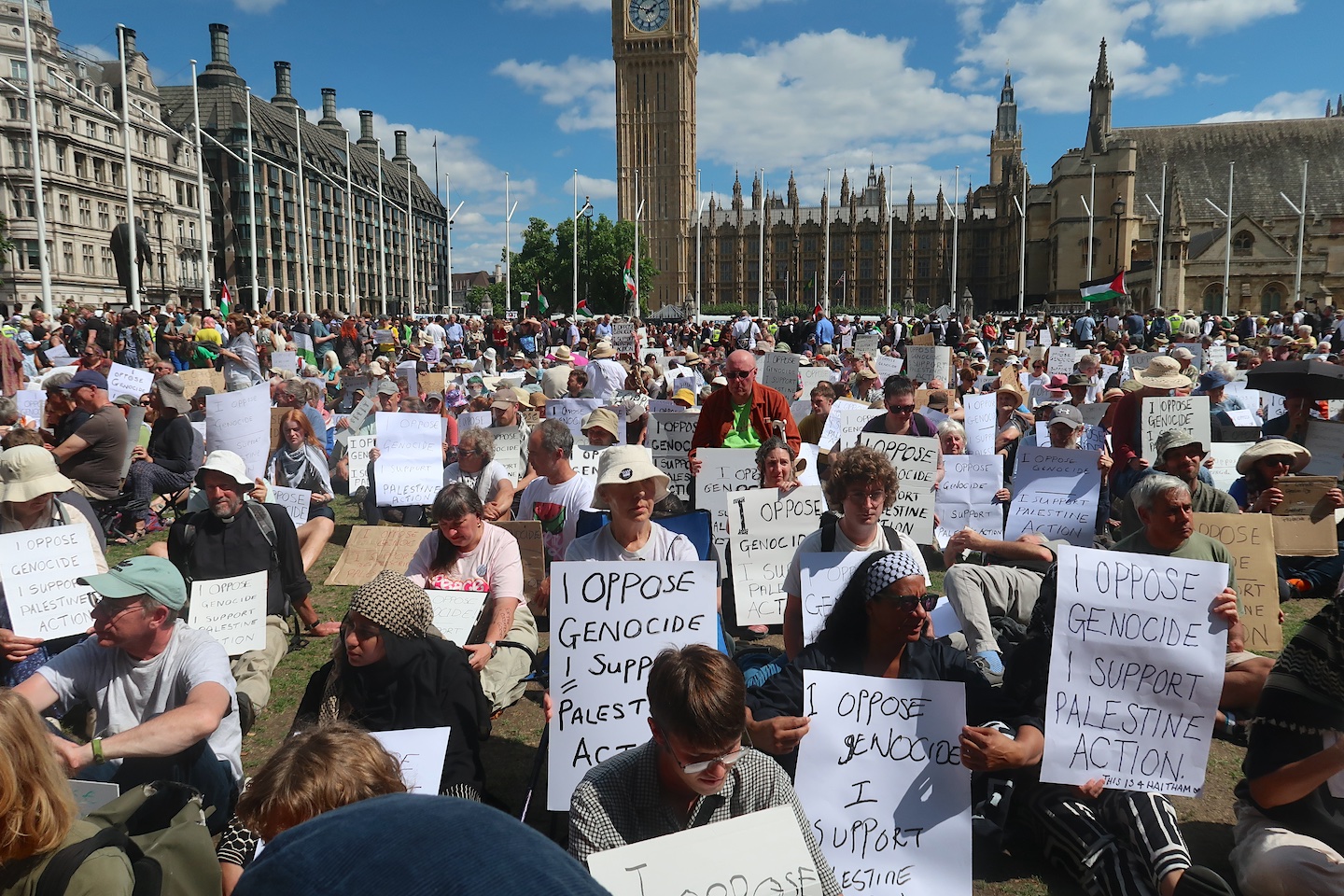
Please click on either of the ‘Donate’ or ‘Buy’ buttons below (via PayPal or Stripe) to make a donation towards the $2,500 (£2,000) I’m trying to raise to support my work as a reader-funded investigative journalist, commentator and activist over the next three months. To get links to all my work in your inbox, please also consider taking out a free or paid subscription to my new Substack newsletter.
In a dispiriting ruling yesterday, the Court of Appeal in London overturned a ruling in February, by the High Court, that the government’s proscription of the direct action group Palestine Action as a terrorist organization, which was passed by Parliament last July, was unlawful.
The High Court’s ruling, in response to a judicial review submitted by Huda Ammori, one of Palestine Action’s two co-founders, repudiated the two counts on which the High Court had ruled the proscription unlawful.
Garden Court Chambers, whose barristers represented Huda Ammori at the judicial review in February, explained that these two counts were, firstly, that the Court “upheld the Claimant’s challenge that the Home Secretary failed to comply with her own policy when making the decision to proscribe Palestine Action”, and, secondly, that “proscription breached the rights of Freedom of Expression and Assembly as protected under Articles 10 and 11 of the European Convention on Human Rights.”
The Court of Appeal shamefully reinstates the terrorism proscription
Yesterday, the Court of Appeal overturned both. The repudiation of the first was a long and detailed analysis of the home secretary’s powers regarding proscription, in which it was noticeable that, in dismissing it, the Court of Appeal not only poured scorn on the High Court, declaring that they had “adopted an excessively analytical approach to the interpretation of the Proscription Policy”, but also showed repeated and obsequious deference to Yvette Cooper, the home secretary at the time of the proscription, and her “expert” advisers from the police and the intelligence services.
At one point, for instance, the judges described how they were “required to attach special weight to the judgments and assessments of a primary decision-maker with special institutional competence” — yes, that really is a fawning description of Yvette Cooper! — and elsewhere, in deference to the executive branch of government, they noted that “The Proscription Decision lies in the area of national security which, before the Human Rights Act 1998, would have been regarded as unsuitable for judicial scrutiny at all.”
On the ECHR issues, described by the Court of Appeal as “questions of proportionality and the fair balance between the rights of individuals (free speech and freedom of assembly) and the rights of the community (national security and the rights of others)”, the Court acknowledged difficulties involving “the rights of the many law-abiding citizens wishing peacefully to protest, hold placards and otherwise support Palestine Action”, over 3,500 of whom have now been arrested — although they did also note that all of them ought to have been aware that doing so had become a “criminal act.” They also acknowledged “the ‘chilling effect’ that proscription may have upon those wishing to support the Palestinian cause, but who may be dissuaded from doing so by fear of committing offences under the 2000 Act.”
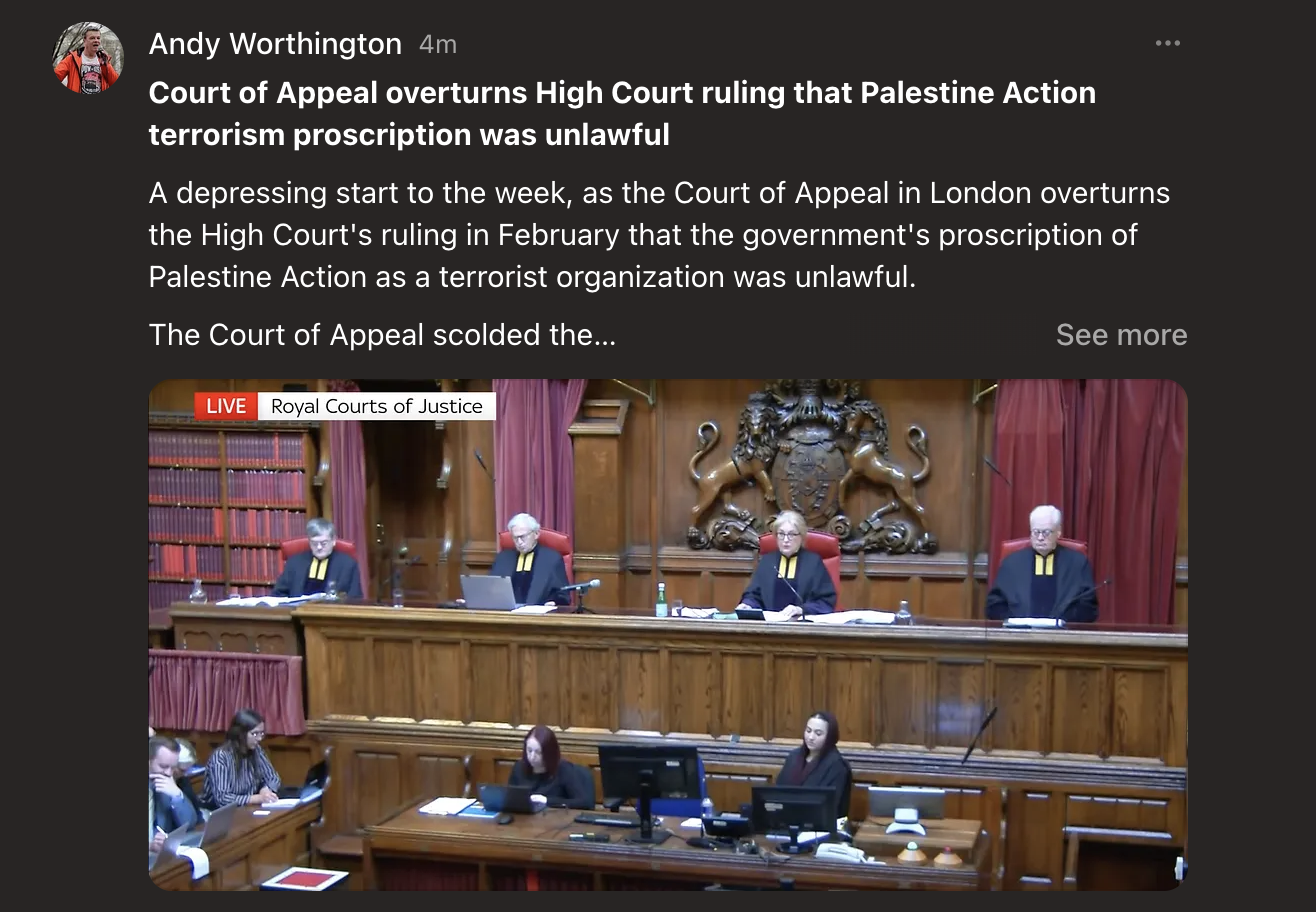
In the end, however, they came down heavily in favour of the government’s position, providing a roll-call of Palestine Action’s operations, interpreted through the darkest of lenses, and also defending what they evidently regard as the inalienable right of arms companies to conduct their business unmolested.
Here’s that roll-call:
- (i) Palestine Action is not an organisation engaged in activities falling within the well-established tradition of peaceful protest;
- (ii) Palestine Action is, instead, an organisation that is concerned in terrorism as defined in the 2000 Act and is engaged in causing serious damage to property using weapons, including sledgehammers, presenting very real risks of injury to members of the public;
- (iii) Palestine Action’s “Underground Manual” published in late 2023 advocates the disruption and destruction of and damage to its targets, and avoiding detection;
- (iv) Palestine Action’s nationwide campaign was escalating and was not being pursued with any restraint;
- (v) that campaign was intended to close down the operations of companies pursuing lawful businesses, and has involved direct criminal action against businesses and institutions, including key national infrastructure and defence firms that provide services and supplies to support Ukraine, the North Atlantic Treaty Organisation (NATO), the “Five Eyes” allies and the UK defence enterprise;
- (vi) a key benefit of proscribing Palestine Action was to prevent it from funding terrorism and to degrade its covert infrastructure characterised by secret cells.
There are, of course, a number of profound problems with the above. Firstly, I would say, the claim that that the group’s actions presented “very real risks of injury to members of the public” is unsubstantiated scaremongering, and, secondly, the consistent efforts to portray the group as “covert”, reinforced through repeated reference to the “Underground Manual”, which, with hindsight, is something that those managing the group’s social media should perhaps have considered not making public, overlooks the fact that the very case they were adjudicating was brought by one of Palestine Action’s co-founders, Huda Ammori, which really ought to be a definition of the opposite of “covert.”
I also found the emphasis on the rights of “lawful businesses” and the extensive list of “national security” partners disturbing, but that’s because, as I freely admit, I completely identify with Palestine Action’s frustrations, and recognize that the intensity of their direct action was because what they were opposing — Israel’s ongoing genocide in Gaza, and the existence of genocidal Israeli arms companies on UK soil, all supported by the British government — is a crime of such magnitude that it dwarfs anything that any of us have seen, experienced and had to endure before.
It’s no wonder that, like the climate activists prosecuted before them, for daring to be furious that we are marching ever more giddily towards our own self-imposed extinction, the activists of Palestine Action — mostly young and idealistic — have found it intolerable that no other avenue existed for them to try to make a difference, which they clearly did, disabling or destroying weapons which, otherwise, would have undoubtedly killed even more civilians in Gaza.
At one point in their ruling, the Court of Appeal reproduced the opening statements made by Raza Husain KC, the barrister for Huda Ammori, at the start of the judicial review in November, which were meant to shed light on what they viewed as Ms. Ammori’s distorted view of Palestine Action. Instead, however, it seems to me that Raza Husain’s opening statements provide an excellent summary of why the Court’s ruling yesterday was so adrift from the real story of the grotesque overreach of the proscription. As he said:
- (i) the Proscription Decision was novel and unprecedented, based as it was on serious damage to property;
- (ii) the Proscription Decision was based on 385 actions committed over 5 years, only three of which were categorised as terrorist incidents;
- (iii) the Proscription Decision has alarmed and concerned civil society organisations and UN experts;
- (iv) the Proscription Decision has given rise to a mass campaign of civil disobedience with over 2,000 people arrested by October 2025;
- (v) the level of public support for Palestine Action is not surprising;
- (vi) the Proscription Decision is unprecedented because “we have a long and honourable history of accommodating protests and demonstrations where people break the law to affirm their belief in the injustice of law or government action.”
The Court of Appeal also noted that Raza Husain “highlight[ed] orally that Ms. Ammori’s evidence was that ‘Palestine Action [had] never promoted or endorsed violence against people’”, which was, of course, true, despite the Court’s efforts elsewhere to deny it.
The sledgehammer episode, in the Filton 6’s attack on an Elbit factory in Bristol in August 2024, for which four of the six were sentenced on Friday, was the only incidence of violence against a person, and, despite the best efforts of the biased judge, Mr. Justice Johnson, to persuade the jury that it was GBH (grievous bodily harm) “with intent”, they refused to accept that, only convicting him of GBH “without intent.”
They did so after recognizing that the accused, Sam Corner, who is autistic, was disorientated after being pepper-sprayed, and only struck police sergeant Kate Evans — who suffered a minor fracture and not a “broken back”, as so many vindictive online commenters allege — because the screams of his one of his fellow activists made him fear that she was being “seriously hurt.”
Without this one incident, which the jury helpfully contextualised, the entire case for Palestine Action engaging in anything other than property damage completely collapses.
The Court lies about the suffragettes
Raza Husain also, as was reported at the time, compared Palestine Action to the suffragettes, telling the Court that “Ms. Huda Ammori has explained that she was inspired by the long tradition in this country from suffragettes to anti-apartheid activists, to Iraq war activists”, adding, “The suffragettes had resorted to direct action, property damage and even attempted arson at Westminster Abbey.” In his written submissions to the court, he also stated, “The suffragettes would have been liable to proscription if the Terrorism Act 2000 regime had been in force at the turn of the 20th century.”
The Court of Appeals specifically disagreed, claiming that, “on a fair analysis, Palestine Action has little or nothing in common with the suffragettes or the anti-apartheid or Iraq War protest groups”, and warming to their theme by claiming, absurdly, that Palestine Action “is not, as it claims, a direct action civil disobedience protest group like the suffragettes operating transparently in the open.”
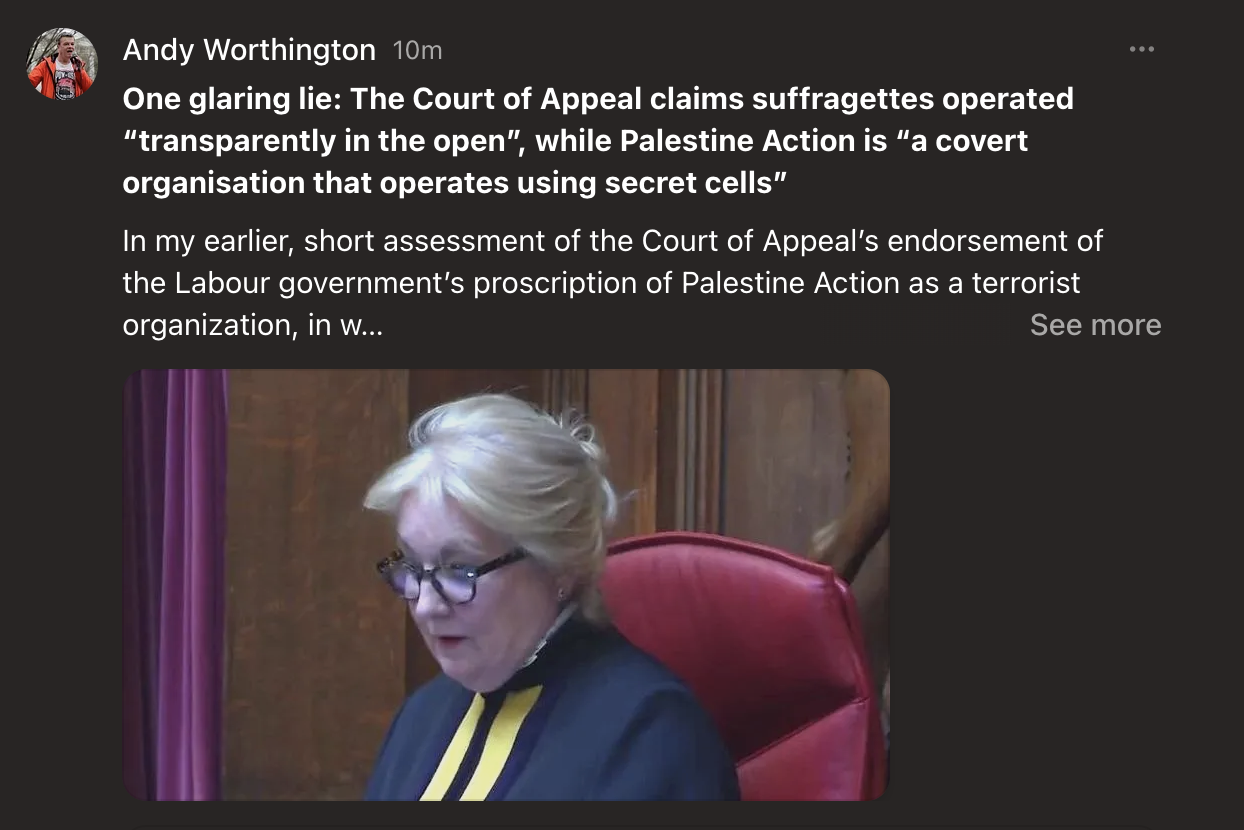
In response, in a post on Substack, I cited John McEvoy of Declassified UK, who wrote on X, “The suffragettes launched a sustained campaign of arson and bombing, employed anti-surveillance tactics to evade police, and attacked politicians”, and I added:
The suffragettes were clearly more violent than Palestine Action, but time has sanitized their violence, because, of course, what they were fighting for — votes for women, as part of sustained struggle for equality — was ultimately successful, as the woman reading out today’s ruling in the Court, Lady Chief Justice Sue Carr, must be well aware of, as she would not have her job had the suffragettes not been successful.
By lying about the suffragettes, the Court allowed a chink of light into their otherwise dark repudiation of any kind of direct action that involves significant criminal damage to achieve a political aim.
At what point, I wonder, will it be recognized that undertaking actions akin to, but less grave than those of the suffragettes — and with the aim of damaging or destroying weapons to be used in a genocide rather than to secure votes for women — was morally right, as the suffragettes’ actions obviously were.
Why property damage is not terrorism
When the government proscribed Palestine Action as a terrorist organization, five UN Rapporteurs, led by Prof. Ben Saul, the Special Rapporteur on the promotion and protection of human rights and fundamental freedoms while countering terrorism, issued an urgent press release, urging the government “not to misuse terrorism laws” against Palestine Action, stating that, “According to international standards, acts of protest that damage property, but are not intended to kill or injure people, should not be treated as terrorism.”
As the experts added, “While there is no binding definition of terrorism in international law, best practice international standards limit terrorism to criminal acts intended to cause death, serious personal injury or hostage taking, in order to intimidate a population or compel a government or an international organisation to do or to abstain from doing any act.”
As the experts also noted, “if national law criminalises property damage as terrorism, as it does in the UK, then it would be good international practice in a democracy to exclude acts of advocacy, protest, dissent or industrial action that do not result in death or serious injury.” As they also explained, “The Security Council’s Counter-Terrorism Executive Directorate supports this approach.”
This was a critical point, because the “national law” referred to by the UN Rapporteurs is the key to all of the government’s supposed justification regarding the proscription of Palestine Action.
The blame lies with the Terrorism Act 2000
26 years ago, in the Terrorism Act 2000 — the first major legislation dealing with terrorism in the UK — a previous Labour government, led by Tony Blair, shamefully included “serious damage to property”, when it is “designed to influence the government or to intimidate the public or a section of the public”, and/or is “made for the purpose of advancing a political, religious or ideological cause”, as a definition of terrorism under Section 1(2)(b) of the Act.
Its inclusion has been contentious ever since, primarily because it is at odds with the generally accepted requirement that terrorism must involve “acts intended to cause death, serious personal injury or hostage taking”, as the UN Rapporteurs explained last year, but also because no measurement was provided to assess what constitutes “serious damage.”
These problems were highlighted in “Home Secretary vs Palestine Action: The Constitutional Implications of Widening the Legal Understanding of Terrorism”, an article last July by Nour Haidar, a barrister at 7BR, on Bedford Row in London, for the UK Constitutional Law Association. She wrote:
In proscribing Palestine Action the Home Secretary is seeking to cast vandalism, criminal damage and direct action as acts of terrorism … There need not be evidence that such vandalism, criminal damage and direct action has posed or will pose any harm to life and safety. It seems enough, on her approach, that it costs millions of pounds worth of damage. In effect, this decision attempts to lower the threshold of what amounts to ‘serious’ harm.”
As she added:
The proscription of Palestine Action therefore involves a subtle but significant shifting of the legal understanding of terrorism. Prior to the Home Secretary’s decision to proscribe Palestine Action, no organisation, movement or group has ever been proscribed solely on the basis that they carry out actions which cause serious damage to property under s.1(2)(b) of the Terrorism Act.
With the heady days now apparently long gone, when juries, exercising their conscience, were allowed to acquit defendants accused of criminal damage in cases involving the sabotage of weapons to be used in war, or in a genocide — as I explained in my article, “Why We Are All Palestine Action, and Why Direct Action to Prevent Genocide Is the Opposite of Terrorism”, when Palestine Action was proscribed last year — it’s worthwhile for those of us who are appalled by this latest ruling (and the Filton 4 ruling on Friday) to try to shift the focus onto the appalling legislation that, yesterday, allowed Lady Chief Justice Sue Carr and her compliant fellow judges to uphold the proscription of Palestine Action as a terrorist organization, when they are not.
They are, I aver, not terrorists at all, but people who, feeling too much and unable to tolerate their supposed enforced compliance in the gravest crimes imaginable, taking place, still, in Gaza, have undertaken criminal damage to try to destroy genocidal equipment made here in the UK.
Juries should be allowed to decide whether, on this basis, defendants should be acquitted, and, if they don’t, the courts should, reluctantly, be allowed to impose custodial sentences based on them undertaking criminal damage.
But terrorism? No, not at all. Over my lifetime, as I have discussed before, the introduction of punitive, authoritarian laws that suppress our right to protest and to gather freely, and that seek to turn any form of inconvenient and even damaging dissent into terrorism, have never been repealed, and have only ever been followed by even more punitive and authoritarian “refinements”, increasing in frequency and severity over the last five years, and threatening a future in which, even when a genocide is taking place with the full support of our government, the only response we’re allowed is silence.
And this, ironically, is what the Palestinians have been told for nearly 80 years — that the only response they are allowed to show, despite their ceaseless repression, dispossession, murder and arbitrary imprisonment, is silence.
Resistance, they are told, is forbidden. Resistance, they are told, is terrorism.
Now that message is spreading to the west, spearheaded by slaves of Israel in positions of power here, and we must not be silent, neither for ourselves, nor for those being oppressed and killed in Gaza and elsewhere.
The Court of Appeal doesn’t speak for us, and, after 117 people were arrested outside the court yesterday, on suspicion of supporting Palestine Action, it’s clear that their efforts to suppress dissent will continue to make the UK a laughing stock around the world, a broken authoritarian would-be police state that can never silence the biggest protest movement in modern history, which won’t rest until the genocidal regime in Israel, and all its supporters in high office in the west, are defeated.
* * * * *
 Andy Worthington is a freelance investigative journalist, activist, author, photographer (of a photo-journalism project, ‘The State of London’, which ran from 2012 to 2023), film-maker and singer-songwriter (the lead singer and main songwriter for the London-based band The Four Fathers, whose music is available via Bandcamp). He is the co-founder of the Close Guantánamo campaign (see the ongoing photo campaign here) and the successful We Stand With Shaker campaign of 2014-15, and the author of The Guantánamo Files: The Stories of the 774 Detainees in America’s Illegal Prison and of two other books: Stonehenge: Celebration and Subversion and The Battle of the Beanfield. He is also the co-director (with Polly Nash) of the documentary film, “Outside the Law: Stories from Guantánamo”, which you can watch on YouTube here.
In 2017, Andy became very involved in housing issues. He is the narrator of the documentary film, ‘Concrete Soldiers UK’, about the destruction of council estates, and the inspiring resistance of residents, he wrote a song ‘Grenfell’, in the aftermath of the entirely preventable fire in June 2017 that killed over 70 people, and, in 2018, he was part of the occupation of the Old Tidemill Wildlife Garden in Deptford, to try to prevent its destruction — and that of 16 structurally sound council flats next door — by Lewisham Council and Peabody.
Since 2019, Andy has become increasingly involved in environmental activism, recognizing that climate change poses an unprecedented threat to life on earth, and that the window for change — requiring a severe reduction in the emission of all greenhouse gases, and the dismantling of our suicidal global capitalist system — is rapidly shrinking, as tipping points are reached that are occurring much quicker than even pessimistic climate scientists expected. You can read his articles about the climate crisis here. He has also, since, October 2023, been sickened and appalled by Israel’s genocide in Gaza, and you can read his detailed coverage here.
To receive new articles in your inbox, please subscribe to Andy’s new Substack account, set up in November 2024, where he’ll be sending out a weekly newsletter, or his RSS feed — and he can also be found on Facebook (and here), Twitter and YouTube. Also see the six-part definitive Guantánamo prisoner list, The Complete Guantánamo Files, the definitive Guantánamo habeas list, and the full military commissions list.
Please also consider joining the Close Guantánamo campaign, and, if you appreciate Andy’s work, feel free to make a donation via PayPal or via Stripe.











 Who's still at Guantánamo?

15 Responses
Andy Worthington says...
When I posted this on Facebook, I wrote:
My analysis of yesterday’s dispiriting ruling by the Court of Appeal in London, reinstating the government’s proscription, as a terrorist organization, of the stunningly successful direct action group Palestine Action, which has been extraordinarily tenacious in its efforts to destroy or disable genocidal weapons produced in the UK by Elbit Systems, Israel’s biggest arms company.
The proscription was ruled unlawful by the High Court, in February, in a judicial review, initiated by Huda Ammori, one of Palestine Action’s two co-founders, on two counts — one involving legally technical issues relating to home secretary Yvette Cooper’s powers to proscribe, and the other relating to issues of freedom of speech and freedom of assembly under the European Convention on Human Rights.
The Court stuck down both, in what was a very “pro-establishment” ruling, full of deference for the home secretary, and for the “expertise” of the intelligence services and the police, and insistent in its portrayal of Palestine Action as a shadowy, covert terrorist organization, operating via secretive “cells.”
A notable distortion in the ruling was the Court’s effort to refute Ammori locating Palestine Action as part of a long history of resistance to injustice, when the lead judge, Lady Chief Justice Sue Carr, openly lied by stating that, in contrast to Palestine Action, the suffragettes were “a direct action civil disobedience protest group … operating transparently in the open.”
The suffragettes were, of course, considerably more violent than Palestine Action, and resolutely operated in the shadows, and it is to be hoped that her patently false assessment of their activities will come back to haunt her when the court’s ruling is appealed, as it inevitably will be.
As I explain, however, the biggest problem with the proscription lies not with the courts, but with the Labour government of Tony Blair, which, in the Terrorism Act 2000, defined one aspect of terrorism as involving “serious damage to property.”
As a group of UN Special Rapporteurs explained last July, when Palestine Action was proscribed, “While there is no binding definition of terrorism in international law, best practice international standards limit terrorism to criminal acts intended to cause death, serious personal injury or hostage taking”, not mere “damage to property.”
As lawyers start working on an appeal, I hope that there will be increased scrutiny of the overreach of the Terrorism Act 2000, to redress a situation whereby those who, like the Palestine Action activists, are inspired by their consciences to cause damage to weapons for use in a genocide, are regarded as terrorists.
If these activists are to be tried, they should be tried solely for criminal damage, and they should also be allowed to be acquitted by jurors on the basis of their own consciences, a long tradition that, in these fevered authoritarian times, when the establishment is doing all it can to protect Israel and to continue enabling its genocide, the judicial system has also sought to suppress.
...on June 16th, 2026 at 2:05 pm
Andy Worthington says...
Please join me on Substack where I welcome new subscribers, paid or free, although the former (at $8/month or $80 a year) are essential to continue my work. Sign up and get links to all my work in your inbox.
Here’s my new post, promoting the article above: https://andyworthington.substack.com/p/the-shameful-revival-of-the-palestine
...on June 16th, 2026 at 2:06 pm
Andy Worthington says...
Jonathan Nield wrote:
Conscience is supreme.
...on June 16th, 2026 at 2:07 pm
Andy Worthington says...
What a brilliant slogan for human rights and anti-genocide campaigners and activists, Jonathan. Thank you.
...on June 16th, 2026 at 2:07 pm
Andy Worthington says...
John Dakin wrote:
Another good point, made by Richard Sanders, is the lack of openness about the appointment of judges, especially the Lady Chief Justice of England and Wales, whose statement about the Suffragettes is breathtaking in its dishonesty.
...on June 16th, 2026 at 10:24 pm
Andy Worthington says...
Thanks for pointing that out, John. I have lot of time for Richard Sanders, as should anyone interested in the truth rather than lies and distortions.
...on June 16th, 2026 at 10:24 pm
Andy Worthington says...
Chris Harlos wrote:
The whole terror construct should be rubbished. After all, state terrorism is the problem but the legal machinery is never aimed at it.
...on June 16th, 2026 at 10:24 pm
Andy Worthington says...
Well said, Chris. Good to hear from you.
...on June 16th, 2026 at 10:25 pm
Andy Worthington says...
Paul O’Hanlon posted a photo of Keir Starmer welcoming Israel’s President Isaac Herzog at 10 Downing Street in September 2025, with a quote from John McEvoy of Declassified UK, which reads, “While proscribing Palestine Action as a terrorist organisation, the UK government has repeatedly granted special immunity to visiting Israeli military officers, protecting them from prosecution for genocide and war crimes”:
https://www.facebook.com/photo.php?fbid=10162244159961673&set=p.10162244159961673&type=3
...on June 16th, 2026 at 10:29 pm
Andy Worthington says...
Thanks, Paul. The photo says it all really, doesn’t it? Keir Starmer warmly greeting Isaac Herzog, Israel’s President, cited by the International Court of Justice as a senior Israeli official encouraging genocide, when he said, shortly after Oct. 7, “there are no innocent civilians in Gaza”, and for his assertion that “it’s an entire nation out there that is responsible.”
...on June 16th, 2026 at 10:30 pm
Andy Worthington says...
A great quote from Palestine Action co-founder Huda Ammori in the Guardian: “Remember who we are acting in solidarity with, which is the Palestinian people, who, despite all of the setbacks and challenges they face, including being labelled as terrorists, are continuing to resist for their freedom. And remember that we are acting in solidarity with them and we can take strength from the Palestinian people and that whenever there is repression, there is more resistance. The way that we respond to this is by fighting even harder, that every struggle has its setbacks. But we are going to win in the end. We can’t give in. We can’t be deterred.”
https://www.theguardian.com/uk-news/2026/jun/16/palestine-action-ban-will-be-overturned-groups-co-founder-vows
...on June 16th, 2026 at 10:30 pm
Andy Worthington says...
And here’s an article by Palestine Action co-founder Huda Ammori for Tribune – ‘We Will Fight the Ban on Palestine Action’: https://tribunemag.co.uk/2026/06/we-will-fight-the-palestine-action-ban-until-we-beat-it
...on June 16th, 2026 at 10:32 pm
Andy Worthington says...
It’s worth reading the whole of George Monbiot’s new Guardian column, with its scathing denunciation of the strenuous efforts, by the government and judiciary, to portray, proscribe and sentence Palestine Action and its activists and supporters as terrorists.
However, I’m particularly grateful for his opening paragraphs, in which he points out the hypocrisy of the government NOT denouncing recent rioters in Belfast and Southampton as terrorists, when that is clearly what their actions constitute:
https://www.theguardian.com/commentisfree/2026/jun/17/belfast-riots-palestine-action-protests-terrorism
...on June 17th, 2026 at 1:26 pm
Andy Worthington says...
Alastair Rosie wrote:
Blair was very much Thatcher’s legacy, and went further than even she would have dared, remember the case against Katharine Gun in the lead up to the Iraq war?
...on June 17th, 2026 at 1:40 pm
Andy Worthington says...
Good to hear from you, Alastair. I do indeed recall the case of Katharine Gun, who worked as a linguist at GCHQ and became a whistleblower regarding an email from the NSA asking the UK government to help in bugging the UN offices of six nations in the run-up to the Iraq. Interestingly, the government dropped its intended prosecution, when, as the Guardian described it, prosecutors “realised that evidence would emerge … that even British government lawyers believed the invasion was unlawful”!
Where are today’s whistleblowers with evidence that the Starmer government knew, from very early on, that it was defending a genocide by Israel in Gaza, and that it would be held complicit unless it terminated its support?
...on June 17th, 2026 at 1:41 pm