Repression and Resistance: 40 Years from the Brutal Police Violence at the Battle of the Beanfield to the Suppression of Environmental Protest
1.6.25

Please support my work as a reader-funded investigative journalist, commentator and activist. If you can help, please click on the button below to donate via PayPal. To get links to all my work in your inbox, please also consider taking out a free or paid subscription to my new Substack newsletter.
Today is the 40th anniversary of the largest and most violent peacetime assault on civilians in modern British history, when a convoy of 140 vehicles, home to around 500 individuals and families, was attacked with astonishing ferocity by around 1,400 paramilitarized police drawn from six countries and the MoD, as they tried to make their way to Stonehenge to set up what would have been the 12th annual Stonehenge Free Festival.
The festival culture of which Stonehenge was a part was largely influenced by counter-cultural ideas that had drifted across the water from the US in the late 1960s, via the hippie gatherings at Woodstock and elsewhere.
Their most famous British manifestation — the Glastonbury Festival — is still in existence today, confirming the power of the appeal of holding hedonistic music festivals outdoors that, over 50 years ago, had first been introduced by a bunch of visionary hippies, although its format today, like that of the many imitators it has spawned, is now largely dominated by the capitalistic forces that have devoured almost every aspect of the anti-materialistic impulses of its early pioneers.
Glastonbury wasn’t a free festival, as such, as it was run by Michael Eavis, once memorably described as “a Somerset farmer with crowd-gathering tendencies”, but key players in the free festival movement were intrinsically tied into its development in those years, as they and others pursued their vision of hedonistic pastoral egalitarianism.
In 1972, a civil servant, Bill ‘Ubi’ Dwyer, provocatively set up a free festival in the grounds of Windsor Castle, which ran for three years until it was violently suppressed by the police in August 1974 — the first major manifestation of the establishment’s hostility towards the free festival culture. That same summer, a young man named Phil Russell, identifying himself as Wally Hope, gathered a group of ‘Wallies’ and set up the first Stonehenge Free Festival, camping near Britain’s most celebrated ancient monument, and largely providing amusing fodder for the media over the summer months.
Russell died in mysterious circumstances in 1975, but his festival outlived him, growing in the years that followed to become Glastonbury’s unruly neighbour, the centrepiece of an annual cycle of free festivals and gatherings that steadily increased in size as more and more young people began taking to the road in cheap second-hand vehicles to escape the increasing desolation of Britain’s unemployment-wracked towns and cities.
By 1984, Stonehenge had become a colossus of the counter-culture, occupying the fields around Stonehenge for the whole of the month of June, and drawing in up to 50,000 people over the course of its existence, an autonomous alternative town that defiantly refused to bow to the increasingly hectoring and threatening authoritarianism of Margaret Thatcher and her government.
1984, of course, was the year of the Miners’ Strike, when Thatcher paramilitarized the police to destroy striking miners, most noticeably at Orgreave, in South Yorkshire, on June 18, 1984, while the free festival was underway in Wiltshire.
How Thatcher paved the way for the violence of the Beanfield
Margaret Thatcher, notoriously, described the miners as “the enemy within”, and that summer a new “enemy within” was added — the travellers who were the vanguard of the Stonehenge festival. An injunction was taken out to prevent the 1985 festival from taking place, and advance warning of the government’s intent was provided just a month after Orgreave when travellers at a music festival in West Yorkshire, in the grounds of a stately home called Nostell Priory, were attacked by police, with some arrested and others driven south.
Many ended up at Molesworth, a former RAF base in Cambridgeshire, where activists were inspired by the Greenham Common Women’s Peace Camp in Berkshire, an extraordinary permanent peace camp that had been established in September 1981 to resist the establishment, within the base, of a US-controlled cruise missile facility.
Molesworth was meant to be the second UK base for US cruise missiles, and the peace camp set up there, known as Rainbow Fields, survived until February 5, 1985, when it was evicted in a raid by over 1,000 troops and police led by then-defence minister Michael Heseltine.
The travellers’ convoy then shifted uneasily around the country for the next four months, under constant surveillance, until the fateful day that, after gathering in Savernake Forest, in Wiltshire, they set off for Stonehenge.
That morning, after being alerted to a roadblock established by the police, by the motorbike outrider, Dale Vince, now the owner of Ecotricity, the convoy, violently attacked by police in their vehicles, broke through a fence into the beanfield that gave the day its name. After a tense-stand off, the police eventually stormed the site in the late afternoon, violently assaulting men and women, terrifying their children, smashing and burning vehicles, and, eventually, arresting everyone. The travellers’ dogs were put down, the travellers themselves were dispersed to holding cells throughout southern England, and numerous children were taken into care.
A handful of reporters were present — most noticeably Kim Sabido and a film crew from ITN News, and Nick Davies, reporting for the Observer, who had joined the convoy in the days before the attack. ITN’s reporting was largely suppressed, however, and the rest of the media essentially obeyed the government’s twisted narrative about the necessity for the police to take robust action against lawless anarchists.
Please follow the link here for the new, expanded edit of ‘Operation Solstice’, the 1992 documentary about the Battle of the Beanfield, filmed in 1991 while the Beanfield trial was taking place, at which a group of travellers unsuccessfully sought to sue the police for wrongful arrest. The new extended edit, over twice the length of the original documentary, has been put together over the last year by my friend Neil Goodwin, one of the co-directors of the original documentary. Neil has also set up a compelling new website, ‘The Beanfield’, featuring the full-length interviews with key figures with in the travellers’ community, and with the few journalists present on the day, on which ‘Operation Solstice’ was based, which have been digitized with the support of Dale Vince.

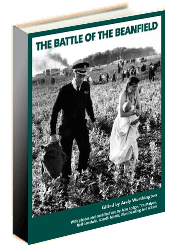
You’re also welcome to buy my books ‘The Battle of the Beanfield’ and ’Stonehenge: Celebration and Subversion’, both still in print and available to order from me. The latter, a counter-cultural history of Stonehenge, was published in 2004, and the former was an offshoot of that initial project, published on the 20th anniversary of the Beanfield, 20 years ago, in which I transcribed some of the interviews for ‘Operation Solstice’, and also included other interviews, excerpts from the police log, and framing chapters by myself and the publisher Alan Dearling.

After the Beanfield
The knock-on effects of the Beanfield were many. The travelling community was deeply traumatized, and, at Stonehenge itself, a military exclusion zone was imposed every summer solstice for the next 15 years, which was only finally defeated by a Law Lords ruling in 1999. This, ironically, has allowed the public access to Stonehenge on the summer solstice ever since, via what is mundanely described as ‘Managed Open Access.’
Above all, the Beanfield led to draconian changes to the laws governing Gypsies and travellers, our ability to gather freely without prior consent, and our ability to protest, which have cumulatively increased in severity over the last four decades, demonstrating, sadly, that increasing authoritarianism is cumulative; once imposed, draconian laws are rarely, if ever repealed.
The immediate legislative response to the Beanfield, the Public Order Act of 1986, began a process of suppressing the activities of Gypsies and travellers, and restricting our ability to gather freely, inching closer to the criminalization of trespass, which had traditionally been a civil matter, by empowering the police to arrest two or more people for trespass at scheduled monuments — aimed at Stonehenge, of course, as well as “land forming part of a highway”, and agricultural buildings. In addition, whereas, previously, damage to property had been required to permit police action, that requirement was now amended to cover the use of “threatening, abusive or insulting words or behaviour” and/or the presence of 12 or more vehicles.
Ironically, the state’s efforts to clamp down on travellers and on unlicensed gatherings was undermined by a new wave of dissent, via the arrival of a new recreational drug, ecstasy, in the UK, and the rapid mushrooming of the rave scene, which involved colossal unlicensed events across the country, and which soon drew in the survivors of the free festival movement.
In addition, with free movement suppressed, other activists, reflecting the environmental concerns of the politicized traveller and festival culture, started occupying locations of natural beauty where road expansion plans were underway, rooting themselves to the land, digging and occupying tunnels, building and occupying treehouses and aerial walkways, and locking themselves on to industrial equipment.
In 1992, the last huge unlicensed gathering — akin to the last Stonehenge Free Festival — took place over the Bank Holiday weekend at Castlemorton Common in Gloucestershire, when tens of thousands of ravers, travellers, anarchists and festival-goers came together in an unparalleled mingling of the UK’s various sub-cultures and dissenters.
The state’s response was to implement even more draconian legislation — the Criminal Justice Act of 1994, which, notoriously, targeted the “repetitive beats” of the sound systems. The Act also reduced, from 12 to six, the number of vehicles required before actions against trespass could be undertaken, and, even more alarmingly, created a new offence of “trespassory assembly”, whereby the police were enabled to ban groups of 20 people or more gathering in a particular area if they feared “serious disruption to the life of the community”, even if the meeting was non-obstructive and non-violent, and “aggravated trespass”, which finally succeeded in transforming trespassing from a civil to a criminal matter.
The Act also repealed the 1968 Caravan Sites Act, removing the obligation on local authorities to provide sites for Gypsies and travellers, which was a huge and repressive backwards step towards the criminalization of the entire nomadic way of life.
21st century repression
Although resistance continued after the passing of the Criminal Justice Act, most visibly via the vast and international anti-globalization movement of the late 1990s, increasing authoritarianism largely embedded itself in western societies after the terrorist attacks of September 11, 2001, and the entrenchment of permanent fear and paranoia in political life.
In conjunction with the deliberate and increasing commodification of everything, and a surveillance culture facilitated by the rise of the internet and social media, it’s remarkable that any counter-cultural movements have managed to thrive at all in the 21st century.
Nevertheless, in 2018, a new environmental movement emerged via the activities of the Swedish teenage activist Greta Thunberg and the actions of the environmental group Extinction Rebellion, dedicated to highlighting and challenging the unparalleled threat we all face from man-made climate change.
While they succeeded in raising awareness of the unique threat posed by climate change, and Extinction Rebellion’s occupation of key sites in London in the spring of 2019 was a thrilling reminder of the potential of mass disobedience, the arrival of Covid in 2020, and the subsequent lockdowns, enabled the far-right post-Brexit Tory government, under two particularly malignant Home Secretaries, Priti Patel and Suella Braverman, to build on the draconian public order legislation enacted after the Beanfield and Castlemorton by seeking to repress all meaningful dissent in its entirety.
Via the Police, Crime, Sentencing and Courts Act of 2022, and the Public Order Act of 2023, our right to protest has been eroded to such an extent that environmental campaigners stepping into the road to slow down traffic can be immediately arrested, and many dozens of climate protestors are serving draconian prison sentences for non-violent protest.
It’s a far cry from the days when tens of thousands of people were able to gather freely, in a manner unencumbered by corporate profiteering, but while that time is now so long gone that it can seem like nothing but a dream, the current and present threat to our ability to gather at all to disrupt in any meaningful way the juggernaut of capitalism’s “business as usual”, which is killing us all, is a knock-on effect of the authoritarian clampdowns of the 1980s and the 1990s that desperately needs to be dismantled.
POSTSCRIPT: See below for my interview with Tony Gosling for his weekly show in Bristol, in which we discussed the 40th anniversary of the Beanfield, the events leading up to it, overlapping with the Miners’ Strike, and with both the miners and the travellers targeted by Margaret Thatcher as “enemies within.” We also discussed the corporate takeover of festivals, increasing authoritarianism in the decades since the Beanfield, and the current increase in people having to find alternative housing as a result of the housing crisis.
* * * * *
 Andy Worthington is a freelance investigative journalist, activist, author, photographer (of an ongoing photo-journalism project, ‘The State of London’), film-maker and singer-songwriter (the lead singer and main songwriter for the London-based band The Four Fathers, whose music is available via Bandcamp). He is the co-founder of the Close Guantánamo campaign (see the ongoing photo campaign here) and the successful We Stand With Shaker campaign of 2014-15, and the author of The Guantánamo Files: The Stories of the 774 Detainees in America’s Illegal Prison and of two other books: Stonehenge: Celebration and Subversion and The Battle of the Beanfield. He is also the co-director (with Polly Nash) of the documentary film, “Outside the Law: Stories from Guantánamo”, which you can watch on YouTube here.
In 2017, Andy became very involved in housing issues. He is the narrator of the documentary film, ‘Concrete Soldiers UK’, about the destruction of council estates, and the inspiring resistance of residents, he wrote a song ‘Grenfell’, in the aftermath of the entirely preventable fire in June 2017 that killed over 70 people, and, in 2018, he was part of the occupation of the Old Tidemill Wildlife Garden in Deptford, to try to prevent its destruction — and that of 16 structurally sound council flats next door — by Lewisham Council and Peabody.
Since 2019, Andy has become increasingly involved in environmental activism, recognizing that climate change poses an unprecedented threat to life on earth, and that the window for change — requiring a severe reduction in the emission of all greenhouse gases, and the dismantling of our suicidal global capitalist system — is rapidly shrinking, as tipping points are reached that are occurring much quicker than even pessimistic climate scientists expected. You can read his articles about the climate crisis here. He has also, since, October 2023, been sickened and appalled by Israel’s genocide in Gaza, and you can read his detailed coverage here.
To receive new articles in your inbox, please subscribe to Andy’s new Substack account, set up in November 2024, where he’ll be sending out a weekly newsletter, or his RSS feed — and he can also be found on Facebook (and here), Twitter and YouTube. Also see the six-part definitive Guantánamo prisoner list, The Complete Guantánamo Files, the definitive Guantánamo habeas list, and the full military commissions list.
Please also consider joining the Close Guantánamo campaign, and, if you appreciate Andy’s work, feel free to make a donation.










 Who's still at Guantánamo?

9 Responses
Andy Worthington says...
When I posted this on Facebook, I wrote:
Marking the 40th anniversary, today, of the Battle of the Beanfield, the largest and most violent peacetime assault on civilians in modern British history, when a convoy of of 140 vehicles, home to around 500 individuals and families, was attacked with astonishing ferocity by around 1,400 paramilitarized police drawn from six countries and the MoD, as they tried to make their way to Stonehenge to set up what would have been the 12th annual Stonehenge Free Festival.
To mark the occasion, I run through the history of the free festival movement, the year-long persecution that preceded the violence of the Beanfield, its context as part of a broader assault on Thatcher’s perceived “enemies within”, who also included the striking miners, and the ways in which new forms of dissent arose in the wake of the Beanfield, most notably via the rave scene and the road protest movement.
Nevertheless, the increasingly authoritarian laws passed after the Beanfield, and after the last major unlicensed gathering at Castlemorton in 1992, attacking the way of life of Gypsies and travellers, and severely curtailing our right to gather freely, have paved the way for recent legislation targeting environmental protestors, which is so draconian that a single campaigner stepping into the road to slow down traffic can be immediately arrested, and many dozens of climate activists are serving excessively long prison sentences for non-violent protest.
Sadly, what has been revealed in particular over the last 40 years is how increasing authoritarianism is cumulative; once imposed, draconian laws are rarely, if ever repealed.
...on June 1st, 2025 at 9:17 pm
Andy Worthington says...
Damien Morrison wrote:
Not only did the pigs beat people, destroy their homes … but kill their dogs also … c..ts.
...on June 2nd, 2025 at 10:01 am
Andy Worthington says...
And the children taken into care was another scandal, Damien. It was eye-opening at yesterday’s anniversary event in Brockley, at which Neil Goodwin showed his new edit of the 1992 documentary ‘Operation Solstice’, to see additional footage from the day, and to realize quite how much the most aggressive, tooled-up police were given free licence to be as violent as they wanted towards the “anarchists” who had enraged them throughout the previous eleven years, simply by setting up a temporary autonomous zone every June, from which they were excluded, and over which they had no power.
In the end, it’s all about domination; the establishment wants us to believe that we’re “free”, but in fact they only want the illusion of freedom behind an authoritarian framework of control that is fundamentally repressive.
...on June 2nd, 2025 at 10:02 am
Andy Worthington says...
Dez Mundie wrote:
Thatcher has a lot to answer for. Not tolerating a few unconventional friends and families celebrating an annual festival at a heritage site that all should enjoy. It was one of the most frightening things I witnessed. Until then, I always assumed coppers’ truncheons were rubber, but it was like solid steel coshes raining down on people’s skulls. I saw blood all the way up one copper’s sleeve. I was almost physically sick.
Then, afterwards, the stones fenced off like a US military base for decades. What were the authorities on?
No hippies, no miners, no travellers, no AIDS patients, everyone who wasn’t a yuppie or a homeowner was the enemy within.
That era was completely batshit.
...on June 2nd, 2025 at 8:41 pm
Andy Worthington says...
Thanks so much for that powerful appraisal, Dez, both of the festival itself, and what it meant to those who went to it, and of the extraordinary violence used to suppress it. There was such vile black propaganda from the government and the gutter press portraying the travellers as a menace, even though it bore no resemblance to reality, as those of us who attended the festival remember to this day.
...on June 2nd, 2025 at 8:41 pm
Andy Worthington says...
Jud Relf wrote:
And, Dez, she listed environmentalists too in her “enemy within” speech.
...on June 2nd, 2025 at 8:42 pm
Andy Worthington says...
What a vile individual she was, Jud. “Enemies within.” What a monster.
...on June 2nd, 2025 at 8:42 pm
Musk Humiliates Trump To Create Good Impression at Next Week’s Stockholm Bilderberg Conference – NOT The BCfm Politics Show presented by Tony Gosling – NOT The BCfm Politics Show says...
[…] Andy Worthington on 40 years after the Battle of the Beanfield. Thatcher’s Britain, Miner’s strike, cruise missiles. Repression and Resistance: 40 Years from the Brutal Police Violence at the Battle of the Beanfield to the Suppression of Environmental Protest Today is the 40th anniversary of the largest and most violent peacetime assault on civilians in modern British history, when a convoy of 140 vehicles, home to around 500 individuals and families, was attacked with astonishing ferocity by around 1,400 paramilitarized police drawn from six countries and the MoD, as they tried to make their way to Stonehenge to set up what would have been the 12th annual Stonehenge Free Festival. The festival culture of which Stonehenge was a part was largely influenced by counter-cultural ideas… […]
...on June 8th, 2025 at 11:42 pm
Andy Worthington says...
BBC Wiltshire marked the 40th anniversary of the Battle of the Beanfield with an hour-long audio documentary, and an accompanying article, both available here: https://www.bbc.co.uk/news/articles/c780ve9nde0o
...on June 11th, 2025 at 6:16 pm