Earth Day at 56: Extinction Beckons
22.4.26
Please click on either of the ‘Donate’ or ‘Buy’ buttons below (via PayPal or Stripe) to make a donation towards the $2,500 (£2,000) I’m trying to raise to support my work as a reader-funded investigative journalist, commentator and activist over the next three months. To get links to all my work in your inbox, please also consider taking out a free or paid subscription to my new Substack newsletter.
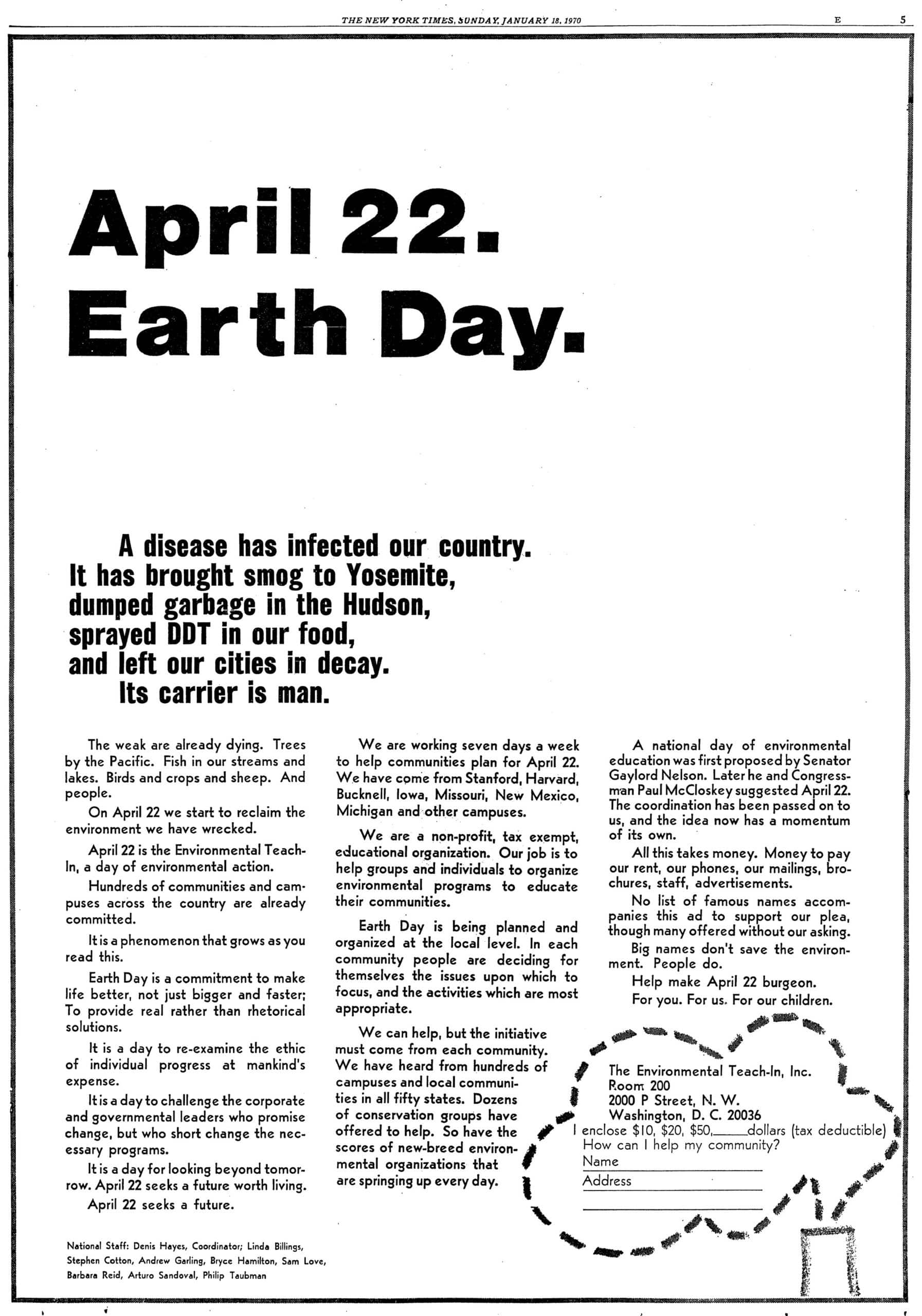
56 years ago, 20 million Americans took to the streets to mark the first Earth Day, to promote support for environmental protections, and, as it was described in a full-page promotional advert in the New York Times, to “start to reclaim the environment we have wrecked”, via “a commitment to make life better, not just bigger and faster”, and to “provide real rather than rhetorical solutions.”
In large letters, the ad proclaimed, boldly, “A disease has infected our country. It has brought smog to Yosemite, dumped garbage in the Hudson, sprayed DDT in our food, and left our cities in decay. Its carrier is man.”
The name, and the promotional messages, came via the legendary advertising copywriter Julian Koenig, whose campaign for Volkswagen, “Think Small,” was later cited by Advertising Age as the “greatest advertising campaign of the 20th century.”
The campaign was led by the activist Denis Hayes, hired by US Senator Gaylord Nelson, an ardent conservationist who had long been looking for ways to raise environmental awareness as a political issue. Inspired by the success of Rachel Carson’s 1962 book, Silent Spring, about the environmental catastrophe of DDT, by the extraordinary power of the 1968 NASA photo showing the earth from the moon, and by huge coverage for recent man-made environmental disasters in the US, particularly a huge oil spill off Santa Barbara in California, Nelson concluded that the time was ripe for an environmental initiative, proposing a nationwide environmental teach-in, which, on the day, included a vast number of rallies and marches across the country.
For decades now, Earth Day has been an international event, joining a calendar of annual events that are worthwhile — in this case, enabling children’s education and events, tree-planting and environmental clean-up campaigns — but that fundamentally lack the drive for radical revolutionary change that animated the first Earth Day, which led to the passage of laws to protect the environment and the humans dependent on it — the Clean Water Act, the Endangered Species Act and the establishment of the Environmental Protection Agency — and helped to precipitate the creation of environmental organizations like Greenpeace and Friends of the Earth.
It was also, clearly, part of a powerful counter-cultural current in the US and other western countries at the time.
The 1980s: the last gasp of mass dissent, as neoliberalism took over
I grew up in the embers of this counter-cultural decade, as it was usurped by authoritarian “free market” evangelists — Margaret Thatcher and Ronald Reagan — with an emphasis on “order” and “traditional family values” after the disruptive iconoclasm of the 1970s.
Even so, dissent was still powerful. In the early 1980s, the threat of nuclear war between the US and the Soviet Union was palpable, focusing an entire generation on both the horrors of war, via nuclear annihilation, and what would also have been its deadly environmental impact.
Perhaps it was the fall of the Berlin Wall and the end of Cold War in 1989 that brought this fever pitch of existential dread to an end, or perhaps it was the creeping success of the new world order, as the west celebrated its “victory” over “socialism”, elevating the notion of the supremacy of the individual, and of individual entitlement, as, behind the scenes, the puppet-masters consolidated a commitment to financial deregulation and the unfettered expansion of extractive capitalism.
Whatever the exact reason, by the 1990s the dissent of earlier decades had largely been defused, even though the starkest demonstration to date of the perils of man-made climate change had been made in a presentation to Congress by NASA scientist James Hansen in 1988.
Revolutionary change slipped off the agenda, even as the UN began working to bring the governments of the world together via the establishment of the Intergovernmental Panel on Climate Change (IPCC) and the convening of annual summits to try to create binding rules on reducing greenhouse gas emissions to ensure a liveable future for humanity in a still ever-warming world.
The resurgence of climate protest in 2018 and 2019
Although the world’s only global forum for tackling climate change crawled slowly towards consensus — the Kyoto Protocol of 1997, which set supposedly legally binding targets for developed countries to reduce greenhouse gas emissions, and the Paris Agreement of 2015, which set supposedly legally binding aims to limit global warming to well below 2°C, and preferably to 1.5°C, compared to pre-industrial levels — movement was so slow that, by 2018, climate scientists, who had, by now, been sounding the alarm for 30 years, were close to despair.
In September 2018, the IPCC issued its starkest warning to date, declaring that we had just 12 years left, until 2030, to halve our emissions to prevent the advent of a climate tipping point — an increase of 1.5°C in the global temperature since the start of the industrial era — beyond which ever-increasing climate chaos was guaranteed.
The announcement coincided with the creation of two campaigning groups that finally managed to galvanize public opinion to recognize the severity of the crisis, and that nudged governments to declare “climate emergencies.”
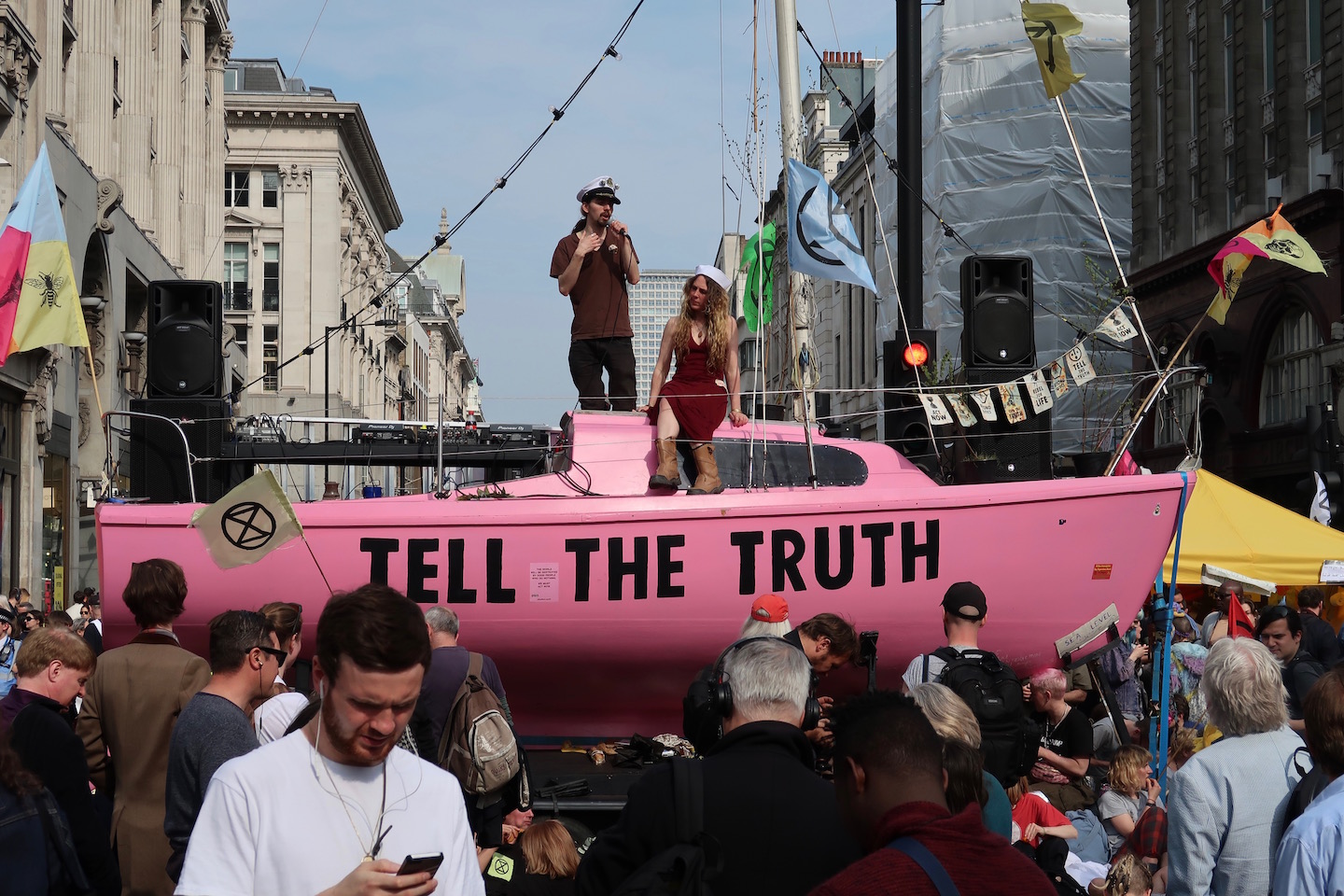
These groups were Extinction Rebellion (XR), who regularly brought London to a standstill via colourful, theatrical efforts to get politicians and the media to “tell the truth” about the extent of the climate crisis, and the School Strike for Climate movement started by the Swedish teenager Greta Thunberg.
Throughout this period, I was galvanized by XR’s efforts, regularly taking part in and photographing their protests, and hoping — because hope is the only viable antidote to despair — that the crucial changes needed, and foreseen since the 1970s, might actually come to pass.
Covid and the subsequent derangement of world leaders
In 2020, however, all of the progress that was being made was derailed by the arrival of the Covid pandemic, and the lockdowns that suppressed all public gatherings — as well as almost all meaningful human interaction.
As the world began to ease out of the lockdowns in 2021, it slowly became apparent that the fossil fuel industry, far from accepting defeat, had regrouped, and was pressurizing governments to respond not by reducing emissions, but by targeting environmental protestors with punitive laws designed to prevent protest, and to imprison frontline climate activists.
It was, I believe, part of a general derangement throughout the political leadership of the west, which I can only attribute to a crisis of confidence in their ludicrous faith in neoliberalism as having ushered in the most bountiful phase of economic success, wealth, cleverness and comfort in human history, and also to the nagging knowledge, which they were determined to extinguish, that climate collapse was all too real, and that it threatened humanity’s future like never before.
The two were intimately connected, because it was, of course, the ever more frenzied appetite of extractive neoliberal capitalism that was killing us, and that had been exposed as reality wobbled under the strains of the Covid lockdowns.
The response, as I first pointed out here, and expanded on in a second article here, was to retreat into a regressive form of denial, resurrecting a primitive urge to lash out when confronted by problems of our own making, which, throughout human history, has all too often meant a descent into war as a violent and gratifying response that drowns out all other concerns.
The first bogeyman required for this recidivist transformation emerged as Russia invaded Ukraine in February 2022. Ignoring all nuance and context relating to the conflict, involving, in particular, the steady encroachment of NATO and the 2014 coup, the west collectively seized on Vladimir Putin as the personification of evil.
Excruciatingly, western leaders did the same again in October 2023, this time with Hamas, when the armed wing of Palestinian resistance in the Gaza Strip, along with other armed factions, broke out of the “open-air prison” of Gaza — a noose that Israel had kept in place for 16 years — and engaged in a day of violent reprisals against 75 years of relentlessly predatory settler colonialism.
As Hamas became the second personification of evil in the doomed third decade of the 21st century, western leaders queued up to endorse Israel’s declared “right to defend itself”, maintaining their “ironclad” support, even as Israel demonstrated that, for them, self-defense meant nothing less than the genocide of the long-oppressed Palestinian people.
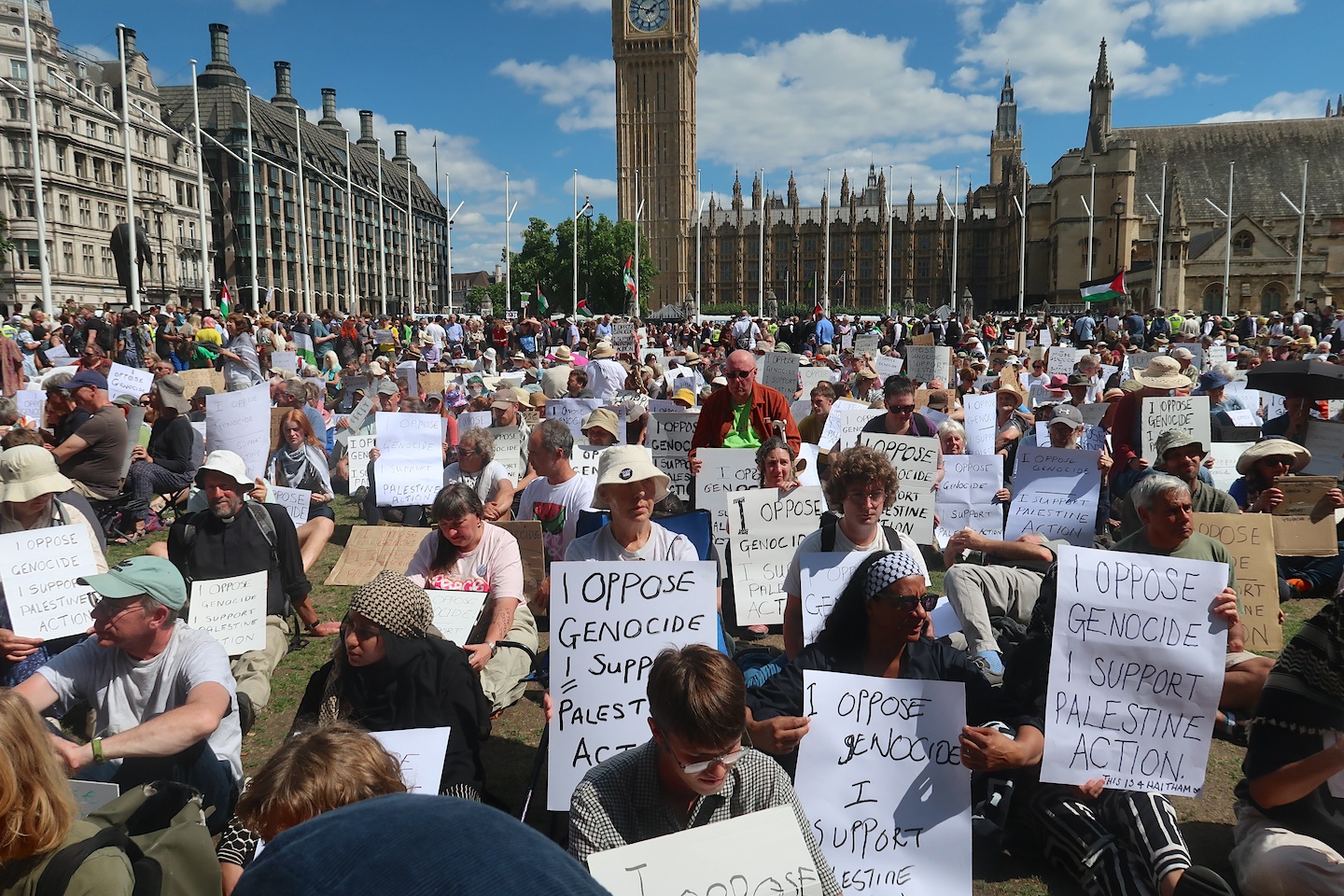
As this sickening and unjustifiable pursuit of endless war has played out, not only has it destroyed all notions of international humanitarian law, and of any idea of proportionality in wartime; it has also required even more draconian assaults on the right to protest in the west, or even to speak out — or even to silently hold handmade placards — opposing a genocide.
The unprecedented perils of AI-driven warfare, surveillance and control
Furthermore, the west’s deranged leaders are now embracing AI (artificial intelligence), not only to to horrifically redefine the parameters of warfare, but also as a means to secure the compete surveillance and control of their populations, who they increasingly regard with suspicion and even contempt.
While those driving the AI “revolution” suggest that it is the next frontier for humanity, they are unable to actually explain how any of these developments are beneficial to human beings, and for good reason, because, fundamentally, there are very few tangible benefits, as is apparent when AI’s cheerleaders openly celebrate the new technology’s promise to make vast numbers of people unemployed, without any thought for what these surplus humans might to do without jobs in a capitalist system.
Even more chilling, however, are the new technology’s darker aims. With a handful of exceptions, AI’s tech bro leaders — various disturbed, sociopathic misfits and nerds — are fundamentally anti-human, enthusiastically embedding themselves into governments worldwide, and being paid to collate and process information on everyone and everything, to redefine warfare through super-fast military targeting without any human oversight, and, as I noted above, to establish programs of surveillance and control that imperil civilian populations everywhere.
I’ve recently covered in depth the dangers of AI-driven military targeting, as used in Gaza, which demonstrated, unerringly, how the systems used tend to be overbroad in their scope, making it appallingly easy to target vast numbers of people who don’t pose any threat, and how mistakes are rife, as was also seen in the US’s mistaken targeting of a girls’ school in Iran on the first day of the “war”, which was misidentified by the AI system largely developed by the frankly evil company Palantir.
On surveillance and control, meanwhile, our governments are determined to control our lives through digital ID, which will enable anyone regarded as “dissenting” to be cut off entirely from the bureaucratic machinery of modern existence, or to be targeted for imprisonment or even, as Gaza has shown, for eventual elimination. The power to have our every move monitored and then fed through systems that look for compliance or dissent shouldn’t be in the hands of anyone, and especially not governments that, to be frank, no longer represent us, and tend to see us all as a potential threat.
Can the Trump-made energy crisis, via his war on Iran, effect the change we need?
The only good news is that, ironically, the promise offered by AI-driven military targeting has, inadvertently, via Donald Trump’s deranged decision to allow himself to be talked into an illegal and unprovoked war on Iran by Benjamin Netanyahu, precipitated an unforeseen crisis that may yet offer us a way out of our otherwise incessant hurtling towards a fossil fuel-powered apocalypse.
Underestimating Iran’s long planning, and its capacity to resist US and Israeli attacks, the aggressors were taken by surprise when, despite the AI-targeted assassinations of Ayatollah Khameini, Iran’s Supreme Leader, and other senior officials, Iranian society didn’t collapse, and, instead, its surviving leaders took out the US’s defensive capabilities in the region, and targeted oil and gas facilities in Gulf countries allied with the US — to expose the lie that the US could protect them, and also to expose how the US’s only real allegiance is to Israel.
The Iranians also cut off the world’s vital supply of oil and gas supplies through the Strait of Hormuz, precipitating an energy crisis that, as befits the hubris of both the US and Israel, will be considerably more devastating than previous crises in 1973, 1979 and 2022.
The mainstream media’s gatekeepers have tried to play down the impact of the crisis, revelling, as in their coverage of climate collapse, in their supposed power and “responsibility” to prevent “panic” in their audiences, who they treat as both stupid and unreliable.
As with climate collapse, however, their influence is monstrously and unacceptably counter-productive. Neither climate collapse nor the coming energy crisis can be ducked or wished away. Refusing to deal with them isn’t brave; it’s actually devastatingly irresponsible. The longer they delay in “telling the truth”, in XR’s words, the worse will be the reckoning when the inevitable disasters emerge.
As genuine experts have already established, the crisis caused by Trump’s reckless actions doesn’t just affect oil and gas supplies; it also affects the supplies of other hugely significant elements (helium, for example, a finite resource, which cannot be synthesised, and which is crucial for the semiconductor manufacturing that powers the entire modern world), and the wealth of by-products of the petro-chemical industry on which global civilization depends; most notably, sulphur, urea and ammonia, on which fertilizer production depends, although a full list of products for which fossil fuels are required would run for many pages.
While I wouldn’t want, in any way, to downplay the amount of suffering that lies ahead, even if Donald Trump holds off from further action against Iran, one useful outcome of this Trump-made disaster is that people are finally waking up to the extent of their dependence on fossil fuels, and to a recognition that, in volatile times, the massive expansion of renewable energy sources is, definitively, a sensible alternative.
I also hope that the coming restrictions on the supply of energy and materials might bring to an end the remorseless expansion of AI data centers, which are, without a doubt, capitalism’s latest environmentally catastrophic horror show, using huge amounts of energy, draining precious water supplies and poisoning communities for no discernibly useful reason.
In conclusion, I can only hope that this unprovoked crisis derails the otherwise inexorable expansion of the AI industry, with its triple threats of automated genocide, complete surveillance and complete control, because otherwise the anti-human monsters in charge will have to have their plans derailed by we, the humans, at whom all of his malevolence is targeted.
And as we know all too well, looking back over the last 56 years since the promise of that first Earth Day, we have, especially over the last 40 years, been steadily shepherded into self-imprisoning compliance with our own diminished futures, seduced by trinkets, pointless distractions and meaningless assertions of self-worth, and apparently unable to muster the required commitment to take down, by sheer numbers, the tiny number of our fellow humans who, fundamentally, despise our very existence.
* * * * *
 Andy Worthington is a freelance investigative journalist, activist, author, photographer (of a photo-journalism project, ‘The State of London’, which ran from 2012 to 2023), film-maker and singer-songwriter (the lead singer and main songwriter for the London-based band The Four Fathers, whose music is available via Bandcamp). He is the co-founder of the Close Guantánamo campaign (see the ongoing photo campaign here) and the successful We Stand With Shaker campaign of 2014-15, and the author of The Guantánamo Files: The Stories of the 774 Detainees in America’s Illegal Prison and of two other books: Stonehenge: Celebration and Subversion and The Battle of the Beanfield. He is also the co-director (with Polly Nash) of the documentary film, “Outside the Law: Stories from Guantánamo”, which you can watch on YouTube here.
In 2017, Andy became very involved in housing issues. He is the narrator of the documentary film, ‘Concrete Soldiers UK’, about the destruction of council estates, and the inspiring resistance of residents, he wrote a song ‘Grenfell’, in the aftermath of the entirely preventable fire in June 2017 that killed over 70 people, and, in 2018, he was part of the occupation of the Old Tidemill Wildlife Garden in Deptford, to try to prevent its destruction — and that of 16 structurally sound council flats next door — by Lewisham Council and Peabody.
Since 2019, Andy has become increasingly involved in environmental activism, recognizing that climate change poses an unprecedented threat to life on earth, and that the window for change — requiring a severe reduction in the emission of all greenhouse gases, and the dismantling of our suicidal global capitalist system — is rapidly shrinking, as tipping points are reached that are occurring much quicker than even pessimistic climate scientists expected. You can read his articles about the climate crisis here. He has also, since, October 2023, been sickened and appalled by Israel’s genocide in Gaza, and you can read his detailed coverage here.
To receive new articles in your inbox, please subscribe to Andy’s new Substack account, set up in November 2024, where he’ll be sending out a weekly newsletter, or his RSS feed — and he can also be found on Facebook (and here), Twitter and YouTube. Also see the six-part definitive Guantánamo prisoner list, The Complete Guantánamo Files, the definitive Guantánamo habeas list, and the full military commissions list.
Please also consider joining the Close Guantánamo campaign, and, if you appreciate Andy’s work, feel free to make a donation via PayPal or via Stripe.











 Who's still at Guantánamo?


8 Responses
Andy Worthington says...
When I posted this on Facebook, I wrote:
Marking Earth Day, which began 56 years ago today, on April 22, 1970, I reflect on the visionary drive of that first event, when 20 million Americans took to the streets to call for the establishment of environmental protections, and how, under neoliberalism and the cult of the individual, the counter-cultural power of the 1970s and ‘80s started to dwindle from the 1990s onwards, even as the realities of man-made climate change were confirmed, and efforts began to get the countries of the world to agree on reducing greenhouse gas emissions.
By 2018, when meaningful change was still elusive, Extinction Rebellion and Greta Thunberg managed to galvanize public opinion to recognize the severity of the crisis, although their impetus was lost when the Covid pandemic and its attendant lockdowns took place.
Afterwards, I suggest, there was a widespread derangement amongst western leaders, who were unable to accept the threat to the neoliberal order that was glimpsed during Covid, and who were also haunted by the reality of climate collapse, and who responded, as I describe it, by “retreat[ing] into a regressive form of denial, resurrecting a primitive urge to lash out when confronted by problems of our own making, which, throughout human history, has all too often meant a descent into war as a violent and gratifying response that drowns out all other concerns.”
When Russia invaded Ukraine in February 2022, this led to Vladimir Putin being defined by western leaders as the personification of evil, and, excruciatingly, they did the same again in October 2023, this time with Hamas.
Simultaneously, following on from the passage of laws to suppress dissent following the actions of climate activists, these same leaders passed even more punitive laws to criminalize those who were opposing Israel’s genocide in Gaza, and are now working with AI companies, who are horrifically redefining warfare through AI-driven military targeting, and are also working to implement the surveillance and control of entire populations.
The best hope, right now, is that a huge energy crisis, precipitated by the illegal and unprovoked US-Israeli war on Iran, may, inadvertently, push the world into moving away from fossil fuels for renewables, as its unintended impacts may also disrupt the planned expansion of the deadly AI industry and other manifestations of the broken, extractive neoliberal capitalist system that will, otherwise, kill us all.
...on April 22nd, 2026 at 10:37 pm
Andy Worthington says...
If you want to support my work, please join me on Substack to get links to everything I write in your inbox. Free or paid subscriptions are available, although the latter ($8/month or $2/week) are absolutely essential for a reader-funded writer like myself, and if you can help out at all it will be very greatly appreciated.
Here’s my new post, promoting the article above: https://andyworthington.substack.com/p/earth-day-at-56-extinction-beckons
...on April 22nd, 2026 at 10:38 pm
Andy Worthington says...
Johnny Linehan wrote:
·
Shared – Cheers.
...on April 24th, 2026 at 8:23 pm
Andy Worthington says...
Thanks so much, Johnny. Good to hear from you.
...on April 24th, 2026 at 8:23 pm
Andy Worthington says...
Johnny Linehan wrote:
·
Andy, this is how I described it when I shared:
The 56th Earth Day after its start in 1970
What have we achieved? What must we do?
...on April 24th, 2026 at 8:24 pm
Andy Worthington says...
I wish I had an answer, Johnny. I’m constantly reeling from the fact that, although we still very evidently have aspects of a survival instinct, without which we would never have survived as long as we have, we’ve mostly become so abstracted that most people genuinely can’t grasp the enormous inescapable reality of the suicidal culture we’re part of. There is no bigger story in the whole of human history, and yet we’re impotent.
As I’ve feared for years, I suspect people may only mobilize when collapse is already happening, and at that point I really wouldn’t want to trust those who denied it, or whose sense of entitlement is such that they won’t be able to suddenly discover the lost contours of human solidarity.
...on April 24th, 2026 at 8:24 pm
Andy Worthington says...
Johnny Linehan wrote:
·
Andy, the problems are long term and those dealing with it are short term. At least when leaders were influenced by print headlines, they were on a 24 cycle.
Now with the Internet and 24 hour news, they decide within a minute and then spend the rest of the time finding someone else to blame for their hasty decision.
It’s a kind of insanity.
...on April 27th, 2026 at 12:57 pm
Andy Worthington says...
That’s a succinct and accurate analysis of how the news cycle and political leaders’ priorities work these days, Johnny. Thanks.
...on April 27th, 2026 at 12:58 pm