Repression and Resistance: 40 Years from the Brutal Police Violence at the Battle of the Beanfield to the Suppression of Environmental Protest

Please support my work as a reader-funded investigative journalist, commentator and activist. If you can help, please click on the button below to donate via PayPal. To get links to all my work in your inbox, please also consider taking out a free or paid subscription to my new Substack newsletter.
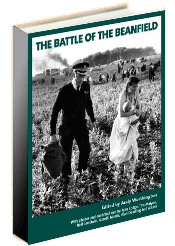
Today is the 40th anniversary of the largest and most violent peacetime assault on civilians in modern British history, when a convoy of 140 vehicles, home to around 500 individuals and families, was attacked with astonishing ferocity by around 1,400 paramilitarized police drawn from six countries and the MoD, as they tried to make their way to Stonehenge to set up what would have been the 12th annual Stonehenge Free Festival.
The festival culture of which Stonehenge was a part was largely influenced by counter-cultural ideas that had drifted across the water from the US in the late 1960s, via the hippie gatherings at Woodstock and elsewhere.
Their most famous British manifestation — the Glastonbury Festival — is still in existence today, confirming the power of the appeal of holding hedonistic music festivals outdoors that, over 50 years ago, had first been introduced by a bunch of visionary hippies, although its format today, like that of the many imitators it has spawned, is now largely dominated by the capitalistic forces that have devoured almost every aspect of the anti-materialistic impulses of its early pioneers.
Glastonbury wasn’t a free festival, as such, as it was run by Michael Eavis, once memorably described as “a Somerset farmer with crowd-gathering tendencies”, but key players in the free festival movement were intrinsically tied into its development in those years, as they and others pursued their vision of hedonistic pastoral egalitarianism.










 Who's still at Guantánamo?
