Israel Begrudgingly Re-Opens the Rafah Crossing, But With Onerous Restrictions on Palestinians’ Entry and Departure
5.2.26

Please click on either of the ‘Donate’ or ‘Buy’ buttons below (via PayPal or Stripe) to make a donation towards the $2,500 (£2,000) I’m trying to raise to support my work as a reader-funded investigative journalist, commentator and activist over the next three months. To get links to all my work in your inbox, please also consider taking out a free or paid subscription to my new Substack newsletter.
The re-opening, this week, of the Rafah Crossing, connecting the Gaza Strip to Egypt, and the only route in and out of Gaza that doesn’t pass through Israeli territory, was meant to provide a lifeline of hope for the estimated 20,000 medical patients in Gaza who need treatment abroad (including around 4,000 children, and about 440 critical cases in need of immediate attention) as well as for the more than 30,000 Palestinians who left Gaza in the early months of Israel’s genocide, and who, as the Council on Foreign Relations explained, “have registered their intent to return.”
Predictably, however, Israel has done all it can to to turn the re-opening into yet another example of its obsessive desire to control every aspect of the sealed death camp it has created in Gaza over the last 28 months, and its equally obsessive desire to humiliate Palestinians — when not killing them directly — at every opportunity.
According to the ceasefire agreement that Israel was reluctantly obliged to accept in October as part of Donald Trump’s “Peace Plan”, the Rafah Crossing was meant to re-open in the first phase of the deal, when Israel stopped its carpet-bombing in exchange for the return of the remaining hostages seized on October 7, 2023. It was, however, “an unmet requirement” of the first phase, as CPR described it, because Israel “delayed the reopening until it recovered the final hostage body from Gaza, which occurred last week.”
As the preparations for the re-opening began, the Israeli authorities indicated that, on a daily basis, 50 medical patients, each accompanied by two companions, would be allowed out, and 50 others would be allowed to return.
On both sides of the border, those seeking to leave or return had gone through a strict process of registration and screening that ought to have ensured that the process ran smoothly, but, in the end, just five medical patients and seven companions were allowed to leave Gaza on Monday, and just 12 women and children were allowed to return. No explanation was provided for why coaches containing the other 38 Palestinians were turned back, nor why so few medical patients were allowed to leave. Regarding the medical patients, the UN reported that 27 names were submitted, but 22 of them were turned down, again without explanation.
On Tuesday, the number increased slightly, with 16 patients and 40 companions crossing into Egypt, and, according to some reports, 40 others allowed to return, but as Palestinian Red Crescent spokesperson Raed al-Nims told the Associated Press, the number of patients allowed to leave “was far less than the 45 patients and wounded the Red Crescent was told would be allowed into Egypt, along with 90 relatives.”
25 more Palestinians returned on Wednesday, while 13 more patients, accompanied by family members and World Health Organization officials, left for Egypt, after Israel had initially suggested that it was suspending departures, claiming that the WHO, which is responsible for coordinating the arrival of residents from the Gaza Strip to the Rafah Crossing, had not submitted “the required coordination details at this stage for procedural reasons.”
Abuse and intimidation
Moreover, the women returning to Gaza from Egypt reported a distressing catalog of abuse. In a summary, the Palestine Chronicle explained that they “describe[d] hours-long interrogations at Israeli-controlled checkpoints inside and around the crossing”, and that “several women reported being blindfolded, having their hands bound, and being questioned for hours about political affiliations, family members, and events related to October 7.”
Others said that their interrogators “raised the issue of ‘migration’, pressing them on whether they intended to leave Gaza permanently”, with some adding that they “were threatened with denial of future crossings or separation from their children if they refused to cooperate.”
One woman called the experience “psychological torture”, with the news report describing how “the message was unmistakable: return to Gaza would come at a cost.”
Noticeably, the women returning to Gaza also highlighted how, when they had passed through the checkpoint managed by Palestinian and EU observers, and were delivered into part of the 58% of Gaza that is controlled by the Israelis, prior to being allowed to proceed to the 42% still controlled by Hamas, a key role was played by members of the Abu Shabab gang, Palestinian criminals and terrorists working for the Israelis, who “operated near Israeli-controlled checkpoints, escorting buses, managing transfers between locations, and participating in the handover of Palestinians to Israeli forces for interrogation.”
Several of the women returning to Gaza said they were “removed from buses” by the group’s members, and “delivered to Israeli soldiers, who then conducted questioning lasting several hours.” They described the presence of gang members as “coercive and intimidating.”
Even the BBC, normally wary of criticizing Israel, noted the presence of members of the gang, which, they stated, was now calling itself “the Popular Forces.” One of the returnees, Lamia Rabia, who was travelling with her children, said that after they were escorted by Israeli forces from the border to a nearby checkpoint, “There was a woman from the Abu Shabab group who conducted the searches on the women.”
Another woman, who did not want to be named, told the BBC that the group had “told her they would help her travel to Europe if she co-operated.” She also said that “she was mistreated by the militia, alleging that she was beaten and strip-searched along with three other women, and that they had been handcuffed and verbally abused.”
Further claims of coercion were made by Sabah al-Raqab, who returned with her five daughters. As Al Jazeera reported, “Two Israeli interrogators, fluent in Arabic, offered her a choice between leaving Gaza again or providing intelligence to the army.” She said that they told her, “We need you to be our eyes and ears”, and that the coercion only came to an end when EU monitors intervened.
The BBC added that, because of the allegations of abuse, the EU monitors were “reportedly considering whether to escort new arrivals to the Israeli checkpoint”, after what it described as the “reports of harsh treatment there.”
Those returning to Gaza also reported that the Israeli forces “confiscated personal belongings, including food, hygiene items, perfumes, medicines, and children’s toys”, with each person only “allowed only one small bag of clothing.”
One mother recounted how soldiers “forcibly took her child’s toy, telling the child it was ‘forbidden’”, and described the moment as “one of the most painful she had endured, saying it broke the child’s heart after months of displacement and illness.”
On X, Alaa from Gaza, a writer, teacher and mother who crossed into Egypt in the early days of the genocide, when the Rafah Crossing was still open, posted a photo of a sign spelling out the rules for those returning to Gaza — information that had evidently not been conveyed to those coming home.
Posting a photo of a sign in Arabic, she provided the following translation:
Each person is allowed to enter with one personal bag containing clothes and personal documents only. Each person may bring in cash up to 2,000 shekels (around $640), provided a permit is submitted 24 hours in advance. Liquids are not allowed, including water, deodorant, creams, and similar items. Only one mobile phone per person is allowed. No other electrical or electronic devices are permitted. Cigarettes are not allowed.
No explanation has been provided for why Israel should so cruelly prevent those returning to Gaza from bringing in anything beyond one bag of clothes and a mobile phone, but it is evidently part of what the Palestine Chronicle described as the crossing “now function[ing] less as a humanitarian lifeline and more as an extension of Israel’s siege architecture — combining surveillance, interrogation, proxy enforcement, and exclusion.”
As one of the returning women said, “They don’t want us to come back. They want Gaza emptied of its people.”

Why the Rafah Crossing is so important, and how Israel has used it as part of its genocidal intent
In an article for Middle East Monitor, Tamer Ajrami, a student of political science living in Belgium, asked, “Why is the Rafah Crossing no longer a gateway?”, stating, “It is no longer a border crossing. It now works like a security checkpoint; the same kind Palestinians face every day in the occupied West Bank.”
He added, “Rafah did not always function this way. It was Gaza’s only door to the outside world. Patients used it to reach hospitals. Students used it to study. Families used it to reunite.”
That may slightly romanticize the long decades of conflict between Israel, Egypt and the Palestinians regarding the crossing, which was particularly fraught after Hamas took control in Gaza in 2007, and Israel turned the whole of Gaza into a “open-air prison.”
However, even after Israel’s genocide began, the crossing remained open, and Israel only seized it and closed it on May 7, 2024, as a prelude to their hideous destruction of the whole of the city of Rafah, when they claimed that it was being used for “terrorist purposes.”
That, however, was a lie, because what their actions were clearly intended to do was to ruthlessly cut off Gaza from the outside world, turning what had long been an “open-air prison” into a sealed death camp.
No other explanation was possible. Throughout its nearly 28-month long genocide in Gaza, Israel has long maintained that it wants to encourage “voluntary migration” from Gaza to other countries, ignoring the reality that no country anywhere on earth wants to be seen to play a role in mass ethnic cleansing or forced displacement.
Until its closure, the Rafah Crossing was the only means whereby Palestinians in Gaza could avail themselves of the opportunity for “voluntary migration.” An estimated 100,000 Palestinians — mostly those who could afford to pay extortionate fees to organized Egyptian people-smugglers — left Gaza for Egypt in the first seven months of the genocide, including several thousand medical patients.
However, many of those who left “have been unable to obtain temporary residency permits that would allow their children to attend Egyptian public schools, work, or open bank accounts”, as Shahad Ali, an English literature student and writer from Gaza, explained in an article for Truthout on January 14.
After the crossing was seized and closed, the numbers of those managing to leave Gaza in any way — either as “voluntary migrants” or as medical patients — dwindled to almost nothing, with only a brief reprieve for the evacuation of medical patients during the previous ceasefire deal, in January 2025, which was violently broken by Israel in March.
As the Associated Press reported on February 3, “More than 10,000 patients have been evacuated from Gaza since the war began, according to the World Health Organization. But Israel’s seizure of the Rafah crossing brought the pace of evacuations to a crawl, with an average of 17 patients a week leaving for most of the time since.”
The closing of the crossing also enabled Israel to maintain its barbaric siege on all humanitarian aid deliveries into Gaza — a hallmark of its persistent genocidal intent as much as its generally relentless carpet-bombing of civilians — as well as ruthlessly ensuring that no Palestinians could return to their homeland.
So what now?
This is the prohibition that Israel has now been forced to drop, however much it is working to lessen the impact of the crossing’s re-opening. As a result, it is at least worth celebrating what, for Israel, is a symbolic defeat, although that will mean very little unless it can be persuaded, or obliged to lift its restrictions.
As the UN reported on February 2, after medical patients hoping to leave Gaza had gathered with their families in the courtyard of Al-Amal Hospital in the south of the Gaza Strip, “dozens of injured Palestinians staged a demonstration, sitting in their wheelchairs and demanding an increase in the number of people allowed to travel daily which ‘should be in the hundreds’ instead of 50.”
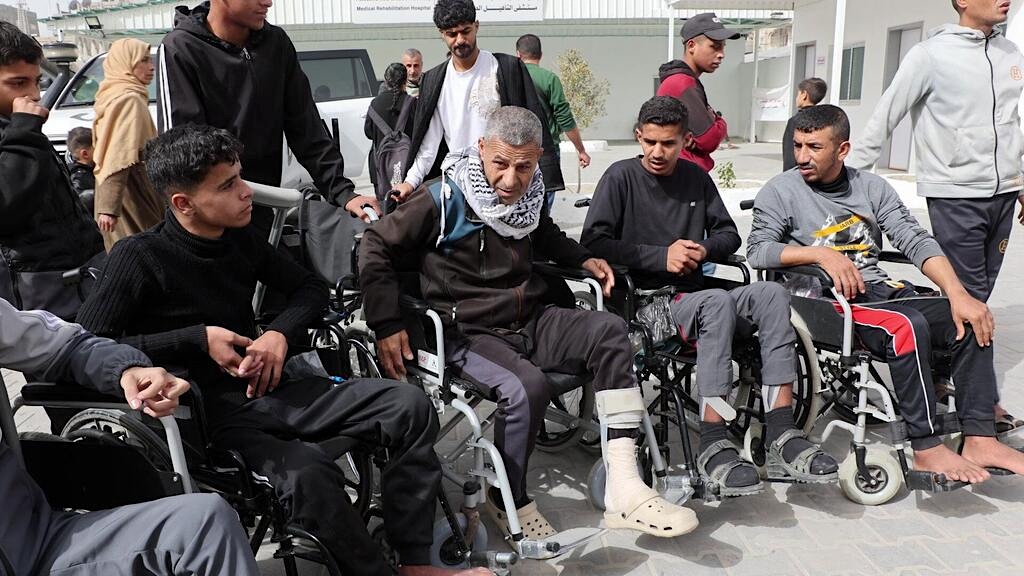
However, with 20,000 people in need of medical treatment that cannot be provided in Gaza — almost entirely through Israel’s deliberate destruction of its hospitals and its healthcare sector, and its ongoing refusal to allow in adequate medical supplies, medical equipment, and materials for reconstruction — it would take two years, at 200 departures a day, for everyone to get the treatment they require.
Similarly, for those who have registered their interest to return, even 200 returns a day would take three years for everyone who wishes to return to come home.
However, it seems unlikely that Israel will change its behavior without external pressure, and for that, unfortunately, the most likely candidate, Donald Trump, has repeatedly demonstrated that he is unwilling to act.
Three times now — following detailed negotiations behind the scenes by US envoys, Qatar and Egypt, liaising with both Israel and Hamas and other Palestinian militant factions — Trump has pressurized Israel to change its behavior — last January, when he pushed for a ceasefire deal as he took office; last October, when he announced his “Peace Plan” and secured a longer-lasting ceasefire (despite Israel’s repeated refusals to honor its terms); and just two weeks ago, in Davos, when he launched his “Board of Peace”, allegedly to oversee an enduring peace in Gaza.
Each time, however, he has moved on, after milking these developments solely to promote his own deluded opinion of himself as an extraordinary peacemaker, and to secure sycophantic praise from other world leaders, and often, subsequently, undermining his own progress.
Last January, the ceasefire had barely begun before he began talking of taking over Gaza and rebuilding it as the “Riviera of the Middle East”, and also supporting the forced displacement of the Palestinian population for “humanitarian reasons”, and he did nothing when, after six weeks, Israel broke the ceasefire deal without provocation, and resumed its genocidal assault on Gaza with terrifyingly renewed and depraved vigor.
In October, when he launched his “Peace Plan”, he used it primarily to secure sycophantic praise from world leaders at a “Gaza Peace Summit” that he convened in Egypt, and last month the launch of his “Board of Peace” was followed by his son-in-law, Jared Kushner, pitching for the development of a grotesque, futuristic “New Gaza” from which the Palestinians themselves were entirely excluded.
At Davos, Trump also launched the other components of his “Peace Plan” — a specific “Economic Board” for Gaza, and a Palestinian technocratic committee, the National Committee for the Administration of Gaza (NCAG), which was supposed to be responsible for the day-to-day running of Gaza until a reformed Palestinian Authority could take over.
All of these components don’t seem to actually fit together in any credible manner, and in the meantime Israel continues, alarmingly, to behave as though any and all constraints on its behavior are unacceptable.
If there is hope, it may rest with the negotiators who have worked so hard and for so long to make peace a reality. On February 3, evidently appalled by Israel’s continuing obstructions, Majed al-Ansari, a spokesperson for the Qatari Foreign Ministry, called the re-opening of the Rafah Crossing “a positive step” but stressed, as Al Jazeera described it, that it was “completely insufficient for the tremendous needs of Gaza’s besieged population.”
“The crossing must be fully opened to allow the entry of aid, and we will not accept this being used as a tool of pressure,” al-Ansari told a press briefing in Doha.
“Preventing the passage of thousands of medical cases is a crime, and this issue must be resolved,” he added, also stating, “We are sounding the alarm regarding the severity of the humanitarian situation in Gaza, where the necessary machinery, equipment, and aid have not entered.”
Will anyone find the means to intervene, or will Israel continue to behave as though no one can ever tell it what to do? It’s a particularly burning question right now, as Israel not only exercises a vice-like grip on the Rafah Crossing, but also steps up its unconscionable bombing attacks on Palestinian civilians, killing over a hundred in unprovoked attacks over the last five days.
* * * * *
 Andy Worthington is a freelance investigative journalist, activist, author, photographer (of a photo-journalism project, ‘The State of London’, which ran from 2012 to 2023), film-maker and singer-songwriter (the lead singer and main songwriter for the London-based band The Four Fathers, whose music is available via Bandcamp). He is the co-founder of the Close Guantánamo campaign (see the ongoing photo campaign here) and the successful We Stand With Shaker campaign of 2014-15, and the author of The Guantánamo Files: The Stories of the 774 Detainees in America’s Illegal Prison and of two other books: Stonehenge: Celebration and Subversion and The Battle of the Beanfield. He is also the co-director (with Polly Nash) of the documentary film, “Outside the Law: Stories from Guantánamo”, which you can watch on YouTube here.
In 2017, Andy became very involved in housing issues. He is the narrator of the documentary film, ‘Concrete Soldiers UK’, about the destruction of council estates, and the inspiring resistance of residents, he wrote a song ‘Grenfell’, in the aftermath of the entirely preventable fire in June 2017 that killed over 70 people, and, in 2018, he was part of the occupation of the Old Tidemill Wildlife Garden in Deptford, to try to prevent its destruction — and that of 16 structurally sound council flats next door — by Lewisham Council and Peabody.
Since 2019, Andy has become increasingly involved in environmental activism, recognizing that climate change poses an unprecedented threat to life on earth, and that the window for change — requiring a severe reduction in the emission of all greenhouse gases, and the dismantling of our suicidal global capitalist system — is rapidly shrinking, as tipping points are reached that are occurring much quicker than even pessimistic climate scientists expected. You can read his articles about the climate crisis here. He has also, since, October 2023, been sickened and appalled by Israel’s genocide in Gaza, and you can read his detailed coverage here.
To receive new articles in your inbox, please subscribe to Andy’s new Substack account, set up in November 2024, where he’ll be sending out a weekly newsletter, or his RSS feed — and he can also be found on Facebook (and here), Twitter and YouTube. Also see the six-part definitive Guantánamo prisoner list, The Complete Guantánamo Files, the definitive Guantánamo habeas list, and the full military commissions list.
Please also consider joining the Close Guantánamo campaign, and, if you appreciate Andy’s work, feel free to make a donation via PayPal or via Stripe.












 Who's still at Guantánamo?

7 Responses
Andy Worthington says...
When I posted this on Facebook, I wrote:
In my new article, I examine Israel’s begrudging and belated re-opening of the Rafah Crossing between Gaza and Egypt — the only route in and out of Gaza that doesn’t pass through Israeli territory — and reflect on how, as I describe it, “Israel has done all it can to to turn the re-opening into yet another example of its obsessive desire to control every aspect of the sealed death camp it has created in Gaza over the last 28 months, and its equally obsessive desire to humiliate Palestinians — when not killing them directly — at every opportunity.”
After procrastinating for months, Israel nominally agreed to allow 50 wounded Palestinians (plus 100 companions) to leave Gaza for Egypt every day, and also to allow 50 vetted Palestinians to return from Egypt, where 100,000 Palestinians fled, generally at great expense, in the seven months of genocide until Israel closed the crossing in May 2024.
Despite Israel’s promises, however, the numbers allowed in and out of Gaza, in the first few days, have been far less than those promised, and many of the women who have been allowed to return to date have stated that they were blindfolded, subjected to abusive interrogations and urged to become informants, with Abu Shabab gang members involved as they reached Gaza.
The women also explained that everything that they brought with them was taken off them, except for one bag of clothes and a mobile phone, which was clearly unnecessary and intentionally cruel.
I also look back on the history of the crossing, and focus particularly on how its closure in May 2024 exposed Israel’s lies about encouraging “voluntary migration”, as it deliberately sealed off the only route that made that possible, confirming that what it “clearly intended to do was to ruthlessly cut off Gaza from the outside world, turning what had long been an ‘open-air prison’ into a sealed death camp.”
With Donald Trump only interested in Gaza when it serves his purpose to get world leaders together to fawn over him as a “peacemaker”, it remains to be seen if any meaningful pressure can be exerted on Israel to significantly increase the numbers of arrivals and departures, especially as it will otherwise take many years for the 20,000 people in need of medical care to leave, and for the 30,000 to come home who have registered their intent to return, but also because it is reasonable to assume that, otherwise, Israel will find any excuse it can to shut the whole process down.
...on February 5th, 2026 at 5:32 pm
Andy Worthington says...
Today, the Office of the UN Office of the High Commissioner for Human Rights posted a press release, “Patterns of ill-treatment and coercion reported among Palestinians returning to Gaza”, confirming reports received over the last three days.
The press release stated:
For the third consecutive day, Palestinians returning to Gaza through the newly reopened Rafah crossing have reported a consistent pattern of ill-treatment, abuse, and humiliation by Israeli military forces.
Palestinian returnees reported to the UN Human Rights Office in the Occupied Palestinian Territory being escorted after crossing by armed Palestinians allegedly backed by the Israeli military, to an Israeli military checkpoint. Consistent accounts indicate that some of these armed Palestinians handcuffed and blindfolded returnees, conducted searches, threatened and intimidated, and stole personal belongings and money.
Upon arrival at the Israeli checkpoint, returnees described a pattern of violence, degrading interrogations, and invasive body searches, in some cases while blindfolded and handcuffed. They also reported that soldiers denied them access to medical care when needed, and access to bathrooms, resulting in extreme humiliation, including being forced to urinate in public.
Several returnees said they were asked whether they would accept money to return to Egypt with their families and never return. Some said that they were offered money to become informants for the Israeli military.
Taken together, these accounts point to a pattern of conduct that violates Palestinians’ rights to personal security, dignity, and freedom from torture, ill-treatment, and other cruel, inhuman, or degrading treatment.
The reported pattern of conduct towards returnees raises serious concerns of coercion, discouraging Palestinians from exercising their right to return to areas they were forced to leave, further contributing to the ethnic cleansing of Gaza.
“The international community has a responsibility to ensure that all measures affecting Gaza strictly comply with international law and fully respect Palestinians’ human rights,” said Ajith Sunghay, head of the UN Human Rights Office in the OPT. “After two years of utter devastation, being able to return to their families and what remains of their homes in safety and dignity is the bare minimum.”
https://reliefweb.int/report/occupied-palestinian-territory/patterns-ill-treatment-and-coercion-reported-among-palestinians-returning-gaza
...on February 5th, 2026 at 10:30 pm
Andy Worthington says...
An update about the numbers of patients in Gaza who are in need of medical treatment abroad, according to Dr. Mohammad Abu Silmiya, the director of Al-Shifa Hospital. He says that “more than 20,000 patients in Gaza urgently need treatment abroad, including about 4,500 children, 4,500 cancer patients, over 10,000 wounded requiring complex surgeries, and around 450 critically ill cases.” He added that “more than 3,300 patients, many of them children, have died while on waiting lists due to lack of adequate care in Gaza and restrictions on travel for treatment.”
https://x.com/MosabAbuToha/status/2019526553542005199
...on February 5th, 2026 at 10:41 pm
Andy Worthington says...
Despite a ceasefire being in place in Gaza for the last four months, and despite the re-opening of the Rafah Crossing, the Israeli government and the Israeli Supreme Court maintain their implacable opposition to any foreign journalist being allowed into Gaza, relentlessly reiterating that “the entry of journalists still poses a security risk, both to the journalists themselves and to military forces.”
We know why it is, though, don’t we? It’s because Israel still hopes that no foreign journalist will ever be allowed to discover the truth: that Gaza is a genocidal crime scene beyond all imagining.
+972 Magazine report here: https://www.972mag.com/gaza-foreign-press-supreme-court/
...on February 6th, 2026 at 6:11 pm
Andy Worthington says...
And meanwhile, of course, while persistently refusing to allow any foreign journalists to have access to Gaza, Israel has been murdering almost every Palestinian journalist on the ground in Gaza. Next month, sadly, will mark the first anniversary of its brutal and unforgivable murder of Hossam Shabat, the brave 23-year old whose smile lit up the world: https://www.andyworthington.co.uk/2025/03/25/as-israel-murders-hossam-shabat-and-the-gaza-death-toll-passes-50000-did-you-know-israel-has-killed-over-500-times-more-children-than-were-killed-on-oct-7/
...on February 6th, 2026 at 6:42 pm
Andy Worthington says...
Today, February 11, the following information was released by Gaza’s Movement Media Office:
Only 102 patients left Gaza in the nine days after Rafah reopened — despite Israel saying 50 per day would be allowed.
Gaza’s Government Media Office released new figures on movement through Rafah from Feb. 2–10, 2026. Israel had said 50 patients with two companions each would exit daily (150 total departures), plus 50 daily entries — 1,800 total crossings over nine days.
Instead, just 488 people crossed, about 27% of the projected movement. Only 102 were patients. Meanwhile, roughly 20,000 people in Gaza are on the WHO-approved list for urgent medical evacuation.
📌 Daily breakdown:
➤ Feb 2: 20 departed (5 patients), 12 arrived
➤ Feb 3: 40 departed (16 patients), 26 blocked from travel, 26 arrived
➤ Feb 4: 47 departed (16 patients), 25 arrived
➤ Feb 5: 28 departed (7 patients), 25 arrived
➤ Feb 6–7: Crossing closed
➤ Feb 8: 50 departed (19 patients), 44 arrived
➤ Feb 9: 40 departed (20 patients), 40 arrived
➤ Feb 10: 50 departed (19 patients), 41 arrived
▪️ Totals:
275 departures, including 102 patients
213 arrivals
26 people turned back
https://x.com/DropSiteNews/status/2021590487224709370
...on February 11th, 2026 at 5:13 pm
Israel’s New World Order: Threat of Endless Death – Palestine Uncensored says...
[…] Israel reluctantly re-opened the Rafah Crossing with Egypt in February, it was an opportunity for senior Israeli officials to demonstrate their […]
...on May 6th, 2026 at 7:51 am