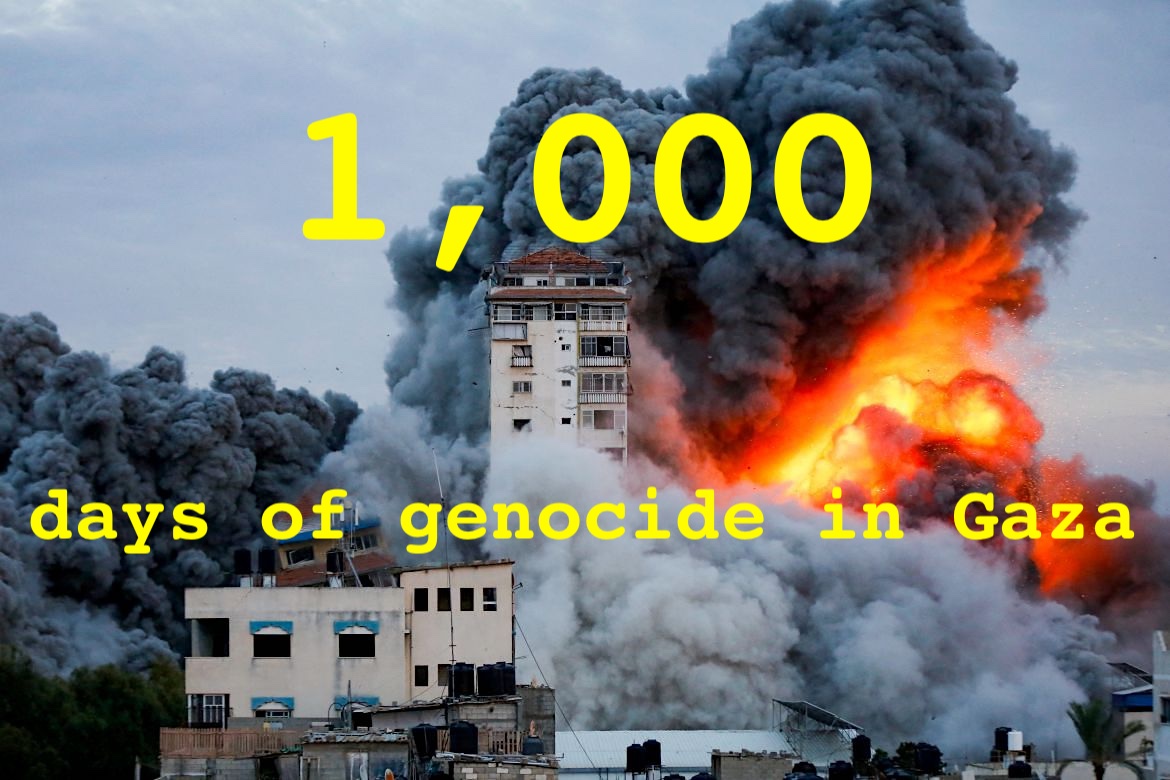
Gaza As a Death Camp, After 1,000 Days of Genocide
Please click on either of the ‘Donate’ or ‘Buy’ buttons below (via PayPal or Stripe) to make a donation towards the $2,500 (£2,000) I’m trying to raise to support my work as a reader-funded investigative journalist, commentator and activist over the next three months. To get links to all my work in your inbox, please also consider taking out a free or paid subscription to my new Substack newsletter.
Today marks 1,000 days of Israel’s genocide in the Gaza Strip, in which, at the most conservative estimate, almost a quarter of a million people have been killed or wounded. On June 29, Gaza’s shattered Health Ministry reported that the death toll stood at 73,058, and the numbers of those injured stood at 173,488, many of them gravely so.
These figures are devastating enough, as they constitute a death toll of 73 people every single day over the last 33 months, but they are, without any doubt, a serious undercount. The real death toll is at least double that figure, and maybe more, as I establish in my notes at the end of this article.
In addition, as was revealed last August, an official Israeli military intelligence database, keeping tabs on how many suspected militants had been killed in Gaza, revealed that, according the military’s own figures, only 17% of those killed in Gaza were assessed as having been militants: in other words, 83% were civilians, a figure that, as I discussed in my analysis at the time, could actually be as high as 95%.
Israel Begrudgingly Re-Opens the Rafah Crossing, But With Onerous Restrictions on Palestinians’ Entry and Departure

Please click on either of the ‘Donate’ or ‘Buy’ buttons below (via PayPal or Stripe) to make a donation towards the $2,500 (£2,000) I’m trying to raise to support my work as a reader-funded investigative journalist, commentator and activist over the next three months. To get links to all my work in your inbox, please also consider taking out a free or paid subscription to my new Substack newsletter.
The re-opening, this week, of the Rafah Crossing, connecting the Gaza Strip to Egypt, and the only route in and out of Gaza that doesn’t pass through Israeli territory, was meant to provide a lifeline of hope for the estimated 20,000 medical patients in Gaza who need treatment abroad (including around 4,000 children, and about 440 critical cases in need of immediate attention) as well as for the more than 30,000 Palestinians who left Gaza in the early months of Israel’s genocide, and who, as the Council on Foreign Relations explained, “have registered their intent to return.”
Predictably, however, Israel has done all it can to to turn the re-opening into yet another example of its obsessive desire to control every aspect of the sealed death camp it has created in Gaza over the last 28 months, and its equally obsessive desire to humiliate Palestinians — when not killing them directly — at every opportunity.
According to the ceasefire agreement that Israel was reluctantly obliged to accept in October as part of Donald Trump’s “Peace Plan”, the Rafah Crossing was meant to re-open in the first phase of the deal, when Israel stopped its carpet-bombing in exchange for the return of the remaining hostages seized on October 7, 2023. It was, however, “an unmet requirement” of the first phase, as CPR described it, because Israel “delayed the reopening until it recovered the final hostage body from Gaza, which occurred last week.”












 Who's still at Guantánamo?
