Yemeni Torture Victim and Insignificant Afghan Approved for Release from Guantánamo by Periodic Review Boards

Please support my work as a reader-funded journalist! I’m currently trying to raise $2500 (£2000) to support my writing and campaigning on Guantánamo and related issues over the next three months. If you can help, please click on the button below to donate via PayPal.
Fresh from the news that Pakistani torture victim Ahmed Rabbani has been approved for release from Guantánamo by a Periodic Review Board, a parole-type process established by President Obama, comes the further revelation that two more “forever prisoners” have also been approved for release — Sanad al-Kazimi, a Yemeni, and Asadullah Haroon Gul, one of the last two Afghans in the prison.
The approval for the release of both men is long overdue, but it is reassuring that, after nearly 20 years, it has finally become unfashionable for the US government to suggest that men who have never been charged or tried can be held indefinitely in the notorious offshore prison at the US’s naval base in Cuba. This year, letters to President Biden from 24 Senators and 75 members of the House of Representatives have spelled out, in no uncertain terms, how men who have not been charged with crimes must be released.
In the case of Asadullah Haroon Gul, held at Guantánamo since 2007, the US’s reasons for holding him evaporated many years ago. Despite his youth (he was only around 19 years old when the US-led coalition invaded Afghanistan in October 2001), he had allegedly held some kind of leadership position in Hezb-e-Islami Gulbuddin (HIG), the militia led by the former warlord Gulbuddin Hekmatyar. A recipient of significant US funding during the time of the Soviet occupation, Hekmatyar had turned against the US following the invasion in October 2001, but in recent years had joined the Afghan government via a peace deal in 2016 that had led to HIG members being released from prison (and one, sent to the UAE from Guantánamo, being repatriated).
Never-Ending Injustice: State Secrets and the Torture of Abu Zubaydah

Please support my work as a reader-funded journalist! I’m currently trying to raise $2500 (£2000) to support my writing and campaigning on Guantánamo and related issues over the next three months. If you can help, please click on the button below to donate via PayPal.
I wrote the following article for the “Close Guantánamo” website, which I established in January 2012, on the 10th anniversary of the opening of Guantánamo, with the US attorney Tom Wilner. Please join us — just an email address is required to be counted amongst those opposed to the ongoing existence of Guantánamo, and to receive updates of our activities by email.
On Wednesday, the Supreme Court heard arguments in the case of the notorious torture victim and Guantánamo prisoner Abu Zubaydah, for whom the US’s post-9/11 torture program was invented. Zubaydah, whose real name is Zayn al-Abidin Muhammad Husayn, was held and tortured in CIA “black sites” for four and a half years, after his capture in a house raid in Pakistan in March 2002, until his eventual transfer to Guantánamo with 13 other so-called “high-value detainees” in September 2006, and he has been held there without charge or trial ever since.
Wednesday’s hearing was the result of an appeal by the government against a ground-breaking ruling two years ago, by the Ninth Circuit Court of Appeals, in which the judges openly declared that Abu Zubaydah had been tortured. It was, as Abu Zubaydah’s attorney, Cornell University law professor Joseph Margulies, explained, “the first time an appellate court” had “come right out and said that the enhanced interrogation techniques were torture.”
While this was significant, it wasn’t the main topic of the case, which involved the state secrets privilege, whereby government officials can argue that sensitive information whose disclosure, they claim, might endanger national security, must not be disclosed in a court. Abu Zubaydah’s lawyers were — and still are — seeking permission for the architects of the torture program, the contractors James Mitchell and Bruce Jessen, to be questioned about the details of his torture while he was held in a “black site” in Poland, in 2002-03, after his initial torture in a “black site” in Thailand in 2002, for use in the Polish government’s ongoing investigation.
How the Law Failed at Guantánamo

Please support my work as a reader-funded journalist! I’m currently trying to raise $2500 (£2000) to support my writing and campaigning on Guantánamo and related issues over the next three months. If you can help, please click on the button below to donate via PayPal.
Just five days ago, on July 11, the prison at Guantánamo Bay marked another sad and unjustifiable milestone in its long history — nineteen and a half years since it first opened on January 11, 2002.
From the beginning, Guantánamo was a project of executive overreach — of the US government, under George W. Bush, deciding, after the 9/11 attacks, that the normal rules governing the imprisonment of combatants during wartime should be swept aside. The men who arrived at Guantánamo were deprived of the protections of the Geneva Conventions, and were designated as “unlawful enemy combatants,” who, the Bush administration claimed, could be held indefinitely. For those who were to be charged with crimes, the Bush administration revived the military commission trial system, last used for German saboteurs in the Second World War, deciding that acts of terrorism — and even some actions that were a normal part of war, such as engaging in firefights — were war crimes. The result was that soldiers came to be regarded as terrorists, and alleged terrorists came to be regarded as warriors, with the former denied all notions of justice, and the latter provided only with a legal forum that was intended to lead to their execution after cursory trials.
The mess that ensued has still not been adequately addressed. Nearly two and a half years after Guantánamo opened, the Supreme Court took the unusual step of granting habeas corpus rights to wartime prisoners, having recognized that the men held had no way whatsoever to challenge the basis of their imprisonment if, as many of them claimed, they had been seized by mistake. That ruling, Rasul v. Bush, allowed lawyers into the prison, to begin preparing habeas corpus cases, but on the same day, in another ruling, Hamdi v. Rumsfeld, the Supreme Court essentially approved Guantánamo as the venue for the exercise of a parallel version of the wartime detention policies of the Geneva Conventions, ruling that prisoners could be held until the end of hostilities — an unwise move, given that the Bush administration regarded its “war on terror” as a global war that ignored geographical context, and could last for generations.
The Bleak Legacy of Donald Rumsfeld: Guantánamo, Torture and Two Failed and Astonishingly Destructive Wars

Please support my work as a reader-funded journalist! I’m currently trying to raise $2500 (£2000) to support my writing and campaigning on Guantánamo and related issues over the next three months. If you can help, please click on the button below to donate via PayPal.
If there was any justice in this world, Donald Rumsfeld, the former US defense secretary from 2001 to 2006 under George W. Bush, who has died at the age of 88, would have been held accountable for his crimes against humanity at Guantánamo, in Afghanistan and in Iraq; instead, he apparently passed away peacefully surrounded by his family in Taos, New Mexico.
In response to the terrorist attacks of September 11, 2001, Rumsfeld directed the US-led invasion of Afghanistan in October 2001, when the Geneva Conventions regarding the treatment of prisoners in wartime were shamefully jettisoned, and he was also responsible for the establishment of the prison at Guantánamo Bay, which opened on January 11, 2002.
At Kandahar and Bagram — and at numerous other prisons across Afghanistan — all those who came into US custody were regarded as “enemy combatants,” who could be held without any rights whatsoever. The torture and abuse of prisoners was widespread, and numerous prisoners were killed in US custody, as I reported in When Torture Kills: Ten Murders In US Prisons In Afghanistan, an article I published 12 years ago today.
On UN Torture Day, Please Remember the 40 Torture Victims Still Held at Guantánamo

Please support my work as a reader-funded journalist! I’m currently trying to raise $2500 (£2000) to support my writing and campaigning on Guantánamo and related issues over the next three months. If you can help, please click on the button below to donate via PayPal.
Today, June 26, is the UN International Day in Support of Victims of Torture, which was first established 23 years ago, on June 26, 1998, to mark the 11th anniversary of the day that, in 1987, the UN Convention Against Torture and Other Cruel, Inhuman or Degrading Treatment or Punishment came into effect.
The long struggle against the use of torture began nearly 40 years before, on December 10, 1948, when, as the UN explains, “the international community condemned torture and other cruel, inhuman or degrading treatment in the Universal Declaration of Human Rights adopted by the United Nations General Assembly.”
Created in response to the horrors of the Second World War, the Universal Declaration of Human Rights represented an aspiration for a better world, which “set out, for the first time, fundamental human rights to be universally protected.” Now translated into over 500 languages, it is “widely recognized”, as the UN also explains, “as having inspired, and paved the way for, the adoption of more than seventy human rights treaties, applied today on a permanent basis at global and regional levels,” including the Convention Against Torture.
Abu Zubaydah Files Complaint About Torture and Ongoing Imprisonment at Guantánamo with UN Arbitrary Detention Experts
Please support my work as a reader-funded journalist! I’m currently trying to raise $2500 (£2000) to support my writing and campaigning on Guantánamo and related issues over the next three months. If you can help, please click on the button below to donate via PayPal.
On Friday, Abu Zubaydah (Zayn al-Abidin Muhammad Husayn), a notorious victim of torture in the CIA’s “black site” program, who has been held without charge or trial at Guantánamo since September 2006, submitted a complaint to the UN Working Group on Arbitrary Detention, regarding the lawless nature of his imprisonment and treatment since he was first seized in a house raid in Pakistan in March 2002.
The case has been submitted by Helen Duffy, Abu Zubaydah’s international legal representative since 2010, who represented him in his successful cases before the European Court of Human Rights regarding his “black site” detention in Poland and Lithuania, and the complaint accuses seven countries of having responsibility for his long imprisonment and mistreatment — not only (and primarily) the US, but also Thailand, Poland, Morocco, Lithuania and Afghanistan, the five countries in which he was held in “black sites” over a period of four and a half years, and the UK, which is accused of having “participated in other ways in the ‘global spider’s web’ of complicity in rendition,” primarily via “estimates that UK personnel were involved in approximately 2,000-3,000 interviews of CIA detainees in the aftermath of 9/11”, as indicated by the findings of the UK Parliament’s Intelligence and Security Committee (ISC) in 2019.
In a press release, Duffy explains that this is “the first international case brought by Zubaydah against the United States,” and is also “the first time that international legal action is taken against the UK, Afghanistan, Morocco and Thailand for their complicity in the US rendition and secret detention program.” In addition it is “the first time that a case has been brought against all states participating in an individual’s rendition and torture and ongoing unlawful detention at Guantánamo.”
Torture Victims Lead Call for Torture Apologists Avril Haines and Mike Morell Not to be Confirmed as Director of National Intelligence and CIA Director

Please support my work as a reader-funded journalist! I’m currently trying to raise $2500 (£2000) to support my writing and campaigning on Guantánamo and related issues over the next three months. If you can help, please click on the button below to donate via PayPal.
I’m delighted to be a signatory to an open letter, initiated by Medea Benjamin of CODEPINK and Marcy Winograd of Progressive Democrats of America and CODEPINKCONGRESS, urging President-elect Joe Biden not to nominate Mike Morell as CIA Director, and asking the Senate not to approve Biden’s nominee Avril Haines as Director of National Intelligence (the head of the 16 branches of the US Intelligence Community) — and I’m particularly gratified that I was able to reach out to a number of former Guantánamo prisoners to encourage them to sign the letter.
Both Morell and Haynes have a troubling history of defending torture. Morell, who was a CIA analyst under George W. Bush, and Deputy and Acting CIA Director under Barack Obama, defended the use of torture when speaking to VICE in 2015. “I don’t like calling it torture for one simple reason: to call it torture says my guys were torturers,” he said, adding, “I’m gonna defend my guys till my last breath.” As Medea Benjamin and Marcy Winograd explained in an article for Common Dreams yesterday, Morell “put his CIA buddies above truth, the law and basic decency.”
Hopefully, as they also noted, “Morell’s traction may be on the wane with the Biden administration … after progressives launched a campaign against [him], and Senator Ron Wyden — a powerful Democrat on the Senate Intelligence Committee — called him a ‘torture apologist’ and said his appointment to head the CIA was a ‘non starter.’”
As You Read This, Guantánamo Prisoner Ahmed Rabbani Has Been On A Hunger Strike for 2,846 Days
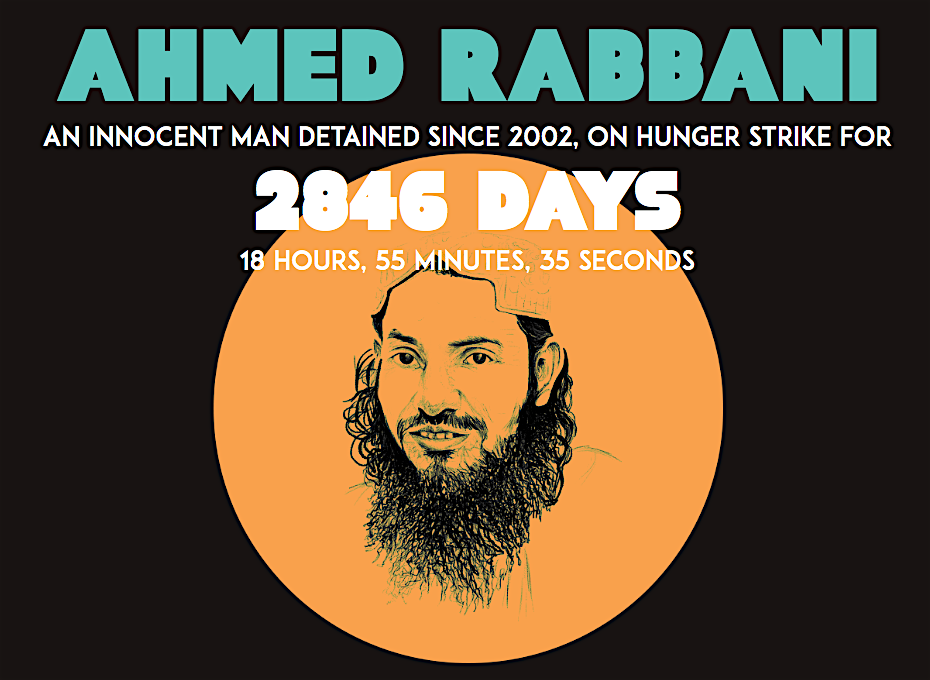
Please support my work as a reader-funded journalist! I’m currently trying to raise $2500 (£2000) to support my writing and campaigning on Guantánamo and related issues over the next three months. If you can help, please click on the button below to donate via PayPal.
With the media spotlight hopefully being shone anew on the prison at Guantánamo Bay, now that Joe Biden has been elected as the US president, it is to be hoped that, as I explained in my recent article, President Elect Biden, It’s Time to Close Guantánamo, arrangements will be made to release the five men still held who were unanimously approved for release by high-level government review processes under President Obama, and that there will be an acceptance within the Biden administration that holding 26 other men indefinitely without charge or trial is unacceptable.
These 26 men — accurately described as “forever prisoners” by the media — were recommended either or for prosecution, or for ongoing imprisonment without charge or trial, on the basis that they were “too dangerous to release,” even though it was acknowledged that insufficient evidence — or insufficient untainted evidence — existed for them to be charged, by the first of Obama’s two review processes, the Guantánamo Review Task Force, in 2009.
Four years later, the 26 — along with 38 others — were deemed eligible for a second review process, the Periodic Review Boards. Unlike the first process, which involved officials assessing whether prisoners should be freed, charged or held on an ongoing basis without charge or trial, the PRBs were a parole-type process, in which the men were encouraged to express contrition for the activities in which they were alleged to have been involved (whether those allegations were accurate or not), and to present credible proposals for a peaceful and constructive life if released.
After Years in Secret Prisons, UAE Threatens Unsafe Repatriations to Yemen for Former Guantánamo Prisoners

Please support my work as a reader-funded journalist! I’m currently trying to raise $2500 (£2000) to support my writing and campaigning on Guantánamo and related issues over the next three months of the Trump administration. If you can help, please click on the button below to donate via PayPal.
I wrote the following article for the “Close Guantánamo” website, which I established in January 2012, on the 10th anniversary of the opening of Guantánamo, with the US attorney Tom Wilner. Please join us — just an email address is required to be counted amongst those opposed to the ongoing existence of Guantánamo, and to receive updates of our activities by email.
Depressing but important news about life after Guantánamo was published by the Associated Press on Wednesday, focusing on the appalling treatment that former Guantánamo prisoners have received since being resettled in the United Arab Emirates between November 2015 and January 2017, when President Obama left office; specifically, 18 Yemenis (out of 23 men in total sent to the UAE), who have now been told that the UAE is preparing to repatriate them, even though their lives may well be at risk in Yemen.
As reporter Maggie Michael described it, the prisoners “were promised they were being sent to a Muslim country for rehabilitation that would help integrate them into society, opening the way to jobs, money, and marriage, according to their lawyers and families. It was a lie.”
To anyone paying close attention, this wasn’t news. The Washington Post reported in May 2018 that former prisoners sent to the UAE after being unanimously approved for release by high-level US government review processes remain imprisoned, despite promises that their new host country would help them rebuild their lives. Missy Ryan’s story was entitled, “After over a decade at Guantanamo, these men were supposed to go free. Instead, they’re locked in a secretive center in the UAE.”
Mohammed Al-Qahtani: Will Severe Mental Illness Secure His Release from Guantánamo?

Please support my work as a reader-funded journalist! I’m currently trying to raise $2500 (£2000) to support my writing and campaigning on Guantánamo and related issues over the next three months of the Trump administration. If you can help, please click on the button below to donate via PayPal.
For anyone seeking a single story that is emblematic of the horrors of Guantánamo, the story of Mohammed al-Qahtani ought to be instructive.
One of hundreds of prisoners seized in the chaos of Afghanistan after the US-led invasion in October 2001 and sent to Guantánamo after brutal treatment in US prisons in Afghanistan, al-Qahtani finally came to the attention of the US authorities in Guantánamo when it was assessed that he was the same man who had tried and failed to enter the US before the 9/11 attacks, and was presumed to have been intended to be the 20th hijacker.
He was then subjected to a horrible torture program, personally approved by then-defense secretary Donald Rumsfeld, which lasted for several months in late 2002, and which, as Murtaza Hussain explained for the Intercept in April 2018, involved him being subjected to “solitary confinement, sleep deprivation, extreme temperature and noise exposure, stress positions, forced nudity, body cavity searches, sexual assault and humiliation, beatings, strangling, threats of rendition, and water-boarding.” On two occasions he was hospitalized with a dangerously low heart rate.












 Who's still at Guantánamo?

