Keeping Live Music and Performance Alive in a Covid Lockdown Culture

Please support my work as a reader-funded investigative journalist, commentator and activist. If you can help, please click on the button below to donate via PayPal.
I was preparing to play a gig — yes, an actual gig! — on Saturday evening, with my band The Four Fathers, when news of a second lockdown in England was finally confirmed by the government. It wasn’t surprising, because infection rates had been steadily rising, but the government — as indecisive as ever — had missed the opportunity to impose a two-week “circuit breaker” lockdown to coincide with half-term, as recommended by medical experts, and was now, belatedly, announcing a four-week lockdown instead, starting on Thursday, November 5, and lasting until December 2.
Unlike the first time around, though, the government announced that schools and universities were to stay open, even though what are regarded as “non-essential” shops and businesses will be required to shut, imperilling the future of countless small businesses, who had just begun to find their feet, and who must now be facing, in numerous cases, a fatal loss of business in the run-up to Christmas. Even if they are allowed to reopen on December 3, it seems pretty certain that Amazon and a host of other online retailers — many in the “fast fashion” business, and many with dodgy employment practices — will be making a fortune while nailing shut the coffins of high streets across the land.
To impose this kind of sweeping lockdown for an entire month while leaving schools and universities open is exactly the kind of muddled thinking on the government’s part that — even putting aside for a moment their cronyism, corruption, and obsession with incompetent, overpaid corporate service providers to do jobs that should be provided by health professionals — will enrage and alienate people, whilst also failing to actually tackle the problems of rising infection rates.
Covid Lockdown: Video of My Band The Four Fathers Playing at a Small Party in a London Park That Would Now Be Illegal

Please support my work as a reader-funded investigative journalist, commentator and activist. If you can help, please click on the button below to donate via PayPal.
On the August Bank Holiday weekend, my band The Four Fathers played a largely acoustic set — and then joined other musicians in a jam session — as part of a little party in our local park in south London, parts of which were filmed by our bassist’s daughter, and which now constitute a record of what London looked like five months after the government first declared a lockdown to prevent the spread of the Covid-19 virus.
The party normally takes place in a friend’s house, but this year, because of Covid-19, everyone concerned recognised that even a well-behaved house party wasn’t acceptable at the time, and so the proposal to move it to our local park was suggested instead.
In the earliest days of lockdown, London’s parks were patrolled by the police and local officials to make sure that no one stopped or mingled during their allotted one hour of exercise a day, but, as the peak of the panic passed, parks then became the focal point of human interaction, and while there were some obvious examples of slightly reckless behaviour — parties of young people drinking late into the night, provoking the wrath of the curtain-twitching brigade — for the most part people were aware of social distancing, and were simply trying to balance the need to avoid spreading the virus with an equally important need to socialise.
COVID-19: Institutional Inertia, the Need for Vision, and the Collapse of the US and the UK
Please support my work as a reader-funded investigative journalist, commentator and activist. If you can help, please click on the button below to donate via PayPal.
Six months since the arrival of the novel coronavirus, COVID-19, prompted an unprecedented lockdown on social and economic activity, a veneer of normality has been resumed, although it remains an uneasy time. Pubs and restaurants are open, cars once more fill the streets, turning the taste of the air to one of petrol after months without it, and zombie shoppers once more return to high streets and shopping malls to buy clothing produced in factories — mostly in the “developing world” — that involves economic exploitation of the unseen, and nothing short of environmental destruction, as these factories kill off rivers with their noxious chemicals.
As I see on an almost daily basis, however, on my bike rides into the West End and the City of London to take photos for my ongoing photo-journalism project ‘The State of London’, the veneer is very thin. Although people have been returning to the West End since June 15, when “non-essential” shops were allowed to to reopen, the numbers are down, and massively so.
As I explained in my most recent COVID-related article, COVID-19: Workers and Employers Show No Great Enthusiasm for Returning to the Office to Revive “Business As Usual”, 5.1m people visited the West End in the first full month of the post-lockdown re-opening of retail outlets, but that was 73% down year-on-year, and will not enable businesses to survive unless landlords also write off 73% of their rents. If they do, the virus will have succeeded in denting the wealth of the rich; if they don’t, the West End will soon be a wasteland of shuttered shops, because however much some people are enjoying al fresco street dining in pedestrianised streets in Soho, there is an achingly huge financial hole where the tourists and office workers used to be.
COVID-19: Workers and Employers Show No Great Enthusiasm for Returning to the Office to Revive “Business As Usual”

Please support my work as a reader-funded investigative journalist, commentator and activist. If you can help, please click on the button below to donate via PayPal.
In Sunday’s Observer, the paper’s chief political commentator Andrew Rawnsley related how, a few weeks ago, a group of civil servants at the Cabinet Office were “told to find a way of re-opening nightclubs in a coronavirus-safe way.” Although they were, in Rawnsley’s words, a “bright group”, they couldn’t overcome the fundamental — one might say fatal — flaw at the heart of the exercise. “The socially distanced nightclub is a contradiction in terms”, as Rawnsley put it, adding, “Nightclubs, by their very nature, are all about social intimacy.”
Rawnsley proceeded to explain that he was telling this story “to illustrate just how very desperate the government has been to release Britain from every aspect of lockdown and return us to something that resembles the pre-coronavirus world as closely as possible.” Our leaders, as he put it, “dreamed of returning to that prelapsarian age in which you could eat out with your family, go drinking with your mates, commute to work, celebrate a religious festival or jet off to a holiday somewhere reliably sunny without having to worry about catching or spreading a deadly disease. While never quite saying it explicitly, their ambition has essentially been to get everything open again.”
This indeed seems to be the case, and it is typical of a government made up largely of inadequate ministers who are only in place because of their enthusiasm for the insanity of Brexit, and who are led by the laziest example of a Prime Minister in living memory, that the nuances of the challenges facing us — and the unexpected opportunities for a less chaotic and more environmentally sustainable world — are being ignored.
3,000 Days of My Photo-Journalism Project ‘The State of London’

Check out all ‘The State of London’ photos here!
Please feel free to support my work on ‘The State of London’, for which I have no institutional funding. If you can help, please click on the button below to donate via PayPal.
My photo-journalism project ’The State of London’ has just reached a noteworthy milestone — 3,000 days since I first consciously went out on my bike, on May 11, 2012, to cycle around London taking photos to chronicle the fabric of London and the many changes wrought upon it, beginning with the upheaval that attended the capital’s role as the host city of the 2012 Olympic Games. I began posting a photo a day on Facebook on the fifth anniversary of that first trip, on May 11, 2017, and have been posting a photo a day for the 1,176 days since.
In the eight years since, I have taken many tens of thousands of photos, covering all 120 of London’s postcodes in the 241 square miles of the London postal district (those beginning EC, WC, W, NW, N, E, SE and SW), with a particular focus on central London — the City (EC1 to EC4) and the West End (WC1, WC2 and W1), and the immediate surrounding postcodes (SE1, SW1, NW1, N1 and E1) — and with other clusters of repeated activity in the whole of south east London, where I live, in east London, most readily accessed via the Greenwich Foot Tunnel, and in parts of south west London — particularly, it seems, Brixton, Vauxhall and Battersea and Chelsea — and west London; especially Paddington, Notting Hill and Ladbroke Grove.
These 3,000 days have not only been a way of keeping physically fit; they have also played a major role in ensuring some sort of mental equilibrium amidst the general chaos of the state of the world — even if some aspects of ‘The State of London’ have added to my sense of rage rather than placating it; in particular, the colossal and colossally expensive construction projects that have transformed the city to an alarming degree over the last eight years.
The State of London: Marking 120 Days of My London Lockdown Photos with Some Previously Unpublished Images
Please feel free to support ‘The State of London’ with a donation, as I have no institutional backing for it, and it is, instead, a reader-funded project. If you can help, please click on the button below to donate via PayPal.
Check out all ‘The State of London’ photos here.
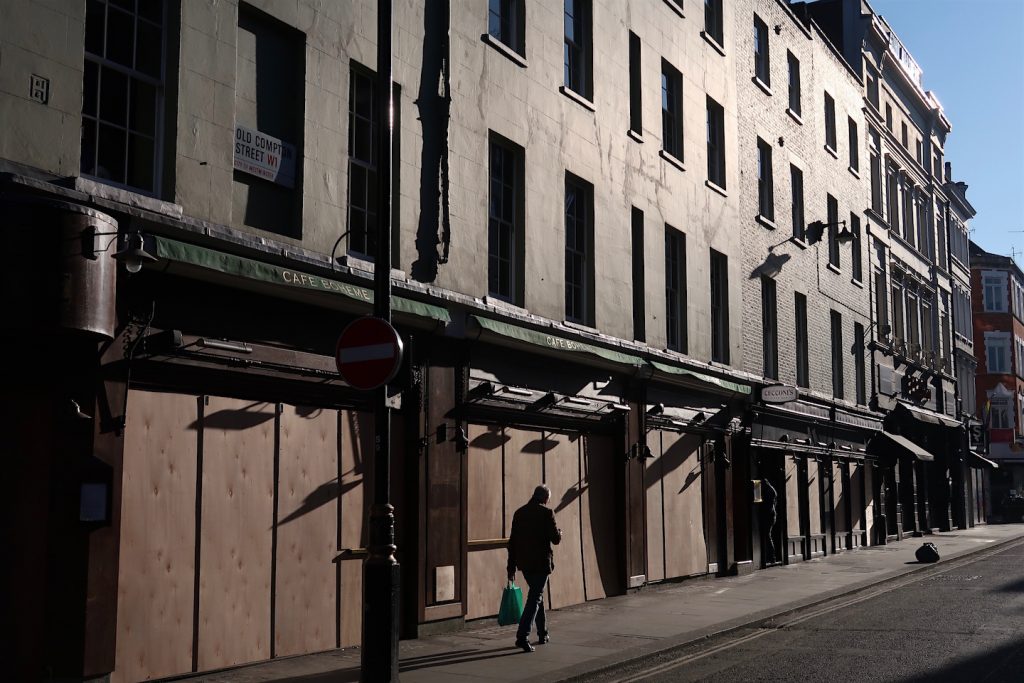
Yesterday marked 120 days straight that I’ve been cycling around London, taking photos of the coronavirus lockdown — and, in recent weeks, its partial easing — and posting a photo a day on ‘The State of London’ Facebook and Twitter pages.
I first began cycling around London on a daily basis, taking photos for a photo-journalism project that I soon named ‘The State of London’, over eight years ago, in May 2012, and on the fifth anniversary I began posting a photo a day on Facebook. Until the coronavirus hit, the photos I posted were drawn from the various years since I began the project — on that particular day, but from any of the years since the project began in 2012.
When the coronavirus hit, however — and particularly after the lockdown officially began on March 23 — the archive suddenly seemed, if not irrelevant, then relating to another, lost time, as the streets of the capital emptied, and economic activity ground almost to a halt.
COVID-19 and the Economic Meltdown: Was Global Tourism the Only Thing Keeping Us Afloat?

Please support my work as a reader-funded investigative journalist, commentator and activist. If you can help, please click on the button below to donate via PayPal.
Three months since the arrival of the novel coronavirus COVID-19 prompted an unprecedented lockdown on human interaction and on huge swathes of our economy, the primary objective — preventing our hospitals and morgues from being overwhelmed — has been achieved. The cost — economically, and, in some cases, psychologically — has been enormous, but the road ahead, as those in charge attempt to revive a functioning economy, looks like it will be even more arduous.
No congratulations should be extended to Boris Johnson and his government for the achievements of the lockdown. Johnson dithered for far too long at the beginning of the crisis, and the deaths of tens of thousands of people are, as a result, his responsibility, although not his responsibility alone, as the last few months have also shown us that, sadly, this empty windbag of a Prime Minister is largely manipulated by his senior adviser, the sneering eugenicist Dominic Cummings.
Both men were initially prepared to allow the virus to spread unchecked throughout the entire population, with people required to “take it on the chin”, as they let it “move through the population”, as Johnson explained in a now notorious TV appearance. It was only when medical experts pointed out the potential death toll of the “herd immunity” scenario that the lockdown began, following similar conclusions that were, in most other countries, reached rather earlier in the virus’s spread.
It’s 35 Years Since the Battle of the Beanfield; Where Do We Go Now?

Please support my work as a reader-funded investigative journalist, commentator and activist. If you can help, please click on the button below to donate via PayPal.
Today is the 35th anniversary of the Battle of the Beanfield; actually, a one-sided rout of heartbreaking brutality in a field in Wiltshire, when 1,400 police from six counties and the MoD violently “decommissioned” a convoy of 400 travellers trying to get to Stonehenge to establish what would have been the 12th annual Stonehenge Free Festival, a huge autonomous settlement, numbering tens of thousands of people, that occupied the fields by Stonehenge for the whole of the month of June, and that had become a target for violent suppression by Margaret Thatcher.
My book The Battle of the Beanfield, published to mark the 20th anniversary of the Battle of the Beanfield, is still in print, so please feel free to order a copy. Also available: Stonehenge: Celebration & Subversion, my counter-cultural history of Stonehenge.
Thatcher had spent 1984 crushing one group of citizens described as the “enemy within” — the miners — while also paving the way for the next “enemy within” to be crushed — the travellers, anarchists and environmental and anti-nuclear activists who made up the convoy attempting to get to Stonehenge when they were ambushed, and then crushed after they sought refuge in a bean field off the A303.
Elements of the convoy had been violently set upon by police in the summer of 1984, at Nostell Priory in Yorkshire, and in February 1985, activists and travellers who had established a settlement at RAF Molesworth in Cambridgeshire (the second proposed site for cruise missiles after Greenham Common in Berkshire, the site of the famous women’s peace camp) were evicted by the largest peacetime mobilisation of troops in modern British history, symbolically led by Thatcher’s right-hand man and defence secretary, Michael Heseltine.
The Dim and Dom Show: Why Dominic Cummings Must Be Banished From Political Life, and Boris Johnson Must Fall With Him

Please support my work as a reader-funded investigative journalist, commentator and activist. If you can help, please click on the button below to donate via PayPal.
“The Dim and Dom Show” is a phrase I came across on Twitter, and is apparently how the UK is being referred to in New Zealand.
The whole world has been laughing at us, as our Prime Minister Boris Johnson has revealed himself, more conclusively than ever, to be little more than an empty vessel incapable of any kind of leadership without his chief advisor — and effectively his only advisor — Dominic Cummings, the former campaign director of the Vote Leave campaign, which, for those of us who can recall the world before the coronavirus, persuaded a small majority of those who could be bothered to vote in the EU referendum in June 2016 to vote to leave the EU.
Cummings — an alleged anti-elitist who is actually privately educated and an Oxford graduate, and married to the daughter of a Baronet — is routinely described as a brilliant political strategist, but if that is the case then it is only in the malicious, dumbed-down way in which politics has been conducted over the last decade in particular. He is credited with coming up with the winning phrase ‘Take Back Control’, to twist the electorate’s understanding of how EU membership worked, and was instrumental in the lie that leaving the EU would mean an extra £350m a week for the NHS.
Landlords: The Front Line of Coronavirus Greed

Please support my work as a reader-funded investigative journalist, commentator and activist. If you can help, please click on the button below to donate via PayPal.
As the coronavirus continues to cripple the economy, it is clear to anyone paying attention — a situation not encouraged by either our political leaders or the mainstream media — that its disastrous effects are extremely unevenly distributed.
While some people are working from home on 100% pay, others — the essential workers of the NHS, pharmacists, those in the food industry, postal workers and other delivery people, public transport workers, and many others — have continued to work, often at severe risk to their health, because of the government’s inability to provide proper PPE or a coherent testing system. Other workers, meanwhile, have been furloughed on 80% of pay (up to £2,500 a month), while another huge group of former workers have been summarily laid off, and have been required to apply for Universal Credit, a humiliating process that also involves the requirement to try to survive on less than £100 a week.
While those on Universal Credit receive support in paying their rent, and one of the government’s first moves, when the lockdown began, was to secure mortgage holidays for homeowners, no such support exists elsewhere in the economy for those who are renting. This is a disaster both for businesses and for those living in properties owned by landlords and not receiving housing benefit, as there has been no suggestion from the government, at any time over the last seven weeks, that landlords should share everyone else’s pain.










 Who's still at Guantánamo?
