15 Years of Torture: The Unending Agony of Abu Zubaydah, in CIA “Black Sites” and Guantánamo
 Please support my work! I’m currently trying to raise $2500 (£2000) to support my writing and campaigning on Guantánamo and related issues over the next three months of the Trump administration.
In the eleven years since I first began working on Guantánamo full-time, researching its history and the stories of the men held there, writing about them and working to get the prison closed down, one date has been burned into my mind: March 28, 2002, when Abu Zubaydah (Zayn al-Abidin Muhammad Husayn), an alleged “high-value detainee,” was seized in a house raid in Faisalabad, Pakistan. That night dozens of prisoners were seized in a number of house raids in Faisalabad, and some were taken to CIA “black sites” or sent abroad on behalf of the CIA to torture facilities in other countries, run by their own torturers. Most ended up, after a few months, in Guantánamo, and most — through not all — have now been released, but not Abu Zubaydah.
He, instead, was sent to a CIA “black site” in Thailand, where he was the first prisoner subjected to the CIA’s vile post-9/11 torture program, revealed most clearly to date in the executive summary of the Senate Intelligence Committee’s report about the program, published in December 2014. Although the executive summary was heavily redacted, and the full report has never been made public, it remains the most powerful official indictment of the torture program, which, it is clear, should never have been embarked upon in the first place.
After Thailand, where he was subjected to waterboarding (an ancient form of water torture) on 83 occasions, Abu Zubaydah was sent to Poland, and, after other flights to other locations (a “black site” in Guantánamo, briefly), and others in Morocco, Lithuania, and — probably — Afghanistan, he ended up back at Guantánamo, though not covertly, in September 2006, when President Bush announced to the world that he and 13 other “high-value detainees” had been removed from the CIA “black sites” whose existence he had previously denied, but which, he now admitted, had existed but had just been shut down. Read the rest of this entry »
Video: On CBS’s 60 Minutes, Former Guantánamo Prisoner, Torture Victim and Best-Selling Author Mohamedou Ould Slahi Tells His Story
 Please support my work! I’m currently trying to raise $2500 (£2000) to support my writing and campaigning on Guantánamo and related issues over the next three months of the Trump administration.
If you haven’t already seen it, I urge you to watch the first full-length, post-release interview with former Guantánamo prisoner, torture victim and best-selling author Mohamedou Ould Slahi, freed last October, which was shown on CBS’s 60 Minutes show on Sunday. A transcript is here.
Slahi was handed over to the CIA in November 2001, on the mistaken basis that he possessed important information about al-Qaeda, and was then tortured in Guantánamo, in a special program approved by defence secretary Donald Rumsfeld, until, after being taken out on a boat and beaten for hours while freezing from ice packed into his clothing, and after being told that his mother was being brought to Guantánamo, he was “broken” and began telling his interrogators whatever they wanted to hear — lies, but lies that were somehow regarded as credible.
Moved into separate housing with another perceived informant, he was then allowed to write the memoir that was eventually published as Guantánamo Diary in 2015, a devastating account of US torture and incompetence that was profoundly shocking despite its many redactions, and that also revealed Slahi as a witty, perceptive and thoroughly likeable human being. I should note also that I find it ironic that Slahi was only allowed to write a memoir in the first place because of his torture and his subsequent cooperation. Read the rest of this entry »
Trump’s Dystopian America: The Unforgivable First Ten Days

Please support my work! I’m currently trying to raise $2500 (£2000) to support my work over the first two months of the Trump administration.
Ten days ago, reality as we knew it seemed to disappear with Donald Trump’s inauguration, and the bleak, insular, threatening speech at its heart, which bore all the hallmarks of the miserable white supremacist world view of his most trusted advisor, Steve Bannon, a man who needs constantly exposing as the genuinely malevolent force behind Trump’s throne.
I was in New York City at the time of the inauguration, staying in a house in Brooklyn. My hosts had gone out to work, and I was alone as the realization that no last minute miracle had spared us from Trump truly sank in. I was chilled, and spent the day in a fog of anxiety, as did tens of millions of other Americans.
The following day, the Women’s March played a hugely important role in establishing the resistance to Trump. Millions of women (and supportive men), inspired by opposition to Trump’s misogyny, marched in Washington, D.C., in New York and in other cities across the US and around the world. I wrote about the inspiring New York event here, and my photos are here. Read the rest of this entry »
Donald Trump Proposes to Keep Guantánamo Open, to Prevent Further Releases, and to Reintroduce Torture and “Black Sites”
 Please support my work! I’m currently trying to raise $2500 (£2000) to support my writing and campaigning on Guantánamo and related issues over the first two months of the Trump administration.
I wrote the following article for the “Close Guantánamo” website, which I established in January 2012, on the 10th anniversary of the opening of Guantánamo, with the US attorney Tom Wilner. Please join us — just an email address is required to be counted amongst those opposed to the ongoing existence of Guantánamo, and to receive updates of our activities by email.
On Wednesday our worst fears on Guantánamo and torture were confirmed, when the New York Times published a leaked draft executive order, “Detention and Interrogation of Enemy Combatants,” indicating that Donald Trump wants to keep Guantánamo open, wants to send new prisoners there, and wants to “suspend any existing transfer efforts pending a new review as to whether any such transfers are in the national security interests of the United States.” Trump also, it seems, wants to reinstate torture and the use of CIA “black sites.”
Specifically, the draft executive order proposes revoking the two executive orders, 13492 and 13491, that President Obama issued on his second day in office in January 2009 — the first ordering the closure of Guantánamo, and the second to close CIA “black sites,” to grant the International Committee of the Red Cross access to all prisoners, and to ensure that interrogators only use techniques approved in the Army Field Manual.
The draft executive order also proposes to “resurrect a 2007 executive order issued by President Bush,” as the New York Times put it, which “responded to a 2006 Supreme Court ruling about the Geneva Conventions that had put CIA interrogators at risk of prosecution for war crimes, leading to a temporary halt of the agency’s ‘enhanced’ interrogations program.” Read the rest of this entry »
Andy Worthington Visits the US for the 15th Anniversary of the Opening of Guantánamo, and for Donald Trump’s Troubling Inauguration
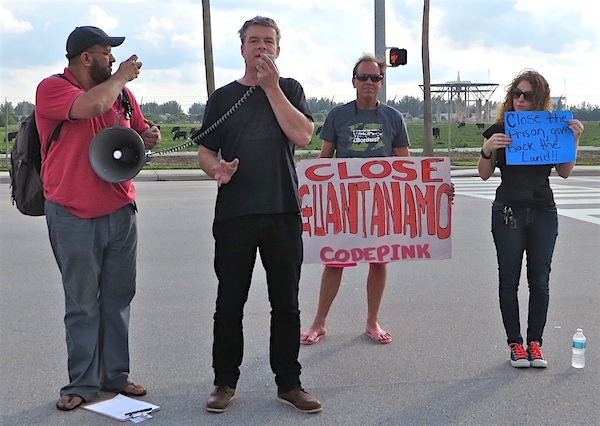 Please support my work! I’m currently trying to raise $2500 (£2000) to support my writing and campaigning on Guantánamo over the next two months.
Dear friends and supporters,
I’m delighted to be writing to you from Heathrow Airport — despite a seriously disruptive Tube strike in London — awaiting a flight to New York City, for what will be my seventh annual visit at this time of year, to campaign for the closure of the prison at Guantánamo Bay on and around the anniversary of its opening, on Jan. 11.
I’m not delighted to have to keep calling for Guantánamo’s closure, of course, and this year, the 15th anniversary of the prison’s opening is a particular difficult occasion: simultaneously, a definitive black mark against President Obama for having failed to fulfill the promise to close the prison — within a year! — that he made when he first took office eight years ago, and the introduction to Guantánamo under a third president, the worryingly unpredictable Donald Trump, who has vowed to keep Guantánamo open, and to “load it up with bad dudes,” and who, just days ago, tweeted that there should be no more releases from Guantánamo.
Trump’s comments came in spite of the fact that 19 of the 55 men still held have been approved for release by high-level, inter-agency review processes, and others may well be approved for release in future by the latest review process, the Periodic Review Boards, unless he decides, unwisely, to scrap them.
I will be talking about these topics, and reflecting on Guantánamo’s history, what it means, who is held, and why the closure of the prison remains so essential, during my visit. Read the rest of this entry »
Andy Worthington’s Band The Four Fathers’ Top Ten Songs on Bandcamp
 For Christmas, if you want a last-minute present, why not buy some music by my band The Four Fathers? Please also feel free to like us on Facebook, and to follow us on Twitter.
We play politically-charged roots reggae and rock — mostly original songs, and mostly my own compositions —and our first LP ‘Love and War’ was released last year, and is available on CD via Bandcamp (it can be sent anywhere in the world). On our Bandcamp page you can also buy the whole album as a download, or buy individual tracks — and you can also listen to or buy our subsequent EP, ‘Fighting Injustice,’ and our song ‘Close Guantánamo,’ released as an online single, as downloads.
We’re currently working on our second album, which will be released next year, featuring a number of songs that are becoming prominent in our live shows: ‘How Much Is A Life Worth?’ (about how white westerners regard their lives as more important than others), ‘London’ (about gentrification, and how London has changed over the last 30 years), ‘Riot’ (about the need to end inequality), ‘Equal Rights And Justice For All’ (about the importance of habeas corpus) — as well as two songs by guitarist Richard Clare — ‘When He Is Sane’, about mental health, and ‘She’s Back’ (about ‘Pussy Riot’) — and some love songs, ‘Tell Me Baby’ (about love and aging), ‘Dreamers’ (written for a friend’s 50th birthday) and ‘River Run Dry’ (about the end of a relationship, a song I wrote as a young man).
For now, however, feel free to check out our ten most popular songs on Bandcamp and have a listen — or buy them if you’d like, which would, of course, delight us! Read the rest of this entry »
In Final Counter-Terrorism Speech, Obama Targets Trump But Fails to Acknowledge His Own Mistakes on Guantánamo and War
 I wrote the following article for the “Close Guantánamo” website, which I established in January 2012, on the 10th anniversary of the opening of Guantánamo, with the US attorney Tom Wilner. Please join us — just an email address is required to be counted amongst those opposed to the ongoing existence of Guantánamo, and to receive updates of our activities by email.
On Tuesday, at MacDill Air Force Base in Tampa, Florida, the home of US Special Operations Command and Central Command, President Obama made what is expected to be his final speech on counter-terrorism before he leaves office in just six weeks’ time.
As Jessica Schulberg noted for the Huffington Post, in his speech he “defended his legacy ― both from hawks who have accused him of withdrawing from the Middle East, and from liberals who have criticized his reliance on expansive surveillance and drones to fight wars,” and “sought to convince the country that he had struck the correct balance.”
Spying and drones
However, as Spencer Ackerman noted for the Guardian, this was “a highly selective account of his record, particularly about the mass surveillance architecture he embraced and the drone strikes that will be synonymous with his name.” Read the rest of this entry »
Quarterly Fundraiser: With Trump Presidency Looming, Please Support My Work on Guantánamo – $3500 (£2750) Needed
 Please support my work and my efforts to raise $3500 (£2750) for the next three months!
Dear friends and supporters,
It’s that time of year again, when I ask you, if you can, to support my independent research, writing and commentary on Guantánamo and related issues. This is work I’ve been doing, largely as a reader-supported independent writer, for over ten years, but whilst it was reasonable to suppose, until recently, that Guantánamo might close, if not under President Obama, then under Hillary Clinton as his successor, the election of Donald Trump indicates, alarmingly, that the prison may gain a new lease of life from January onwards. On the campaign trail, Trump promised to keep Guantánamo open, to bring back torture, and even to send US citizens to Guantánamo to face military commission trials — all developments that are completely unacceptable.
I need your support to be able to continue the struggle to get Guantánamo closed (to bring to an end indefinite imprisonment without charge or trial), to make sure that no efforts to revive torture will be successful, and to continue to call for those who authorized and implemented the post-9/11 programs of extraordinary rendition, torture and arbitrary detention to be held accountable for their actions. It is hugely important that Donald Trump — and those he is appointing to key positions — are resisted every step of the way if they attempt to revive Guantánamo in any way, or to revisit any of the other lawless excesses of the Bush years.
So if you can help out at all, please click on the “Donate” button above to donate via PayPal (and I should add that you don’t need to be a PayPal member to use PayPal). I’m hoping to raise $3,500 (£2,700) for the next three months, which is just $270 (£200) a week for my constant work campaigning on behalf of the Guantánamo prisoners. Read the rest of this entry »
Guantánamo Lawyer’s Moving Memories of Her Client Obaidullah, an Afghan Released in the UAE in August
 Please support my work! I’m currently trying to raise $2500 (£2000) to support my writing and campaigning on Guantánamo until the end of the year.
In August, a long-suffering Afghan prisoner at Guantánamo, Obaidullah, was finally released after 14 years of imprisonment without charge or trial, sent to the United Arab Emirates rather than to his home village, because the US Congress had, with a rather hysterical disregard for any sense of proportion, passed a law preventing any Afghan prisoner at Guantánamo from being repatriated. Below I’m cross-posting a moving account of Obaidullah himself, and of his wrongful imprisonment, by one of his attorneys, Anne Richardson. Other civilian lawyers who worked on his case include Dan Stormer and Cindy Pánuco of Hadsell Stormer & Renick LLP in Pasadena, CA, where Richardson worked before moving to Public Counsel, the US’s largest pro bono firm, where she is the directing attorney of the Consumer Law Project.
Obaidullah, who has just one name like many Afghans, was seized in July 2002, when he was around 22 years old (he doesn’t know his exact year of birth), and was accused of having “stored and concealed anti-tank mines, other explosive devices, and related equipment,” and it was also claimed that he “concealed on his person a notebook describing how to wire and detonate explosive devices”; and that he “knew or intended” that his “material support and resources were to be used in preparation for and in carrying out a terrorist attack.”
The charges were listed when he was, absurdly, put forward for a trial by military commission in September 2008. Even if the allegations were true, putting forward a minor insurgent for a war crimes trial was a disgracefully overblown response to his alleged activities, but as an investigation by his military lawyers found in 2011, it appears that the US authorities were mistaken about Obaidullah’s role in any kind of plot against US forces. His wife had just given birth, and blood found in his car, interpreted as being a sign that someone was wounded in an attack, seems to have been from his wife’s labor, which he failed to mention because speaking about such things is not something an Afghan man does. Read the rest of this entry »
Great New York Times Exposé of How Torture, Abuse and Command Indifference Compromised Psychiatric Care at Guantánamo
 Please support my work! I’m currently trying to raise $2500 (£2000) to support my writing and campaigning on Guantánamo until the end of the year.
A recent detailed New York Times article, “Where Even Nightmares Are Classified: Psychiatric Care at Guantánamo,” provides a powerful review of the horrors of Guantánamo from the perspective of “more than two dozen military medical personnel who served or consulted” at the prison.
The Times article, written by Sheri Fink, explains how some prisoners were disturbed when they arrived at the prison, others “struggled with despair” as their imprisonment without charge or trial dragged on, and some “had developed symptoms including hallucinations, nightmares, anxiety or depression after undergoing brutal interrogations” by US personnel — sometime in CIA “black sites,” sometimes at Guantánamo — who had themselves been advised by other health personnel. Those who were tortured — although the Times refused to mention the word “torture,” as has been the paper’s wont over the years, coyly referring to dozens of men who “underwent agonizing treatment” — “were left with psychological problems that persisted for years, despite government lawyers’ assurances that the practices did not constitute torture and would cause no lasting harm.”
The result, Fink concluded, was that “a willful blindness to the consequences emerged. Those equipped to diagnose, document and treat the effects — psychiatrists, psychologists and mental health teams — were often unaware of what had happened.” Doctors told the Times that, “[s]ometimes by instruction and sometimes by choice, they typically did not ask what the prisoners had experienced in interrogations,” a situation that seriously compromised their care. Read the rest of this entry »











 Who's still at Guantánamo?

