“He Didn’t Commit a War Crime”: Omar Khadr’s US Lawyer Challenges His Conviction at Guantánamo
 Last week was a busy week for legal challenges by former Guantánamo prisoners. Just after David Hicks announced that he was appealing against his 2007 conviction for providing material support for terrorism (which I wrote about here), Omar Khadr’s lawyer in the US announced that the Canadian citizen, who was repatriated in September 2012 but is still imprisoned in his home country, is “set to appeal his five war crimes convictions on the grounds that the military commission had no legal authority to try him or accept his guilty pleas,” as Colin Perkel described it for The Canadian Press.
In order to leave Guantánamo, Khadr accepted a plea deal in October 2010, in which he admitted that he was guilty of murder in violation of the law of war, attempted murder in violation of the law of war, conspiracy, providing material support for terrorism, and spying, even though there are serious problems with the credibility of the main charge against him — that he threw a grenade that killed a US soldier — as an investigation of the evidence indicates that, at the time, he was unconscious, having been shot twice in the back at close range.
Khadr is able to challenge two of the charges against him — providing material support for terrorism and conspiracy — because of two rulings by the court of appeals in Washington D.C. last October and in January this year, when judges threw out two of the only convictions secured in the military commissions at Guantánamo, in 2008 — against Salim Hamdan, a driver for Osama bin Laden, and Ali Hamza al-Bahlul, a propagandist for al-Qaeda. Read the rest of this entry »
Former Guantánamo Prisoner David Hicks Appeals His 2007 Conviction for Non-Existent War Crime
 Ever since the conservative court of appeals in Washington D.C. delivered an extraordinary ruling last October, vacating one of the only convictions in the military commission trial system introduced for prisoners at Guantánamo, it has only been a matter of time before other appeals would be lodged.
Last Tuesday, November 5, the first man convicted in the trials — the Australian citizen David Hicks, who agreed to a plea deal in March 2007, on the basis that he would be returned to Australia to serve a seven-month sentence — lodged an appeal with the US Court of Military Commission Review, “arguing for a summary dismissal of the conviction,” as the Sydney Morning Herald described it, “because the offence was not a war crime at the time Mr. Hicks was detained, and his guilty plea was made under duress because of his detention, torture and abuse at Guantánamo.”
Just seven convictions have been secured in Guantánamo’s military commission system (between March 2007 and February 2012), which has struggled — and failed — to achieve any kind of credibility since George W. Bush’s Vice President, Dick Cheney, ill-advisedly dragged the commissions from the history books in November 2001. Ruled illegal by the Supreme Court in June 2006, they were then revived by Congress, and revived by Congress a second time under President Obama in 2009, despite warnings by senior administration lawyers that convictions would almost certainly be overturned on appeal. Read the rest of this entry »
Meet the Guantánamo Prisoner Who Wants to be Prosecuted Rather than Rot in Legal Limbo
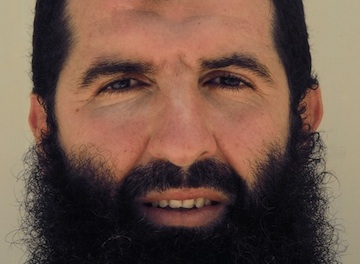 Throughout the spring and summer, while the prison-wide hunger strike at Guantánamo raged, taking up most of my attention, as I reported prisoners’ accounts, and campaigned to get President Obama to release the 86 prisoners cleared for release in January 2010 by his own inter-agency Guantánamo Review Task Force, I missed some other developments, which I intend to revisit over the next few weeks, beginning with an article by Jess Bravin for the Wall Street Journal in July.
Bravin, the Supreme Court correspondent for the Wall Street Journal and the author of the acclaimed book The Terror Courts: Rough Justice at Guantanamo Bay, wrote an article entitled, “Guantánamo Detainee Begs to Be Charged as Legal Limbo Worsens,” which perfectly captured the Alice in Wonderland-style absurdity of the prison, eleven and half years after it opened, with the remaining 164 prisoners no closer to securing justice than they were when George W. Bush set up the prison, which, at the time, was intended to be a place where they could be held without any rights whatsoever.
Highlighting one aspect of this ongoing injustice, Bravin looked at the case of Sufyian Barhoumi, identified in his article as Sufiyan Barhoumi, who, as he described it, “has decided to plead guilty to war crimes, throw himself on the mercy of the court and serve whatever sentence a US military commission deems just.” As Bravin added, however, “There’s just one problem: The Pentagon refuses to charge him.” Read the rest of this entry »
US Military Admits Only 2.5 Percent of All Prisoners Ever Held at Guantánamo Will Be Tried
 So it’s official, then. Eleven and a half years after the “war on terror” prison opened at Guantánamo, the maximum number of prisoners that the US military intends to prosecute, or has already prosecuted, is 20 — or just 2.5 percent of the 779 men held at the prison since it opened in January 2002.
The news was announced on Monday June 10 by Army Brig. Gen. Mark Martins, the chief prosecutor for the military commissions at Guantánamo, and it is a humiliating climbdown for the authorities.
When President Obama appointed an inter-agency task force to review the cases of the remaining Guantánamo prisoners, which issued its report in January 2010, the task force recommended that 36 of the remaining prisoners should be tried.
Just five of the 36 have since been to trial — one in the US, and four through plea deals in their military commissions at Guantánamo. Another man — Ali Hamza al-Bahlul — had already been tried and convicted, in the dying days of George W. Bush’s second term, and two others had been sent home after their trials — David Hicks after a plea deal in March 2007, and Salim Hamdan after a trial in July 2008 — making a total of 39 prosecutions, or intended prosecutions, after eleven and a half years of the prison’s existence. That was just 5 percent of the men held throughout Guantánamo’s history, but now that figure, which was, in itself, an extremely poor reflection on the efficacy of the prison and its relationship to any acceptable notions of justice, has been halved.
As Reuters described it, Brig. Gen. Martins explained that the number set by the task force was “ambitious” in light of two rulings last October and in January this year by judges in the court of appeals in Washington D.C. Read the rest of this entry »
On Terrorism, America Has Lost Its Way
 Last week at Guantánamo, a farcical dance played out, as it does every six months or so. Representatives of the US mainstream media — and other reporters from around the world — flew to the US naval base at Guantánamo Bay, Cuba, to witness the latest round of the seemingly interminable pre-trial hearings in the cases of Khalid Sheikh Mohammed and four other men accused of masterminding, or otherwise facilitating the terrorist attacks of September 11, 2001 on New York and Washington D.C.
The farce of the Guantánamo trials is, by now, well established, although last week’s hearings introduced the novelty of a hidden hand, unknown even to the judge, flicking an invisible switch to silence potentially embarrassing testimony, and the proceedings also took place against the backdrop of two courtroom appeals that have dealt savage blows to the claimed legitimacy of the commissions.
In the case of the 9/11 trial, a permanent feature is the seemingly insoluble tussle between the prosecution and the defense. On the one hand are the attorneys for the accused, whose job is to try and ensure that their clients do not receive unfair trials. This involves attempting, incessantly, to point out the elephant in the room — the fact that all the men were held for many years in “black sites” run by the CIA, where they were subjected to torture, approved at the highest levels of the government during the Bush administration, even though torture is a crime. On the other hand are the prosecutors, whose job, above all, appears to be to hide all mention of torture. In the middle is the judge — in the case of the “high-value detainees,” Army Col. James L. Pohl, who replaced Marine Col. Ralph Kohlmann as the Chief Presiding Officer for the Military Commissions on January 6, 2009. Read the rest of this entry »
Andy Worthington Discusses the Urgent Need to Close Guantánamo with Peter B. Collins
 As the 11th anniversary of the opening of the “war on terror” prison at Guantánamo Bay approaches (on January 11, 2013), I wanted to make sure that I made available an interview I undertook recently with the respected progressive radio host Peter B. Collins, in San Francisco. Peter’s site is here, and our 50-minute interview is here, as an MP3.
Peter and I have spoken many times over the years, and it is always a pleasure to talk to him, as he is such a well-informed host, and his shows allow complex issues — like Guantánamo — to be discussed in depth.
Out latest conversation followed the reelection of Barack Obama, and gave us an opportunity to catch up on where we stand nearly four years on from the President’s failed promise to close Guantánamo within a year. Read the rest of this entry »
Conservative Judges Demolish the False Legitimacy of Guantánamo’s Terror Trials
 When is a war crime not a war crime? When it is invented by the executive branch and Congress, and implemented for six years until a profoundly Conservative appeals court strikes it down.
The invented war crime is “providing material support to terrorism,” and on October 16, 2012, a panel of three judges in the D.C. Circuit Court (the Court of Appeals in Washington D.C.) threw out the conviction of Salim Hamdan, a driver for Osama bin Laden, who had received a five and a half year sentence for “providing material support to terrorism” at the end of his trial by military commission in August 2008 (although he was freed just five months later, as his sentence included time already served).
In its ruling, the court stated, “When Hamdan committed the conduct in question, the international law of war proscribed a variety of war crimes, including forms of terrorism. At that time, however, the international law of war did not proscribe material support for terrorism as a war crime.”
For anyone who has followed the history of the military commissions in any depth, the result was not completely unexpected. Revived by the Bush administration in November 2001, specifically for trying prisoners seized in the “war on terror,” the commissions were struck down by the Supreme Court in June 2006, but were then revived by Congress, when “providing material support to terrorism” and “conspiracy” were included as war crimes, even though there was no precedent for doing so. Read the rest of this entry »
At Guantánamo, Another Bleak Ramadan for 87 Cleared Prisoners Who Are Still Held
 I wrote the following article for the “Close Guantánamo” website, which I established in January with US attorney Tom Wilner. Please join us — just an email address is required to be counted amongst those opposed to the ongoing existence of Guantánamo, and to receive updates of our activities by email.
On Friday, when the Muslim holy month of Ramadan began, 168 men still held in the US prison at Guantánamo Bay, Cuba must have wondered if their long ordeal will ever come to an end. Now held for as long as the First and Second World Wars combined, these men — of whom only a handful are accused of any involvement with terrorism — have become scapegoats, the victims of a cowardly administration, a cynical Congress and fearful judges.
How else are we to explain the presence of 87 men whose release was approved by the Guantánamo Review Task Force, appointed by President Obama himself, when he took office in January 2009 and promised to close Guantánamo within a year? Consisting of around 60 representatives of the relevant government departments and the intelligence services, the Task Force concluded in its final report (PDF), issued in January 2010, that, of the 168 men still held, 33 should be tried and 46 should be held indefinitely without charge or trial, while the other 87 should be released.
Here at “Close Guantánamo,” we are rigorously and implacably opposed to President Obama’s claim that it is acceptable to hold 46 men indefinitely without charge or trial, because it is fundamentally unjust to claim, as the administration does, that these 46 men represent a danger to the United States, even though there is insufficient evidence to put them on trial. What this means is that the so-called evidence is fatally tainted, produced through the use of torture, or other forms of coercion, and is therefore fundamentally unreliable. Read the rest of this entry »
US Honors Deal to Release Convicted Bin Laden Cook from Guantánamo to Sudan; 87 Cleared Men Still Await Release
 Getting out of Guantánamo is such a feat these days (with just three men released in the last 18 months) that it is remarkable that Ibrahim al-Qosi, a Sudanese prisoner who agreed to a plea deal at his war crimes trial in Guantánamo in July 2010, guaranteeing that he would be freed after two years, has been repatriated as promised. 168 prisoners now remain in Guantánamo.
With a typical disregard for the principle that a prisoner — any prisoner — must be freed when their sentence comes to an end, the US has maintained, since the “war on terror” began nearly 11 years ago, that prisoners at Guantánamo can continue to be held after their sentence has come to an end, and be returned to the general population as “enemy combatants,” even though President Bush failed to do this when he had the opportunity — with Salim Hamdan, a driver for Osama bin Laden who was freed after serving a five-month sentence handed down after his military trial in 2008.
A source with knowledge of al-Qosi’s case, who does not wish to be identified, told me that the Obama administration was unwilling to detain al-Qosi after his sentence came to an end, and I believe that one of the reasons that the President negotiated a waiver to the provisions in the National Defense Authorization Act, allowing him to bypass restrictions on releasing prisoners that were imposed by Congress, was to prevent Republicans from trying to force him to continue holding al-Qosi. Read the rest of this entry »
Chaos at Guantánamo as the 9/11 Trial Begins
 On Saturday, the eyes of the world were on Guantánamo, as Khalid Sheikh Mohammed and four other men accused of planning and facilitating the terrorist attacks of September 11, 2001 — Ramzi bin al-Shibh, Ali Abd al-Aziz Ali, Mustafa Ahmed al-Hawsawi and Walid bin Attash — appeared in a courtroom for the first time since December 2008. All were dressed in white, apparently at the insistence of the authorities at Guantánamo, and most observers made a point of noting that Mohammed’s long gray beard was streaked red with henna.
For the Obama administration and the Pentagon, the five men’s appearance — for their arraignment prior to their planned trial by military commission — was supposed to show that the commissions are a competent and legitimate alternative to the federal court trial that the Obama administration announced for the men in November 2009, but then abandoned after caving in to pressure from Republicans. The five defendants face 2,976 counts of murder — one for each of the victims of the 9/11 attacks — as well as charges of terrorism, hijacking, conspiracy and destruction of property, and the prosecution is seeking the death penalty.
Unfortunately for the administration, the omens were not good. The military commissions have been condemned as an inadequate trial system ever since the Bush administration first resurrected them in November 2001, intending, in the heat of post-9/11 vengeance, to use them to swiftly try and execute those it regarded as terrorists. However, after long delays and chaotic hearings, this first reincarnation of the commissions was struck down as illegal by the Supreme Court in June 2006. The commissions were then revived by Congress a few months later, and were then tweaked and revived by President Obama in the summer of 2009, despite criticism from legal experts. Read the rest of this entry »












 Who's still at Guantánamo?

