As Trump Becomes President, New Close Guantánamo Poster and Photo Campaign Launches: “Donald Trump No! Please Close Guantánamo!”
 Please support my work! I’m currently trying to raise $2500 (£2000) to support my writing and campaigning on Guantánamo over the first two months of the Trump administration.
I wrote the following article for the “Close Guantánamo” website, which I established in January 2012, on the 10th anniversary of the opening of Guantánamo, with the US attorney Tom Wilner. Please join us — just an email address is required to be counted amongst those opposed to the ongoing existence of Guantánamo, and to receive updates of our activities by email.
So let’s keep this short and sweet. We need to work on Donald Trump from Day One of his presidency to get Guantánamo closed. Here’s the poster for you to print off, take a photo with, and send to us!
Unfortunately, President Obama is leaving office with a black stain on his name for having failed to close Guantánamo despite promising to do so on his second day in office eight long years ago, and despite our relentless campaigning here for the last five years, including over the last year with the Countdown to Close Guantánamo, an initiative that campaign co-founder Andy Worthington launched with music legend Roger Waters on Democracy Now! last January.
Throughout the year, campaigners across the US and around the world stood with posters reminding President Obama how many days he had left to close Guantánamo — at first at 50-day intervals, and then, in the last 50 days, at 5-day intervals, and, for the last five days, on a daily basis. Over 700 photos were submitted, and we thank all of you who took part. See the photos here: Celebrity photos, Public photos 1, Public photos 2, Public photos 3, Public photos 4 and Public photos 5. Read the rest of this entry »
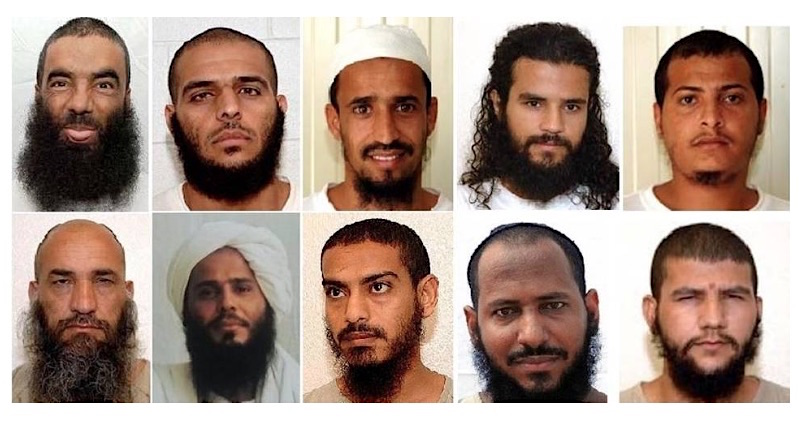
Who Are the Ten Guantánamo Prisoners Released in Oman, Leaving 45 Men Still Held, Including Nine Approved for Release?
 Please support my work! I’m currently trying to raise $2500 (£2000) to support my writing and campaigning on Guantánamo during the first two months of the incoming Trump administration.
So there was great news from Guantánamo on Monday, when ten men — eight Yemenis and two Afghans — were released and sent to Oman, which has previously taken in 20 Yemenis. The Yemenis have been the most difficult category of prisoners to be freed from Guantánamo, because the entire US establishment is unwilling to repatriate them, fearing the security situation in their home country, meaning that third countries must be found that are prepared to offer them a new home — and are prepared to overlook the fact that the US itself is unwilling to do that, and, in fact, that Congress has, for many years, passed laws specifically preventing any Guantánamo prisoner from being brought to the US mainland for any reason.
The ten releases leave 45 men still held at Guantánamo, with three or four more releases expected before President Obama leaves office on Friday, according to the latest reports. At present, however, nine men approved for release are still held, and the release of those left behind when Obama leaves the White House must be a priority for campaigners as soon as Donald Trump takes office.
Of the ten men released, two were approved for release in 2009 by the high-level, inter-agency Guantánamo Review Task Force that President Obama established shortly after first taking office, while the other eight were approved for release between May 2014 and December 2016 by Periodic Review Boards, another high-level, inter-agency review process, and one that campaigners must also press Donald Trump to keep. Read the rest of this entry »
Video: Andy Worthington Laments Obama’s Failure to Close Guantánamo – and Fears What Trump Will Do – Outside the Supreme Court on Jan. 11
 Please support my work! I’m currently in the US to campaign for the closure of Guantánamo and trying to raise $1000 (£800) to support my visit.
On Wednesday, I was outside the Supreme Court in Washington, D.C. for the annual protest against the continued existence of the “war on terror” prison at Guantánamo Bay, with representatives from rights groups including Witness Against Torture, Amnesty International, the Center for Constitutional Rights and the National Religious Campaign Against Torture, plus some powerful spoken word pieces by The Peace Poets.
I spoke about the double disappointment of this depressing anniversary, with Obama just days away from failing to fulfill the promise to close Guantánamo that he made on his second day in office nearly eight years ago, and Donald Trump about to take the prison over with his wild promises to “load it up with some bad dudes,” and I urged those gathered to make it a priority, from Day One of the Trump presidency, to demand that Trump frees those men still held who have been approved for release (19 at present, although we are told that between 13 and 15 will be freed by Obama in his last week), and also to demand that he continues with the latest review process, the Periodic Review Boards, for which 26 of the remaining 55 prisoners continue to be eligible.
The PRBs, which function like parole boards, have reviewed the cases of 64 men in the last three years, and 38 have been approved for release. The 26 other men had their ongoing imprisonment upheld, but their cases are regularly reviewed, and some of them will almost certainly also be approved for release — unless Trump repeals Obama’s 2011 executive order establishing the PRBs. Read the rest of this entry »
Please Read “Teaching Trump About Gitmo,” An Op-ed in the New York Daily News by Close Guantánamo Co-Founders Tom Wilner and Andy Worthington
 Please support my work! I’m currently in the US to campaign for the closure of Guantánamo on the 15th anniversary of its opening, and trying to raise $1000 (£800) to support my visit.
I’m delighted to report that yesterday, while I was crossing the Atlantic by plane and was offline, the New York Daily News published “Teaching Trump About Gitmo,” an op-ed that I wrote with my friend and colleague Tom Wilner, the US attorney with whom I co-founded the Close Guantánamo campaign exactly five years ago.
The op-ed was a response to the president elect’s recent — and disgraceful — tweet, in which he stated, “There should be no further releases from Gitmo. These are extremely dangerous people and should not be allowed back onto the battlefield.”
In the hope of educating Mr. Trump, Tom and I pointed out that, of the 55 men still held, 19 have been approved for release by two inter-agency review processes — 2009’s Guantánamo Review Task Force, and the current Periodic Review Boards — which are “made up of our nation’s top security, defense and justice officials,” and just ten are facing — or have faced — trials, leaving 26 others whose cases should continue to be reviewed by the Periodic Review Boards, as it seems certain that some of them will also end up being approved for release, like 38 of the 64 men originally whose cases have been reviewed by the PRBs in the last three years. Read the rest of this entry »
Who Are the Four Guantánamo Prisoners Freed in Saudi Arabia, Leaving 55 Men Still Held?
 Please support my work! I’m currently trying to raise $2500 (£2000) to support my work on Guantánamo over the next two months.
Good news from Guantánamo, as four men have been released to Saudi Arabia, reducing the prison’s population to 55, the lowest number since its opening weeks 15 years ago.
The four men are Yemeni citizens — although one was born in Saudi Arabia, but to Yemeni parents, meaning that he was not given citizenship. A third country had to be found that was prepared to take them in, because the entire US establishment agrees that it is unsafe, from a security perspective, to repatriate any Yemenis. The men will go through Saudi Arabia’s well-established rehabilitation program, although, to be honest, it is obvious upfront that none of these men can be regarded as a threat.
Two were approved for release by President Obama’s cautious, inter-agency Guantánamo Review Task Force in 2009, while the other two were approved for release more recently by the latest inter-agency review process, the Periodic Review Boards, which consider the prisoners’ cases in a manner similar to parole boards — except, of course, for the crucial fact that the men in question have never been convicted of any crimes.
The first of the four, whose case has rarely been discussed, is Abdullah Yahia Yousef al Shabli (ISN 240), who, according to US records, was born in Jeddah on September 10, 1977. Al-Shabli was approved for release by the task force in 2009, but is one of 30 men the task force placed in a category of their own invention, “conditional detention,” which was only supposed to end when someone — it was not determined who, or how — established that the security situation in Yemen had improved. As I explained in August, when 12 Yemenis were released in the UAE, “those in the ‘conditional detention’ group languished until the Obama administration began finding countries that would offer new homes to them, a process that only began last November and that, before [the August] releases, had led to 19 men being given new homes — in the UAE, Ghana, Oman, Montenegro and Saudi Arabia.” Six of the 12 Yemenis freed in August were from the “conditional detention group,” and with the two releases to Saudi Arabia from this group, just three men from this group are left — plus another two men from the 126 other men approved for release by the task force. Read the rest of this entry »
Another Yemeni Approved for Release from Guantánamo: Did He Make the List of Prisoners Being Freed in the New Year?
 Please support my work! I’m currently trying to raise $3000 (£2400) to support my writing and campaigning on Guantánamo into 2017.
Just before Christmas, it was announced that Mohammed al-Ansi aka Muhammad al-Ansi (ISN 029), a Yemeni prisoner at Guantánamo, had been approved for release by a Periodic Review Board. The decision made al-Ansi the 38th prisoner to be approved for release by a PRB, and the seventh to be approved for release not after a first review, but after a second review. The decision also means that, of the 59 men still held, 23 have been approved for release.
The PRBs — consisting of representatives of the Departments of State, Defense, Justice and Homeland Security, as well as the office of the Director of National Intelligence and the Office of the Joint Chiefs of Staff — were set up in 2013 to review the cases of all the prisoners not already approved for release or facing trials, and 64 men have had their cases reviewed, with just 26, to date, having their ongoing imprisonment upheld. That’s a success rate of 59% for the prisoners, which rather undermines the alleged basis of their ongoing imprisonment when the PRBs were set up.
41 of the 64 men had been described as “too dangerous to release” by the previous review process, the Guantánamo Review Task Force that President Obama established shortly after taking office in 2009, even though the task force acknowledged that there was insufficient evidence to put them on trial, while the 23 other men had been recommended for prosecution until the basis for prosecutions largely collapsed under judicial scrutiny. For further information, see my definitive Periodic Review Board list on the Close Guantánamo website. Read the rest of this entry »
Periodic Review Boards Approve Another Two Yemenis for Release from Guantánamo
 Please support my work! I’m currently trying to raise $3000 (£2400) to support my writing and campaigning on Guantánamo into the new year.
Attentive Guantánamo-watchers will recall that, in September, the first round of Periodic Review Boards was completed at Guantánamo, for prisoners assessed as being “too dangerous to release,” or as eligible for prosecution by the high-level, inter-agency Guantánamo Review Task Force that President Obama set up shortly after taking office for the first time in January 2009. For full details, see my definitive Periodic Review Board list on the Close Guantánamo website.
On both fronts, the decisions taken about these men back in 2009 were dubious. For those deemed “too dangerous to release,” the task force acknowledged that insufficient evidence existed to put them on trial, rather undermining the credibility of their assessment, because, if information cannot be produced at a trial, it is fundamentally unreliable and does not rise to the level of evidence — and with Guantánamo, of course, torture and abuse run through everything, distorting all manner of claims regarding the credibility of the US authorities’ information about the prisoners.
41 men put forward for the PRBs were regarded as “too dangerous to release,” while 23 others had been recommended for prosecution, until the basis for prosecutions at Guantánamo — in the much-criticized military commission system, dragged unwisely from the history books after 9/11 — largely collapsed as a result of a number of appeals court rulings, which overturned some of the few convictions secured in the commissions, on the basis that the war crimes for which the men in question had been convicted were not internationally recognized, and had, in fact, been invented by Congress. Read the rest of this entry »
Please Write to the Remaining Prisoners in Guantánamo in Obama’s Last Month in Office
 Please support my work! I’m currently trying to raise $3000 (£2400) to support my writing and campaigning on Guantánamo into the new year.
Twice a year, since 2010, I’ve asked those who oppose the ongoing existence of Guantánamo to write to the prisoners still held there, to let them — and the US authorities — know that they have not been forgotten. For the last letter-writing campaign, in March, I expressed my hope that President Obama might fulfill the promise he made on his second day in office in January 2009, to close the prison for good, but that has not happened, of course, and now the specter of Donald Trump hovers over the wretched facility, with his promises to keep it open, and to send new prisoners there.
Whether the prisoners are worried is unclear. Eight years ago, they cheered President Obama’s victory, thinking that it meant Guantánamo would soon be closed, but eight years later many of them are still held, and presumably have every reason to believe that there is little to hope for. The day after the election, the Miami Herald reported that Army Lt. Col. John Parks, the spokesman for the prison, said that “[m]any detainees did stay up and watch the election results,” although they showed no reaction that he could discern. However, on December 1, on “CBS This Morning,” Margaret Brennan spoke to David Remes, the attorney for the Pakistani prisoner Saifullah Paracha, who “said that many detainees thought that it was the end of the world and felt terrible [and] asked for tranquilizers, sleeping pills, because they were so distraught.”
The letter-writing campaign was started six and a half years ago by two Facebook friends, Shahrina and Mahfuja Ahmed, and, as I mentioned above, it has been repeated every six months, more or less (see here, here, here, here, here, here, here, here, here and here for my other articles encouraging people to write to the prisoners). Read the rest of this entry »
Yemeni Freed in Cape Verde: 59 Men Left in Guantánamo

Please support my work! I’m currently trying to raise $2500 (£2000) to support my writing and campaigning on Guantánamo into the new year.
Good news from Guantánamo, as the first prisoner to be released since Donald Trump won the Presidential Election last month has been freed in Cape Verde, an island nation off the west coast of Africa.
Shawki Awad Balzuhair aka Shawqi Balzuhair (ISN 838), a 35-year old Yemeni prisoner, was approved for release in July, by a Periodic Review Board, a high-level government review process set up in 2013 to review the cases of all the prisoners still held who are not facing trials and had not already been approved for release.
Seized in one of a series of house raids in Karachi, Pakistan on September 11, 2002, Balzuhair and five other men were originally — and mistakenly — regarded as members of an al-Qaeda cell-in-waiting, and described as the “Karachi Six.” By the time the six had their cases reviewed this year, however, the US government had walked back from its claims, after “a review of all available reporting,” accepting that “this label more accurately reflects the common circumstances of their arrest and that it is more likely the six Yemenis were elements of a large pool of Yemeni fighters that senior al-Qa’ida planners considered potentially available to support future operations,” and describing Balzuhair as “probably awaiting a chance to return to Yemen when he was arrested at the Karachi safe house.” Of the six men, five have been approved for release, and Balzuhair is the third to be freed. Read the rest of this entry »
Final Two Review Board Decisions Announced: 21 Men Now Approved for Release from Guantánamo
 Please support my work! I’m currently trying to raise $2500 (£2000) to support my writing and campaigning on Guantánamo into the new year.
On September 9, as I reported at the time, the last of 64 Guantánamo prisoners to face a Periodic Review Board— Hassan bin Attash, who was just 17 when he was seized in September 2002 — had his case reviewed. A month later, a decision was taken in his case (to continue holding him), bringing the first round of the PRBs to an end, with two exceptions.
In the cases of two men whose cases were reviewed in April and May, the board members had been unable to reach a unanimous decision, and. for these two men, decisions were not reached until last week — November 21, to be exact. In the case of one man, Jabran al-Qahtani, a Saudi, the board members approved his release, while in the case of the other man, Said Nashir, a Yemeni, a decision was taken to recommend his continued imprisonment.
The decisions mean that, of the remaining 60 prisoners, 21 have been recommended for release —seven by the high-level, inter-agency Guantánamo Review Task Force, which President Obama established shortly after taking office in 2009, to review the cases of all the men he had inherited from George W. Bush, and 14 by the PRBs. For further information, see my definitive Periodic Review Board list on the Close Guantánamo website. Read the rest of this entry »












 Who's still at Guantánamo?
