Big Skies and Global Beats: Photos from WOMAD’s 30th Anniversary Festival (2/2)


Big Skies and Global Beats: WOMAD’s 30th Anniversary Festival (2/2), a set on Flickr.
Yesterday I published my first set of photos from this year’s WOMAD world music festival in Charlton Park, Wiltshire, celebrating its 30th anniversary this year. The product of a great flowering of interest in festivals, WOMAD, which began in 1982, as the brainchild of Peter Gabriel and five friends and colleagues, tapped into the thirst for festivals that Michael Eavis had identified at Glastonbury, when the modern era of Glastonbury began with the 1981 festival and a name change from the Glastonbury Fayre to the Glastonbury Festival.
Long-time readers of my work will know how much the festival culture that has since bloomed into a phenomenon that draws millions of people into fields every summer came out of the upheavals of the 1960s and free festival movement of the 1970s, and, at its best, drew on Utopian, cooperative, environmentally aware ideals that were ahead of their time. A trajectory of these counter-cultural movements, and their successors in the 1980s and 1990s, in the rave scene and the road protest movement, can be found in my books Stonehenge: Celebration and Subversion and The Battle of the Beanfield. Read the rest of this entry »
I’m Off to WOMAD, Back on Monday: Please Listen to Me Discussing Bagram on the Radio with Scott Horton
 Every year, on the last weekend in July, WOMAD (World of Music, Arts and Dance), the world music festival, takes place in the UK — for the last few years, in Wiltshire, on a wonderful site in Charlton Park — and this year is its 30th anniversary. My wife has been running children’s workshops there since 2002, and every year a group of us — friends and our kids — get to hang out together for four days, to do the workshops and create a wonderful sculpture for the children’s procession on the Sunday, to eat great food (unlike the kind of catering that will be in place for the Olympics), to watch great music, and to chill out backstage, and also in the backstage camp. My guitar is tuned, and I’m looking forward to some strumming and singing.
I’m back on Monday, but while I’m away, please check out the photos I’ve been posting regularly over the last month, if you haven’t yet seen them, beginning with yesterday’s excursion to the Olympic Park in the blazing sun — and see below for a bonus photo from Greenwich, which I took on my way back home. Click on the photo to enlarge it — and I’ve also just added it to the Olympics set on Flickr. Read the rest of this entry »
The Olympics Minus One Day: Photos from the Frontline in Stratford


The Olympics Minus One Day: Photos from the Frontline in Stratford, a set on Flickr.
So the Games are nearly upon us! I won’t be here in London, as I’ll be at the WOMAD festival in Wiltshire; that’s World of Music, Arts and Dance, the wonderful world music festival celebrating its 30th anniversary this year, where my wife has been running children’s workshops since 2002, and a whole crowd of us has a wonderful escape from the normal routine for four days.
However, I couldn’t leave without paying one more visit to the Olympic Park in Stratford to see how everything was proceeding with preparations for the Games, with just one day to go before the Opening Ceremony on Friday July 27. I last paid a visit three weeks ago — the photos can be seen here — and I had wondered whether security would be hectic.
The bad news, of course, is the same as ever. In the run up to the Games, we have been subjected to jingoism, militarism, the corporate tax evasion of the Games’ sponsors, the brand police patrolling up and down the land, the International Olympic Committee’s inflexibility and arrogance, the dubious “cleansing” of the Lea Valley, and the inexcusable decision by two successive governments to write blank cheques for the Games without even a proper audit. Read the rest of this entry »
Photos: The Olympic Torch in Lewisham, and Some Last Thoughts on the Dodgy Games


The Olympic Torch in Lewisham, a set on Flickr.
So the time is nearly upon us. The Olympic Games — corporate, militarised, jingoistic — begin on Friday, and, after a plague of disasters in recent weeks, everything appears to be running relatively smoothly on the last lap. This morning I popped down the hill with my family, to Ladywell Leisure Centre, on the main road between Lewisham and Catford, to watch the Olympic torch pass by, and to watch those watching.
Despite the early hour — the torch passed by just after 8am — there were hundreds of people present for the passage of the torch itself, and of the corporate sponsors’ vehicles — in this case, those of Coca-Cola and Lloyds TSB, although sadly no one asked me about my T-shirt, which features a Union Jack and the message, “Extradite Me, I’m British.” Available here (for just £9), the shirts were created to publicise the plight of Talha Ahsan, Babar Ahmad, Gary McKinnon and Richard O’Dwyer, who face extradition to the United States under the US-UK Extradiiton Treaty of 2003, a creation of Tony Blair’s government that allows British citizens to be spirited away to the US — and its out-of-control judicial system — without the US having to provide any evidence, even if the alleged crimes took place in the UK, and even if the alleged crimes are not crimes in the UK. See here, here, here and here for further information.
Nevertheless, despite the concerted effort to focus on the supposedly positive sporting message of the Games, the stink caused by the recent scandals still lingers. It can be noted with some sense of satisfaction that G4S, the inept security firm, has done permanent damage to the cynical corporate — and governmental — mantra that “private is best” by failing to employ enough security, despite being paid £284 million to do so. Read the rest of this entry »
Olympics Disaster: The G4S Security Scandal and Corporate Sponsors’ £600 Million Tax Avoidance
 As the cracks in the Tory-led coalition government grow more and more obvious, the biggest question may be whether it is incompetence or corruption that will depose the clowns who have been pretending to run the country for the last two years. In terms of the Olympics, which, two months ago, I described as a militarised, corporate, jingoistic disgrace, the incompetence particularly involves security and travel, and in terms of corruption, it involves the tax haven created for the duration of the Games, as reported last week.
On the security front, it was revealed that G4S, the biggest employer listed on the London Stock Exchange, with more than 650,000 staff worldwide, had spectacularly failed to fulfil its £284 million Olympics contract, in which it was supposed to provide 13,700 personnel for the Games. Just two months ago, it was reported that G4S had had 100,000 applications for 10,000 job vacancies, the inference being that all was proceeding smoothly.
That, however, was spectacularly untrue, as became apparent on Thursday, with just two weeks to go before the Games begin, when it was revealed that the government was arranging for 3,500 military personnel to be provided to make up for G4S’s inability to meet its commitment.
As the Guardian noted, “The news was met with disbelief. Diana Johnson, the shadow home office minister, tweeted: ‘This is the same G4S who aspire to win policing services through privatisation. Not reassuring.'” Read the rest of this entry »
Rivers at Dusk: Photos of My Journey from Stratford to Canary Wharf


Rivers at Dusk: My Journey from Stratford to Canary Wharf, a set on Flickr.
This eighth set of my photos of London, on the Flickr account that I set up last month, is part of my ongoing mission to travel the whole of London by bike, taking photos of everything that appeals to me — from the famous to the obscure, the rich, the poor, the natural and the man-made — and is the third and final part of a journey I undertook on July 5, 2012, first of all touring the bankers’ towers and the former docks of Canary Wharf, which I published as The Power of Greed: Photos of Canary Wharf, and then cycling the Lea Valley Walk — along the Limehouse Cut and the River Lea — to Stratford, for a glimpse of the Olympic Park, which I published as In Search of the Olympics: Photos of a Journey from Limehouse to Stratford.
After the alarm of the Olympic experience — far too much building work, and palpable paranoia, or, at least, the presence of a handful of zealous security jobsworths — it was refreshing to get lost in the backwaters of Three Mills Island, just a stone’s throw from the Olympic Park, and then to be beside the River Lea as the sun began slowly to set and to paint the trees and the river in a warm light that had been missing from a day in which the weather oscillated between sharp sunlight and the swift emergence of dark clouds filled with showers. Read the rest of this entry »
In Search of the Olympics: Photos of a Journey from Limehouse to Stratford


In Search of the Olympics: A Journey from Limehouse to Stratford, a set on Flickr.
On July 5, after I had undertaken the photographic tour of Canary Wharf that I recorded in my previous set of photos, The Power of Greed: Photos of Canary Wharf, I headed north, up to Commerical Road, unsure if I would travel on to the East End or visit the Olympic Park at Stratford. After joining a towpath, which I thought was the Regent’s Canal, which I had travelled the day before, I soon realised that I was, in fact, on Limehouse Cut, the southern end of the 18-mile Lea Valley Walk, which follows the formidable River Lea all the way up to its origin at Leagrave, north of Luton, near Waulud’s Bank, one of the great henges — circular earthen banks and ditches — of Neolithic Britain, along with those at Durrington Walls (near Stonehenge), and at Avebury and Marden in Wiltshire.
Having found myself on the Lea Valley Walk by accident, I took it as a sign that I should follow it to Stratford and the Olympic park, but I had no idea that, after travelling through Bow Common and Bromley in Tower Hamlets, I would suddenly — after passing under the A12 — find myself in what appeared to be the countryside, as the canal came up alongside the River Lea, and there were locks, sweeping views, the extraordinary old buildings at Three Mills, and then, suddenly, the gigantic building site in Stratford that is the home of the 2012 Olympics.
As another stage of my ongoing mission to travel the whole of London by bike, photographing whatever interests me — the buildings old and new, the rivers and canals, the skies and trees, the street art and decay — this journey pitted the traditional infrastructure of London’s waterways with the modem developments that have sprung up alongside it, and, in particular, with the cleansing of history along the Lea Valley and the outrageous and irresponsible blank cheque issued to those erecting the giant Olympics playground. Read the rest of this entry »
My Photos on Flickr: Bermondsey and the River Thames, June 2012
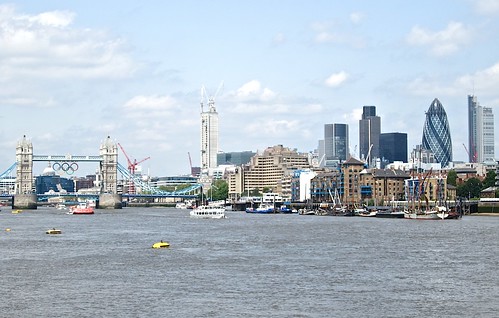


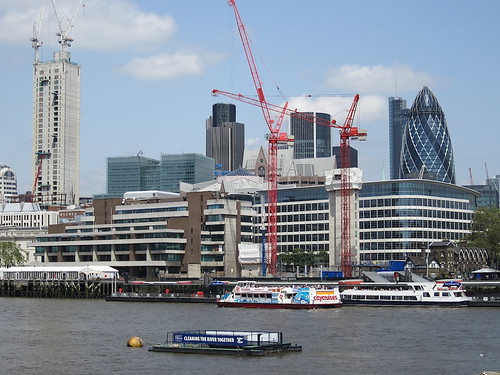
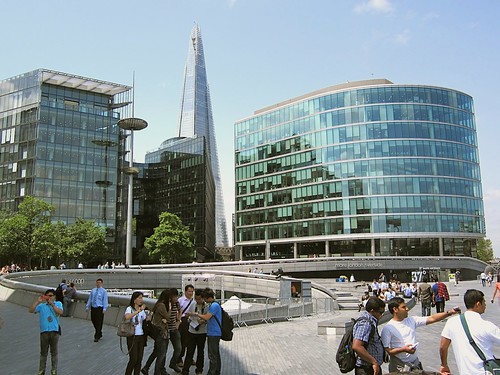


Bermondsey and the River Thames, June 2012, a set on Flickr.
This set of photos, recording elements of a journey I made by bike on June 28, 2012 from south east London to the West End and back, is the third set of photos of London that I’ve uploaded to my recently established Flickr account, based on my newly-discovered means of escape from the chains that tie me to my computer and my work as a freelance investigative journalist — cycling around London with a camera, recording whatever captures my attention: buildings old and new, the sky, the river, trees and parks, and street art.
I’m also drawn to signs of emptiness, untidiness and decay that stand in contrast to the shiny new corporate buildings and endless “luxury” housing developments that are still springing up as part of a rigged economy, and that stand in such marked contrast to the savage age of austerity to which London’s poorer citizens are being subjected. Read the rest of this entry »
My Photos on Flickr: The Isle of Dogs, the River Lea and the Olympics


The Isle of Dogs, the River Lea and the Olympics, a set on Flickr.
Regular readers will know that, after the rainiest spring in living memory, I found myself unable to stay in the house when the sun started shining again. My mission to take advantage of the good weather, and to take exercise and stretch my eyes and my mind beyond what I was beginning to regard as the confines of my computer, has resulted, over the last few months, in numerous journeys around London by bike. With my camera close at hand, the intention of these journeys has generally had less to do with getting from A to B than with wandering, getting lost and exploring.
I recently set up a Flickr account, initially posting photos of my trip to the US in January to campaign for the closure of Guantánamo, and of other protests in the UK, but this week I also began posting photos from my London journeys, beginning with a set of photos of my initial cycle journey around Deptford and Greenwich, and continuing here. Others will follow soon.
I am, I think, fulfilling a long dormant need to be in motion physically rather than constantly undertaking the mental journeys of the last five years of my life as a full-time freelance investigative journalist, and I am also at the beginning of a long project to travel — and photograph — the whole of London by bike. I have discovered that, as well as looking for spectacular views of the city that has been my home for 27 years, including many that I have never seen before, I am also in search of forgotten corners, and images of decay, often set against those of what is often termed “regeneration,” as well as the explosions of dissent and nonconformity and colour that are to be found in London’s street art. Read the rest of this entry »
My Photos on Flickr: Deptford and Greenwich, May 2012
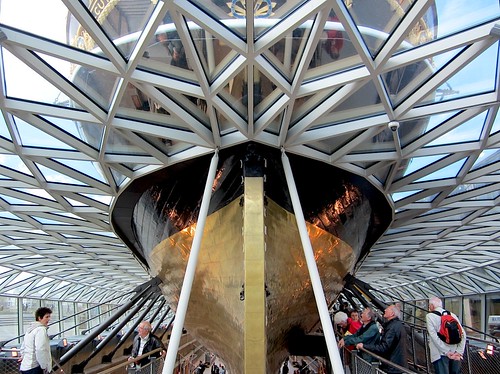

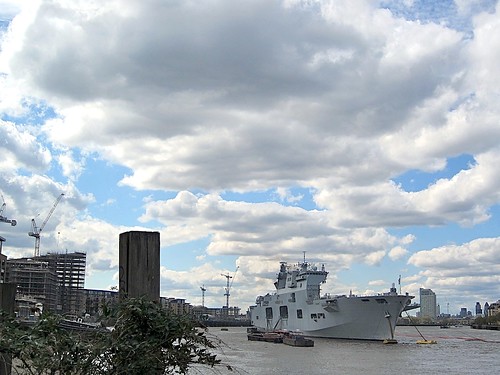

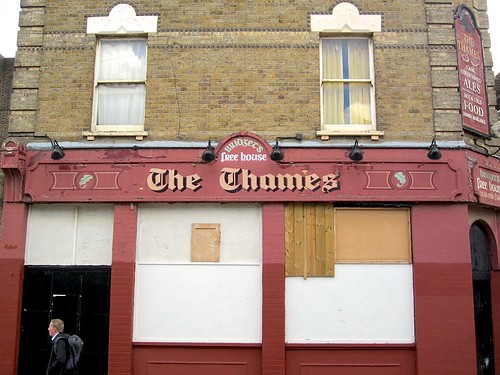


Deptford and Greenwich, May 2012, a set on Flickr.
The latest set of photos I have posted to my new Flickr account is something of a departure for me, after my three US photosets and a UK protest set: the first instalment of a regular, ongoing series in which my intention is to visit — by bike — as much of London as possible, and to photograph whatever takes my interest: trees, rivers, skies, architecture and street art, derelict places, industrial sites, decay, hubris, forgotten corners and unusual juxtapositions.
I have been a cyclist from an early age, and first began taking photos around the age of 17, a passion that I let slip for many years, after my last analogue camera gave up the ghost, and that I did not renew — apart from regularly hijacking my wife’s camera on holidays — until she bought me a digital camera at Christmas: the small and attractive Canon Ixus 115 HS.
On May 11, when the sun started shining after the wettest spring in living memory, I found myself unable to stay indoors, and began to cycle — at first, as this set shows, down the hill from my home in Brockley, in south east London, to Greenwich and Deptford, and, as future sets will reveal, also around Brockley, Lewisham, Hither Green, Lee, Catford, to Forest Hill and on to Dulwich, and along the Thames north and south of the river. Read the rest of this entry »











 Who's still at Guantánamo?
