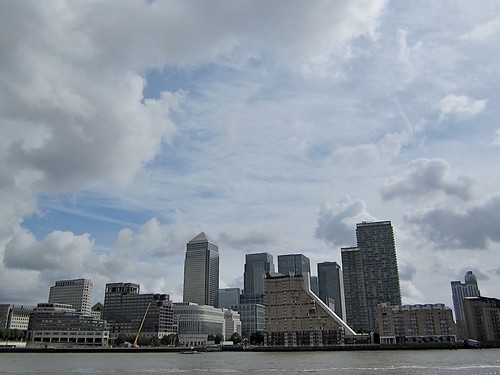
Shops, Ships and Union Jacks: Photos of a Surreal Tour Around Canary Wharf


Shops, Ships and Union Jacks: A Surreal Tour Around Canary Wharf, a set on Flickr.
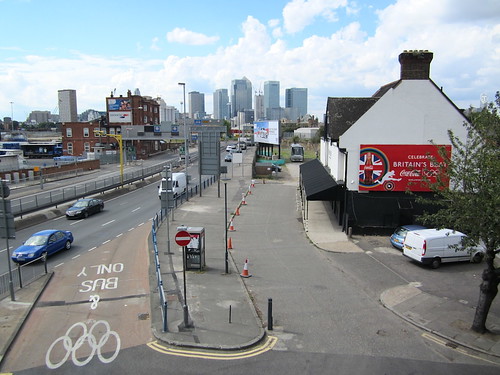
This photo set — the 60th in my ongoing project to photograph the whole of London by bike — is the last in a series of five sets recording a journey I made one sunny day in July, from my home in south London, through New Cross and Bermondsey by bike, across Tower Bridge, and up through Shadwell to Commercial Road, which I followed — with many fruitful deviations — along its whole length, to the junction where West India Road bears off towards Canary Wharf, and Commercial Road becomes East India Road.
As my camera battery had run out, but I couldn’t bear not having a working camera, I decided to find one in Canary Wharf, which was more difficult than I expected, as the shop I needed was some distance from where I parked my bike, through a series of shopping malls whose scale surprised me, as they now constitute another city entirely. Read the rest of this entry »
Call Time on This Wretched Government and Its Assault on the Disabled
 Please, please, please sign and promote the petition, initiated by Pat Onions and other disabled activists, calling for the British government to “stop and review the cuts to benefits and services which are falling disproportionately on disabled people, their carers and families.” The petition needs to reach 100,000 signatures by November 1 to be eligible for Parliamentary debate.
One month ago, the Paralympic Games came to an end, and there were hopes that, after two weeks in which disabled people had been the focus of the media and the British people, and had performed spectacularly well, the time might be ripe for those fortunate enough not to be physically or mentally disabled to realise that they were being lied to by their government, and that the Tories’ wretched assault on disabled people as cheats and scroungers was both cruel and deeply unfair.
In a cynical attempt to cut expenditure on welfare, the government has embarked upon a particularly horrific assault on the mentally and/or physically disabled through the Work Capability Assessment (WCA), administered by the French-based multinational company Atos Healthcare, and designed to find disabled people fit for work, even when, as in a heartbreakingly large number of cases, they are not.
In addition, hundreds of thousands of disabled people will lose between £20 and £131.50 a week when the Disability Living Allowance (DLA) that is a crucial part of their support is ”replaced with the more restrictive Personal Independence Payments as part of a £2.2billion cost-cutting plan,” as the Sunday Mirror explained last month. As the Mirror also explained, “The DLA currently goes to around 3.2 million people at a cost of £12.6 billion a year. Analysts estimate up to 500,000 disabled people will have their allowance entirely withdrawn over the next four years as eligibility criteria is tightened.” Read the rest of this entry »
Photos of Blackheath and Greenwich: Olympic Memories and Other Journeys


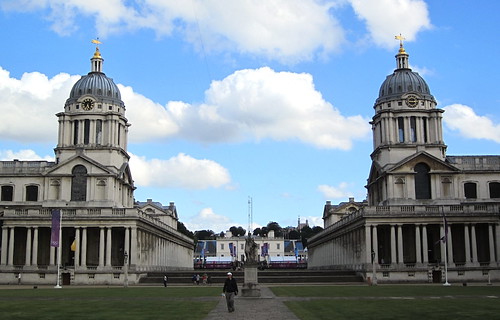


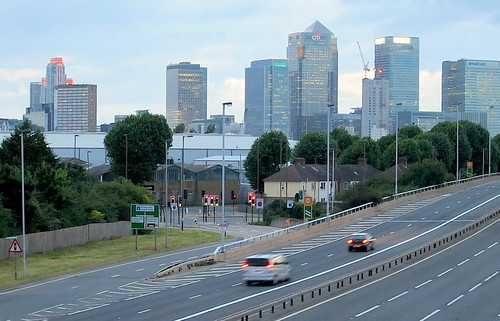


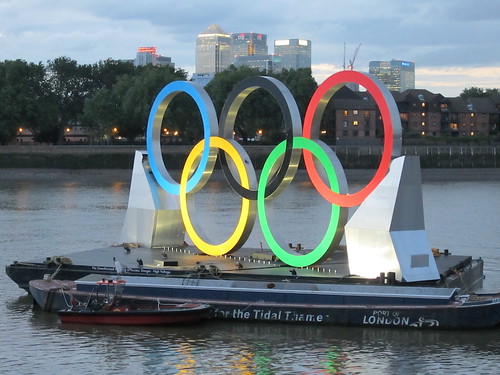

Blackheath and Greenwich: Olympic Memories and Other Journeys, a set on Flickr.
In my ongoing project to photograph the whole of London by bike, which I began in May, the extent of my cycling, and of my photography, has far exceeded my ability to upload the photos to my Flickr account. I have over 160 photos sets to upload, of photos taken before my family holiday in August, and in the six weeks since my return — photos from the West End, the City, from east London, north London, west London and south London.
As autumn continues, and the days get shorter, and the weather — presumably — will become less conducive to photography, I will no doubt find more time to make these photos available, but for now I’m dipping in and out of the archive, uploading whatever draws my attention, and to that end this latest set features photos from a visit I made, with my son Tyler, to Blackheath, the big, high plateau to the east of where I live in Brockley, in south east London, on August 1. This was when the Olympic Games were in full swing, and Greenwich Park, accessed from Blackheath as well as from the centre of Greenwich, at the foot of the hill, was the venue for the equestrian events, which I initially photographed here. Read the rest of this entry »
Crowds and Culture: Photos of Trafalgar Square, Charing Cross and the Southbank Centre


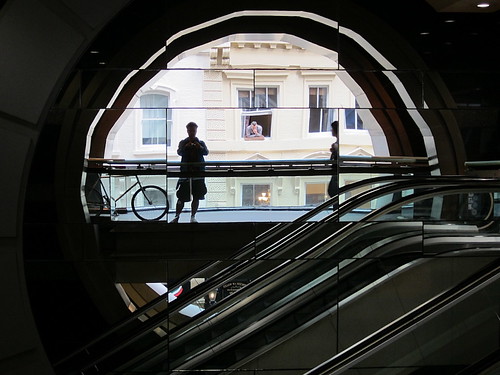


On Friday August 31, 2012, I attended a protest in Triton Square, just north of Euston Road, outside the offices of Atos Healthcare, the multinational company that is running the government’s vile review process for disabled people, which is designed to find them fit for work when they are not. See the Flickr set here.
Afterwards, as part of my ongoing project to photograph the whole of London by bike, I took the opportunity to take photographs as I travelled through Fitzrovia to Oxford Street, where I met my wife and my son for a visit to HMV in search of DVDs and CDs, and then, afterwards, to take photos of Oxford Street, and then to visit Trafalgar Square, where a screen had been set up for the Paralympic Games. I then crossed the river on the Hungerford Bridge, taking photos from the elevated walkway beside Charing Cross station, and on to the Southbank Centre. The previous Flickr sets are here and here. Read the rest of this entry »
Photos of the Paralympics Demonstration Against Atos Healthcare in London


The Paralympics Demonstration Against Atos Healthcare in London, a set on Flickr.
Yesterday, Friday August 31, was the last day of the Atos Games, a week of events organised by Disabled People Against Cuts (DPAC) and UK Uncut against the jaw-dropping hypocrisy involved in Atos Healthcare, the French IT giant, being allowed to sponsor the Paralympic Games, while the company is also in charge of running the government’s Work Capability Assessments, a review process that is designed to find disabled people fit for work.
As a result, huge numbers of disabled people, who are not fit for work by any genuinely objective measure, are being driven into poverty — a wretched and cruel policy for a government that claims to have Christian values — and the results are leading directly to suicides, or other deaths through the stress involved. Undeterred, however, the government recently renewed Atos’ contract, to the tune of £400 million, and ministers are permanently involved in ignoring the inconvenient truth that, on appeal, tens of thousands of decisions made by Atos’ representatives are being overturned. The average is 40 percent, but in Scotland campaigners discovered that, when claimants were helped by representatives of Citizens Advice Bureaux, 70 percent of decisions were overturned on appeal. Read the rest of this entry »
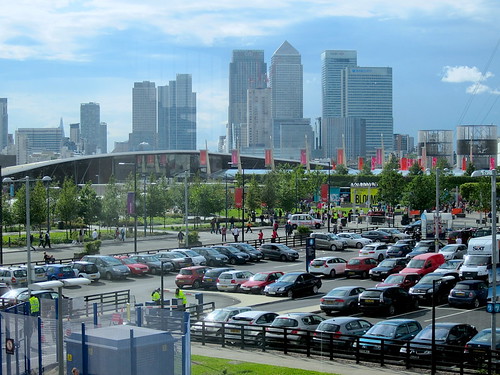
Photos of the Olympics: In Search of the Paralympic Torch



The Olympics: In Search of the Paralympic Torch, a set on Flickr.
With the main Olympic Games now a memory, the focus, for the next 11 days, is on the Paralympic Games, before Britain returns to the gloom of life under the crushing yoke of a myopic Tory-led government. While the Games were a great success, the emotional resonance of the Paralympic Games is much stronger, given the obstacles people have had to overcome to take part in the first place, and it is a tribute to the UK that the Paralympics began here in 1948. As Wikipedia explains:
The first organised athletic event for disabled athletes that coincided with the Olympic Games took place on the day of the opening of the 1948 Summer Olympics in London, United Kingdom. German born Dr. Ludwig Guttmann of Stoke Mandeville Hospital, who had been helped to flee Nazi Germany by the Council for Assisting Refugee Academics (CARA) in 1939, hosted a sports competition for British World War II veteran patients with spinal cord injuries. The first games were called the 1948 International Wheelchair Games, and were intended to coincide with the 1948 Olympics. Dr. Guttman’s aim was to create an elite sports competition for people with disabilities that would be equivalent to the Olympic Games. Read the rest of this entry »
Photos of a Journey Across the Thames on the Olympics Cable Car




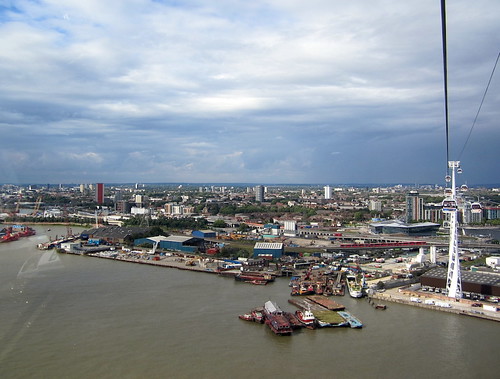


A Journey Across the Thames on the Olympics Cable Car, a set on Flickr.
On August 6, as I explained in a previous article, Jamaican Independence and a Giant Tent: Photos of a Visit to the Olympic Site at the O2, featuring photos and commentary, I cycled along the river from Deptford to Greenwich peninsula with my wife and son, to visit the O2 (recorded in that previous set of photos), and also to travel on the Emirates Air Line, the cable cars across the Thames, which run from North Greenwich, near the O2 (formerly the Millennium Dome) to the Royal Docks. The visit was for fun, but was also part of my ongoing project to photograph the whole of London by bike, which I have been recording here since June.
Intended to transport Olympics visitors from one venue to another, the Emirates Air Line project — named after the Emirates airline company, the biggest sponsor of the cable cars, who provided £36 million in a ten-year sponsorship deal — also provides a useful way of crossing the river at a point where there are few other options — just the Greenwich Foot Tunnel to the west, and the Woolwich Ferry to the east — and it is both remarkable and commendable that bicycles are also allowed. Read the rest of this entry »
Jamaican Independence and a Giant Tent: Photos of a Visit to the Olympic Site at the O2

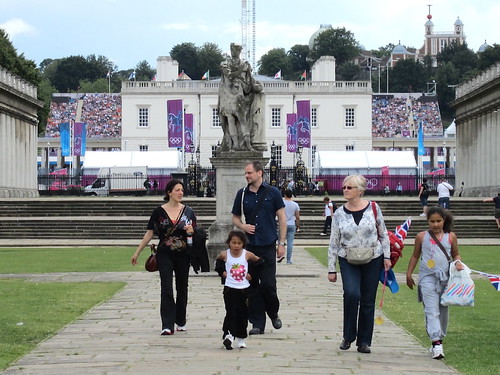



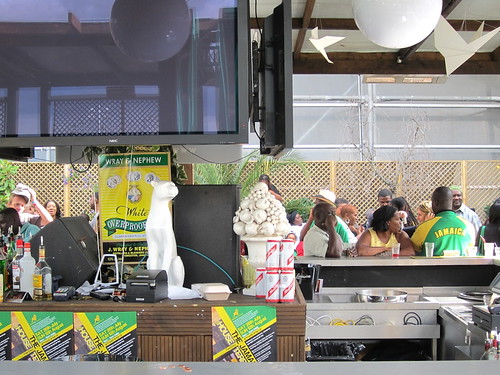


As Olympics fever continues to grip the UK, I can just about about cope with the competitiveness of the Games on an individual level, and have admiration for athletes’ self-discipline and determination, although I maintain that the greatest achievement of humanity is cooperation and not competition, and I also believe that it is important to bear in mind, as the hyperbole threatens to engulf us, that, as well as not being the highest form of human achievement — something that should be reserved for endeavours that improve all our lives — sport is not generally an undertaking that contributes to the political well-being of a nation and its people, beyond a kind of short-term thrill.
In thinking of the disturbing subtexts of the Games — including their humourless corporate greed, their ballooning costs, unchecked by government, the instigation of various forms of social cleansing, and their use as an excuse for empty nationalistic displays, which always do more for warmongers than for peacemakers, by encouraging a sense of supremacy amongst groups whose athletes do particularly well — I have been reminded of the phrase “bread and circuses” (from the Latin panem et circuses), for which an excellent description exists on Wikipedia: “In the case of politics, the phrase is used to describe the creation of public approval, not through exemplary or excellent public service or public policy, but through diversion, distraction, and/or the mere satisfaction of the immediate, shallow requirements of a populace.” Read the rest of this entry »
Union Jack Summer: Photos of the Queen’s Diamond Jubilee and the Olympics


Union Jack Summer: The Queen’s Diamond Jubilee and the Olympics, a set on Flickr.
I have no great love for either the Royal Family or the Olympics, and, on this latter point, my articles should make clear where I stand — Our Olympic Hell: A Militarised, Corporate, Jingoistic Disgrace, Olympics Disaster: The G4S Security Scandal and Corporate Sponsors’ £600 Million Tax Avoidance and The Dark Side of the Olympics: Kettling Cyclists and Telling Fairytales About Our Heritage. You can also find some more photos here.
As for the Queen, I have long adored “God Save the Queen” by the Sex Pistols — one of the greatest rock songs of all time, along with “Anarchy in the UK” — and I did dream of mounting a black sound system to a black bike with a black flag, pumping out the Pistols’ “God Save the Queen,” and cycling around every street party I could find in London on the Diamond Jubilee weekend.
That never came to pass, and in truth, although I find the existence of the Royal Family objectionable, some of the individuals involved work hard (the Queen and Princess Anne come to mind) and I also don’t trust any politicians to preside over the dissolution of the Royal Family and the disposal of their assets in a way that would benefit the majority of the people. More sensible, then, would be for their role to be scaled down enormously, as in other European countries, but there appears to be no hint of that on the horizon, and so we are stuck with something that looks like the divine right of kings (or queens), but is in fact a very expensive charade. Read the rest of this entry »
The Dark Side of the Olympics: Kettling Cyclists and Telling Fairytales About Our Heritage
 I was at WOMAD last Friday when the £27 million Olympics Opening Ceremony took place, but a screen had been set up especially for the occasion, and I managed to catch everything from the 800 nurses celebrating the NHS, through the tour of Britain’s modern musical history, to the start of the athletes’ processions.
The disorientation I felt initially has not gone away — a celebration of the NHS taking place while the current government, largely unopposed by the British people, has begun the process of destroying it, pushing through dreadful legislation despite the opposition of a majority of healthcare professionals, with the sole purpose of forcing the NHS to be prised open for private companies to profit as much as possible from it, while, over time, cutting the universal provision of services, especially to those who have little or no money.
There was also a disorientating musical celebration, which specifically included music that was either banned or caused consternation at the time of its release — the Sex Pistols performing “Pretty Vacant,” “Relax” by Frankie Goes to Hollywood and “Firestarter” by the Prodigy. It was a good recap of the music that has defined Britain’s cultural landscape — also including the Clash and the Specials, to name but two of the many overtly political acts included — but at the same time it also failed to explain why such ferocious music had arisen in the first place; how, indeed, much of this music had come about because Britain is such a hard country to live in, in which the establishment has persistently done whatever it can to make life particularly difficult for young people unfortunate enough to be born without a silver spoon in their mouths. Read the rest of this entry »











 Who's still at Guantánamo?
