Radio: I Discuss Israel’s Genocide in Gaza and Guantánamo’s 22nd Anniversary with Misty Winston on TNT Radio

Please support my work as a reader-funded journalist! I’m currently trying to raise $2500 (£2000) to support my writing and campaigning on Guantánamo and related issues over the next three months. If you can help, please click on the button below to donate via PayPal.
On Tuesday, I was delighted to talk to the US radio host Misty Winston, on the Australian-based online radio station TNT Radio, about Israel’s ongoing genocide in Gaza, and the imminent 22nd anniversary of the opening of the prison at Guantánamo Bay. The interview is available here on video, and I’ve also embedded it below, and the audio only version is available here.
Misty and I have spoken many times before, and our interview began 18 minutes into the one-hour show, after Misty spoke about the significance of the Jeffrey Epstein case, and her colleague Adam Clark spoke about the struggle against censorship — and for free speech — in the US election year.
Misty and I began by discussing Israel’s genocidal assault on Gaza, with Misty thanking me for acknowledging, very early on in what Al Jazeera accurately calls “Israel’s War on Gaza”, but most western media disgracefully describe as the “Israeli-Hamas War”, that, after years of remaining silent on Israel’s crimes over the last 75 years, because I feared its impact on my Guantánamo work, I could no longer remain silent as what is very evidently a genocide began to unfold. Misty also thanked me for my writing, in which I’ve been covering the unforgivable lawlessness of Israel’s three-month assault, via my articles here, here, here, here, here, here, here, here and here.
Why I Value Your Support For My Ongoing Work on Guantánamo as a Truly Independent Journalist and Campaigner

Please click on the ‘Donate’ button below to make a donation towards the $2,500 (£2,000) I’m trying to raise to support my work on Guantánamo over the next three months.
It’s nearly 18 years since I first began writing about Guantánamo on a full time basis, first via the research and writing I undertook for my book The Guantánamo Files, (which quite literally consumed my life from March 2006 until May 2007), and, ever since, via the more than 2,500 articles I’ve written for this site, many of which have also been posted on the website of the Close Guantánamo campaign, which I established with the US lawyer Tom Wilner in January 2012, on the 10th anniversary of the prison’s opening.
While I have undertaken paid work with various publications and organizations over the years, including the United Nations, WikiLeaks, the New York Times, the Guardian and Al Jazeera, most of my writing — as well as my campaigning work to get the prison closed — has been published here, establishing this website not only as the most significant repository of information about Guantánamo, but also as a kind of living diary of my existence since May 2007, when I first began publishing articles here.
I was recently reminded of the durability of my writing by Ed Charles, the editor of the World Can’t Wait’s Spanish website, where, for many years, most of my articles have been translated to reach an audience in the Spanish-speaking world. I was taken aback when, a few months ago, Ed translated dozens of my articles dating back to when I first began writing about Guantánamo, and, when I asked him why, he said that not only was my writing important, but also that many other historical mainstream media reports covering Guantánamo have disappeared from the internet, making the archive here on this site even more significant in terms of providing a rolling history of Guantánamo, as written at the time.
Celebrating 2,400 Days of ‘The State of London’: Please Donate to Support This Unique Photo-Journalism Project

Please click on the ‘Donate’ button below to make a donation to support my photo-journalism project ‘The State of London’.
Dear friends and supporters,
Today marks 2,400 days — or a little over six and a half years — since I first set up ‘The State of London’ Facebook page, and began posting a photo a day, with an accompanying essay, drawn from the photos I had been taking since I first began cycling around London and taking photos throughout the capital’s 120 geographic postcodes five years before — on May 11, 2012, to be precise. I also post the photos on X (formerly Twitter).
From the beginning, this has been something of a deranged hobby. I have no financial backing for the project and, as a result, am reliant on you, my readers and followers, to provide me with any kind of monetary recompense for the ridiculous amount of time that I’ve spent cycling around London with a camera over the last eleven and a half years — and, in particular, the many hours I spend researching and writing about the photos that I post to entertain and inform you about London’s history, its social housing, its takeover, in recent decades, by predatory capitalism, the changing seasons, forgotten corners, rivers, hills and canals, parks and graveyards, seats of power, poverty and protests.
In the last six months, for example, I’ve celebrated pubs and cafes, inter-war council estates, Art Deco and Brutalist triumphs, delved through the archive for coverage of lost or soon to be lost reminders of London’s history — Coal Drops Yard in King’s Cross, prior to redevelopment, slipper baths in South Bermondsey, council flats in Homerton, a lodge in Archway and a prefab in Stepney Green, and have also posted about horrible new developments in Pimlico, Canary Wharf, the City, Vauxhall and Lewisham, as well as covering the massive and frequent protests against Israel’s genocidal war on Gaza.
Video: ‘The Legacy of the War on Terror – Guantánamo Bay’ at SOAS with Andy Worthington, Moazzam Begg and Mansoor Adayfi

Please support my work as a reader-funded journalist! I’m currently trying to raise $2500 (£2000) to support my writing and campaigning on Guantánamo and related issues over the next three months. If you can help, please click on the button below to donate via PayPal.
On November 21, I was delighted to take part in ‘The Legacy of the War on Terror: Guantánamo Bay’, a well-attended panel discussion about Guantánamo at SOAS (the School of Oriental and African Studies) in London, with two former Guantánamo prisoners, the British citizen Moazzam Begg, who is the outreach director at CAGE, and, via Zoom, Mansoor Adayfi, a Yemeni citizen who was resettled in Serbia in 2016. Also joining us via Zoom was Deepa Govindarajan Driver, an academic and trade unionist, and a legal observer in the Julian Assange case for the Unified European Left at the Parliamentary Assembly of the Council of Europe.
The chair — and organizer — was Nina Arif, and the meeting was convened by SOAS ICOP (Influencing the Corridors of Power), an organization set up to bring together politicians and university researchers to “address the democratic deficit that … results from encroaching government control on freedom of speech and assembly on SOAS and other campuses”, a particularly topical purpose right now, as Palestinian voices are being silenced.
I must note, however, that much of this silencing is coming from within universities and other institutions without any prompting from central government, an alarming trend that ought not to be allowed to proceed unchallenged, and that is also particularly pernicious in light of the crimes being committed by Israel, and the necessity for criticism of the Israeli government to be able to take place without being shut down through false allegations that it constitutes anti-semitism.
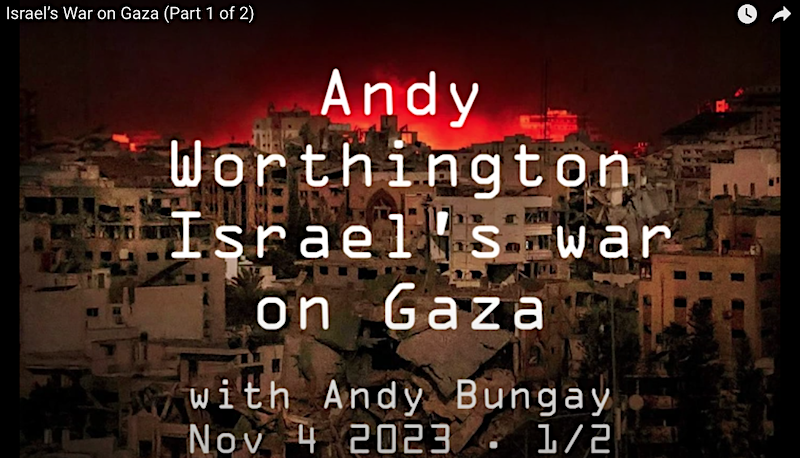
Radio: I Discuss Israel’s War on Gaza with Andy Bungay of Riverside Radio
Please support my work as a reader-funded investigative journalist, commentator and activist. If you can help, please click on the button below to donate via PayPal.
I’m pleased to post below an interview about Israel’s war on Gaza that I undertook two weeks ago with Andy Bungay of Riverside Radio, a community radio station in Wandsworth, which was previously included in a podcast here.
I hope you have time to listen to it, and that you’ll find it interesting. Anyone who knows my work will know that, when it comes to Guantánamo, which I’ve been writing about and speaking about for 17 years, I can talk about it eloquently at any time of the day or night, but this interview was the first time that I’d spoken publicly about Israel and Palestine. I have subsequently discussed it with Chris Cook on his Gorilla Radio show in Victoria, Canada, and I’m more than willing to discuss it in future with anyone who is interested in my perspective.
In my interview with Andy, I discussed my revulsion at Israel’s actions in Gaza, where, as of November 14, 11,320 people have been killed, including 4,650 children and 3,145 women, suggesting that it amounts to a genocide, a conclusion reinforced by several assessments, in the last few weeks, by experts in genocide.
Radio: I Discuss Guantánamo Vigils, “Forever Prisoners” and Genocide in Gaza with Chris Cook on Gorilla Radio

Please support my work as a reader-funded journalist! I’m currently trying to raise $2500 (£2000) to support my writing and campaigning on Guantánamo and related issues over the next three months. If you can help, please click on the button below to donate via PayPal.
My thanks to Chris Cook of Gorilla Radio, in Victoria, Canada, for reaching out to interview me last week about the coordinated monthly vigils for the closure of Guantánamo which take place in London, across the US and around the world on the first Wednesday of every month, and which I initiated in February (following up on monthly vigils in London, which began last September) by reaching out to friends and colleagues elsewhere to join us. Chris and I have spoken many times over the years, and it’s always a pleasure to talk to him.
Our interview takes up the second half of the one-hour show, available on Substack here, and beginning at 28:45, following an interview that is also worth listening to — with William S. Geimer, a peace activist, Professor Emeritus of Law at Washington and Lee University, a military veteran who resigned his 82nd Airborne commission in opposition to the war against Vietnam, the author of the book, ‘Canada: The Case for Staying Out of Other People’s Wars’, and the founder of the Greater Victoria Peace School.
Chris was following up on my recent article, Photos and Report: The Coordinated Global Vigils for the Closure of Guantánamo on November 1, 2023, and as I explained, although the numbers taking part are small — because, fundamentally, so very few people care about the monstrous ongoing injustice of Guantánamo — the effort is worth it because, as I also explained, it’s “one of those things that you do that’s an important reminder that it hasn’t gone away and that not everyone has forgotten”, and that “there’s a huge difference between nobody turning up and a handful of people bothering to make their presence felt.”
Nov. 21: Guantánamo Event at SOAS with Andy Worthington, Moazzam Begg and Mansoor Adayfi

Please support my work as a reader-funded journalist! I’m currently trying to raise $2500 (£2000) to support my writing and campaigning on Guantánamo and related issues over the next three months. If you can help, please click on the button below to donate via PayPal.
I’m delighted to announce that, a week on Tuesday, on November 21, I’m taking part in a panel discussion about Guantánamo in SOAS (the School of Oriental and African Studies) in London, with two former prisoners, the British citizen Moazzam Begg, who is the outreach director at CAGE, and, via Zoom, Mansoor Adayfi, a Yemeni citizen who was resettled in Serbia in 2016, after being held at Guantánamo for 14 years without charge or trial, and who has only this year secured the return of his passport, allowing him to travel to other countries. The chair of the event is Deepa Govindarajan Driver, an academic and trade unionist, and a legal observer in the Julian Assange case for the Unified European Left at the Parliamentary Assembly of the Council of Europe.
The event, ‘The Legacy of the War on Terror: Guantánamo Bay’, is organised by SOAS ICOP (Influencing the Corridors of Power), which was set up to bring together politicians and university researchers to, as ICOP describe it, “address the democratic deficit that we believe results from encroaching government control on freedom of speech and assembly on SOAS and other campuses.”
The 90-minute event, with individual presentations followed by a Q&A session, runs from 7 to 8.30pm, and takes place in the Khalili Lecture Theatre, in the Main Building at SOAS, at 10 Thornhaugh Street, London WC1H 0XG. Entry is free, but you need to book in advance, via the Eventbrite page here. The event will be recorded, and a video will be made available afterwards.
Photos and Report: The Coordinated Global Vigils for the Closure of Guantánamo on November 1, 2023

Please support my work as a reader-funded journalist! I’m currently trying to raise $2500 (£2000) to support my writing and campaigning on Guantánamo and related issues over the next three months. If you can help, please click on the button below to donate via PayPal.


Celebrating Eight Years Since the Release from Guantánamo of Shaker Aamer, the Last British Resident in the Prison

Please support my work as a reader-funded journalist! I’m currently trying to raise $2500 (£2000) to support my writing and campaigning on Guantánamo and related issues over the next three months. If you can help, please click on the button below to donate via PayPal.
Eight years ago today, I was awoken in the morning, while it was still dark, by a phone call from my friend and colleague Joanne MacInnes, telling me that she was at Biggin Hill airport, where Shaker Aamer, the last British resident in the US prison at Guantánamo Bay, was arriving by plane, a free man after nearly 14 years in US custody, almost all of it spent without charge or trial at Guantánamo, where he was regularly held in solitary confinement, and where he railed relentlessly against the injustice of his imprisonment.
It was the cumulation of over nine years, on my part, of writing about and campaigning for Shaker’s release, which began in 2006 when I was researching my book The Guantánamo Files, in which I told, for the first time, the stories of around 450 of the 779 men held at Guantánamo by the US military since the prison opened in January 2002, and noted that Shaker was an “enormously charismatic figure”, who, as a result, was regarded with great suspicion by the authorities.
After I completed the manuscript for the book in May 2007, one of the first events about Guantánamo that I attended was ‘Shaker Aamer, A South London Man in Guantánamo: The Children Speak’, held in south London on June 29, 2007, at which Shaker’s daughter Johina, then nine years old, spoke, as did Marium Begg, the daughter of Shaker’s friend Moazzam Begg, also held in Guantánamo, who had been released in January 2005.
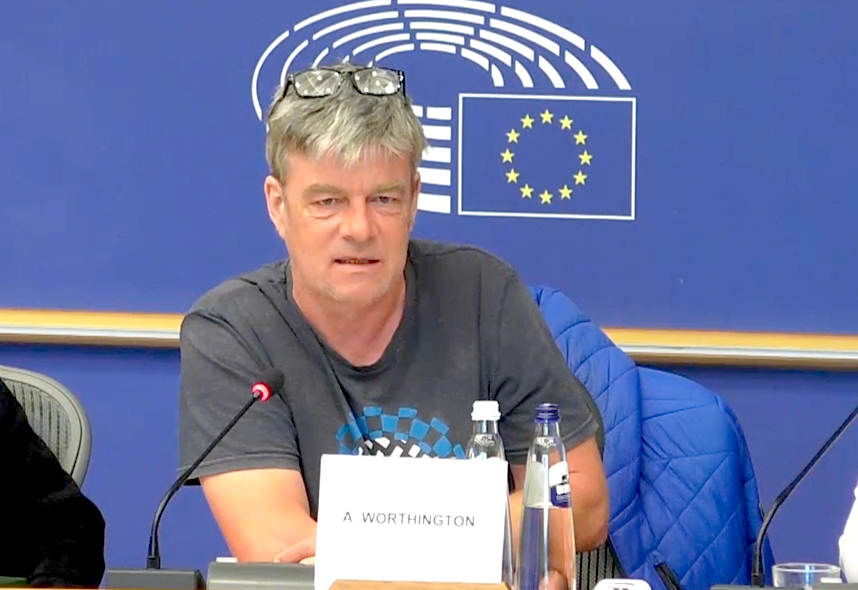
Video: My Impassioned Speech at the EU Parliament’s “Close Guantánamo!” Event on Sep. 28, 2023
Please support my work as a reader-funded journalist! I’m currently trying to raise $2500 (£2000) to support my writing and campaigning on Guantánamo and related issues over the next three months. If you can help, please click on the button below to donate via PayPal.
What a difference a month makes.
On September 28, I was in Brussels, taking part in “Close Guantánamo!”, a moving and powerful event in the European Parliament that I’d been working towards for six months with the indefatigable Irish independent MEPs Clare Daly and Mick Wallace, and former Guantánamo prisoner Mansoor Adayfi.
Over the course of three hours, a rapt audience heard a mixture of emotional, inspiring and legally compelling testimony about the evils of Guantánamo, the need to get the prison closed, and the urgent need to find new homes for at least 13 of the 30 men still held, who have been approved for release but cannot be repatriated. This is a pressing problem in need of a solution, with which, we all hoped, European countries might be able to help.
On October 1, I posted a detailed report about the event, also featuring the full three-hour video of it, at which the speakers, including Mansoor and myself, were two other former prisoners, Lakhdar Boumediene and Moazzam Begg, Fionnuala Ní Aoláin, the UN Special Rapporteur on the Promotion and Protection of Human Rights and Fundamental Freedoms while Countering Terrorism, who summarized her devastating report about historic and continuing abuses at Guantánamo, based on the first ever visit to Guantánamo by a UN Rapporteur, which she undertook in February, the lawyers Alka Pradhan and Beth Jacob, Valerie Lucznikowska of September 11th Families for Peaceful Tomorrows and James Yee, the former Muslim Chaplain at Guantánamo.
Afterwards, however, just as Clare and Mick were preparing to follow up, editing the event into smaller and more manageable podcasts and videos, and just as I was preparing to post a video of my speech, which Clare’s team had sent to me, the events of October 7 — when Hamas militants broke out of their “open air prison” in the Gaza Strip and went on a killing spree that left 1,400 people dead — threw all our plans into disarray, as it was immediately followed up by indiscriminate bombing raids of unprecedented ferocity on Gaza’s mercilessly trapped civilians, who, to compound their agonies, also had all their water, food, medical supplies and fuel supplies cut off.










 Who's still at Guantánamo?
