Quarterly Appeal: Please Support My Ongoing 18 Years of Campaigning to Close Guantánamo and My Work on Israel’s Genocide in Gaza

Please click on the ‘Donate’ button below to make a donation towards the $2,500 (£2,000) I’m trying to raise to support my work on Guantánamo over the next three months.
It’s over 18 years since I gave my life over to telling the true story of the prison at Guantánamo Bay and the men and boys held there, and to the seemingly endless task of trying to get the prison closed.
I began with a book, The Guantánamo Files, which absolutely consumed 14 months of my life, and since then I’ve written over 2,000 articles, about every aspect of Guantánamo’s story, mostly here, but also, at various times, for the New York Times, the Guardian and Al Jazeera, as well as on the Close Guantánamo website, which I established with the US attorney Tom Wilner in 2012.
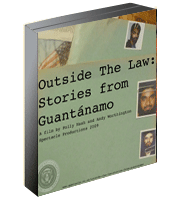
I also co-directed a film, ’Outside the Law: Stories from Guantánamo’, released in 2009, and have worked with the United Nations, WikiLeaks, Reprieve and Cagepisoners (now CAGE International). I’ve also spoken publicly about Guantánamo at every opportunity, have undertaken numerous TV and radio appearances, and, more recently, via podcasts and other online media outlets, have written and recorded songs about Guantánamo (and the CIA’s “black site” torture program), and have launched numerous campaigns.
These include, most recently, an ongoing photo campaign involving posters marking every 100 days of Guantánamo’s existence, and ongoing monthly coordinated vigils for the prison’s closure, which take place across the US and around the world on the first Wednesday of every month, and which have specifically focused on the 16 men (out of the 30 still held) who have long been approved for release, but who are still held because the decisions taken to release them were purely administrative, meaning that no legal mechanism whatsoever exists to compel the government to free them if, as is abundantly apparent, the Biden administration has no interest in prioritizing their release. In fact, as recently became clear, in the cases of eleven of these men, the Biden administration specifically prevented their resettlement after the events of October 7, fearing the “political optics” of doing so.
Joys and Agonies Past: 40 Years Since the Last Stonehenge Free Festival; 39 Years Since the Battle of the Beanfield

Please support my work as a reader-funded investigative journalist, commentator and activist. If you can help, please click on the button below to donate via PayPal.
40 years ago, a colourful, kaleidoscopic array of old second-hand vehicles — trucks, coaches, buses, even old military vehicles — began arriving in the fields opposite Stonehenge, the ancient stone sun temple on Salisbury Plain, for what would be the last huge, unlicensed, unpoliced, weeks-long temporary autonomous zone to root itself to the earth of ancient Albion.
The vehicles that arrived were the vanguard of the eleventh annual Stonehenge Free Festival, a month-long anarchic happening, which began in June 1974 with a handful of playful mystics, but had grown significantly in its latter years, as ever-increasing numbers of young refugees from Margaret Thatcher’s decimation of the economy joined the political hippies of an earlier generation, on the road, and on a circuit of free festivals whose biggest manifestation was at Stonehenge, to rock out, to consume vast amounts of drugs, and to — in some cases — visit the stones for invented pagan rituals on the morning of the summer solstice.
It was a demonstration that, more or less, the anti-materialistic US counter-culture of 1960s America, which had spread to the small towns and suburbia of Britain in the 1970s, could create a low-impact nomadic lifestyle, in convoys that travelled across England and Wales from May to September, and that, at Stonehenge, involved a gathering of the tribes, joined by tens of thousands of other participants, who arrived in cars and camper vans, or who came by train to Salisbury, set up tents and stayed for days or for long weekends to soak up the acid rock, punk and reggae, and the rebel atmosphere.
Radio: I Discuss Israel’s Horrendous Prisons for Palestinians and the ICC Noose Tightening Around Netanyahu’s Neck on Gorilla Radio

Please support my work as a reader-funded investigative journalist, commentator and activist. If you can help, please click on the button below to donate via PayPal.
My thanks to the indefatigable Chris Cook, based in western Canada, for having me on his Gorilla Radio show to discuss Ending Israel’s Impunity for Genocide in Gaza, and the Threat to Those, Like Joe Biden, Who Are Most Complicit, my latest article on the defining horror of our times. Our discussion takes place in the second half of the one-hour show, available on Substack here, after an illuminating first half with Yves Engler, the Montreal-based political activist, whose latest book, co-authored with Owen Schalk, is ‘Canada’s Long Fight Against Democracy.’ I’m also pleased to note that Chris played my song ‘Forever Prisoner’, about Guantánamo prisoner Khaled Qassim, recorded with my band The Four Fathers.
Chris and I began by discussing Jonathan Cook’s latest article for Middle East Eye, The message of Israel’s torture chambers is directed at all of us, not just Palestinians, which drew on a detailed CNN investigation published on May 11, Strapped down, blindfolded, held in diapers: Israeli whistleblowers detail abuse of Palestinians in shadowy detention center, about Sde Teiman, a secret Israeli prison on a military base in the Negev Desert, where Palestinians seized in the Gaza Strip since October 7 are kept naked, blindfolded and handcuffed, and, permanently, “forced to remain motionless and silent”, as Cook describes it, adding, “At night, dogs are set on them. Anyone who speaks or moves risks being savagely beaten till bones are broken.”
The whistleblowers who spoke to CNN also explained that “doctors sometimes amputated prisoners’ limbs due to injuries sustained from constant handcuffing; of medical procedures sometimes performed by underqualified medics earning it a reputation for being “a paradise for interns”; and where the air is filled with the smell of neglected wounds left to rot.”
Video: I Discuss Guantánamo and My Work with Julian Assange and WikiLeaks on Consortium News

Please support my work as a reader-funded journalist! I’m currently trying to raise $2500 (£2000) to support my writing and campaigning on Guantánamo and related issues over the next three months. If you can help, please click on the button below to donate via PayPal.
I’m delighted to be posting the video interview I undertook recently, discussing my work articulating and opposing the ongoing 22-year horror story of the US prison at Guantánamo Bay, and my work with Julian Assange and WikiLeaks on the release of classified military files from Guantánamo in 2011, with Cathy Vogan and Elizabeth Vos of Consortium News, the independent news website established in 1995 by the late investigative journalist Robert Parry, which is now run by Cathy and Joe Lauria.
After the interview, I met Joe and Cathy at an event for Julian Assange in London, and was pleased to find two like-minded souls in the unending struggle to expose the truth about the state of the world, and to resist further crimes and abuses of power by those in charge.
In the interview, I began by explaining how I had become involved in the Guantánamo story, in 2006, and the forensic investigative work that was required to piece together — from documents reluctantly made publicly available by the Pentagon through Freedom of Information legislation, including, for the first time, the names and nationalities of the prisoners — a coherent narrative about who was held in Guantánamo, and how the overwhelming majority of the 779 men and boys held there by the US military since January 2002 had no connection with terrorism, for my book The Guantánamo Files, published in 2007.
Video: On the 13th Anniversary of WikiLeaks’ Release of the Guantánamo Files, My Interview with the Julian Assange Defence Committee

Please support my work as a reader-funded journalist! I’m currently trying to raise $2500 (£2000) to support my writing and campaigning on Guantánamo and related issues over the next three months. If you can help, please click on the button below to donate via PayPal.
13 years ago today, on April 25, 2011, WikiLeaks and a host of international newspapers — the Daily Telegraph, the Washington Post, McClatchy, Der Spiegel, Le Monde, El Pais, La Repubblica, L’Espresso and Aftonbladet — published, or began publishing “The Guantánamo Files,” a treasure trove of classified US military documents from the prison at Guantánamo Bay, the last of four significant releases, in 2010-11, of classified material leaked by Chelsea Manning, the first three being the Afghan and Iraq War Logs, and a vast archive of diplomatic cables.
I was also a media partner for the release of the files, having been asked by WikiLeaks, as an independent expert on Guantánamo, to investigate them, and to brief journalists from the mainstream media partners about their significance, which I did in the days following the release of the files on April 25. The publishing date had been brought forward abruptly, from an intended release date in May, after we heard that the Guardian and the New York Times had obtained them from another source, and were intending to preempt us with the files’ publication.
I still vividly recall getting a call about this on the evening of April 24, and then having to write an introduction to the files in a matter of hours, explaining their significance. This ended up on the front page of “The Guantánamo Files,” on the WikiLeaks website, as “WikiLeaks Reveals Secret Files on All Guantánamo Prisoners,” and I also posted it on my website as “WikiLeaks Reveals Secret Guantánamo Files, Exposes Detention Policy as a Construct of Lies.”
Please Support My Truly Independent Reader-Funded Work on Guantánamo as a Journalist and Activist

Please click on the ‘Donate’ button below to make a donation towards the $2,500 (£2,000) I’m trying to raise to support my work on Guantánamo over the next three months.
I never meant to become a world authority on Guantánamo, or the most persistent independent journalist and activist campaigning for the prison’s closure, but over the last 18 years, as my youth has given way to middle age, that is, apparently, what I’ve become.
I’ve done this through a combination of personal tenacity, through persistent efforts to navigate and not drown in the ever-changing media landscape of the 21st century, through a refusal to accept the false distinction between journalism and activism that makes far too much “liberal” journalism self-defeating, and through a belief that, in the face of almost complete indifference from politicians, the mainstream media and the American people, those of us who recognize that the prison at Guantánamo Bay is a uniquely lawless affront to all notions of decency need to do all that we can to persistently raise our voices and to be heard.
When I began this work on a full-time basis, in March 2006, social media and smartphones barely existed, and the internet was much more of a level playing field than it is now. Drawing on publicly available documents — largely extracted from the US government through Freedom of Information legislation — I spent 14 months researching and writing my book The Guantánamo Files, and then began writing and publishing articles here on my website, which has subsequently become the largest repository of publicly available information about Guantánamo, with none of it hidden behind a paywall, and none of it having been erased, as is sadly the case with the archives of so much of the mainstream media.
Video: Andy Worthington Calls for the Closure of Guantánamo at London Rally on Jan. 20, 2024

Please support my work as a reader-funded journalist! I’m currently trying to raise $2500 (£2000) to support my writing and campaigning on Guantánamo and related issues over the next three months. If you can help, please click on the button below to donate via PayPal.
Two weeks ago, on Saturday January 20, a march and rally for the closure of the prison at Guantánamo Bay was held in London, marking the 22nd anniversary of the the prison’s opening on January 11. The event was organized by the UK Guantánamo Network, a coalition of campaigning groups including numerous Amnesty International members from across London and the south east.
I posted a detailed report about that event, illustrated with photos by myself and by photographer Sinai Noor, two weeks ago, and I’m now following up with the video of the speech I gave at the rally, following the procession of campaigners in orange jumpsuits from Old Palace Yard, by the Houses of Parliament, through Parliament Square, and up Whitehall to Trafalgar Square.
My speech followed a brave and principled speech by Apsana Begum MP, which is available on X here, where, I’m glad to note, it has had nearly 20,000 views, and I was followed by a number of UK Guantánamo Network campaigners — Aaron Humphrey-May, Harry McWhirter, Lise Rossi and Dave Esbester, whose speeches are available on Canva and filmed by Melissa Schweizer, as well as a poem read out by another campaigner.
Close Guantánamo: Our Achievements in 2023, Marking Guantánamo’s 22nd Anniversary on Jan. 11, and What We Can Do in 2024

Please support my work as a reader-funded journalist! I’m currently trying to raise $2500 (£2000) to support my writing and campaigning on Guantánamo and related issues over the next three months. If you can help, please click on the button below to donate via PayPal.
I wrote the following article for the “Close Guantánamo” website, which I established in January 2012, on the 10th anniversary of the opening of Guantánamo, with the US attorney Tom Wilner. Please join us — just an email address is required to be counted amongst those opposed to the ongoing existence of Guantánamo, and to receive updates of our activities by email.
Thanks to everyone who took part in events marking the 22nd anniversary of the opening of the prison at Guantánamo Bay on January 11 — via the 20 vigils for the prison’s closure that took place across the US and around the world, via our ongoing photo campaign, for which over 120 people sent in photos of themselves with a poster marking 8,036 days of the prison’s existence on January 11, and calling for its closure, and via a number of online events.
One of these events was an online panel discussion, hosted by the New America think-tank in Washington, D.C., at which I was joined by the eloquent former prisoner Mohamedou Ould Slahi, and Fionnuala Ní Aoláin, who, until recently, was the UN Special Rapporteur on the Promotion and Protection of Human Rights and Fundamental Freedoms while Countering Terrorism.
Last year, Fionnuala became the first UN Rapporteur to visit the prison, subsequently producing what I described at the time as “a devastatingly critical report about systemic, historic and ongoing human rights abuses at the prison,” in which she concluded that, despite some improvements to the regime under Presidents Obama and Biden, the totality of ongoing conditions at the prison amounts to “ongoing cruel, inhuman, and degrading treatment,” which, in certain cases, “may also meet the legal threshold for torture.”
Video: Guantánamo at 22 – Mohamedou Ould Slahi, Fionnuala Ní Aoláin and Andy Worthington at New America

Please support my work as a reader-funded journalist! I’m currently trying to raise $2500 (£2000) to support my writing and campaigning on Guantánamo and related issues over the next three months. If you can help, please click on the button below to donate via PayPal.
On January 11, the 22nd anniversary of the opening of the prison at Guantánamo Bay, I was delighted to take part in an online panel discussion, “Guantánamo at Twenty-Two: What is the Future of the Prison Camp?”, hosted by New America, the US think-tank located close to the White House in Washington, D.C.
I’ve been taking part in annual panel discussions about Guantánamo at New America since 2011, normally with Tom Wilner, the US attorney with whom I co-founded the Close Guantánamo campaign in 2012, but this year Tom wasn’t available, and I was pleased that my suggestions for two compelling replacements — former prisoner Mohamedou Ould Slahi, the author of the best-selling Guantánamo Diary, and Fionnuala Ní Aoláin, the UN Special Rapporteur on the Promotion and Protection of Human Rights and Fundamental Freedoms while Countering Terrorism — were met with enthusiasm.
The moderator was Peter Bergen, New America’s Vice President, and the video, via YouTube, is posted below. It was a powerful event, and I hope that you have time to watch it, and that you’ll share it if you find it useful.
Photos and Report: The Close Guantánamo March and Rally in Central London, Jan. 20, 2024

Please support my work as a reader-funded journalist! I’m currently trying to raise $2500 (£2000) to support my writing and campaigning on Guantánamo and related issues over the next three months. If you can help, please click on the button below to donate via PayPal.
On Saturday (January 20), a colourful and inspiring march and rally for the closure of the prison at Guantánamo Bay took place in central London, organized by the UK Guantánamo Network, which consists of members of a number of local Amnesty International groups from across London and the south east, plus other campaigners, myself included.
The event was organized to mark the recent 22nd anniversary of the opening of Guantánamo, on January 11, when a handful of campaigners braved bitterly cold weather to stage a vigil outside the US Embassy in Nine Elms, as part of the monthly coordinated global vigils for Guantánamo’s closure that I initiated a year ago. See here for my report about, and photos from the 16 vigils that took place in the US and around the world to mark the anniversary.
Complementing that vigil, the march and rally took place on a Saturday for maximum visibility, and would have taken place on Saturday January 13 had it not been for the fact that a massive March for Palestine was scheduled for that particular date, which I posted photos of — and commentary about — here.










 Who's still at Guantánamo?


