The 41st Anniversary of the Battle of the Beanfield: Still No Accountability for a Monstrous Crime of State Violence
1.6.26
Please click on either of the ‘Donate’ or ‘Buy’ buttons below (via PayPal or Stripe) to make a donation towards the $2,500 (£2,000) I’m trying to raise to support my work as a reader-funded investigative journalist, commentator and activist over the next three months. To get links to all my work in your inbox, please also consider taking out a free or paid subscription to my new Substack newsletter.
Somewhere south of Savernake Forest, and just to the north of the A303, in Wiltshire, is a crime scene that has never been examined by the British authorities.
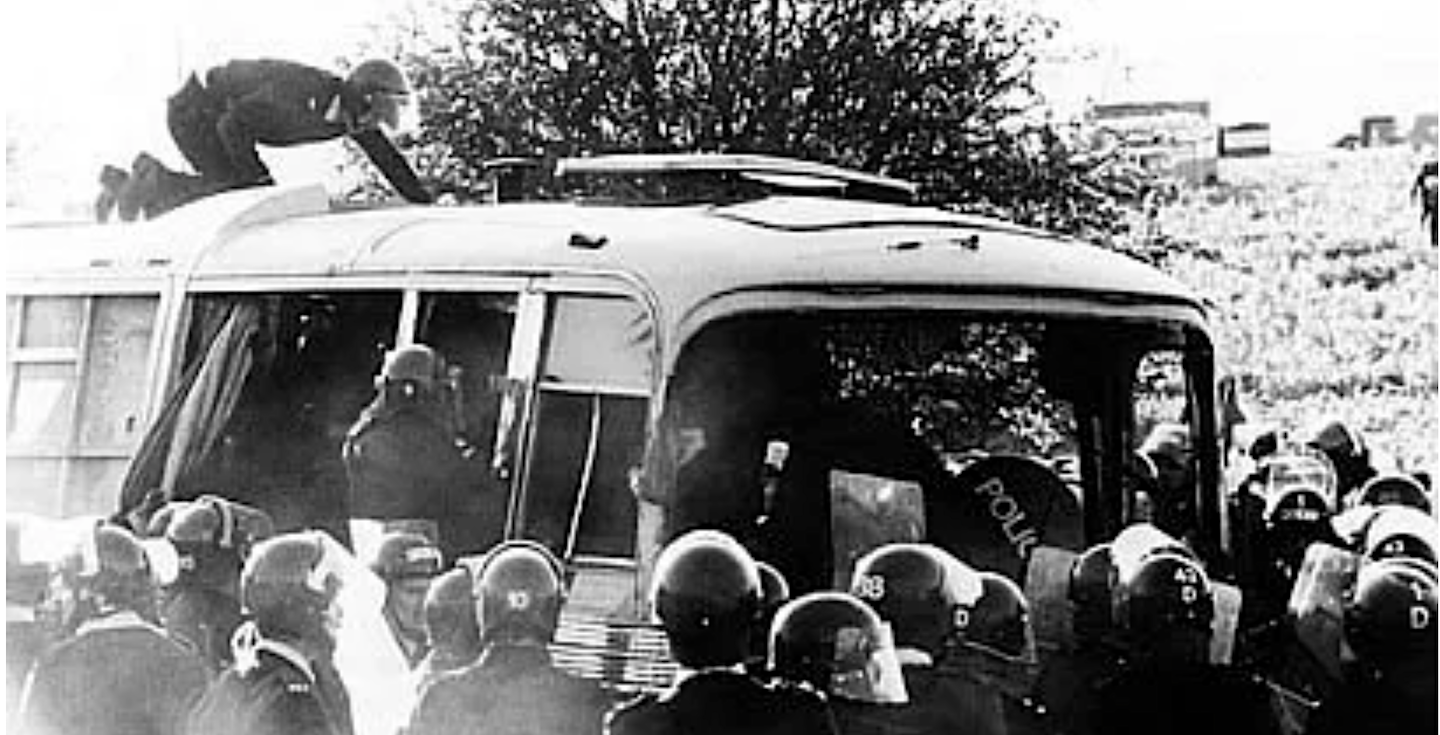
It was in a field here that, 41 years ago today, on June 1, 1985, the British state undertook the most savage assault on unarmed civilians in modern British history.
This has become known as the Battle of the Beanfield, although, in reality, it was a one-sided rout of heartbreaking brutality, as riot police from six counties cornered a vastly-outnumbered convoy of vehicles seeking to make their way to establish what would have been the 12th annual Stonehenge Free Festival, in fields around the ancient sun temple on Salisbury Plain, and “decommissioned” them with extreme violence, brutally assaulting the men and women of the convoy, terrorizing their children, destroying their live-in vehicles, and making 537 arrests in total.
The events of that day dealt a crippling blow to a growing counter-cultural movement of modern-day nomads, known as the new travellers, or new age travellers, who travelled around the country in old coaches, buses, vans, trucks and even decommissioned military vehicles.
Many of the travellers took part in a loose network of free festivals at rural locations, mostly in southern England and Wales, which ran from May to September, and whose focal point, in the month of June, was Stonehenge, the Neolithic and Bronze Age sun temple, and one of the wonders of the ancient world.
While coveted by the state and by the archeological community, Stonehenge had also long been a focus for a colourful array of outsiders, from the Druidic revivalists of the early 20th century, to the students and beatniks who partied there in the 1950s and ‘60s, and, eventually, to the anarchists, mystics and political agitators — generally described, with sweeping imprecision, as “hippies” — who first held a free festival in the fields around the ancient temple in the summer of 1974.
Slowly, but inexorably, the Stonehenge Free Festival grew in the decade that followed to become, by 1984, an autonomous settlement, the size of a small town, where acid rock and punk rock collided in a druggy haze, and where, on the morning of the summer solstice, the still-existent Druidic revivalists continued their rituals in proximity to the counter-culture’s own midsummer celebrations.
1984: Margaret Thatcher’s “enemies within”
The 1984 festival took place against a backdrop of increasing darkness and oppression in the UK. Margaret Thatcher, elected as Prime Minister in 1979, ironically contributed enormously to the growth of the new traveller movement, through the economic carnage she unleashed, which saw unemployment reaching unprecedented heights in the early 1980s, as she took an axe to traditional manufacturing communities. The lack of prospects encouraged untold numbers of young people to take to the road in response.
Thatcher also encouraged dissent through her close association with Ronald Reagan, the US president whose election in 1980 cemented a reaction, in both the US and the UK, to what these two leaders perceived as the permissiveness and anti-capitalist dissent of the 1970s. When she agreed to host US Cruise missiles — nuclear weapons — at RAF Greenham Common in Berkshire, she enraged a generation of politicised women who set up a long-running Women’s Peace Camp in response, to protest and disrupt the complicity of the UK in the US’s dangerous, nuclear-powered military expansion.
Travellers from the free festival circuit, describing themselves as the “Peace Convoy”, visited Greenham Common to show solidarity with the Greenham women in the camp’s early years, and were also involved with the Molesworth Peace Camp, at the site of the second proposed Cruise missile base, in Cambridgeshire, which also involved Quakers, Christians and environmental activists.
By 1984, the country was more bitterly divided than ever before, as Thatcher co-opted the police as a politicized paramilitary force in the Miners’ Strike, using them against striking coal miners, who she described as “the enemy within.” While the 1984 festival was taking place, the police responded with startling violence to a picket at the Orgreave coking plant in South Yorkshire on June 18, immortalized as the Battle of Orgreave, and, just over a month later, after the Stonehenge festival had moved on, pursuing travellers — as a second “enemy within” — at a festival in Nostell Priory, just 30 miles north of Orgreave.
Violently attacked, the convoy members, subsequently harried all the way south, sought solace at the Molesworth Peace Camp, but, on February 1, 1985, the entire camp was evicted via the largest peacetime mobilization of troops in British history, symbolically led by the defense secretary Michael Heseltine.
From then on, the convoy was again harried throughout the south, as the noose tightened on their actions, in preparation for the assault on June 1, which was justified by the authorities through injunctions, supposedly aimed at the festival’s organizers, preventing them from approaching Stonehenge. After staying overnight in Savernake Forest on May 31, 1985, they set off for Stonehenge, little realizing the gravity of the threat that faced them.
The Beanfield remembered
The Battle of the Beanfield has never been forgotten, although it has never had much mainstream resonance. The Levellers wrote a song about it, and in 1991, after some of those brutalized and detained on the day had taken the police to court, a documentary film, ‘Operation Solstice’, directed by Gareth Morris and Neil Goodwin, was shown on Channel 4, and subsequently became a popular DVD in the days before streaming.
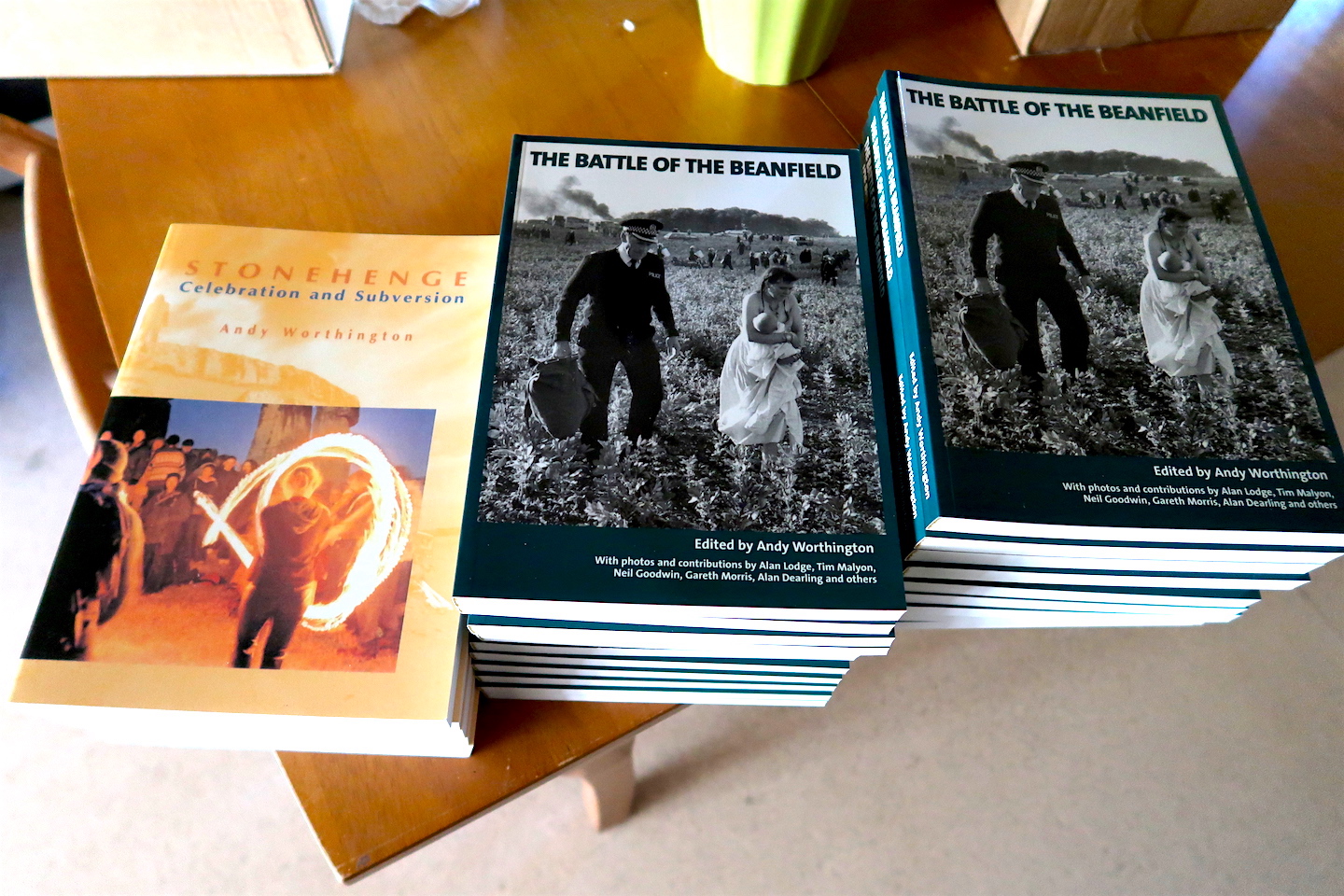
In 2005, following up on my first book, Stonehenge: Celebration and Subversion, a social history of Stonehenge in which the Beanfield features prominently, I compiled interviews from those who were present on the day — including travellers, journalists and other key individuals — for my book The Battle of the Beanfield, and both books are still in print because of an enduring interest both in Stonehenge and its counter-cultural history, and in the shameful and perpetually shocking events of June 1, 1985.
Last year, marking the 40th anniversary of the Battle of the Beanfield, there was a noticeable revival of interest in its enduring and corrosive effect on liberty in the UK. With support from Ecotricity’s Dale Vince, who was the motorbike outrider on the day of the Beanfield, a revised and expanded version of ‘Operation Solstice’ was produced by Neil Goodwin and Gareth Morris, and the archive of interviews for the documentary (some of which I had transcribed for my book) was preserved, on a website, ‘The Beanfield’, that is well worth a visit.
BBC Wiltshire published a detailed analysis of the events of the day for the BBC’s website, highlighting ongoing calls for a public inquiry, which have been shunned by the government even more than their delaying tactics regarding an inquiry into the Battle of Orgreave, and there were also several screenings of ‘Operation Solstice’, including a well-attended screening that I organized on the anniversary in my home borough of Lewisham, in south east London, as part of the Brockley Max arts festival, and another well-attended screening that I was part of, which took place in Salisbury in October.
The most prominent screenings, however took place at the Glastonbury Festival, which was attended by Dale Vince, and at the Green Gathering, which I attended, and where I was grateful for the opportunity to trace how a line can be drawn from the punitive legislation that followed the Beanfield to the extraordinarily authoritarian repression of protest and direct action that has been taking place in the UK over the last four years.
The authoritarian line that connects the Beanfield to now
This is via unprecedented and unprincipled legislation imposing prison sentences and even a terrorist designation on those seeking to highlight the existential perils of fossil fuel-engineered climate collapse, and the UK government’s complicity in Israel’s ongoing genocide in the Gaza Strip.
The first of these legislative responses was the Public Order Act of 1986, with its restriction on gypsies’ and travellers’ rights, and on our ability to gather freely, and this was followed by further draconian legislation in 1994 — the Criminal Justice Act, provoked by hysteria following the last great free and unlicensed gathering in the UK, the Castlemorton Free Festival, in 1992, after years of extraordinary dissent, via the rave scene and the road protest movement, none of which had been foreseen by Thatcher.
Although dissent never went away, the passage of the CJA marked a noticeable clampdown on our freedoms, and although Stonehenge itself was eventually liberated, by the Law Lords, from the military exclusion zones that were erected there every summer after the Beanfield, the post-Beanfield and post-Castlemorton legislation set the scene for the increasingly draconian assaults on our right to protest and our right to gather freely that have been particularly noticeable since 2022.
This ferocious clampdown began under the last Tory government, when two authoritarian home secretaries, Priti Patel and Suella Braverman, sought to criminalize protest and dissent by climate activists and activists opposing the state’s whitewashing of its colonial history, including through the imposition of prison sentences.
Disgracefully, the current Labour government has gone even further into dystopian “police state” territory, designating the direct action group Palestine Action, which had been targeting facilities owned by Israel’s largest weapons manufacturer, Elbit Systems, as a terrorist organization, and seeking long prison sentences for those involved.
While the historical resonances from the Beanfield to now will continue to be picked up on by those who are aware that our politicians and our mainstream media like to keep the truth about our history hidden, it’s rather sad that, today, the horrific and still resonant events of June 1, 1985 seem, in general, to have fallen off the radar, because what the authoritarian line drawn from the Public Order Act of 1986 to now shows most clearly is that, once enacted, draconian laws are rarely, if ever repealed, and, as a result, authoritarianism only ever increases until it starts, as is happening now, to increasingly resemble the fundamental suppression of rights that accompanies the rise of fascism.
* * * * *
 Andy Worthington is a freelance investigative journalist, activist, author, photographer (of a photo-journalism project, ‘The State of London’, which ran from 2012 to 2023), film-maker and singer-songwriter (the lead singer and main songwriter for the London-based band The Four Fathers, whose music is available via Bandcamp). He is the co-founder of the Close Guantánamo campaign (see the ongoing photo campaign here) and the successful We Stand With Shaker campaign of 2014-15, and the author of The Guantánamo Files: The Stories of the 774 Detainees in America’s Illegal Prison and of two other books: Stonehenge: Celebration and Subversion and The Battle of the Beanfield. He is also the co-director (with Polly Nash) of the documentary film, “Outside the Law: Stories from Guantánamo.”
In 2017, Andy became very involved in housing issues. He is the narrator of the documentary film, ‘Concrete Soldiers UK’, about the destruction of council estates, and the inspiring resistance of residents, he wrote a song ‘Grenfell’, in the aftermath of the entirely preventable fire in June 2017 that killed over 70 people, and, in 2018, he was part of the occupation of the Old Tidemill Wildlife Garden in Deptford, to try to prevent its destruction — and that of 16 structurally sound council flats next door — by Lewisham Council and Peabody.
Since 2019, Andy has become increasingly involved in environmental activism, recognizing that climate change poses an unprecedented threat to life on earth, and that the window for change — requiring a severe reduction in the emission of all greenhouse gases, and the dismantling of our suicidal global capitalist system — is rapidly shrinking, as tipping points are reached that are occurring much quicker than even pessimistic climate scientists expected. You can read his articles about the climate crisis here. He has also, since, October 2023, been sickened and appalled by Israel’s genocide in Gaza, and you can read his detailed coverage here.
To receive new articles in your inbox, please subscribe to Andy’s new Substack account, set up in November 2024, where he’ll be sending out a weekly newsletter, or his RSS feed — and he can also be found on Facebook (and here), Twitter and YouTube. Also see the six-part definitive Guantánamo prisoner list, The Complete Guantánamo Files, the definitive Guantánamo habeas list, and the full military commissions list.
Please also consider joining the Close Guantánamo campaign, and, if you appreciate Andy’s work, feel free to make a donation via PayPal or via Stripe.










 Who's still at Guantánamo?

41 Responses
Andy Worthington says...
When I posted this on Facebook, I wrote:
Marking the 41st anniversary, today, of the Battle of the Beanfield, when the British state undertook the most savage assault on unarmed civilians in modern British history. On June 1, 1985, riot police from six counties cornered a vastly-outnumbered convoy of vehicles seeking to make their way to establish what would have been the 12th annual Stonehenge Free Festival, in fields around the ancient sun temple on Salisbury Plain, and “decommissioned” them with extreme violence, brutally assaulting the men and women of the convoy, terrorizing their children, destroying their live-in vehicles, and making 537 arrests in total.
As part of the necessary act of remembering acts of state violence that those responsible would prefer to keep hidden, I wrote a book about the Beanfield, published in 2005, which is still in print, and which followed on from an earlier book, ’Stonehenge: Celebration and Subversion’, a social history of Stonehenge, in which the Beanfield featured prominently, and which is also still in print.
Marking today’s anniversary, I revisit the history of the free festival and traveller movements that led up to the Beanfield, trace its impact on the communities involved, and also draw an important line from the draconian legislation that followed the Beanfield, undermining travellers’ rights, and our right to gather freely, through further legislation in the ‘90s, after the British counter-culture refused to accept Thatcher’s edict that all dissent was forbidden, through to the huge increase in even more draconian legislation in recent years, aimed primarily at climate activists, and, most recently, those taking direct action against Israel’s biggest weapons manufacturer, Elbit Systems, who, alarmingly, have, as a result, been designated as a terrorist organization by the Labour government.
As I note in my conclusion, “what the authoritarian line drawn from the Public Order Act of 1986 to now shows most clearly is that, once enacted, draconian laws are rarely, if ever repealed, and, as a result, authoritarianism only ever increases until it starts, as now, to increasingly resemble the fundamental suppression of rights that accompanies the rise of fascism.”
...on June 1st, 2026 at 5:33 pm
Andy Worthington says...
Here’s my new Substack post promoting the article above: https://andyworthington.substack.com/p/the-battle-of-the-beanfield-at-41
Please join me on Substack to get links to everything I write in your inbox, and, if you can, to support my work. Free or paid subscriptions are available, although the latter ($8 a month or $80 a year) are absolutely essential for a reader-funded writer like myself, and if you can help out at all it will be very greatly appreciated.
...on June 1st, 2026 at 11:30 pm
Andy Worthington says...
Julie Vaughan wrote:
Andy, you write the best and most informative books and I have read both of these cover to cover more than once so if anyone is thinking of buying one then buy both of these because they are beautiful written and you’ll love them ♥️
...on June 1st, 2026 at 11:31 pm
Andy Worthington says...
Thanks so much for your wonderfully supportive words, Julie. You’ve made my day!
...on June 1st, 2026 at 11:31 pm
Andy Worthington says...
when my friend Jacqueline Durban shared this, she wrote:
·
Marking the 41st anniversary of the Battle of the Beanfield. Thank you, as ever, to Andy Worthington for keeping this memory alive. It matters.
...on June 1st, 2026 at 11:33 pm
Andy Worthington says...
Thanks so much for sharing, Jacqueline, and for your comments. It does still matter, doesn’t it, even as attention spans grow shorter, and people’s sense of even their own history seems to be fading away.
...on June 1st, 2026 at 11:33 pm
Andy Worthington says...
Shaun Tebbs wrote:
I still have your book that you and Phil the beer signed for me when the chief of Wiltshire police made his apology at Glastonbury, thanks for the memories
...on June 1st, 2026 at 11:34 pm
Andy Worthington says...
Thanks, Shaun. Good to hear from you.
...on June 1st, 2026 at 11:34 pm
Andy Worthington says...
Jacqueline Durban wrote, in response to 6, above:
Truly, Andy. Learning of the Battle of the Beanfield when I was a teenager has shaped my life. Being taught the dates when kings and queens ruled has made no difference. This is the history that needs preserving.
...on June 2nd, 2026 at 2:42 pm
Andy Worthington says...
Thanks again, Jacqueline. There’s such an ocean of meaning in your comment about the people’s history versus that of the establishment with their kings and queens.
...on June 2nd, 2026 at 2:42 pm
Andy Worthington says...
James McCarraher wrote:
Superb read Andy.
...on June 2nd, 2026 at 2:55 pm
Andy Worthington says...
Thanks so much, James. Good to hear from you.
...on June 2nd, 2026 at 2:55 pm
Andy Worthington says...
Julie Vaughan wrote, in response to 4, above:
Andy, you Sir are a true hero of mine ♥️
...on June 2nd, 2026 at 2:57 pm
Andy Worthington says...
You just made my day again, Julie. Thank you so much! ♥️
...on June 2nd, 2026 at 2:58 pm
Andy Worthington says...
Joelle Laws wrote:
I’m glad Julie wrote it for me! Great work & recommended reading.
...on June 2nd, 2026 at 2:58 pm
Andy Worthington says...
Thanks so much, Joelle. So glad to hear that!
...on June 2nd, 2026 at 3:00 pm
Andy Worthington says...
Iyona Truck wrote:
Ditto that, I witnessed the event on the TV, it wasn’t until 5 yrs later, that I finally had access to you through your books and knowledge of the event, and then I was able to make sense of the true story. So thank you 🙏❤️
...on June 2nd, 2026 at 3:01 pm
Andy Worthington says...
Thanks so much, Iyona, for the wonderful message!
...on June 2nd, 2026 at 3:02 pm
Andy Worthington says...
Emily Rose Townsend wrote:
Hi Andy – thanks for sharing your article.
You might be interested in this short story I serialised on Substack last year, which is set in the Beanfield. I drew heavily on your book & Operation Solstice when I was writing it & you are credited at the end.
https://open.substack.com/pub/emilyrosetownsend/p/the-field-where-we-stood-part-i
...on June 2nd, 2026 at 3:12 pm
Andy Worthington says...
Excellent, Emily. Great storytelling. Thanks for sharing.
...on June 2nd, 2026 at 3:13 pm
Andy Worthington says...
Ember Alice wrote:
My mum was there, she was 16 with her best friend and big brother and the police separated them from him. They ended up only being saved from harm by a smashed up bus that ushered them in and drove them to safety. She still remembers the brutality in detail.
...on June 2nd, 2026 at 3:43 pm
Andy Worthington says...
Good to hear from you, Ember. How horrible to think of that happening to a 16-year old. They were monsters that day.
...on June 2nd, 2026 at 3:43 pm
Andy Worthington says...
Gary Adcock wrote:
Remember this, it was absolutely shocking. The same level of violence meted out to the striking miners.
...on June 2nd, 2026 at 3:44 pm
Andy Worthington says...
Exactly, Gary. Both labelled “enemies within” by the chief “enemy within” herself, Margaret Thatcher, with her contempt for workers and any disruptive influences interfering with her vision of what we ha
...on June 2nd, 2026 at 3:44 pm
Andy Worthington says...
Amanda Currie wrote:
I remember both, I had friends whose Dads, brothers etc were miners, and friends who were New Age Travellers.
...on June 2nd, 2026 at 3:45 pm
Andy Worthington says...
It was a war, Amanda, waged by the government on those regarded as the “enemies within.” Manufacturing never recovered, but on the counter-cultural front at least Thatcher was ambushed by forces she never saw coming – the rave scene, which overshadowed her last years of attempting to impose order on the unruly, and the Poll Tax Riot, which eventually took her down.
...on June 2nd, 2026 at 3:45 pm
Andy Worthington says...
Dean Deanyoda wrote:
Eggtek this year was the same. Bloody violence for dancing. Dogs truncheons and beatings. Police in full riot gear attacking unprovoked. Same then as now only this time its labour. Two sided coin. Still the same coin.
...on June 2nd, 2026 at 3:46 pm
Andy Worthington says...
Thanks for updating the story of the state’s suppression of illegal, unlicensed gatherings, Dean, which has been pretty constant since the CJA was passed in 1994, the whole point being not to suppress all partygoing, but only to allow it when it’s licensed and making money for someone – the complete opposite of the free party vibe.
There’s a VICE report here about the police’s violent attack on Eggtek: https://www.vice.com/en/article/ravers-tell-us-what-actually-happened-when-eggtek-was-violently-shut-down-by-police/
...on June 2nd, 2026 at 3:46 pm
Andy Worthington says...
Trevor Lewis wrote:
The police involved should have been charged, they still should even if they are retired.
Worse than animals.
...on June 2nd, 2026 at 3:59 pm
Andy Worthington says...
Kelvin Samms wrote:
Weren’t wearing id numbers so prosecution was fruitless.
...on June 2nd, 2026 at 4:00 pm
Andy Worthington says...
Exactly, Kelvin. A sign that a line was being crossed – and always is, still, whenever the police turn up without identification.
...on June 2nd, 2026 at 4:00 pm
Andy Worthington says...
Trevor Lewis wrote:
Many were army personnel in dark blue jumpers.
...on June 2nd, 2026 at 4:00 pm
Andy Worthington says...
An important note, Trevor, following on from the Molesworth eviction. It wasn’t just militarized police; it was the military too.
...on June 2nd, 2026 at 4:01 pm
Andy Worthington says...
Gi Neve wrote:
I was there and not something i will ever forget, on a lighter note one thing that sticks with me is a bus driving away with a large sign in the back window saying Acid for sale hehehe.
...on June 2nd, 2026 at 4:01 pm
Andy Worthington says...
Thanks for the memories, Gi Neve. Good to hear from you.
...on June 2nd, 2026 at 4:02 pm
Andy Worthington says...
Kelvin Samms wrote:
I caught up with everyone that somber night at Savenake forest, any water we tried to take into the site the police made us empty at the side of the road. The following morning the pure misery was uplifted when each vehicle limped into site, how we cheered, hugged, cried. Love and peace to all who share the memories of that time x
...on June 2nd, 2026 at 4:02 pm
Andy Worthington says...
Good to hear from you, Kelvin, and thanks for sharing your memories. Worth remembering too that Lord Gifford, the owner of Savernake Forest, which is privately owned, refused to allow the police to “come in and finish the job” after he’d witnessed the violence the day before.
...on June 2nd, 2026 at 4:03 pm
Andy Worthington says...
Jacqueline Dee wrote:
All a part of Thatcher’s strategy for weakening the people.
...on June 2nd, 2026 at 4:06 pm
Andy Worthington says...
Yes, it was a war, Jacqueline, on the miners, on the travellers, on the Fleet Street printers. The damage to communities – especially the miners – was immense, and many have never recovered. Her enforced de-industrialization had long-term effects that she never even bothered to think about.
...on June 2nd, 2026 at 4:06 pm
Andy Worthington says...
Dawn Newell wrote:
Police brutality n all of them hiding their collar nos, if I remember correctly.
Andy, I wasn’t aware of this book n just ordered a copy, so thank you.
I’ve got a well preserved copy of my Medieval Brigands book that mostly documented the aftermath n Stoney Cross. But has some great photos of all our vehicles in it. One of my few cherished possessions.
...on June 2nd, 2026 at 6:19 pm
Andy Worthington says...
Yes, they definitely all kept their identities hidden, Dawn, which was a sign that it was, essentially, a covert operation, albeit one with the public face of Lionel Grundy.
Thanks for the book order. So glad you’ve found out about it. I too have a copy of ‘Medieval Brigands’, which is a powerful visual record of the year after.
...on June 2nd, 2026 at 6:20 pm