Archive for February, 2012
Three UK Protests to Mark the 10th Anniversary of Shaker Aamer’s Arrival at Guantánamo
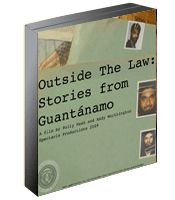
 February 14 marks the 10th anniversary of the arrival at Guantánamo of Shaker Aamer, who is now the last British resident in the prison, but was once one of 15 British citizens and residents held at Guantánamo. Shaker’s story is one that I have told and retold over the years, including in the documentary film, “Outside the Law: Stories from Guantánamo,” which I co-directed with Polly Nash, and it is distressing, for his British wife, and his four British children (the youngest of whom has never seen his father, because he was born after his capture) to have to endure another anniversary without Shaker, an eloquent man of great compassion, who has spent ten years demanding that he and his fellow prisoners be treated as human beings, and not as “enemy combatants” without rights, which is what they essentially remain, despite some general improvement in their living conditions under President Obama.
Throughout this period in which I have been studying Shaker’s story (for the last six years), it has been clear that there was no good reason for Shaker Aamer to be held. He was told in spring 2007 that he had been cleared for release by the Bush administration, and in August 2007 Gordon Brown, taking over from Tony Blair as Prime Minister, requested his return along with the other British residents.
Nevertheless, he was not freed, and with a new President in the US and a new government in the UK it was not initially known what his status was as the 10th anniversary of the opening of Guantánamo approached. However, two recent discoveries have ensured that, on the 10th anniversary of Shaker’s arrival at Guantánamo, there are no obstacles to his immediate release, however much representatives of the US or UK governments may pretend otherwise. Read the rest of this entry »
Life After Guantánamo: The Suffering of the Uighurs in Palau
 The story of Guantánamo’s Uighurs has always been one of monstrous injustice — as well as a monstrous failure of intelligence, and an equally monstrous failure when it comes to the US government taking responsibility for its own mistakes. This is not a unique occurrence in Guantánamo, of course, but it has long been emblematic of the many failures of Guantánamo.
Briefly, the Uighurs are Muslims from Xinjiang province in north-western China, an area subjected to persecution by the Chinese government. The 22 Uighurs who ended up at Guantánamo were, for the most part, refugees who had been thwarted in their attempts to reach Turkey or Europe in search of work, or who, in some instances, nursed futile hopes of rising up against their oppressors. None had any involvement with al-Qaeda, terrorism or militancy against the United States, and they only ended up in Guantánamo because the rundown settlement in which they had been living in the mountains of Afghanistan was bombed by US forces, and, after they fled to Pakistan, they were sold to US forces by Pakistani villagers.
It was clear from the beginning that prisoners whose only enemy was the Chinese government should never have been held at Guantánamo, but they were used as pawns in negotiations with the Chinese government prior to the invasion of Iraq, and although five of the Uighurs were found a new home in Albania in May 2006, it took until 2008 — and a humiliating court defeat — for the Bush administration to give up its claim that the other 17 were “enemy combatants.” As a result, their habeas corpus petitions were granted in October 2008, but although a judge ordered them to be released in the United States, the Bush administration, and then the Obama administration disagreed, and appealed the ruling, securing a favorable response in February 2009 from the right wing judges in the D.C. Circuit Court. Read the rest of this entry »
Video: Guantánamo Panel Discussion in Washington D.C. with Andy Worthington and Lawyers Tom Wilner, Darold Killmer and Mari Newman
 Yesterday, I posted a short video of a speech I gave on January 10, while I was visiting the US for events marking the 10th anniversary of the opening of Guantánamo, prior to a screening of the documentary film, “Outside the Law: Stories from Guantánamo” (which I co-directed with Polly Nash) at a branch of Busboys and Poets in Washington D.C.
That screening, the day before protests marking the 10th anniversary (which I covered here, here and here), was organized by the World Can’t Wait, the campaigners responsible for my visit, and was followed by a panel discussion in which I was delighted to be speaking alongside the attorney Tom Wilner — my colleague in the newly established “Close Guantánamo” campaign and website, with whom I had just taken part in a lunchtime event at the New America Foundation (also with Congressman Jim Moran and Col. Morris Davis) — and Darold Killmer and Mari Newman, attorneys from Denver whom I had asked to come along and speak about their clients, five Yemenis who are still held at Guantánamo.
Introducing the Q&A session, I spoke briefly about the “Close Guantánamo” campaign and the now-closed petition on the White House’s “We the People” website, asking President Obama to fulfil his promise to close Guantánamo, and also reminded those attending that, while criticizing Congress for inserting provisions in the National Defense Authorization Act (NDAA) demanding the mandatory military custody, without charge or trial, of anyone who can be accused of being associated with al-Qaeda, they should not forget that, for ten years, the prisoners in Guantánamo have been detained on essentially the same basis. Read the rest of this entry »
Save the NHS: A Doctor’s Moving Defence of Her Profession, and How Care is More Important Than Budgets
 Yesterday, I published an article about the Tory-led coalition government’s ongoing attempts to destroy the NHS, after the health minister Andrew Lansley issued a new set of amendments to his Health and Social Care Bill, in an attempt to suppress dissent in the House of Lords, which only succeeded in prompting GPs and physiotherapists to issue their own official opposition to the bill.
It is but no means clear that the government can be persuaded to scrap its bill, as the entire rationale for the coalition government’s existence seems to be to remove whatever remains in public ownership and to hand it over to the private sector, even though that particular approach to politics is exactly the opposite of what we need, after the unfettered greed of bankers and the private sector led to the economic crash of 2008, whose reverberations have, perhaps fatally, undermined the economic health of the West, even while, in the UK, cynical and thoroughly unqualified ideologues like David Cameron and George Osborne attempt to pin all the blame for Britain’s economic woes on the poor, the unemployed and the disabled.
This approach — and the way it is being lapped up by a majority of the British people — marks a particularly low point in my lack of respect for politicians or my fellow citizens, and I’ll be writing more about it soon, but for now, in an effort to maintain the focus on the NHS, and the need for persistent opposition to the government’s plans from anyone who understands how extraordinary it is to have a health service paid for by general taxation, which is free at the point of entry and exit, and how important it is to hold onto this service, I’m cross-posting below an article by Dr. Clare Gerada, the chair of the Royal College of GPs — whose members last week voiced their considerable opposition to the government’s planned reforms — which was published in October in the Guardian. Read the rest of this entry »
Save the NHS: 100,000 GPs and Physiotherapists Call for Health Bill to be Scrapped
 Ever since the coalition government introduced its Health and Social Care Bill, it has been obvious that what was planned was nothing less than the destruction of the NHS as a universal healthcare provider, and the gradual privatisation of the service, leading to greater profits for private companies and, simultaneously, cuts to services.
Understanding this, the professional bodies representing those who actually work in the NHS have opposed the bill. Amongst other bodies, the British Medical Association, the Royal College of Nursing and the Royal College of Midwives have opposed the government’s plans, and last week, in an editorial published simultaneously in the British Medical Journal, the Health Service Journal and Nursing Times, the editors of those magazines described the government’s plans as a “damaging … unholy mess,” and stated that the NHS “is far too important to be left at the mercy of ideological and incompetent intervention” and that “we must make sure that nothing like this ever happens again.”
In a second British Medical Journal editorial last week, Kieran Walshe, professor of health policy at Manchester Business School, explained how abandoning the bill now would save over £1bn in 2013. As he explained, “Going ahead with the bill means setting up the NHS Commissioning Board (with an annual running cost of £492m), 260 clinical commissioning groups (with an annual running cost of £1.25bn), and the new economic regulator, Monitor (with its anticipated annual running cost of £82m). Each of these new statutory organisations will have additional set-up costs — perhaps amounting to a one-off spend of £360m. If the bill were stopped now, it would save all those set-up costs, and at least £650m in annual running costs — just over £1bn in 2013.” Read the rest of this entry »
Video: In Washington D.C., Andy Worthington Discusses Protests in Guantánamo, and the Campaign to Free Shaker Aamer
 On January 10, while I was visiting the US for events marking the 10th anniversary of the opening of Guantánamo, the World Can’t Wait, the campaigning organization responsible for my visit, hosted a screening of the documentary film, “Outside the Law: Stories from Guantánamo” (which I co-directed with Polly Nash) at a branch of Busboys and Poets in Washington D.C.
This was the day before the rally and march to close Guantánamo, which I covered here, here and here, and it was an extremely well attended event, with over a hundred people in the audience — mostly campaigners from the various organizations involved in the January 11 protest, including Amnesty International, Witness Against Torture, the World Can’t Wait, Code Pink and the National Religious Campaign Against Torture.
Also present were: the attorney Tom Wilner — my colleague in the newly established “Close Guantánamo” campaign and website, with whom I had just taken part in a lunchtime event at the New America Foundation (also with Congressman Jim Moran and Col. Morris Davis) — and Darold Killmer and Mari Newman, attorneys from Denver whom I had asked to come along and speak about their clients, five Yemenis who are still held at Guantánamo. Read the rest of this entry »
Last Call to Sign the White House Petition to Close Guantánamo
 |
To mark the 10th anniversary of the opening of Guantánamo, on January 11, I was involved in two particular projects — firstly, the establishment of a new campaign and website, “Close Guantánamo,” designed to raise awareness of the continuing injustice of Guantánamo, and, in particular, the injustice of continuing to hold 89 of the remaining 171 prisoners, even though they have been cleared for release; and secondly, the establishment of a petition on the White House’s “We the People” website, calling on President Obama to fulfil his promise to close Guantánamo.
The “Close Guantánamo” project has only just begun, and will enter a new phase next week with the publication of the first of the profiles of the 171 prisoners still held, designed to inform people that they are human beings, with feelings, and with families, who, after ten years, are not held legitimately, but are, as Navi Pillay, the UN High Commissioner for Human Rights, explained last week, subjected to arbitrary detention.
 In contrast, the second project — the petition on the White House’s “We the People” website — has just three days left until its deadline of one month is reached, so please, if you haven’t yet signed it, sign it now, and please also tell everyone you know. This could be the weekend that we beat the odds and come up with the signatures we need to secure a response from President Obama. The countdown clock, above, by the way, is from the Center for Constitutional Rights’ “Close Guantánamo” page, which also features videos from the protests in Washington D.C. on January 11 (and which I wrote about here). Read the rest of this entry »
Former Guantánamo Prisoner Adel Al-Gazzar Is Freed in Egypt After Six Months in Custody
 When looking at the stories of the released Guantánamo prisoners, one of the most tragic individual stories of last year was that of Adel al-Gazzar (aka Adel El-Gazzar), a former officer in the Egyptian army, who lost a leg in US custody and spent eight years in Guantánamo. Adel returned to Egypt last June, after being freed in Slovakia in January 2010, where he embarked on a hunger strike to protest about the Slovakian government’s inability to look after him adequately, and where, at one point, he was interviewed by his fellow ex-prisoner Moazzam Begg in a powerful and revealing interview available here. On his return to Egypt, he was promptly arrested, and imprisoned based on trumped-up charges that had been used to secure a conviction against him while he was in Guantánamo, and while the now-deposed dictator Hosni Mubarak was in power.
In December, following six months of pressure from his lawyers — at the London-based legal action charity Reprieve — the Supreme Council of the Armed Forces agreed to hear his case on December 27, in an appeal for a new trial, and on December 30, as AllAfrica.com reported, “The Military Court of Cassation accepted the claim of Adel Fattouh al-Gazzar for the re-trial,” noting that “Hafez Abu Seada, attorney at law, submitted the claim after Adel was sentenced to three years in prison.”
On January 16, Adel was freed, although the English-speaking media did not report the story, and I did not discover it until last week, when Moazzam Begg told me about it while we were in Brussels for a screening at the European Parliament of “Outside the Law: Stories from Guantánamo,” the documentary film that I co-directed with Polly Nash. Read the rest of this entry »
Why Algeria Is Not A Safe Country for the Repatriation of Guantánamo Prisoners
 Since July 2008, when the first Algerian prisoners were repatriated from Guantánamo, the position taken by the US government — first under George W. Bush, and, for the last three years, under Barack Obama — has been that Algeria is a safe country for the repatriation of prisoners cleared for release.
Lawyers and NGOs aware of Algeria’s poor human rights record disagreed, as did some of the Algerian prisoners themselves, to the extent that the last two Algerians sent home — Abdul Aziz Naji in July 2010 and Farhi Saeed bin Mohammed in January 2011 — had actively resisted being sent home, and had taken their cases all the way to the US Supreme Court, which had paved the way for their enforced return by refusing to accept their appeals.
In assessing whether or not it was safe for Algerians to be repatriated from Guantánamo, the US government was required to weigh Algeria’s established reputation for using torture against the “diplomatic assurances” agreed between Washington and Algiers, whereby, as an Obama administration official told the Washington Post at the time of Naji’s repatriation, the Algerian government had promised that prisoners returned from Guantánamo “would not be mistreated.” The US official added, “We take some care in evaluating countries for repatriation. In the case of Algeria, there is an established track record and we have given that a lot of weight. The Algerians have handled this pretty well: You don’t have recidivism and you don’t have torture.” Read the rest of this entry »











 Who's still at Guantánamo?

