Archive for November, 2010
Andy Worthington and Former Guantánamo Prisoners Speak at “Bring Aafia Siddiqui Home,” London, November 14, 2010
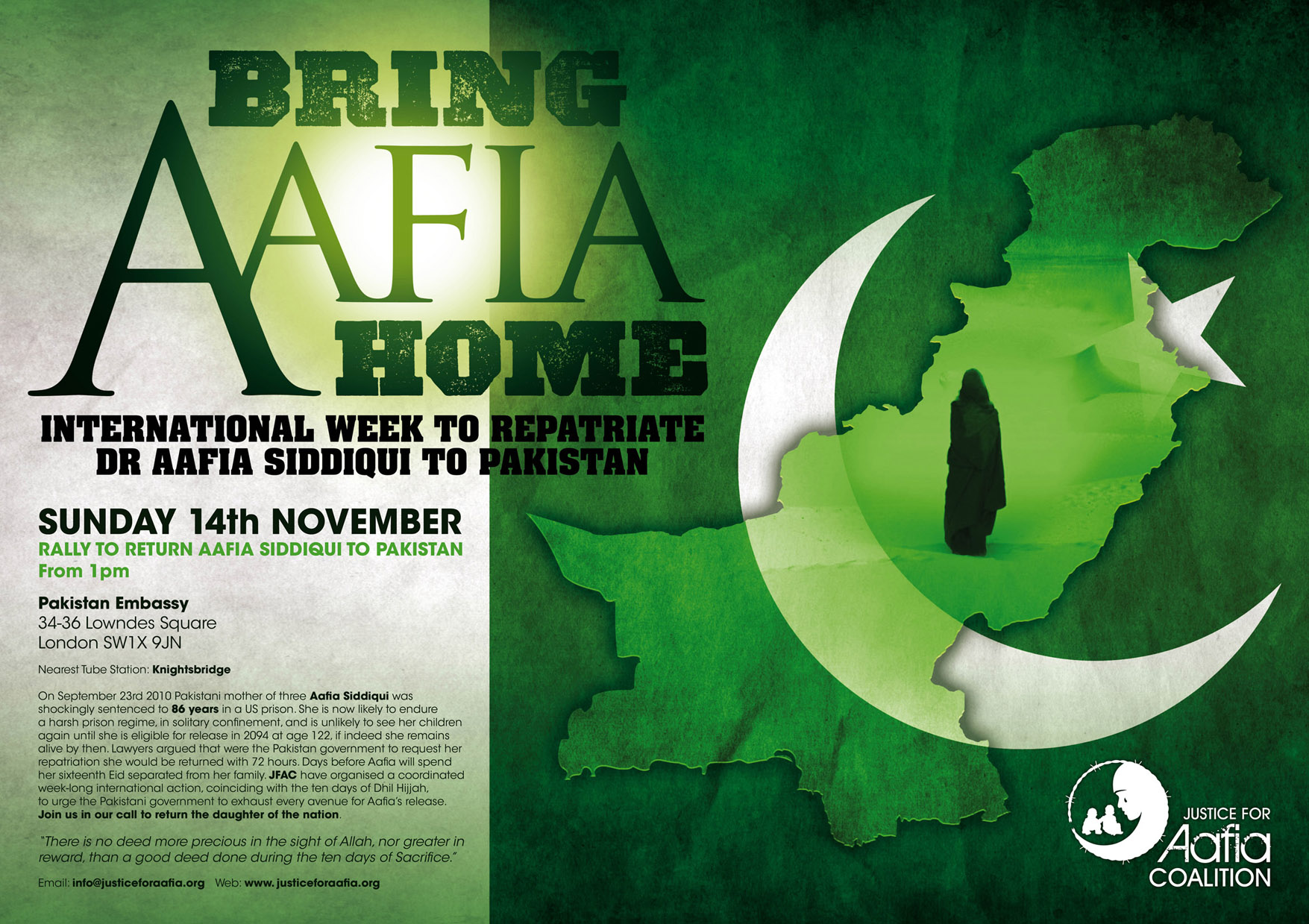 In an attempt to maintain pressure on the Pakistani government to secure the return to Pakistan of Dr. Aafia Siddiqui, the neuroscientist who, in September, was sentenced in New York to 86 years in prison, the Justice for Aafia Coalition is holding a week-long series of events around the world, entitled “Bring Aafia Home.”
As part of this series of events, the JFAC will be demonstrating outside the Pakistan Embassy in London at 1 pm on Sunday November 14. The embassy is at 34-36 Lowndes Square, London, SW1X 9JN, and the nearest underground station is Knightsbridge.
I have previously written at length about the distressing case of Aafia Siddiqui — the punitive sentence, the murky circumstances of her capture in Afghanistan in 2008 and her rendition to the US, the five lost years when, it appears, she was held in the US prison at Bagram airbase in Afghanistan, and the fate of her three young children — and I was delighted to be asked to take part in the event in London on Sunday to raise awareness of Dr. Siddiqui’s case, and to highlight the disturbing conditions in which she is currently held, in the Federal Medical Facility in Carswell, Texas, a notorious establishment described in an article by Yvonne Ridley for Cageprisoners as the “Hospital of horror.”
I’m also pleased to report that amongst the many speakers are Ruhal Ahmed and Shafiq Rasul, two former Guantánamo prisoners whom I had the pleasure of interviewing live at a previous event for Dr. Siddiqui in east London in September. Videos of that interview, for those who are interested in hearing disturbing first-hand accounts of torture and abuse in the US prisons in Afghanistan and at Guantánamo, are available here.
The list of speakers on Sunday is as follows:
1.00pm: Introduction by Abdul Jaleel (JFAC). Statement of Support from Haldane Society of Socialist Lawyers.
1.05pm: Chris Nineham, Stop the War Coalition
1.15pm: Andy Worthington, Journalist and author of The Guantánamo Files
1.25pm: Jamal Harwood, Writer
1.35pm: Rabia Zia, UK Coordinator, PTI UK
1.45pm: Yaqub AbduSalaam, Poet
1.50pm: Massoud Shadjareh, Chair, Islamic Human Rights Commission
2.00pm: Ilyas Townsend, JFAC
2.10pm: Adnan Rashid, Hittin Institute
2.20pm: Ustadh Abdullah Hasan, Islamic Forum Europe
2.30pm: Poet Razette, Poet
2.35pm: Imam Wasim Kempson, Patron, HHUGS
2.45pm: Ruhal Ahmed and Shafiq Rasul, former Guantánamo prisoners
2.55pm: Ustadh Uthman Lateef, Hittin Institute
3.05pm: Conclusion by Abdul Jaleel
For further information, please contact the Justice for Aafia Coalition.
 Andy Worthington is the author of The Guantánamo Files: The Stories of the 774 Detainees in America’s Illegal Prison (published by Pluto Press, distributed by Macmillan in the US, and available from Amazon — click on the following for the US and the UK) and of two other books: Stonehenge: Celebration and Subversion and The Battle of the Beanfield. To receive new articles in your inbox, please subscribe to my RSS feed (and I can also be found on Facebook and Twitter). Also see my definitive Guantánamo prisoner list, updated in July 2010, details about the new documentary film, “Outside the Law: Stories from Guantánamo” (co-directed by Polly Nash and Andy Worthington, currently on tour in the UK, and available on DVD here), and my definitive Guantánamo habeas list, and, if you appreciate my work, feel free to make a donation.
The Cruelty and Stupidity of the Government’s Welfare Reforms
 Journalists like to portray Iain Duncan Smith, the work and pensions secretary, as a caring, decent man, but while this may be true in his personal life, politically he is a ruthless ideologue, whose white paper on welfare reform, unveiled yesterday, reveals that he is, to be blunt, monstrously cruel and stupid. In the Daily Telegraph on Saturday, Mary Riddell provided a cautionary warning about how this would-be reformer’s mind works, which harks back uncomfortably to the Social Darwinism of the Victorian age. Duncan Smith, she wrote, “believes that dysfunctional lives are the root cause of poverty, while the centre Left thinks, correctly, that the reverse is true.”
Although everyone in Parliament seems to agree with Duncan Smith’s assessment that the tangled welfare system needs an overhaul, and that the notion of a universal credit is a good idea, the details in his white paper, unveiled in Parliament yesterday — which followed a shocking claim on BBC4’s “Today” programme that not taking a job was “a sin” — were greeted with horror by anti-poverty campaigners, who, quite rightly, accused Duncan Smith of creating a “climate of fear” and of exposing the most vulnerable families and children to the “risk of destitution.” In addition, Rowan Williams, the Archbishop of Canterbury — a man whose job involves a more professional assessment of what constitutes “a sin” than that of a politician — also weighed in, warning that the plans were unfair and could plunge the unemployed into “a downward spiral of uncertainty, even despair”.
Under Duncan Smtih’s proposals, the long-term unemployed will be required to do unpaid community work, and unemployed people will be obliged to take whatever jobs are offered to them. If they refuse, they will lose their benefits for three months. If they refuse twice, they will lose benefits for six months, and if they refuse for a third time, they will be deprived of their benefits for three years. Elsewhere, a mainstay of authoritarian governments — attacking single mothers — resurfaced, as Duncan Smith promised that out-of-work parents of young children — those with children between the age of one and five — “will be penalised if they fail to keep in touch with their local jobcentre.”
The main problem with Duncan Smith’s proposals — which appears to me to be blindingly obvious, but is not even perceived by an alarmingly large number of my flint-hearted fellow citizens — is that it paints a picture of millions of workshy scroungers shirking work opportunities, which is fundamentally at odds with the actual situation in the job market.
Given that the government’s own figures show that there are currently 2.45 million unemployed people, and just 459,000 available jobs (and with the government having vowed to add another 1.3 million to the jobless total in the imminent future), beating up on the unemployed with such a variety of sticks is nothing short of heartless.
With one job available for every five people unemployed, only someone who has put ideology before common sense (as Duncan Smith admitted at the weekend, when he told the Telegraph that this particular period in time — during a recession — was “a dreadful period to try and do any of this”) would want to penalize every single person who doesn’t take up a job that is offered them, would want to harangue single parents with babies and toddlers (almost always mothers) in their own homes, would delight in humiliating the long-term unemployed — and undermining the minimum wage — by making them work for their benefit (presumably in orange jackets that will make them look like convicted criminals doing community service), and would delight in continuing the onslaught on the mentally and physically disabled that was begun by the Labour goverment.
In a malignant campaign to eradicate invalidity benefit, which began in 2008, Labour replaced it with employment support allowance, and then recruited malleable doctors to give disabled claimants tests and pronounce that almost anyone with a pulse was capable of work (see here for an appraisal by Edward Lawrence, a disabled man supported by the State). However, the new government has now taken this one step further, announcing that employment support allowance will only last for one year, after which those claiming it will be downgraded to jobseekers’ allowance, leaving campaigners concluding, with some justification, that a shockingly large number of people with long-term health problems will be consigned to a minimum of state support, even though their chances of ever finding a job are, to put it midly, remote. — or, as Polly Toynbee put it yesterday, “Large numbers who have been on incapacity benefit for years, who even in good times were pretty unemployable, will now lose a large slab of their income on the spurious grounds that they could, in theory, be fit for something or other.”
As the Guardian explained last month, according to estimates from the Department for Work and Pensions, about 290,000 people “are likely to be deemed too incapacitated to work, and will not see their benefits time-limited,” but 865,000 people on incapacity benefit will be “placed in the ‘work-related activity group,’ who will see their benefits cut after one year.” The Guardian also pointed out that “Those with assets, savings or partners who work will no longer receive benefits. They will not be able to claim JSA even if they are out of work, so would therefore have to rely on partners’ income or savings — if they have any — or sell off their assets.”
For those, like the government, who persist in ignroing evidence that the tests are unfair, Anjuli Veall, social policy and campaigns manager at Parkinson’s UK, said, “In spite of the government’s assurance that any cuts would protect the most vulnerable in society, we are concerned that the latest policy shift regarding ESA will unnecessarily target people with long-term conditions, such as Parkinson’s,” which, to my mind, indicates the extent to which the seriously ill are being regarded as fit for work.
A final problem with Duncan Smith’s reforms is that, although they involve an attempt to help those on low pay out of a benefit trap, where they end up poorer by working, they fail to address a far better solution: raising the minimum wage, as Mehdi Hasan noted in the Guardian on Tuesday, when he explained that, according to a recent report from the Institute for Public Policy Research, there are 1.7 million children in working households identified as living in poverty, and 3.4 million adults. Hasan also pointed out that the TUC has recommended to the low pay commission that it raises the minimum wage by 21p (3.5%) to £6.14 from October 2011 (which, it says, would save the government about £125m in tax credits and in-work benefits), but as he also noted, Tories have always despised the minimum wage, introduced in 1999, and “In opposition, Tory sources suggested the minimum wage would be allowed to ‘wither on the vine.'”
In contrast, as John Harris noted in the Guardian today, “on 3 November, a Treasury minister named Lord Sassoon served notice that the coalition’s work on City bonuses was done.” Lord Harris stated, “The government has taken action to tackle unacceptable bonuses in the banking sector,” meaning, as previously reported, that an annual £2.5 bn levy on the City — almost all of which will be returned due to a convenient reduction in Corporation Tax — is the sum of the government’s demands on the City fat cats who got us into this mess in the first place. As Harris also noted, “Six days later, Barclays announced that its latest bonus pot would total £1.6bn.” In the context of his article, framed around the proposed demolition of university funding, he pointed out that this is “about a third of what the government currently spends each year on university teaching,” although it should also be noted that it is about two-thirds of what the government plans to save through its remorseless assault on the disabled.
In conclusion, then, my message to Iain Duncan Smith is simple: ask the City for more money before you start hitting the poor, think long and hard about your duty of care to people with disabilities, create two million new jobs and raise the minimum wage, and then I might be prepared to listen. Until then, however, I will resist your self-righteous cruelty with every fibre of my being, and will encourage everyone I meet — whose heart has not yet frozen over — to do the same.
Andy Worthington is the author of The Guantánamo Files: The Stories of the 774 Detainees in America’s Illegal Prison (published by Pluto Press, distributed by Macmillan in the US, and available from Amazon — click on the following for the US and the UK) and of two other books: Stonehenge: Celebration and Subversion and The Battle of the Beanfield. To receive new articles in your inbox, please subscribe to my RSS feed (and I can also be found on Facebook and Twitter). Also see my definitive Guantánamo prisoner list, updated in July 2010, details about the new documentary film, “Outside the Law: Stories from Guantánamo” (co-directed by Polly Nash and Andy Worthington, currently on tour in the UK, and available on DVD here), and my definitive Guantánamo habeas list, and, if you appreciate my work, feel free to make a donation.
50,000 Students Revolt: A Sign of Much Greater Anger to Come in Neo-Con Britain
 They came from all over the country, creating a 50,000-strong throng of students and University lecturers that filled Whitehall. Peaceful but vocal, the protestors were armed only with banners and placards, but at times the noise, as they chanted their opposition to the government’s planned £2.9 bn cut in university funding, was deafening.
I attended the demo for about an hour and a half, and was heartened that so many had turned up. To be frank, every single student in the country should have been there, or they might as well have had ministers turning up at their door asking them to agree that, from today, they will start paying up to £9,000 a year in fees — as opposed to the current rate of £3,290.
There was anger too, as some protestors smashed up Tory HQ on Millbank, while others took to the roof of the building. Some were students, others were not, but predictably, the violence overshadowed the main events of the day in the majority of media reports, and in much of the hand-wringing commentary today. In truth, however, both the massive peaceful demo and the considerably smaller group of violent protestors were indicative of much more unrest to come — and for good reason.
On university education, as on welfare, the coalition government is mounting nothing less than a full-scale assault on the State and on fundamental notions of how British society operates. Critics — either the usual suspects whining about students’ privileges, or the new breed of middle class hypocrites ignoring the fact that their own university educations were subsidized — seem content to accept that university education is not something that contributes to the good of society as a whole, and also to accept, without a murmur, that as a result the axemen of Downing Street should be allowed to impose the most swingeing cuts imaginable.
The government’s comprehensive spending review indicated that the cuts will amount to 40 percent, but once the ring-fenced fields of science, technology, engineering and maths are removed, the blunt truth is that arts, humanities and social science courses — and the infrastructure that supports them — are facing 100 percent cuts, transferring, overnight, the entire burden of university education from the State to the individual.
I find it enormously depressing that no one seems to be calling for moderation — asking, for example, for cuts to be imposed more gradually, and over a longer period of time. As it stands, this is a horribly experimental project, and there is a very real fear that axing the entire budget for arts, humanities and social sciences and shifting the burden onto students will lead to the closure of numerous departments and entire institutions with long and influential histories — think of art colleges and drama schools, for example, or departments of literature and foreign languages — if enough young people decide that debts of £30,000 and above are simply not acceptable.
Also ignored in all this troubling meanness of spirit is any recognition that arts and humanities courses contribute enormously to the crucial role that the creative industries play in the modern British economy, and which is reflected in the huge number of self-employed creative people — in the arts, crafts, and writing, for example — who enrich society while not necessarily enriching themselves, and who would otherwise add to the growing numbers of the unemployed, given that there are currently 2.45 million unemployed people, and just 459,000 available jobs. Anyone thinking coherently about society as a whole might realize that an investment in university education as a whole might actually be contributing to the creation of self-starters, capable of independent thought and analysis, whose abilities might be essential to growth and employment, but cannot necessarily be measured by salary, or by their place in the corporate pecking order.
And yet, this absurd gamble — and this failure to value university education as something that is useful for society as a whole — is being embraced by people who should know better, who have been caught up in the government’s rhetoric about the necessity for cuts to be as deep and as swift as possible. Gleefully clutching scalpels, these same people seem incapable of thinking that the government may be operating for ideological reasons, attacking the unemployed, the working poor and even the middle classes (everyone, it seems, except the upper middle class, the rich and the super-rich) as part of an arrogant and essentially neo-con attempt to reshape the UK as a country that is as harsh and pitiless — and as consumed by greed — as the United States.
Are these cheerleaders for draconian cuts not aware of the mind-boggling amount of tax evasion and tax avoidance that takes place in this country, through corporations and wealthy individuals, which could cover most of the proposed cuts? And have they forgotten that the City is directly responsible for much of the deficit, from the economic meltdown of 2008 to the bank bailouts, the loss of tax revenue and the increase in welfare spending that occurred as a result, but is being asked to contribute nothing to the economy? Although an annual levy of £2.5 bn has been announced, this will almost all be given back through the generous cut in Corporation Tax that the government wasted no time in providing to its chums in the Square Mile.
As this is an example of what David Cameron and George Osborne and Nick Clegg are hiding when they talk about being “fair,” and about the necessity for all of us to tighten our belts, it is no wonder that yesterday’s massive peaceful protest is a sign of things to come, or that yesterday’s violence — and the cries of “Tory scum!” and newly-coined insults for the Liberal Democrats that accompanied it — are also here to stay.
What we needed at the General Election was a grown-up debate about Britain’s future. Instead, after all the major parties avoided discussing the economy, we got an incomprehensible coalition government, in which the major players — the Tories — have emerged as butchers, acting as though they had an electoral mandate for savage revolutionary change, and content to hack away not just at the poor but also at a significant swathe of their own less wealthy supporters, the Liberal Democrats have committed political suicide — unless enough of them revolt against the university cuts — and the people of Britain are dividing into two camps: the cruel, the complacent and the brainwashed on one side, and, on the other, those with empathy, a quaint belief in the common good, and an awareness that the destructive power of unfettered capitalism has yet to be seriously challenged.
Andy Worthington is the author of The Guantánamo Files: The Stories of the 774 Detainees in America’s Illegal Prison (published by Pluto Press, distributed by Macmillan in the US, and available from Amazon — click on the following for the US and the UK) and of two other books: Stonehenge: Celebration and Subversion and The Battle of the Beanfield. To receive new articles in your inbox, please subscribe to my RSS feed (and I can also be found on Facebook and Twitter). Also see my definitive Guantánamo prisoner list, updated in July 2010, details about the new documentary film, “Outside the Law: Stories from Guantánamo” (co-directed by Polly Nash and Andy Worthington, currently on tour in the UK, and available on DVD here), and my definitive Guantánamo habeas list, and, if you appreciate my work, feel free to make a donation.
Five New UK Screenings of “Outside the Law: Stories from Guantánamo” – in Bangor, Oxford, London and Sheffield
 “‘Outside the Law’ is a powerful film that has helped ensure that Guantánamo and the men unlawfully held there have not been forgotten.”
Kate Allen, Director, Amnesty International UK
“This is a strong movie examining the imprisonment and subsequent torture of those falsely accused of anti-American conspiracy.”
Joe Burnham, Time Out
As featured on Democracy Now!, ABC News and Truthout. Buy the DVD here.
One year ago, when Polly Nash and I launched our documentary film, “Outside the Law: Stories from Guantánamo,” it still seemed just about conceivable that, by now, it would be something of a historical document. However, in January, President Obama failed to keep his promise to close Guantánamo within a year, and, ten months on, with no new deadline set, there is no sign of when, if ever, the prison will close, leaving the 174 remaining prisoners in a distressing limbo as the ninth anniversary of the prison’s opening approaches. With Republicans once more in charge of the House of Representatives, the task of closing Guantánamo has become much more difficult, and it is a bitter disappointment that Obama and his party lacked the courage or the conviction to act more decisively on Guantánamo when they had the chance.
As a result, “Outside the Law: Stories from Guantánamo,” which punctures the myths about Guantanamo holding “the worst of the worst,” telling the story of the prison’s chaos and cruelty, and focusing on three British residents — Shaker Aamer (who is still held, despite being cleared for release in 2007), and Binyam Mohamed and Omar Deghayes (both released) — remains, sadly, as important and as pertinent as ever.
Because Shaker Aamer is still held, the focus of these screenings will be very much on his case, and letters will be made available, which viewers can send to the foreign secretary William Hague, demanding his immediate return to the UK, where his British wife and children live (a template of a letter can be found here). Distressingly, the coalition government is peddling the same lies as its predecessor regarding Shaker’s continued presence at Guantánamo — that he is still regarded as a “security risk” by the US authorities — even though it is well within the government’s abilities to monitor him on his return if this should be required.
As I have explained over the last year, the truth appears to be that the British and American governments are in no hurry to release Shaker, because he knows too much about British complicity in torture in Afghanistan, about the troubling deaths of three prisoners at Guantánamo in June 2006, and about the dark workings of Guantánamo in general. This is a truly disgraceful state of affairs, and is made all the worse because the government’s plans to hold a judicial inquiry into British complicity in torture (announced by David Cameron in July) will be worthless if it takes place while Shaker is still held.
Below is the list of new screenings in November and December. Unless otherwise noted, the screenings are free.
Wednesday November 17, 7.30 pm: Film screening – “Outside the Law: Stories from Guantánamo.” Followed by Q&A.
Blue Sky Cafe, Ambassador Hall, Rear of 236 High Street, Bangor, LL57 1PA.
With Andy Worthington.
This screening is organized by Occasional Cinema and Bangor Peace Group. Tickets cost £3 and food will be served.
For further information, please contact Linda Rogers. Also see the Blue Sky Cafe website.
Monday November 22, 6.30 pm: Film screening – “Outside the Law: Stories from Guantánamo.” Followed by Q&A.
The Ultimate Picture Palace, Jeune Street, Oxford, OX4 1BN.
With Andy Worthington and Polly Nash.
This screening was a fundraiser for the Medical Foundation for the Care of Victims of Torture and was organized by the Oxford regional group. Tickets cost £6.
For further information, please contact Rosemary Shurgold on 01865 722820 or by email. Also see the website here, and see here for the Medical Foundation’s main website.
Friday December 10, 7 pm: Film screening – “Outside the Law: Stories from Guantánamo.” Followed by Q&A.
Roehampton University, London, SW15 5PU.
With Andy Worthington and Polly Nash.
This screening is part of the Roehampton Human Rights Film Festival, organized by the Human Rights Society, and is taking place on the 60th anniversary of Human Rights Day, which began on the second anniversary of the creation of the Universal Declaration of Human Rights in 1948. Sadly, the human rights course at Roehampton faces the axe as a result of the Tory-led coalition government’s unprecedented assault on funding for arts and humanities subjects. Please sign the petition here opposing the closure of the course.
For further information, please contact Marina Manners.
Saturday December 11, 4.30 pm: Film screening – “Outside the Law: Stories from Guantánamo.” Followed by Q&A.
Battersea Arts Centre, Lavender Hill, London, SW11 5TN.
With Omar Deghayes, Andy Worthington and Polly Nash.
This screening is part of “A Day for Shaker Aamer,” organized by the Save Shaker Aamer Campaign in his home borough of Wandsworth. The day begins at 12 noon, with a demonstration at Ponton Road, Nine Elms, London SW8, the site of the new US embassy. At 12.30 those gathered will march to Battersea Arts Centre for a public meeting, beginning at 2 pm, with speakers including Ken Livingstone, Moazzam Begg, Victoria Brittain, Jeremy Corbyn, Lindsey German, Kate Hudson, Gareth Peirce and Yvonne Ridley. Throughout the day, there will also be stalls and displays in the Great Hall.
For further information or to book a stall, please phone the SSAC on 07756 493877 or email. Also see the Facebook page here, and see here for the BAC website.
Wednesday December 15, 6 pm: Film screening – “Outside the Law: Stories from Guantánamo.” Followed by Q&A.
Showroom & Workstation, 15 Paternoster Row, Sheffield, S1 2BX.
With Omar Deghayes and Andy Worthington.
This screening is organized by Showroom and the Centre for Peace History at Sheffield University.
For further information, please contact Michael S. Foley, and also see the Showroom website.
All these details are also available on the dedicated page for the UK tour of the film, which began in February, and will continue into 2011.
About the film
Outside the Law: Stories from Guantánamo” is directed by Polly Nash and Andy Worthington, and tells the story of Guantánamo (including sections on extraordinary rendition and secret prisons) with a particular focus on how the Bush administration turned its back on domestic and international laws, how prisoners were rounded up in Afghanistan and Pakistan without adequate screening (and often for bounty payments), and why some of these men may have been in Afghanistan or Pakistan for reasons unconnected with militancy or terrorism (as missionaries or humanitarian aid workers, for example).
The film is based around interviews with former prisoners (Moazzam Begg and, in his first major interview, Omar Deghayes, who was released in December 2007), lawyers for the prisoners (Clive Stafford Smith in the UK and Tom Wilner in the US), and journalist and author Andy Worthington, and also includes appearances from Guantánamo’s former Muslim chaplain James Yee, Shakeel Begg, a London-based Imam, and the British human rights lawyer Gareth Peirce.
Focusing on the stories of three particular prisoners — Shaker Aamer (who is still held), Binyam Mohamed (who was released in February 2009) and Omar Deghayes — “Outside the Law: Stories from Guantánamo” provides a powerful rebuke to those who believe that Guantánamo holds “the worst of the worst” and that the Bush administration was justified in responding to the terrorist attacks of September 11, 2001 by holding men neither as prisoners of war, protected by the Geneva Conventions, nor as criminal suspects with habeas corpus rights, but as “illegal enemy combatants” with no rights whatsoever.
For further information, interviews, or to inquire about broadcasting, distributing or showing “Outside the Law: Stories from Guantánamo,” please contact Andy Worthington or Polly Nash.
Feedback
““Outside the Law” is essential viewing for anyone interested in Guantánamo and other prisons. The film explores what happens when a nation with a reputation for morality and justice acts out of impulse and fear. To my mind, Andy Worthington is a quintessential force for all things related to the journalism of GTMO and its inhabitants. As a military lawyer for Fayiz al-Kandari, I am constantly reminded that GTMO is ongoing and that people still have an opportunity to make history today by becoming involved. “Outside the Law” is a fantastic entry point into the arena that is GTMO.”
Lt. Col. Barry Wingard, attorney for Guantánamo prisoner Fayiz al-Kandari
“I thought the film was absolutely brilliant and the most powerful, moving and hard-hitting piece I have seen at the cinema. I admire and congratulate you for your vital work, pioneering the truth and demanding that people sit up and take notice of the outrageous human rights injustices perpetrated against detainees at Guantánamo and other prisons.”
Harriet Wong, Medical Foundation for Care of Victims of Torture
“[T]hought-provoking, harrowing, emotional to watch, touching and politically powerful.”
Harpymarx, blogger
“Last Saturday I went to see Polly Nash and Andy Worthington’s harrowing documentary, “Outside the Law: Stories from Guantánamo” at London’s BFI. The film knits together narratives so heart-wrenching I half wish I had not heard them. Yet the camaraderie between the detainees and occasional humorous anecdotes … provide a glimpse into the wit, courage and normalcy of the men we are encouraged to perceive as monsters.”
Sarah Gillespie, singer/songwriter
“The film was great — not because I was in it, but because it told the legal and human story of Guantánamo more clearly than anything I have seen.”
Tom Wilner, US attorney who represented the Guantánamo prisoners before the US Supreme Court
“The film was fantastic! It has the unique ability of humanizing those who were detained at Guantánamo like no other I have seen.”
Sari Gelzer, Truthout
“Engaging and moving, and personal. The first [film] to really take you through the lives of the men from their own eyes.”
Debra Sweet, The World Can’t Wait
“I am part of a community of folks from the US who attempted to visit the Guantánamo prison in December 2005, and ended up fasting for a number of days outside the gates. We went then, and we continue our work now, because we heard the cries for justice from within the prison walls. As we gathered tonight as a community, we watched “Outside the Law,” and by the end, we all sat silent, many with tears in our eyes and on our faces. I have so much I’d like to say, but for now I wanted to write a quick note to say how grateful we are that you are out, and that you are speaking out with such profound humanity. I am only sorry what we can do is so little, and that so many remain in the prison.”
Matt Daloisio, Witness Against Torture
Andy Worthington is the author of The Guantánamo Files: The Stories of the 774 Detainees in America’s Illegal Prison (published by Pluto Press, distributed by Macmillan in the US, and available from Amazon — click on the following for the US and the UK) and of two other books: Stonehenge: Celebration and Subversion and The Battle of the Beanfield. To receive new articles in your inbox, please subscribe to my RSS feed (and I can also be found on Facebook and Twitter). Also see my definitive Guantánamo prisoner list, updated in July 2010, details about the new documentary film, “Outside the Law: Stories from Guantánamo” (co-directed by Polly Nash and Andy Worthington, currently on tour in the UK, and available on DVD here), and my definitive Guantánamo habeas list, and, if you appreciate my work, feel free to make a donation.
Are Control Orders About To Be Scrapped?
 Well, well. I’m not holding my breath, but the Observer‘s announcement on Sunday that “The scrapping of control orders for terror suspects moved a step closer last night when … senior Whitehall security sources broke ranks to reveal that MI5 was ‘not wedded’ to keeping the contentious regime” is promising.
A form of virtual house arrest, control orders were introduced in 2005 after the government’s immediate post-9/11 response to dealing with foreign “terror suspects” — imprisoning them in Belmarsh without charge or trial, on the basis of secret evidence — was ruled illegal by the Law Lords. In recent years, their use was expanded to include British nationals, as well as foreign nationals, who have often been subjected to a form of extrajudicial “internal exile,” obliged to move hundreds of miles from their homes, as well as being subjected to strict curfews, tagging, a requirement to report to the security services at all times of the day and night, the vetting of all visitors, a ban on the use of computers and mobile phones, and the chance that Home office personnel could raid their homes at any time.
However, the continued existence of control orders has been under threat since June 2009, when the Law Lords ruled that imposing them breaches Article 6 of the European Convention on Human Rights, which guarantees the right to a fair trial, because a suspect held under a control order is not given “sufficient information about the allegations against him to enable him to give effective instructions to the special advocate assigned to him.”
Although the control order regime requires Parliamentary support to exist, being renewed in the House of Commons on an annual basis, this year the Liberal Democrats were determined to bring it to an end, voting en masse to repeal the legislation, and as a result the abolition of control orders was central to their outspoken position on civil liberties, and was something that they were intent on fulfilling, along with the repeal of the 28-day period of pre-trial detention for suspects held within the normal bounds of the law.
Last week, as I explained in detail in a previous article, a rift within the government opened up when it was revealed that home secretary Theresa May had been spooked by the spooks, and was changing her mind about dropping control orders, and that Jonathan Evans, the new head of MI5, had also had a quiet word with David Cameron about the perceived importance of control orders to the security services.
This prompted Ken Macdonald, the Liberal Democrat peer appointed by Theresa May to oversee the review of Labour’s counter-terrorism legislation, to write to the home secretary, “warning that he would publicly denounce any decision to retain control orders,” leading to a public belittling of Macdonald in return, when May used a BBC appearance to state that, although she “thought it appropriate that someone externally should look at it and say they have looked at the right questions and talked to the right people … ultimately, the decision on what is in place in terms of our counter-terrorism legislation is a decision for government.”
Despite this, other opponents lined up behind Ken Macdonald — including energy secretary Chris Huhne, an outspoken critic as a Liberal Democrat in opposition, justice secretary Ken Clarke and the maverick anti-torture MP David Davies, who told the government that he expected 50 Tory and Lib Dem MPs to vote against the government if a decision was taken to keep control orders.
Given that the Liberal Democrats are increasingly seen — by their own party members, and by the public in general — as the losers in this coalition, I would be surprised if Nick Clegg can afford to let control orders slip, as he did with his flagship promise not to raise university tuition fees. This, of course, was recently shot to pieces with the government’s announcement that universities will be allowed to double or triple their fees, leading Aaron Porter, the president of the National Union of Students, to tell the BBC that the NUS will “chase down” any Liberal Democrats voting for the rise in fees.
In conclusion, then, this Saturday night leak from Whitehall to the Observer may well be significant, although it should be noted, in closing, that it does nothing to address the plight of other “terror suspects,” who are also held without charge or trial on the basis of secret evidence — either on deportation bail, where the constraints on their liberty are remarkably similar to control orders, or in other cases, in prison.
Unlike those on control orders, these men are facing deportation to their home countries — including Algeria and Jordan — on the basis of flimsy “memoranda of understanding” (or, in Algeria’s case, nothing more than a verbal agreement), which are supposed to guarantee that they will be treated humanely, even though these agreements have been widely criticized for being unreliable, and for being nothing more than a cynical attempt by Western countries to undermine their obligations, under the UN Convention Against Torture, not to “expel, return (‘refouler’) or extradite a person to another State where there are substantial grounds for believing that he would be in danger of being subjected to torture.”
For these men, the Law Lords’ intervention regarding the use of secret evidence in control orders has not been extended, and they remain trapped — in their homes or in prison — without charge or trial, and on the basis of secret evidence, with few MPs prepared to follow up on the Early Day Motion submitted by Diane Abbott MP in March 2009, which called for an end to the use of secret evidence in all cases related to allegations of terrorism, and a return to the guiding principle of all countries that like to claim that they are civilized: the right to be charged and tried in an open court.
While we await the findings of the counter-terrorism review headed by Ken Macdonald, let us not forget those for whom justice still seems to be an unattainable dream.
Andy Worthington is the author of The Guantánamo Files: The Stories of the 774 Detainees in America’s Illegal Prison (published by Pluto Press, distributed by Macmillan in the US, and available from Amazon — click on the following for the US and the UK) and of two other books: Stonehenge: Celebration and Subversion and The Battle of the Beanfield. To receive new articles in your inbox, please subscribe to my RSS feed (and I can also be found on Facebook and Twitter). Also see my definitive Guantánamo prisoner list, updated in July 2010, details about the new documentary film, “Outside the Law: Stories from Guantánamo” (co-directed by Polly Nash and Andy Worthington, currently on tour in the UK, and available on DVD here), and my definitive Guantánamo habeas list, and, if you appreciate my work, feel free to make a donation.
As published exclusively on Cageprisoners.
For other articles dealing with Belmarsh, control orders, deportation bail, deportations and extraditions, see Abu Qatada: Law Lords and Government Endorse Torture (February 2009), Ex-Guantánamo prisoner refused entry into UK, held in deportation centre (February 2009), Home Secretary ignores Court decision, kidnaps bailed men and imprisons them in Belmarsh (February 2009), Britain’s insane secret terror evidence (March 2009), Torture taints all our lives (published in the Guardian’s Comment is free), Britain’s Guantánamo: Calling For An End To Secret Evidence, Five Stories From Britain’s Guantánamo: (1) Detainee Y, Five Stories From Britain’s Guantánamo: (2) Detainee BB, Five Stories From Britain’s Guantánamo: (3) Detainee U, Five Stories From Britain’s Guantánamo: (4) Hussain Al-Samamara, Five Stories From Britain’s Guantánamo: (5) Detainee Z, Britain’s Guantánamo: Fact or Fiction? (all April 2009), Taking liberties with our justice system and Death in Libya, betrayal in the West (both for the Guardian), Law Lords Condemn UK’s Use of Secret Evidence And Control Orders (June 2009), Miliband Shows Leadership, Reveals Nothing About Torture To Parliamentary Committee (June 2009), Britain’s Torture Troubles: What Tony Blair Knew (June 2009), Seven years of madness: the harrowing tale of Mahmoud Abu Rideh and Britain’s anti-terror laws, Would you be able to cope?: Letters by the children of control order detainee Mahmoud Abu Rideh, Control order detainee Mahmoud Abu Rideh to be allowed to leave the UK (all June 2009), Testing control orders and Dismantle the secret state (for the Guardian), UK government issues travel document to control order detainee Mahmoud Abu Rideh after horrific suicide attempt (July 2009), Secret evidence in the case of the North West 10 “terror suspects” (August 2009), Letting go of control orders (for the Guardian, September 2009), Another Blow To Britain’s Crumbling Control Order Regime (September 2009), UK Judge Approves Use of Secret Evidence in Guantánamo Case (November 2009), Calling Time On The Use Of Secret Evidence In The UK (December 2009), Compensation for control orders is a distraction (for the Guardian, January 2010), Control Orders Take Another Blow: Libyan Cartoonist Freed (Detainee DD) (January 2010), Control Orders: Solicitors’ Evidence before the Joint Committee on Human Rights, February 3, 2010 and Control Orders: Special Advocates’ Evidence before the Joint Committee on Human Rights, February 3, 2010 (both February 2010), Will Parliament Rid Us of the Cruel and Unjust Control Order Regime? (February 2010), Don’t renew control orders, CAMPACC, JUSTICE and the Joint Committee on Human Rights tell MPs (February 2010), Fahad Hashmi and Terrorist Hysteria in US Courts (April 2010), 98 MPs Who Supported Human Rights While Countering Terrorism (May 2010), UK Terror Ruling Provides Urgent Test for New Government (May 2010), An uncivilized society (in the Guardian), New letter to MPs asking them to oppose the use of secret evidence in UK courts, and to support the return from Guantánamo of Shaker Aamer (May 2010), Torture Complicity Under the Spotlight in Europe (Part One): The UK (July 2010), Fighting Ghosts: An Interview with Husein Al-Samamara (July 2010), Ruling sends message on control orders (for the Guardian, July 2010), UK Judges Endorse Double Standards on Terror Deportations (August 2010), In Memoriam: Faraj Hassan Alsaadi (1980-2010) (August 2010), An interview with Faraj Hassan Alsaadi (from 2007) (August 2010).
On Bush’s Waterboarding Claims, UK Media Loses Its Moral Compass
 The mainstream media likes to claim that it has high journalistic standards, but when the opportunity for a sensational headline turns up, those principles are often abandoned. A recent example of this was the hysterical response to the supposed swine flu epidemic last year, and a new example — central to my work and that of many others chipping away at the enduring lies of the “War on Terror” — is currently sweeping the UK.
Led by the Times, whose headline today is, “George W. Bush: waterboarding saved London from attacks,” newspapers and broadcasters have uncritically parrotted the former US President’s claims, failing to mention that waterboarding is torture, and that torture is a crime, for which Bush can and should be prosecuted, and also failing to mention the lack of evidence for his claim that the use of waterboarding saved London from any planned terrorist attacks.
All of these problems are highlighted in the Times‘ front-page article, whose first few paragraphs are available online (the rest is hidden behind Rupert Murdoch’s unpopular firewall). Reporter Ben Macintyre, observing the protocol that, since 9/11, has led to the mainstream media refusing to recognize waterboarding as an ancient torture technique, whose use — in the Vietnam War, for example — led to the prosecution of the US military officer involved, described how Bush “offered a vigorous defence of the coercive interrogation technique,” to which three supposed “high-value detainees” — Khalid Sheikh Mohammed, Abu Zubaydah and Abd al-Rahim al-Nashiri — were subjected, and “denied that waterboarding, which simulates drowning, amounted to torture.”
“Coercive interrogation technique” is, of course, Bush-speak for “torture,” and is all part of the pretence that a technique known to the honest torturers of the Spanish Inquisition as “tortura del agua” can be repackaged, with the advice of corrupt lawyers in the Justice Department, as an “enhanced interrogation technique” that is legally permissible. In addition, waterboarding is not, as the Times claimed, a process that “simulates drowning,” but is actually a form of controlled drowning, which is rather a different matter.
In the US, the former President has so far managed to escape accountability for his actions, after an internal Justice Department report — examining the behaviour of the lawyers who twisted the law out of shape in a clumsy and disgraceful attempt to redefine torture so that it could be used by CIA operatives under Bush’s command — was whitewashed in February this year. Although the original report concluded that the lawyers in question — John Yoo and Jay S. Bybee — were guilty of “professional misconduct,” a senior DoJ fixer, David Margolis, was allowed to override those conclusions, claiming that Yoo and Bybee had only exercised “poor judgment.”
Critics of these conclusions include President Obama and the US Attorney General Eric Holder, who have both stated that waterboarding is torture, and Lt. Gen. Michael D. Maples, the director of the Defense Intelligence Agency, who told the Senate Armed Services Committee in February 2008 (PDF, p. 31), after CIA director Gen. Mike Hayden first admitted that three prisoners had been waterboarded, that he believes waterboarding violates Common Article 3 of the Geneva Conventions, the baseline protection for all prisoners in wartime (which the Bush administration chose to ignore from February 2002 until June 2006, when the US Supreme Court compelled them to reinstate it). Common Article 3 prevents “cruel treatment and torture” and “outrages upon personal dignity, in particular humiliating and degrading treatment.”
This is the exchange between Sen. Carl Levin and Lt. Gen. Maples:
SEN. LEVIN: General, do you believe that waterboarding is consistent with Article 3 of the Geneva Conventions?
LTG MAPLES: No, sir, I don’t.
SEN. LEVIN: Do you believe it’s humane?
LTG MAPLES: No, sir. I think it would go beyond that bound.
In addition, Bent Sørensen, a former member of the United Nations Committee Against Torture, and now a Senior Medical Consultant to the International Rehabilitation Council for Torture Victims, stated unequivocally in February 2008:
It’s a clear-cut case: Waterboarding can without any reservation be labeled as torture. It fulfils all of the four central criteria that according to the United Nations Convention Against Torture (UNCAT) defines an act of torture. First, when water is forced into your lungs in this fashion, in addition to the pain you are likely to experience an immediate and extreme fear of death. You may even suffer a heart attack from the stress or damage to the lungs and brain from inhalation of water and oxygen deprivation. In other words there is no doubt that waterboarding causes severe physical and/or mental suffering — one central element in the UNCAT’s definition of torture. In addition the CIA’s waterboarding clearly fulfills the three additional definition criteria stated in the Convention for a deed to be labeled torture, since it is 1) done intentionally, 2) for a specific purpose and 3) by a representative of a state — in this case the US.
As well as failing to mention any of these criticisms — by people whose knowledge of the law was considerably deeper than that of George W. Bush — the Times also uncritically reported the former President’s claim that the interrogations of Khalid Sheikh Mohammed, Abu Zubaydah and Abd al-Rahim al-Nashiri “helped break up plots to attack American diplomatic facilities abroad, Heathrow airport and Canary Wharf in London, and multiple targets in the United States,” even though no evidence has ever been presented to back up these claims.
Critics believe, with considerable justification, that these “plots,” like the “dirty bomb plot” to attack New York — in which British resident Binyam Mohamed and US citizen Jose Padilla were implicated (by Abu Zubaydah), and which had involved nothing more than some casual browsing on the Internet — were similarly spectral, and, as I explained in an article last Friday, “No appetite for prosecution: In memoir, Bush admits he authorised the use of torture, but no one cares,” which cast a critical eye on Bush’s culpability for torture and his dubious claims regarding intelligence, four days before today’s tsunami of uncritical reporting in the British media, the British journalist David Rose explained in an article for Vanity Fair in December 2008 that, “according to a former senior CIA official, who read all the interrogation reports on KSM, ‘90 percent of it was total f*cking bullsh*t,’” and a former Pentagon analyst added, “KSM produced no actionable intelligence. He was trying to tell us how stupid we were.”
The story of Abu Zubaydah, meanwhile, is even more illuminating, as he was not, as alleged, a high-ranking al-Qaeda member, but was, instead, the mentally troubled gatekeeper of the Khaldan training camp in Afghanistan that was closed down by the Taliban because its emir, Ibn al-Shaykh al-Libi, refused to cooperate with Osama bin Laden.
As I have explained previously, Dan Coleman, the FBI’s senior expert on al-Qaeda, has explained how he and others at the FBI concluded not only that Zubaydah had severe mental problems — particularly because of a head injury that he had suffered in 1992 — but also that this led to him being regarded with particular suspicion by the al-Qaeda leadership. “They all knew he was crazy, and they knew he was always on the damn phone,” Coleman said. “You think they’re going to tell him anything?”
Moreover, Coleman’s analysis was, essentially, reinforced by a Justice Department official who told the Washington Post in 2009:
[Abu Zubaydah] “was not even an official member of al-Qaeda,” and was, instead, “a “kind of travel agent” for would-be jihadists. A former Justice Department official, who knows his case, explained, “He was the above-ground support. He was the guy keeping the safe house, and that’s not someone who gets to know the details of the plans. To make him the mastermind of anything is ridiculous.” What happened, it transpired, was that “because his name often turned up in intelligence traffic linked to al-Qaeda transactions,” some within the intelligence community presumed that he was a significant figure, whereas the truth was that, although committed to the idea of jihad, he did not share Osama bin Laden’s aims, and “regarded the United States as an enemy principally because of its support of Israel.” The officials explained that he “had strained and limited relations with bin Laden and only vague knowledge before the Sept. 11 attacks that something was brewing.”
A more honest appraisal of the result of Abu Zubaydah’s torture would note that it began before George W. Bush received the Justice Department’s legally twisted approval for it, and that, as Ron Suskind explained in his 2006 book, The One Percent Doctrine, so misplaced was the CIA’s belief in Zubaydah’s importance that when they subjected him to waterboarding and other forms of torture, he “confessed” to all manner of supposed plots — against shopping malls, banks, supermarkets, water systems, nuclear plants, apartment buildings, the Brooklyn Bridge, and the Statue of Liberty — and, as a result, “thousands of uniformed men and women raced in a panic to each target … The United States would torture a mentally disturbed man and then leap, screaming, at every word he uttered.”
Even more disturbingly, a far clearer example of how torture work in practice — to produce false confessions — is to be found in the story of Ibn al-Shaykh al-Libi, conveniently ignored by George W. Bush and his courtiers in the mainstream media. Seized in December 2001, al-Libi was sent to Egypt by the CIA where, under torture — including, it seems, waterboarding — he falsely confessed that Saddam Hussein was advising al-Qaeda members on the use of chemical weapons. This claim made its way into Colin Powell’s presentation to the United Nations before the Iraq invasion in March 2003, and, as well as demonstrating how torture is only reliable for producing false intelligence, it also highlights something else that George W. Bush would like to have ignored while he brags about how, “Had I not authorized waterboarding on senior al-Qaeda leaders, I would have had to accept a greater risk that the country would be attacked.”
As Powell’s former Chief of Staff, Col. Lawrence Wilkerson, explained to me last year, the truth is that, far from fearing another terrorist attack, the Bush administration had actually decided by December 2001 to shift its focus to Iraq, and was therefore using torture to try to justify the invasion of Iraq. Bush may not have been driving this policy, which, as he indicates in his book, was in the hands of Dick Cheney, but as Commander-in-Chief he bears the ultimate responsibility not only for authorizing torture, but also for what seems to be to be the treasonous policy of torturing “terror suspects” to justify the illegal invasion of a sovereign country, while lying to his countrymen that he was doing it to keep them safe.
As a result, all those media outlets queuing up to join the Times in sitting at Bush’s feet and uncritically reporting his lies, evasions and self-deceptions about torture ought to be ashamed. The former President is a war criminal, and not some kind of flawed hero returning from the wilderness to salvage his legacy.
Andy Worthington is the author of The Guantánamo Files: The Stories of the 774 Detainees in America’s Illegal Prison (published by Pluto Press, distributed by Macmillan in the US, and available from Amazon — click on the following for the US and the UK) and of two other books: Stonehenge: Celebration and Subversion and The Battle of the Beanfield. To receive new articles in your inbox, please subscribe to my RSS feed (and I can also be found on Facebook and Twitter). Also see my definitive Guantánamo prisoner list, updated in July 2010, details about the new documentary film, “Outside the Law: Stories from Guantánamo” (co-directed by Polly Nash and Andy Worthington, currently on tour in the UK, and available on DVD here), and my definitive Guantánamo habeas list, and, if you appreciate my work, feel free to make a donation.
As published exclusively on Cageprisoners. Cross-posted on The Public Record, Manchester Stop the War Coalition, Uruknet, Dandelion Salad and The Land of the Not So Free.
For a selection of articles discussing the use of torture in secret prisons, see: Rendered to Egypt for torture, Mohammed Saad Iqbal Madni is released from Guantánamo (September 2008), A History of Music Torture in the “War on Terror” (December 2008), Seven Years of Torture: Binyam Mohamed Tells His Story (March 2009), Ten Terrible Truths About The CIA Torture Memos (Part One), Ten Terrible Truths About The CIA Torture Memos (Part Two) (April 2009), Ibn al-Shaykh al-Libi Has Died In A Libyan Prison (May 2009), WORLD EXCLUSIVE: New Revelations About The Torture Of Ibn al-Shaykh al-Libi (June 2009), What The British Government Knew About The Torture Of Binyam Mohamed (August 2009), UK Judges Order Release Of Details About The Torture Of Binyam Mohamed By US Agents (October 2009), Dark Revelations in the Bagram Prisoner List (January 2010), UN Secret Detention Report Asks, “Where Are The CIA Ghost Prisoners?” (January 2010), Mohamedou Ould Salahi: How a Judge Demolished the US Government’s Al-Qaeda Claims (April 2010), Judge Rules Yemeni’s Detention at Guantánamo Based Solely on Torture (April 2010), UN Human Rights Council Discusses Secret Detention Report (June 2010), UN Secret Detention Report (Part Two): CIA Prisons in Afghanistan and Iraq (June 2010), UN Secret Detention Report (Part Three): Proxy Detention, Other Countries’ Complicity, and Obama’s Record (June 2010), and also see the extensive Binyam Mohamed archive.
On Antiwar Radio, Andy Worthington Discusses Bush’s War Crimes and “Congressional Depravity” on Guantánamo
 Yesterday I had the pleasure of talking once more to my long-time compadre Scott Horton of Antiwar Radio, for a planned 20-minute interview that turned into an extended 38-minute workout. Available here (and here as an MP3), the interview covers George W. Bush’s reemergence as an unrepentant war criminal at the helm of a memoir of selective truths, evasions and outright lies, how the truth about torture is that it was used to extract false confessions to justify the invasion of Iraq, and the reasons why the story of the supposed “high-value detainee” Abu Zubaydah reveals the horrific arrogance and stupidity at the heart of Bush’s torture program.
We also spoke about how the scandal of “Britain’s Abu Ghraib” is emerging in the UK, and I added some final thoughts about the show trial of former child prisoner Omar Khadr. I was also delighted to have the opportunity to highlight a prime slice of Republican hypocrisy regarding Guantánamo, which emerged just before the mid-term elections — signifying the kind of monstrous obstruction and hyperbole to come — and which I covered in my recent article, “Is There No End to Republicans’ Abuse of Guantánamo Prisoners?”
Here’s Scott’ s description of the show:
Andy Worthington, author of The Guantánamo Files, discusses George W. Bush’s admission that he emphatically approved of waterboarding — with the unsupported caveat that it saved lives, the post-9/11 US torture regime designed to extract “evidence” linking al-Qaeda and Saddam Hussein’s Iraq, tracing DHS orange alerts back to false confessions of torture victims, how Congress essentially jails scheduled-for-release Guantánamo prisoners for 2 weeks while vetting their releases, the abolition of accountable and limited government thanks to Obama’s refusal to “look back” at the Bush administration’s lawlessness and how the British got their own Abu Ghraib-type scandal.
Enjoy! I’d write more about it, but time is tight right now, with so much trouble on both sides of the Atlantic.
Andy Worthington is the author of The Guantánamo Files: The Stories of the 774 Detainees in America’s Illegal Prison (published by Pluto Press, distributed by Macmillan in the US, and available from Amazon — click on the following for the US and the UK) and of two other books: Stonehenge: Celebration and Subversion and The Battle of the Beanfield. To receive new articles in your inbox, please subscribe to my RSS feed (and I can also be found on Facebook and Twitter). Also see my definitive Guantánamo prisoner list, updated in July 2010, details about the new documentary film, “Outside the Law: Stories from Guantánamo” (co-directed by Polly Nash and Andy Worthington, currently on tour in the UK, and available on DVD here), and my definitive Guantánamo habeas list, and, if you appreciate my work, feel free to make a donation.
Court Orders Rethink on Tortured Guantánamo Prisoner’s Successful Habeas Petition
 In the struggle in the US courts to establish who can be detained at Guantánamo, and on what basis, following the Supreme Court’s ruling, in June 2008, that the Guantánamo prisoners have constitutionally guaranteed habeas corpus rights, there are three main players: the District Court judges, who, in 57 cases over the last two years, have formulated their own interpretation of the level of involvement with al-Qaeda and/or the Taliban that is required to endorse ongoing detention, granting the petitions of 38 prisoners; and, broadly speaking, two blocs within the largely conservative D.C. Circuit Court, who have been issuing rulings on appeals since January this year, pushing back, to varying degrees, against the lower court, and favoring more expansive powers for the government.
Differing power blocs within the D.C. Circuit Court
The first bloc within the Circuit Court consists of Judge Janice Rogers Brown, and Judge Brett M. Kavanaugh, both appointees of George W. Bush, and Senior Judge A. Raymond Randolph.
In January, ruling on the appeal of Ghaleb al-Bihani, a Yemeni who had served as a cook for Arab forces supporting the Taliban, and had lost his habeas petition in January 2009, Judges Brown and Kavanaugh claimed that the President’s detention powers in wartime were not limited by the international laws of war. These two judges were mounting a far-reaching defense of the legislation used to justify the detentions at Guantánamo — the Authorization for Use of Military Force, passed by Congress the week after the 9/11 attacks — that even the Obama administration thought was excessive.
Judge Randolph’s interventions, meanwhile, have been even more troubling. Having defended every piece of legislation related to Guantánamo that was subsequently overturned by the Supreme Court during the Bush administration, he delighted, in July, in overturning the successful habeas petition of Mohammed al-Adahi, a Yemeni who had accompanied his sister to Afghanistan to marry a man connected to al-Qaeda, but who had won his habeas petition because Judge Gladys Kessler had concluded that al-Adahi himself was not “part of” al-Qaeda.
This appeared to be correct, but in a ruling notable for personal slurs against Judge Kessler’s integrity, Judge Randolph not only reversed al-Adahi’s successful petition, but also indicated that he thought that the burden of proof in the habeas cases was too high, even though the government only has to establish, by a preponderance of the evidence (a potentially very vague balance of probabilities), that the petitioners were “part of” al-Qaeda and/or the Taliban to approve their ongoing detention.
The other bloc in the Circuit Court, consisting of Chief Judge David B. Sentelle and Judges Douglas H. Ginsburg, Karen LeCraft Henderson, Judith Ann Wilson Rogers, David S. Tatel, Merrick B. Garland, and Thomas B. Griffith, has proven to be rather less driven by ideology in dealing with the habeas appeals. In August, when they denied al-Bihani’s en banc habeas appeal, they nevertheless made a point of issuing a note demonstrating their dissatisfaction with the extreme position taken by Judges Brown and Kavanaugh regarding the President’s wartime powers, which effectively discredited it.
In addition, in June this year, Judges Ginsburg and Henderson and another judge, Senior Judge Harry T. Edwards, ordered the lower court to reconsider the case of Belkacem Bensayah, one of six Algerians living in Bosnia-Herzegovina, who had been kidnapped and flown to Guantánamo in January 2002, on the basis of a spectral plot to blow up the US embassy in Sarajevo. In November 2008, Judge Richard Leon had granted the habeas petitions of all these men, with the exception of Bensayah, but the Circuit Court found that “the evidence upon which the district court relied in concluding Bensayah ‘supported’ al-Qaeda is insufficient … to show he was part of that organization.”
These judges have not always been so alert. Just six days before the Bensayah ruling, for example, Judges Ginsburg and Tatel joined Judge Kavanaugh in denying the habeas appeal of Sufyian Barhoumi, an Algerian seized with Abu Zubaydah in Faisalabad, Pakistan in March 2002, drawing on discredited claims that Zubaydah, for whom the CIA torture program was specifically developed, was a major player in al-Qaeda, despite copious evidence in recent years to demonstrate that, in fact, the misappraisal of Abu Zubaydah’s significance is one of the most chronic intelligence failures in the whole of the “War on Terror.”
Nevertheless, on Friday, when Chief Judge Sentelle and Judge Tatel were joined by Judge Brown to consider the government’s appeal against the successful habeas petition of Mohamedou Ould Salahi (aka Slahi), a Mauritanian whose habeas petition was granted in April by Judge James Robertson, it was noticeable that reason was rather more in evidence than ideology.
Crucially, however, in every appeal from Al-Bihani onwards, the Circuit Court has agreed that being “part of” al-Qaeda and/or the Taliban is sufficient to justify detention, rather than being part of the “command structure” of either organization, as Judge John D. Bates had, for a while, established in the District Court rulings. This narrowing of the detention standard has had a knock-on effect on recent rulings, leading to more recent victories for the government, and it also played a major part in the deliberations of Judges Sentelle, Tatel and Brown.
The case of Mohamedou Ould Salahi: Torture, and Judge Robertson’s ruling
Salahi’s case is contentious for a variety of reasons, not least because, after his capture in Mauritania in November 2001, he was subjected to torture in Jordan, on behalf of the CIA, and was then subjected to a specifically tailored torture program in Guantánamo, which included:
prolonged isolation, prolonged sleep deprivation, beatings, death threats, and threats that his mother would be brought to Guantánamo and gang-raped. This program, which was implemented in May 2003, and augmented with further “enhanced interrogation techniques” authorized by defense secretary Donald Rumsfeld, culminated, in August 2003, in an incident when Salahi was taken out on a boat, wearing isolation goggles, while agents whispered, within earshot, that he was “about to be executed and made to disappear.”
Salahi’s torture was so severe that that, in May 2004, Lt. Col. Stuart Couch of the Marine Corps, who had been assigned his case as a prosecutor the year before, resigned rather than pursuing the case, telling his boss that, in addition to legal reasons, he was “morally opposed” to the interrogation techniques used on Salahi.
Quite what Salahi had done to warrant this treatment, and that had led to him once being described as the “highest-value detainee at the facility,” was thoroughly explored by Judge Robertson in April. Although the 9/11 Commission Report described him as “a significant al-Qaeda operative” who “recruited 9/11 hijackers in Germany,” along with Ramzi bin al-Shibh, the “high-value detainee” who allegedly coordinated the 9/11 attacks with Khalid Sheikh Mohammed, Judge Robertson was not convinced, noting that Salahi has stated that “he did nothing more than give bin al-Shibh and his friends lodging for one night,” and also noting that the government now “acknowledg[es] that Salahi probably did not even know about the 9/11 attacks.”
Judge Robertson accepted, as I explained in a previous article, that “Salahi was obviously no stranger to al-Qaeda. His cousin and brother-in-law is Mahfouz Walad al-Walid (better known as Abu Hafs al-Mauritania, a religious scholar regarded by US authorities as a spiritual advisor to Osama bin Laden,” and he also lived briefly in Canada, where he moved in circles that included Ahmed Ressam, the failed “Millennium Bomber,” and was also in contact, at various points in the 1990s, with a handful of other men who were later convicted for terrorist activities. However, as I also pointed out:
[A]s Judge Robertson explained in his unclassified opinion, “Associations alone are not enough … to make detention lawful.” Although he accepted, as Salahi himself admitted, that “he traveled to Afghanistan in early 1990 to fight jihad against communists and that there he swore bayat [an oath of loyalty] to al-Qaeda,” he also, essentially, accepted Salahi’s assertion that “his association with al-Qaeda ended after 1992, and that, even though he remained in contact thereafter with people he knew to be al-Qaeda members, he did nothing for al-Qaeda after that time.”
The Circuit Court refers the case back to the District Court
In assessing the government’s appeal, the Circuit Court judges accepted (PDF) that the government had dropped claims that Salahi was involved in any way in the 9/11 attacks or had “’purposefully and materially support[ed]’ forces associated with al-Qaeda ‘in hostilities against US Coalition partners,’” but maintained that, following the Circuit Court’s narrowing of the definition of involvement with al-Qaeda and/or the Taliban required to justify ongoing detention — that the prisoners were “part of” either organization — Judge Robertson’s opinion should be vacated and the case sent back to the District Court to reconsider in light of the revised definition.
This was, I believe, an acceptable compromise, as the government had urged the Circuit Court “to reverse and direct the district court to deny Salahi’s habeas petition,” whereas the Court accepted instead that further questions needed asking, which required further investigations by the lower court. Crucially, the Court noted that, “When Salahi took his oath of allegiance in March 1991, al-Qaeda and the United States shared a common objective: they both sought to topple Afghanistan’s Communist Government,” which is an important point, and the judges also included a list of possible questions for the District Court to consider, which demonstrate that they had given some thought to Salahi’s history:
For example, does the government’s evidence support the inference that even if Salahi was not acting under express orders, he nonetheless had a tacit understanding with al-Qaeda operatives that he would refer prospective jihadists to the organization? Has the government presented sufficient evidence for the court to make findings regarding what Salahi said to bin al-Shibh during their “discussion of jihad and Afghanistan”? Did al-Qaeda operatives ask Salahi to assist the organization with telecommunications projects in Sudan, Afghanistan, or Pakistan? Did Salahi provide any assistance to al-Qaeda in planning denial-of-service computer attacks, even if those attacks never came to fruition? May the court infer from Salahi’s numerous ties to known al-Qaeda operatives that he remained a trusted member of the organization?
The government’s unacceptable position regarding Salahi’s torture and his status as an informer
However, while the decision to “remand for further proceedings” is acceptable, it remains apparent that the government continues to play unacceptable games with Salahi for two reasons. The first is because its behavior begs the question of whether it is morally acceptable to seek a legal basis for Salahi’s ongoing detention when, as Judge Robertson stated (and as was cited by the Circuit Court), “The government’s problem is that its proof that Salahi gave material support to terrorists is so attenuated, or so tainted by coercion and mistreatment, or so classified, that it cannot support a successful criminal prosecution.”
The second reason, as I have discussed before, is because, as Peter Finn explained for the Washington Post in an article in March this year, Salahi and another man, Tariq al-Sawah, an Egyptian explosives expert for al-Qaeda, have, over the years, become “two of the most significant informants ever to be held at Guantánamo” — in al-Sawah’s case because he was thoroughly disillusioned with his former life, and in Salahi’s case because he began cooperating after his torture in 2003.
As a result of their cooperation, both men “are housed in a little fenced-in compound at the military prison, where they live a life of relative privilege — gardening, writing and painting — separated from other detainees in a cocoon designed to reward and protect … Each has a modular unit outfitted with a television. Each has a well-stocked refrigerator. They share a garden, where they grow mint for tea [and] are reported to have become close.”
Crucially, as I also explained:
[A]lthough the government has, to some extent, “rewarded them for cooperation,” no one in a position of authority has dared to propose the next logical step: releasing them under some sort of witness protection program. Finn explained that some military officials endorsed this proposal, believing that the establishment of a witness protection program, “in conjunction with allies,” might well “cultivate more informants.”
W. Patrick Lang, a retired senior military intelligence officer, told Finn bluntly, “I don’t see why they aren’t given asylum. If we don’t do this right, it will be that much harder to get other people to cooperate with us. And if I was still in the business, I’d want it known we protected them. It’s good advertising.”
As Guantánamo nears the ninth anniversary of its opening, however, no one in the Obama administration seems to care how counter-productive it is to treat informants this way. Instead, the Justice Department remains as determined as it was under George W. Bush to defeat every habeas petition, whether, as in most of the 19 cases won by the government, the men in question were nothing more than insignificant foot soldiers for the Taliban in a military conflict that had nothing to do with the 9/11 attacks or other acts of international terrorism, or whether, as in the cases of Salahi and Tariq al-Sawah, it would be useful to reflect on what message it sends to would-be informants when the government fights aggressively in court to continue detaining “two of the most significant informants ever to be held at Guantánamo,” rewarding them only with mint tea.
Andy Worthington is the author of The Guantánamo Files: The Stories of the 774 Detainees in America’s Illegal Prison (published by Pluto Press, distributed by Macmillan in the US, and available from Amazon — click on the following for the US and the UK) and of two other books: Stonehenge: Celebration and Subversion and The Battle of the Beanfield. To receive new articles in your inbox, please subscribe to my RSS feed (and I can also be found on Facebook and Twitter). Also see my definitive Guantánamo prisoner list, updated in July 2010, details about the new documentary film, “Outside the Law: Stories from Guantánamo” (co-directed by Polly Nash and Andy Worthington, currently on tour in the UK, and available on DVD here), and my definitive Guantánamo habeas list, and, if you appreciate my work, feel free to make a donation.
As published exclusively on the website of the Future of Freedom Foundation, as “Terrorism, Habeas Corpus, and the D.C. Circuit Court of Appeals Habeas Petition.”
For an overview of all the habeas rulings, including links to all my articles, and to the judges’ unclassified opinions, see: Guantánamo Habeas Results: The Definitive List. For a sequence of articles dealing with the Guantánamo habeas cases since the start of 2010, see: Appeals Court Extends President’s Wartime Powers, Limits Guantánamo Prisoners’ Rights (January 2010), Fear and Paranoia as Guantánamo Marks its Eighth Anniversary (January 2010), Rubbing Salt in Guantánamo’s Wounds: Task Force Announces Indefinite Detention (January 2010), The Black Hole of Guantánamo (March 2010), Guantánamo Uighurs Back in Legal Limbo (March 2010), Guantánamo and Habeas Corpus: The Torture Victim and the Taliban Recruit (April 2010), An Insignificant Yemeni at Guantánamo Loses His Habeas Petition (April 2010), With Regrets, Judge Allows Indefinite Detention at Guantánamo of a Medic (April 2010), Mohamedou Ould Salahi: How a Judge Demolished the US Government’s Al-Qaeda Claims (April 2010), Judge Rules Yemeni’s Detention at Guantánamo Based Solely on Torture (April 2010), Why Judges Can’t Free Torture Victims from Guantánamo (April 2010), How Binyam Mohamed’s Torture Was Revealed in a US Court (May 2010), Guantánamo and Habeas Corpus: Consigning Soldiers to Oblivion (May 2010), Judge Denies Habeas Petition of an Ill and Abused Libyan in Guantánamo (May 2010), Judge Orders Release from Guantánamo of Russian Caught in Abu Zubaydah’s Web (May 2010), No Escape from Guantánamo: Uighurs Lose Again in US Court (June 2010), Does Obama Really Know or Care About Who Is at Guantánamo? (June 2010), Guantánamo and Habeas Corpus: 2 Years, 50 Cases, 36 Victories for the Prisoners (June 2010), Obama Thinks About Releasing Innocent Yemenis from Guantánamo (June 2010), Calling for US Accountability on the International Day in Support of Victims of Torture (June 2010), Judge Orders Release from Guantánamo of Yemeni Seized in Iran, Held in Secret CIA Prisons (July 2010), Innocent Student Finally Released from Guantánamo (July 2010), Guantánamo and Habeas Corpus: Prisoners Win 3 out of 4 Cases, But Lose 5 out of 6 in Court of Appeals (Part One) (July 2010), Obama and US Courts Repatriate Algerian from Guantánamo Against His Will; May Be Complicit in Torture (July 2010), In Abu Zubaydah’s Case, Court Relies on Propaganda and Lies (July 2010), Guantánamo and Habeas Corpus: Prisoners Win 3 out of 4 Cases, But Lose 5 out of 6 in Court of Appeals (Part Two) (July 2010), Judge Orders Release from Guantánamo of Mentally Ill Yemeni; 2nd Judge Approves Detention of Minor Taliban Recruit (August 2010), Judge Denies Habeas Petition of Afghan Shopkeeper at Guantánamo (September 2010), Nine Years After 9/11, US Court Concedes that International Laws of War Restrict President’s Wartime Powers (September 2010), Fayiz Al-Kandari, A Kuwaiti Aid Worker in Guantánamo, Loses His Habeas Petition (September 2010), Heads You Lose, Tails You Lose: The Betrayal of Mohamedou Ould Slahi (September 2010), First Guantánamo Habeas Appeal to US Supreme Court (Fayiz al-Kandari, October 2010).
Video: Shafiq Rasul and Ruhal Ahmed Discuss US Detention at Kandahar, Bagram and Guantánamo with Andy Worthington at “Eid Without Aafia Siddiqui” Event
 On September 18, I was delighted to be asked to attend “Eid Without Aafia,” and to conduct a live interview with former Guantánamo prisoners Shafiq Rasul and Ruhal Ahmed. The event, in east London, was organized by the Justice for Aafia Coalition to raise awareness about the case of Dr. Aafia Siddiqui, the Pakistani neuroscientist who, just five days later, was given an 86-year sentence in a court in New York for allegedly trying — and failing — to shoot two US soldiers in Ghazni, Afghanistan in the summer of 2008, after which she was rendered to New York to be put on trial.
In an article following the ruling, “Barbaric: 86-Year Sentence for Aafia Siddiqui,” I presented the outline of Dr. Siddiqui’s story, and how the sentence hinted at a cynical cover-up by the US authorities, as follows:
Such a disproportionate sentence would be barbaric, even if Aafia Siddiqui had killed the soldiers she shot at, but as she missed entirely, and was herself shot twice in the abdomen, it simply doesn’t make sense. Moreover, the sentencing overlooks claims by her lawyers that her fingerprints were not even on the gun that she allegedly fired, and, even more significantly, hints at a chilling cover-up, mentioned everywhere except at Aafia’s trial earlier this year. Seen this way, her sudden reappearance in Ghazni in July 2008, the shooting incident, the trial and the conviction were designed to hide the fact that, for five years and four months, from March 2003, when she and her three children were reportedly kidnapped in Karachi, she was held in secret US detention — possibly in the US prison in Bagram, Afghanistan — where she was subjected to horrendous abuse.
More of Aafia Siddiqui’s story can be found in my earlier articles here and here, and also, of course, on the website of the Justice for Aafia Coalition. Post-sentencing, she is now held in the Federal Medical Facility in Carswell, Texas, a notorious establishment described in an article by Yvonne Ridley for Cageprisoners as the “Hospital of horror.” Please visit this JFAC page for details about how to send letters of support.
I’m pleased to report that videos of my interview with Shafiq and Ruhal are now available, via YouTube, and are posted below. I thank Maryam Hassan for encouraging me to do my first ever live interview in the host’s chair, rather than as an interviewee, and also for preparing an excellent list of questions, which I modified and expanded on, to encourage Shafiq and Ruhal not only to talk about their experiences in US custody in Afghanistan and Guantánamo, which are harrowing enough on their own terms, but also to help the audience to imagine the brutality to which Aafia Siddiqui would have been subjected, the effects of isolation and torture, the establishment of a climate of cruelty and despair in which false confessions can be extracted, and the effects of isolation from one’s family — in Aafia Siddiqui’s case, her three young children.
In the first of the three videos, I asked Shafiq and Ruhal about the brutal conditions in the US prison at Kandahar airport, where they were taken following their capture in Afghanistan in November 2001, after they had survived a notorious massacre of prisoners in container trucks and a stay in the Northern Alliance’s brutal and overcrowded Sheberghan prison. I also asked them what they knew about the US prison at Bagram airbase, where Aafia Siddiqui was held, and asked them about the isolating effect of not only being prohibited from receiving any visitors, but of not even receiving letters from their family — or only receiving letters that were heavily censored.
In the second video, Shafiq and Ruhal talked about the despair they felt in Guantánamo when it became clear that the British government had no intention of helping them. I also spoke about how torture is both illegal and counter-productive, and asked Shafiq and Ruhal to explain how the use of torture can lead to false confessions, which allowed them to explain how, in Guantánamo, they eventually made false confessions after being subjected to the “frequent flier program,” a program of prolonged sleep deprivation that involved being moved from cell to cell every few hours, being held in isolation for five months, where they were given very little food, being short-shackled in painful stress position for two to three days at a time, when they were obliged to urinate and defecate on themselves, and being subjected to extremely loud music.
In the third video, Shafiq and Rasul explained how their treatment in Guantánamo led them to think of committing suicide, and, following up on how they were forced into making false confessions, I noted how false confessions don’t necessarily lead to prisoners being released from Guantánamo. I also asked Shafiq and Ruhal to explain more about the circumstances that led to their release, and Shafiq explained how, on the date that they were supposedly filmed at a training camp with Osama bin Laden, he was attending university in the UK (although he also explained that British agents suggested that he might have traveled on a false passport).
I also asked Shafiq and Ruhal to discuss how receiving medical treatment at Guantánamo was entirely dependent on cooperation with the interrogators (in other words, making false confessions). This allowed them to explain how Omar Khadr, the Canadian who was just 15 years old when he was seized (and who was recently convicted in a trial by Military Commission), was one of the many prisoners deprived of medical treatment because he would not make false confessions, even though his wounds were “horrific,” and they couldn’t understand how he was still alive. They explained that they regularly heard him crying in an isolation cell, and also explained that he had been subjected to the “frequent flier program,” adding that, although he is now 24 years old, he “still has that child mentality,” In a moving finale, Ruhal reflected on the barbarity of separating Aafia Siddiqui from her children, and on how they may have been used in an attempt to secure her compliance, as the authorities at Guantánamo had no qualms about abusing child prisoners.
I do hope that you have the time to watch the videos below, and to circulate them if you find Shafiq and Ruhal’s testimony to be as powerful as I did. I’m honored that they agreed to take part in the event, and grateful that we also had some time to hang out and have a meal together, away from the ghosts of Guantánamo and Kandahar that are still with them, five and a half years after they were released.
Andy Worthington is the author of The Guantánamo Files: The Stories of the 774 Detainees in America’s Illegal Prison (published by Pluto Press, distributed by Macmillan in the US, and available from Amazon — click on the following for the US and the UK) and of two other books: Stonehenge: Celebration and Subversion and The Battle of the Beanfield. To receive new articles in your inbox, please subscribe to my RSS feed (and I can also be found on Facebook and Twitter). Also see my definitive Guantánamo prisoner list, updated in July 2010, details about the new documentary film, “Outside the Law: Stories from Guantánamo” (co-directed by Polly Nash and Andy Worthington, currently on tour in the UK, and available on DVD here), and my definitive Guantánamo habeas list, and, if you appreciate my work, feel free to make a donation.
Andy Worthington and Gareth Peirce On Guantánamo and UK Anti-Terror Laws at Amnesty International UK Student Conference, London, November 13, 2010
 On Saturday November 13, at 9.30 am, I’ll be at Amnesty International’s Human Rights Action Centre in London for a panel discussion, “Unlawful detention — Guantánamo and beyond,” as part of the AIUK Student Conference 2010, which runs from November 12 to 14. Details of all three days’ events can be found here, although it should be noted that the conference is fully booked.
For the panel discussion, chaired by Steve Ballinger, Security & Human Rights Campaigner for AIUK, I’ll be joining the renowned human rights lawyer Gareth Peirce, whose book, Dispatches from the Dark Side: On Torture and the Death of Justice, has just been published, and Covadonga De La Campa Alonso, Iraq Campaigner for AIUK.
While Gareth will primarily be discussing her work on behalf of “terror suspects” — both foreign and British nationals — who are imprisoned in the UK without charge or trial on the basis of secret evidence or held under virtual house arrest on deportation bail or control orders, and Covadonga will be talking about unlawful detention in Iraq (where torture by British soldiers was most recently exposed at the weekend), I have been asked to discuss the case of Shaker Aamer, the last British resident in Guantánamo, who is still held despite being cleared for release in 2007.
I will also talk about the current situation at Guantánamo, where 174 men are still held (including Shaker), and President Obama has been advised to hold 48 men indefinitely without charge or trial (in a distressing continuation of the Bush administration’s policies), and to put 34 others on trial (down from 35, after Omar Khadr’s disturbing show trial two weeks ago). I will also discuss the problems facing the other men, who have been “approved for transfer,” but who include 58 Yemenis whose repatriation is on indefinite hold because of a moratorium issued by Obama in January, and I will also discuss US secret detention in other countries, either in secret CIA prisons or in proxy prisons in third countries.
I have also been advised that an excerpt from the documentary film, “Outside the Law: Stories from Guantánamo,” which I co-directed with Polly Nash, will be shown as part of the session. The film, which was shown at the Human Rights Action Centre in February, at the start of an ongoing UK tour, focuses on the stories of three British residents — Shaker Aamer, Binyam Mohamed and Omar Deghayes — and I hope that showing it will help to raise the profile of Shaker, and will also encourage some of the student groups attending the conference to arrange their own screenings.
Andy Worthington is the author of The Guantánamo Files: The Stories of the 774 Detainees in America’s Illegal Prison (published by Pluto Press, distributed by Macmillan in the US, and available from Amazon — click on the following for the US and the UK) and of two other books: Stonehenge: Celebration and Subversion and The Battle of the Beanfield. To receive new articles in your inbox, please subscribe to my RSS feed (and I can also be found on Facebook and Twitter). Also see my definitive Guantánamo prisoner list, updated in July 2010, details about the new documentary film, “Outside the Law: Stories from Guantánamo” (co-directed by Polly Nash and Andy Worthington, currently on tour in the UK, and available on DVD here), and my definitive Guantánamo habeas list, and, if you appreciate my work, feel free to make a donation.











 Who's still at Guantánamo?
