Archive for November, 2010
Why I’ll Be Attending the Demonstration Against University Cuts on November 10
 On Wednesday November 10, a demonstration against the coalition government’s cuts to university funding, “Fund Our Future: Stop Education Cuts,” organized by the National Union of Students (NUS) and the University and College Union (UCU), is taking place in central London. Assembly is at 11.30 am on Horse Guards Avenue, between Whitehall and Victoria Embankment, London SW1. A map is here, on the UCU website.
Since the coalition government began hypnotizing the British public, persuading us that we are bankrupt (when we are not), and that we must all tighten our belts (although the jowls of David Cameron and George Osborne show no signs of shrinking), it is as if a malignant occupying army has seized control of the UK, treating dialogue and moderation as vices and insisting that only swingeing cuts will cure our economic malaise.
The fact that these reforms are, almost universally, arrogant and ill-conceived does not trouble our new masters, and they are similarly unconcerned that the cure might make the illness worse, stifling growth rather than helping to create it. They are also using some sort of cloak of invisibility to shield the City from scrutiny, levying just £2.5 bn a year on the engineers of the financial crisis that led to the deficit (which will largely be offset by cuts in corporation tax), while cutting £18 bn from the welfare budget, and £2.9 bn from the university teaching budget (a 40 percent cut, from £7.1 bn to £4.2 bn).
To compensate, fees are to rise from £3,290 a year to somewhere between £6,000 and £9.000 a year, which, with maintenance fees of £5,500 a year, means that a university education will leave students between £34,500 and £43,500 in debt when they begin their working lives. It is not all doom and gloom: the threshold at which graduates will be required to repay their loans will rise from £15,000 to £21,000, which is a distinct improvement, and there, is apparently, to be a £150 m pot for poorer students, although it remains to be seen how that will work in practice.
Overall, however, this is another example of the coalition government’s almost pathological determination to take an axe to issues that might be better approached with a skilled surgeon’s hand. Nevertheless, support for this enormous transfer of the cost of a university education from the state to an individual (which ought to sound the death knell for the Liberal Democrats, who strenuously opposed it before Nick Clegg signed his Faustian deal with David Cameron) has been defended in unlikely quarters. In the Guardian, for example, Polly Toynbee wrote, “ In an ideal world all education would be free, but in a world of scrimp and pinch can you make families whose children will never graduate pay in taxes for the ones born to be life’s winners?”
This, to my mind, rather simplistically sweeps away the notion that university education benefits society as a whole, like welfare and health and education and public transport, and might, therefore, be worth subsidizing by pursuing corporate tax evaders and asking the City to pay more for its sins rather than imposing cuts and raising fees by 100 to 200 percent, which will ensure that, as Toynbee conceded, “UK fees will be the highest in the world for state universities.”
As with every other target of the coalition government’s cuts, the Etonian butchers’ success relies on people failing to look at the bigger picture, to ask why such drastic measures are needed and whether they are not ideological rather than strictly necessary, and, to reiterate, also involves people turning a blind eye to those other possible sources of funding: the City and its unfettered robber barons, and the tax evaders of the corporate world.
Note: See here for a report on the demonstration, and for more thoughts on the Con-Dem government’s assault on university education, and see here for all my posts on the “Battle for Britain: Fighting the Coalition Government’s Vile Ideology.”
 Andy Worthington is the author of The Guantánamo Files: The Stories of the 774 Detainees in America’s Illegal Prison (published by Pluto Press, distributed by Macmillan in the US, and available from Amazon — click on the following for the US and the UK) and of two other books: Stonehenge: Celebration and Subversion and The Battle of the Beanfield. To receive new articles in your inbox, please subscribe to my RSS feed (and I can also be found on Facebook and Twitter). Also see my definitive Guantánamo prisoner list, updated in July 2010, details about the new documentary film, “Outside the Law: Stories from Guantánamo” (co-directed by Polly Nash and Andy Worthington, currently on tour in the UK, and available on DVD here), and my definitive Guantánamo habeas list, and, if you appreciate my work, feel free to make a donation.
No Appetite for Prosecution: In Memoir, Bush Admits He Authorized the Use of Torture, But No One Cares
 With just days to go before George W. Bush’s memoir, Decision Points, hits bookstores (on November 9), and with reports on the book’s contents doing the rounds after review copies were made available to the New York Times and Reuters, it will be interesting to see how many media outlets allow the former President the opportunity to try to salvage his reputation, how many are distracted by his spat with Kanye West or his claim that he thought about replacing Dick Cheney as Vice President in 2004, and how many decide that, on balance, it would be more honest to remind readers and viewers of the former President’s many crimes — including the illegal invasion of Iraq, and the authorization of the use of torture on “high-value detainees” seized in the “War on Terror.”
As I fall firmly into the latter camp, this article focuses on what little has so far emerged regarding the President’s views on Guantánamo, and, in particular, on his confession that he authorized the waterboarding of “high-value detainee” Khalid Sheikh Mohammed, which is rather more important than trading blows with a rapper about whether or not his response to the Katrina disaster was racist, as it is a crime under domestic and international law.
On Guantánamo
On Guantánamo, the only comments in the book that have so far emerged are insultingly flippant, which is disgraceful from the man who shredded the Geneva Conventions and authorized an unprecedented program of arbitrary detention, coercive interrogation and torture. In addition, Bush’s baleful legacy lives on in the cases of the 174 men still held, in the recent show trial of Omar Khadr, and in the complacency regarding the basis for detaining prisoners of the “War on Terror” — the Authorization for Use of Military Force, passed by Congress the week after the 9/11 attacks — on which Barack Obama continues to rely, despite its formidable shortcomings.
As Michiko Kakutani explained in a review of the book for the New York Times:
He tries to play down the problems of Guantánamo Bay, writing that detainees were given “a personal copy of the Koran” and access to a library among whose popular offerings was “an Arabic translation of Harry Potter.”
On torture
On torture, however, Bush remains as casual about authorizing waterboarding (a form of controlled drowning used on at least three “high-value detainees” held in secret CIA prisons), as he did in June this year, when he told the Economic Club of Grand Rapids, Michigan, “Yeah, we waterboarded Khalid Sheikh Mohammed. I’d do it again to save lives.”
In his book, he writes that his response, when asked if he would approve the waterboarding of Khalid Sheikh Mohammed, was, “Damn right!” He added, “Had I not authorized waterboarding on senior al-Qaeda leaders, I would have had to accept a greater risk that the country would be attacked.”
On Thursday, Reuters revealed more about the passages in the book in which Bush discusses waterboarding. This largely revisits the scenario as he described it in a press conference in September 2006, when Khalid Sheikh Mohammed, Abu Zubaydah and Abd al-Rahim al-Nashiri (the three men waterboarded by the CIA), plus 11 other “high-value detainees,” were transferred to Guantánamo from the secret CIA prisons whose existence, until that moment, had been strenuously denied by the administration.
On that occasion, he spoke at length about Abu Zubaydah, the supposed “high-value detainee” for whom the torture program was specifically developed, who, according to the “torture memos” released last year (written by lawyers in the Justice Department’s Office of Legal Counsel in 2002 and 2005) was waterboarded 83 times.
Revisiting his claims that, “When Abu Zubaydah stopped answering questions from the FBI, CIA Director George Tenet told Bush he thought the detainee had more information to offer” (as Reuters described it), Bush explains that “CIA and Justice Department lawyers conducted a careful legal review and came up with an ‘enhanced interrogation program,’ which he said complied with the US Constitution and all applicable laws, including those that ban torture.”
“No doubt the procedure was tough, but medical experts assured the CIA that it did no lasting harm,” Bush writes, adding that the methods were “highly effective,” and that Abu Zubaydah “revealed large amounts of information about al-Qaeda’s structure as well as the location of Ramzi bin al-Shibh, who he called the logistical planner of September 11 attacks” — an analysis that is unconvincing, as FBI interrogator Ali Soufan explained in an op-ed for the New York Times in April 2009. Soufan wrote:
Defenders of these techniques have claimed that they got Abu Zubaydah to give up information leading to the capture of Ramzi bin al-Shibh, a top aide to Khalid Sheikh Mohammed … This is false. The information that led to Mr. Shibh’s capture came primarily from a different terrorist operative who was interviewed using traditional methods.
Bizarrely, Bush also attempts to explain how Abu Zubaydah began cooperating, in a troubling passage in which he seems to be trying to make out that waterboarding was some sort of specific test for Muslims. He writes, “His understanding of Islam was that he had to resist interrogation only up to a certain point. Waterboarding was the technique that allowed him to reach that threshold, fulfill his religious duty, and then cooperate.” He adds that Abu Zubaydah then explained, “You must do this for all the brothers.”
Writing of Khalid Sheikh Mohammed, who was waterboarded 183 times, according to the OLC memos, Bush describes him as “difficult to break,” as Reuters put it, “but when he did, he gave us a lot.” As Reuters explained, “He disclosed plans to attack American targets with anthrax and ‘directed us to three people involved in the al-Qaeda biological weapons program,’ among other breakthroughs.”
Again, this is a claim that is not backed up with any evidence. As David Rose explained in an article for Vanity Fair in December 2008, “according to a former senior CIA official, who read all the interrogation reports on KSM, ‘90 percent of it was total f*cking bullsh*t.’ A former Pentagon analyst adds: ‘KSM produced no actionable intelligence. He was trying to tell us how stupid we were.’”
In conclusion, however, Bush claims that “the CIA interrogation program saved lives,” as Reuters described it, and states, “Had we captured more al-Qaeda operatives with significant intelligence value, I would have used the program for them as well.”
Why waterboarding is torture, and torture is a crime
The problem with Bush’s off-hand acknowledgment that he authorized the waterboarding of Khalid Sheikh Mohammed — and Abu Zubaydah and Abd al-Rahim al-Nashiri — is that waterboarding is torture, and torture is a crime.
As Isabel Macdonald of FAIR (Fairness and Accuracy in Reporting) explained in 2008 in an excellent overview of US reporting on waterboarding, “During the insurrection against the US occupation of the Philippines, the Washington Post described how the US military tortured suspected members of the Filipino resistance using “the form of torture known as the water cure.” That was in September 1902, but after the Second World War, when US military tribunals tried Japanese military officials for war crimes for torturing prisoners of war with techniques including waterboarding, the New York Times described the procedure as “forced drownings,” and it was referred to by the Washington Post as “water torture.”
Similarly, in March 1968:
“water torture” was mentioned in the headline of a Washington Post article about the Australian army’s admission that a soldier had administered the “water treatment” to a Vietnamese woman suspected of being a guerilla. Six months later, the Post published a front-page photographic exposé of US soldiers administering this same “water treatment” to a Vietnamese prisoner. A follow-up report in the Post [in 1970] referred to this practice, which resulted in charges against the commander of the US Army troops in South Vietnam, as “an ancient Oriental torture called ‘the water treatment.’”
Moreover, when it comes to torture in more general terms, the US anti-torture statute (Title 18, Part I, Chapter 113C of the US Code, introduced in 1994) describes torture as “an act … specifically intended to inflict severe physical or mental pain or suffering … upon another person within his custody or physical control,” and, as I explained in an article in July this year about Jay S. Bybee, the former OLC head (and now a judge in the Ninth Circuit Court of Appeals) who signed his name to the most notorious of the “torture memos,” written by John Yoo in the summer of 2002:
The US anti-torture statute [also] requires a fine, or 20 years’ imprisonment (or both) for “[w]hoever outside the United States commits or attempts to commit torture,” and a death sentence, or a prison sentence up to and including a life sentence, “if death results to any person from conduct prohibited by this subsection.”
In addition:
The UN Convention Against Torture [ratified by Ronald Reagan in 1987] stipulates (Article 2.2), “No exceptional circumstances whatsoever, whether a state of war or a threat or war, internal political instability or any other public emergency, may be invoked as a justification of torture.” Moreover, the Convention also stipulates (Article 4. 1) that signatories “shall ensure that all acts of torture are offences under its criminal law” and requires each State, when torture has been exposed, to “submit the case to its competent authorities for the purpose of prosecution” (Article 7.1).
These facts are generally ignored by mainstream media outlets, where those in charge have, since 2004, when waterboarding under the Bush administration was first introduced to the US public, coyly — and deceptively — chosen to refer to it as “a form of simulated drowning condemned by human rights activists as torture” (as Reuters did on Thursday), thereby helping to foster the culture of impunity which has allowed Bush to make this statement so publicly, and which, in February, allowed Dick Cheney to tell Jonathan Karl, on ABC News’ “This Week,” “I was a big supporter of waterboarding.”
Why the Obama administration bears responsibility for Bush’s impunity
In addition, the Obama administration is also responsible. Neither President Obama nor Attorney General Eric Holder has chosen to hold Bush administration officials and lawyers — up to and including the former President — accountable for their crimes, even though, as I explained in an article in March 2009:
In an interview with ABC News on January 11, 2009, President-Elect Obama responded to a recent CBS interview with Dick Cheney, in which the then-Vice President had sounded his usual alarms about the need for “extraordinary” policies to deal with terror suspects, by stating, “Vice President Cheney I think continues to defend what he calls extraordinary measures or procedures and from my view waterboarding is torture. I have said that under my administration we will not torture.”
Two days later, at his confirmation hearing, Eric Holder reinforced Obama’s opinion. Noting, as the New York Times described it, that waterboarding had been used to torment prisoners during the Inquisition, by the Japanese in World War II and in Cambodia under the Khmer Rouge, and adding, “We prosecuted our own soldiers for using it in Vietnam,” he stated unequivocally, “Waterboarding is torture,” and reiterated his opinion on March 2, 2009, in a speech to the Jewish Council of Public Affairs in Washington. “Waterboarding is torture,” he said again, adding, “My Justice Department will not justify it, will not rationalize it and will not condone it.”
Instead, after a promising start on torture, which involved the President upholding the absolute ban on torture in an executive order issued on his second day in office, and the release of the OLC “torture memos” last April, in response to a court order, the Obama administration has retreated to a place where every attempt to seek accountability for the Bush administration’s torturers has been resolutely blocked.
In January this year, it was revealed that Holder had appointed — or had allowed — the veteran Justice Department fixer David Margolis to override the conclusions of a four-year internal investigation into the behavior of John Yoo and Jay Bybee, in which the author’s conclusions — that both men had been willfully guilty of “professional misconduct” — were watered down so that they were merely reprimanded for exercising “poor judgment.”
In addition, the administration’s stock response to attempts to investigate torture claims in court — as, for example, in the cases of five men subjected to “extraordinary rendition” and torture, who sought to sue Jeppesen Dataplan Inc., a Boeing subsidiary that acted as the CIA’s torture travel agent — has been to slam all the doors shut mercilessly, inappropriately invoking the little-known “state secrets” privilege to prevent anyone with a valid complaint from even getting anywhere near a court.
This is unlikely to change in the near future, of course, leaving George W. Bush able to boast openly about his crimes, apparently secure in the knowledge that he is untouchable, although as David Cole, a law professor at Georgetown University, and a long-standing critic of the Bush administration’s interrogation and detention policies, told the Washington Post on Thursday, “The fact that he did admit it suggests he believes he is politically immune from being held accountable … But politics can change.”
At present, it is difficult to see how, but those compiling evidence will have taken note that, in the very public forum of an internationally available memoir, George W. Bush has failed to rehabilitate his legacy and has, instead, openly confessed to war crimes.
Note: For a perceptive analysis of George W. Bush’s thoughts about his responsibility for the Iraq fiasco, see this post by Amy Davidson of the New Yorker.
Andy Worthington is the author of The Guantánamo Files: The Stories of the 774 Detainees in America’s Illegal Prison (published by Pluto Press, distributed by Macmillan in the US, and available from Amazon — click on the following for the US and the UK) and of two other books: Stonehenge: Celebration and Subversion and The Battle of the Beanfield. To receive new articles in your inbox, please subscribe to my RSS feed (and I can also be found on Facebook and Twitter). Also see my definitive Guantánamo prisoner list, updated in July 2010, details about the new documentary film, “Outside the Law: Stories from Guantánamo” (co-directed by Polly Nash and Andy Worthington, currently on tour in the UK, and available on DVD here), and my definitive Guantánamo habeas list, and, if you appreciate my work, feel free to make a donation.
As published exclusively on Cageprisoners. Cross-posted on Common Dreams, The World Can’t Wait, Invictus (Jeffrey Kaye’s blog), Psyche, Science, and Society (Stephen Soldz’s blog), Uruknet, Democraciaglobal.net and Breathing Out Psychedelic Air.
For a selection of articles discussing the use of torture in secret prisons, see: Rendered to Egypt for torture, Mohammed Saad Iqbal Madni is released from Guantánamo (September 2008), A History of Music Torture in the “War on Terror” (December 2008), Seven Years of Torture: Binyam Mohamed Tells His Story (March 2009), Ten Terrible Truths About The CIA Torture Memos (Part One), Ten Terrible Truths About The CIA Torture Memos (Part Two) (April 2009), Ibn al-Shaykh al-Libi Has Died In A Libyan Prison (May 2009), WORLD EXCLUSIVE: New Revelations About The Torture Of Ibn al-Shaykh al-Libi (June 2009), What The British Government Knew About The Torture Of Binyam Mohamed (August 2009), UK Judges Order Release Of Details About The Torture Of Binyam Mohamed By US Agents (October 2009), Dark Revelations in the Bagram Prisoner List (January 2010), UN Secret Detention Report Asks, “Where Are The CIA Ghost Prisoners?” (January 2010), Mohamedou Ould Salahi: How a Judge Demolished the US Government’s Al-Qaeda Claims (April 2010), Judge Rules Yemeni’s Detention at Guantánamo Based Solely on Torture (April 2010), UN Human Rights Council Discusses Secret Detention Report (June 2010), UN Secret Detention Report (Part Two): CIA Prisons in Afghanistan and Iraq (June 2010), UN Secret Detention Report (Part Three): Proxy Detention, Other Countries’ Complicity, and Obama’s Record (June 2010), and also see the extensive Binyam Mohamed archive.
Gareth Peirce Discusses Her New Book, “Dispatches from the Dark Side: On Torture and the Death of Justice”
 I was in the United States, campaigning against torture as part of “Berkeley Says No to Torture” Week, when a new book of essays by human rights lawyer Gareth Peirce, Dispatches from the Dark Side: On Torture and the Death of Justice, was published in the UK. In these essays, originally published in the London Review of Books over the last two and half years, Peirce, who knows from first-hand experience, representing some of the most demonized men in the UK, that the hysteria that attended the IRA bombings in the 1970s and 1980s, and that led to numerous wrongful imprisonments as the British establishment embraced scapegoating, torture and abuse, has been replicated since 9/11, but this time with Muslims as the target, and with the law itself as a prominent casualty.
On its website, Verso, the publisher of Dispatches from the Dark Side, begins its description of the book with the now-mistaken assertion that “The Obama administration, under some pressure from its antiwar base, has begun to release carefully selected evidence concerning the widespread use of torture in the ‘War on Terror,’” ignoring the distressing fact that, since a series of “torture memos” were released in April 2009, the Obama administration has closed ranks, and is now intent on preventing the disclosure of any information that may implicate senior Bush administration officials, allowing a senior Justice Department official to whitewash a damning report into the authors of the notorious “torture memos,” and misusing an obscure “state secrets” doctrine as a shield to prevent scrutiny of Bush-era policies in the courts. This was most recently demonstrated in a case brought by five men subjected to “extraordinary rendition” and torture, including British resident Binyam Mohamed, and was recently extended to include the Obama administration’s own disgraceful — and illegal — plans to assassinate US citizens anywhere in the world.
Nevertheless, Verso is correct to point out that, in her essays, Peirce argues that there needs to be an “accounting of the British government’s activities,” and to continue with the following description of the book:
Exploring the few cases that have come to light, such as those of Guantánamo detainees Shafiq Rasul [one of the Tipton Three, along with Ruhal Ahmed and Asif Iqbal] and Binyam Mohamed, Peirce argues that they are evidence of a deeply entrenched culture of impunity toward the new suspect community in the UK — British Muslim nationals and residents. Peirce shows how the British New Labour government has colluded in a whole range of extrajudicial activities — rendition, internment without trial, torture — and has gone to extraordinary lengths to conceal its actions: its devices for maintaining secrecy are probably more deep-rooted than those of any other comparable democracy. If the British government continues along this path, it will destroy much of the moral and legal fabric it claims to be protecting.
Cross-posted below, to publicize this important book, is an article from the Guardian, based on interviews with Peirce, with Gerry Conlon of the Guildford Four, and with former Guantánamo prisoner Moazzam Begg.
Gareth Peirce: Why I still fight for human rights
Stuart Jeffries, The Guardian, October 12, 2010
I don’t have any memories of my childhood now,” says Gerry Conlon, as he rolls a cigarette in the sun-dappled garden of a cafe in Camden Town, north London. “But everything that happened from Saturday 30 November 1974 is absolutely vivid.” That was the day the 20-year-old was arrested in Belfast for his supposed part in the Guildford pub bombings, in which five people died and 65 were injured. It was 15 years before Conlon was finally released from prison — thanks mostly to the human rights lawyer Gareth Peirce.
Conlon became known as one of the Guildford Four, whose convictions, along with those of the Birmingham Six and the Maguire Seven, remain among the most grievous miscarriages of justice in British history. Here’s a typical vignette from Conlon’s 15 years in British jail: “When they put me in a cell in the police station, there was no mattress or anywhere to sit. There was no glass in the windows, so flurries of snow were coming in. I was shivering. To make myself small I rolled into the foetal position. A policeman came into the cell with an alsatian as I was lying on the floor naked. He loosened the lead and the dog leaped at me. Its teeth were not even an inch away from my face. He said, ‘Don’t lie down again or I’ll come back with the dog and take it off the leash.'”
In her new book, Dispatches from the Dark Side: On Torture and the Death of Justice, Peirce argues that these miscarriages catalysed conflict in Northern Ireland. “Central to the anger and despair that fuelled the conflict was the realisation that the British courts would offer neither protection nor justice,” she writes. “This should be always in our minds as we analyse the experiences of our new suspect community.” Certainly, this thought has been in her mind a long time. Moazzam Begg, the one-time terror suspect whom Peirce represented before and during his imprisonment in Guantánamo Bay, says, “She said soon after I met her in 1998: ‘It was the Irish first and I can see now it’s the turn of the Muslims.'”
Peirce, who represented many wrongfully jailed Irish men and women in the 1980s and has spent much of the last decade working for Muslim terror suspects, adds: “Muslim men and women here and across the world are registering the ill-treatment of their community, and recognising the analogies with the experiences of the Irish.”
Conlon says that, after losing his 1977 appeal and learning of the death of his father Giuseppe Conlon (also wrongly convicted for terrorist crimes) in a British jail in 1980, he gave up all faith in British justice and British lawyers. Only in 1987 did a Catholic nun change his mind. Sister Sarah Clarke told him that she had a friend she’d like him to meet. That was Gareth Peirce.
It must have been some meeting in Long Lartin prison. Peirce looked and sounded like a pillar of the British establishment; Conlon did not. She had been educated at one of Britain’s most exclusive schools for girls, Cheltenham Ladies, before studying at Oxford and the London School of Economics. And yet: “Within 20 minutes, I felt this is the person who’s going to get me out of prison,” Conlon now says. “She was so convincing in her belief that the system had the ability to own up to huge errors and mistakes. She spoke in a calm, intelligent way that gave me hope for the first time. She was so believable when she said: ‘My job is to get you out and I’m going to get you out.'”
Peirce found a suppressed police statement from Charles Burke, who had been living in the same Kilburn hostel as Conlon, which gave Conlon an alibi. In 1989, mostly as a result of the overwhelming doubt Peirce’s work cast on his conviction, Conlon was freed.
His ordeal isn’t over. In 2005, he had a month’s worth of state-funded therapy: “Until then, I’d never thought about my father’s death and what happened to his body, but it haunts me now.” The story of the treatment of Giuseppe Conlon’s corpse, when staff at Belfast Airport refused to handle the coffin, is told on the final page of Peirce’s book: “His body was flown back to England three times. A British army officer, after Conlon’s body was flown to Belfast a fourth time, informed the undertaker, ‘It is on that plane but it is not coming off. The problem is the press have been notified and we can’t be seen to be handling the body of an IRA man.'”
Peirce relates this incident not just to show how a lie can pursue an innocent man after his death, but to draw a parallel between the treatment of Giuseppe Conlon and Abdelbaset al-Megrahi, the Libyan jailed for the Lockerbie plane bomb in 1988 in which 243 passengers and 16 crew were killed. Giuseppe, she writes, was wrongly convicted on disputed forensic scientific evidence, as later was al-Megrahi.
Peirce has no doubts that the Libyan, like the Conlons, was fitted up for a crime he did not commit by a British state prioritising its own supposed interests over justice. She writes: “Only a simpleton could believe that Abdelbaset Ali al-Megrahi … was not recently returned to his home in Libya because it suited Britain considerably to have him do so. The political furore has been very obviously contrived, since both the British and American governments know perfectly well the history of how and for what reasons he came to be prosecuted.”
There is, Peirce argues, “clear and compelling evidence” linking the bombing to a Palestinian splinter group, the Popular Front for the Liberation of Palestine — General Command, which at the time hired itself out to regimes known to sponsor terrorism, notably Syria and Iran. On this account, Lockerbie was a tit-for-tat response to the US shooting down an Iranian plane and killing 290 passengers, including pilgrims flying to Mecca, in July that year. For two years, the Lockerbie investigation focused on that link. Then something changed, and the Palestinian splinter group was no longer in the frame for Lockerbie.
Peirce argues that Saddam Hussein’s invasion of Kuwait, threatening 10% of US oil supplies, drove the US and Britain to change geopolitical tack. She writes: “A sudden shift of alliances was essential: if Iraq were to be confronted, then Iran had to be treated differently and the Syrian regime needed to be brought on board.” And one way of cosying up to Iran and Syria was to change the Lockerbie investigation’s focus, so that these countries were no longer suspected of harbouring the terrorists or commissioning them. By this stage, the CIA rather than Scottish police led the Lockerbie investigation, and the finger of suspicion moved from the Iranian state’s hired terrorists to Libya. The result? The wrong man wound up in a British jail, Peirce claims.
This is the great theme of her book and, arguably, her professional life too: that justice dies when the law is co-opted for political purposes. “Justice has been subverted many times in this country for political ends that seem hard to credit,” Peirce tells me when we meet at Birnberg Peirce & Partners, the law firm in Camden where she trained and is now a partner.
“She thinks this is a good country and that justice will eventually be done,” Conlon tells me, adding that in the 1960s, before Peirce became a lawyer, she spent time as a journalist in the US. “She followed Martin Luther King around on his campaign and embraced his struggle for human rights for black people. She saw there that the system had the capacity for change and she sees that here too.” But when I put this to Peirce, she is sceptical. “We’re very apathetic politically and morally in this country. We take it on trust that if the government suspects people of terrorism and locks them up, or puts them on control orders without charge, they must be terrorists.”
After 9/11, the Bush administration introduced the Patriot Act, which, Peirce says, legitimised the detention of so-called “enemy combatants” by presidential order, the abolition of habeas corpus, and the subjection of detainees to torture in Afghanistan or Guantánamo, or their outsourcing via rendition flights to countries specialising in what she calls “even more grotesque interrogative practices.”
“In Britain, Blair bulldozed through parliament a new brand of internment claiming that Britain faced a similar emergency,” Peirce says. “This resulted in the arrest on 17 December 2001 of 12 foreign nationals living in Britain who were all sent to Belmarsh prison. These men have been locked up indefinitely without trial, never told the accusations against them, never questioned, never spoken to by the police, the detainee’s lawyer not permitted to see the evidence against him. Nothing this bad happened during the Irish conflict.”
But wasn’t Blair right to say that the rules have changed — that Britain has to respond to an unprecedented terrorist threat by any means necessary? “No. What has to be done is that the cases against these men have to be made in public, evidence needs to presented in court, the accused should be questioned by the police, and they must know why they are in jail. None of this has happened in the cases of the men I represent.”
The men she means are the 12 so-called Belmarsh detainees. Peirce fought against their detention for three years until the 2005 House of Lords ruling that holding the men without trial was illegal. Soon after that ruling, these men and others were subjected to control orders involving curfews, tagging, communication bans and restrictions on internet access. Some tags, she says, have voice-recognition systems that don’t work for Arabic accents.
After the 7/7 bombings in London in 2005, says Peirce, diplomatic agreements were established so that some detainees could be deported to their countries of origin, although the government knew the use of torture was still routine in several of these states. “Many of the detainees came here precisely because they sought asylum here thinking this is a home of justice,” she says. “That’s proved to be a sick joke.” She cites the case of an Algerian asylum seeker who decided his control order made life so miserable that he would risk torture by returning to his native Algeria. Benaissa Taleb was tortured, and charged on the basis of a false confession obtained from torture. Worse yet, says Peirce, his interrogation in Algeria was based on information supplied from the UK.
Peirce looks what she isn’t — a timid figure. She is in her early 60s, married and with grown-up children, but has a fringe that dangles over her eyes like a gauche schoolgirl’s response to the intolerableness of being looked at. She will not talk about herself, not even to tell me why she decided to be known not by her birth name Jean, but as Gareth. Yet this is the woman who has represented some of the highest-profile human rights cases in recent British legal history. “For over 30 years, she has worked in an area where the most vulnerable are often facing the full might of the state,” says her colleague, Dame Helena Kennedy QC. Among her clients have been the Tipton Three, the Birmingham Six, the Guildford Four, former spy David Shayler, and Jean Charles de Menezes‘s family. “She specialises in representing pariahs of society,” says Moazzam Begg. “I know because I’m one of them.”
Begg tells me that some of the Arabic-speaking detainees she has represented in the last nine years call her al-Umm. “In Arabic, ‘al-Umm,’ which means mother, can signify the greatest. She’s organised rotas with people in her office for babysitting so men on control orders can go to hospital. Sympathy is the word that comes to mind. She genuinely cares.”
Why does Peirce represent people whom Begg calls pariahs? “It’s because the minority has to be protected from what the majority thinks — otherwise the Benthamite thing, the greatest happiness of the greatest number, prevails. Most think secret trials, torture, rendition flights and all the rest — that these things are the right thing to do. But secrecy kills justice: it has the effect of burying understanding.”
But didn’t some of her clients train at al-Qaeda camps? “Those men were thinking of fighting for the Chechens or for the Taliban before the allies invaded Afghanistan. I’ve represented these men for a very long time, men who are stigmatised as a threat to national security when they’re not. I know that they are intelligent, thoughtful men.”
How long these men will suffer from their treatment by British authorities is depressing to contemplate. Conlon, now 56, says: “It’s 20 years since I got out. In those years I’ve been addicted to drugs and alcohol, I’ve had breakdowns, I’ve tried to kill myself twice. I wake up crying. It’s better sometimes not to go to sleep, because the memories are waiting for me.”
Note: Also see this review by Victoria Brittain on the Institute of Race Relations website.
Andy Worthington is the author of The Guantánamo Files: The Stories of the 774 Detainees in America’s Illegal Prison (published by Pluto Press, distributed by Macmillan in the US, and available from Amazon — click on the following for the US and the UK) and of two other books: Stonehenge: Celebration and Subversion and The Battle of the Beanfield. To receive new articles in your inbox, please subscribe to my RSS feed (and I can also be found on Facebook and Twitter). Also see my definitive Guantánamo prisoner list, updated in July 2010, details about the new documentary film, “Outside the Law: Stories from Guantánamo” (co-directed by Polly Nash and Andy Worthington, currently on tour in the UK, and available on DVD here), and my definitive Guantánamo habeas list, and, if you appreciate my work, feel free to make a donation.
For other articles dealing with Belmarsh, control orders, deportation bail, deportations and extraditions, see Abu Qatada: Law Lords and Government Endorse Torture (February 2009), Ex-Guantánamo prisoner refused entry into UK, held in deportation centre (February 2009), Home Secretary ignores Court decision, kidnaps bailed men and imprisons them in Belmarsh (February 2009), Britain’s insane secret terror evidence (March 2009), Torture taints all our lives (published in the Guardian’s Comment is free), Britain’s Guantánamo: Calling For An End To Secret Evidence, Five Stories From Britain’s Guantánamo: (1) Detainee Y, Five Stories From Britain’s Guantánamo: (2) Detainee BB, Five Stories From Britain’s Guantánamo: (3) Detainee U, Five Stories From Britain’s Guantánamo: (4) Hussain Al-Samamara, Five Stories From Britain’s Guantánamo: (5) Detainee Z, Britain’s Guantánamo: Fact or Fiction? (all April 2009), Taking liberties with our justice system and Death in Libya, betrayal in the West (both for the Guardian), Law Lords Condemn UK’s Use of Secret Evidence And Control Orders (June 2009), Miliband Shows Leadership, Reveals Nothing About Torture To Parliamentary Committee (June 2009), Britain’s Torture Troubles: What Tony Blair Knew (June 2009), Seven years of madness: the harrowing tale of Mahmoud Abu Rideh and Britain’s anti-terror laws, Would you be able to cope?: Letters by the children of control order detainee Mahmoud Abu Rideh, Control order detainee Mahmoud Abu Rideh to be allowed to leave the UK (all June 2009), Testing control orders and Dismantle the secret state (for the Guardian), UK government issues travel document to control order detainee Mahmoud Abu Rideh after horrific suicide attempt (July 2009), Secret evidence in the case of the North West 10 “terror suspects” (August 2009), Letting go of control orders (for the Guardian, September 2009), Another Blow To Britain’s Crumbling Control Order Regime (September 2009), UK Judge Approves Use of Secret Evidence in Guantánamo Case (November 2009), Calling Time On The Use Of Secret Evidence In The UK (December 2009), Compensation for control orders is a distraction (for the Guardian, January 2010), Control Orders Take Another Blow: Libyan Cartoonist Freed (Detainee DD) (January 2010), Control Orders: Solicitors’ Evidence before the Joint Committee on Human Rights, February 3, 2010 and Control Orders: Special Advocates’ Evidence before the Joint Committee on Human Rights, February 3, 2010 (both February 2010), Will Parliament Rid Us of the Cruel and Unjust Control Order Regime? (February 2010), Don’t renew control orders, CAMPACC, JUSTICE and the Joint Committee on Human Rights tell MPs (February 2010), Fahad Hashmi and Terrorist Hysteria in US Courts (April 2010), 98 MPs Who Supported Human Rights While Countering Terrorism (May 2010), UK Terror Ruling Provides Urgent Test for New Government (May 2010), An uncivilized society (in the Guardian), New letter to MPs asking them to oppose the use of secret evidence in UK courts, and to support the return from Guantánamo of Shaker Aamer (May 2010), Torture Complicity Under the Spotlight in Europe (Part One): The UK (July 2010), Fighting Ghosts: An Interview with Husein Al-Samamara (July 2010), Ruling sends message on control orders (for the Guardian, July 2010), UK Judges Endorse Double Standards on Terror Deportations (August 2010), In Memoriam: Faraj Hassan Alsaadi (1980-2010) (August 2010), An interview with Faraj Hassan Alsaadi (from 2007) (August 2010).
Video: “Berkeley Says No to Torture” Week – Forum on Torture with Marjorie Cohn, Andy Worthington, Shahid Buttar, Debra Sweet and Ray McGovern
 Last month, as I reported extensively at the time, I traveled to Berkeley to take part in “Berkeley Says No to Torture” Week, an exciting series of events focused in and around Boalt Hall, the home of UC Berkeley School of Law, where torture lawyer John Yoo teaches, when he is not hiding out from lawyers and activists seeking his prosecution for knowingly breaking domestic and international law by redefining torture so that it could be used by US personnel in the Bush administration’s “War on Terror.”
As I explained in Part Five of my six-part series of reports about the week’s events, on Thursday October 14, I took part in a “Forum on Torture and the Law, Torture and Human Rights,” moderated by peace activist and former CIA analyst Ray McGovern, which also featured Marjorie Cohn, author, law professor and former president of the National Lawyers Guild, Debra Sweet, national director of the World Can’t Wait, and Shahid Buttar, the executive director of the Bill of Rights Defense Committee.
As I also explained, although I was, by then, “punch-drunk from my punishing itinerary, I nevertheless managed to summon up a last burst of energy to join the debate, as Marjorie laid out the case for prosecution, and Shahid and Debra weighed in, and after a lively discussion I even managed to maintain my composure when, during our closing remarks, I had to follow Shahid, who decided to deliver a powerful rap about torture as some sort of lyrical gauntlet.”
I’m pleased to report that videos of the event are now available, and are posted below via YouTube. Although Shahid’s rap is not included (or my follow-up), many of the evening’s key elements are contained in these five videos. Part One features Marjorie, Part Two features Shahid and me (although I’m sorry to say that my comments about the importance of the Guantanamo prisoners’ habeas corpus petitions, which have been proceeding through the US courts for the last two years, were largely edited out, although an archive of relevant documents can be found here). In Part Three, Debra delivered her thoughts, and in Parts Four and Five the panel responded to questions from the audience.
I hope these videos provide some useful information, and that they will also contribute to a movement to raise torture — and accountability for those who authorized it — as a crucial issue for campaigners in the coming year, as the whole question of torture remains central to the ongoing struggle for the soul of America.
With his losses in the mid-term elections, President Obama needs to understand that, to win back support from those who propelled him to power in 2008, he must now find the spine to reshape America’s foreign policy and national security objectives — tackling the military-industrial complex and thoroughly repudiating the dreadful legacy of the Bush years, on the basis that maintaining his current path is financially ruinous, morally corrosive and counter-productive — if he is to have a chance of winning in 2012.
Part One: Marjorie Cohn
Part Two: Shahid Buttar and Andy Worthington
Part Three: Debra Sweet
Part Four: Q&A
Part Five: Q&A
Andy Worthington is the author of The Guantánamo Files: The Stories of the 774 Detainees in America’s Illegal Prison (published by Pluto Press, distributed by Macmillan in the US, and available from Amazon — click on the following for the US and the UK) and of two other books: Stonehenge: Celebration and Subversion and The Battle of the Beanfield. To receive new articles in your inbox, please subscribe to my RSS feed (and I can also be found on Facebook and Twitter). Also see my definitive Guantánamo prisoner list, updated in July 2010, details about the new documentary film, “Outside the Law: Stories from Guantánamo” (co-directed by Polly Nash and Andy Worthington, currently on tour in the UK, and available on DVD here), and my definitive Guantánamo habeas list, and, if you appreciate my work, feel free to make a donation.
US Mid-Term Elections: The Death of Hope and Change
 To be brutally honest, those of us concerned with “national security” issues (indefinite detention without charge or trial at Guantánamo and elsewhere, trials by Military Commission and accountability for the Bush administration’s torturers) and foreign policy (the wars in Iraq and Afghanistan) could tell by May 2009 that “hope” and “change” were dead in the water.
Whereas Barack Obama had never disguised his desire to step up the military occupation of Afghanistan, while scaling down operations in Iraq, he had promised — or had seemed to promise — a thorough repudiation of the detention policies at Guantánamo and Bagram, and the coercive interrogations and torture that had stalked their cells and interrogation rooms.
However, although he promised to close Guantánamo within a year and to uphold the absolute ban on torture in a series of executive orders issued on his second day in office, fine words were followed by months of inactivity, as a cautious Task Force of career officials from government departments and the intelligence agencies was convened to review the Guantánamo cases.
By May 2009, with Republicans seizing on the President’s court-ordered release of a notorious series of “torture memos,” issued by Justice Department lawyers in the Office of Legal Counsel in 2002 and 2005, as a demonstration of his untrustworthiness on national security issues, a fundamental change occurred.
The reviled Military Commission trial system for Guantánamo prisoners, which Obama had suspended on his first day in office, was reintroduced, as was indefinite detention without charge or trial as an official policy, even though this was the heart of the Bush administration’s program, and even though progressive supporters of the President had presumed that there were only two options for the remaining prisoners: federal court trials, or release.
This was followed by another deeply unsavory official policy — resisting any more embarrassing disclosures about the Bush administration’s torture program by inappropriately invoking sweeping “state secrets” privileges, as, for example, in the case of five men subjected to “extraordinary rendition” and torture, who sought to sue Jeppesen Dataplan Inc., a Boeing subsidiary that had operated as the CIA’s torture travel agent.
There were also several other disgraces: fighting a court order providing new homes on the US mainland to Guantánamo prisoners (the Uighurs) who had won their habeas corpus petitions but who could not be repatriated (to China) because of the risk of torture in their home countries; fighting a court order extending habeas corpus rights to a handful of foreign prisoners rendered to Bagram from other countries; preventing the release of any cleared prisoners to Yemen after a hysterical overreaction to the news that the failed Christmas Day plane bomber, Umar Farouk Abdulmutallab, was recruited in Yemen; replacing the Bush administration’s detention and interrogation policies with drone attacks on Pakistan; and approving the assassination of US citizens anywhere in the world.
Although Republicans in Congress — and cowardly members of Obama’s own party — bear considerable blame for the descent into paralysis of those few parts of the President’s bold promises that he had not already undermined voluntarily, the end result of the last 21 months of cowardice and compromise is that, on foreign policy and national security issues, there was little positive momentum that a shift of political power in the mid-term elections could actually erode.
That said, losing control of the House of Representatives guarantees that anything the administration might have still contemplated doing — standing up to critics and insisting that, as announced a year ago, the trial of Khalid Sheikh Mohammed and four others accused of involvement in the 9/11 attacks will take place in federal court, or moving any of the Guantánamo prisoners to a prison on the US mainland — has no chance of happening at all, making the United States a slightly gloomier place than it was before the mid-term elections.
Moreover, given the deepening of Obama’s paralysis that this signifies, it also makes it seem less, rather than more likely that the President and his party will be able to do anything meaningful to lure back the progressive base that helped secure victory in 2008, in time for the 2012 Presidential election, unless, by some miracle, someone decides to try to rein in the Pentagon and the military-industrial complex as an economic necessity (if for no other reason).
That, however, sounds too much like “hope” and “change,” which, to reiterate, are dead in the water in America today.
Andy Worthington is the author of The Guantánamo Files: The Stories of the 774 Detainees in America’s Illegal Prison (published by Pluto Press, distributed by Macmillan in the US, and available from Amazon — click on the following for the US and the UK) and of two other books: Stonehenge: Celebration and Subversion and The Battle of the Beanfield. To receive new articles in your inbox, please subscribe to my RSS feed (and I can also be found on Facebook and Twitter). Also see my definitive Guantánamo prisoner list, updated in July 2010, details about the new documentary film, “Outside the Law: Stories from Guantánamo” (co-directed by Polly Nash and Andy Worthington, currently on tour in the UK, and available on DVD here), and my definitive Guantánamo habeas list, and, if you appreciate my work, feel free to make a donation.
As published on the Huffington Post. Cross-posted on Common Dreams, The Public Record, The Smirking Chimp, Global Research, Information Clearing House, War on You and The World Can’t Wait.
UK Government Faces Major Rebellion on Control Orders
 Since the General Election in May, when the Liberal Democrats formed an unlikely alliance with the Tories, cracks in the coalition have been kept to a minimum, although this, hopefully, is about to change.
The battleground is not, sadly, the all-out and ill-conceived assault on the poor unleashed in George Osborne’s smug and cruel comprehensive spending review, but civil liberties, and specifically the control orders that formed such a key part of the Labour government’s paranoid and draconian counter-terrorism legislation.
Introduced in March 2005 after the Law Lords ruled that the government’s previous response to the perceived terrorist threat from a handful of foreign nationals — imprisoning them without charge or trial in Belmarsh for three years — was illegal, control orders are a form of house arrest, in which foreign nationals — and, increasingly, British nationals — are severely deprived of their liberty, on the basis of secret evidence and without being charged or tried.
Typically, they involve forced relocation within the UK (often to almost uninhabitable flats in areas where racism is prevalent), punitive curfews, the vetting of all visitors, a ban on the use of computers and mobile phones, tagging, the obligation to check in regularly (at all times of the day and night) with the security firms monitoring the tags, and random raids by Home Office personnel. For those with families, their wives and children suffer; those who live alone are often horrendously isolated.
Although the coalition government hit some easy civil liberties targets in its early days — scrapping the crippled ID card project, for example — control orders (which were savaged by the Law Lords in June 2009) always looked to be a potential battleground, as I explained in an article just after the election, “98 MPs Who Supported Human Rights While Countering Terrorism.” In that article, I noted that, on March 1 this year, when the House of Commons voted on whether or not to renew control orders, as they have done every year since 2005, almost every Lib Dem MP — including Nick Clegg, Vince Cable, Chris Huhne and Danny Alexander — voted against the renewal of the legislation, whereas just one Tory — the maverick David Davis — joined them.
Moreover, as Andrew Rawnsley explained at the weekend in the Observer:
Nick Clegg condemned the “control order regime” in these terms: “It removes the pressure to charge and prosecute the criminals whom we all want to see apprehended. It diverts energy and attention away from other important innovations that we should be examining to strengthen our criminal justice system, and it infringes the most fundamental principles of due process and human rights.” The Liberal Democrat manifesto pledged to abolish control orders on the grounds that: “The best way to combat terrorism is to prosecute terrorists, not give away hard-won British freedoms.”
If this did not augur well for the outcome of a post-election review of the Labour government’s counter-terrorism legislation, this was confirmed on Saturday, in an official response from the Liberal Democrats to a letter from Jonathan Evans, the head of MI5, to David Cameron, in which Evans claimed that he “could not guarantee the safety of the public if the control order regime was scrapped.” Evans and Charles Farr, the head of the Office of Security and Counter-terrorism in the Home Office, have also told ministers they regard “keeping control orders and a 28-day period of pre-charge detention for terror suspects as ‘red lines’ in the review.”
In the Liberal Democrats’ letter to the Prime Minister, Tom Brake MP, the co-chair of the Lib Dem home affairs parliamentary party committee, backed up by Baroness Sally Hamwee, and Lord Martin Thomas, representing Lib Dem peers, stated, “We have been delighted by the coalition government’s commitment to reclaiming our civil liberties. You will appreciate of course that the continuance of control orders is quite inconsistent with the thrust of those assurances. In principle, as we argued many times during the administration of the last government, control orders should be scrapped.”
They added that, “even if a marginal security advantage is gained from their use, it would be wholly negated by their adverse impact on Muslims both as individuals and as a community,” and also argued that “an alternative package of measures including the withdrawal of travel rights, more surveillance, unannounced home visits, and the use of intercept evidence to enable more prosecutions to go ahead would be more effective and have less impact on civil liberties.”
On the proposed 14-day limit on pre-charge detention, favoured by home secretary Theresa May, there is more consensus amongst ministers, although the Liberal Democrat letter took exception to another idea floated as part of the review, telling David Cameron that it “would not be acceptable” for “a back door attempt to retain control orders” to be implemented “by introducing bail conditions with similar restrictions for periods beyond the new limit of 14 days.” The letter’s signatories stated, “We believe a maximum of 14 days pre-charge detention gives wholly adequate time to bring charges, even in the most complicated cases of multiple attack. We will regretfully advise opposition to the introduction of draconian bail conditions, which would seek to impose restrictions equivalent to control orders as they currently exist.”
The problem for the government, as the Guardian explained on Saturday, is that Theresa May is “thought to have recently reluctantly swung behind the retention of control orders as a necessary evil, despite repeated interventions by Nick Clegg,” provoking the possibility of a high-profile split in the coalition, prompted in particular by disagreements between Jonathan Evans and Ken Macdonald, the former director of public prosecutions, and now a Liberal Democrat peer, who was appointed by the government to lead its counter-terrorism review.
Unlike Evans, Macdonald was “a particularly potent critic of control orders and 28-day detention without charge, and as a result, when it was suggested two weeks ago that the review he headed, which was undertaken by the Office of Security and Counter-terrorism, was “expected to tell ministers that control orders … should remain, but the time police can hold suspects without charge should be cut to 14 days from 28,” he apparently wrote to the home secretary, “warning that he would publicly denounce any decision to retain control orders” when the review is finally published. A source told the Guardian, “Ken will go ballistic if the government decides to keep control orders.”
Such is the tension within the government that, according to Andrew Rawnsley, when Theresa May “went to Number 10 a fortnight ago for a difficult meeting with David Cameron and Nick Clegg [and] revealed that they had hit this impasse, both men were horrified.” and David Cameron told the meeting, “We are heading for a fucking car crash.”
Whether this is true or not may depend largely on Cameron himself. According to Rawnsley’s analysis, May, “an inexperienced home secretary,” has been “easily captured by securicrats who are always reluctant to give up powers once they have them,” and Cameron therefore needs to find the strength to rebut both May and Jonathan Evans, paying attention to a comment made by a “senior figure with a ringside seat,” who told Rawnsley, “This is what they always do. When Jonathan Evans eyeballs the prime minister and says, ‘I can’t guarantee that the public will be safe from terrorism if you don’t give me this,’ it is hard for the prime minister to stand up to that.”
A further need for decisive action on Cameron’s part was identified when Theresa May attempted to publicly rebuke Macdonald, telling Andrew Marr on his BBC show on Sunday, “Lord Macdonald is doing a specific job, which is looking at the review which is taking place. He is ensuring that the process of that review is a proper one because the review itself is an internal review, so I thought it appropriate that someone externally should look at it and say they have looked at the right questions and talked to the right people. That is the job Lord Macdonald is doing — but ultimately, the decision on what is in place in terms of our counter-terrorism legislation is a decision for government.”
For Nick Clegg, giving up on his promise to scrap control orders would be a disaster, and for once he needs to stand his ground and detach himself from Cameron, if the PM looks set to waver. After all, support for his position comes not only from Ken Macdonald, but also from his own party and from several prominent Tory MPs.
The energy secretary, Chris Huhne, countered Theresa May’s caution on the BBC’s Politics Show, when he stated unambiguously, “We voted against control orders repeatedly, and I think that all of us in government frankly want to preserve the rule of law. It’s an absolute key part of out tradition. Let us see what happens in terms of the review — but I very firmly believe that the values we have in this country of a fair trial … you should know what you’re accused of, you shouldn’t be locked up or put under house arrest. It is not the sort of thing that we have traditionally done in this country, and I want to get to a situation where we do not have to do that.”
Huhne added that, if the authorities wanted to “deal with” terrorists, they should prosecute them. “I want to see people who are suspected of terrorism brought to justice properly, through the courts, in the same way we have traditionally done in this country for any other offence,” he said.
Other critics include the attorney general Dominic Grieve, who has described control orders as “a departure from our established principles [which] threaten our liberties greatly,” security minister Pauline Neville-Jones, a former chairwoman of the Joint Intelligence Committee, who told the Lords that the Tories would take office “with the aim, if we possibly can, of eliminating the control order regime,” and the justice secretary, Kenneth Clarke, who, as Andrew Rawnsley explained, “hasn’t budged in his opposition. Mr. Clarke has been round the Whitehall block several times in his long career. He has been home secretary. He is not intimidated by the heavy breathing of the head of MI5. He understands that politicians should be attentive to the advice of the security services, but not slaves to them.”
There is also David Davis, who waged a one-man war against the Labour government’s complicity in the torture of terror suspects abroad. Davis told the Daily Mail on Monday that David Cameron was facing “a ‘major scale’ rebellion” on control orders, with at least 25 Tory MPs prepared to vote against the government. Asked if keeping control orders would be a “classic mistake,” Davis stated, “I will oppose it. I think it’s wrong. Full stop.” He added, “You’ve probably got 25 Lib Dem MPs who would find trouble voting for this. I suspect as many Tory MPs as well, maybe more. Certainly many more who are worried about it.”
If David Cameron remains concerned about Jonathan Evans’ whispering in his ear, he should listen closely to Andrew Rawnsley:
The head of MI5 does a vital and difficult job. He knows a lot more than most of us about the nature of the terror threat. But that shouldn’t make him the supreme arbiter of the balance between protection and civil liberties. Nor is he an infallible authority on the appropriate policy response to terrorism. Mr Evans’s predecessor at MI5, Eliza Manningham-Buller, took the opposite view: she was deeply sceptical about control orders and downright hostile to extended detention without charge.
In addition, as the Guardian explained in an editorial on Monday:
This does not need to be a confrontation. As the Tories so forcefully argued in 2005, refusing to compromise on national security and keeping control orders are not two sides of the same coin. Control orders were brought in to contain individuals who could not be prosecuted for lack of admissible evidence. Since then, prosecution has become simpler and the number of terror offences has been increased. One more change is needed, one familiar in every other democracy and opposed here only through outdated cold-war-era fears: making intercept evidence admissible.
That last point is crucial, and anyone wishing to know more would be well advised to read the detailed June 2009 report by JUSTICE, an all-party pressure group seeking reform of Britain’s antiquated approach to accepting the use of intercept evidence (PDF). With the careful and appropriate use of intercept evidence (accepted in most other countries that claim to be civilized), trials could take place, and a fundamental respect for the law could be reintroduced.
To do so, however, would involve the acceptance, by both the security services and ministers, that they can no longer use secrecy — and the use of secret evidence — to hide not their operating methods and the identities of their operatives (which can, and would be protected), but their mistakes, incompetence and unacceptable scaremongering.
Note: As the Guardian also explained, “The OSCT has drawn up six papers covering control orders, pre-charge detention, deportation of terror suspects to countries where ‘no torture, no ill-treatment’ assurances have been given, local authority surveillance powers, stop and search powers and photography in public places.” In addition, “Further details of a separate part of the counter-terrorism review, covering the future of the Prevent programme to tackle radicalisation in Britain, are expected to be published this week.”
Andy Worthington is the author of The Guantánamo Files: The Stories of the 774 Detainees in America’s Illegal Prison (published by Pluto Press, distributed by Macmillan in the US, and available from Amazon — click on the following for the US and the UK) and of two other books: Stonehenge: Celebration and Subversion and The Battle of the Beanfield. To receive new articles in your inbox, please subscribe to my RSS feed (and I can also be found on Facebook and Twitter). Also see my definitive Guantánamo prisoner list, updated in July 2010, details about the new documentary film, “Outside the Law: Stories from Guantánamo” (co-directed by Polly Nash and Andy Worthington, currently on tour in the UK, and available on DVD here), and my definitive Guantánamo habeas list, and, if you appreciate my work, feel free to make a donation.
As published exclusively on Cageprisoners.
For other articles dealing with Belmarsh, control orders, deportation bail, deportations and extraditions, see Abu Qatada: Law Lords and Government Endorse Torture (February 2009), Ex-Guantánamo prisoner refused entry into UK, held in deportation centre (February 2009), Home Secretary ignores Court decision, kidnaps bailed men and imprisons them in Belmarsh (February 2009), Britain’s insane secret terror evidence (March 2009), Torture taints all our lives (published in the Guardian’s Comment is free), Britain’s Guantánamo: Calling For An End To Secret Evidence, Five Stories From Britain’s Guantánamo: (1) Detainee Y, Five Stories From Britain’s Guantánamo: (2) Detainee BB, Five Stories From Britain’s Guantánamo: (3) Detainee U, Five Stories From Britain’s Guantánamo: (4) Hussain Al-Samamara, Five Stories From Britain’s Guantánamo: (5) Detainee Z, Britain’s Guantánamo: Fact or Fiction? (all April 2009), Taking liberties with our justice system and Death in Libya, betrayal in the West (both for the Guardian), Law Lords Condemn UK’s Use of Secret Evidence And Control Orders (June 2009), Miliband Shows Leadership, Reveals Nothing About Torture To Parliamentary Committee (June 2009), Britain’s Torture Troubles: What Tony Blair Knew (June 2009), Seven years of madness: the harrowing tale of Mahmoud Abu Rideh and Britain’s anti-terror laws, Would you be able to cope?: Letters by the children of control order detainee Mahmoud Abu Rideh, Control order detainee Mahmoud Abu Rideh to be allowed to leave the UK (all June 2009), Testing control orders and Dismantle the secret state (for the Guardian), UK government issues travel document to control order detainee Mahmoud Abu Rideh after horrific suicide attempt (July 2009), Secret evidence in the case of the North West 10 “terror suspects” (August 2009), Letting go of control orders (for the Guardian, September 2009), Another Blow To Britain’s Crumbling Control Order Regime (September 2009), UK Judge Approves Use of Secret Evidence in Guantánamo Case (November 2009), Calling Time On The Use Of Secret Evidence In The UK (December 2009), Compensation for control orders is a distraction (for the Guardian, January 2010), Control Orders Take Another Blow: Libyan Cartoonist Freed (Detainee DD) (January 2010), Control Orders: Solicitors’ Evidence before the Joint Committee on Human Rights, February 3, 2010 and Control Orders: Special Advocates’ Evidence before the Joint Committee on Human Rights, February 3, 2010 (both February 2010), Will Parliament Rid Us of the Cruel and Unjust Control Order Regime? (February 2010), Don’t renew control orders, CAMPACC, JUSTICE and the Joint Committee on Human Rights tell MPs (February 2010), Fahad Hashmi and Terrorist Hysteria in US Courts (April 2010), 98 MPs Who Supported Human Rights While Countering Terrorism (May 2010), UK Terror Ruling Provides Urgent Test for New Government (May 2010), An uncivilized society (in the Guardian), New letter to MPs asking them to oppose the use of secret evidence in UK courts, and to support the return from Guantánamo of Shaker Aamer (May 2010), Torture Complicity Under the Spotlight in Europe (Part One): The UK (July 2010), Fighting Ghosts: An Interview with Husein Al-Samamara (July 2010), Ruling sends message on control orders (for the Guardian, July 2010), UK Judges Endorse Double Standards on Terror Deportations (August 2010), In Memoriam: Faraj Hassan Alsaadi (1980-2010) (August 2010), An interview with Faraj Hassan Alsaadi (from 2007) (August 2010).
Omar Khadr Jury Hammers the Final Nail into the Coffin of American Justice
 On Sunday, a military jury at Guantánamo handed down a 40-year sentence to Omar Khadr, the Canadian citizen who was just 15 years old when he was seized after a firefight in Afghanistan. The decision brought to an end a week of hearings that began when Khadr, now 24, accepted a plea deal giving him an eight-year sentence in exchange for agreeing that he was guilty of murder in violation of the laws of war, spying, conspiracy, providing material support to terrorism, and attempted murder, with one year to be served in Guantánamo, and the remaining seven in Canada.
Because the sentence negotiated as part of the plea deal is less than the one delivered by the military jury, the latter will stand only as a symbolic conviction, but it will be seized upon by those who have long wished to have Khadr convicted as a dangerous terrorist. In addition, the 40-year sentence confirms that, since last Monday, when Khadr accepted his plea deal at Guantánamo, two worlds — and two wildly divergent views of American justice — have coexisted unhappily.
In the first, Khadr’s acceptance that he threw the grenade that killed Delta Force Sgt. Christopher Speer, at the end of a four-hour firefight in Afghanistan on July 27, 2002, and his acceptance that he was a member of al-Qaeda and an “alien unprivileged enemy belligerent,” who did not have “any legal basis to commit any war-like acts,” was a vindication of the system of trials by Military Commission at Guantánamo that was revived last year by President Obama.
In the other, everything about the last week’s events has been a travesty of justice that heaps shame upon the United States, and convicting Khadr for being an “alien unprivileged enemy combatant,” who was not even allowed to legitimately be in any kind of combat situation whatsoever, is an almost incomprehensible farce.
Moreover, the analysis of the last week’s events as a disturbing travesty of justice is supported by the United States’ ratification, in December 2002, of the UN Optional Protocol to the Convention on the Rights of the Child on the involvement of children in armed conflict, and also by analyses of the legislation authorizing the Military Commissions, which reveals that the war crimes that Khadr agreed to committing as part of his plea deal are not war crimes at all.
Under the terms of the UN Optional Protocol, which deals with prisoners who are under 18 when their alleged crimes take place, signatories are obliged to “[r]ecogniz[e] the special needs of those children who are particularly vulnerable to recruitment or use in hostilities,” and are also called upon to ensure “the physical and psychosocial rehabilitation and social reintegration of children who are victims of armed conflict.”
In Khadr’s case, however, his conviction in a war crimes trial under President Obama only serves to reinforce the melancholy truth that little has changed since it was revealed in 2003 that juvenile prisoners — as many as 22 in total — were being held at Guantánamo, and defense secretary Donald Rumsfeld responded to reporters’ concerns with the memorable quip, “these are not children.”
As for the war crimes, even putting aside for a moment any reasonable doubts that Khadr may only have agreed to the charges in order to secure his release, the crimes in question are only recognized as war crimes by the Obama administration and by Congress, as Lt. Col. David Frakt, a law professor and the former military defense attorney for two Guantánamo prisoners, has explained.
Back in April, Lt. Col. Frakt made it clear that, when it came to the central charge of “murder in violation of the law of war,” even if Khadr did throw the grenade, “there is no evidence that he violated the law of war in doing so.”
This confusion first arose because the Bush administration wanted to find a way to ensure that “any attempt to fight Americans or coalition forces was a war crime,” and, in 2006, and, disturbingly, last year under Obama, Congress maintained this unjustifiable position by refusing to distinguish between legitimate and illegitimate actions during wartime.
Lt. Col. Frakt explained that the Bush administration’s original invented charge for the Commissions — “Murder by an Unprivileged Belligerent” — was, essentially, replaced by the Congress-endorsed “Murder in Violation of the Law of War,” even though it “conflated two different concepts — unprivileged belligerents and war criminals.”
He continued:
Under Article 4 of the Geneva Prisoner of War Convention, it is clear that while a member of an organized resistance movement or militia may be an unprivileged belligerent (because of not wearing a uniform or failing to carry arms openly, for example) he may still comply with the laws and customs of war, so not all hostile acts committed by unprivileged belligerents are war crimes. Attacks by unprivileged belligerents which comply with the law of war (in that they attack lawful military targets with lawful weapons) may only be tried in domestic courts. In Iraq, for example, insurgents who try to kill Americans by implanting roadside bombs are properly arrested and tried before the Central Criminal Court of Iraq as common criminals. Attacks by unprivileged belligerents which violate the law of war, such as attacks on civilians or soldiers attempting to surrender, or using prohibited weapons like poison gas, can be tried in a war crimes tribunal.
Furthermore, in a cynical attempt to overcome this glaring contradiction between legitimate and illegitimate actions in wartime, the Obama administration added the following “official comment” to the explanation of the offense of “Murder in Violation of the Law of War” in the new Military Commissions Manual:
[A]n accused may be convicted in a military commission … if the commission finds that the accused engaged in conduct traditionally triable by military commission (e.g., spying; murder committed while the accused did not meet the requirements of privileged belligerency) even if such conduct does not violate the international law of war.
As Lt. Col. Frakt commented, “Astoundingly, according to the Pentagon, a detainee may be convicted of murder in violation of the law of war even if they did not actually violate the law of war.”
In other words, then, a former child prisoner, who should have been rehabilitated rather than punished, because the responsibility for his actions lay with his militant father, was convicted on war crimes charges that were invented by Congress, and were then reworked by the Obama administration so that the glaring contradiction between real war crimes and invented war crimes could be papered over with a veneer of legitimacy.
Small wonder then that, in the “Statement of Fact” that Khadr signed as part of his plea deal (PDF), he was also obliged to waive his right to appeal, in a passage that stated that he “does not have any legal defense to any of the offenses to which he is pleading guilty.”
With such grotesque distortions of justice taking place over the last week, it is easy to forget that the judge, Army Col. Patrick Parrish, had also prevented Khadr’s lawyers from drawing on their client’s well-chronicled reports of his torture and abuse in US custody. As a result, claims that Khadr was subjected to abusive treatment in Bagram –- and was later subjected to variations on the reverse-engineered torture techniques used in Guantánamo, and derived from the US military’s SERE program — were not even mentioned until the final day of his sentencing hearing,
In their closing comments, his lawyers managed to introduce a statement, written by Khadr, referring to the terror he felt when an interrogator, Sgt. Joshua Claus, threatened him with being sent to a US jail where he would be raped by “four big black guys.”
Claus served a five-month prison sentence for the abuse of an unidentified prisoner at Bagram, and for his part in the murder of Dilawar, an Afghan taxi driver who was murdered in Bagram in December 2002, but this was a relatively mild anecdote, compared to other claims made by Khadr over the years — that on one occasion in Guantánamo, for example, he was used as a human mop after urinating on himself while being held in isolation and subjected to painful short-shackling, and that he was regularly threatened with rape and with being transferred to another country where he could be raped.
In conclusion, while those who exult in the depths to which America has sunk over the last nine years, since “the gloves came off” following the 9/11 attacks, will rejoice in Khadr’s 40-year sentence (and will complain that his real sentence is only eight years), anyone who retains a shred of decency and respect for the rule of law will be more inclined to accept the words of Dennis Edney, one of Khadr’s long-term Canadian civilian lawyers, who stated after the military jury announced its sentence:
The fact that the trial of a child soldier, Omar Khadr, has ended with a guilty plea in exchange for his eventual release to Canada does not change the fact that fundamental principles of law and due process were long since abandoned in Omar’s case. Politics also played a role. To date, there have been in excess of 1,200 US troops killed in Afghanistan yet it is only Omar who has been put on trial.
Edney followed up by referring to those two polarized worlds of opinion that I mentioned at the start of this article, saying that those watching the Military Commission “may choose to believe that through his plea Omar finally came clean and accepted his involvement in a firefight when he was 15 years of age,” or, conversely, that they may have concluded that “this was one final coerced confession from a victimized young man who was in the wrong place at the wrong time because his father placed him there.”
Andy Worthington is the author of The Guantánamo Files: The Stories of the 774 Detainees in America’s Illegal Prison (published by Pluto Press, distributed by Macmillan in the US, and available from Amazon — click on the following for the US and the UK) and of two other books: Stonehenge: Celebration and Subversion and The Battle of the Beanfield. To receive new articles in your inbox, please subscribe to my RSS feed (and I can also be found on Facebook and Twitter). Also see my definitive Guantánamo prisoner list, updated in July 2010, details about the new documentary film, “Outside the Law: Stories from Guantánamo” (co-directed by Polly Nash and Andy Worthington, currently on tour in the UK, and available on DVD here), and my definitive Guantánamo habeas list, and, if you appreciate my work, feel free to make a donation.
As published exclusively on Truthout. Cross-posted on Uruknet and Cageprisoners.
For a sequence of articles dealing with the Obama administration’s response to the Military Commissions, see: Don’t Forget Guantánamo (February 2009), Who’s Running Guantánamo? (February 2009), The Talking Dog interviews Darrel Vandeveld, former Guantánamo prosecutor (February 2009), Obama’s First 100 Days: A Start On Guantánamo, But Not Enough (May 2009), Obama Returns To Bush Era On Guantánamo (May 2009), New Chief Prosecutor Appointed For Military Commissions At Guantánamo (May 2009), Pain At Guantánamo And Paralysis In Government (May 2009), My Message To Obama: Great Speech, But No Military Commissions and No “Preventive Detention” (May 2009), Guantánamo And The Many Failures Of US Politicians (May 2009), A Child At Guantánamo: The Unending Torment of Mohamed Jawad (June 2009), A Broken Circus: Guantánamo Trials Convene For One Day Of Chaos (June 2009), Obama Proposes Swift Execution of Alleged 9/11 Conspirators (June 2009), Predictable Chaos As Guantánamo Trials Resume (July 2009), David Frakt: Military Commissions “A Catastrophic Failure” (August 2009), 9/11 Trial At Guantánamo Delayed Again: Can We Have Federal Court Trials Now, Please? (September 2009), Torture And Futility: Is This The End Of The Military Commissions At Guantánamo? (September 2009), Resisting Injustice In Guantánamo: The Story Of Fayiz Al-Kandari (October 2009), Military Commissions Revived: Don’t Do It, Mr. President! (November 2009), The Logic of the 9/11 Trials, The Madness of the Military Commissions (November 2009), Rep. Jerrold Nadler and David Frakt on Obama’s Three-Tier Justice System For Guantánamo (November 2009), Guantánamo: Idealists Leave Obama’s Sinking Ship (November 2009), Chaos and Confusion: The Return of the Military Commissions (December 2009), Afghan Nobody Faces Trial by Military Commission (January 2010), Lawyers Appeal Guantánamo Trial Convictions (February 2010), When Rhetoric Trumps Good Sense: The GOP’s Counter-Productive Call for Military Commissions (March 2010), David Frakt’s Damning Verdict on the New Military Commissions Manual (May 2010), Prosecuting a Tortured Child: Obama’s Guantánamo Legacy (May 2010), The Torture of Omar Khadr, a Child in Bagram and Guantánamo (May 2010), Bin Laden Cook Accepts Plea Deal at Guantánamo Trial (July 2010), Defiance in Isolation: The Last Stand of Omar Khadr (July 2010), Omar Khadr Accepts US Military Lawyer for Forthcoming Trial by Military Commission (July 2010), A Letter from Omar Khadr in Guantánamo (July 2010), Bin Laden Cook Expected to Serve Two More Years at Guantánamo – And Some Thoughts on the Remaining Sudanese Prisoners (August 2010), Lawlessness Haunts Omar Khadr’s Blighted War Crimes Trial at Guantánamo (August 2010), No Surprise at Obama’s Guantánamo Trial Chaos (September 2010).
Is There No End to Republicans’ Abuse of Guantánamo Prisoners?
 Every now and then I’m forcefully reminded of the extent to which Guantánamo is still used by unscrupulous lawmakers as a political plaything, even though it is a place where, by any objective measure, a small number of terrorist suspects are held alongside insignificant Taliban foot soldiers and others unfortunate enough to be in the wrong place at the wrong time when the Bush administration decided that the Geneva Conventions were “quaint” and that it would be a good idea to offer substantial bounty payments for anyone who could be dressed up as a terrorist by the US military’s Afghan or Pakistani allies.
One of these instances of shameful political maneuvering arose last week, when the Wall Street Journal published an article explaining that “Republican staffers on the Senate Intelligence Committee recently traveled to Spain, Germany, France and other countries to dig for evidence of lax oversight of former detainees transferred there.”
The Journal described the trip as “an indicator of the next phase of the fight” over Guantánamo, focused on whether the release of prisoners to their home countries, or to third countries if they face the risk of torture or other ill-treatment in their home countries, “can continue at the same pace” that it has over the last 21 months, with the release of 64 men under President Obama.
This news was shocking for two particular reasons, both of which reveal deep cynicism on the part of the two men responsible for the trip: Sen. Christopher Bond of Missouri, the senior Republican on the Senate Intelligence Committee, who has stated the administration should “start prioritizing the safety and security of the American people over the so-called rights of these terrorists,” and Sen. Jeff Sessions of Alabama, the senior Republican on the Judiciary Committee, who has complained about what he has called the “administration’s politicized rush to shut down Gitmo and release dangerous inmates,” and who has apparently written to Attorney General Eric Holder “seeking documents related to the decisions to transfer detainees.”
The first reason for shock at the latest attempt by Sens. Bond and Sessions to undermine efforts to close Guantánamo is that all of the transfers from the prison were approved by the Guantánamo Review Task Force, an interagency body established by President Obama to review the remaining Guantánamo cases. The Task Force was led by Matthew G. Olsen, a lawyer with the Department of Justice for 12 years (who, in other words, had served eight years under President Bush), and it consisted of around 60 lawyers, analysts and agents, including representatives from the intelligence agencies (in other words, a cross-section of career officials who did not obviously have a radical left-wing ax to grind).
In addition, when the Task Force delivered its report in January, its members presented an extremely cautious appraisal, concluding that, of the 174 men still held, 35 should face trials, 48 should continue to be held indefinitely without charge or trial (which should please Sens. Bond and Sessions as much as it has enraged opponents of Guantánamo), and the remainder — around 90 men at present — were eligible for transfer.
However, no sooner had the Task Force issued its findings than the President announced a moratorium on the transfer of any prisoners to Yemen, following hysterical overreaction to the news that the failed Christmas Day plane bomber, Umar Farouk Abdulmutallab, a Nigerian, had apparently been recruited in Yemen. As 58 of the men approved for transfer were Yemenis, and there is no sign of when, if ever, the President will lift the moratorium, this means that Sens. Bond and Sessions are fretting about the release of just 32 men — all of whom, to reiterate, have been approved for transfer by a Task Force of cautious career officials.
The second reason for shock at the outrage manufactured by Sens. Bond and Sessions — along with the mention of Sessions’ letter to Attorney General Holder “seeking documents related to the decisions to transfer detainees” — is that no prisoner can actually be released from Guantánamo without the approval of Congress in the first place.
Last October, Lt. Col. David Frakt, a law professor and the former military defense attorney for two Guantánamo prisoners, pointed out that, in summer 2009, Congress “passed a law that requires the Administration to give Congress 15 days notice before releasing anyone from Guantánamo.” Lt. Col. Frakt explained that this is what had happened to his client, Mohamed Jawad, an Afghan, and a former child prisoner, who had won his habeas corpus petition in July, but had not been released from Guantánamo until Congress had reviewed his case. As he also explained:
I consider this Congressional notification requirement to be blatantly unconstitutional as a violation of the separation of powers. In Jawad’s case, it meant that after the Executive Branch and the Judiciary had concluded there was no lawful basis for the military to detain Mohammed Jawad (after the Department of Justice ultimately conceded the habeas corpus petition), the military was required to continue to detain him at Guantánamo at the order of the legislature, Congress. As I explained in Federal District Court, this placed Jawad in the status of “Congressional prisoner,” a status for which there is no Constitutional authority.
Lt. Col. Frakt added that this, coupled with a “refusal to authorize funds for detainees to be resettled in the United States — even those determined to be innocent of any wrongdoing who should qualify for political asylum,” revealed “the extent of Congressional depravity on any issues related to detainees.”
However, although he was undoubtedly correct to assert that Congress had no authority to interfere in the cases of prisoners determined by the Executive and the Judiciary to be unlawfully held, he conceded that, “It may be that, if the US is contemplating releasing a detainee that it has the lawful basis to detain under the laws of war, that Congress can legitimately condition the expenditure of US funds to effectuate the release on the provision of this notification to Congress.”
In other words, Congress already has extensive powers not only to review a prisoner’s case before release for 15 days, but also, if it wishes, to raise questions about the expenditure involved. This realization, coupled with the fact that the likes of Sens. Bond and Sessions have already succeeded in stopping the release of any prisoners to Yemen, thoroughly undermines the credibility of any attempt by either Senator to turn the release of Guantánamo prisoners to Europe and other countries into an opportunistic new campaign against the closure of the prison.
Despite the Senators’ best efforts to stir up dissent on the deceptive basis that they have no say over the administration’s transfer policy — and the Wall Street Journal’s willing part in promoting these lies — the Republican staffers were unable to pinpoint any specific problems they encountered in their visit to Europe, where the prisoners released have either had their release approved by federal court judges (through their habeas corpus petitions), or by the Guantánamo Review Task Force.
Lamely, they “declined to say whether the delegation uncovered any evidence of detainees being in touch with suspected al-Qaeda affiliates” — because there clearly was no evidence of anything of the kind – and, “[w]ithout offering details,” claimed that “some countries’ monitoring of detainees differed from what the administration has described.”
This was countered by an Obama administration official “involved in overseeing the Guantánamo transfers,” who stated that “US security officials receive regular reports from countries hosting transferred detainees,” and explained that, although the reports “include details of behavioral problems by some detainees, some of whom are experiencing culture shock,” there was absolutely no evidence that any of the men were “dangerous,” and none “has been confirmed or suspected of re-engaging” with terror groups.
This denial of the scaremongering of Sens. Bond and Sessions was only introduced towards the end of the article, but it should have been sufficient to silence the Senators. Elsewhere, however, it was made clear that they were also obsessed with the propaganda that regularly emerges from the Pentagon regarding the supposed “recidivism” of released prisoners, which, on its last outing, in January this year, involved an outrageous claim that 20 percent of the prisoners released under President Bush — at least 110 men — had “returned to the fight.”
I have previously dealt with the shocking unreliability of this figure and its obvious genesis as black propaganda aimed at keeping Guantánamo open — citing thorough research by the Seton Hall Law School and the New America Foundation, refuting the Pentagon’s claims — but even on this point the Republican critics were unable to establish why, as the Journal put it, “Mr. Obama should abandon the release policy in light of that figure,” for the simple reason that, of the 66 men released by Obama, only one, an Afghan named Abdul Hafiz, released in December 2009, has allegedly “returned to the fight,” reportedly joining the Taliban in Afghanistan.
With no case whatsoever, and lies and deceit aplenty, Sens. Bond and Sessions should cease their negative campaigning, stop wasting tax-payers’ money on cynical jaunts to Europe, accept that Obama’s release policy is deeply cautious, and start answering some more difficult questions instead, such as why they think it is appropriate to suspend the release of 58 men to Yemen, approved for transfer by the cautious officials of the President’s Task Force. If they were capable of thinking straight, they would realize that all that does is inflame anti-American sentiment in Yemen, where the entire population has, essentially, been accused of being terrorist sympathizers.
Note: Sen. Kit Bond retired at the 2010 mid-term elections. The new Senator for Missouri is Roy Blunt, who takes over from Bond on January 3, 2011.
Andy Worthington is the author of The Guantánamo Files: The Stories of the 774 Detainees in America’s Illegal Prison (published by Pluto Press, distributed by Macmillan in the US, and available from Amazon — click on the following for the US and the UK) and of two other books: Stonehenge: Celebration and Subversion and The Battle of the Beanfield. To receive new articles in your inbox, please subscribe to my RSS feed (and I can also be found on Facebook and Twitter). Also see my definitive Guantánamo prisoner list, updated in July 2010, details about the new documentary film, “Outside the Law: Stories from Guantánamo” (co-directed by Polly Nash and Andy Worthington, currently on tour in the UK, and available on DVD here), and my definitive Guantánamo habeas list, and, if you appreciate my work, feel free to make a donation.
As published exclusively on the website of the Future of Freedom Foundation. Cross-posted on The Public Record, Cageprisoners, Uruknet and Free Thought Manifesto.
“A Child’s Soul is Sacred”: Omar Khadr’s Touching Exchange of Letters with Canadian Professor
 Note: A detailed response to the 40-year sentence handed down by Omar Khadr’s military jury on Sunday will be published soon. Although largely symbolic, as Khadr’s plea deal involves an eight-year sentence instead, it nevertheless provided a suitably grim epitaph to a week of events in which the staggering injustices of the Bush administration’s “War on Terror” were revealed to have been thoroughly revived and reinvigorated under President Obama.
At Guantánamo last week, following Omar Khadr’s acceptance of a plea deal in which he followed a script dictated by the Obama administration and pleaded guilty to invented war crimes including being an “alien unprivileged enemy belligerent,” who had committed murder in violation of the laws of war, the Military Commission circus moved on to a sentencing phase, in which the prosecution and the defense produced witnesses for the deliberations of a seven-member military jury.
Following the often inexplicable rules of the Military Commissions, the jury members made their own decision about an appropriate sentence for the Canadian, delivering a sentence of 40 years on Sunday. This was a largely symbolic victory for the government, and would only have had any practical significance if it had been less than the eight years negotiated as an open secret at the heart of the plea deal, but it was still deeply shocking, and particularly so in light of some little-reported facts about Khadr’s case that emerged during his sentencing hearings last week, regarding his appetite for learning and his openness to positive, constructive thinking about the world.
As I explained in a previous article, one of the prosecution’s key witnesses last week was a dubious psychiatrist, Michael Welner, who attempted to portray Khadr as an unrepentant terrorist, and, at one point during his generally hysterical appearance in the Guantánamo courtroom, claimed that Khadr had “read only Harry Potter and the Quran,” and had memorized the latter while “marinating inside [the] radical Islamic community” in Guantánamo.
Even leaving aside, for a moment, the slanderous nature of his comments about the atmosphere within Guantánamo (which is belied by the accounts of those released from the prison — most recently here), and also leaving aside the problems with al-Qaeda terrorists reading the pagan adventures of Harry Potter (which I discussed here), Michael Welner’s appraisal of Khadr’s reading habits was exposed as a lie by Khadr’s defense team.
In what was described by Carol Rosenberg of the Miami Herald as “a feisty and at times disorganized cross-examination,” one of Khadr’s lawyers, Air Force Maj. Matthew Schwartz, got Welner to “pull from his notes more of [Khadr’s] reading list,” revealing that he had also read Nelson Mandela’s Long Walk to Freedom, Barack Obama’s Dreams From My Father, Ishmael Beah’s A Long Way Gone: Memoirs of a Boy Soldier, Stephanie Meyer’s Twilight series, and “unnamed thrillers by John Grisham and steamy novels by Danielle Steel.”
If further proof was needed that the attempt to portray Khadr as an unreconstructed terrorist was thoroughly deceptive, this came with the exposure to the court, by Khadr’s defense team, of a two-year exchange of letters between Khadr and Arlette Zinck, an English professor at King’s University College in Edmonton.
In his letters, as the Edmonton Journal explained on Saturday, Khadr “expressed his gratitude” to Zinck “to know I am not alone now,” and discussed other books he had read, including Great Expectations by Charles Dickens, and Three Cups of Tea by Greg Mortenson and David Oliver Relin. As the Journal also explained, having obtained copies of the letters, which are available here and here, “He often signed off saying he hoped to meet Zinck and King’s students one day and possibly attend the small Christian college.”
The fact that Nelson Mandela’s book left a deep impression on Khadr can be seen from his reference to Mandela in a statement he delivered to the court on Thursday, when he said, “During my time here, as Nelson Mandela says, in prison, the most thing you have is time to think about things. I’ve had a lot of time to think about things. I came to a conclusion that hate, first thing is, you’re not going to gain anything with hate. Second thing, it’s more destructive than it’s constructive. Third thing: I came to a conclusion that love and forgiveness are more constructive and will bring people together and will give them understanding and will solve a lot of problems.”
 The Journal also noted that, in a letter in April this year, Khadr wrote a page on his thoughts about the book, A Long Way Gone: Memoirs of a Boy Soldier, by Ishmael Beah, which must have affected him profoundly, as Beah was forced to fight in Sierra Leone as a boy soldier at the age of 13, and, as the Journal described it, “committed terrible violence but survived and was rehabilitated.”
Without dwelling on how neither the US nor Canadian governments had fulfilled their obligation to rehabilitate him, under the terms of the UN Optional Protocol to the Convention on the Rights of the Child on the involvement of children in armed conflict, which obliges signatories to “[r]ecogniz[e] the special needs of those children who are particularly vulnerable to recruitment or use in hostilities,” and to ensure “the physical and psychosocial rehabilitation and social reintegration of children who are victims of armed conflict,” Khadr wrote:
After I’ve finished reading A Long Way Gone, I was struck by the simplicity, truthfulness and the straight-from-the-heart fact of it. A Long Way Gone is the best example to what humans have reached from horrors they committed to the way they cured it and especially in the child field, a treatment that guaranteed success and cureness, a way that leaves no traces of the horrors that have scarred the soul.
In the most powerful passage, which ought to cause undying shame to those in the United States who have persisted with prosecution of Khadr, or, like the Canadian government, have washed their hands of him, he wrote:
Children’s hearts are like a sponge that will absorb what is around it, like wet cement, soft until it is sculptured in a certain way. A child’s soul is a sacred dough that must be shaped in a holy way.
Describing the relationship between Khadr and Zinck, the Journal explained that Zinck “took on the role of professor, urging Khadr to do a lot of reading and writing so he can one day apply to university as a mature student. She also wrote from her faith, urging him to react to his difficult surroundings with love and strength and remember that ‘God keeps you close.’”
In a telephone interview from Guantánamo on Friday, Zinck said that she “began writing to Khadr in November 2008 because her Christian faith asks people to comfort those in need, including prisoners,” and explained that her inspiration came from the Gospel According to St. Matthew, chapter 25, verse 35, in which “Christ commands His disciples to comfort the sick, feed the hungry and thirsty and provide support for prisoners,” adding that, “Out of that grew the idea to encourage Omar to get an education.”
Describing how it became clear that Khadr is a “voracious reader,” Zinck also explained that the young man she came to know through the letters was a “polite, thoughtful, intelligent person.”
As a result of the exchange of letters, a group of students at King’s University College organized a public meeting to discuss Khadr’s case, at whch 700 people turned up, who “actively pushed” for him to receive a fair trial.
Moreover, on Friday, Khadr told his sentencing hearing at Guantánamo that he would like to attend King’s University College, and Zinck told the hearing she would “write a letter of recommendation for Khadr if he applied to attend the college.”
The following are excerpts from the letters between Zinck and Khadr.
October 23, 2008, Khadr to Zinck:
I got your letter and picture, was very surprised by them. So thank you very much for them, I’m in your debt and what you showed is more than I expected and that you are a true friend and as they say: The true friend is not in the time of ease but in the time of hardship.
January 22, 2009, Khadr to Zinck:
I have received your response so thank you very much … Your letters are like candles, very bright in my hardship and darkness. About myself, what can I say? We hold on to hope in our hearts and the love from others to us and that keeps us going until we reach our happiness.
October 18, 2009, Zinck to Khadr, as part of “a long letter with daily lesson plans and writing assignments, urging him to choose a novel, Huckleberry Finn or Harry Potter, and write an essay”:
See if you can do a little bit each day. You want to strike a balance between challenging yourself and to do a little more than is easy and putting undue pressure on yourself … [D]on’t feel discouraged about the time you are spending in Guantánamo right now. Live it fully. Be kind to those around you. Know that there are many of us here at home who are thinking about you. Right now you have time to read slowly and think deeply. Believe it or not this is a blessing if you will see it as such. I hope this modest plan will help to give your studies shape. Everything is an opportunity to learn, Omar. Some of the world’s most important stories have been written by men in prison. Your circumstances will teach you things that other people will never know. Be a good student of the lessons that life is presenting to you right at this moment. They are precious, uniquely yours and irreplaceable.
February 5, 2010, Zinck to Khadr:
Whenever you are lonesome, remember you have many friends who keep you in their prayers. Each morning at 9 o’clock, I include you in mine. I know you are likely busy and preoccupied these days but I hope you have had time to do some reading. Reading provides an education that no school can provide. Will you take a few minutes sometime before Mr. Edney [one of Khadr’s Canadian civilian lawyers] leaves to write me a one-page essay on whatever aspect of Huckleberry Finn most interests you. Attached are a few words on how to write a good essay … When you come home you can apply to university as a mature student. I wish we could correspond more regularly. I have tried to send a letter by way of Amnesty International but I suspect that did not reach you. Take care, dear Omar, and let me know which books you are going to read next.
February 17, 2010, Khadr to Zinck:
About me, I’m OK. More nonsense (novel) reading than good reading. Here is the list of books I’ve read since our last letter: Great Expectations, The Broker (John Grisham,) A Long Way Gone, Three Cups of Tea, the four books of Twilight series. [Khadr added that he was reading Grisham novels before he got back to “school stuff”]. The problem is some things here are so stressful you need some novels to get you out of this place. Educational things need more peace of mind. But I guess I have to do with what I have, some of this and some of that. On a separate paper, I will try to write something about the book you asked me but don’t get surprised. It’s my first time to write such a thing.
May 23, 2010, Khadr to Zinck:
Thank you for your letter and thanks for the compliment, I don’t think I deserve it. Before I end, I say again your letters are one of the most important things for me down here. I treasure them and reread them, they mean a lot.
July 18, 2010, Zinck to Khadr, on the eve of pre-trial hearings:
Omar, are you sure that this is the moment to fire your US lawyers? … The problem is that the moment you fire your lawyers, the forces of evil and injustice win … [T]hings are moving behind the scenes even if we can’t see them. We need to have faith that something good may yet happen. As you know, Omar, you are a pawn in a high stakes game of chess. If you quit before the trial begins, you lose … Be strong, Omar. Stand tall … Choose to be loving, patient, kind. As Mahatma Gandhi has said, we each need to be the change that we want to see in the world … You have done a wonderful job to date of seeing the best in everyone around you and finding ways to be fully human in an environment that seeks at every turn to deny your humanity. The strongest, most compelling thing you can do is react with LOVE to everything and everyone you encounter. This will take every ounce of strength you have but you will not be alone as you do this important work. God keeps you especially close when people are mean. He takes our suffering and makes something beautiful with it. If you ask for God’s help, He will provide you with strength you did not know you could muster.
Note: The picture of Omar Khadr above is a courtroom sketch by Janet Hamlin, and is reproduced courtesy of Janet Hamlin Illustration.
Andy Worthington is the author of The Guantánamo Files: The Stories of the 774 Detainees in America’s Illegal Prison (published by Pluto Press, distributed by Macmillan in the US, and available from Amazon — click on the following for the US and the UK) and of two other books: Stonehenge: Celebration and Subversion and The Battle of the Beanfield. To receive new articles in your inbox, please subscribe to my RSS feed (and I can also be found on Facebook and Twitter). Also see my definitive Guantánamo prisoner list, updated in July 2010, details about the new documentary film, “Outside the Law: Stories from Guantánamo” (co-directed by Polly Nash and Andy Worthington, currently on tour in the UK, and available on DVD here), and my definitive Guantánamo habeas list, and, if you appreciate my work, feel free to make a donation.
As published exclusively on Cageprisoners. Cross-posted on The Public Record and Uruknet.




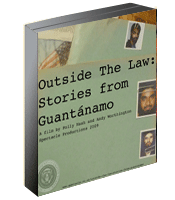







 Who's still at Guantánamo?
