Archive for June, 2009
Council Of Europe’s Human Rights Commissioner Urges European Governments To Help Close Guantánamo
 Following a visit to Washington D.C. on 1 and 2 June, Thomas Hammarberg, the Council Of Europe’s Human Rights Commissioner, has sent a letter to all 47 Council of Europe member states urging them to follow the example already provided by Albania, France, Sweden and the UK in accepting “cleared” prisoners from Guantánamo who cannot be repatriated “because they are stateless or likely to face torture or other serious human rights violations if forcibly returned to their home countries.”
In the letter, the Commissioner addresses the need for the United States to also play its part in accepting “cleared” prisoners, an issue that he raised with his hosts and which, he wrote, “was well received by my interlocutors though the recent Congress discussion had not been helpful in this respect.” Specifically, he states that he has “reason to believe that such offers will indeed be given,” although he notes that “some detainees would not, for obvious reasons, accept to stay in the country [the US],” and that this is the “major reason that European states should lend a hand.”
In a press release that announced the issuing of the letter, he added, “Those ‘cleared’ detainees who cannot be repatriated and have no wish to stay in the US should be offered an alternative. This requires a process during which the views of the detainees themselves should be sought on where they wish to go. Possible family ties is a factor to be seriously considered in this context. This is where European governments could give a very important contribution — which might be crucial to facilitate the final closing of the Guantánamo camp.”
He also demonstrates a healthy understanding of the scale of the mistakes made in sending prisoners to Guantánamo who “have not committed hostile acts against the US or its allies,” and, in the press release, also made clear his position that “detainees for whom there is evidence of criminal activities should be tried in accordance with international human rights law standards. The others should be released in full respect of the principle of presumption of innocence. Reparation for all those unlawfully detained should also be provided.”
The Commissioner’s letter, dated 5 June, is reproduced below:
Letter addressed to all Permanent Representatives of the 47 Council of Europe member states of Thomas Hammarberg, Council of Europe Commissioner for Human Rights, following his visit to Washington D.C.
Dear Ambassador,
This is a letter that I address to all Permanent Representatives of the 47 Council of Europe member states following my visit to Washington D.C. on 1 and 2 June and concerns the possibility of resettlement to member states of certain detainees from the Guantánamo detainee facility.
As you know, the US President has ordered the closure of the prison camp. The US administration is now working for this closure by January 2010 at the latest. Ambassador Daniel Fried at the State Department has been appointed as Special Envoy for Closure of the Guantánamo Detainee Facility. During my visit to Washington D.C. I met with him, as well as with representatives of the National Security Council at the White House and of the Department of Defense.
Based on these discussions, I am convinced about the US authorities’ determination to go ahead with the closure and the urgent need of effective support by European states to contribute to the attainment of this goal.
The Guantánamo prison camp has become a world-wide symbol of injustice and oppression, which has stained the US but to some extent also some other countries given the inter-state transfers to Guantánamo that have occurred, as reported by the Council of Europe Parliamentary Assembly and others. Resolutions 1340 (2003) and 1433 (2005) of the Assembly attest to the fact that the serious affronts to the rule of law that have occurred in Guantánamo are very much also a matter of serious concern to Europe. I recall furthermore that USA has an observer status with the Council of Europe.
There have been 778 persons from various countries who have been detained in Guantánamo [Note: the number is actually 779]. The first arrived hooded and shackled on 11 January 2002. The number of the remaining detainees is today 240 [Note: 239 since the death of Muhammad Salih]. Expert reports have made clear that the majority of the Guantánamo detainees have not committed hostile acts against the US or its allies, only less than ten per cent have been characterized as al-Qaeda fighters and several of them are no more than “volunteer foot soldiers”.
Among the current detainees there are approximately fifty persons who are “cleared for release” by the US authorities but cannot be repatriated because they are stateless or likely to face torture or other serious human rights violations if forcibly returned to their home countries. They come from various countries such as Algeria, China, Libya, the Occupied Palestinian Territories, Russia, Syria, Tajikistan, Tunisia and Uzbekistan.
While Council of Europe member states have accepted their own nationals who had been in Guantánamo, certain others, such as Albania, France, Sweden and the United Kingdom, have also accepted non-citizens from Guantánamo. Authorities from a number of other member states have made public their willingness to accept non-citizen Guantánamo detainees. Last April the EU ministers for justice and the interior started to work towards a EU response to the closure of Guantánamo that would include possible provision of residence for persons “cleared for release” but cannot return to their countries of origin for “compelling reasons”.
It is beyond doubt that a number of the Guantánamo detainees are in need of international protection. Reliable reports have indicated that some of those released and returned to their home countries have suffered serious human rights violations, such as torture and unlawful detention.
I made the point during my visit that the US authorities must offer at least to some of the “cleared” detainees with protection needs a possibility to settle down in the United States. This was well received by my interlocutors though the recent Congress discussion had not been helpful in this respect. I have, however, reason to believe that such offers will indeed be given. However, it is likely that some detainees would not, for obvious reasons, accept to stay in the country. It is for this major reason that European states should lend a hand.
In view of the above, I would like to call upon your government, along with other member state governments, to consider receiving some few released detainees for whom return home is not really an option. Such transfers should of course be voluntary in nature.
I believe that such a decision by Council of Europe member states will constitute not merely a gesture of a humanitarian nature. They will in effect strengthen their fight against terrorism by reaffirming that all measures taken to prevent or suppress terrorist offences have to respect the rule of law and democratic values, human rights and fundamental freedoms, for which the Council of Europe was created and has worked for sixty years now.
Looking forward to hearing from you, I remain
Yours sincerely
Thomas Hammarberg
 Andy Worthington is the author of The Guantánamo Files: The Stories of the 774 Detainees in America’s Illegal Prison (published by Pluto Press, distributed by Macmillan in the US, and available from Amazon — click on the following for the US and the UK). To receive new articles in your inbox, please subscribe to my RSS feed, and also see my definitive Guantánamo prisoner list, published in March 2009.
Obama Proposes Swift Execution of Alleged 9/11 Conspirators
In a leak that seems designed to gauge public opinion — and that of lawyers and other relevant parties around the world — anonymous officials in the Obama administration have told the New York Times about a proposal, in draft legislation to be submitted to Congress, which, as the Times put it, “would clear the way for detainees facing the death penalty [in Guantánamo] to plead guilty without a full trial.”

The five alleged co-conspirators in the 9/11 attacks. From the top: Khalid Sheikh Mohammed (KSM), Ramzi bin al-Shibh, Mustafa al-Hawsawi, Ali Abdul Aziz Ali and Walid bin Attash.
Such a statement can only set alarm bells ringing, of course, as it clearly refers to the five alleged co-conspirators in the 9/11 attacks — Khalid Sheikh Mohammed, Ramzi bin al-Shibh, Mustafa al-Hawsawi, Ali Abdul Aziz Ali and Walid bin Attash — and it indicates that, in order to avoid having to disclose distressing details of the torture to which these men were subjected, during their long years in secret CIA prisons, the Obama administration is wondering if allowing them to fulfill their stated aim of pleading guilty and becoming martyrs might be an effective way to dispose of what is probably the thorniest problem inherited from the government of George W. Bush.
It’s tempting to take this view, of course, because the Obama administration has already demonstrated its unwillingness to thoroughly repudiate its predecessor’s brutally innovative approach to detention and trials in terrorist cases; firstly by announcing its intention to revive the system of trials by Military Commission (the much-criticized “terror courts,” conceived by Dick Cheney and his legal counsel David Addington, which were mired in incompetence and corruption throughout their seven-year history), and secondly by proposing to push for legislation authorizing the use of “preventive detention” for 50 to 100 of the remaining 239 prisoners. As I explained in an article three weeks ago, “Fundamentally, Guantánamo is a prison that was founded on the presumption that the Bush administration’s “new paradigm” [in the “War on Terror”] justified “preventive detention” for life,” and “to even entertain the prospect that a third category of justice (beyond guilt and innocence) can be conjured out of thin air without fatally undermining the principles on which the United States was founded is to enter perilous territory indeed.”
 These are not the only proposals put forward by the administration to facilitate the closure of Guantánamo by January 2010, as Obama promised on taking office. In fact, one prisoner — Ahmed Khalfan Ghailani, allegedly involved in the African embassy bombings in 1998 — has already been put forward for trial in a federal court in New York, demonstrating that the administration is capable of trusting the federal courts to successfully prosecute cases related to terrorism, as they have done on over a hundred occasions in the last 15 years (PDF). As I also explained in my article three weeks ago, I regarded the decision to charge Ghailani in a federal court “as a clear indication that trials in the US court system are the only legitimate way forward, and that setting up a two-tier system — of federal courts on the one hand, and Military Commissions on the other — appears to be nothing but a recipe for disaster.”
However, the leaked proposal to allow guilty pleas that could lead to swift executions has been raised specifically in connection with the Military Commissions, and it should be noted that, although it appears to be designed primarily to circumvent all mention of torture while reaching a verdict that the government thinks is appropriate, it is not quite as cynical as this analysis suggests.
Essentially, the question of whether guilty pleas are acceptable in the Commissions was raised last year, during pre-trial hearings for the alleged 9/11 co-conspirators, when, as the Times described it, military prosecutors sought “to clarify what they view[ed] as an oversight in the 2006 law that created the commissions.” This oversight — based, it should be noted, on the Bush administration’s determination to fashion a legal system that was based neither on the federal court system nor on precedents in the military’s own judicial system — centered on the fact that the Military Commissions Act of 2006 “did not make clear if guilty pleas would be permitted in capital cases,” and the problem is that federal courts permit guilty pleas in capital cases, but the military’s own judicial system, on which the military commissions are modeled, do not. As the Times explained, “Partly to assure fairness when execution is possible, court-martial prosecutors are required to prove guilt in a trial even against service members who want to plead guilty.”

The five alleged co-conspirators in the 9/11 attacks are shown this sketch by courtroom artist Janet Hamlin at their arraignment in Guantánamo on June 5, 2008. They are, from top to bottom, Khalid Sheikh Mohammed, Walid bin Attash, Ramzi bin al-Shibh, Ali Abdul Aziz Ali, and Mustafa al-Hawsawi.
In December, when Khalid Sheikh Mohammed and his co-defendants announced that they wanted to plead guilty, all parties discovered that the Military Commissions Act had failed to provide clear rules determining the appropriate response. Military prosecutors argued that the men should be allowed to make a guilty plea, because Congress had a “clear intent” to allow them to do so, while their defense teams countered by stating that the trial should follow US military law, and that therefore guilty pleas were not allowed.
In response to these conflicting opinions, the judge, Col. Stephen Henley, pointedly asked, “Can an accused plead guilty to a capital offense at a military commission?” and ordered both sides to provide written submissions, but, as the Times noted, he has not yet made a decision about how to proceed.
However, while this provides a context for the Obama administration’s deliberations, lawyers are unimpressed by the nuances, and have seized on the leaked proposal as an indication that the administration is only concerned with securing guilty verdicts via the least problematical route. Denny LeBoeuf, a lawyer for the ACLU who works on issues relating to Guantánamo and the death penalty, told the Times that “Requiring prosecutors to reveal what they know about detainees and how they know it would cast light both on the interrogation techniques used against the men and the acts of terrorism for which they are facing death,” and asked, “Don’t we have an interest as a society in a trial that examines the evidence and provides some reliable picture of what went on?” and
David Glazier, a law professor in Los Angeles, who has studied the commissions, explained, “This unfortunately strikes me as an effort to get rid of the problem in the easiest way possible, which is to have those people plead guilty and presumably be executed. But I think it’s going to lack international credibility.”
Both made valid points about openness and international credibility. As David Seth asked in a Daily Kos article on Saturday, “How does dispensing with a full, albeit difficult trial for prosecutors and avoiding inquiries about extensive torture benefit the detainees? How does it assure that their guilty pleas are knowing, intelligent and voluntary?” Moreover, as the website Moon of Alabama explained, “military law forbids death penalties based solely on guilty pleas for two good reasons: the guilty plea could be coerced, [and it] could be a way for people who are not guilty to commit a form of suicide” (as happened in the case of the Beatrice Six, four of whom “falsely confessed in a rape and murder case and were later exonerated through DNA analysis”).
These fears are especially true in the cases of two of the men. Lawyers for Ramzi bin al-Shibh have long claimed that they have doubts about his mental health. Noting, during a pre-trial hearing last September, that his medications include “a psychotropic drug prescribed to persons with schizophrenia,” his lawyers stated that he “might not be competent to stand trial or able to participate in his own defense,” and lawyers for Mustafa al-Hawsawi have claimed that his involvement in the rush to martyrdom is not voluntary because he has been bullied by Mohammed and at least two other co-defendants.
In addition, David Glazier’s comments about “international credibility” only scratch the surface of what would undoubtedly be ferocious opposition to a trial that was perceived as providing a short-cut to convenient executions — even, for a moment, leaving aside other complaints that, if the men are guilty, then it would be far better to imprison them for life than to kill them, which, if their statements are to be believed, is the twisted “martyrdom” they seek.
However, what is most disappointing about the leaked proposal is a suggestion in the Times article that what is motivating the administration more than any other factor is the fear that establishing a case against these men in a conventional trial in a federal court might result in the Justice Department’s inability to mount an effective case against one of them. As the Times described it, “Officials involved in the process said that lawyers reviewing the case have said that federal-court charges against four of the men might be possible, but that the evidence might be too weak for a federal court case against one of the five, Walid Bin Attash.”
As David Seth explained,
Usually, when “the evidence might be too weak for a federal court case” the prosecution recognizes that it cannot meet its burden of proof and it dismisses the charges. If the prosecution doesn’t dismiss the charges, it’s up to a jury or a judge to find the accused not guilty. And then? And then the accused goes free. Not so in Gitmo. Evidently in Gitmo, somebody who might be released because the case is “too weak for a federal court case” instead gets to plead guilty and be executed.
Seth added, “And to think that I was worried that those with weak cases would be ‘preventively detained’ forever and ever. Even that would be better than coerced guilty pleas followed by execution.”
Sadly, I think that this analysis is accurate, and I can only hope that the leaking of the proposal — which has already provided yet another example of the administration’s inability to act decisively to undo the crimes of the Bush years — is intended to test the waters, and that the feedback will so overwhelmingly negative that the government will accept that, in cleaning up its inherited mess, justice must not only be pursued without cutting corners, but must also be seen to be done, and must also involve an acceptance that the men it is dealing with are criminals — not “warriors” who stand somehow outside the law — and that, as in any criminal case, it is possible that not every prosecution will be successful.
If senior officials need any further reminders about the importance of operating within the bounds of the law, they should recall that one of the reasons that Col. Morris Davis, the former chief prosecutor of the Commissions, resigned in October 2007 was the following exchange with William J. Haynes II, the Pentagon’s chief counsel, which took place in August 2005.
According to Col. Davis, Haynes “said these trials will be the Nuremberg of our time ” — a reference to the 1945 trials of Nazi leaders, “considered the model of procedural rights in the prosecution of war crimes,” as an article in the Nation described them. Col. Davis replied that he had noted that there had been some acquittals at Nuremberg, which had “lent great credibility to the proceedings,” and added, “I said to him that if we come up short and there are some acquittals in our cases, it will at least validate the process. At which point, his eyes got wide and he said, ‘Wait a minute, we can’t have acquittals. If we’ve been holding these guys for so long, how can we explain letting them get off? We can’t have acquittals. We’ve got to have convictions.’”
Andy Worthington is the author of The Guantánamo Files: The Stories of the 774 Detainees in America’s Illegal Prison (published by Pluto Press, distributed by Macmillan in the US, and available from Amazon — click on the following for the US and the UK). To receive new articles in your inbox, please subscribe to my RSS feed, and also see my definitive Guantánamo prisoner list, published in March 2009.
As published exclusively on the website of the Future of Freedom Foundation.
See the following for a sequence of articles dealing with the stumbling progress of the Military Commissions: The reviled Military Commissions collapse (June 2007), A bad week at Guantánamo (Commissions revived, September 2007), The curse of the Military Commissions strikes the prosecutors (September 2007), A good week at Guantánamo (chief prosecutor resigns, October 2007), The story of Mohamed Jawad (October 2007), The story of Omar Khadr (November 2007), Guantánamo trials: where are the terrorists? (February 2008), Six in Guantánamo charged with 9/11 attacks: why now, and what about the torture? (February 2008), Guantánamo’s shambolic trials (ex-prosecutor turns, February 2008), Torture allegations dog Guantánamo trials (March 2008), African embassy bombing suspect charged (March 2008), The US military’s shameless propaganda over 9/11 trials (April 2008), Betrayals, backsliding and boycotts (May 2008), Fact Sheet: The 16 prisoners charged (May 2008), Afghan fantasist to face trial (June 2008), 9/11 trial defendants cry torture (June 2008), USS Cole bombing suspect charged (July 2008), Folly and injustice (Salim Hamdan’s trial approved, July 2008), A critical overview of Salim Hamdan’s Guantánamo trial and the dubious verdict (August 2008), Salim Hamdan’s sentence signals the end of Guantánamo (August 2008), Controversy still plagues Guantánamo’s Military Commissions (September 2008), Another Insignificant Afghan Charged (September 2008), Seized at 15, Omar Khadr Turns 22 in Guantánamo (September 2008), Is Khalid Sheikh Mohammed Running the 9/11 Trials? (September 2008), two articles exploring the Commissions’ corrupt command structure (The Dark Heart of the Guantánamo Trials, and New Evidence of Systemic Bias in Guantánamo Trials, October 2008), The collapse of Omar Khadr’s Guantánamo trial (October 2008), Corruption at Guantánamo (legal adviser faces military investigations, October 2008), An empty trial at Guantánamo (Ali Hamza al-Bahlul, October 2008), Life sentence for al-Qaeda propagandist fails to justify Guantánamo trials (al-Bahlul, November 2008), 20 Reasons To Shut Down The Guantánamo Trials (profiles of all the prisoners charged, November 2008), How Guantánamo Can Be Closed: Advice for Barack Obama (November 2008), More Dubious Charges in the Guantánamo Trials (two Kuwaitis, November 2008), The End of Guantánamo (Salim Hamdan repatriated, November 2008), Torture, Preventive Detention and the Terror Trials at Guantánamo (December 2008), Is the 9/11 trial confession an al-Qaeda coup? (December 2008), The Dying Days of the Guantánamo Trials (January 2009), Former Guantánamo Prosecutor Condemns Chaotic Trials (Lt. Col. Vandeveld on Mohamed Jawad, January 2009), Torture taints the case of Mohamed Jawad (January 2009), Bush Era Ends with Guantánamo Trial Chief’s Torture Confession (Susan Crawford on Mohammed al-Qahtani, January 2009), Chaos and Lies: Why Obama Was Right to Halt The Guantánamo Trials (January 2009), Binyam Mohamed’s Plea Bargain: Trading Torture For Freedom (March 2009).
And for a sequence of articles dealing with the Obama administration’s response to the Military Commissions, see: Don’t Forget Guantánamo (February 2009), Who’s Running Guantánamo? (February 2009), The Talking Dog interviews Darrel Vandeveld, former Guantánamo prosecutor (February 2009), Obama’s First 100 Days: A Start On Guantánamo, But Not Enough (May 2009), Obama Returns To Bush Era On Guantánamo (May 2009), New Chief Prosecutor Appointed For Military Commissions At Guantánamo (May 2009), Pain At Guantánamo And Paralysis In Government (May 2009), My Message To Obama: Great Speech, But No Military Commissions and No “Preventive Detention” (May 2009), Guantánamo And The Many Failures Of US Politicians (May 2009), A Child At Guantánamo: The Unending Torment of Mohamed Jawad (June 2009), A Broken Circus: Guantánamo Trials Convene For One Day Of Chaos (June 2009), Obama’s Confusion Over Guantánamo Terror Trials (June 2009).
Broken Britain: BNP’s Nick Griffin, Andrew Brons elected as MEPs
 To be honest, I wasn’t initially sure which was worse: the knowledge that, for the first time, the UK has two fascist MEPs, who will — if they can overcome their xenophobia — be free to mingle with other far-right MEPs from other countries in the European parliament, or the knowledge that, throughout the UK, nearly a million of my fellow citizens voted for the poisonous British National Party (BNP), although, on balance, that figure of a million — a million! — openly racist votes, strongest in areas where Islamophobia has raged unchecked and unchallenged by the main parties (who have spent the last decade doing little to oppose racism, and often tacitly condoning it) ought to be a cause of major concern.
Behind its tightly-scripted makeover, which involves an order that all party members “refrain from any acts” that are “likely to bring the party into disrepute,” the BNP remains a party founded on a disturbingly aggressive form of racism, as revealed in its Constitution, which proclaims that the party “stands for the preservation of the national and ethnic character of the British people and is wholly opposed to any form of racial integration between British and non-European peoples,” and also advocates ethnic cleansing, albeit through a careful choice of words. As the Constitution explains, the party is “committed to stemming and reversing the tide of non-white immigration and to restoring, by legal changes, negotiation and consent, the overwhelmingly white makeup of the British population that existed in Britain prior to 1948.”
In the elections to the European parliament, Andrew Brons, a recently retired teacher of politics and government at Harrogate College, who took 9.8% of the vote in the Yorkshire and Humber region (with 120,139 votes), was described in the Guardian as “a dapper, besuited figure,” and appears to represent the “new-look” BNP at its most efficient. His acceptance speech was notably uncontentious, focusing primarily on one of the BNP’s main tactics — a sense of victimization. “The onslaught against us has been more than against any other party in recent times, but somehow we’ve overcome it. Despite the lies, despite the money, despite the misrepresentation, we’ve been able to win through,” he said. Behind the veneer, however, leaks a seasoned fascist. A member of the British National Socialist party as a teenager (named, of course, after Hitler’s National Socialist party), he then stood for the National Front as a parliamentary candidate five times in the 1970s, and was, at one point, its leader.
Nick Griffin, the leader of the BNP, who took 8 percent of the vote in the North West of England (132,094 votes), is a more openly poisonous figure. Despite getting his party into suits and running a tight campaign to avoid openly racist comments in public, Griffin has persistently demonstrated an inability to avoid inflammatory racist rhetoric when surrounded by other white supremacists. Generally railing about how the indigenous people of the UK are hard done by (that same thread of whining victimization that runs through every aspect of the BNP), he has also presided over a period in the BNP’s history when the focus of its racist bile has shifted from anti-semitism to an all-out assault on Islam.
After the terrorist attacks of 7 July 2005, Griffin dismissed a statement by Iqbal Sacranie of the Muslim Council of Britain, who pointed out that the bombers “were not Islamic, because Islam categorically prohibits the deliberate targeting of civilians,” by stating that, although “the BNP does not believe that all Muslims are wicked and vicious, the stark truth is that aspects of the religion they follow ARE wicked and vicious.”
In private, Griffin’s rhetoric shows less restraint. In 2005, he and party activist Mark Collett were cleared of charges of inciting racial hatred after they were secretly filmed doing just that. In the BBC documentary “The Secret Agent,” Griffin was filmed, in a meeting at a pub in Keighley, West Yorkshire on 19 January 2004, in which he described Islam as a “wicked, vicious faith” and claimed that Muslims were turning Britain into a “multi-racial hell hole,” while Collett told the audience, “Let’s show these ethnics the door in 2004.”
Griffin’s electoral success was greeted with anger and dismay in Manchester, where the result was announced. Anti-fascist demonstrators tried to prevent him from entering Manchester Town Hall, and after the results were announced the Tory MP Sir Robert Atkins, who polled the most votes in the North West, described the BNP as “an aberration” and, as the Guardian put it, “condemned Griffin’s success as a sad day for British politics.” Labour’s Arlene McCarthy followed up, telling the crowd that the BNP was “a party whose members include convicted rapists.”
As the Guardian also explained, “When Griffin’s turn came to speak, all the other candidates took the unprecedented step of walking off the platform in protest.” Griffin proceeded to claim that “we’re here to look after our people because no one else is,” and followed up with another bout of self-pity, claiming that other increases in the BNP vote — 15% in Rotherham and nearly 12% in Doncaster — took place because “This is ordinary decent people in Yorkshire kicking back against racism, because racism in this country is now directed overwhelmingly against people who look like me.” As is typical, however, he also couldn’t resist attacking Britain’s Muslim citizens. “Take Bradford,” he said, “it isn’t immigration that’s happening there, it’s colonialism.”
Manchester Town Hall was the only venue where concerted opposition to the BNP was apparent. Throughout the rest of the country, the BNP’s results were generally greeted with silence, or the odd bout of booing, but when their results were announced in the South East of England, where they collected 101,769 votes (4.36% of the total vote), the cheers of BNP supporters were followed by a lone voice of indignation. “Fascists!” a man shouted. “F*cking fascists!”
This may not be the most constructive way of tackling the disturbing spread of the BNP, but at least it brought a smile to my face on a night that was sorely lacking in reasons for optimism. The continued success of the UK Independence Party, who collected 2,498,226 votes (running Labour into third place, with 16.5% of the total vote) is another troubling sign, as their pointless anti-European existence only hides a better-disguised form of racism, but the real problem lies with the main parties — and, in particular, Labour and the Conservatives — who have failed to examine thoroughly their own racist tendencies — especially in the wake of the 9/11 attacks — or have been content to let xenophobia and racism spread unchallenged, pandering to the right-wing press when they should have been speaking out, and drifting ever further to the right in their desire to be tough on issues connected with law and order, terrorism and immigration.
Note: With eleven of the 12 European election results announced in the UK (Northern Ireland to follow), the following is the tally of BNP votes:
North West: 132,094 (8%)
North East: 52, 700 (8.93%)
Yorkshire & Humber: 120,139 (9.8%)
East Midlands: 106, 319 (9.1%)
West Midlands: 121,967 (8.63%)
East: 97, 013 (6.05%)
Wales: 37,114 (5.42%)
London: 86, 420 (4.94%)
South East 101,769 (4.36%)
South West: 60, 889 (3.93%)
Scotland: 27,174 (2.5%)
Total: 943,598 (6.2%, up 1.3% on 2005)
 Andy Worthington is the author of The Guantánamo Files: The Stories of the 774 Detainees in America’s Illegal Prison (published by Pluto Press, distributed by Macmillan in the US, and available from Amazon — click on the following for the US and the UK). To receive new articles in your inbox, please subscribe to my RSS feed, and see here for my definitive Guantánamo prisoner list, published in March 2009.
Broken Britain: BNP Wins Three County Council Seats
 OK, so less than 3,000 votes were required to elect three BNP (British National Party) county councillors in the UK elections on Thursday — and the party fielded another 456 candidates who didn’t get elected — but I’m still compelled to register my disappointment that I now live in a country that has three fascist-loving and openly racist county councillors (and that the party can field 459 candidates in total, up from just 39 in 2005).
For the record, Sharon Wilkinson won the seat in Padiham & Burnley West, Lancashire, with 1155 votes out of a total of 3790 votes cast (35% of the vote), Graham Partner won the seat in Coalville, Leicestershire with 1039 votes out of 3750 cast (27.7% of the vote), and Deirdre Gates won the seat of South Oxhey, Hertfordshire (a suburb of Watford) with 783 votes out of 2681 cast (29% of the vote), beating the Labour candidate by just 27 votes.
For some context on these councillors’ credentials, Antifascist noted on a post last year on the blog Lancaster Unity: taking on the BNP and other riff-raff on the far right, that this is what Deirdre Gates had to say about Hitler in a comment on her blog in June 2007: “Hitler set up a ‘General Government’ in conquered Eastern Europe states, while maintaining the national integrity of Western nation states — France, Netherlands, Denmark etc. Seems England has become McLabour’s area of General Government, nameless, sucked and stuffed.”
The BNP-watching website The Real BNP notes that Sharon Wilkinson, the former BNP group leader on Burnley Council, “opposes money to build new schools because they will force children to integrate.” In response, Council leader Gordon Birtwistle said the BNP “seems to be objecting to anything new coming to Burnley — they seem to want to be back in the Dark Ages.”
In a post on his website in March, Graham Partner claimed that “Uncontrolled immigration has sent our population soaring,” and that same month, on Land of Hope and Glory, another website he maintains, he presented his supporters with a poem, “Surrender is not an option,” which begins with the lines “This is a land of Kings and Queens / Cobbled streets, rivers and streams / This is the land of Hope and Glory / This is a land of beautiful places / Fields of green and open spaces / This is the land of Hope and Glory” and also includes the following: “They bleed the state and ask for more / It’s time Britannia closed the door / They crossed these shore for thirty pieces of silver / They took the passport / They took the pound / And now they’ve bombed the underground.”
I’m pleased to note that, in the Guardian, a spokesman for the anti-fascist group Searchlight said that the BNP had in general only polled significantly — 14% or more — where it was the only “non-mainstream” alternative to the major parties, but I still find it depressing that the BNP is thriving not only on ignorance, but in a milieu of racism, xenophobia and Islamophobia that has been either tolerated or endorsed by mainstream politicians since the 1990s — and has been thoroughly promoted by certain newspapers — in contrast to the militantly anti-fascist times in which I came of age, when Rock Against Racism and the Anti-Nazi League campaigned relentlessly to combat the kind of racism that, although epitomized by the BNP, has been allowed to seep into almost every corner of modern Britain.
Andy Worthington is the author of The Guantánamo Files: The Stories of the 774 Detainees in America’s Illegal Prison (published by Pluto Press, distributed by Macmillan in the US, and available from Amazon — click on the following for the US and the UK). To receive new articles in your inbox, please subscribe to my RSS feed, and see here for my definitive Guantánamo prisoner list, published in March 2009.
Uighur Protest In Guantánamo: Photos
On Monday, just hours after the first war crimes hearing for four months was convened at Guantánamo, and just hours before the Pentagon announced that a sixth prisoner had died, apparently by committing suicide, the small group of reporters — “less than a dozen,” according to Michelle Shephard of the Toronto Star — who had made the trip to watch a military judge commend the Canadian prisoner Omar Khadr for being “well-spoken” and “professional,” while criticizing his lawyers for their infighting, witnessed what Shephard called “a rare unscripted moment on the base,” when two prisoners staged “an impromptu protest.”
The prisoners — two of the 17 Uighur prisoners at Guantánamo (Muslims from China’s oppressed Xinjiang province) — are still held at the prison, despite having convinced the Bush administration (through a humiliating court defeat) to drop its claims that they were “enemy combatants,” and despite the fact that District Court Judge Ricardo Urbina ordered their release into the United States last October. Judge Urbina based his ruling on several important facts — that the men could not be returned to China because they faced the risk of torture (or worse), that no other country had been found that was prepared to risk the wrath of China by offering them a home, and that holding innocent men at Guantánamo was unconstitutional — but a notoriously reactionary appeals court overturned his ruling in February, and last week the Obama administration sought to prevent the Supreme Court from reviewing their case by agreeing with the appeals court judges.
This was in spite of the fact that, on various occasions since January, the administration has also suggested that it was prepared to move at least some of the men to the United States, if for no other reason that one of solid pragmatism, in that doing so would almost certainly encourage European countries to accept some of the other prisoners at Guantánamo who cannot be repatriated (because they too are from regimes with bleak human rights records, including Algeria, Libya, Tunisia and Uzbekistan).
As the Obama administration dithers, the Uighurs — and one Algerian, Sabir Lahmar, who was cleared for release by a judge in November, but has similar fears to the Uighurs — are held in Camp Iguana, a separate part of the prison from the other 221 prisoners, where they are allowed privileges denied to the other inmates, including the crayons and sketch pads they used on Monday to bypass the Pentagon’s prohibition on allowing journalists to speak to prisoners.
In an unconscious echo of the famous film of Bob Dylan holding up and discarding cards featuring words from his song “Subterranean Homesick Blues,” the Uighurs held up a pad featuring messages written in crayon, and for a few minutes, as Shephard described it, “silently turned the pages quickly, as journalists shot video, photos and scribbled down their messages.”
Three of these messages are shown below:

“We need to freedom”

“What is the difference of the Democracy and Communist”

“Now we are being oppressed in America for the second time”
As Shephard described it, other messages read, “We are being held in prison but we have been announced innocent acorrding to the virdict in caurt,” and “America is Double Hetler [Hitler] in unjustice.” She added, “Reporters were ushered away from the fenced-in area shortly after the Uighurs had their written protest. One of the captives yelled as the gate was locked behind the group: ‘Is Obama Communist or a Democrat? We have the same operation in China.’”
Shephard also pointed out that the reporters were ”forbidden from sending photos or video footage of the signs until Guantánamo officials received clearance from the White House,” because the Pentagon’s rules “stipulate that images of detainees must be pre-screened and cannot identify the captives due to regulations in the Geneva Conventions prohibiting the exploitation of prisoners of war” (a rule which, I feel compelled to add, is rather hypocritical, given that, just a month after the prison opened, President Bush issued an executive order establishing that the Geneva Conventions did not apply to prisoners seized in the “War on Terror,” and that serious doubts about the prisoners’ treatment remain to this day, despite a review conducted in Obama’s first month in office, which found that the prison was run humanely and in accordance with the Geneva Conventions).
Shephard also explained that clearance from the White House “didn’t come until about 14 hours later,” and added that the reporters were also kept in the dark about the suicide, only being informed, by email, as their flight landed in Maryland.
Responding to news of the protest, Sabin Willett, one of the Uighurs’ lawyers, added further details, explaining that his clients took advantage of the fact that reporters had been invited to “come and shoot pictures of their quarters” by staging the protest. “The English is a little clumsy,” he wrote, “but then again, it’s probably better than your Uighur.” He also described as a “fiction” the notion that “it doesn’t invade their privacy to be photographed like zoo animals so long as faces are not shown,” adding that attempts to persuade the military to be more genuinely open — by allowing “proper interviews” with the prisoners, for example — have been pursued for years “to no avail.”
Pointing out further details, Willett wrote, “The fellow in the blue T-shirt is one of our favorite clients, the surpassingly gentle Abdulnasser, whose English, picked up in GTMO, is rather remarkable,” and added that, according to press reports, the trigger for the Obama administration’s refusal to follow through on its plans to release some of the men into the US was “when Newt Gingrich declared that they had conspired with al-Qaeda and wanted to promote Sharia law.” He went on to explain, “They first heard of al-Qaeda in Guantánamo, and mainly what they’d like to promote is getting a girlfriend.” Nevertheless, as a result of this smear campaign, “The President backed down, and the political branches are now operating under the delusion that we can be the broom while Europe will volunteer to be the dustpan.”
He added, “That will never happen. Instead, we may very well see the Democrats preside over the creation of the true American Gulag,” and concluded by stating, “Abdulnasser was cleared by the courts and the military of being an enemy. No one has ever accused him of a crime, and yet he began his eighth year in the Guantánamo prison last month.”
Andy Worthington is the author of The Guantánamo Files: The Stories of the 774 Detainees in America’s Illegal Prison (published by Pluto Press, distributed by Macmillan in the US, and available from Amazon — click on the following for the US and the UK). To receive new articles in your inbox, please subscribe to my RSS feed, and also see my definitive Guantánamo prisoner list, published in March 2009.
For a sequence of articles dealing with the Uighurs in Guantánamo, see: The Guantánamo whistleblower, a Libyan shopkeeper, some Chinese Muslims and a desperate government (July 2007), Guantánamo’s Uyghurs: Stranded in Albania (October 2007), Former Guantánamo detainee seeks asylum in Sweden (November 2007), A transcript of Sabin Willett’s speech in Stockholm (November 2007), Support for ex-Guantánamo detainee’s Swedish asylum claim (January 2008), A Chinese Muslim’s desperate plea from Guantánamo (March 2008), Former Guantánamo prisoner denied asylum in Sweden (June 2008), Six Years Late, Court Throws Out Guantánamo Case (June 2008), Guantánamo as Alice in Wonderland (July 2008), From Guantánamo to the United States: The Story of the Wrongly Imprisoned Uighurs (October 2008), Guantánamo Uyghurs’ resettlement prospects skewered by Justice Department lies (October 2008), A Pastor’s Plea for the Guantánamo Uyghurs (October 2008), Guantánamo: Justice Delayed or Justice Denied? (October 2008), Sabin Willett’s letter to the Justice Department (November 2008), Will Europe Take The Cleared Guantánamo Prisoners? (December 2008), A New Year Message to Barack Obama: Free the Guantánamo Uighurs (January 2009), Guantanamo’s refugees (February 2009), Bad News And Good News For The Guantánamo Uighurs (February 2009), A Letter To Barack Obama From A Guantánamo Uighur (March 2009), Obama’s First 100 Days: A Start On Guantánamo, But Not Enough (May 2009), Pain At Guantánamo And Paralysis In Government (May 2009), Guantánamo: A Prison Built On Lies (May 2009), Guantánamo: A Real Uyghur Slams Newt Gingrich’s Racist Stupidity (May 2009), and the stories in the additional chapters of The Guantánamo Files: Website Extras 1, Website Extras 6 and Website Extras 9.
New York Times finally apologizes for false Guantánamo recidivism story
 Too late, the damage is already done.
On May 21, the New York Times published a front-page story, entitled, “1 In 7 Detainees Rejoined Jihad, Pentagon Finds” (or, in the web version, “1 in 7 freed detainees rejoins fight, reports says”), in which Elisabeth Bumiller, relying on an unpublished Pentagon report, stated that “74 prisoners released from Guantánamo have returned to terrorism, making for a recidivism rate of nearly 14 percent.”
Claiming that the report “provides new details concluding that about one in seven of the 534 prisoners already transferred abroad from the detention center in Guantánamo Bay, Cuba, has returned to terrorism or militant activity, according to administration officials,” Bumiller also played straight into the hands of right-wing commentators by adding, “The conclusion could strengthen the arguments of critics who have warned against releasing any more prisoners as part of President Obama’s plan to shut down the prison by January 2010.” The use of “could” was presumably meant to imply some sort of objectivity, but in reality it might as well have been replaced with the self-fulfillingly prophetic use of the word “will.”
Critics — essentially, anyone aware of the Seton Hall Law School’s excellent work in debunking the Pentagon’s numerous “recidivism” reports (PDF) — immediately denounced the story. On Think Progress, for example, Ken Gude wrote that Bumiller “discards any semblance of journalism and merely serves as a conduit for unnamed Pentagon officials to claim without any supporting evidence that 74 released Guantánamo detainees are ‘engaged in terrorism.’”
Within hours the Times amended the headline to the bewildering “Later Terror Link Cited for 1 in 7 Freed Detainees,” and Bumiller appeared on MSNBC, conceding that “there is some debate about whether you should say ‘returned’ because some of them were perhaps not engaged in terrorism, as we know — some of them are being held there on vague charges.”
This was a start –- as there is clearly a world of difference between “returning to terrorism” and “turning to terrorism after not being a terrorist but being treated in the most inhumane manner for years as an ‘enemy combatant’ without rights in an experimental prison designed to be beyond the law” — but it did not address the more fundamental problem of whether there was any truth to the Pentagon’s claims.
On May 28, the Times allowed Peter Bergen and Katherine Tiedemann of the New America Foundation to write an op-ed criticizing Bumiller’s article, in which they concluded, from an examination of the report (PDF), that a more probable figure for recidivism — based on the fact that there were “12 former detainees who can be independently confirmed to have taken part in terrorist acts directed at American targets, and eight others suspected of such acts” — was “about 4 percent of the 534 men who have been released.”
This went some way to apologizing for the damage caused by uncritically publishing Pentagon propaganda on its front page, and on Friday the Times went one step further, and published the following Editor’s Note:
A front-page article and headline on May 21 reported findings from an unreleased Pentagon report about prisoners who have been transferred abroad from the American detention center in Guantánamo Bay, Cuba. The article said that the Pentagon had found about one in seven of former Guantánamo prisoners had “returned to terrorism or other militant activity,” or as the headline put it, had “rejoined jihad.”
Those phrases accepted a premise of the report that all the former prisoners had been engaged in terrorism before their detention. Because that premise remains unproved, the day the article appeared in the newspaper, editors changed the headline and the first paragraph on the Times Web site to refer to prisoners the report said had engaged in terrorism or militant activity since their release.
The article and headline also conflated two categories of former prisoners. In the Pentagon report, 27 former Guantánamo prisoners were described as having been confirmed as engaging in terrorism, with another 47 suspected of doing so without substantiation. The article should have distinguished between the two categories, to say that about one in 20 of former Guantánamo prisoners described in the Pentagon report were now said to be engaging in terrorism. (The larger share — about one in seven –applies to the total number described in the report as confirmed or suspected of engaging in terrorism.)
That’s 5 percent, then, which is certainly more appropriate, but as I stated at the start of this article, the damage has already been done. As Gregg Mitchell noted in the Huffington Post yesterday, “here’s what [former Vice President Dick] Cheney said the day after the story was published at the American Enterprise Institute. As with the Iraq run-up stories, he took the Times‘ non-facts and exaggerated them”:
Keep in mind that these are hardened terrorists picked up overseas since 9/11. The ones that were considered low-risk were released a long time ago. And among these, we learned yesterday, many were treated too leniently, because 1 in 7 cut a straight path back to their prior line of work and have conducted murderous attacks in the Middle East. I think the President will find, upon reflection, that to bring the worst of the worst terrorists inside the United States would be cause for great danger and regret in the years to come …
When a front-page story in the Times only fuel more lies from Cheney, who is on a mission to portray the failed Guantánamo project as something noble, bold and essential, in an attempt to silence calls for his prosecution as the “Vice President for Torture,” you can tell that something has gone seriously wrong …
Andy Worthington is the author of The Guantánamo Files: The Stories of the 774 Detainees in America’s Illegal Prison (published by Pluto Press, distributed by Macmillan in the US, and available from Amazon — click on the following for the US and the UK). To receive new articles in your inbox, please subscribe to my RSS feed, and also see my definitive Guantánamo prisoner list, published in March 2009.
Death At Guantánamo Hovers Over Obama’s Middle East Visit
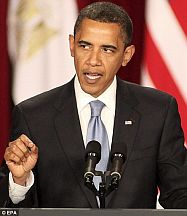 In his speech in Egypt on Thursday, in which he promised “A New Beginning,” Barack Obama did not specifically mention the death of a prisoner at Guantánamo on Monday — and the extent to which the prison’s existence has soured relations between the United States and the Muslim world — except to repeat his most concise promise to move on from the lawlessness of the Bush years: “I have unequivocally prohibited the use of torture by the United States, and I have ordered the prison at Guantánamo Bay closed by early next year.”
And yet, Guantánamo — and recent events at the prison — hovered unnervingly over the President’s visit to the Middle East. A death at Guantánamo is always felt keenly in the Muslim world, and is also uncomfortable for the Obama administration, which, since reviewing conditions at the prison in January, claims that it is running a “humane” facility.
Behind the rhetoric, however, the truth is still bleak. Guantánamo may look, more than ever, like a regular US prison, with half of the remaining 239 prisoners now sharing communal facilities, and others, in two maximum security blocks, allowed limited opportunities to socialize, but the prisoners held there have, for the most part, been imprisoned without charge or trial for over seven years, unlike even the most hardened convicted criminals on the US mainland.
In addition, the widespread euphoria that greeted Obama’s election victory, and the hope that it would result in the prison’s swift closure, has turned to frustration, as only two prisoners (Binyam Mohamed and Lakhdar Boumediene) have been released in the last four months. Shane Kadidal, a lawyer with New York’s Center for Constitutional Rights, explained that the prisoners were now saying, “At least Bush sent some people home,” and further frustration has greeted news that Obama is considering proposing new legislation authorizing “preventive detention” for up to a hundred of the remaining prisoners, effectively legitimising the Bush administration’s detention policies.
As a result, many of the prisoners, like Muhammad Salih, the Yemeni prisoner who died on Monday, apparently by committing suicide, have resorted to hunger strikes as the only means of protesting against their arbitrary and seemingly endless imprisonment. For these men, strapped into a restraint chair twice a day, and force-fed against their will via a tube that is thrust up their noses and into their stomachs, the prison is anything but “humane.”

One of the restraint chairs used to force-feed prisoners in Guantánamo. Photo discovered by Geo Swan for Wikipedia.
Muhammad Salih was the fifth prisoner to commit suicide at Guantánamo, but the first under Obama’s watch. In keeping with the President’s desire to portray the prison in the best possible light, it is unlikely that anyone in the administration will make a comment to compare with a statement made by Rear Admiral Harry Harris, the commander of Guantánamo at the time of the first three deaths in June 2006, who said, “I believe this was not an act of desperation, but an act of asymmetric warfare committed against us.” However, it is also unlikely that the government will come clean about Muhammad Salih’s status, and concede that there is no evidence that he even remotely resembled one of the fabled “terror suspects” whom the prison was ostensibly established to hold.
Salih himself admitted that he had traveled to Afghanistan many months before the 9/11 attacks, to fight as a foot soldier for the Taliban against the Muslims of the Northern Alliance in Afghanistan’s long-running civil war. When the US military reviewed his case at Guantánamo in 2004, he acknowledged being a member of the Taliban, but made a point of adding, “Yes, but that doesn’t mean I supported Osama bin Laden.”
With no information to indicate that Muhammad Salih was connected to al-Qaeda’s terrorist activities, his death should serve as another important reminder that the Bush administration’s policy of subjecting prisoners to arbitrary detention as “enemy combatants” has been a wretched failure. Had the former regime obeyed domestic and international laws, it would have held those regarded as terrorists as criminal suspects, to be prosecuted in federal courts, and, after adequate screening (which never took place) would have held other combatants as prisoners of war, according to the Geneva Conventions.
If this had happened, we would now be discussing whether it was feasible to imprison someone until the end of hostilities in a “war” whose supporters regard it as a struggle that might last for generations, and the answer, of course, would be no. Muhammad Salih, a foot soldier in another war, which preceded the 9/11 attacks, and had nothing to do with international terrorism, had been imprisoned for longer than the duration of the Second World War when his life ended in Guantánamo, even though the circumstances in which he was captured — during the overthrow of the Taliban and the establishment of a new Afghan government — came to an end no later than 3 November 2004, when Hamid Karzai was elected as President.
Although the response to Muhammad Salih’s death has been muted in the West, and did not surface publicly in the Middle East during President Obama’s visit, the ripples from the latest death in Guantánamo — and, no doubt, rumors that Salih was killed, or, perhaps more convincingly, that he died as a result of years of brutal force-feeding — surely made themselves felt behind the scenes. If Obama truly wishes to distance himself from the lawless initiatives of his predecessor, he needs to think deeply about an appropriate response, and will, I hope, reflect on the distinction between terror suspects and foot soldiers, rethink what “preventive detention” really means, and, above all, move swiftly to release more prisoners before there are any other deaths at Guantánamo.
Andy Worthington is the author of The Guantánamo Files: The Stories of the 774 Detainees in America’s Illegal Prison (published by Pluto Press, distributed by Macmillan in the US, and available from Amazon — click on the following for the US and the UK). To receive new articles in your inbox, please subscribe to my RSS feed, and also see my definitive Guantánamo prisoner list, published in March 2009.
As published on the Huffington Post, AlterNet, CounterPunch and Antiwar.com.
A Broken Circus: Guantánamo Trials Convene For One Day Of Chaos
 If President Obama is serious about ever closing Guantánamo, and bringing justice to any of the 239 men still held there, the chaotic events on Monday, in the first hearing of the Military Commission trial system since the President’s four-month freeze on proceedings expired, should persuade him that all that awaits him, if he proceeds with his plan to revive the trials, is ridicule, frustration and injustice.
Last month, evidently scared by the advice of paranoid officials who suggested that, in some cases, trials in federal courts might fail (and ignoring the fact that no US jury would fail to convict a terror suspect against whom the merest shred of genuine evidence could be mustered), Obama announced that he was planning to revive the Commissions.
Critics bayed in disbelief. After all, the much-criticized system, conceived by former Vice President Dick Cheney and his legal counsel David Addington, ruled illegal by the Supreme Court in 2006, and then revived by Congress, was, essentially, a shape-shifting legal quagmire, which, over six years, had led to only three convictions (of David Hicks, Salim Hamdan and Ali Hamza al-Bahlul, each of which had its own problems), the resignation of several prosecutors (including one Chief Prosecutor), the sacking of the Pentagon’s legal adviser, and a permanent state of semi-open revolt against the government in the military defense teams.
It therefore seemed implausible that Obama’s intention to tweak the existing system — by imposing restrictions on the use of hearsay evidence, or on evidence obtained through coercion — would either silence the Commissions’ many critics or lead to a functional system in which constitutional and legal experts, like the President himself, could have any belief.
Even disregarding, for a moment, complaints that the Commissions would still be a manifestation of a two-tier judicial system, in which evidence that is inadmissible in a federal court would somehow, magically, be purified, two more fundamental problems were apparent on Monday: firstly, observers were reminded that any novel judicial system that turns its back on more than 200 years of established legal history (let alone one designed primarily to secure convictions) is bound to be so full of holes that it cannot function adequately; and, secondly, the Commissions are, in any case, weighed down with the sometimes rancorous baggage of their existing history.
The first session of the court, under the new President, was convened specifically to address some of these festering issues, and descended almost immediately into chaos, as long-running disagreements between members of the defense team for Omar Khadr — the Canadian prisoner who was just 15 years old when he was seized by US forces after a firefight in Afghanistan — burst into florid life as soon as the proceedings opened.
The judge in Khadr’s case, Army Col. Patrick Parrish, held the hearing in an attempt to sort out the disputes between the lawyers, which resulted, two months ago, in the dismissal of Navy Lt. Cmdr. William Kuebler, the longest serving and most outspoken member of his military defense team, by the chief defense counsel, Air Force Col. Peter Masciola, who had also prevented Kuebler from visiting Khadr at Guantánamo.
Col. Parrish ruled that the dismissal had been made without the relevant authority and reinstated Kuebler, but on Monday, as Khadr himself was consulted, he tried to fire his entire military defense team. “Right now I can’t trust them,” he told the judge, adding, “If it was my wish, I want to erase all of them, but I don’t have any choices.” He then explained that he wanted to consult with his Canadian civilian lawyers, Dennis Edney and Nathan Whitling, who have been fighting his case for years in the Canadian courts, but they were not present. As Carol Rosenberg explained in the Miami Herald, “Under current war court rules, foreign attorneys can act as advisors but cannot defend alleged war criminals.” In the Toronto Star, Michelle Shephard also noted that the Canadian government “did not send a representative here this week as they have for past hearings.”
In an attempt to break the impasse, Col. Parrish suggested, 30 minutes into the hearing, that Khadr should “meet with his team, saying that they would put their differences aside and talk in a ‘professional and dignified’ manner,” but Khadr replied that it “wasn’t possible,” telling the judge, “That’s not true. They had a fight just this morning.”
In the end, Khadr agreed to meet with the defense team, but afterwards, when Col. Parrish pointed out that he could, if he wished, defend himself, Khadr refused, explaining that he was unable to mount his own defense. The judge then made him choose between Kuebler and Ruiz, explaining, “I am not going to allow you to go unrepresented” until the next hearing, scheduled for July 13, but allowing him to consult with his Canadian lawyers, at a later date, so that they “can help him choose a permanent replacement,” as Jane Sutton described it for Reuters. Khadr then chose to retain Kuebler, firing Ruiz and Michel Paradis, a civilian lawyer paid by the Pentagon to work on the case.
“Visibly angry,” as Michelle Shephard explained, Col. Parrish “repeatedly lambasted Khadr’s legal team,” but commended Khadr for being “well-spoken” and “professional.” As Reuters put it, he also “expressed annoyance” that a third lawyer “had already left to take a new job without notifying the court.”
Whether Khadr’s next hearing — scheduled in the hope of finalizing the issues relating to his representation — will actually take place is another matter. Col. Parrish refused to put a stay on his order, but the Obama administration has already requested another four-month hold on all pending trials, to give it more time to work out who to prosecute, and in what venue. As Khadr’s hearing stumbled on, Navy Capt. John Murphy, the new chief prosecutor, confirmed that the prosecution had “asked for an additional 120 days to complete the review process,” and added that the latest request had been filed last Friday and that two judges had already agreed to the suspension. Acknowledging this, Col. Parrish also explained that he would consider a request to delay the July hearing until September, but did not appear to be entirely happy with the prospect. “Apparently there’s going to be some changes in the rules,” he said.
Quite how Barack Obama thinks that tinkering with the rules can mend this broken circus is difficult to see. As Alexander Abdo, an observer with the American Civil Liberties Union, said, “The real question is, ‘Why are we here?’ It’s indicative of the kind of justice you get with an ad hoc system that hasn’t even decided the basic rules of the commissions because they are being changed.”
But perhaps the best line was delivered by Khadr himself, when he stated, “It’s not the first unfairness I’m going through and I’m expecting more unfairness.”
Andy Worthington is the author of The Guantánamo Files: The Stories of the 774 Detainees in America’s Illegal Prison (published by Pluto Press, distributed by Macmillan in the US, and available from Amazon — click on the following for the US and the UK). To receive new articles in your inbox, please subscribe to my RSS feed, and also see my definitive Guantánamo prisoner list, published in March 2009.
See the following for a sequence of articles dealing with the stumbling progress of the Military Commissions: The reviled Military Commissions collapse (June 2007), A bad week at Guantánamo (Commissions revived, September 2007), The curse of the Military Commissions strikes the prosecutors (September 2007), A good week at Guantánamo (chief prosecutor resigns, October 2007), The story of Mohamed Jawad (October 2007), The story of Omar Khadr (November 2007), Guantánamo trials: where are the terrorists? (February 2008), Six in Guantánamo charged with 9/11 attacks: why now, and what about the torture? (February 2008), Guantánamo’s shambolic trials (ex-prosecutor turns, February 2008), Torture allegations dog Guantánamo trials (March 2008), African embassy bombing suspect charged (March 2008), The US military’s shameless propaganda over 9/11 trials (April 2008), Betrayals, backsliding and boycotts (May 2008), Fact Sheet: The 16 prisoners charged (May 2008), Afghan fantasist to face trial (June 2008), 9/11 trial defendants cry torture (June 2008), USS Cole bombing suspect charged (July 2008), Folly and injustice (Salim Hamdan’s trial approved, July 2008), A critical overview of Salim Hamdan’s Guantánamo trial and the dubious verdict (August 2008), Salim Hamdan’s sentence signals the end of Guantánamo (August 2008), Controversy still plagues Guantánamo’s Military Commissions (September 2008), Another Insignificant Afghan Charged (September 2008), Seized at 15, Omar Khadr Turns 22 in Guantánamo (September 2008), Is Khalid Sheikh Mohammed Running the 9/11 Trials? (September 2008), two articles exploring the Commissions’ corrupt command structure (The Dark Heart of the Guantánamo Trials, and New Evidence of Systemic Bias in Guantánamo Trials, October 2008), The collapse of Omar Khadr’s Guantánamo trial (October 2008), Corruption at Guantánamo (legal adviser faces military investigations, October 2008), An empty trial at Guantánamo (Ali Hamza al-Bahlul, October 2008), Life sentence for al-Qaeda propagandist fails to justify Guantánamo trials (al-Bahlul, November 2008), 20 Reasons To Shut Down The Guantánamo Trials (profiles of all the prisoners charged, November 2008), How Guantánamo Can Be Closed: Advice for Barack Obama (November 2008), More Dubious Charges in the Guantánamo Trials (two Kuwaitis, November 2008), The End of Guantánamo (Salim Hamdan repatriated, November 2008), Torture, Preventive Detention and the Terror Trials at Guantánamo (December 2008), Is the 9/11 trial confession an al-Qaeda coup? (December 2008), The Dying Days of the Guantánamo Trials (January 2009), Former Guantánamo Prosecutor Condemns Chaotic Trials (Lt. Col. Vandeveld on Mohamed Jawad, January 2009), Torture taints the case of Mohamed Jawad (January 2009), Bush Era Ends with Guantánamo Trial Chief’s Torture Confession (Susan Crawford on Mohammed al-Qahtani, January 2009), Chaos and Lies: Why Obama Was Right to Halt The Guantánamo Trials (January 2009), Binyam Mohamed’s Plea Bargain: Trading Torture For Freedom (March 2009).
And for a sequence of articles dealing with the Obama administration’s response to the Military Commissions, see: Don’t Forget Guantánamo (February 2009), Who’s Running Guantánamo? (February 2009), The Talking Dog interviews Darrel Vandeveld, former Guantánamo prosecutor (February 2009), Obama’s First 100 Days: A Start On Guantánamo, But Not Enough (May 2009), Obama Returns To Bush Era On Guantánamo (May 2009), New Chief Prosecutor Appointed For Military Commissions At Guantánamo (May 2009), Pain At Guantánamo And Paralysis In Government (May 2009), My Message To Obama: Great Speech, But No Military Commissions and No “Preventive Detention” (May 2009), Guantánamo And The Many Failures Of US Politicians (May 2009), A Child At Guantánamo: The Unending Torment of Mohamed Jawad (June 2009), Obama Proposes Swift Execution of Alleged 9/11 Conspirators (June 2009), Obama’s Confusion Over Guantánamo Terror Trials (June 2009).
Transcript of President Obama’s Speech in Egypt, June 4, 2009
 “A New Beginning”
Delivered at Cairo University
I am honored to be in the timeless city of Cairo, and to be hosted by two remarkable institutions. For over a thousand years, Al-Azhar has stood as a beacon of Islamic learning, and for over a century, Cairo University has been a source of Egypt’s advancement. Together, you represent the harmony between tradition and progress. I am grateful for your hospitality, and the hospitality of the people of Egypt. I am also proud to carry with me the goodwill of the American people, and a greeting of peace from Muslim communities in my country: assalaamu alaykum.
We meet at a time of tension between the United States and Muslims around the world — tension rooted in historical forces that go beyond any current policy debate. The relationship between Islam and the West includes centuries of co-existence and cooperation, but also conflict and religious wars. More recently, tension has been fed by colonialism that denied rights and opportunities to many Muslims, and a Cold War in which Muslim-majority countries were too often treated as proxies without regard to their own aspirations. Moreover, the sweeping change brought by modernity and globalization led many Muslims to view the West as hostile to the traditions of Islam.
Violent extremists have exploited these tensions in a small but potent minority of Muslims. The attacks of September 11th, 2001 and the continued efforts of these extremists to engage in violence against civilians has led some in my country to view Islam as inevitably hostile not only to America and Western countries, but also to human rights. This has bred more fear and mistrust.
So long as our relationship is defined by our differences, we will empower those who sow hatred rather than peace, and who promote conflict rather than the cooperation that can help all of our people achieve justice and prosperity. This cycle of suspicion and discord must end.
I have come here to seek a new beginning between the United States and Muslims around the world; one based upon mutual interest and mutual respect; and one based upon the truth that America and Islam are not exclusive, and need not be in competition. Instead, they overlap, and share common principles – principles of justice and progress; tolerance and the dignity of all human beings.
I do so recognizing that change cannot happen overnight. No single speech can eradicate years of mistrust, nor can I answer in the time that I have all the complex questions that brought us to this point. But I am convinced that in order to move forward, we must say openly the things we hold in our hearts, and that too often are said only behind closed doors. There must be a sustained effort to listen to each other; to learn from each other; to respect one another; and to seek common ground. As the Holy Koran tells us, “Be conscious of God and speak always the truth.” That is what I will try to do — to speak the truth as best I can, humbled by the task before us, and firm in my belief that the interests we share as human beings are far more powerful than the forces that drive us apart.
Part of this conviction is rooted in my own experience. I am a Christian, but my father came from a Kenyan family that includes generations of Muslims. As a boy, I spent several years in Indonesia and heard the call of the azaan at the break of dawn and the fall of dusk. As a young man, I worked in Chicago communities where many found dignity and peace in their Muslim faith.
As a student of history, I also know civilization’s debt to Islam. It was Islam — at places like Al-Azhar University — that carried the light of learning through so many centuries, paving the way for Europe’s Renaissance and Enlightenment. It was innovation in Muslim communities that developed the order of algebra; our magnetic compass and tools of navigation; our mastery of pens and printing; our understanding of how disease spreads and how it can be healed. Islamic culture has given us majestic arches and soaring spires; timeless poetry and cherished music; elegant calligraphy and places of peaceful contemplation. And throughout history, Islam has demonstrated through words and deeds the possibilities of religious tolerance and racial equality.
I know, too, that Islam has always been a part of America’s story. The first nation to recognize my country was Morocco. In signing the Treaty of Tripoli in 1796, our second President John Adams wrote, “The United States has in itself no character of enmity against the laws, religion or tranquility of Muslims.” And since our founding, American Muslims have enriched the United States. They have fought in our wars, served in government, stood for civil rights, started businesses, taught at our Universities, excelled in our sports arenas, won Nobel Prizes, built our tallest building, and lit the Olympic Torch. And when the first Muslim-American was recently elected to Congress, he took the oath to defend our Constitution using the same Holy Koran that one of our Founding Fathers — Thomas Jefferson — kept in his personal library.
So I have known Islam on three continents before coming to the region where it was first revealed. That experience guides my conviction that partnership between America and Islam must be based on what Islam is, not what it isn’t. And I consider it part of my responsibility as President of the United States to fight against negative stereotypes of Islam wherever they appear.
But that same principle must apply to Muslim perceptions of America. Just as Muslims do not fit a crude stereotype, America is not the crude stereotype of a self-interested empire. The United States has been one of the greatest sources of progress that the world has ever known. We were born out of revolution against an empire. We were founded upon the ideal that all are created equal, and we have shed blood and struggled for centuries to give meaning to those words — within our borders, and around the world. We are shaped by every culture, drawn from every end of the Earth, and dedicated to a simple concept: E pluribus unum: “Out of many, one.”
Much has been made of the fact that an African-American with the name Barack Hussein Obama could be elected President. But my personal story is not so unique. The dream of opportunity for all people has not come true for everyone in America, but its promise exists for all who come to our shores — that includes nearly seven million American Muslims in our country today who enjoy incomes and education that are higher than average.
Moreover, freedom in America is indivisible from the freedom to practice one’s religion. That is why there is a mosque in every state of our union, and over 1,200 mosques within our borders. That is why the U.S. government has gone to court to protect the right of women and girls to wear the hijab, and to punish those who would deny it.
So let there be no doubt: Islam is a part of America. And I believe that America holds within her the truth that regardless of race, religion, or station in life, all of us share common aspirations — to live in peace and security; to get an education and to work with dignity; to love our families, our communities, and our God. These things we share. This is the hope of all humanity.
Of course, recognizing our common humanity is only the beginning of our task. Words alone cannot meet the needs of our people. These needs will be met only if we act boldly in the years ahead; and if we understand that the challenges we face are shared, and our failure to meet them will hurt us all.
For we have learned from recent experience that when a financial system weakens in one country, prosperity is hurt everywhere. When a new flu infects one human being, all are at risk. When one nation pursues a nuclear weapon, the risk of nuclear attack rises for all nations. When violent extremists operate in one stretch of mountains, people are endangered across an ocean. And when innocents in Bosnia and Darfur are slaughtered, that is a stain on our collective conscience. That is what it means to share this world in the 21st century. That is the responsibility we have to one another as human beings.
This is a difficult responsibility to embrace. For human history has often been a record of nations and tribes subjugating one another to serve their own interests. Yet in this new age, such attitudes are self-defeating. Given our interdependence, any world order that elevates one nation or group of people over another will inevitably fail. So whatever we think of the past, we must not be prisoners of it. Our problems must be dealt with through partnership; progress must be shared.
That does not mean we should ignore sources of tension. Indeed, it suggests the opposite: we must face these tensions squarely. And so in that spirit, let me speak as clearly and plainly as I can about some specific issues that I believe we must finally confront together.
The first issue that we have to confront is violent extremism in all of its forms.
In Ankara, I made clear that America is not — and never will be — at war with Islam. We will, however, relentlessly confront violent extremists who pose a grave threat to our security. Because we reject the same thing that people of all faiths reject: the killing of innocent men, women, and children. And it is my first duty as President to protect the American people.
The situation in Afghanistan demonstrates America’s goals, and our need to work together. Over seven years ago, the United States pursued al-Qaeda and the Taliban with broad international support. We did not go by choice, we went because of necessity. I am aware that some question or justify the events of 9/11. But let us be clear: al-Qaeda killed nearly 3,000 people on that day. The victims were innocent men, women and children from America and many other nations who had done nothing to harm anybody. And yet al-Qaeda chose to ruthlessly murder these people, claimed credit for the attack, and even now states their determination to kill on a massive scale. They have affiliates in many countries and are trying to expand their reach. These are not opinions to be debated; these are facts to be dealt with.
Make no mistake: we do not want to keep our troops in Afghanistan. We seek no military bases there. It is agonizing for America to lose our young men and women. It is costly and politically difficult to continue this conflict. We would gladly bring every single one of our troops home if we could be confident that there were not violent extremists in Afghanistan and Pakistan determined to kill as many Americans as they possibly can. But that is not yet the case.
That’s why we’re partnering with a coalition of forty-six countries. And despite the costs involved, America’s commitment will not weaken. Indeed, none of us should tolerate these extremists. They have killed in many countries. They have killed people of different faiths — more than any other, they have killed Muslims. Their actions are irreconcilable with the rights of human beings, the progress of nations, and with Islam. The Holy Koran teaches that whoever kills an innocent, it is as if he has killed all mankind; and whoever saves a person, it is as if he has saved all mankind. The enduring faith of over a billion people is so much bigger than the narrow hatred of a few. Islam is not part of the problem in combating violent extremism — it is an important part of promoting peace.
We also know that military power alone is not going to solve the problems in Afghanistan and Pakistan. That is why we plan to invest $1.5 billion each year over the next five years to partner with Pakistanis to build schools and hospitals, roads and businesses, and hundreds of millions to help those who have been displaced. And that is why we are providing more than $2.8 billion to help Afghans develop their economy and deliver services that people depend upon.
Let me also address the issue of Iraq. Unlike Afghanistan, Iraq was a war of choice that provoked strong differences in my country and around the world. Although I believe that the Iraqi people are ultimately better off without the tyranny of Saddam Hussein, I also believe that events in Iraq have reminded America of the need to use diplomacy and build international consensus to resolve our problems whenever possible. Indeed, we can recall the words of Thomas Jefferson, who said: “I hope that our wisdom will grow with our power, and teach us that the less we use our power the greater it will be.”
Today, America has a dual responsibility: to help Iraq forge a better future — and to leave Iraq to Iraqis. I have made it clear to the Iraqi people that we pursue no bases, and no claim on their territory or resources. Iraq’s sovereignty is its own. That is why I ordered the removal of our combat brigades by next August. That is why we will honor our agreement with Iraq’s democratically-elected government to remove combat troops from Iraqi cities by July, and to remove all our troops from Iraq by 2012. We will help Iraq train its Security Forces and develop its economy. But we will support a secure and united Iraq as a partner, and never as a patron.
And finally, just as America can never tolerate violence by extremists, we must never alter our principles. 9/11 was an enormous trauma to our country. The fear and anger that it provoked was understandable, but in some cases, it led us to act contrary to our ideals. We are taking concrete actions to change course. I have unequivocally prohibited the use of torture by the United States, and I have ordered the prison at Guantánamo Bay closed by early next year.
So America will defend itself respectful of the sovereignty of nations and the rule of law. And we will do so in partnership with Muslim communities which are also threatened. The sooner the extremists are isolated and unwelcome in Muslim communities, the sooner we will all be safer.
The second major source of tension that we need to discuss is the situation between Israelis, Palestinians and the Arab world.
America’s strong bonds with Israel are well known. This bond is unbreakable. It is based upon cultural and historical ties, and the recognition that the aspiration for a Jewish homeland is rooted in a tragic history that cannot be denied.
Around the world, the Jewish people were persecuted for centuries, and anti-Semitism in Europe culminated in an unprecedented Holocaust. Tomorrow, I will visit Buchenwald, which was part of a network of camps where Jews were enslaved, tortured, shot and gassed to death by the Third Reich. Six million Jews were killed — more than the entire Jewish population of Israel today. Denying that fact is baseless, ignorant, and hateful. Threatening Israel with destruction — or repeating vile stereotypes about Jews — is deeply wrong, and only serves to evoke in the minds of Israelis this most painful of memories while preventing the peace that the people of this region deserve.
On the other hand, it is also undeniable that the Palestinian people — Muslims and Christians — have suffered in pursuit of a homeland. For more than sixty years they have endured the pain of dislocation. Many wait in refugee camps in the West Bank, Gaza, and neighboring lands for a life of peace and security that they have never been able to lead. They endure the daily humiliations — large and small — that come with occupation. So let there be no doubt: the situation for the Palestinian people is intolerable. America will not turn our backs on the legitimate Palestinian aspiration for dignity, opportunity, and a state of their own.
For decades, there has been a stalemate: two peoples with legitimate aspirations, each with a painful history that makes compromise elusive. It is easy to point fingers — for Palestinians to point to the displacement brought by Israel’s founding, and for Israelis to point to the constant hostility and attacks throughout its history from within its borders as well as beyond. But if we see this conflict only from one side or the other, then we will be blind to the truth: the only resolution is for the aspirations of both sides to be met through two states, where Israelis and Palestinians each live in peace and security.
That is in Israel’s interest, Palestine’s interest, America’s interest, and the world’s interest. That is why I intend to personally pursue this outcome with all the patience that the task requires. The obligations that the parties have agreed to under the Road Map are clear. For peace to come, it is time for them — and all of us — to live up to our responsibilities.
Palestinians must abandon violence. Resistance through violence and killing is wrong and does not succeed. For centuries, black people in America suffered the lash of the whip as slaves and the humiliation of segregation. But it was not violence that won full and equal rights. It was a peaceful and determined insistence upon the ideals at the center of America’s founding. This same story can be told by people from South Africa to South Asia; from Eastern Europe to Indonesia. It’s a story with a simple truth: that violence is a dead end. It is a sign of neither courage nor power to shoot rockets at sleeping children, or to blow up old women on a bus. That is not how moral authority is claimed; that is how it is surrendered.
Now is the time for Palestinians to focus on what they can build. The Palestinian Authority must develop its capacity to govern, with institutions that serve the needs of its people. Hamas does have support among some Palestinians, but they also have responsibilities. To play a role in fulfilling Palestinian aspirations, and to unify the Palestinian people, Hamas must put an end to violence, recognize past agreements, and recognize Israel’s right to exist.
At the same time, Israelis must acknowledge that just as Israel’s right to exist cannot be denied, neither can Palestine’s. The United States does not accept the legitimacy of continued Israeli settlements. This construction violates previous agreements and undermines efforts to achieve peace. It is time for these settlements to stop.
Israel must also live up to its obligations to ensure that Palestinians can live, and work, and develop their society. And just as it devastates Palestinian families, the continuing humanitarian crisis in Gaza does not serve Israel’s security; neither does the continuing lack of opportunity in the West Bank. Progress in the daily lives of the Palestinian people must be part of a road to peace, and Israel must take concrete steps to enable such progress.
Finally, the Arab States must recognize that the Arab Peace Initiative was an important beginning, but not the end of their responsibilities. The Arab-Israeli conflict should no longer be used to distract the people of Arab nations from other problems. Instead, it must be a cause for action to help the Palestinian people develop the institutions that will sustain their state; to recognize Israel’s legitimacy; and to choose progress over a self-defeating focus on the past.
America will align our policies with those who pursue peace, and say in public what we say in private to Israelis and Palestinians and Arabs. We cannot impose peace. But privately, many Muslims recognize that Israel will not go away. Likewise, many Israelis recognize the need for a Palestinian state. It is time for us to act on what everyone knows to be true.
Too many tears have flowed. Too much blood has been shed. All of us have a responsibility to work for the day when the mothers of Israelis and Palestinians can see their children grow up without fear; when the Holy Land of three great faiths is the place of peace that God intended it to be; when Jerusalem is a secure and lasting home for Jews and Christians and Muslims, and a place for all of the children of Abraham to mingle peacefully together as in the story of Isra, when Moses, Jesus, and Mohammed (peace be upon them) joined in prayer.
The third source of tension is our shared interest in the rights and responsibilities of nations on nuclear weapons.
This issue has been a source of tension between the United States and the Islamic Republic of Iran. For many years, Iran has defined itself in part by its opposition to my country, and there is indeed a tumultuous history between us. In the middle of the Cold War, the United States played a role in the overthrow of a democratically-elected Iranian government. Since the Islamic Revolution, Iran has played a role in acts of hostage-taking and violence against U.S. troops and civilians. This history is well known. Rather than remain trapped in the past, I have made it clear to Iran’s leaders and people that my country is prepared to move forward. The question, now, is not what Iran is against, but rather what future it wants to build.
It will be hard to overcome decades of mistrust, but we will proceed with courage, rectitude and resolve. There will be many issues to discuss between our two countries, and we are willing to move forward without preconditions on the basis of mutual respect. But it is clear to all concerned that when it comes to nuclear weapons, we have reached a decisive point. This is not simply about America’s interests. It is about preventing a nuclear arms race in the Middle East that could lead this region and the world down a hugely dangerous path.
I understand those who protest that some countries have weapons that others do not. No single nation should pick and choose which nations hold nuclear weapons. That is why I strongly reaffirmed America’s commitment to seek a world in which no nations hold nuclear weapons. And any nation — including Iran — should have the right to access peaceful nuclear power if it complies with its responsibilities under the nuclear Non-Proliferation Treaty. That commitment is at the core of the Treaty, and it must be kept for all who fully abide by it. And I am hopeful that all countries in the region can share in this goal.
The fourth issue that I will address is democracy.
I know there has been controversy about the promotion of democracy in recent years, and much of this controversy is connected to the war in Iraq. So let me be clear: no system of government can or should be imposed upon one nation by any other.
That does not lessen my commitment, however, to governments that reflect the will of the people. Each nation gives life to this principle in its own way, grounded in the traditions of its own people. America does not presume to know what is best for everyone, just as we would not presume to pick the outcome of a peaceful election. But I do have an unyielding belief that all people yearn for certain things: the ability to speak your mind and have a say in how you are governed; confidence in the rule of law and the equal administration of justice; government that is transparent and doesn’t steal from the people; the freedom to live as you choose. Those are not just American ideas, they are human rights, and that is why we will support them everywhere.
There is no straight line to realize this promise. But this much is clear: governments that protect these rights are ultimately more stable, successful and secure. Suppressing ideas never succeeds in making them go away. America respects the right of all peaceful and law-abiding voices to be heard around the world, even if we disagree with them. And we will welcome all elected, peaceful governments — provided they govern with respect for all their people.
This last point is important because there are some who advocate for democracy only when they are out of power; once in power, they are ruthless in suppressing the rights of others. No matter where it takes hold, government of the people and by the people sets a single standard for all who hold power: you must maintain your power through consent, not coercion; you must respect the rights of minorities, and participate with a spirit of tolerance and compromise; you must place the interests of your people and the legitimate workings of the political process above your party. Without these ingredients, elections alone do not make true democracy.
The fifth issue that we must address together is religious freedom.
Islam has a proud tradition of tolerance. We see it in the history of Andalusia and Cordoba during the Inquisition. I saw it firsthand as a child in Indonesia, where devout Christians worshiped freely in an overwhelmingly Muslim country. That is the spirit we need today. People in every country should be free to choose and live their faith based upon the persuasion of the mind, heart, and soul. This tolerance is essential for religion to thrive, but it is being challenged in many different ways.
Among some Muslims, there is a disturbing tendency to measure one’s own faith by the rejection of another’s. The richness of religious diversity must be upheld — whether it is for Maronites in Lebanon or the Copts in Egypt. And fault lines must be closed among Muslims as well, as the divisions between Sunni and Shia have led to tragic violence, particularly in Iraq.
Freedom of religion is central to the ability of peoples to live together. We must always examine the ways in which we protect it. For instance, in the United States, rules on charitable giving have made it harder for Muslims to fulfill their religious obligation. That is why I am committed to working with American Muslims to ensure that they can fulfill zakat.
Likewise, it is important for Western countries to avoid impeding Muslim citizens from practicing religion as they see fit — for instance, by dictating what clothes a Muslim woman should wear. We cannot disguise hostility towards any religion behind the pretence of liberalism.
Indeed, faith should bring us together. That is why we are forging service projects in America that bring together Christians, Muslims, and Jews. That is why we welcome efforts like Saudi Arabian King Abdullah’s Interfaith dialogue and Turkey’s leadership in the Alliance of Civilizations. Around the world, we can turn dialogue into Interfaith service, so bridges between peoples lead to action — whether it is combating malaria in Africa, or providing relief after a natural disaster.
The sixth issue that I want to address is women’s rights.
I know there is debate about this issue. I reject the view of some in the West that a woman who chooses to cover her hair is somehow less equal, but I do believe that a woman who is denied an education is denied equality. And it is no coincidence that countries where women are well-educated are far more likely to be prosperous.
Now let me be clear: issues of women’s equality are by no means simply an issue for Islam. In Turkey, Pakistan, Bangladesh and Indonesia, we have seen Muslim-majority countries elect a woman to lead. Meanwhile, the struggle for women’s equality continues in many aspects of American life, and in countries around the world.
Our daughters can contribute just as much to society as our sons, and our common prosperity will be advanced by allowing all humanity — men and women — to reach their full potential. I do not believe that women must make the same choices as men in order to be equal, and I respect those women who choose to live their lives in traditional roles. But it should be their choice. That is why the United States will partner with any Muslim-majority country to support expanded literacy for girls, and to help young women pursue employment through micro-financing that helps people live their dreams.
Finally, I want to discuss economic development and opportunity.
I know that for many, the face of globalization is contradictory. The Internet and television can bring knowledge and information, but also offensive sexuality and mindless violence. Trade can bring new wealth and opportunities, but also huge disruptions and changing communities. In all nations — including my own — this change can bring fear. Fear that because of modernity we will lose of control over our economic choices, our politics, and most importantly our identities – those things we most cherish about our communities, our families, our traditions, and our faith.
But I also know that human progress cannot be denied. There need not be contradiction between development and tradition. Countries like Japan and South Korea grew their economies while maintaining distinct cultures. The same is true for the astonishing progress within Muslim-majority countries from Kuala Lumpur to Dubai. In ancient times and in our times, Muslim communities have been at the forefront of innovation and education.
This is important because no development strategy can be based only upon what comes out of the ground, nor can it be sustained while young people are out of work. Many Gulf States have enjoyed great wealth as a consequence of oil, and some are beginning to focus it on broader development. But all of us must recognize that education and innovation will be the currency of the 21st century, and in too many Muslim communities there remains underinvestment in these areas. I am emphasizing such investments within my country. And while America in the past has focused on oil and gas in this part of the world, we now seek a broader engagement.
On education, we will expand exchange programs, and increase scholarships, like the one that brought my father to America, while encouraging more Americans to study in Muslim communities. And we will match promising Muslim students with internships in America; invest in on-line learning for teachers and children around the world; and create a new online network, so a teenager in Kansas can communicate instantly with a teenager in Cairo.
On economic development, we will create a new corps of business volunteers to partner with counterparts in Muslim-majority countries. And I will host a Summit on Entrepreneurship this year to identify how we can deepen ties between business leaders, foundations and social entrepreneurs in the United States and Muslim communities around the world.
On science and technology, we will launch a new fund to support technological development in Muslim-majority countries, and to help transfer ideas to the marketplace so they can create jobs. We will open centers of scientific excellence in Africa, the Middle East and Southeast Asia, and appoint new Science Envoys to collaborate on programs that develop new sources of energy, create green jobs, digitize records, clean water, and grow new crops. And today I am announcing a new global effort with the Organization of the Islamic Conference to eradicate polio. And we will also expand partnerships with Muslim communities to promote child and maternal health.
All these things must be done in partnership. Americans are ready to join with citizens and governments; community organizations, religious leaders, and businesses in Muslim communities around the world to help our people pursue a better life.
The issues that I have described will not be easy to address. But we have a responsibility to join together on behalf of the world we seek — a world where extremists no longer threaten our people, and American troops have come home; a world where Israelis and Palestinians are each secure in a state of their own, and nuclear energy is used for peaceful purposes; a world where governments serve their citizens, and the rights of all God’s children are respected. Those are mutual interests. That is the world we seek. But we can only achieve it together.
I know there are many — Muslim and non-Muslim — who question whether we can forge this new beginning. Some are eager to stoke the flames of division, and to stand in the way of progress. Some suggest that it isn’t worth the effort — that we are fated to disagree, and civilizations are doomed to clash. Many more are simply skeptical that real change can occur. There is so much fear, so much mistrust. But if we choose to be bound by the past, we will never move forward. And I want to particularly say this to young people of every faith, in every country — you, more than anyone, have the ability to remake this world.
All of us share this world for but a brief moment in time. The question is whether we spend that time focused on what pushes us apart, or whether we commit ourselves to an effort — a sustained effort — to find common ground, to focus on the future we seek for our children, and to respect the dignity of all human beings.
It is easier to start wars than to end them. It is easier to blame others than to look inward; to see what is different about someone than to find the things we share. But we should choose the right path, not just the easy path. There is also one rule that lies at the heart of every religion — that we do unto others as we would have them do unto us. This truth transcends nations and peoples — a belief that isn’t new; that isn’t black or white or brown; that isn’t Christian, or Muslim or Jew. It’s a belief that pulsed in the cradle of civilization, and that still beats in the heart of billions. It’s a faith in other people, and it’s what brought me here today.
We have the power to make the world we seek, but only if we have the courage to make a new beginning, keeping in mind what has been written.
The Holy Koran tells us, “O mankind! We have created you male and a female; and we have made you into nations and tribes so that you may know one another.”
The Talmud tells us: “The whole of the Torah is for the purpose of promoting peace.”
The Holy Bible tells us, “Blessed are the peacemakers, for they shall be called sons of God.”
The people of the world can live together in peace. We know that is God’s vision. Now, that must be our work here on Earth. Thank you. And may God’s peace be upon you.
Andy Worthington is the author of The Guantánamo Files: The Stories of the 774 Detainees in America’s Illegal Prison (published by Pluto Press, distributed by Macmillan in the US, and available from Amazon — click on the following for the US and the UK). To receive new articles in your inbox, please subscribe to my RSS feed, and also see my definitive Guantánamo prisoner list, published in March 2009.
Revealed: Identity Of Guantánamo Torture Victim Rendered Through Diego Garcia
 Using some old-fashioned clerical detective work, Reprieve, the legal action charity that represents around 10 percent of the remaining 240 prisoners in Guantánamo, has compiled a report, “Ghost Detention on Diego Garcia,” identifying one of two prisoners rendered through the British Overseas Territory of Diego Garcia as Mohammed Saad Iqbal Madni (and tentatively identifying the other as Ibn al-Shaykh al-Libi, the former “ghost prisoner” who died in a Libyan jail last month). A dual Pakistani-Egyptian national, seized in Jakarta, Indonesia, and rendered for torture in Egypt, Madni was later transferred to Guantánamo and released in August 2008.
Reprieve’s director, Clive Stafford Smith, had been planning to unveil the report at a meeting of the Commons Committee on Foreign Affairs two weeks ago, but when the government pulled the plug on the meeting (as I reported here and here), because Stafford Smith also intended to talk about former Guantánamo prisoner Binyam Mohamed and the recently disclosed evidence that a British spy had visited him while he was being held by the CIA’s proxy torturers in Morocco, his revelation about the identity of Mohammed Saad Iqbal Madni was also shelved.
This was a shame, because Madni’s story also deserves to be thoroughly aired in public. Like Mohamed’s, it involves cover-ups on both sides of the Atlantic, as both the US and UK governments continue to try to hide the full extent of their involvement in a global network of secret torture prisons, in which “ghost prisoners” were subjected to “extraordinary rendition” via a secretive fleet of planes run by the CIA.
How the British government provided the pieces of the jigsaw puzzle
Until last year, claims that prisoners in the “War on Terror” had been rendered through Diego Garcia — leased to the US for a military base that has been described as the United States’ “single most important military facility” — had been flatly denied by the British government. However, on February 21, 2008, the British foreign secretary David Miliband finally admitted that two rendition flights carrying US prisoners had stopped on Diego Garcia in January and September 2002. In a statement to Parliament, Miliband said,
Contrary to earlier explicit assurances that Diego Garcia had not been used for rendition flights, recent US investigations have now revealed two occasions, both in 2002, when this had in fact occurred. An error in the earlier US records search meant that these cases did not come to light. In both cases a US plane with a single detainee on board refuelled at the US facility in Diego Garcia. The detainees did not leave the plane, and the US government has assured us that no US detainees have ever been held on Diego Garcia. US investigations show no record of any other rendition through Diego Garcia or any other Overseas Territory or through the UK itself since then.
On the same day, General Michael Hayden, the director of the CIA, also supplied an apology. “The refuelling, conducted more than five years ago, lasted just a short time,” he wrote, adding, “But it happened. That we found this mistake ourselves, and that we brought it to the attention of the British government, in no way changes or excuses the reality that we were in the wrong. An important part of intelligence work, inherently urgent, complex and uncertain, is to take responsibility for errors and learn from them … Our government had told the British that there had been no rendition flights involving their soil or airspace since 9/11. That information, supplied in good faith, turned out to be wrong.”
At the time, I stated that I thought these concessions reeked of damage limitation, and were designed to curtail further inquiries into the use of Diego Garcia, but Reprieve noticed that an additional comment made by David Miliband in fact raised more questions than answers. “The House will want to know what has become of the two individuals in question,” he said, adding, “There is a limit to what I can say, but I can tell the House the following. The US government has told us that neither man was a British national or a British resident. One is currently in Guantánamo Bay. The other has been released.”
The next piece of the jigsaw puzzle appeared on February 12, 2009, when, in response to a parliamentary question by Andrew Tyrie MP asking about the fate of the prisoner who, in February 2008, was still at Guantánamo, Miliband said, “Both of the individuals rendered through Diego Garcia in 2002 have been returned to their countries of nationality.”
Reprieve then set about working out, from flight logs in its possession, and from the dates when prisoners were released from Guantánamo, the identity of the prisoner who was released between February 2008 and February 2009, and discovered, by a neat process of elimination, that it could only have been Mohammed Saad Iqbal Madni.
The story of Mohammed Saad Iqbal Madni
 As I reported after Madni’s release, his case “deserves to be more than a mere footnote in the history of the Bush administration’s vile and unprincipled policies of “extraordinary rendition” and torture,” as the suffering inflicted on the 24-year old Islamic scholar — which involved three months of torture in Egypt, followed by eleven months in the US prison at Bagram airbase in Afghanistan and over five years in Guantánamo — was based not on detailed evidence that he was a terrorist, but on a single ill-advised comment picked up by the Indonesian intelligence services (which, Madni has stated since his release, was not even made by him).
A renowned Islamic scholar, fluent in nine languages and from a wealthy and influential family, Madni maintained throughout his imprisonment that he was betrayed by one of four would-be jihadists whom he met by accident on a trip to Indonesia in November 2001 to sort out family business after his father’s death. “After I went to Indonesia, I got introduced to some people who were not good,” he told his tribunal in Guantánamo, adding, “They were bad people. Maybe I can say they were terrorists. When someone gets introduced to someone, it is not written on their foreheads that they are bad or good.”
In fact, Madni had not been betrayed by one of these men, but had been seized by the CIA after the Indonesian intelligence services, who were monitoring the men he had met — members of the Islamic Defenders Front, an organization that espoused anti-Americanism, but had not been involved in any terrorist attacks — heard him say that bombs could be hidden in shoes, and handed the information on to the CIA.
Although a US intelligence official told Ray Bonner of the New York Times in 2005 that Madni was nothing more than a “blowhard,” who “wanted us to believe he was more important than he was,” and another thought that he would be held for a few days, “then booted out of jail,” more senior officials, in a heightened state of fear following the capture of the inept and mentally troubled British shoe-bomber Richard Reid, demonstrated how casual the Bush administration’s use of “extraordinary rendition” was by rendering him to Egypt, presumably under the mistaken belief that torture would reveal the truth, one way or another.
More recent details of Madni’s rendition and torture
Since Madni’s release, Reprieve has been in touch with him, and he was also featured in a New York Times article in January, which added gruesome details to what was already known of his experiences. Madni explained that he had first suffered physical abuse at the airport in Jakarta, before his rendition flight took off. “One person from Egyptian intelligence, he come and he punch me here, very hard,” Madni said, hitting his chest to make his point, “and he grab me like this and he throw me against the wall.”
On the flight, Madni said, he was “bleeding from his nose, mouth and ears,” and on arrival in Cairo “they make me naked, they torture me.” Locked up in an underground cell like “a grave,” he said that he was held for 92 days, and was interrogated on three occasions soon after his arrival, for 12 to 15 hours at a time. He told the Times that his interrogators were Egyptian, but that “there were other men in the room whose faces were covered and who did not speak, but who passed notes with questions to the Egyptians.” When he refused to concede that he had traveled to Afghanistan and had met Osama bin Laden, he said that the Egyptians tortured him with electric shocks. “I cry and I yell,” he explained, adding, “they gave me brain electric shocks,” and that they also gave him drug-laced drinks “so you don’t know what you are talking about.”
Transferred to Bagram in early April, Madni confirmed that the abuse continued. He explained that a CIA agent told him, “We forgive you; just accept you met Osama bin Laden,” but that despite his refusal to confess, and even though he took several polygraph tests, which showed that he was telling the truth, he was subjected to sleep deprivation for six months, moved from cell to cell every few hours as part of a program that, when it surfaced in Guantánamo, was known euphemistically as the “frequent flier program.”
 After his arrival at Guantánamo, on March 23, 2003, Madni was so depressed that, according to Mamdouh Habib, an Australian prisoner, released in January 2005, who had also been rendered for torture in Egypt, “he tried to hang himself twice, and went on three hunger strikes.“ By the time of his release, as the Times described it, “he had difficulty walking, his left ear was severely infected, and he was dependent on a cocktail of antibiotics and antidepressants.”
Everything about Mohammed Saad Iqbal Madni’s treatment at the hands of US forces — and their willing accomplices in Egypt — should be a source of profound shame, and it is no wonder that Madni told the New York Times, “It’s easy for the United States to say no charges were found, but who is responsible for the seven years of my life?” and that his lawyer, Richard L. Cys, said he planned to sue the US government for his client’s unlawful detention, and has filed a lawsuit in the federal courts in the hope of gaining access to his medical records from Guantánamo, which, he hopes, will confirm his account of his torture in Egypt.
The complicity of the UK government
However, Reprieve is also concerned about the complicity of the British government in Madni’s rendition, noting that “the 1976 Exchange of Notes between the UK and US governments in relation to Diego Garcia clearly requires that the UK must be informed of all intended movements of US ships and aircraft on or through” Diego Garcia, and that the Foreign and Commonwealth Office has also “stated that the United States would need to ask permission of the UK should it bring any ‘unlawful combatants’ onto the island.”
Reprieve also pointed out that, in response to questions about why it had taken so long for evidence of the two rendition flights through Diego Garcia to come to light, former foreign secretary Margaret Beckett told the BBC, “It was very difficult for the government … to go back and look at what had happened on previous occasions … [T]here was not a clear, simple trace of record keeping. That may, I don’t know, that may have been the case in the United States also.” Asking why this should have been so, Reprieve noted that “more than one independent source has since suggested that there had been logs of flights through Diego Garcia but the logs had been destroyed.”
That said, Reprieve also provided another explanation of why it may have been “difficult” to source the records, which, while tending to validate the British government’s claims about record keeping, demonstrates instead that approval for the activities of US agents must have come from the highest levels of the British government, through a rather devious arrangement whereby the Bush administration sought approval for its actions from cooperating governments, without necessarily providing them with any details of its activities.
 A detailed examination of flights conducted by a well-known CIA rendition plane, a Gulfstream V turbojet identified by its tailfin number N379P, has indicated that it “routinely operated under various ‘special status designators’” (STS), including the designation “STS/STATE,” for which, as Reprieve notes, “the operators were claiming an official status for N379P as an aircraft on state duty, only one category below the aircraft that carry Heads of State [STS/HEAD].”
Moreover, Reprieve has also established, after studying four rendition cases, that “the operators of N379P also declared the plane to have the special status ‘ATFMEXEMPT,’” an even more limited STS designator, which “allows deviations from planned routes and other exemptions.” As Reprieve stated, this “effectively allowed N379P to fly wherever it liked, whenever it liked, without having to file new flight plans.”
Crucially, however, this special status is only granted when “specifically authorized by the relevant national authority,” and is taken very seriously by European air traffic controllers, indicating that approval must have come from the highest levels of the governments involved. As Council of Europe Senator Dick Marty has explained, based on his detailed investigations into “extraordinary rendition,” “Both of these ‘special status’ designations … vouch for the prior knowledge and collaborative planning input of the states whose territory or airspace was being traversed, because such exemptions ‘shall only be used with the proper authority.’”
While these investigations indicate that approval for the passage of US rendition flights through other countries’ airspace required high-level consultations with the governments involved, it should be noted that Reprieve also uncovered evidence indicating that the US may, in fact, have been given blanket approval to conduct “operations against terrorism” without having to provide cooperating governments with any specific details of these operations, using a “military travel order,” approved as part of a largely classified NATO agreement signed on October 4, 2001, in which NATO allies “agreed — at the request of the United States — to take eight measures, individually and collectively, to expand the options available in the campaign against terrorism.”
As Reprieve explained, only two of these measures have been made publicly available, but they certainly seem to provide all the approval the United States would have needed to conduct rendition operations while keeping its allies ignorant of the details. One provides “Blanket overflight clearances for the United States’ and other Allies’ aircraft for military flights related to operations against terrorism,” and the other provides “Blanket access to ports and airfields on NATO territory, including for refuelling, for United States and other Allies for operations against terrorism.”
What about the secret prison?
By revealing the identity of one of the prisoners rendered through Diego Garcia — and, perhaps more importantly, through its investigations of the types of government approval required for rendition flights — Reprieve’s report should renew pressure not only on the British government, but on other cooperating governments, to explain what special measures were adopted after the 9/11 attacks to facilitate “extraordinary rendition” and torture, and, I believe, to open up a debate about both their legality and the fact that they are presumably still in effect, should the Obama administration — or any other NATO member — feel that further renditions are required.
What also needs noting, however, is that, behind the revelation of one man’s identity — and the ongoing question of the identity of the other man rendered through Diego Garcia — is an even more thorny question that has more profound implications for both the British and American governments: whether a secret “War on Terror” prison has existed on the island, or on a ship (or ships) moored in its territorial waters.
This question has been raised since July 2002, when TIME, “quoting a source familiar with the operation,” reported that the alleged senior al-Qaeda operative Abu Zubaydah had been transferred to a prison on Diego Garcia from a US naval ship, and has been reinforced in the years since by other reports, in the US and Spanish media, claiming that other “high-value detainees” — Khalid Sheikh Mohammed, Ramzi bin al-Shibh, the Bali bombing suspect Hambali and two of his alleged associates, and Mustafa Setmariam Nasar, the only one of the six who was not eventually transferred to Guantánamo — were also held on the island, as I reported in a detailed article last summer.
Both Dick Marty and Manfred Novak, the UN’s Special Rapporteur on Terrorism, have stated their belief that prisoners have been held on Diego Garcia. In March 2008, Novak said that he had “received credible evidence from well-placed sources familiar with the situation on the island that detainees were held on Diego Garcia between 2002 and 2003,” and, after consultation with senior CIA officials and other knowledgeable sources, Marty told the Council of Europe, following the publication of a report into “Alleged secret detentions and illegal transfers of detainees involving Council of Europe member states” in June 2006 (PDF), “We have received concurring confirmations that United States agencies have used Diego Garcia, which is the international legal responsibility of the UK, in the ‘processing’ of high-value detainees. It is true that the UK government has readily accepted ‘assurances’ from US authorities to the contrary, without ever independently or transparently inquiring into the allegations itself, or accounting to the public in a sufficiently thorough manner.”
Moreover, confirmation has also come from two sources within the Bush administration. Last summer, a “senior American official” (now retired), who was “a frequent participant in White House Situation Room meetings” after the 9/11 attacks, told Adam Zagorin of TIME that “a CIA counter-terrorism official twice said that a high-value prisoner or prisoners were being interrogated on the island,” and in two interviews with National Public Radio, Barry McCaffrey, a retired four-star US general, who is now professor of international security studies at the West Point military academy, let slip that Diego Garcia had been used to hold terror suspects. In May 2004, he blithely declared, “We’re probably holding around 3,000 people, you know, Bagram air field, Diego Garcia, Guantánamo, 16 camps throughout Iraq,” and in December 2006 he slipped the leash again, saying, “They’re behind bars … we’ve got them on Diego Garcia, in Bagram air field, in Guantánamo.”
In conclusion, it is ten months since the scandal of Diego Garcia’s secret prison last surfaced, and I can only hope that the ordeal of Mohammed Saad Iqbal Madni — and the painstaking research undertaken by Reprieve — will once more give this sordid story to the prominence it deserves.
Note: The description of Diego Garcia as the United States’ “single most important military facility” was made by John Pike, who runs the website GlobalSecurity.org, to David Vine, author of the newly-published book Island of Shame: The Secret History of the US Military Base on Diego Garcia (Princeton University Press). For Dick Marty’s second report on “Secret detentions and illegal transfers of detainees involving Council of Europe member states” (published in June 2007) see here.
 Andy Worthington is the author of The Guantánamo Files: The Stories of the 774 Detainees in America’s Illegal Prison (published by Pluto Press, distributed by Macmillan in the US, and available from Amazon — click on the following for the US and the UK). To receive new articles in your inbox, please subscribe to my RSS feed, and see here for my definitive Guantánamo prisoner list, published in March 2009.
As published exclusively on Cageprisoners.
For a sequence of articles dealing with the use of torture by the CIA, on “high-value detainees,” and in the secret prisons, see: Guantánamo’s tangled web: Khalid Sheikh Mohammed, Majid Khan, dubious US convictions, and a dying man (July 2007), Jane Mayer on the CIA’s “black sites,” condemnation by the Red Cross, and Guantánamo’s “high-value” detainees (including Khalid Sheikh Mohammed) (August 2007), Waterboarding: two questions for Michael Hayden about three “high-value” detainees now in Guantánamo (February 2008), Six in Guantánamo Charged with 9/11 Murders: Why Now? And What About the Torture? (February 2008), The Insignificance and Insanity of Abu Zubaydah: Ex-Guantánamo Prisoner Confirms FBI’s Doubts (April 2008), Guantánamo Trials: Another Torture Victim Charged (Abdul Rahim al-Nashiri, July 2008), Secret Prison on Diego Garcia Confirmed: Six “High-Value” Guantánamo Prisoners Held, Plus “Ghost Prisoner” Mustafa Setmariam Nasar (August 2008), Will the Bush administration be held accountable for war crimes? (December 2008), The Ten Lies of Dick Cheney (Part One) and The Ten Lies of Dick Cheney (Part Two) (December 2008), Prosecuting the Bush Administration’s Torturers (March 2009), Abu Zubaydah: The Futility Of Torture and A Trail of Broken Lives (March 2009), Ten Terrible Truths About The CIA Torture Memos (Part One), Ten Terrible Truths About The CIA Torture Memos (Part Two), 9/11 Commission Director Philip Zelikow Condemns Bush Torture Program, Who Authorized The Torture of Abu Zubaydah? and CIA Torture Began In Afghanistan 8 Months before DoJ Approval, Even In Cheney’s Bleak World, The Al-Qaeda-Iraq Torture Story Is A New Low (all April 2009), Ibn al-Shaykh al-Libi Has Died In A Libyan Prison (May 2009, and follow the links for further articles about al-Libi). Also see the extensive archive of articles about the Military Commissions.
For other stories discussing the use of torture in secret prisons, see: An unreported story from Guantánamo: the tale of Sanad al-Kazimi (August 2007), Rendered to Egypt for torture, Mohammed Saad Iqbal Madni is released from Guantánamo (September 2008), A History of Music Torture in the “War on Terror” (December 2008), Seven Years of Torture: Binyam Mohamed Tells His Story (March 2009), and also see the extensive Binyam Mohamed archive. And for other stories discussing torture at Guantánamo and/or in “conventional” US prisons in Afghanistan, see: The testimony of Guantánamo detainee Omar Deghayes: includes allegations of previously unreported murders in the US prison at Bagram airbase (August 2007), Guantánamo Transcripts: “Ghost” Prisoners Speak After Five And A Half Years, And “9/11 hijacker” Recants His Tortured Confession (September 2007), The Trials of Omar Khadr, Guantánamo’s “child soldier” (November 2007), Former US interrogator Damien Corsetti recalls the torture of prisoners in Bagram and Abu Ghraib (December 2007), Guantánamo’s shambolic trials (February 2008), Torture allegations dog Guantánamo trials (March 2008), Sami al-Haj: the banned torture pictures of a journalist in Guantánamo (April 2008), Former Guantánamo Prosecutor Condemns “Chaotic” Trials in Case of Teenage Torture Victim (Lt. Col. Darrel Vandeveld on Mohamed Jawad, January 2009), Judge Orders Release of Guantánamo’s Forgotten Child (Mohammed El-Gharani, January 2009), Bush Era Ends With Guantánamo Trial Chief’s Torture Confession (Susan Crawford on Mohammed al-Qahtani, January 2009), Forgotten in Guantánamo: British Resident Shaker Aamer (March 2009), A Child At Guantánamo: The Unending Torment of Mohamed Jawad (June 2009) and the extensive archive of articles about the Military Commissions.












 Who's still at Guantánamo?
