Archive for June, 2009
Guantánamo’s Uighurs In Bermuda: Interviews And New Photos
As representatives of the world’s media descended on Bermuda to meet the four Uighurs (Muslims from China’s oppressed Xinjiang province) who had just arrived in the capital, Hamilton, after being freed from Guantánamo and given a new home by Bermuda’s Premier Ewart Brown, they gave their first interview to Bermuda’s Royal Gazette, reveling in their early experience of “a small country of people with big hearts,” and explaining, as the Gazette described it, that they “had never even heard of al-Qaeda” until they arrived at Guantánamo seven years ago. They added that they “had never seen pictures of what happened on September 11, 2001, but they did not approve of the terrorist attacks that killed about 3,000 people in the US.”

An exclusive photo of the Uighurs, as provided by Rushan Abbas. From L to R: Salahidin Abdulahad, Ablikim Turahun, lawyers Sabin Willett and Susan Baker Manning, Khalil Manut, and Abdulla Abdulqadir.
One of the men, Salahidin Abdulahad, explained, “We had not seen anything of the 9/11 attacks, but from what we have heard, it was a terrible tragedy that happened to the American people. We are very sympathetic with the families of those who lost their lives. We’d never heard of al-Qaeda until we came to Guantánamo and heard about them from our interrogators. From what we have heard about them, they are an extremely radical group, with totally different ideals from ours. We are a peace-loving people.”
As someone who has studied the Uighurs’ stories since 2006, first in my book The Guantánamo Files and then in several dozen articles over the last few years, the men’s lack of knowledge about al-Qaeda did not surprise me, as they left their homeland before the 9/11 attacks, and ended up in a small, rundown settlement in Afghanistan’s Tora Bora mountains that was almost totally cut off from the outside world. Such is the taint of Guantánamo, however, that, despite being cleared of being “enemy combatants” by the Bush administration, the US military and the US courts, the Uighurs are still required to prove that they had no connection to terrorist activities.
In the interview, the men took issue with an allegation that has plagued them since being cleared for release: that they had attended “a terrorist training camp” in Afghanistan. Such is the nature of political maneuvering in the United States that this allegation still clings to them, because the Justice Department, first under President Bush, and then under President Obama, used it in an unprincipled attempt to find a reason to deny them entry into the United States (after a judge ordered them to be resettled in the US last October), despite the fact that it contradicts the Bush administration’s own finding that the men never had any involvement in terrorist activity.
Responding to the allegation, Salahidin Abdulahad told the Gazette, “That is a totally false accusation. We were just fleeing Chinese suppression when we went to Afghanistan. We did not go to a military or terrorist training camp. We were in a little village and stayed in some abandoned buildings there. If you saw it you would know it’s ridiculous to call this place a military training camp.”
After explaining that they “were persecuted in their homeland by the Chinese authorities and fled over the border into Afghanistan to escape,” Abdulahad added, “We wanted to go to a peaceful country in Europe, but because of the difficulties with visas and passports, we had to do the next best thing, which was to cross the border into Afghanistan, which was much easier to do.”
The Uighurs then gave the Gazette a brief history lesson, explaining that they “had their own country until it was seized by China in 1949,” and adding that they “have been an oppressed minority for decades.” Providing an example, the men explained that “a mother who had two children and who was pregnant would be subject to a forced abortion at the hands of the authorities,” even though abortion is against the Uighurs’ religion.
The men also explained that, after the US-led invasion of Afghanistan, when the settlement was bombed by US forces, they fled to Pakistan, where they were “tricked by Pakistani tribesman, who handed them over to the US military for cash.”
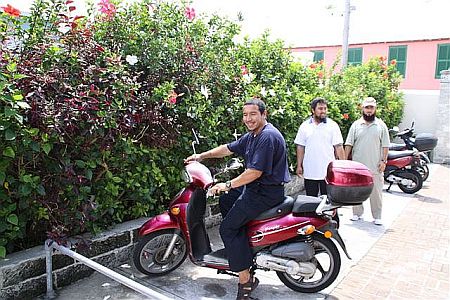
Another exclusive photo provided by Rushan Abbas. Khalil Manut gets to grips with a moped.
Moving on to Guantánamo, the men said that their “worst moments” came not during their “long stretches of solitary confinement in the spartan cells,” but “when the Americans allowed a visit by Chinese military officials,” who were permitted to interrogate them for two weeks. This was indeed a cynical move on the part of the US authorities, who were currying favor with the Chinese government in the run-up to the invasion of Iraq in 2003, and was in marked contrast to the situation that prevailed in previous years, when the Uighurs’ plight was recognized in some US political circles as being akin to that of the Tibetans.
Describing the visit of the Chinese intelligence agents, Salahidin Abdulahad said, “The Chinese delegation treated us very badly. They brought me out and interrogated me for six hours straight with no food or rest. They took me back to my cell and I was extremely tired. But then they came straight back to my cell and took me out for another six hours of interrogation. It went on that way for one-and-a-half days.” Another of the men, Ablikim Turahun, added more disturbing details. “When the Chinese came they wanted to take my picture, but I didn’t want them to, because I was afraid they would harm my family.” He said. “But one of the American guards grabbed my beard and the other held my hands behind my back so they could take the picture.”
Everything the Uighurs told the Gazette — with the exception of Ablikim Turahun’s recollection of being restrained by US guards while Chinese agents took his photo — has, of course, been reported before, as the Uighurs’ explanations of how they ended up in Guantánamo were unwavering throughout their long ordeal in US custody. Nevertheless, Premier Brown has come under pressure for accepting the men, partly from the British government, which has claimed that it was not informed about the decision to accept them (although, as I reported previously, I find this claim unconvincing), and partly from opposition politicians, who appear to view the men’s arrival as an opportunity to score political points at the expense of Premier Brown, and have threatened to call for a vote of no confidence in the current administration.
On Bermuda itself, however, the men appear to have sidestepped the fallout from the political wrangling, at least in their personal dealings with the islands’ citizens. One of their lawyers, Sabin Willett, told the Gazette that when they went into a local store to buy clothes, the radio was on, and various participants in a talk show “were complaining about ‘terrorists’ not being welcome in Bermuda.” Willett explained that the storekeeper, who “looked at the men and quickly realized who they must be,” ignored the voices on the radio and said, “Well, I welcome you here.”
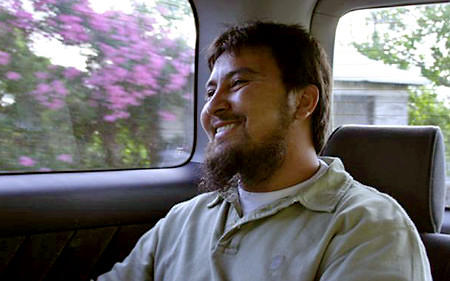
Abdulla Abdulqadir, photographed by Susan Baker Manning.
A welcome — and the opportunity to work, and to prove themselves capable of contributing positively to their new home — is all the men seek. “Bermuda had the courage to step up and do this,” Salahidin Abdulahad explained. “It’s a small place but the people have extremely big hearts. We want to live a peaceful and beautiful life here and we are ready to work hard. People know we have been in Guantánamo and they have a picture of us which is very different from who we are. When people get to know us they will know what kind of people we are. We are peace-loving people.”
Other reporters who have met the men in the last few days have confirmed their joy at their new-found freedom, and their desire to integrate as swiftly as possible. Michelle Shephard of the Toronto Star noted that, in the apartment provided for them by the US government until they find work — “which likely won’t be a problem since local companies have reportedly already made six offers,” as she put it — the men have “managed to form a makeshift family,” helped by their American translator Rushan Abbas, who initially worked with US interrogators after arriving at Guantánamo in 2002, before joining the Uighurs’ defense team. As Shephard described it, Abbas, who alternated between typing emails and “kneading dough for a traditional Uighur dinner … joked that, despite only being a few years older, she considered the men her children.” Shephard also explained that the men “have the assistance of a retired Bermudian army major, Glenn Brangman, who now works with the government,” and who “has become their energetic guide.”
In the New York Times, Eric Eckholm found Maj. Gen. Brangman to be a strong advocate for the Uighurs’ acceptance in Bermuda. After speaking to the men’s lawyers, who explained that they “have been promised work visas and, in perhaps a year or so, possible citizenship,” which “would give them passports and a right to travel,” Eckholm sought the opinion of Brangman, who said, simply, “The intent is that they shall become Bermudians.” Eckholm also wrote more about the islanders’ response to the new arrivals, noting that, “As the men venture from the seaside cottage where they temporarily live until they get jobs and figure out next steps, people often come up to shake their hands and wish them well, and the men said they were deeply touched.” He added that, “While some less affluent residents said they felt it was unfair to offer jobs and citizenship to men the United States itself would not take, many others shrugged and expressed pride at Bermudan hospitality.”
As the men settle into their new lives, they are all hoping that, after seven years of wrongful imprisonment, Bermudan hospitality will prevail over the rumors and innuendo that are a peculiar side-effect of Guantánamo, in which men held outside the law, never charged or tried, and treated abominably for seven long years, are, perversely, regarded with suspicion for the rest of their lives by all manner of people who should know better, and who should realize that holding prisoners based on a presumption of guilt, and attempting to prevent them from ever having the opportunity to challenge the basis of that presumption, will remain a particularly low point in the history of the United States, until Guantánamo is finally closed, and those still held are either charged or released.
In the meantime, the men also want the world to remember that 13 of their compatriots are still in Guantánamo, although according to information leaked last week, the US government is hoping to resettle them on the Pacific island of Palau, and is, it must be noted, anxious to do this before June 25, when the US Supreme Court is scheduled to meet to discuss whether US courts have any authority to order Guantánamo prisoners to be released into the United States. Speaking to a reporter from Britain’s Daily Telegraph, Abdulla Abdulqadir made a point of saying, “Our 13 brothers still in Guantánamo are just the same as us. People need to understand that.”

Salahidin Abdulahad and Khalil Manut, photographed by Michelle Shephard for the Toronto Star, enjoy their new-found freedom by fishing in the ocean.
POSTSCRIPT: On June 18, I was prompted to write the following letter to the Royal Gazette, in response to a rather cheap tabloid article in the paper, entitled, “Tourists upset by Guantánamo issue threaten to boycott Bermuda”:
Fearmongering
June 18, 2009
Dear Sir,
I write to express dismay at your story, “Tourists upset by Guantánamo issue threaten to boycott Bermuda.” If you’re going to pander to this kind of groundless fearmongering, you really should do more to present the other side of the story than just mentioning that the Uighurs were “twice cleared of being enemy combatants by the United States.”
You should spell out that they were cleared of being enemy combatants by the Bush administration and by the US courts, and that the only reason that rumours persist regarding their supposed danger is because certain politicians in the United States decided to score political points by campaigning to resist their release into the care of communities in Washington D.C. and Florida, who had prepared detailed plans for their resettlement.
These men pose a danger to no one, but, like the many hundreds of innocent men who were imprisoned in Guantánamo because of the incompetence and arrogance of the Bush administration, they will forever be tainted by their ordeal, unless braver voices than those who whine about “terrorists” are prepared to point this out, and to congratulate the government of Bermuda for doing the right thing and offering a home to these men when others in America were not prepared to do so.
ANDY WORTHINGTON
London, UK
Note: There seems to be an enormous amount of confusion regarding the men’s names. Salahidin Abdulahad was previously identified as Abdul Semet and was known to the Pentagon as Emam Abdulahat, Ablikim Turahun was previously identified as Huzaifa Parhat, Khalil Manut was previously identified as Abdul Nasser and was known to the Pentagon as Abdul Helil Mamut, and Abdulla Abdulqadir was previously identified as Jalal Jalaladin and was known to the Pentagon as Abdullah Abdulquadirakhun.
 Andy Worthington is the author of The Guantánamo Files: The Stories of the 774 Detainees in America’s Illegal Prison (published by Pluto Press, distributed by Macmillan in the US, and available from Amazon — click on the following for the US and the UK). To receive new articles in your inbox, please subscribe to my RSS feed, and also see my definitive Guantánamo prisoner list, published in March 2009.
For a sequence of articles dealing with the Uighurs in Guantánamo, see: The Guantánamo whistleblower, a Libyan shopkeeper, some Chinese Muslims and a desperate government (July 2007), Guantánamo’s Uyghurs: Stranded in Albania (October 2007), Former Guantánamo detainee seeks asylum in Sweden (November 2007), A transcript of Sabin Willett’s speech in Stockholm (November 2007), Support for ex-Guantánamo detainee’s Swedish asylum claim (January 2008), A Chinese Muslim’s desperate plea from Guantánamo (March 2008), Former Guantánamo prisoner denied asylum in Sweden (June 2008), Six Years Late, Court Throws Out Guantánamo Case (June 2008), Guantánamo as Alice in Wonderland (July 2008), From Guantánamo to the United States: The Story of the Wrongly Imprisoned Uighurs (October 2008), Guantánamo Uyghurs’ resettlement prospects skewered by Justice Department lies (October 2008), A Pastor’s Plea for the Guantánamo Uyghurs (October 2008), Guantánamo: Justice Delayed or Justice Denied? (October 2008), Sabin Willett’s letter to the Justice Department (November 2008), Will Europe Take The Cleared Guantánamo Prisoners? (December 2008), A New Year Message to Barack Obama: Free the Guantánamo Uighurs (January 2009), Guantanamo’s refugees (February 2009), Bad News And Good News For The Guantánamo Uighurs (February 2009), A Letter To Barack Obama From A Guantánamo Uighur (March 2009), Obama’s First 100 Days: A Start On Guantánamo, But Not Enough (May 2009), Pain At Guantánamo And Paralysis In Government (May 2009), Guantánamo: A Prison Built On Lies (May 2009), Guantánamo: A Real Uyghur Slams Newt Gingrich’s Racist Stupidity (May 2009), Free The Guantánamo Uighurs! (May 2009), and the stories in the additional chapters of The Guantánamo Files: Website Extras 1, Website Extras 6 and Website Extras 9.
Andy Worthington discusses Guantánamo on the BBC and al-Jazeera
On Friday, al-Jazeera English’s “Listening Post” ran a feature on the New York Times’ now-notorious May 21 cover story, “1 In 7 Detainees Rejoined Jihad, Pentagon Finds,” which quoted uncritically from a Pentagon report alleging that 74 ex-prisoners had “returned to the battlefield.” I discussed the many problems with this story in a recent article, “New York Times finally apologizes for false Guantánamo recidivism story,” and was featured in the program, with other interviewees including Mark Denbeaux of the Seton Hall Law School in New Jersey, whose team of lawyers and students have done more than anyone else in debunking the Pentagon’s many reports about Guantánamo, proving, time and again, that they are nothing more than propaganda masquerading as evidence. The School’s latest report, “Revisionist Recidivism: An Analysis of the Government’s Representations of Alleged ‘Recidivism’ of the Guantánamo Detainees,” is available here as a PDF.
On June 6, after issuing an Editor’s Note regarding the original story, Clark Hoyt, the Times’ Public Editor, wrote an op-ed, entitled, “What Happened to Skepticism?” in which he conceded that the article was “seriously flawed and greatly overplayed,” and added, “It demonstrated again the dangers when editors run with exclusive leaked material in politically charged circumstances and fail to push back skeptically.” He also made a point of stating, “The lapse is especially unfortunate at the Times, given its history in covering the run-up to the Iraq war,” which is a gratifyingly frank admission of the Times’ failures during that critical period.
On Saturday, I took part in a discussion about the future of Guantánamo on the BBC World Service’s “Newshour,” with guests including Pierre-Richard Prosper, the Bush administration’s ambassador-at-large for war crimes, and Moazzam Begg, former Guantánamo prisoner and spokesman for the human rights group Cageprisoners. This wide-ranging discussion of some of the many issues surrounding the closure of Guantánamo is available on the BBC iPlayer. The discussion starts 26 minutes in, lasts for around 25 minutes, but is only available online until June 20.
This was not my only recent radio appearance. On May 5, I was interviewed by the ever indignant Scott Horton for Antiwar Radio (for the eighth time — the MP3 is here), which was a pleasure, as ever, although the sound quality is rather poor at my end (otherwise I would have mentioned it earlier), and on June 6 I was interviewed by Kevin Barrett for Truth Jihad Radio on American Freedom Radio. My interview followed Kevin’s discussion of torture with Brad Friedman of the excellent Brad Blog, and can be found on the Truth Jihad Radio Archives (under 06/06/2009), starting about one hour and nine minutes in, and lasting for 50 minutes.
Kevin and I started off by discussing the mysterious death last month, in a Libyan prison, of the CIA “ghost prisoner” Ibn al-Shaykh al-Libi, and moved on to a wider discussion of secret prisons and other “ghost prisoners,” and the West’s extremely dubious relationship with Libya since the 9/11 attacks. Kevin also asked me to explain the proportion of prisoners held in Guantánamo who were involved in terrorism, allowing me to recap the extraordinary story of arrogance and ineptitude that led the capture of only a few dozen genuine terror suspects, as opposed to the 700-plus innocent men or low-level Taliban foot soldiers who were also seized. In the second half of the show we had a lively discussion about the basis of the 9/11 attacks, and then moved on to talk about Barack Obama’s promise to close Guantánamo, and the problems — some of his own making; others not — that are complicating the fulfillment of this promise, as I have discussed in numerous articles over the last few months.
Andy Worthington is the author of The Guantánamo Files: The Stories of the 774 Detainees in America’s Illegal Prison (published by Pluto Press, distributed by Macmillan in the US, and available from Amazon — click on the following for the US and the UK). To receive new articles in your inbox, please subscribe to my RSS feed, and also see my definitive Guantánamo prisoner list, published in March 2009.
Law Lords Condemn UK’s Use of Secret Evidence And Control Orders
 Four years late, the Law Lords finally put the British government’s anti-terror policies under the spotlight on Wednesday by delivering a resounding repudiation of the government’s use of secret evidence to impose control orders on alleged terror suspects (the full judgment is here).
An unjustified stranglehold on liberty: the control orders
Introduced in March 2005 after the Law Lords ruled in December 2004 that the government’s previous policy of imprisoning suspects without charge or trial in Belmarsh prison (which had begun three years before) was in contravention of the Human Rights Act, the control order regime is effectively a form of house arrest. As I explained in an article for the Guardian in April,
[Control orders] keep suspects, for most hours of the day, confined to their houses. They are tagged, told to report to the authorities several times a day, and are subjected to unannounced house raids by Home Office officials to ensure they are not breaching the conditions of their confinement.
Visitors have to be vetted by the Home Office. If the detainee is a single man, he is unbearably isolated; if married with children, he is trapped, unable to work, pushed to mental collapse as his children are unable to have friends over to visit, and are denied access to a computer for their studies.
In the Belmarsh years, several of the prisoners held without charge or trial developed what Gareth Peirce, one of their lawyers, described as “florid psychosis,” and as Press TV reported two weeks ago in an exclusive interview with one of these men, Mahmoud Abu Rideh, a Palestinian who has spent the last seven years either in Belmarsh, Broadmoor psychiatric hospital, or at home under a control order, the practical difference between prison and house arrest is often minimal.
On May 25, Abu Rideh’s wife finally gave up the struggle and returned to Jordan with their children. As Cageprisoners explained, “They were prevented from taking many of their belongings with them since many of the children’s possessions had been seized by police as claimed breaches of their father’s control order.” Cageprisoners also noted that “Mr. Abu Rideh was denied the opportunity of bidding his family farewell at the airport,” and stated that “He now despairs at the thought of never seeing his family again, since he cannot leave the country and his family were told that they have no right to return to the UK, despite the fact that they are British nationals.”
In his interview with Press TV, which took place just a week before the death, reportedly by suicide, of Muhammad Salih, a prisoner at Guantánamo who was held for seven years without charge or trial, Abu Rideh stated that he was unable to bear the thought of living any longer:
I am already dead. My soul, my life, my heart — every part of me is dead. I am just like a machine walking, with no other feeling. I have nothing left — I cannot even sleep at night; I have nightmares of what they have done to me, to my wife, my children, my time in prison, the searches … this is enough. I’ve lost my senses, I’ve been driven insane, I can no longer take it. What is the point of living? I’ve lost everything, I’ve lost my wife, I might as well kill myself, that is better for me. I swear by God I have written to Gordon Brown saying that you have two weeks, if I am not helped in this period I will kill myself, whether that’s by throwing myself in front of a train, or slitting my wrists, or throwing myself from a high building, or taking an overdose, whatever it takes. Nobody has lived the life I have or what I’ve had to endure.
However, while the practical effects of control orders should be genuinely troubling to anyone who believes in open justice, and the ancient right not to have your liberty removed except through the verdict of a jury of your peers, the Lords’ ruling on Wednesday focused on the equally troubling context of how the decisions to impose control orders are made.
The Kafkaesque world of secret evidence
Primarily, this centres on an absurd situation whereby, in the Special Immigration Appeals Court (SIAC), which deals with these cases, special advocates are responsible for representing the accused in closed sessions involving the use of secret evidence, but are prevented from revealing anything about those sessions to the men they represent. This impenetrable barrier to transparency also works in the other direction, as suspects cannot brief the advocates effectively when they are kept in the dark regarding the details of the case against them.
In March, the full, horrific absurdity of this system was exposed by Dinah Rose QC in a Parliamentary meeting chaired by Diane Abbott MP, which was convened to canvas support for an Early Day Motion calling for an end to the use of secret evidence, and to discuss strategies for future campaigns. Uniquely, to my knowledge, Rose has direct experience of SIAC in three different roles — as instructed by the Home Office, as a representative of some of the detainees held on the basis of secret evidence, and as a special advocate — and her insight was, therefore, particularly powerful.
Talking about a case on which she had served as a special advocate, she explained, “The special advocates were told what the evidence was, but we were prohibited from discussing the material with the appellant or his lawyers. We were simply unable to offer any resistance at all to the application, in the absence of any instructions, which might have explained or cast a different light on the evidence.”
As a result, the judge revoked the man’s bail, and ordered him to be sent to Belmarsh. Remembering this ruling, Rose said, “I can still recall my deep feeling of shame when I heard the appellant ask the judge the question: why are you sending me to prison? To which the judge replied: ‘I cannot tell you that.’ I could not believe that I was witnessing such an event in a British court. I could not believe that nobody protested or made a fuss. They simply took him to jail, without any explanation at all.”
She also explained that, “although SIAC looks and sounds like a court, and the judges and barristers behave with the courtesy and formalities that are used in court, it is in reality nothing of the kind. Often it feels to me like an elaborate charade, in which we are all playing the roles of barrister, solicitor, appellant and judge, but where the basic substance of a court hearing — the testing of evidence to establish where truth lies — is entirely missing.”
The detainees and the Law Lords’ ruling
In Wednesday’s ruling, following hearings in February and March, the Law Lords were deciding the cases of three men, a joint Libyan/British national, an Iraqi and a British national, who are identified only as AF, AE and AN. This anonymity is allegedly for their own protection — although it also conveniently dehumanizes them — but a few details about them are in the public domain.
AE, for example, who spoke to the BBC on Wednesday, is a Kurdish imam, who fled Iraq in 2002 after being imprisoned by the regime of Saddam Hussein in Abu Ghraib prison, and was given leave to remain in the UK. Seized from his house in May 2006, he says that he has no idea why he was placed on a control order, and has no way of responding to the vague claims that have been made publicly available, which indicate that the security services regard him as a radicalizing influence who supports the insurgency in Iraq. Speaking about when he was first seized, he told the BBC, “I said, ‘Why am I being put on a control order?’ The answer was that they did not have to tell me.”
AN, the British national, who was born in Derby, is apparently regarded as a link between extremists in the UK and the Middle East, and was placed on a control order after returning from a visit to Syria, and the joint Libyan/British national is AF, who was born in the UK to a Libyan father and a British mother. A banking graduate, he had intended to become an accountant, but was placed on a control order in June 2006, allegedly because the Home Secretary believed that he had connections to members of a group opposed to the regime of Colonel Gaddafi (who, lest we forget, was our own implacable enemy until six years ago, when he cannily signed up to support the “War on Terror”). Under the terms of his control order, he is now compelled to remain in his flat for 16 hours a day, cannot see anyone without permission, and is prohibited from using the Internet.
When the Lords made their ruling, they unanimously declared that they had had enough of the system as it currently stands, By nine votes to nil, they ruled that imposing control orders breaches Article 6 of the European Convention on Human Rights, which guarantees the right to a fair trial, because a suspect held under a control order is not given “sufficient information about the allegations against him to enable him to give effective instructions to the special advocate assigned to him.”
In the ruling, Lord Phillips of Worth Matravers, the senior Law Lord, wrote, “A trial procedure can never be considered fair if a party to it is kept in ignorance of the case against him.”
His opinion was followed by that of Lord Hope of Craigshead, who declared, “The principle that the accused has the right to know what is being alleged against him has a long pedigree … The fundamental principle is that everyone is entitled to the disclosure of sufficient material to enable him to answer effectively the case against him.”
Lord Hope also wrote, “The consequences of a successful terrorist attack are likely to be so appalling that there is an understandable wish to support the system that keeps those who are considered to be most dangerous out of circulation for as long as possible. But the slow creep of complacency must be resisted. If the rule of law is to mean anything, it is in cases such as these that the court must stand by principle. It must insist that the person affected be told what is alleged against him.”
Reinforcing these opinions, Lord Scott of Foscote wrote, “An essential requirement of a fair hearing is that a party against whom allegations are made is given the opportunity to rebut the allegations. That opportunity is absent if the party does not know what the allegations are. The degree of detail necessary to be given must, in my opinion, be sufficient to enable the opportunity to be a real one. The disclosure made to each of these appellants was insufficient to afford him a real opportunity for rebuttal. He did not, therefore, have a fair hearing for Article 6(1) purposes and these appeals must be allowed.
Opposition to control orders in the last two years
Since the control orders were introduced, the scope of their application has regularly been called into question not just by those whose job it is to work tirelessly against the State’s increasingly authoritarian impulses, but also by politicians, and, in particular, by Lord Carlile, the government’s “independent reviewer” of the control order regime.
Last March, a vote in the House of Commons to extend, for another year, the use of control orders — which were, at the time, in place against 15 alleged terror suspects — passed by 267 votes to 60, but, as I explained at the time, “Tory MPs were clearly not bowled over by a hyperbolic statement made by Security Minister Tony McNulty, who, as though infected by the ghosts of previous Labour hard men John Reid and David Blunkett, claimed, ‘The threat (of terrorism) is clearly real, serious and represents a threat unparalleled in our country’s history.’”
Speaking on behalf of his fellow MPs, the Tories’ shadow attorney general Dominic Grieve declared, “On balance, and with a considerable degree of reluctance, our view is we should allow renewal to take place this year.” Other notes of caution were sounded by Labour MPs. Andrew Dismore, the chairman of the joint Human Rights Committee, warned that the orders could create “Guantánamo-style martyrs” unless a maximum time limit was imposed, and Lord Carlile said that no control order should be extended beyond two years “save in genuinely exceptional circumstances.”
Similar scenes — involving Labour scaremongering, Tory “reluctance” and opposition from the Liberal Democrats — took place when the control orders were again renewed three months ago, but the most important dissent to note is Lord Carlile’s mantra, repeated every year in his annual reports (see here for the latest PDF), and just three weeks ago he repeated his call, backed up by peers and MPs on the Parliamentary Human Rights Committee.
Refuting claims by the Home Office that “A definite end-date would mean individuals on control orders could simply disengage from involvement in terrorism-related activity on the basis that they knew they could re-engage at the end of that time period,” Carlile reiterated his assertion that control orders lasting more than two years can only be justified “in a few exceptional cases,” telling the Committee, “After that time, at least the immediate utility of even a dedicated terrorist will seriously have been disrupted.”
Throughout this period, the Law Lords were critical, too, but not with the robustness with which they demolished the policy of imprisonment without charge or trial in December 2004. In November 2007, for example, when they were called upon to review the cases of six Iraqis held under control orders, they ruled that an 18-hour home curfew was in breach of the right to liberty, as guaranteed by the European Convention on Human Rights, and, moreover, ruled that the system of secret evidence must be changed to let the suspects know the case against them, and to give them the right to a fair hearing, even though the Home Secretary, Jacqui Smith, proceeded to ignore their ruling about secret evidence (leading, 19 months later, to Wednesday’s reiteration of terror suspects’ rights), and also showed little willingness to relax the curfews.
As I explained in an article at the time, there was some great rhetoric in the ruling. Lord Brown, memorably, said that the right to a fair hearing was “one of altogether too great importance to be sacrificed on the altar of terrorism control,” and Lord Hoffman declared, “Such is the revulsion against detention without charge or trial, such is this country’s attachment to habeas corpus, that the right to liberty ordinarily trumps even the interests of national security,” adding that such rights were simply “too precious to be sacrificed for any reason other than to safeguard the survival of the state.”
However, as I also noted at the time, it was apparent that, by refusing to condemn the control orders outright, the Lords “perpetuated a brazenly draconian system, which appears, dangerously, to be fuelled by anti-Muslim vindictiveness, even though the more prosaic truth is that it is driven by an anachronistic refusal to ‘compromise the security services’ by proceeding with trials using intercept evidence (despite the fact that most other western democracies have managed to do so without imperiling their ‘spooks’).”
Throughout this period, however, the most disturbing opinions came not from the Lords, but from the Court of Appeal, whose ruling in October 2008 — that there might be cases where “very little indeed” or nothing could be disclosed to people accused of being involved in terrorism, in spite of a dissenting judge’s alarm at a principle that might “move us back towards unbridled executive power over personal liberty” –- partly triggered the Law Lords’ latest review, and may, in its bald defense of intolerable secrecy, have contributed to a necessary backlash.
What next?
What happens next is not entirely clear. The Lords did not quash the control orders on Wednesday, but ordered the men’s cases to be heard again, and it is now up to the Home Office to decide whether to release more material to the men and their lawyers, or to rescind the control orders completely.
It is also unclear what effect the ruling will have on the other 14 men who are currently on control orders, or the 20 or so men in prison — or on deportation bail — whose cases are closely related, differentiated only by the government’s extremely dubious determination to deport them to their home countries, even though, as I reported in February, this involves politicians and judges being obliged to creatively reinterpret the anti-torture laws preventing the return of foreign nationals to countries where they face the risk of torture.
New to his job, Home Secretary Alan Johnson has not yet succumbed to the rabid paranoia that infects all Home Secretaries when confronted by the “terror threat.” In February, for example, Jacqui Smith actually declared war on the government’s own secret terror court, overruling decisions by a SIAC judge that met with her disapproval, and — in what can only be described as an act of executive fiat — unilaterally revoking the bail of five men on deportation bail, kidnapping them on their way home from the London courtroom (or in raids on their homes) and imprisoning them in Belmarsh until the judge reasserted his authority the following day.
Presumably reading from a script that was left for him by Smith, Johnson said on Wednesday that the judgment was “extremely disappointing,” but did not spontaneously combust, as Jacqui Smith may well have done. “Protecting the public is my top priority and this judgment makes that task harder,” he continued. “Nevertheless, the government will continue to take all steps we can to manage the threat presented by terrorism.”
He added, “All control orders will remain in force for the time being and we will continue to seek to uphold them in the courts. In the meantime, we will consider this judgment, and our options, carefully.” Explaining that control orders had been introduced to “limit the risk posed by suspected terrorists who could not be prosecuted or deported,” as the Guardian put it, he also said, “The government relies on sensitive intelligence material to support the imposition of a control order, which the courts have accepted would damage the public interest to disclose in open court. We take our obligations to human rights seriously and as such we have put strong measures in place to try to ensure that our reliance on sensitive material does not prejudice the right of individuals subject to control orders to a fair trial.”
This was standard government fare, though rather muted in its delivery, but if the new Home Secretary is seeking a “third way,” beyond releasing more sensitive material or rescinding the control orders, he might want to take some advice from Chris Huhne, the Liberal Democrat home affairs spokesman, who responded to the Lords’ ruling by saying that it “clearly states that control orders are a fundamental infringement of human rights and an affront to British justice. It is unacceptable to deny a person freedom without even telling them what they are suspected of.” Crucially, Huhne added, “We do not need to sacrifice the freedoms we have fought so hard for. We must not become what we are fighting. This discredited regime should be scrapped immediately. The government should focus instead on making it easier to prosecute terrorists by making intercept evidence available in court.”
Using intercept evidence, and testing the reliability of the intelligence services
Huhne’s main point — that the government should find a way to join the rest of the world in finding a way to use intercept evidence in court without compromising its intelligence sources or methods — is clearly the way forward, as without it the government is left clinging to nothing but its manifestly unjust, and largely failed attempt to deport men on the sly, or is required to maintain the “house arrest” charade that is both horribly petty and ruinously strenuous for those held in such a novel form of legal limbo.
As I also explained in my article in February, the government has, for years, been distressingly intransigent on the subject of intercept evidence, although, in a recent letter from the Home Office, Minister of State Vernon Coaker informed me that “We [the government] have accepted the Chilcot recommendation that we should introduce intercept as evidence provided the conditions outlined in the report can be met.”
The reference to “the Chilcot recommendation” refers to the findings in the Privy Council Review Of Intercept As Evidence (PDF), headed by Sir John Chilcot and published in January 2008, and although Coaker’s concession is still rather hedged in by caveats, I hope that it signifies real change, because on Wednesday, the NGO JUSTICE, which describes itself as “an all-party law reform and human rights organization working to improve the legal system and the quality of justice,” published a major report on the use of secret evidence in British courts since SIAC was introduced in 1997 (241 pages, PDF), establishing the extent to which secret evidence has been used “in a wide range of court proceedings from deportation hearings before SIAC, pre-charge detention hearings in terrorism cases, employment tribunals, asset-freezing cases, parole board hearings, and control order cases in the High Court and the Court of Appeals.”
The report also explains that, although more than 90 special advocates have been appointed since 1997, “no central figures are published and even the government may not know the total number of special advocates that have been appointed,” and also notes, in an analysis of the use of secret evidence that is at least as worrying as the “mission creep” outlined in the paragraph above, that “defendants in some criminal cases are now being convicted on the basis of evidence that has never been made public. Criminal courts have issued judgments with redactions [passages blacked out] to conceal some of the evidence relied upon. Evidence from anonymous witnesses has also been used in criminal trials and is widespread in ASBO hearings.”
In conclusion, then, if justice is once to be asserted in the UK, the government needs to move fast on incorporating intercept evidence in terror trials, so that the public — as well as the suspects themselves — will be able to test the validity of its claims. One additional problem with secret evidence, of course, is that its use shuts off all scrutiny of the intelligence services’ reliability, and although it is necessary for this work to take place behind the scenes, it is also unacceptable for the government to effectively hide behind a blanket assertion that the intelligence services never make mistakes, and that “national security concerns” should quash any notion of skepticism on the part of lawyers, prisoners and members of the public, especially because the public record is littered with abominable failures of intelligence in the years since the 9/11 attacks.
Without even having to draw comparisons with the non-existent “ricin plot,” the pointless and brutal Forest Gate raid, the intelligence failures surrounding the terrorist attacks on July 7, 2005, the murder of Jean Charles De Menezes, and countless other incidents, some of the chronic failures of intelligence in the control order regime — compounded by bureaucratic incompetence — are already well-known. In April 2005, for example, the Home Office was forced to apologize to ten of the men under control orders after what it described as a “clerical error,” which resulted in letters being sent to them stating, incorrectly, that the basis for their detention was their alleged involvement in the “ricin plot,” and in January 2005 an extraordinary list of intelligence blunders relating to the Belmarsh prisoners was published in the Independent.
In an article entitled, “Belmarsh detainees: Flawed intelligence exposes scandal,” Robert Verkaik noted, amongst other errors, that “A security service assessment was embarrassingly withdrawn after it emerged that the purpose behind a visit to Dorset by a group of Muslim men had not been to elect a terrorist leader but to get away from their wives for the weekend,” that “The Home Secretary has been forced to concede that some of the funds raised by [Mahmoud] Abu Rideh for alleged terrorist activity were sent to orphanages in Afghanistan run by a Canadian priest,” that “Two of the detainees were awarded compensation for false arrest shortly before they were detained under the anti-terrorist emergency powers,” and that “Testimony against two of the detainees came from an affidavit sworn by a man who was offered a lenient sentence in return for evidence.”
Although Verkaik observed, justifiably, that these mistakes were based on the “open” evidence against the suspects, he was undoubtedly correct to add that “the inaccuracy of some of these assertions raises questions about the reliability of the secret evidence that the detainees have never been allowed to see.” Given the government’s poor track record, there is absolutely no reason to believe that the quality of the government’s secret evidence is any more reliable, and, in fact, more than enough reasons to suspect that it not only involves credulousness and incompetence, but also, as with the “ricin plot” (one of whose cleared defendants is currently on a control order), material derived from the use of torture.
As Eric Metcalfe, JUSTICE’s director of human rights policy, said in response to the Lords’ ruling on Wednesday, “The House of Lords judgment marks a turning point. The government can decide to limp on with the use of secret evidence for ever diminishing returns. Or Parliament can act to end its use once and for all.” He added, “Secret evidence is always unreliable, unnecessary, undemocratic and unfair. Because it has never been properly tested, it breeds complacency and false confidence in its results. Secret evidence damages public trust in our courts and in the rule of law itself.”
 Andy Worthington is the author of The Guantánamo Files: The Stories of the 774 Detainees in America’s Illegal Prison (published by Pluto Press, distributed by Macmillan in the US, and available from Amazon — click on the following for the US and the UK). To receive new articles in your inbox, please subscribe to my RSS feed, and see here for my definitive Guantánamo prisoner list, published in March 2009.
As published exclusively on Cageprisoners.
For other articles dealing with Belmarsh, control orders, deportation bail, deportations and extraditions, see Deals with dictators undermined by British request for return of five Guantánamo detainees (August 2007), Britain’s Guantánamo: the troubling tale of Tunisian Belmarsh detainee Hedi Boudhiba, extradited, cleared and abandoned in Spain (August 2007), Guantánamo as house arrest: Britain’s law lords capitulate on control orders (November 2007), The Guantánamo Britons and Spain’s dubious extradition request (December 2007), Britain’s Guantánamo: control orders renewed, as one suspect is freed (February 2008), Spanish drop “inhuman” extradition request for Guantánamo Britons (March 2008), UK government deports 60 Iraqi Kurds; no one notices (March 2008), Repatriation as Russian Roulette: Will the Two Algerians Freed from Guantánamo Be Treated Fairly? (July 2008), Abu Qatada: Law Lords and Government Endorse Torture (February 2009), Ex-Guantánamo prisoner refused entry into UK, held in deportation centre (February 2009), Home Secretary ignores Court decision, kidnaps bailed men and imprisons them in Belmarsh (February 2009), Britain’s insane secret terror evidence (March 2009), Torture taints all our lives (published in the Guardian’s Comment is free), Britain’s Guantánamo: Calling For An End To Secret Evidence, Five Stories From Britain’s Guantánamo: (1) Detainee Y, Five Stories From Britain’s Guantánamo: (2) Detainee BB, Five Stories From Britain’s Guantánamo: (3) Detainee U, Five Stories From Britain’s Guantánamo: (4) Hussain Al-Samamara, Five Stories From Britain’s Guantánamo: (5) Detainee Z, Britain’s Guantánamo: Fact or Fiction? and URGENT APPEAL on British terror laws: Get your MP to support Diane Abbott’s Early Day Motion on the use of secret evidence (all April 2009), and Taking liberties with our justice system and Death in Libya, betrayal in the West (both for the Guardian).
Guantánamo: 500 Posts – And A Fundraising Appeal

Please support my work!
As the Obama administration’s muddled mission to clear up the toxic inheritance of Dick Cheney and George W. Bush continues, and fearmongers of both parties — led by Cheney himself — continue to spread lies and misinformation about the men held at Guantánamo and in other “War on Terror” prisons, the need has never been greater for accurate information about who is still held there, why most of them never had any involvement with al-Qaeda or international terrorism, and why the Obama administration should do all in its power to release the majority of these men before January 2010.
It is also important for the President to understand that, to reestablish America’s moral standing in the world, those prisoners regarded as truly dangerous (no more than a few dozen, according to reliable intelligence sources) should be prosecuted in a court that meets internationally acceptable standards (in other words, not in a reworked version of Cheney’s Military Commission trial system, which the administration recently proposed).
The President must also understand that another recent proposal — to seek Congressional approval for a policy of “preventive detention” — is also unacceptable, as it would enshrine, in law, the fundamental betrayal of justice on which Guantánamo was founded. Prisoners in US custody are either prisoners of war, to be protected by the Geneva Conventions, or they are criminal suspects, who must be put forward for a trial, in which they will be found either innocent or guilty. There is no “third way,” whereby men can be deprived of their liberty forever without having the opportunity to prove their innocence, or to have their guilt confirmed by a jury.
President Obama came into office promising to close Guantánamo within a year, to ban the use of torture, and to ensure that, in future, all prisoners in wartime would be held according to the Geneva Conventions and would be interrogated according to the non-coercive techniques laid down in the Army Field Manual.
It was an auspicious beginning, but as the months have passed, it has become clear that many different voices — some less benign and more cowardly than others — have been prevailing upon the President to compromise his mission to undo the damage wrought by the Bush administration’s “War on Terror.”
Some of the resulting problems are outlined above; others include resisting calls to extend habeas corpus rights to foreign prisoners held in the US prison at Bagram airbase, bowing to hysterical pressure from politicians and other fearmongers by refusing to resettle innocent prisoners from Guantánamo on the US mainland, and invoking the “state secrets” doctrine to prevent disclosure of information about “extraordinary rendition” and torture.
To some, the refusal to appoint an independent prosecutor to investigate the legality of the Bush administration’s policies is Obama’s major failing, but as this particular story is still unfolding, I have to say that, on the first anniversary of Boumediene v. Bush, the Supreme Court ruling that reasserted the Guantánamo prisoners’ habeas corpus rights (after they had been granted in 2004 and then taken away by Congress), my major complaint right now is that the Justice Department has been persistently obstructing the District Court judges in their attempts to review the prisoners’ habeas cases — primarily by refusing to provide the prisoners’ defense attorneys with necessary material in a timely manner, if at all — to the extent that there is now a widespread feeling amongst the lawyers that, in the habeas cases, the change of government has made absolutely no difference whatsoever.
I wrote about the Justice Department’s obstruction in several articles recently (see here, here and here), but there is clearly more work to be done, for the simple reason that most people are not yet aware of the extent to which what is being hidden is, for the most part, not evidence of wrongdoing on the part of the prisoners, but evidence of information extracted from unreliable witnesses (through the use of torture, coercion or bribery), and evidence of desperate attempts on the part of the authorities to build up “mosaics” of intelligence that are not actually credible. A substantial amount of work also remains to be done on other crucial topics, including the “ghost prisoners” held in secret CIA prisons, who were not eventually transferred to Guantánamo, and the prisoners in Bagram.
I also remain committed to breaking news stories in the Western media (as I did with the death of Ibn al-Shaykh al-Libi last month), to providing detailed commentary on breaking news stories that is not available elsewhere, and to being able to continue producing reports like the definitive Guantánamo prisoner list that I published in March, and the report on hunger strikes and weight loss in Guantánamo that I published this week.
For over three years, I have been assiduously chronicling every aspect of Guantánamo and the men held there, first through my book The Guantánamo Files, and, for the last two years, through this blog and the many other websites and publications where my work is available. I recently published my 500th post on this site (“Guantánamo’s Youngest Prisoner Released To Chad,” about the release of Mohammed El-Gharani, which was published before anyone else picked up on the story), and although I’m delighted that a number of media outlets support my work financially, and am also generally content to keep doing this work for the sake of combating injustice, and to help to bring an end to the crimes committed in the “War on Terror,” I could do with a little financial help to keep myself and the website running.
I promise only to put out a fundraising appeal every three months, but if you can help at all, it would be greatly appreciated. US readers — or readers anywhere else in the world — can use the “Donate” button, which leads to a PayPal page, at the top of this post. If you’re in the UK and want to help, you can send me a cheque (address here — scroll down to the bottom of the page).
Thank you for your time and support.
Andy Worthington is the author of The Guantánamo Files: The Stories of the 774 Detainees in America’s Illegal Prison (published by Pluto Press, distributed by Macmillan in the US, and available from Amazon — click on the following for the US and the UK). To receive new articles in your inbox, please subscribe to my RSS feed, and also see my definitive Guantánamo prisoner list, published in March 2009.
Binyam Mohamed: Was Muhammad Salih’s Death In Guantánamo Suicide?
 Yesterday, in the “Other Voices” section of the Miami Herald, Binyam Mohamed, the British resident and victim of “extraordinary rendition” and torture, who was returned to the UK in February, provided readers with his interpretation of the recent death in Guantánamo of the Yemeni prisoner Muhammad Salih (also known as Mohammed al-Hanashi).
I’m cross-posting it here because of its significance, as Binyam Mohamed knew Muhammad Salih in Guantánamo, and provides a context for his death that raises some profoundly disturbing questions. The photo that accompanies this article is from Cageprisoners.
Was detainee’s death a suicide?
By Binyam Mohamed, Miami Herald, June 11, 2009
To the prisoners at Guantánamo, Mohammed Ahmed Abdullah Saleh was simply known as Wadhah al-Abyani (Wadhah meaning “one who clarifies” and Abyan the place where he came from in Yemen). Last week, it was announced that he had apparently committed suicide in his cell. After almost eight years in US custody, Wadhah came home to his native Yemen in a coffin. He was no more than a few months older than I. He was born in 1978. Coincidentally, he was numbered 078 by the US military.
At 5’10” in height, his weakened body weighed no more than 104 pounds the last time I saw him. Wadhah had, like many prisoners still held in Guantánamo, been on a hunger strike before I left, protesting the conditions, abuses and absence of justice we were all subjected to.
We were force-fed together, transported to the chair willing or unwilling, strapped to it according to the doctor’s orders. A sympathetic-looking nurse would ask which nostril we would like to have the tube inserted in. While the 25-inch of hard tube is forced through your nostril down to your stomach, your eyes swell with tears and run down your cheeks. It’s always comforting to hear the nurse say, “Oh don’t worry. It’s OK, that happens to everyone,” as she wipes off your tears for you. And as the tube goes through the throat, you get the sensation of choking. Coughing is a norm but some start vomiting blood. With the years of hunger-striking, very few can keep what’s being pumped into them down.
Wadhah was always being put into segregation because of his determined insistence in pointing out the realities of what had happened to us all. The fact is, US authorities didn’t like him talking about words and practices they were only too familiar with: kidnap, rendition, torture, degradation, false imprisonment and injustice. But, while Wadhah opposed the policies and treatment in Guantánamo, he didn’t have problems with the guards. He was always very sociable and tried to help resolve issues between the guards and prisoners. He was patient and encouraged others to be the same. He never viewed suicide as a means to end his despair.
According to my personal diary, on Jan. 5, 2009, at around 11:20 a.m., I was taken from my cell to meet the Camp 5 NCOIC [non-commissioned officer-in-charge]. I was asked if I wanted to represent the prisoners on camp issues such as hunger strikes and other contentious issues. I declined, as did most. But poor Wadhah agreed, wanting to help his brothers the best he could. Little did he realize that if they didn’t get their way he would be the one sacrificed. The following Saturday, on Jan. 17, he was taken outside Camp 5 to meet with the Joint Task Force commander, Adm. David Thomas, and the Joint Detention Group commander, Col. Bruce Vargo.
Wadhah never returned to his cell, and two weeks later we learned that he was moved to what we called the “psych” unit — the behavioral-health unit (BHU). There has yet to be any explanation as to why he was sent there or even what was the cause of death. The BHU was built as a secure unit to prevent, among other things, potential suicide attempts.
Everything that someone could use to hurt himself has been removed from the cell, and a guard watches each prisoner 24 hours a day, in person and on videotape.
In light of this, I am amazed that the US government has the audacity to describe Wadhah’s death categorically as an “apparent suicide.”
I believe that this was a murder, or unlawful killing, whichever way you look at it. An innocent Muslim man not charged or tried for seven years has lost his life because of illegal incarceration:
- If he did take his life — after being forced into a BHU — what put him there? Who takes responsibility for making him lose hope after having held on for so many years, despite the inhumane treatment and conditions?
- If his death occurred by “natural causes,’” then the years of hunger strikes (since 2005) in protest against unjustified incarceration may well have led to some type of organ failure that caused his death.
- If he was killed by US personnel — intentionally or otherwise — then what does this mean for those left behind with no hope of release or a justified solution to their incarceration?
The United States needs to understand how yet another unsatisfactorily explained death in its most infamous prison is going to be interpreted in the Muslim world.
We need answers.
Note: For a recent report on hunger strikes and deaths at Guantánamo, see: Guantánamo’s Hidden History: Shocking Statistics of Starvation.
Andy Worthington is the author of The Guantánamo Files: The Stories of the 774 Detainees in America’s Illegal Prison (published by Pluto Press, distributed by Macmillan in the US, and available from Amazon — click on the following for the US and the UK). To receive new articles in your inbox, please subscribe to my RSS feed, and also see my definitive Guantánamo prisoner list, published in March 2009.
For a sequence of articles dealing with the hunger strikes and deaths at Guantánamo, see Suicide at Guantánamo: the story of Abdul Rahman al-Amri (May 2007), Suicide at Guantánamo: a response to the US military’s allegations that Abdul Rahman al-Amri was a member of al-Qaeda (May 2007), Shaker Aamer, A South London Man in Guantánamo: The Children Speak (July 2007), Guantánamo: al-Jazeera cameraman Sami al-Haj fears that he will die (September 2007), The long suffering of Mohammed al-Amin, a Mauritanian teenager sent home from Guantánamo (October 2007), Guantánamo suicides: so who’s telling the truth? (October 2007), Innocents and Foot Soldiers: The Stories of the 14 Saudis Just Released From Guantánamo (Yousef al-Shehri and Murtadha Makram) (November 2007), A letter from Guantánamo (by Al-Jazeera cameraman Sami al-Haj) (January 2008), A Chinese Muslim’s desperate plea from Guantánamo (March 2008), Sami al-Haj: the banned torture pictures of a journalist in Guantánamo (April 2008), The forgotten anniversary of a Guantánamo suicide (May 2008), Binyam Mohamed embarks on hunger strike to protest Guantánamo charges (June 2008), Second anniversary of triple suicide at Guantánamo (June 2008), Guantánamo Suicide Report: Truth or Travesty? (August 2008), The Pentagon Can’t Count: 22 Juveniles Held at Guantánamo (November 2008), Seven Years Of Guantánamo, And A Call For Justice At Bagram (January 2009), British torture victim Binyam Mohamed to be released from Guantánamo (January 2009), Don’t Forget Guantánamo (February 2009), Who’s Running Guantánamo? (February 2009), Obama’s “Humane” Guantánamo Is A Bitter Joke (February 2009), Forgotten in Guantánamo: British resident Shaker Aamer (March 2009), Guantánamo’s Long-Term Hunger Striker Should Be Sent Home (March 2009), Guantánamo, Bagram and the “Dark Prison”: Binyam Mohamed talks to Moazzam Begg (March 2009), Forgotten: The Second Anniversary Of A Guantánamo Suicide (May 2009), Yemeni Prisoner Muhammad Salih Dies At Guantánamo (June 2009), Death At Guantánamo Hovers Over Obama’s Middle East Visit (June 2009). Also see the following online chapters of The Guantánamo Files: Website Extras 2 (Ahmed Kuman, Mohammed Haidel), Website Extras 3 (Abdullah al-Yafi, Abdul Rahman Shalabi), Website Extras 4 (Bakri al-Samiri, Murtadha Makram), Website Extras 5 (Ali Mohsen Salih, Ali Yahya al-Raimi, Abu Bakr Alahdal, Tarek Baada, Abdul al-Razzaq Salih).
Who Are The Four Guantánamo Uighurs Sent To Bermuda?
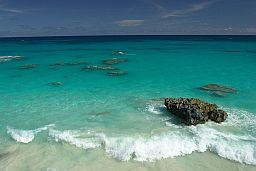 While everyone was looking at a map, trying to work out exactly where Palau is, following the announcement on Tuesday that Guantánamo’s 17 Uighur prisoners were to be resettled there, it now transpires that four of the men have been quietly flown to Bermuda instead.
This is rather a surprise, to put it mildly. The Uighurs — Muslims from China’s oppressed Xinjiang province, who were cleared of being “enemy combatants” last year — have, as I have reported at length, been in a disturbing legal limbo since Barack Obama took office, as the new administration repeatedly failed to find the necessary courage to do the right thing and resettle them in the United States (as ordered by District Court Judge Ricardo Urbina last October).
Instead, senior officials cowered in the face of the poisonous — and, to be honest, libelous — venom spewed forth by Guantánamo’s many defenders in Congress and in the right-wing media, who have popped up to trail around behind Dick Cheney like a zombie reenactment of the Pied Piper of Hamelin.
Moreover, the administration also resorted to defending a ruling that overturned Judge Urbina’s stout defense of Constitutional values, siding with Judge A. Raymond Randolph in the court of appeals and in a petition to the Supreme Court asking the highest court in the land not to look at the Uighurs’ case. This was in spite of the fact that Judge Randolph, who would rather eat his own gavel than allow a judge to order the government to allow wrongly imprisoned men into the United States, defended every wayward proposal put his way by the Bush administration, only to see them all overturned by the Supreme Court.
Why Bermuda?
What’s astonishing about the choice of Bermuda as the new home for four men from north western China is not its location — it is, after all, not a million miles away from Cuba, and the Uighurs must be used to the climate by now — but the fact that it is a British Overseas Territory.
According to London’s Times, the Foreign and Commonwealth Office reacted with ill-disguised fury to the news of the men’s resettlement, because Bermuda, “Britain’s oldest remaining dependency, is one of 14 overseas territories that come under the sovereignty of the United Kingdom, which retains direct responsibility for such matters as foreign policy and security.” An FCO spokesman said, “We’ve underlined to the Bermuda Government that they should have consulted with the United Kingdom as to whether this falls within their competence or is a security issue, for which the Bermuda Government do not have delegated responsibility.” He added, “We have made clear to the Bermuda Government the need for a security assessment, which we are now helping them to carry out, and we will decide on further steps as appropriate.”
According to the Times, potential conflict with China, which has made repeated demands for the return of the Uighurs, means that the Bermuda government “could now be forced to send them back to Cuba or risk a grave diplomatic crisis” — although I must admit that it seems possible to me that the Uighurs’ resettlement may actually have been negotiated between the governments of the US, the UK and Bermuda, and that the FCO’s “fury” is actually a cover for a pretty watertight case of “plausible deniability.”
Before this apparent spat blew up, news of the men’s unexpected move to Bermuda leaked out on Thursday morning, after the Uighurs’ lawyers reported that the men had arrived in Bermuda shortly after 6 a.m., and were accompanied on a charter flight from Guantánamo by two of their lawyers, Sabin Willett and Susan Baker Manning. After disembarking, one of the men, Abdul Nasser, who, throughout his detention, was described by the Pentagon as Abdul Helil Mamut, thanked their new hosts for accepting them. “Growing up in communism,” he said, “we always dreamed of living in peace and working in a free society like this one. Today you have let freedom ring.”
As a Justice Department press release explained, “These detainees, who were subject to release as a result of court orders, had been cleared for release by the prior administration, which determined they would no longer treat them as enemy combatants. The detainees were again cleared for release this year after review by the interagency Guantánamo Review Task Force,” which, the press release noted, included “a threat evaluation.” The DoJ also made a point of stating, “According to available information, these individuals did not travel to Afghanistan with the intent to take any hostile action against the United States.”
In a statement on the website of the Uighurs’ lawyers, who had been tireless in promoting their clients’ innocence, Sabin Willett wrote, “We are deeply grateful to the government and the people of Bermuda for this act of grace. Nations need good friends. When political opportunists blocked justice in our own country, Bermuda has reminded her old friend, America, what justice is.” Susan Baker Manning, added, “These men should never have been at Guantánamo. They were picked up by mistake. And when the US government realized its mistake, it continued to imprison them merely because they are refugees. We are grateful to Bermuda for this humanitarian act.”
The lawyers also explained that the men will probably have an easier time adapting to their new life than the five other Uighurs who were rehoused in Albania in 2006. Unlike Albania, Bermuda is a wealthy country, and, in addition, the men “have been approved to participate in Bermuda’s guest worker program for foreigners.”
Who are the four Uighurs?
So who are these men, whose proposed release into the United States caused such a virulent response? As the lawyers explained, in addition to Abdul Nasser, they are Huzaifa Parhat, Abdul Semet (identified by the Pentagon as Emam Abdulahat) and Jalal Jalaladin (identified by the Pentagon as Abdullah Abdulquadirakhun).
Of the four, Parhat is the only one whose name was known outside Guantánamo. In his Combatant Status Review Tribunal (a one-sided military review board, convened to assess whether, on capture, he had been correctly designated as an “enemy combatant,” who could be held without charge or trial), he explained that he arrived at the settlement in Afghanistan’s Tora Bora mountains (where the Uighurs had been living until it was bombed by US forces following the US-led invasion of Afghanistan) in May 2001, and refuted allegations that it was a facility operated by a militant group that was funded by Osama bin Laden and Taliban.
He also made a heartfelt statement about the Uighurs’ support for the United States, explaining that, “from the time of our great-grandparents centuries ago, we have never been against the United States and we do not want to be against the United States,” and adding, “I can represent for 25 million Uighur people by saying that we will not do anything against the United States. We are willing to be united with the United States. I think that the United States understands the Uighur people much better than other people.” In addition, he was one of several Uighur prisoners to mention threats made by Chinese interrogators who had been allowed to visit Guantánamo, and also to point out that he had had no contact whatsoever with any members of his family.
However, Parhat’s story is particularly significant, because last June, after the Supreme Court concluded years of stalling and legislative reversals on the part of the administration by ruling that the prisoners had constitutional habeas corpus rights, his case was finally reviewed by three judges in a US District Court, who demolished the case against him (and, by extension, against the other Uighurs), by ruling as “invalid” the tribunal’s decision that he was an “enemy combatant.” The judges criticized the government for relying on flimsy and unsubstantiated allegations and associations (primarily to do with the alleged militant group), and in a memorable passage compared the government’s argument that its evidence was reliable because it was mentioned in three different classified documents to a line from a nonsense poem by Lewis Carroll, the author of Alice’s Adventures in Wonderland.
This led the government to concede that it would “serve no purpose” to continue trying to prove that any of the Uighurs were “enemy combatants,” and, in turn, led to Judge Ricardo Urbina’s ruling last October that the Uighurs were to be released into the United States, when he stated, simply, “Because the Constitution prohibits indefinite detentions without cause, the continued detention is unlawful” — although this, of course, was subsequently reversed by the appeals court judges with whom, since coming to power, the Obama administration has maintained an unhealthy judicial alliance.
Abdul Semet told his tribunal that he left home “to escape from the torturing, darkness and suffering of the Chinese government,” and “wanted to go to some other country to live in peace.” He added, “The government, if they suspect us for anything, would torture and beat us, and fine us money. Lately, the young Uighurs would get caught just doing exercising. They would stop us and say it was not our culture, and put us in jail for it.” He also explained, “For the females, if they have [more than] one child, they open them up and throw the baby in the trash.”
Speaking of the Uighurs’ settlement in the Afghan mountains, he explained that he spent most of his time in “construction,” mending the settlement’s decrepit buildings, and indicated that he and his compatriots would have been happy to assist the United States if their home had not been bombed. “If the Americans went to Afghanistan and didn’t bomb our camp,” he said, “then we would be happy and support America; we would’ve stayed there continuously. The reason we went to Afghanistan doesn’t mean we have a relationship with al-Qaeda or some other organization; we went there for peace and not to be turned back over to the Chinese.”
Jalal Jalaladin was one of several of the Uighur prisoners to explain that he ended up in the settlement because he had been thwarted in his attempts to get from Pakistan to Turkey to look for work, and where he also believed that the government would give him citizenship. He explained to his tribunal that he got no further than Kyrgyzstan, where he found a job in a bazaar, and that some locals then gave him an address in Pakistan, where a Uighur businessman told him about the settlement. As he was having difficulties getting a visa for Iran, he decided to go to there instead.
And finally, Abdul Nasser gave an explanation about the “training” at the settlement that ought to make the fearful politicians and Conservative pundits in the United States ashamed. He explained that he had arrived at the settlement in June 2001, and that, during his time there — until it was bombed — he trained on the camp’s one and only gun for no more than a few days. “I don’t know if it was an AK-47,” he said. “It was an old rifle, and I trained for a couple of days.”
Moreover, Abdul Nasser reinforced what another of the men, Abdulghappar (who is still held in Guantánamo), had explained, when asked if it had ever been his intention to fight against the US or its allies. “I have one point: a billion Chinese enemies, that is enough for me,” Abdulghappar said. “Why would I get more enemies?” Abdul Nasser explained, “I went to the camp to train because the Chinese government was torturing my country, my people, and they could not do anything. I was trying to protect my country, my country’s independence and my freedom. From international law, training is not illegal in order to protect your freedom and independence. I did it for my country.”
While waiting to see how Guantánamo’s critics respond to this story of a young man training to protect his freedom and independence (which is something they should surely recognize), and while also wondering if Palau is still prepared to take the other 13 Uighurs (before June 25, presumably, when the Supreme Court is scheduled to meet to discuss whether the courts have any authority to order Guantánamo prisoners to be released into the US), I’d like to wish these four men the best of luck in settling into their new home. For those of us who have studied the story of Guantánamo closely, it has actually been apparent all along that the Uighurs should never have been held at all, and that the Pentagon was only interested in them because of the intelligence that they thought they might provide about the activities of the Chinese government.
Note: For other articles about prisoners released today, see: Guantánamo’s Youngest Prisoner Released To Chad and The Last Iraqi In Guantánamo, Cleared Six Years Ago, Returns Home.
Andy Worthington is the author of The Guantánamo Files: The Stories of the 774 Detainees in America’s Illegal Prison (published by Pluto Press, distributed by Macmillan in the US, and available from Amazon — click on the following for the US and the UK). To receive new articles in your inbox, please subscribe to my RSS feed, and also see my definitive Guantánamo prisoner list, published in March 2009.
As published on the Huffington Post. Also cross-posted on Common Dreams.
For a sequence of articles dealing with the Uighurs in Guantánamo, see: The Guantánamo whistleblower, a Libyan shopkeeper, some Chinese Muslims and a desperate government (July 2007), Guantánamo’s Uyghurs: Stranded in Albania (October 2007), Former Guantánamo detainee seeks asylum in Sweden (November 2007), A transcript of Sabin Willett’s speech in Stockholm (November 2007), Support for ex-Guantánamo detainee’s Swedish asylum claim (January 2008), A Chinese Muslim’s desperate plea from Guantánamo (March 2008), Former Guantánamo prisoner denied asylum in Sweden (June 2008), Six Years Late, Court Throws Out Guantánamo Case (June 2008), Guantánamo as Alice in Wonderland (July 2008), From Guantánamo to the United States: The Story of the Wrongly Imprisoned Uighurs (October 2008), Guantánamo Uyghurs’ resettlement prospects skewered by Justice Department lies (October 2008), A Pastor’s Plea for the Guantánamo Uyghurs (October 2008), Guantánamo: Justice Delayed or Justice Denied? (October 2008), Sabin Willett’s letter to the Justice Department (November 2008), Will Europe Take The Cleared Guantánamo Prisoners? (December 2008), A New Year Message to Barack Obama: Free the Guantánamo Uighurs (January 2009), Guantanamo’s refugees (February 2009), Bad News And Good News For The Guantánamo Uighurs (February 2009), A Letter To Barack Obama From A Guantánamo Uighur (March 2009), Obama’s First 100 Days: A Start On Guantánamo, But Not Enough (May 2009), Pain At Guantánamo And Paralysis In Government (May 2009), Guantánamo: A Prison Built On Lies (May 2009), Guantánamo: A Real Uyghur Slams Newt Gingrich’s Racist Stupidity (May 2009), and the stories in the additional chapters of The Guantánamo Files: Website Extras 1, Website Extras 6 and Website Extras 9.
See the following for articles about the 142 prisoners released from Guantánamo from June 2007 to January 2009, and the eleven prisoners released from February to June 2009, whose stories are covered in more detail than is available anywhere else –- either in print or on the Internet –- although many of them, of course, are also covered in The Guantánamo Files: June 2007 –- 2 Tunisians, 4 Yemenis (here, here and here); July 2007 –- 16 Saudis; August 2007 –- 1 Bahraini, 5 Afghans; September 2007 –- 16 Saudis; September 2007 –- 1 Mauritanian; September 2007 –- 1 Libyan, 1 Yemeni, 6 Afghans; November 2007 –- 3 Jordanians, 8 Afghans; November 2007 –- 14 Saudis; December 2007 –- 2 Sudanese; December 2007 –- 13 Afghans (here and here); December 2007 –- 3 British residents; December 2007 –- 10 Saudis; May 2008 –- 3 Sudanese, 1 Moroccan, 5 Afghans (here, here and here); July 2008 –- 2 Algerians; July 2008 –- 1 Qatari, 1 United Arab Emirati, 1 Afghan; August 2008 –- 2 Algerians; September 2008 –- 1 Pakistani, 2 Afghans (here and here); September 2008 –- 1 Sudanese, 1 Algerian; November 2008 –- 1 Kazakh, 1 Somali, 1 Tajik; November 2008 –- 2 Algerians; November 2008 –- 1 Yemeni (Salim Hamdan) repatriated to serve out the last month of his sentence; December 2008 –- 3 Bosnian Algerians; January 2009 –- 1 Afghan, 1 Algerian, 4 Iraqis; February 2009 — 1 British resident (Binyam Mohamed); May 2009 — 1 Bosnian Algerian (Lakhdar Boumediene); June 2009 — 1 Chadian (Mohammed El-Gharani), 1 Iraqi, 3 Saudis (here and here).
Guantánamo’s Youngest Prisoner Released To Chad
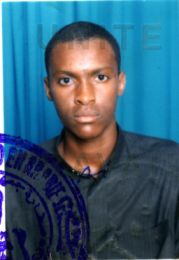 The long ordeal of Mohammed El-Gharani, Guantánamo’s youngest prisoner, has finally come to an end. Reprieve, the legal action charity that represents him, reports today that he has been sent back to Chad.
A Saudi resident and Chadian national, El-Gharani was just 14 years old when he was seized by Pakistani forces in a random raid on a mosque in Karachi, but was treated appallingly both by the Pakistanis who seized him, and by the US military. I provided a detailed explanation of the abuse to which he was subjected in an article last year, “Guantánamo’s Forgotten Child,” which I condensed for an article in January, when I explained:
As with all but three of the 22 confirmed juveniles who have been held at Guantánamo, the US authorities never treated him separately from the adult population, even though they are obliged, under the terms of the Optional Protocol to the UN Convention on the Rights of the Child on the involvement of children in armed conflict, to promote “the physical and psychosocial rehabilitation and social reintegration of children who are victims of armed conflict.”
Instead, El-Gharani was treated with appalling brutality. After being tortured in Pakistani custody, he was sold to US forces, who flew him to a prison at Kandahar airport, where, he said, one particular soldier “would hold my penis, with scissors, and say he’d cut it off.” His treatment did not improve in Guantánamo. Subjected relentlessly to racist abuse, because of the color of his skin, he was hung from his wrists on numerous occasions, and was also subjected to a regime of “enhanced” techniques to prepare him for interrogation — including prolonged sleep deprivation, prolonged isolation and the use of painful stress positions — that clearly constitute torture. As a result of this and other abuse, including regular beatings by the guard force responsible for quelling even the most minor infractions of the rules, El-Gharani has become deeply depressed, and has tried to commit suicide on several occasions.
In January, over seven years after his initial capture, El-Gharani finally had his case reviewed in a US court, following the Supreme Court’s ruling, in June 2008, that the prisoners had habeas corpus rights; in other words, the right to ask a court why they were being held. Judge Richard Leon, who had granted the habeas petitions of five Algerian prisoners in November, ruling that the government had failed to establish a case against them, was, if anything, even more dismissive of the claims against El-Gharani.
In his habeas petition, El-Gharani insisted, as he had throughout his detention, that he “traveled to Pakistan from Saudi Arabia at the age of 14 to escape discrimination against Chadians in that country, acquire computer and English skills, and make a better life for himself,” and that he “remained there until his arrest,” although the government claimed that he “arrived in Afghanistan at some unspecified time in 2001,” and was “part of or supporting Taliban or al-Qaeda forces,” for a variety of reasons, including claims that he received military training at an al-Qaeda-affiliated military training camp, fought against US and allied forces at the battle of Tora Bora, and was a member of an al-Qaeda cell based in London.
Noting that the government’s supposed evidence against El-Gharani consisted of statements made by two other prisoners at Guantánamo, and that, moreover, these statements were “either exclusively, or jointly, the only evidence offered by the Government to substantiate the majority of their allegations,” Judge Leon stated that “the credibility and reliability of the detainees being relied upon by the Government has either been directly called into question by Government personnel or has been characterized by Government personnel as undermined,” and dismissed all the claims, reserving particular criticism for the claim that El-Gharani had been a member of a London-based al-Qaeda cell.
As I wrote in January,
This was, indeed, the most extraordinary allegation, as El-Gharani was just 11 years old at the time, and, as his lawyer, Clive Stafford Smith, explained in his book The Eight O’Clock Ferry to the Windward Side: Seeking Justice in Guantánamo Bay, “he must have been beamed over to the al-Qaeda meetings by the Starship Enterprise, since he never left Saudi Arabia by conventional means.”
Leon’s verdict was marginally less colorful, but no less devastating. “Putting aside the obvious and unanswered questions as to how a Saudi minor from a very poor family could have even become a member of a London-based cell,” he wrote, “the Government simply advances no corroborating evidence for these statements it believes to be reliable from a fellow detainee, the basis of whose knowledge is — at best — unknown.”
Despite this long-overdue court victory, El-Gharani’s suffering in Guantánamo did not come to an end. In April, he was finally allowed to call one of his relatives in Chad, but took the opportunity to call the Arabic broadcaster al-Jazeera instead, telling them, as Reuters described it, that “he had been beaten with batons and teargassed by a group of six soldiers wearing protective gear and helmets after refusing to leave his cell.” He explained, “This treatment started about 20 days before Obama came into power, and since then I’ve been subjected to it almost every day,” and added, “Since Obama took charge he has not shown us that anything will change.”
El-Gharani’s return to Chad is not without its problems. He is currently being held by the security services, although they have stressed to his lawyers that it is just a formality and that they fully understand the horrors he has been through. More troubling is the fact that, although he has extended family in Chad who will take care of him, he cannot be reunited with his parents, because they live in Saudi Arabia. Representatives of Reprieve are expected to fly out to Chad this weekend, to help with his rehabilitation, but in the meantime El-Gharani himself has said only that he is, of course, delighted to be free, and is looking forward to undertaking an education, to make up for the lost years and lost opportunities while he was held in Guantánamo.
As Zachary Katznelson, Reprieve’s legal director, explained to me in a telephone conversation this evening, “Reprieve is delighted that, after seven long years of unjust, illegal incarceration, Mohammed is finally out of Guantánamo Bay. A federal judge looked at his case in January, and found that there were never any valid grounds to hold him. He should have been released long ago, but we’re glad that justice has finally been served.”
Note: For another article about prisoners released today, see: Who Are The Four Guantánamo Uighurs Sent To Bermuda?
Andy Worthington is the author of The Guantánamo Files: The Stories of the 774 Detainees in America’s Illegal Prison (published by Pluto Press, distributed by Macmillan in the US, and available from Amazon — click on the following for the US and the UK). To receive new articles in your inbox, please subscribe to my RSS feed, and also see my definitive Guantánamo prisoner list, published in March 2009.
As published on CounterPunch and After Downing Street. Also featured on the Brad Blog, and cross-posted on RINF.
See the following for articles about the 142 prisoners released from Guantánamo from June 2007 to January 2009, and the eleven prisoners released from February to June 2009, whose stories are covered in more detail than is available anywhere else –- either in print or on the Internet –- although many of them, of course, are also covered in The Guantánamo Files: June 2007 –- 2 Tunisians, 4 Yemenis (here, here and here); July 2007 –- 16 Saudis; August 2007 –- 1 Bahraini, 5 Afghans; September 2007 –- 16 Saudis; September 2007 –- 1 Mauritanian; September 2007 –- 1 Libyan, 1 Yemeni, 6 Afghans; November 2007 –- 3 Jordanians, 8 Afghans; November 2007 –- 14 Saudis; December 2007 –- 2 Sudanese; December 2007 –- 13 Afghans (here and here); December 2007 –- 3 British residents; December 2007 –- 10 Saudis; May 2008 –- 3 Sudanese, 1 Moroccan, 5 Afghans (here, here and here); July 2008 –- 2 Algerians; July 2008 –- 1 Qatari, 1 United Arab Emirati, 1 Afghan; August 2008 –- 2 Algerians; September 2008 –- 1 Pakistani, 2 Afghans (here and here); September 2008 –- 1 Sudanese, 1 Algerian; November 2008 –- 1 Kazakh, 1 Somali, 1 Tajik; November 2008 –- 2 Algerians; November 2008 –- 1 Yemeni (Salim Hamdan) repatriated to serve out the last month of his sentence; December 2008 –- 3 Bosnian Algerians; January 2009 –- 1 Afghan, 1 Algerian, 4 Iraqis; February 2009 — 1 British resident (Binyam Mohamed); May 2009 — 1 Bosnian Algerian (Lakhdar Boumediene); June 2009 — 4 Uighurs, 1 Iraqi, 3 Saudis (here and here).
Guantánamo’s Hidden History: Shocking Statistics of Starvation
 “Guantánamo’s Hidden History: Shocking Statistics of Starvation” is a report I’ve compiled for Cageprisoners analyzing the weight records for prisoners at Guantánamo (released by the Pentagon in March 2007), which demonstrate that, from January 2002, when the prison opened, until February 2007, when these particular records came to an end, one in ten of the total population — 80 prisoners in total — weighed, at some point, less than 112 pounds (eight stone, or 50 kg), and 20 of these prisoners weighed less than 98 pounds (seven stone, or 44 kg).
The report is available here (as a PDF):
Guantanamo’s Hidden History: Shocking Statistics Of Starvation
The following is the introduction to the report:
Today is the third anniversary of the deaths in Guantánamo of three prisoners, Ali al-Salami, Mani al-Utaybi and Yasser al-Zahrani. The anniversary comes just two weeks after the second anniversary of the death of Abdul Rahman al-Amri, the fourth prisoner to die in mysterious circumstances, and just eight days after the death of a fifth prisoner, Muhammad Salih. The authorities maintain that the men died by committing suicide, although doubts about this explanation have repeatedly been voiced by former prisoners. However, it is also significant that all five men were long-term hunger strikers.
Cageprisoners is marking this sad anniversary with a brief report about the Guantánamo hunger strikers, and the dreadful toll that prolonged starvation — and brutal force-feeding, which is the response of the US military — exacts on prisoners held, for the most part, without charge or trial in a seemingly endless legal limbo. Force-feeding involves prisoners being strapped into a restraint chair and force-fed twice daily against their will, through an agonizing process that involves having a tube inserted into the stomach through the nose.
As Clive Stafford Smith, the lawyer for several dozen Guantánamo prisoners, explained in the Los Angeles Times in 2007, with reference to Sami al-Haj, who was released in May 2008, “Medical ethics tell us that you cannot force-feed a mentally competent hunger striker, as he has the right to complain about his mistreatment, even unto death. But the Pentagon knows that a prisoner starving himself to death would be abysmal PR, so they force-feed Sami. As if that were not enough, when Gen. Bantz J. Craddock headed up the US Southern Command, he announced that soldiers had started making hunger strikes less ‘convenient.’ Rather than leave a feeding tube in place, they insert and remove it twice a day.”
Statistics can be deceiving, of course, but three months ago, when Ramzi Kassem, the lawyer for Ahmed Zuhair, one of Guantánamo’s most persistent hunger strikers, came back from a recent visit to the prison, he estimated that Zuhair weighed no more than 100 pounds, and “also appeared to be ill, vomiting repeatedly during meetings” at the prison. “Mr. Zuhair lifted his orange shirt and showed me his chest,” Kassem explained. “It was skeletal.“ He added, “Mr. Zuhair’s legs looked like bones with skin wrapped tight around them.”
While this is disturbingly thin, given that an average, healthy man weights between 150 and 200 pounds, Cageprisoners’ latest report only confirms that it is typical of the skeletal state of Guantánamo’s long-term hunger strikers.
In March 2007, the Pentagon released a series of documents, “Measurements of Heights and Weights of Individuals Detained by the Department of Defense at Guantánamo Bay, Cuba,” which recorded, in numbing detail, the prisoners’ weights, from the date of their arrival and, in general, at monthly intervals thereafter until December 2006, when these particular records come to an end. In the cases of prisoners on hunger strike, the weights were recorded at weekly intervals, and, in some cases, on a daily basis.
Unnoticed at the time of their release, these documents have not, until now, been analyzed in depth, but after conducting a comprehensive review of the documents I can reveal that the results demonstrate the extent to which the Pentagon’s prohibition on releasing any photos of the prisoners has enabled it to disguise a truly shocking fact: throughout Guantánamo’s history, one in ten of the total population — 80 prisoners in total — weighed, at some point, less than 112 pounds (eight stone, or 50 kg), and 20 of these prisoners weighed less than 98 pounds (seven stone, or 44 kg).
If photos of these prisoners had been made available, it is, I believe, no understatement to say that calls for Guantánamo’s closure would have been much more strident than they have been, and as dozens of prisoners are still on hunger strike, the fear is that, unless President Obama steps up his efforts to close Guantánamo before his January 2010 deadline, more will follow.
Andy Worthington
For Cageprisoners
10 June 2009
Andy Worthington is the author of The Guantánamo Files: The Stories of the 774 Detainees in America’s Illegal Prison (published by Pluto Press, distributed by Macmillan in the US, and available from Amazon — click on the following for the US and the UK). To receive new articles in your inbox, please subscribe to my RSS feed, and also see my definitive Guantánamo prisoner list, published in March 2009.
For a sequence of articles dealing with the hunger strikes and deaths at Guantánamo, see Suicide at Guantánamo: the story of Abdul Rahman al-Amri (May 2007), Suicide at Guantánamo: a response to the US military’s allegations that Abdul Rahman al-Amri was a member of al-Qaeda (May 2007), Shaker Aamer, A South London Man in Guantánamo: The Children Speak (July 2007), Guantánamo: al-Jazeera cameraman Sami al-Haj fears that he will die (September 2007), The long suffering of Mohammed al-Amin, a Mauritanian teenager sent home from Guantánamo (October 2007), Guantánamo suicides: so who’s telling the truth? (October 2007), Innocents and Foot Soldiers: The Stories of the 14 Saudis Just Released From Guantánamo (Yousef al-Shehri and Murtadha Makram) (November 2007), A letter from Guantánamo (by Al-Jazeera cameraman Sami al-Haj) (January 2008), A Chinese Muslim’s desperate plea from Guantánamo (March 2008), Sami al-Haj: the banned torture pictures of a journalist in Guantánamo (April 2008), The forgotten anniversary of a Guantánamo suicide (May 2008), Binyam Mohamed embarks on hunger strike to protest Guantánamo charges (June 2008), Second anniversary of triple suicide at Guantánamo (June 2008), Guantánamo Suicide Report: Truth or Travesty? (August 2008), The Pentagon Can’t Count: 22 Juveniles Held at Guantánamo (November 2008), Seven Years Of Guantánamo, And A Call For Justice At Bagram (January 2009), British torture victim Binyam Mohamed to be released from Guantánamo (January 2009), Don’t Forget Guantánamo (February 2009), Who’s Running Guantánamo? (February 2009), Obama’s “Humane” Guantánamo Is A Bitter Joke (February 2009), Forgotten in Guantánamo: British resident Shaker Aamer (March 2009), Guantánamo’s Long-Term Hunger Striker Should Be Sent Home (March 2009), Guantánamo, Bagram and the “Dark Prison”: Binyam Mohamed talks to Moazzam Begg (March 2009), Forgotten: The Second Anniversary Of A Guantánamo Suicide (May 2009), Yemeni Prisoner Muhammad Salih Dies At Guantánamo (June 2009), Death At Guantánamo Hovers Over Obama’s Middle East Visit (June 2009). Also see the following online chapters of The Guantánamo Files: Website Extras 2 (Ahmed Kuman, Mohammed Haidel), Website Extras 3 (Abdullah al-Yafi, Abdul Rahman Shalabi), Website Extras 4 (Bakri al-Samiri, Murtadha Makram), Website Extras 5 (Ali Mohsen Salih, Ali Yahya al-Raimi, Abu Bakr Alahdal, Tarek Baada, Abdul al-Razzaq Salih).
From Guantánamo To The South Pacific: Is This A Joke?
 Let’s face it, when it comes to Guantánamo, there’s little to laugh about, unless you’re an Islamophobic sadist — in which case, there’s still nothing for the rest of us to laugh about.
The Associated Press reports that, in a desperate effort to rid itself of the toxic human debris of Guantánamo, the Obama administration is eyeing up the tiny Republic of Palau, an island nation in the Pacific Ocean, some 500 miles (800 km) east of the Philippines, to dispose of some, or all of the 17 Uighurs in Guantánamo.
The Uighurs are Muslims from China’s Xinjiang province, who were swept up in the US-led invasion of Afghanistan, and sold to US forces by Pakistani villagers after fleeing from a run-down hamlet in which they had sought solace from their Chinese oppressors, or, in many cases, because they had found themselves unable to make their way to Turkey or Europe, to look for work, as they had originally intended.
Despite this, their proposed resettlement in the United States has caused panic attacks amongst politicians whose understanding of the prison’s inhabitants has clearly gone no further than to curl up at Dick Cheney’s knee, and say, “Gee, tell me again how the prisoners in Guantánamo are the most dangerous terrorists in the world?”
Apparently unable to understand that the majority of the prisoners in Guantánamo were bought for bounties, and were never adequately screened to determine their status, these fearful politicians continue to ignore the copious amounts of research demonstrating that all but a few dozen of the remaining 239 prisoners are either completely innocent men, or Taliban foot soldiers, recruited to fight an inter-Muslim civil war in Afghanistan that began long before the 9/11 attacks, and had nothing to do with international terrorism.
In this, they have been ably assisted by the appeals court in Washington D.C., where, in February, a panel of judges led by Judge A. Raymond Randolph, who has, to date, defended every single Guantánamo policy decision that was subsequently reversed by the Supreme Court, overturned an earlier ruling by District Court Judge Ricardo Urbina.
In October, Judge Urbina ruled, very sensibly, that the Uighurs were to be allowed to resettle in the United States, in the care of the large Uighur community in and around Washington D.C. and in a community in Tallahassee, Florida that had gone out of its way to help them.
Judge Urbina made his ruling for four very good reasons: firstly, because the government had been persuaded to drop all its charges against the Uighurs (after the most humiliating court defeat, last June); secondly, because they cannot be returned to China, where they face torture or worse: thirdly, because no other country had been found that was prepared to take on China by accepting them: and fourthly, because their continued detention in Guantánamo was, simply, unconstitutional.
Having somehow skipped the class that would have informed them that rocking boats is sometimes required in politics, senior officials in the Obama administration refused to order the men’s release into the United States in those first few halcyon days in office, when anything seemed possible, and have now vacillated to such an extent — most recently, apparently, when Rush Limbaugh started barking — that releasing them into the US is simply too much to contemplate, even though it clearly remains the right thing to do.
To make matters worse, while mumbling occasionally about transferring some of the Uighurs to the mainland, the administration has, at the same time, been instructing the Justice Department to endorse the views of Judge Randolph in a petition intended to prevent the Supreme Court from reviewing the Uighurs’ surreal and intolerable limbo.
Confronted with the problem of rehousing five other Uighurs in 2006, the Bush administration secured, for an undisclosed sum, the cooperation of Albania (a Muslim nation, albeit a poor one, with no other Uighurs and little work), but that escape route was soon sealed off as the Albanians found themselves subjected to the wrath of the People’s Republic. Since then — despite hopeful murmurs from other countries, and the acceptance, in Sweden, of an asylum claim by one of the Uighurs sent to Albania, who made a sneaky escape in November 2007 and was finally accepted in February this year — no other country has yet taken the bait.
The Obama administration could probably weather this — the odd Bob Dylan-style protest notwithstanding — by plying the Uighurs with ever more comfort items in their secluded camp, away from all the other prisoners, and would, perhaps, soon be pointing out how marvelous the climate is, but senior officials are aware that the countries of Europe are unlikely to take any other prisoners from Guantánamo facing similar repatriation problems — from countries including Algeria, China, Libya, Russia, Syria, Tajikistan, Tunisia and Uzbekistan, who are also low achievers in the field of human rights — unless the US government also plays ball.
Hence the appeal of Palau, which, although it appears to be have been chosen as the result of a dart thrown at a globe by a desperate official, is actually a rather canny option. A former US trust territory, the island became independent in 1994, but retains close ties with its former masters, having signed a “Compact of Free Association” with the US, guaranteeing financial assistance in exchange for certain defense rights, More importantly, it maintains diplomatic relations with Taiwan, rather than with the People’s Republic of China. The fact that it has no Uighur population and that its population of 21,000 includes no Muslims is, presumably, neither here nor there.
Could this, then, be the answer to the Obama administration’s Uighur problem? Perhaps, but if so, it will demonstrate only that, when it comes to cleaning up the mess that is Guantánamo, cowardice, desperation and the least enviable form of pragmatism available are yet another example of Bush and Cheney’s despicable legacy.
UPDATE June 10: O-ho, so it really isn’t a joke. Today, the Associated Press reported that Palau President Johnson Toribiong had sent them a message stating that his government had “agreed to accommodate the United States of America’s request to temporarily resettle in Palau up to 17 ethnic Uighur detainees … subject to periodic review.” He added, following the script emailed to him by Hillary Clinton, that Palau was “honored and proud” to take the men, who have been found not to be “enemy combatants.”
Andy Worthington is the author of The Guantánamo Files: The Stories of the 774 Detainees in America’s Illegal Prison (published by Pluto Press, distributed by Macmillan in the US, and available from Amazon — click on the following for the US and the UK). To receive new articles in your inbox, please subscribe to my RSS feed, and also see my definitive Guantánamo prisoner list, published in March 2009.
As published on the Huffington Post. Cross-posted on Common Dreams.
For a sequence of articles dealing with the Uighurs in Guantánamo, see: The Guantánamo whistleblower, a Libyan shopkeeper, some Chinese Muslims and a desperate government (July 2007), Guantánamo’s Uyghurs: Stranded in Albania (October 2007), Former Guantánamo detainee seeks asylum in Sweden (November 2007), A transcript of Sabin Willett’s speech in Stockholm (November 2007), Support for ex-Guantánamo detainee’s Swedish asylum claim (January 2008), A Chinese Muslim’s desperate plea from Guantánamo (March 2008), Former Guantánamo prisoner denied asylum in Sweden (June 2008), Six Years Late, Court Throws Out Guantánamo Case (June 2008), Guantánamo as Alice in Wonderland (July 2008), From Guantánamo to the United States: The Story of the Wrongly Imprisoned Uighurs (October 2008), Guantánamo Uyghurs’ resettlement prospects skewered by Justice Department lies (October 2008), A Pastor’s Plea for the Guantánamo Uyghurs (October 2008), Guantánamo: Justice Delayed or Justice Denied? (October 2008), Sabin Willett’s letter to the Justice Department (November 2008), Will Europe Take The Cleared Guantánamo Prisoners? (December 2008), A New Year Message to Barack Obama: Free the Guantánamo Uighurs (January 2009), Guantanamo’s refugees (February 2009), Bad News And Good News For The Guantánamo Uighurs (February 2009), A Letter To Barack Obama From A Guantánamo Uighur (March 2009), Obama’s First 100 Days: A Start On Guantánamo, But Not Enough (May 2009), Pain At Guantánamo And Paralysis In Government (May 2009), Guantánamo: A Prison Built On Lies (May 2009), Guantánamo: A Real Uyghur Slams Newt Gingrich’s Racist Stupidity (May 2009), and the stories in the additional chapters of The Guantánamo Files: Website Extras 1, Website Extras 6 and Website Extras 9.
Lakhdar Boumediene Talks About Torture At Guantánamo
 Three weeks ago, Lakhdar Boumediene, an Algerian who was kidnapped and sent Guantánamo just a week after the prison opened, was finally released. I had been following Boumediene’s story for years, first in my book The Guantánamo Files, in which I described the non-existent plot to bomb the US embassy in Sarajevo, Bosnia, where Boumediene and five of his fellow countrymen had been living for many years, which apparently formed the basis of the men’s capture. I also noted that they had been treated appallingly in US custody, even though the plot was never mentioned, and, instead, the US authorities sought to milk the men for information about Arabs and other foreigners who had settled in Bosnia.
In 2007 and 2008, I also reported on the progress of Boumediene v. Bush, the court case that bore his name, and last November was delighted when five of the six men’s claims of innocence were finally vindicated in a US court. In a habeas corpus review triggered by the Supreme Court’s ruling in Boumediene, the judge — Richard Leon, an appointee of George W. Bush — ruled that the government had failed to establish that Boumediene and four of his co-accused had been planning to travel to Afghanistan to fight the United States (a charge which had materialized out of nowhere during their long imprisonment) and ordered their release.
Although three of the prisoners were released in December, to be reunited with their families in Bosnia, Boumediene and another man — Sabir Lahmar — faced problems because they did not have Bosnian citizenship. Lahmar is still in Guantánamo, but Boumediene was finally released when President Sarkozy of France, in a gesture of support for Barack Obama, agreed to accept him, because he has relatives in France, and also accepted his wife and two daughters, who had returned to Algeria after his capture.
Two weeks ago, Boumediene was interviewed for the first time since his release, but yesterday ABC News broadcast another, more detailed interview conducted by Jake Tapper (in Paris), in which Boumediene began by confirming that, at the time of his initial arrest in October 2001, after the US authorities had put pressure on their Bosnian counterparts to investigate the supposed plot, he had been working for the Red Crescent, providing help to orphans. “I’m a normal man,” he said. “I’m not a terrorist.” He added that, from the beginning, the whole story of the plot was “false and ludicrous.” “They search my car, my office, nothing,” he said. “Cell phone, nothing. Nothing. Nothing.”
The video is below, via YouTube:
However, although the charges were dropped, and the Bosnian courts ordered the release of Boumediene and the five other men, the Bush administration once more put the Bosnian government under enormous pressure, and on the night of their release — January 17, 2002 — they were handed over to the US military and flown to Guantánamo.
Two weeks later, President Bush mentioned the men in his State of the Union address, stating, “Our soldiers, working with the Bosnian government, seized terrorists who were plotting to bomb our embassy,” even though the plot was never mentioned in Guantánamo, and even though, as Jake Tapper noted, “To this day, officials of the Bush administration have provided no credible evidence to back up that accusation.”
Describing his first few weeks at Guantánamo, Boumediene stated that “he thought that his cooperation, and trust in the United States, would serve him well and quicken his release.” As he explained, “I thought America, the big country, they have CIA, FBI. Maybe one week, two weeks, they know I am innocent. I can go back to my home, to my home.” But instead, as Tapper described it, “he endured harsh treatment for more than seven years.” When Tapper asked him if he thought that he had been tortured, the answer was “unequivocal.” “I don’t think. I’m sure,” Boumediene said.
He proceeded to explain that he “was kept awake for 16 days straight, and physically abused repeatedly,“ described “being pulled up from under his arms while sitting in a chair with his legs shackled, stretching him,” and said that “he was forced to run with the camp’s guards and if he could not keep up, he was dragged, bloody and bruised.”
After he embarked on a hunger strike in December 2006, to protest his seemingly unending imprisonment without charge or trial, he described the “games” the guards would play with him, “putting his food IV up his nose and poking the hypodermic needle in the wrong part of his arm,” and asked, pointing to scars on his arm from the use of tight shackles, “You think that’s not torture? What’s this? What can you call this? Torture or what? I’m an animal? I’m not a human?”
He added that “he had believed that the United States honored religious diversity but believed guards at Guantánamo took actions to disrespect his religious beliefs,” saying, “They shaved my beard, because they don’t respect me, because the guards they don’t let me sleep. They don’t let me read my Koran, they don’t let me pray normal like people like Muslim outside the Guantánamo.”
Boumediene also confirmed that no one at Guantánamo ever asked him about the supposed plot to blow up the embassy in Sarajevo, and asked him only about al-Qaeda and Osama bin Laden, about which he knew “nothing.” However, in a startling confirmation that the prison ran more on false confessions than on real intelligence (which, of course, still plagues the majority of those who are still held), he explained that “it was in his interest to lie to the interrogators, who would reward the detainees if they admitted guilt,” telling Tapper, “If I tell my interrogator, I am from al-Qaeda, I saw Osama bin Laden, he was my boss, I help him, they will tell me, ‘Oh you are a good man.’ But if I refuse? I tell them I’m innocent, never was I terrorist, never never, they tell me, ‘You are not cooperating, I have to punch you.’”
Despite “the harsh treatment and uncertainty over his fate,” Boumediene explained that “he did not want to die because he had something to live for back home.” He told Tapper, “Every day, I think about my wife and my daughters,” but he also explained how the authorities at Guantánamo did everything in their power to enforce his isolation (as part of the techniques designed to “break” prisoners), not only taking away his personal possessions — including his wedding ring — as they would in a “normal” prison, but also making sure that he had almost no communication with his loved ones. As Tapper described it, “He now has a stack of letters, that his wife wrote to him that never arrived, a ‘return to sender’ stamp on the envelope.” Reinforcing the notion that the authorities’ primary motive was to “break” the prisoners, Boumediene added, “Over there you lose all the hopes, you lose all hope. Any good news, they don’t want you to be happy.”
After his two resounding victories against the Bush administration — in Boumediene v. Bush and in his own habeas case — Boumediene revealed that he “made himself a T-shirt that, like a soccer scoreboard, reads, ‘Boumediene: 2, Bush: 0.’”
It was a rare moment of levity in a long and completely unjustifiable ordeal, but it couldn’t make up for all the years he had lost. As he explained to Tapper, his reunion with his family was overwhelming, in part because his daughters are now 13 and 9 years old. “I cried, just cried,” he said. “Because I don’t know my daughters. The younger, when I moved from Bosnia to Gitmo, she had 18 months, only 18 months. Now 9 years. Now she’s big. Between 18 months, baby and 9 years, she walking, she’s talking, she play, she’s joking. It’s a big difference.”
In conclusion, Boumediene said that he understood, “to a degree,” how the 9/11 attacks prompted “strong reactions” from the US government, but was unable to accept that mistakes made would be uncorrected seven years later. “The first month, okay, no problem, the building, the 11 of September, the people, they are scared, but not 7 years,” he said. “They can know whose innocent, who’s not innocent, who’s terrorist, who’s not terrorist. I give you 2 years, no problem, but not 7 years.”
Although Tapper noted that he “stressed that he has no problem with the American people,” he added that he “could not hide his anger against Bush and other senior administration officials,” who he called “stupid.” “Myself, I try to forget Guantánamo,” he explained, “[but] I can’t forget the four or five people, they are stupid, they are very very stupid. I can’t forget them.” He added that he and his attorney, Rob Kirsch of the law firm WilmerHale, were “considering a lawsuit against the US government,” but, more importantly, he “needs money to survive.”
Reparations for Guantánamo have not yet become prominent — although it is surely only a matter of time, and it is a topic that was also raised today by Thomas Hammarberg, the Council Of Europe’s Human Rights Commissioner — but as Rob Kirsch explained, “I think that he needs to have an income paid to him for the rest of his life. His family essentially has been thrown into poverty because of a mistake that we made seven-and-a-half years ago. What he needs is a chance to get back where he would have been.”
Andy Worthington is the author of The Guantánamo Files: The Stories of the 774 Detainees in America’s Illegal Prison (published by Pluto Press, distributed by Macmillan in the US, and available from Amazon — click on the following for the US and the UK). To receive new articles in your inbox, please subscribe to my RSS feed, and also see my definitive Guantánamo prisoner list, published in March 2009.











 Who's still at Guantánamo?
