It’s 25 Years Since The Last Stonehenge Free Festival
20.6.09
 Happy solstice, everyone! As an estimated 30,000 people descend on a field in Wiltshire and its ever-inscrutable ancient stones, I’d like, first of all, to pay tribute to John Michell, English mystic, iconoclast and provocateur, who passed away on April 24, aged 76 (see obituaries in the Fortean Times, the Guardian, the Times, the Independent, the Daily Telegraph and the New York Times).
I last saw John at Megalithomania, a conference in Glastonbury in 2006. He had been asked to talk about The Old Stones of Land’s End, his pioneering work on leylines in West Penwith, and arrived, spliff in hand, with a box of slides which he promptly dropped on the floor. When he came to do his talk, his memories of trawling around Cornish fields were punctuated by a quietly hilarious slideshow, as pictures emerged in random order, and often upside down. “Here’s some lads on a stone, smoking,” he said, as a slide popped up of some Breton boys on a standing stone in the late 19th century. “They look like they’re having fun, don’t they?”
Ever the iconoclast, John had been a stout defender of the right to gather at Stonehenge, and was appalled when the free festival (see below) was terminated with appalling brutality at the Battle of the Beanfield in 1985. He immediately published one of his Radical Traditionalist pamphlets, “Stonehenge, Its History, Meaning, Festival, Unlawful Management, Police Riot ’85 & Future Prospects,” in which he cut to the heart of the conflict between the State and Stonehenge’s many non-establishment admirers, stating:
Those who knew not of Stonehenge, who had never experienced its weird and lasting attraction, were astounded. What is this old pile of rocks which inspires such intensity of popular religious feeling and such vicious expressions of official jealousy?
 Exactly five years ago, my first book, Stonehenge: Celebration and Subversion was published, which told, for the first time, the full story of “how the celebrations at Stonehenge have brought together different aspects of British counter-culture to make the monument a ‘living temple’ and an icon of alternative Britain,” and in the acknowledgments, I wrote that John’s “multi-faceted mysticism hovers over the whole book like a guardian angel,” an appraisal that still strikes me as true.
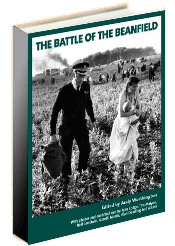
This year’s solstice is one of many anniversaries, not just the fifth anniversary of the publication of Stonehenge: Celebration and Subversion (which, I’m glad to say, is still in print and available to buy), but also the 35th anniversary of the first Stonehenge Free Festival, and the 25th anniversary of the last Stonehenge Free Festival, before the events of the Battle of the Beanfield, which are chronicled in The Battle of the Beanfield (also still available) — a book I edited and compiled in 2005, and recalled in this recent article for the Guardian (and here) — brought the people’s celebrations at Stonehenge to an end for 16 long and strange years, in which, every solstice, the temple and its environs resembled a war zone.
It is also, I’m glad to note, the tenth anniversary of the reopening of Stonehenge on the summer solstice, following a momentous House of Lords ruling in 1999, which prevented the government from establishing an exclusion zone around the temple, and so, to mark all these anniversaries, I’m reproducing below some excerpts from Stonehenge: Celebration and Subversion that deal with that first free festival in 1974 (inspired, elliptically, by John Michell), and its last manifestation, as a riotous outpouring of dissent in the midst of Margaret Thatcher’s Britain, in 1984.
We begin in 1973, when the organizer of the first Stonehenge Free Festival, a charismatic young man called Phil Russell, first enters the picture.
1974: Phil Russell and the first Stonehenge Free Festival
 An orphan from a wealthy background, [Phil] was due to inherit land and property in Hertfordshire on his thirtieth birthday, but in the meantime was funded by a private allowance that left him free to pursue his own interests. In many ways, Phil was typical of the free festival agitators of the time — part acid prankster and part well-heeled dandy. In London, he fell in with a group called the Dwarves, “a kind of Notting Hill version of the Yippies in America: a joke-prankster group,” and adopted the name by which he became better known: Wally Hope. He took the name Wally from a popular festival cry (a kind of “Everyman” joke that arose when the crowd began echoing the name of a lost dog being summoned by his owner at the last Isle of Wight festival) and he had the word “Hope” embroidered on a shirt that “became his trademark: a riot of spectacular colour with the eye of Horus in the middle banked by a rainbow.”
Phil’s allowance also left him free to travel. He regularly visited America, where he sympathized with the plight of the Native Americans, Cyprus, his birthplace, and Ibiza, where he became entranced by the mythology of the sun. According to his friend Jeremy Ratter, who took the name Penny Rimbaud and who later co-founded the anarcho-punk collective Crass, it was at a well-known hippie café on the White Island that Phil first came up with the idea of a free festival at Stonehenge. He “wanted to claim back Stonehenge (a place that he regarded as sacred to the people and stolen by the government) and make it a site for free festivals, free music, free space, free mind.”
The two had met in the early 70s. Phil’s guardians lived near Jeremy’s commune in Essex, and one day Phil just turned up. Here the festival developed from its Mediterranean origins, filtered through his exposure to other cultures, his interest in the legends of King Arthur, and his central fascination with sun worship. It was at the commune, moreover, that he revealed aspects of himself that were significantly different from the other privileged individuals who had set up the festivals in Hyde Park and Glastonbury.
According to Jeremy, it was during the preparations for the first Stonehenge Free Festival that Phil performed miracles: “One day in our garden, it was early summer, he conjured up a snowstorm, huge white flakes falling amongst the daisies on the lawn. Another time he created a multi-rainbowed sky — it was as if he had cut up a rainbow and thrown the pieces into the air where they hung in strange random patterns. Looking back on it now it seems unbelievable but, all the same, I can remember both occasions vividly.” On another occasion, beating out rhythms with sticks on the dying embers of a fire, Jeremy was convinced that he and Phil were “speaking to each other ritually by ESP in an acid-religious ceremony without drugs.” It was after this experience that he allowed Phil to use the facilities of the commune to organize the first festival at Stonehenge.
The first Stonehenge Free Festival duly took place at the summer solstice in 1974, alongside a by-way just a few hundred yards to the west of the stones. Despite a leafleting campaign and promotion by Radio Caroline, it was a small gathering, numbering about 500 people at the most. The only music was provided by early synth pioneers Zorch, who set up stage facing the stones, and who had to compete with a wonky PA system.
It was obviously a slightly surreal affair. Tim Abbott, a friend of Russell’s and later a councillor in Wilton, recalled that “Rhonan O’Rahilly of Radio Caroline sat in his limousine suffering badly from hayfever and muttering about private television coverage of the proceedings being broadcast to Europe from an aircraft above the North Sea.” Nik Turner of Hawkwind, who stopped by for a few hours on the way back from Wales to London, seems to have been at a different event: “There were no bands, no PA, no stage. It was just a gathering of people to celebrate the solstice.”

Roger Hutchinson’s poster for the second Stonehenge Free Festival in 1975. © Roger Hutchinson.
Phil Russell’s fence-hopping antics may have had little impact if the festival had stopped soon after the solstice was over, but by this time he’d persuaded thirty people to stay on in the field beside the stone circle. They styled themselves “The Wallies of Wessex” and lived a makeshift, communal lifestyle in tents, a rickety polythene-covered geodesic dome and a small fluorescent tipi. Nigel Ayers, who visited at the time, said, “It was an open camp, inspired by a diversity of wild ideas, but with the common purpose of discovering the relevance of this ancient mysterious place by the physical experience of spending a lot of time there.”
The Wallies went to court in August, in the newspapers’ silly season, and the story was widely reported. They included in their number Sir Wally Raleigh and Wally Woof the Dog, they gave their address as “Fort Wally, c/o God, Jesus and Buddha, Garden of Allah, Stonehenge Monument, Salisbury, Wiltshire,” and they had a snappy motto: “Every Body is Wally, Every Day is Sun Day.” The fancy dress went down well too, with Phil appearing in the uniform of an officer of the Cypriot National Guard. When they lost the case, Phil told the press: “These legal arguments are like a cannon ball bouncing backwards and forwards in blancmange. We won, because we hold Stonehenge in our hearts. We are not squatters, we are men of God. We want to plant a Garden of Eden with apricots and cherries, where there will be guitars instead of guns and the sun will be our nuclear bomb.”
1984: the biggest free festival in British history
My first visit to the Stonehenge festival took place in 1983, and in Stonehenge: Celebration and Subversion I described how “this seasonal settlement of impossibly weathered and wildly decorated tents, tipis, vans, buses and old army vehicles was little short of a revelation, an alternative state within Thatcher’s Britain that seemed to have rooted itself to the ancient sacred landscape with nonchalant ease.”
In The Battle of the Beanfield, I added, “I returned the following year, to discover, like so many others in their late teens and early twenties, that this edgy, exuberant, anarchic jamboree still provided a thrilling antidote to the grim reality of everyday life under the Tories.”
And this was how I described the 1984 festival in Stonehenge: Celebration and Subversion:
Against [a] backdrop of concerted political activity, widespread social agitation and a deeper, darker undercurrent of anger and frustration that was to see riots breaking out across the inner cities once more, the Stonehenge Free Festival grew even larger in 1984. Despite the continuing problems of managing the unmanageable without any official leadership, conspicuous problems were tackled head-on. Heroin dealers were dealt with even more sharply than the year before, and a burnt-out car, dumped at the entrance, carried an explicit warning: “This was a smack dealer’s car.”

The main drag at the Stonehenge Free Festival, 1984. © Ian Oakley.
Overall, there were reasons for those involved in the organization of the festival to feel, as the Festival Zone website put it, that “the fun far outweighed the fear.” The unprecedented mingling of the tribes continued unabated, breaking down social barriers that were all too noticeable in the “real” world, and [festival veteran] John Pendragon tried to counter the drift towards chaos by establishing a mini-festival within the larger festival, a dealer-free zone with its own stage that sought to recreate the spirit of the early gatherings. He was also one of the founder members — along with the pagan George Firsoff — of “Robin’s Greenwood Gang,” another internal organization that was set up to counter the damage caused to the nearby woods through a process of guidance and education.
Musically, there was a more diverse line-up than ever before, and even the traditional headliners, Hawkwind, tried to top their performance of the year before (when they’d played a two-hour set at sunrise on solstice morning) with a conceptual performance — Earth Ritual — that was spread over two days.
Most spectacularly of all, on solstice morning the fences came down, the sun shone out in all its summer glory, and the Druids and the festival-goers were once more at the stones together. There were pagan weddings, children were blessed, there was nakedness, and all manner of other rituals were performed, from the profound to the impenetrable. For myself, the occupation of Stonehenge was an opportunity to appreciate for the first time the sheer scale of the monument and the skill of its construction, giving me a visceral rush of astonishment and admiration that has not left me to this day, despite the fact that, behind the scenes, the authorities responsible for the temple and its immediate environment — the government, English Heritage (a quango that took over management of the monument on 1 April 1984), the National Trust, local landowners and the police — were already working on plans that would deny access to the stones at the summer solstice for the overwhelming majority of people for another sixteen years.

Summer solstice in the stones, 1984. © Alan Lodge.
I wish everyone a peaceful and happy solstice. Have fun for John Michell, who knew more than most that it was not worth taking life too seriously. In an interview with the Observer, he said, “My pursuits are a joke in that the universe is a joke. One has to reflect the universe faithfully.”
Also see: Stonehenge and the summer solstice: past and present (June 2008), which has more photos.
 Andy Worthington is the author of The Guantánamo Files: The Stories of the 774 Detainees in America’s Illegal Prison (published by Pluto Press, distributed by Macmillan in the US, and available from Amazon — click on the following for the US and the UK). To receive new articles in your inbox, please subscribe to my RSS feed, and see here for my definitive Guantánamo prisoner list, published in March 2009.










 Who's still at Guantánamo?

79 Responses
Erica Rainhart says...
Andy your communication skill compels my interested willing fascination… mahalo nui loa! E
...on June 24th, 2009 at 5:44 am
Andy Worthington says...
Well thank you, Erica. I’m honoured.
...on June 24th, 2009 at 1:08 pm
David says...
I was born here on the 25-06-1984 , My mother was attending the festival when she gave birth to me, I was born in the center of the stones …
...on June 26th, 2009 at 10:09 pm
Andy Worthington says...
That’s very cool! Happy birthday for yesterday!
...on June 26th, 2009 at 10:52 pm
Rheya says...
my mother Trish the fish also known as trish the fudge lady! was one of the original Wally’s she met my dad ronald at stonhenge 1975 they hooked up and also were there together during the equinox later in the year as my dad was a druid, i was concieved amongst the stones as they found away to keep warm! and i was born 26 june 1976, i would have been born at stonhenge but doctors wanted me born in hospital as mum was hooked on a lot of drugs and drink. it’s just as well i was born in hospital as i had the dt’s when born and had to be weaned of drugs! so we missed the festival of 76 due to my fight for life, but we went every year after that including 1985! i remember that lad david being born at stonhenge in 1984 as my mum assisted in his delivery! i even got a chance to hold him then he pissed all down me …. boys will be boys
...on June 29th, 2009 at 12:24 am
Andy Worthington says...
Hi Rheya,
Wow! Thanks for the story, and happy birthday to you too! I had no idea that this article would end up marking the 25th anniversary of the last festival by turning up Stonehenge Birth Stories, but somehow it seems very appropriate …
It reminds me of when my book about the Battle of the Beanfield came out, and the next day a young woman turned up on my doorstep with some friends. “I hope you don’t mind,” she said, “but I saw you were nearby and had to come round and get a book. That baby in the photo on the cover is me.”
...on June 30th, 2009 at 10:55 pm
tam cameron says...
was at the last three festivals ,indeed a wonderful alternative to the hellish realities of tory run britain .travelled down from glasgow in my early twenties then missed the battle of the beanfield ,our bus broke down at lancaster………still got some photos somewhere love thomas
...on September 12th, 2009 at 10:58 pm
Andy Worthington says...
Thanks for the comment, Tam. Would love to see the photos if you can ever dig them up.
...on September 12th, 2009 at 10:59 pm
tam cameron says...
hi andy ive found the photos have about 4 photos taken at stonehenge and one of me and my late grandmother who in the eighties saved me from being homeless ,apparently she had been a revolutionary type in about 1919-1926 in glasgow attending huge workers rallies in george square listening to john maclean the great socialist thinker of the day .she was there when the tanks were sent into the square against the people .almost fell over with shock when she told me this ,in 1967 my older original hippy brother used to rehearse in her front room with his band .when she was 85 she went one of my gigs in a rocker pub in glasgow ,the look on those bikers faces was priceless .she died aged 92 in 1988 .wonder where i get it from………….
...on September 13th, 2009 at 5:42 pm
Andy Worthington says...
What a life-affirming story, Tam. Thanks for sharing that.
Would still love to see the photos, if you get to scan them, but the story of your grandmother has just trumped everything else …
...on September 13th, 2009 at 6:35 pm
ann Heyes says...
Wally Hope was not an orphan, although he may as well have been as his Danish(or German he was a nice kind person ) mother only visited from time to time, and was out of the country for very long periods. We used to visit his house in stoke Podges, where he put us up when I first met my husband who was starting off the Roundhouse. His birth certifcated stated he was born in 1947 Windsor. He was a ncie kind person
...on October 17th, 2009 at 3:39 pm
Andy Worthington says...
Hi Ann,
Thanks for the message, and for clarifying Wally Hope’s status. I actually found out more about Wally’s story after I wrote “Stonehenge: Celebration and Subversion” (from which that excerpt was taken), which I included in “The Battle of the Beanfield.” Always interested to hear more, however!
...on October 17th, 2009 at 3:46 pm
Les Hemmings says...
Ally Ally Ally! Hail & well met my fellow heads! (Now elderly heads!) A month at the henge in ’84 shaped my life, my thoughts.. I still hanker for the Chai stall… burial mounds at dawn, wheat fields on the site bike and… and… EVERYTHING!
Love, peace, good times… Les
...on January 27th, 2010 at 9:06 pm
Martin Evans says...
I went to the free festival at Stonehenge for the first time in 1984. It was an astonishing affair which regrettably I can never experience again. I am so glad I went as alas it was to be the last. Something compelled me to go as I had never done anything like that before or since. I am so proud to have been there! Keep up the good work.
...on March 25th, 2010 at 7:21 am
Jack Daw says...
As it will be the 25th anniversary of Wally Hope’s death it might be nice to do something on the 3rd of September (the date of his death) this year.
...on April 8th, 2010 at 3:20 pm
Ashley says...
I was there in ’84, it was my third Stonehenge. The festival made a real impression on me.
Speed supper, chemical breakfast. Half a mix! We smoked a chillum in the stones after watching Hawkwind. There was nakedness and celebration and madness! I remember a girl shaking her boobs at a policeman and a guy stood on top of one of the stones and then something in the chillum, I think opium, did my head in and me and my friend just ran! What a day we had. Such fun!
I think it was a shame it ended , but also good in a way, becuse it wold have changed and become commercialised and lost it’s true heart.
...on October 5th, 2010 at 8:25 am
The Year of Revolution: The War on Tyranny Replaces the War on Terror « Dandelion Salad says...
[…] galvanized dissenters in large numbers from the early 1990s, and which, in turn, were influenced by the travellers’ movement in the 1970s and the 1980s, and the anti-nuclear protests focused on Greenham Common and […]
...on February 24th, 2011 at 3:43 am
The Year of Revolution: The “War on Tyranny” Replaces the “War on Terror” « Eurasia Review says...
[…] galvanized dissenters in large numbers from the early 1990s, and which, in turn, were influenced by the travellers’ movement in the 1970s and the 1980s, and the anti-nuclear protests focused on Greenham Common and […]
...on February 24th, 2011 at 9:19 am
G says...
I was there in 83 and 84,living under tarp opposite the big cider tent(skull n crossbones flag)
Many other free fests too,great days,acid,veg burgers and hereૐnow band ahhh magick…
...on April 30th, 2011 at 2:29 pm
phil says...
first time saw stonehenge was in 1972 (8 years old) when my old man took me on holiday and there were lots of people with no clothes on, then and there decided i like this idea, so in 1982 got to go to my first festival, spent a week there and best holiday ever, just easy, free, relaxed and many new friends. it now became mission to go to every one after that, 1983 was good year realy enjoyed my self but had to much of something and ended up in hells angels tent, didn’t know anyone or how got there, but one best laughs i had all week. 1984 was the best ever or the ones after 1981 for me, spent nearly 3 weeks there it was hot every day and was lovely sitting under water taps cooling down, managed to drive over some ones cocconut bong that 10 years old, oops, drove into camper van at 3 in morning and woke the occupants, to comments like, what the fu k happening, oops, took to much off something and fell on someones tent and it broke, oops, and on way home drove through a hedge then ditch and into corn field, oops, but can say best time ever, the only thing that did get to me was the sexy belgium woman who was next to us walking around naked all the time, well as blokes do u look at the sky or the beaver when u chatting, well as bloke managed to do both lol, when got home my old man said where did u go on holiday to which i said cornwall, then he delivered the punchline, “so that wasn’t u walking accross tele screen on southern news” any way managed to bull sh t my way out of it, hope some one likes this comment and has bit of a giggle over it and remembers, true festival days
...on August 22nd, 2011 at 11:16 am
Andy Worthington says...
Thanks, Phil, for the recollections!
...on August 22nd, 2011 at 11:25 pm
Adam Beer says...
Thank you so much Andy. Your writings on Stonehenge have really helped, not just on my free festival essays but in making me much more aware of the history that proceeds me!
...on December 13th, 2011 at 12:27 pm
Andy Worthington says...
You’re welcome, Adam. Thank you for the comments. Shining a light on what has happened in the past, to understand what is happening now, was a major intention.
...on December 13th, 2011 at 2:06 pm
Stonehenge, Wiltshire « A Religious Tale of the UK says...
[…] during Winter and Summer solstices and performed their rituals. The site was also the stage of a free festival which was a celebration of different alternative cultures. Nowadays Stonehenge is under a lot of […]
...on June 8th, 2012 at 9:31 am
J says...
This is amazing. Thank you.
...on June 11th, 2012 at 11:06 pm
Heidi says...
Was talking with my colleagues today about my 1974 experiences at Stonehenge. So long ago, such a great time. Kevin, Arthur, Alan, Chris…are you still out there experiencing the wonderful world in which we lived, and learned and grew? Windsor Free Festival and all its chaos? Walking inside Stonehenge before it was totally roped off? Good times. Good memories. I wish you all sun and light.
...on July 14th, 2012 at 2:26 am
Andy Worthington says...
Great to hear from you, Heidi. Very interesting that you were at Stonehenge in ’74. I don’t think the world as it is now compares very favourably to the 1970s.
...on July 14th, 2012 at 11:48 am
Heidi says...
We were more innocent then, and more enlightened in many ways. But I have a 21 year old who is rather similar to the way i once was…so it continues.
...on July 14th, 2012 at 10:14 pm
Andy Worthington says...
Nicely put, Heidi. Sometimes I get so distracted by the bigger political picture that I am in danger of forgetting that individuals can be unaffected by it all, and can make their own wonderful lives despite the many obstacles. It does indeed continue!
...on July 14th, 2012 at 10:26 pm
Gillian says...
My friend and I did O’levels in the morning and in the afternoon we were hitching down to Stonehenge. The year was 1974. How did we find out about it with no Internet? I can’t remember, maybe from Radio Caroline or the old NME.
It was all very hippyish and cool. I can’t remember there being any police, and in those days you could get right up to the stones. The day dawned hot and sunny and we both walked into Amesbury at silly o’clock, like 6am or something, with this guy who had obviously had a bit too much acid. We spent the rest of the day laying around get very sunburnt. Late afternoon we decided to hitch up to London and that’s just what we did.
I look back at my 1974 Stonehenge visit with great fondness and whenever I see it as I have done when passing it on my drive to Cornwall numerous times over the years I feel very wistful and part of me yearns for that time again.
...on October 2nd, 2012 at 1:12 am
Andy Worthington says...
Thanks, Gillian. Mainly, while reading your memories, I thought how much simpler things were back then. Even when I was there, in ’83 and ’84, there were times of great licence, wandering – a little the worse for wear, shall we say – into Salisbury, for example, but feeling generally unsupervised. Now there’s too much surveillance, and too many people far too uptight about order. Back then it was just Mary Whitehouse!
...on October 2nd, 2012 at 2:39 am
Gillian says...
Yes Andy I think what you say is very true. Sadly those times can never be repeated, only remembered. I am impressed that you made it in to Salisbury…..it’s just come back to me through the mists of time that we got our final lift from Salisbury to Stonehenge with a load of other hippies who were also on their way there and from what I can recall it wasn’t just round the corner!! Another memory I have is the friend who I was with lost one of her contact lenses and wanted me to help her look for it. Erm you have just lost a contact lens on Salisbury Plain – hands up those who think we will find it!
...on October 2nd, 2012 at 6:45 pm
Andy Worthington says...
Brilliant. Thanks, Gillian – “Erm you have just lost a contact lens on Salisbury Plain – hands up those who think we will find it!”
...on October 2nd, 2012 at 6:59 pm
Jackie says...
I was there in 83 and 84. My most vivid memories are of the Hell’s Angels tea van, the “acid!” man (he used to walk around shouting “Acid, Acid!”, The Tibetans, the Teepee people, ready rolled joints for sale when you were too messed up to do them yourself, they were 50p if I remember correctly and Hawkwind.
We were in our ‘camper’, which was a 1970’s Luton transit with a camping stove and a mattress, hand painted brown and cream 😀 I remember being completely wasted and watching Rodin statues materialise in the skies and the fibreglass on the inside of the van roof forming itself into the word “laugh” all over the roof. I also remember tourists taking pictures of us.
It was remarkably peaceful for such a mixture of people and the only cross words I ever heard there were from a Druid who took exception to a woman breastfeeding during his ceremony. She was arguing the right to feed her baby (who was totally uninterested in feeding at the time) and thrusting her breast at the poor child.
Another memory is trying to find somewhere secluded to pee (queues for the toilet were long) and being a bit out of it I dropped my jeans where I thought it was ok, only to find my ass illuminated in some headlights 😀
The smell of woodsmoke takes me right back there too. I live 10 minutes drive from Stonehenge now but I really doubt that the stones will see anything quite like those festivals again. It makes me sad that today’s young people don’t seem to have any freedom, it’s all organised and sterile.
...on October 8th, 2012 at 6:44 pm
Andy Worthington says...
Thanks for the memories, Jackie. Yes, when you think back and compare then to now, it’s all extremely controlled now. I’m not advocating a return to being messed up, but it’s horribly, achingly apparent that the dull people took over.
...on October 8th, 2012 at 7:41 pm
Garry Denke says...
Stonehenge Free Festivals Were Completely Wonderful…
They sure were. In the Spring of ’74 we decided to change colleges (IUP/ASU). Vacationed to Stonehenge on June 19th. Met some really neat folks along the way. I told them they should camp at Stonehenge. Always have been big on camping myself. Simply love sleeping (tenting) outdoors. That same year, Winter of ’74, we went to Grand Canyon. Four of us hiked down it, and up. We didn’t camp that time though (blizzard). Had to be back for classes (ASU). Anyway, I saved this from our school paper. State Press, in the Fall of ’74:
“A strange hippie cult calling themselves ‘Wallies’ claim God told them to camp at Stonehenge. The Wallies of Wiltshire turned up in force at the High Court today. There was Kris Wally, Alan Wally, Fritz Wally, Sir Walter Wally, Wally Egypt and a few other wandering Wallys. The sober calm of the High Court was shattered as the Wallies of Stonehenge sought justice. A lady Wally called Egypt with bare feet and bells on her ankles blew soap bubbles in the rarefied legal air and knelt to meditate. Sir Walter Wally wore a theatrical Elizabethan doublet with blue jeans and spoke of peace and equality and hot dogs. Kevin Wally chain-smoked through a grotesque mask and gave the victory sign to embarrassed pin-striped lawyers. And tartan-blanketed Kris Wally – “My mates built Stonehenge” – climbed a lamp-post in the Strand outside the Law Courts and stopped bemused tourists in their tracks. The Wallies (motto `Everyone’s a Wally: Everyday’s a Sun Day’) – made the pilgrimage to the High Court to defend what was their squatter right to camp on Stonehenge. . . the Department of the Environment is bringing an action in the High Court to evict the Wallies from the meadow, a quarter of a mile from the sarsen circle of standing stones, which is held by the National Trust on behalf of the nation. The document, delivered by the Department to the camp is a masterpiece of po-faced humour, addressed to “one known as Arthur Wally, another known as Philip Wally, another known as Ron Wally and four others each known as Wally”. For instance, paragraph seven begins resoundingly: “There were four male adults in the tent and I asked each one in turn his name. Each replied `I’m Wally”‘. There are a soft core of about two dozen, peace-loving, sun worshipping Wallies – including Wally Woof the mongrel dog. Hitch-hikers thumbing their way through Wiltshire from Israel, North America, France, Germany and Scotland have swollen their numbers. Egypt Wally wouldn’t say exactly where she was from – only that she was born 12,870 years ago in the cosmic sun and had a certain affinity with white negative. Last night they were squatting on the grass and meditating on the news.”
Stonehenge Free Festivals Were Completely Wonderful… by the Summer of ’84 there were megaphones, microphones, and geophones everywhere. And of course, recorders. Mine (several) were from school (IUP). The Wallies of Wessex and Hell’s Angels made the ’84 shoot possible. Howard Hughes would have been proud. It was his idea, but he died in ’76. Many thanks Wallies and Hell’s Angels.
G. Willy Wally
...on September 2nd, 2013 at 10:14 am
Andy Worthington says...
Thanks, Garry. Great to hear your reminiscences – and thanks also for the entry from your school paper. How sad that it’s impossible to imagine something similar happening today.
...on September 2nd, 2013 at 10:43 am
phil ozzy says...
I was lucky enough to go to the last 3 festivals, I was looking through some old photo’s and found the A4 sheet of paper u were given at (1984) festival, laying out the site and information, well chuffed as it was still in one piece, haven’t ever seen another one, the last festival (1984) I borrowed some money off me dad saying ‘ i’m going to Cornwall for a holiday’, well when I got back home, my old man said ‘ good holiday in Cornwall’ I replied ‘yes I did thankyou’ he looked at me with grin on his face and said ‘ that wasn’t u then walking past the camara for southern news’ I just grinned and walked off pmsl
...on November 8th, 2013 at 1:26 pm
Andy Worthington says...
Nice memories, Phil. Thanks for sharing! Will you be able to scan that site map of the 84 festival and make it available? It would be good here: http://www.ukrockfestivals.com/henge-menu.html
...on November 8th, 2013 at 10:25 pm
phil ozzy says...
Ure welcome to have a copy Andy, not got scanner, so will take pics of them with camara and put them on comp, just let me know how I get these pics to u as, me not computer person lol
...on November 9th, 2013 at 1:20 am
Andy Worthington says...
Well, you can email photo or photos to me, Phil: andy@andyworthington.co.uk
Just check, though, that the info sheet isn’t included on this page here: http://www.ukrockfestivals.com/henge-history-84.html
...on November 9th, 2013 at 3:20 am
phil ozzy says...
ok will do in next couple of days Andy
...on November 10th, 2013 at 1:01 am
Andy Worthington says...
Thanks, Phil. Looking forward to seeing it!
...on November 10th, 2013 at 1:41 am
phil ozzy says...
have photographed the festival sheet and sent it to, andy@andyworthington.co.uk, hope they ok, if not then will do it on mates scanner, that sheet of A4 is 30 years old next year, me and few mates r going to henge next year to celebrate 30 years since last festival, have a good one Andy
...on November 12th, 2013 at 1:04 pm
Andy Worthington says...
Thanks, Phil. They look great, and take me back to ’84, as I’m sure I remember picking up or being given one of those sheets. Good idea about visiting Stonehenge on the 30th anniversary of the last festival. I may pay a visit myself. Haven’t been since 2005, I think. That means my book, published for the 20th anniversary of the last festival, and still in print, is ten years old! http://www.andyworthington.co.uk/stonehenge-celebration-subversion/
...on November 12th, 2013 at 5:38 pm
Prince rollup "brian" says...
Hi all great page i was at the 79 festival playing with vince pie and the crumbs our drummer didnt turn up so the drummer from the poison girls stood in.It was the highlight
of my musical career never forgotten.I was also at isle of wight festival sitting on the hill and remember Wally being a bloke who went to get some food and couldnt find his way back a lot of people on the hill and his mates started calling him then everybody joined in all the best STILL HATE THATCHER
...on June 21st, 2014 at 8:46 pm
Andy Worthington says...
Thanks for the anecdotes, Prince rollup “brian”. Great to hear about the origin of the “Wally” story.
Oh, and I still hate Thatcher too. Always have done, always will.
...on June 22nd, 2014 at 12:52 am
chris sandman says...
Wow only just into.internet I left england for good after 1984 memoru of free festival I live in fuertreventura. Well laid back and plenty of places to party in countryside .the dairy of a nearly free man!!!
...on August 13th, 2014 at 12:31 pm
Barry Hancock says...
Loved reading this. I was there in 84. I’ll write more sometime as its late now.
...on August 14th, 2014 at 12:39 am
Andy Worthington says...
OK, Barry. I look forward to it.
...on August 15th, 2014 at 10:43 pm
Andy Worthington says...
Good to hear from you, Chris. Welcome to the internet!
...on August 15th, 2014 at 10:43 pm
Barry Hancock says...
Stonehenge 1984
I was there in 84 and the couple of years previous to that, although its more likely to be 82 & 83 but there’s a possibly of 81 as well.
Ok so to Stonehenge 1984.
The enduring memory that has remained with me is what a fantastic scene it was down there. I never would have imagined anything like that could be brought together.
There was a massive array of tents, benders, teepees, caravans and vehicles with all the range of stalls from the free food tent to yoga and meditation to the ‘nice things’ to the cakes and tea. Them there was the music which used to spring up from anywhere and everywhere. But more than this was a real sense of togetherness – you could even say community.
I can remember leaving the festival half way through (the festival ran for the whole of June) to ‘sign on’ this meant catching a coach to Victoria then down on the train to Surrey. Encountering the rush hour on Victoria station was quite a shock to the system – it was so good to get ‘home’ to Stonehenge.
Its truly great to have been there and while you’re there because of the length of the festival you think its not actually going to end. . . .
So much to say bubbling up in me even now . . .
Just been watching ‘visions of stonehenge pt 1’ and although it was a long time ago, it dawned on me that even though I spent the best part of a month there I can’t remember sleeping or being in my tent once – that’s so weird and amazing at the same time. Credit to such a great (if not the greatest) festival.
Ok just to mention a few of the people who were down there with me in 81 – 84. There was Pete Moss, Stuart Gosling (possibly his brother Tim as well), Carl Barker and a guy called Mick who I think joined up with the Tibetans he was a bit younger than the rest of us – we would have been early 20’s – I’d have been 22 in 84 – so so young! And there was my sister Brenna and her fella Billy Russell who only had one arm – they had a moggy minor van. We were all from the Dorking in Surrey area and used to drink in the White Hart.
...on August 25th, 2014 at 3:51 pm
Andy Worthington says...
Great memories, Barry. Thanks very much for sharing them.
I just looked up ‘Visions of Stonehenge Pt 1’ and was pleasantly surprised to discover that it’s Super-8 footage of the Stonehenge festival by Chris Waite, who I had the pleasure to meet after my Stonehenge book was published – in 2004, if I recall correctly, at the Big Green Gathering. And the soundtrack is excellent too – Hawkwind, of course, starting off with ‘The Psychedelic Warlords (Disappear in Smoke)’.
The film’s here: http://vimeo.com/89808330
...on August 25th, 2014 at 5:34 pm
Andy Worthington says...
And here’s Part 2: http://vimeo.com/89811296
And ‘Not the seen’: http://vimeo.com/72905500
This 46-minute film is described by Chris as follows: “The film ‘Not The Seen’ was shot in 1976 and covers our journey from a winter camp on Andrew Stafford-Cripps’s land near Lampeter, to Stonehenge for the scattering of Wally Hope’s ashes; to the Elan valley, Pontrhydygroes and Meigan Fayre held on a farm near the Preseli hills and organised for free by the local hippies and small holders. We then crossed the island for The Peoples Free Festival which ended up by the coast at Seasalter. Then returning to a homeland we had found on the western side of ‘This precious stone set in the silver sea’.”
And Chris’s archive on Vimeo, with other films, is here: http://vimeo.com/chriswaite/videos
...on August 25th, 2014 at 5:44 pm
Barry Hancock says...
Hello Andy, below is a copy and paste version from my facebook post. The only problem is your page here doesn’t allow photos so you’ll have to imagine the picture of the altar stone or hold a photo in your hand as you read this but I’m sure you’ll manage. >>>>>>>>>>>>>>>>>>>>>>>>>>>>>>>>>>>>>>>>>>>>>>>>>>>>>
Stonehenge summer solstice 1988
Ok just to set the scene, this picture is of the altar stone at stonehenge its where I woke up on summer solstice morning 88 with a wound on the side of my head and my long hair streaked with blood. Here the story unfolds . . . ..
Well going down stonehenge in 88 and expecting there to be a festival was a bit adventurous to say the least. The few years before had seen a massive police presence all over Wiltshire so much so that some called it a policed state for the whole of june (not to mention Beanfield 85). But anyway we were determined to have a festival come what may.
I can’t remember where the festival site was or how I got there but I do remember it was in the woods a mile or so from the stones. I recall being camped in the same area as a couple I knew from Surrey who wanted to have a druid wedding that year Salmon and Corrine. Also camped near us were two guys and a girl from the Chertsey (Surrey) area who had a land rover pick up.
The atmosphere was great there, it was really feeling like how it should with good vibes, music, campfires and fun. Don’t recall how long I was there before the solstice but it seemed like a good few days.
So on solstice eve you’ve got the festival going full swing and the evenings drawing in and I guess a lot of people are thinking about the march up to the stones personally I hadn’t given it much thought – I was just enjoying the warm vibes of the festie.
Sometime towards early evening I’m chilling out round where I’m camped probably having food then someone offers me a cup of mushy tea which I savour slowly (whether this was the best thing to do considering how things panned out later who knows, but that’s hindsight for you) then as the night gets later and later people start to talk about going up to the stones – I can’t say I was entirely enthusiastic about the idea of walking a great distance due to the increasing effect the mushy tea was having on me, but anyway I warmed to the idea little by little.
Ok so we set off or should I say I dragged myself along while the crowd overtook me. It seemed like a long and tiring tramp but we got there in the end or as far as we were going to get for the time being . . . . .
Lets put it this way, arrayed along a considerable length of the road that runs adjacent to the stones was first us the hippies, then a line of grey waist-high metal barriers, then a line of normal police, then a line of riot police. So there was a stand off which lasted I don’t know how long but there came a time when the line broke and all I can remember is loads of chaos, barriers breaking up and truncheons flying, basically everything just erupted.
I don’t remember anything else until daybreak.
We’re back to where I started this post – I’ve just woken up and its broad daylight, I’ve just been made aware (whether intuitively or someone telling me) that I’m laying on the altar stone and the wound on the side of my head tells me I’m injured, so because I’m laying on the altar stone injured my first thought is; ‘oh no I’ve been sacrificed’ – thankfully this thought did not last for long – I got off the stone to realise that there were about 4 or 5 people standing close by, one of them said something along the lines of; ‘you had a good time last night’ to which I thought; ‘that could mean anything under the sun, whether good bad or just plain weird’ but I get the feeling they meant good.
Its a shame there wasn’t more time to have a chinwag but before I knew it we were being chased off the field by the boys in blue – but while this was happening I had the perception that because the cows in the field were running away from the cops, I actually thought the cops were chasing the cows – poor cows – nasty policemen! I started shouting at the cops to stop chasing the cows – such compassion – hilarious – (all thanks to Mr Mushy! ).when I did get out onto the road I got to what I recall to be an acute angled crossroads and I couldn’t make up my mind which way I should go to get back to the festie – I’d go down one road then change my mind and try another road – it was so confusing – what a headbanger!
Got back to site to find the cops evicting everyone – what an atmosphere change from the night before. Basically the cops were saying get your stuff in your motor and drive. Salmon and Corrine had left already – I got a lift with the people from the Chertsey area because I lived in Dorking which was close enough anyway it was kind of them to help me out even if it did mean four in the front of a land rover. So I packed up my tent and stuff and headed off to . . . .
Well I think we stopped off in Addlestone (near Chertsey) at a chemist to get some paracetamol for me to take due to my injury. Next stop was a very quiet travellers site where I could stay. There were only about three benders max in the field. I stashed my tent and stuff in a guys bender hoping to get it later after I’d been to the local hospital to get my head checked out (I never did make it back). The local hospital was a long walk away and when I got there I was told that I might not be seen for a couple of hours – the thought of waiting somewhere for a couple of hours was not something I thought I could cope with – I was too restless – so I went for what I intended to be a walk around the block maybe find a shop and then saunter back to the hospital in a bit more of a collected state of mind (never made it back there either).
The last thing I remember that night was talking to a tramp somewhere in Addlestone sitting by what seemed to be the river, and I think that’s where I slept.
Well that’s it. Sorry its a a bit long, but its a bit difficult trying to keep something like that short. I guess part of the reason for writing this is to try to piece together and make sense of such a chaotic yet beautiful time of my life.
My closing sentiment is quite ironic;
THAT WAS MY LONGEST DAY!!!
...on August 31st, 2014 at 4:29 pm
Andy Worthington says...
Thanks, Barry, for the vivid memories. The positive parts of your experience sound wonderful – the festival in the woods before the solstice, for example. The attack by the stones sounds terrible, of course, and I recall it not from personal experience but from researching and writing about it for my book “Stonehenge: Celebration and Subversion.”
Whenever I spend any time thinking about those long-lost days, it strikes me quite how much life has changed – and not, I think generally, for the better. So much control and so much materialism these days …
...on September 1st, 2014 at 8:17 pm
Roger Edwards says...
If anyone can find a clear picture of Phil Russell and tell me where he went to school I would be very grateful indeed, my email is rogeredward5@hotmail.com
...on June 9th, 2015 at 2:18 am
Andy Worthington says...
Good to hear from you, Roger. Try Alan Dearling, who may be able to help: ADearling@aol.com
Alan published my Beanfield book and provided info about Phil that was included in it, and Phil was also featured in Alan’s excellent book ‘Travelling Daze’:
http://www.enablerpublications.co.uk/pages/travelling_daze.htm
...on June 9th, 2015 at 12:30 pm
Claire says...
We went in 1982 I think for the first time, stopped at Stonehenge on the way to see friends who were with them. I remember the first sight of the vehicles of the Peace Convoy on the move there, so exciting to me to see this I wanted to be with them, a sight of freedom and community together. Spent one night there seeing convoy friends. Off to Glasto for the first time ever, saw the queue and realised it wasn’t free!! Straight back to Stonehenge and straight no longer…fantastic days there honest open drug market place with harm reduction even before it has been thought of. Convoy friend knew I was drug worker and wanted me to do welfare tent but I wanted to play……
Came back again in 84, wonderful time again, Sid the stones, Hawkwind, and the Damned camping behind us in a hearse (thought it was the acid) till the morning. Laughing till nose bleeds and that sweat lodge circle before the trek to the stones…..these memories are unrivaled.
Each year my heart feels for those days, oh yes and in the midst of Sid’s railings in the stones the shout “What about the miners!” we all hated Thatcher and what she did to us……..I was too frightened to go the next year and spent time crying watching the brutality of the Bean Field…..then came travellers being excluded from festivals….I remember the Elephant Fayre of 85 I think with the convoy coming to the gates and eventually being let in (could be wrong)
...on June 14th, 2015 at 11:02 am
Andy Worthington says...
Hi Claire,
Great, great memories. Thanks for sharing them. Such freedom of movement in those days, which the Beanfield of course curtailed but didn’t kill, as the rave scene and road protest movement sprang up to continue to challenge the establishment. The decisive change, I think, was in ’94 when the Criminal Justice Act was passed.
I was in Camden the other day, thinking about Reclaim the Streets, and how great that was, not just as a hedonistic day out, but also more fundamentally as a reclamation of public space, although nowadays, of course, the organisers would be arrested as terrorists. The thoughts of Stonehenge’s festival avenues – ‘Hot knives! Speed! Acid!’ – and the little elfin couple who had a barrel of magic mushrooms on my first visit in ’83 is even more removed from our current reality, and almost unimaginable. How sad that the dull people won to such a disturbing extent, and our freedom has so massively been replaced by corporate consumerism.
...on June 14th, 2015 at 12:53 pm
heidi says...
Hi . I was in a nasty accident in the 1983 festival . As a 6 month baby . Do you have any articles etc from then as apparently it was on the BBC news etc … The tent I was in caught light while everyone was watching the sun rise etc. I had very bad injuries .
...on June 25th, 2015 at 3:48 pm
Andy Worthington says...
Hi Heidi,
I remember hearing about a fire in 1983, but I don’t know of any articles mentioning it. Sorry not to be able to help.
...on June 25th, 2015 at 6:40 pm
Alice says...
Hi Andy- I wonder if I could possibly contact you directly regarding an exhibition I am producing on the Free festivals and events in the UK over the past 50 years.
Stonehenge being a major part of this history, I would love to ask you if you have any images/ content you could contribute. It is in 3 weeks however.
I look forward to hearing from you- Alice
...on March 14th, 2016 at 1:06 pm
Andy Worthington says...
Just sent you a reply, Alice. Do tell me more.
...on March 15th, 2016 at 12:26 am
Maxine sharp says...
I’ll never forget Stonehenge 1984 my son was born 6 weeks early right opposite the stones we called him David after the St. John’s ambulance man who delivered him or who was there anyway when he popped out met some amazing people that year who looked after me and also my husband and daughter as my baby and I had to go to hospital and were kept in for a few days the people there showed us wonderful love and I won’t forget that either as for David he has grown up to be a lovely man
...on June 18th, 2016 at 1:36 pm
Andy Worthington says...
Great memories, Maxine. Thanks for sharing them.
...on June 18th, 2016 at 9:45 pm
mardy says...
what a load of shite
...on May 24th, 2017 at 8:50 am
Andy Worthington says...
Er, not sure what you’re specifically referring to, mardy …
...on May 24th, 2017 at 10:41 pm
Hold tight all belated solstice crew… | Weeds up to me knees says...
[…] in bed” at a festival, now that would be nice! More on the Stonehenge festival here […]
...on June 22nd, 2017 at 8:08 pm
David Rodger-Sharp says...
I assume Mardy thinks Maxine’s story is a load of shite.
Funny enough it’s completely true.
I’m her son and was the last child to be born at Stonehenge.
I was named after the responsible medical officer called David Nobbs – He actually delivered 4 babies between 76 & 84. I found reference to one of them in 82. A girl called Jody.
I’m lucky enough to have recently had a private tour and visit the 2019 solstice.
https://www.henleystandard.co.uk/news/henley-on-thames/141007/son-of-stonehenge.html
...on July 22nd, 2019 at 11:52 pm
Andy Worthington says...
Fascinating. Great to hear from you, David.
...on July 22nd, 2019 at 11:54 pm
helen hatt says...
hi Andy and David and Reheya, can you possibly put me in touch! i feel the need to know the lad who was born in the stones and the lass who was conceived there pls, hope you are all keeping well, all the best, Helen Hatt, Stonehenge celebrant and head hornblower x
...on July 2nd, 2020 at 11:49 am
Andy Worthington says...
Sent you an email, Helen. Good to hear from you.
...on July 2nd, 2020 at 5:14 pm
Simon Jones says...
Hey Andy, I was ( mostly ) there for the first three. In between the acid, hooch and mushies here are some memories….
Chilling in the little forest at the top of the adjacent hill on the strange grassy mounds under the Ash trees.
Flirting with some beautiful American woman down by the water trough.
Helping some deranged, freaked out guy in danger of being dragged off by the Bill on the main road by just being there and letting him hold on to me. Incredible sense of peace.
Charging the Bill and the fence to spread someone’s ashes in the henge ( pretty sure it was a Wally who died from the flu ).
Falling in love with a black guy from London while filling spare tshirts with grass in the fields to make pillows.
Great days, Simon, then of The Dove Centre outside Glastonbury.
...on June 21st, 2021 at 12:42 am
Andy Worthington says...
How lovely to hear from you, Simon, and to hear your festival memories from the early days. How long ago that seems (admittedly I was just a young teenager in Hull at the time), and how simple, before mobile phones and the kind of default surveillance of everyone that we have now.
...on June 21st, 2021 at 9:11 am
Wally Fred (how embarrassing it sounds now) says...
I was a squaddie in Tidworth when I first visited the Wallies camping in the lane by the stones. I smoked my first joint there and spent many a stoned night happily talking complete bollocks and listening to atrocious guitar playing. I later spent a lot of time at the squat a couple of miles away in Amesbury where many of the Wallies had gone when they were eventually evicted from the camp.
The festivals went on for over a decade and were great fun although much of their organisation centred around Torriano Avenue in Camden Town. They were linked to the Wallies in spirit more than anything else as most of us were permanently far too stoned to organise anything much more complicated than a sandwich.
Amazing memories, if a tad hazy for obvious reasons.
...on December 15th, 2021 at 5:08 am
Andy Worthington says...
Great to hear from you, Wally Fred. Lovely memories of a distant time that seems almost unimaginable now. I love your description of pretty much everyone being “permanently far too stoned to organise anything much more complicated than a sandwich”!
...on December 16th, 2021 at 1:35 am
Wally Fred says...
It was probably an unfair generalisation. There were certainly some idealistic individuals around who did good things despite the distractions of the flesh.
...on December 29th, 2021 at 8:44 pm
Andy Worthington says...
You do capture the tension of the counter-culture, though, Wally Fred, between hedonism on the one hand and agitation for political change on the other.
...on December 30th, 2021 at 11:31 am