Genocide and Israel’s Defense Ministers: From “Human Animals” to “Terror Nests” and Endless Vengeance
Please click on either of the ‘Donate’ or ‘Buy’ buttons below (via PayPal or Stripe) to make a donation towards the $2,500 (£2,000) I’m trying to raise to support my work as a reader-funded investigative journalist, commentator and activist over the next three months. To get links to all my work in your inbox, please also consider taking out a free or paid subscription to my new Substack newsletter.
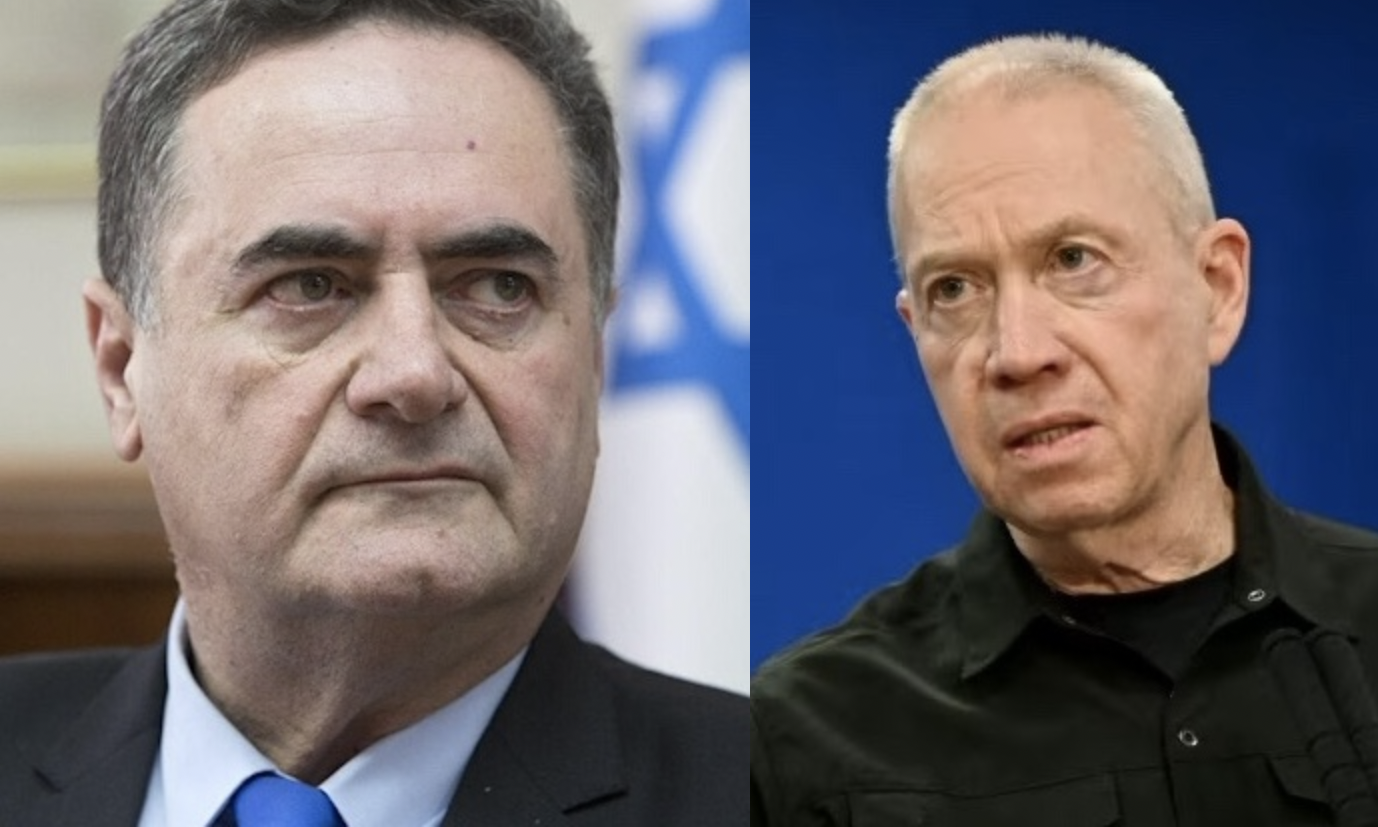
Largely overlooked amongst the grotesque collection of messianic, supremacist enthusiasts for genocide who make up the leadership of the State of Israel — in particular, of course, Prime Minister Benjamin Netanyahu and the two far-right ministers in his coalition government, Itamar Ben-Gvir and Bezalel Smotrich — is the figure of Israel Katz, a longtime “hardliner” and ally of Netanyahu who was appointed as the defense minister in November 2024 after Netanyahu sacked his predecessor Yoav Gallant.
Now 70 years of age, Katz first emerged publicly as a far-right student agitator at the Hebrew University of Jerusalem in the 1980s, opposing what he saw as “Arab students’ campus violence”, when he was suspended for a year for tying the university’s rector, the renowned chemist Raphael Mechoulam, to a chair using a rope. A former solder, whose parents were Holocaust survivors from Romania, he has been a member of the Knesset since 1998, and had held numerous ministerial positions, mostly under Netanyahu, since 2003.
Israel Katz as the epitome of relentless genocidal intent
For the last 18 months, Katz has been the epitome of relentless genocidal intent. In a statement issued after his appointment, he spoke of his intention to secure “victory over our enemies and to achieve the goals of the war: the return of all hostages as the most important moral mission, the destruction of Hamas in Gaza, the defeat of Hezbollah in Lebanon, the containment of Iranian aggression, and the safe return of the residents of the north and south [of Israel] to their homes.”
900 Days of Genocide in Gaza

Please click on either of the ‘Donate’ or ‘Buy’ buttons below (via PayPal or Stripe) to make a donation towards the $2,500 (£2,000) I’m trying to raise to support my work as a reader-funded investigative journalist, commentator and activist over the next three months. To get links to all my work in your inbox, please also consider taking out a free or paid subscription to my new Substack newsletter.
The ever-growing shadow of depravity engulfing the world has grown so huge in recent weeks — since the unprovoked and illegal war launched by the US and Israel on Iran, and, simultaneously, Israel’s renewed assaults on Lebanon, and an increase in its violence in the occupied West Bank — that it’s easy to overlook the fact that the original sin that led to this situation — Israel’s ongoing genocide in the Gaza Strip — began 900 days ago today.
It’s also easy to overlook the fact that today also marks the first anniversary of Israel’s targeted assassination in Gaza of Hossam Shabat, the fearless 23-year old Palestinian journalist whose smile, and whose relentless energetic enthusiasm for recording Israel’s crimes, lit up phones and social media reports and news broadcasts around the world.
As he said in his final message to the world, written in anticipation that he would be killed, “If you’re reading this, it means I have been killed — most likely targeted — by the Israeli occupation forces. When this all began, I was only 21 years old — a college student with dreams like anyone else. For the past 18 months, I have dedicated every moment of my life to my people. I documented the horrors in northern Gaza minute by minute, determined to show the world the truth they tried to bury. I slept on pavements, in schools, in tents — anywhere I could. Each day was a battle for survival. I endured hunger for months, yet I never left my people’s side. By God, I fulfilled my duty as a journalist. I risked everything to report the truth, and now, I am finally at rest — something I haven’t known in the past 18 months. I did all this because I believe in the Palestinian cause. I believe this land is ours, and it has been the highest honor of my life to die defending it and serving its people. I ask you now: do not stop speaking about Gaza. Do not let the world look away. Keep fighting, keep telling our stories — until Palestine is free.”

International Court of Justice Condemns Israel’s Persistent Restrictions on Humanitarian Aid for Gaza

Please click on either of the ‘Donate’ or ‘Buy’ buttons below (via PayPal or Stripe) to make a donation towards the $2,500 (£2,000) I’m trying to raise to support my work as a reader-funded investigative journalist, commentator and activist over the next three months. To get links to all my work in your inbox, please also consider taking out a free or paid subscription to my new Substack newsletter.
On the same day that the Israeli Knesset gave “preliminary approval to a bill to impose Israeli sovereignty on the occupied West Bank”, as Al Jazeera described it, accurately calling it “a move tantamount to annexation of the Palestinian territory, which would be a blatant violation of international law”, over 3,300 km away, in the Hague, the International Court of Justice delivered a blistering condemnation of Israel’s existing failures to “fulfil its obligations under international humanitarian law” as the occupying Power in the Occupied Palestinian Territory; namely, the Gaza Strip, the West Bank and East Jerusalem, first occupied in 1967.
In an advisory opinion relating to the “Obligations of Israel in relation to the Presence and Activities of the United Nations, Other International Organizations and Third States in and in relation to the Occupied Palestinian Territory”, the Court’s eleven judges unanimously ruled that the State of Israel was required “to ensure that the population of the Occupied Palestinian Territory has the essential supplies of daily life, including food, water, clothing, bedding, shelter, fuel, medical supplies and services” — from all of which, despite persistent and risible protestations to the contrary by senior Israeli officials, the Palestinians of the Gaza Strip have been horrendously deprived, though various “sieges” on all essential supplies, for most of the last two years.
The Court also ruled, by ten votes to one, that Israel was required “to agree to and facilitate by all means at its disposal relief schemes on behalf of the population of the Occupied Palestinian Territory so long as that population is inadequately supplied, as has been the case in the Gaza Strip, including relief provided by the United Nations and its entities, in particular the United Nations Relief and Works Agency for Palestine Refugees in the Near East [UNRWA], other international organizations and third States, and not to impede such relief.”












 Who's still at Guantánamo?
