Nine Yemenis Freed from Guantánamo to Saudi Arabia; 80 Prisoners Remain
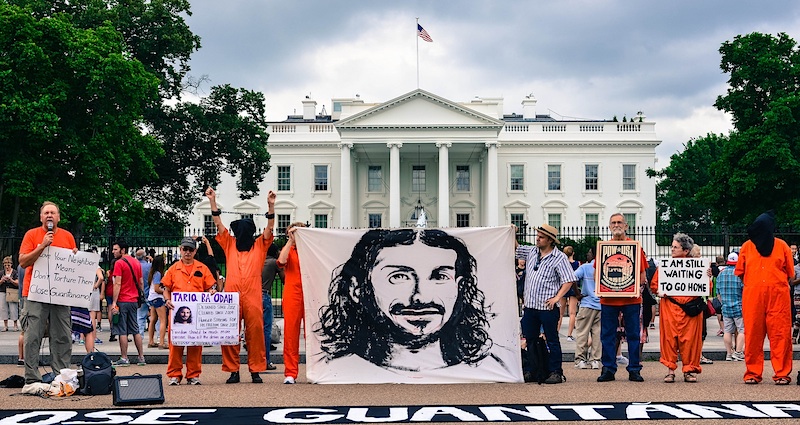 Good news from Guantánamo, as nine prisoners have been released, bringing the remaining number of prisoners down to 80. The nine men freed are all Yemeni citizens, but all have a connection with Saudi Arabia. Four were born there to Yemeni parents, while the other five have close family members who live in the country.
Only one of the nine is at all well-known: Tariq Ba Odah, a long-term hunger striker, who, last year, asked a judge to order his release, via a habeas corpus petition, because of the precarious state of his health. After more than eight years on a permanent hunger strike, he weighed just 74 pounds, and, according to medical experts and his lawyers, was at risk of death. Disgracefully, the Justice Department challenged his habeas petition, and, at the end of the year, Reuters revealed that the Pentagon had prevented representatives from an undisclosed foreign country that was prepared to offer him a new home from having access to his medical records, so that the country in question dropped its resettlement offer.
The New York Times also discussed the long history of how Saudi Arabia came to take in the Yemenis, revealing how the move completed “a long-sought diplomatic deal ahead of a planned visit to Riyadh by President Obama in the coming week.” Read the rest of this entry »
Saifullah Paracha, 68-Year Old Pakistani Businessman, Has His Ongoing Imprisonment at Guantánamo Approved
 Bad news from Guantánamo for Saifullah Paracha, a Pakistani businessman, a victim of kidnap, extraordinary rendition and torture, and, at 68, the prison’s oldest prisoner, as his ongoing imprisonment has been recommended by a Periodic Review Board, following a hearing on March 8, which I wrote about here. The PRB process involves representatives of the Departments of State, Defense, Justice and Homeland Security, as well as the office of the Director of National Intelligence and the Office of the Joint Chiefs of Staff, and it was established in 2013 to review the cases of all the prisoners not already approved for release by President Obama’s high-level, inter-agency Guantánamo Review Task Force, which reviewed all the prisoners’ cases in 2009, or facing trials (and just ten of the remaining 89 prisoners are in this latter category).
With this decision, 27 prisoners have had their cases decided, with 20 men approved for release, and just seven having their ongoing imprisonment approved. However, most of those approved for release were mistakenly described as “too dangerous to release” by the task force, while Paracha is from a smaller group of men initially recommended for prosecution until the basis for prosecutions largely collapsed, and in that group his is the second application for release that has been turned down, with just one success to date.
I have never found the case against Paracha — that he worked with Al-Qaeda in a plot or plots relating to the US — to be convincing, as he lived and worked as a successful businessman in the US from 1970-86, appears to be socially liberal, and has been a model prisoner at Guantánamo, where he has helped numerous younger prisoners engage with the various review processes established over the years. When his PRB took place, the authorities described him as as “very compliant” with the prison guards, with “moderate views and acceptance of Western norms.” Read the rest of this entry »
Two Yemenis Approved for Release from Guantánamo Via Periodic Review Boards As “Highly Compliant” Afghan and Another Yemeni Also Seek Release
 I wrote the following article for the “Close Guantánamo” website, which I established in January 2012 with US attorney Tom Wilner. Please join us — just an email address is required to be counted amongst those opposed to the ongoing existence of Guantánamo, and to receive updates of our activities by email. Please also get involved in the new Countdown to Close Guantánamo.
Two weeks into the Guantánamo prison’s 15th year of operations, the last of a wave of recent releases has taken place — with 16 men freed between January 6 and January 20 — but progress towards the prison’s closure continues.
Of particular significance on this front are the ongoing Periodic Review Boards. Of the 91 men still held, 34 have been approved for release. 24 of those men were approved for release six unforgivably long years ago, by the high-level, inter-agency Guantánamo Review Task Force that President Obama established shortly after first taking office in January 2009, but ten others have been approved for release in the last two years, by Periodic Review Boards, set up to review the cases of most of the other men still held at Guantánamo. Just ten of these men are facing– or have faced — trials, leaving 47 others awaiting PRBs, or the result of PRBs, or, in a few cases, repeat reviews. Just ten of the men still held are facing, or have faced trials.
Initially, the PRBs were meant to be for 48 men recommended for ongoing detention by the task force in January 2010 on the basis that they were “too dangerous to release,” even though the task force’s members acknowledged that insufficient evidence existed to put them on trial. President Obama at least tacitly acknowledged that this was a disgraceful basis on which to deprive people of their liberty, by promising periodic reviews of the men’s cases when he authorized their ongoing detention in March 2011, although he failed to spell out why — because, of course, not having enough evidence to try someone means that the information you hold is not evidence at all, but rumors, hunches and hearsay, from frontline interrogations made shortly after capture, when the use of violence was widespread, and from other statements made by the prisoners later, about themselves and about each other, in interrogations at Guantánamo — or, in some cases, “black sites” — where the use of torture, abuse and bribery (the promise of better living conditions) was widespread. Read the rest of this entry »
Ten Yemenis Freed from Guantánamo, Given New Homes in Oman; Now 93 Men Remain
 As the disgraceful US prison at Guantánamo Bay begins its 15th year of operations, President Obama has been busy attempting to show that, with just one year left in office, he is determined to close the prison, as he promised to do on his second day in office back in January 2009, when he promised to close it within a year. Last month, we heard that 17 men would be released in January, and the releases began just days before the 14th anniversary of the opening of the prison with the release of two Yemenis in Ghana and the return to Kuwait of Fayiz al-Kandari, the last Kuwaiti in the prison. On the actual anniversary, a Saudi was returned home, and two days after the anniversary ten more Yemenis were released in Oman, Yemen’s neighbor, to add to the ten Yemenis sent to Oman last year.
David Remes, who represents three of the men sent to Oman, said it was “a particularly good fit for them,” as the New York Times described it. “I’m sure that they are ecstatic just leaving Guantánamo,” he said. “But it’s even better than that. They’ve been sent to Oman, an Arab country, whose language, culture and religion are their own. Oman is also one of Yemen’s neighbors, so their families will be able to visit them often.”
Three more releases — of unidentified prisoners to unidentified countries — are expected soon, and, after the release of the ten men to Oman, Lee Wolosky, the Special Envoy for Guantánamo Closure in the State Department, said, “We expect to be in a position to empty Guantánamo of all detainees who are currently approved for transfer by this summer.” Including the three men who are expected to be freed soon, Wolosky’s description currently applies to 34 of the 93 men still held — 25 since January 2010, who were approved for release by President Obama’s high-level, inter-agency Guantánamo Review Task Force, and nine in the last two years, by a new review process, the Periodic Review Boards. Read the rest of this entry »
Two Yemeni Prisoners Released from Guantánamo to Ghana; 105 Men Remain
 Yesterday, the Pentagon announced that it had released two Yemeni prisoners from Guantánamo to new homes in Ghana. These releases are the first since November, when five Yemenis were given new homes in the United Arab Emirates, releases that followed the release of Shaker Aamer, the last British resident in the prison, and the Mauritanian Ahmed Ould Abdel Aziz, at the end of October. With these releases, 105 men remain at the prison — including 46 also approved for release, ten facing (or having faced) trials, and 43 others awaiting reviews promised five years ago but not yet delivered. Three others had their ongoing imprisonment approved by the review boards, and another three are awaiting the results of theirs.
The release of these two Yemenis is progress, of course, and, as we heard last month, another 15 releases are expected in the near future. With the 14th anniversary of the opening of Guantánamo taking place on Monday, this is a good time for President Obama to be making sure that men are being freed, to maintain the focus on his intention to close Guantánamo before he leaves office, and to neutralize the sting of critics pointing out that, on January 22, it will be seven years since he promised to close Guantánamo within a year.
The two Yemenis released — who were both born in Saudi Arabia, but to Yemeni parents — are men I identified in June 2012 in a major article about the failures to release prisoners approved for release, entitled, “Guantánamo Scandal: The 40 Prisoners Still Held But Cleared for Release At Least Five Years Ago.” The five years in the title, of course, is now eight and half years, and both of these men were first approved for release long before President Bush left office. They were then approved for release again under President Obama, following the deliberations of the high-level, inter-agency Guantánamo Review Task Force that Obama established shortly after taking office in January 2009. Read the rest of this entry »
Haji Ghalib, the Afghan Freed from Guantánamo Who Is Now Fighting Isis and the Taliban
 When it comes to reports about prisoners released from Guantánamo, there has, since President Obama took office, been an aggressive black propaganda policy — firstly from within the Pentagon and latterly from the Office of the Director of National Intelligence — painting a false picture of the alleged rate of “recidivism” amongst former prisoners, a trend that has also been echoed in the mainstream media, which has repeatedly published whatever nonsense it has been told without questioning it, or asking for anything resembling proof from those government departments that are responsible. For some background, see my articles here, here, here and here – and my appearance on Democracy Now! in January 2010.
The three outstanding problems with the supposed recidivism rate — beyond the lamentable truth that no information backing up the claims has been made publicly available since 2009, and that the media should therefore have been very wary of it — are, firstly, that lazy or cynical media outlets regular add up the numbers of former prisoners described as “confirmed” and “suspected” recidivists to reach an alarming grand total, which, in recent years, is over 25% of those released, when the numbers of those “suspected” of recidivism are based on unverified, single source reporting, and may very well be unreliable. Back in March 2012, for example, as I explained in my article, “Guantánamo and Recidivism: The Media’s Ongoing Failure to Question Official Statistics,” Pentagon spokesman Lt. Col. Todd Breasseale said, “Someone on the ‘suspected’ list could very possibly not be engaged in activities that are counter to our national security interests.” (emphasis added).
The second huge problem with the reports is that even the “confirmed” rate is, very evidently, exaggerated, as it is, to be blunt, inconceivable that as many former prisoners as alleged can have been engaged in military or terrorist activities against the US. In the latest DNI report, for example, made available in September 2015, it is claimed that 117 former prisoners (17.9% of those released) are “Confirmed of Reengaging,” but no indication is given of how that can be possible. Claims can certainly be made for a few dozen “recidivists” — primarily in Afghanistan, and amongst those few former Gulf prisoners who apparently set up an Al-Qaeda offshoot in Yemen — but the figure of 117 is simply implausible. Read the rest of this entry »
Eroding Hyperbole: The Steady Reclassification of Guantánamo’s “Forever Prisoners”
 I wrote the following article for the “Close Guantánamo” website, which I established in January 2012 with US attorney Tom Wilner. Please join us — just an email address is required to be counted amongst those opposed to the ongoing existence of Guantánamo, and to receive updates of our activities by email.
Despite the relentless fearmongering of Republican supporters of Guantánamo, claims that the prison holds a significant number of people who pose a threat to the US continue to be eroded; primarily, in recent years, through the deliberations of Periodic Review Boards — panels consisting of representatives of the Departments of State, Defense, Justice and Homeland Security, as well as the office of the Director of National Intelligence and the Office of the Joint Chiefs of Staff, who hear from the prisoners, their lawyers and their military representatives via video-link from Guantánamo, where the men are able to make a case for why they should be approved for release.
The men in question have, with some accuracy, been dubbed “forever prisoners” by the media. Originally numbering 71 men, they comprised two groups: 46 men assessed to be “too dangerous to release” by the high-level, inter-agency Guantánamo Review Task Force that President Obama established shortly after taking office in January 2009 to recommend whether the men he inherited from George W. Bush should be released or prosecuted. This third alarming option — “too dangerous to release” — was, as far as we know, dreamt up by the task force itself, for prisoners regarded as a threat but against whom insufficient evidence existed to put them on trial.
Reading between the lines, this meant tainted evidence — in other words, men regarded as unprovably dangerous because the evidence against them was derived through the use of torture or other forms of abuse, making it fundamentally untrustworthy — or, in some (perhaps many) cases, a perceived attitude problem: prisoners who, though perhaps understandably aggrieved at being held without charge or trial for over a decade in abusive conditions, had threatened retaliation, however hollow those threats may have been, that were taken seriously by the authorities. Read the rest of this entry »
Prisoners in Guantánamo Ask to be Freed Because of the End of the War in Afghanistan
 I wrote the following article for the “Close Guantánamo” website, which I established in January 2012 with US attorney Tom Wilner. Please join us — just an email address is required to be counted amongst those opposed to the ongoing existence of Guantánamo, and to receive updates of our activities by email.
On March 30, lawyers for five Afghan prisoners still held at Guantánamo wrote a letter to President Obama and other senior officials in the Obama administration asking for their clients to be released.
The five men in question are: Haji Hamdullah (aka Haji Hamidullah), ISN 1119; Mohammed Kamin, ISN 1045; Bostan Karim, ISN 975; Obaidullah, ISN 762; and Abdul Zahir, ISN 753.
The lawyers wrote, “Their continued detention is illegal because the hostilities in Afghanistan, the only possible justification for detention, have ended. Therefore, these individuals should be released and repatriated or resettled immediately.” They referred to President Obama’s State of the Union Address, on January 20 this year, at which the president said, “Tonight, for the first time since 9/11, our combat mission in Afghanistan is over.” Read the rest of this entry »
Pentagon Defends Bowe Bergdahl/Guantánamo Prisoner Swap as Government Accountability Office Delivers Critical Opinion
 In a move that has no legal weight, but which will embolden supporters of the “war on terror” prison at Guantánamo Bay, the Government Accountability Office, the non-partisan investigative arm of Congress, which is “charged with examining matters relating to the receipt and payment of public funds,” has concluded that the Department of Defense broke the law when, in May, five Taliban prisoners in Guantánamo were released in Qatar in a prisoner swap for Sgt. Bowe Bergdahl, the only US prisoner of war in Afghanistan.
The GAO concluded that the DoD acted in violation of section 8111 of the Department of Defense Appropriations Act, 2014, which “prohibits DOD from using appropriated funds to transfer any individuals detained at Guantánamo Bay unless the Secretary of Defense notifies certain congressional committees at least 30 days before the transfer.”
When the prisoner swap was announced, a tsunami of manufactured outrage poured forth from Republicans and right-wing pundits, even though both defense secretary Chuck Hagel and President Obama provided robust explanations about why they had bypassed Congress. As I explained at the time, Hagel said that the decision to go ahead with the swap — which, it should be noted, had been mooted for at least two years — came about after intelligence suggested Bergdahl’s “safety and health were both in jeopardy, and in particular his health was deteriorating.” Read the rest of this entry »
Please Read Tom Wilner’s Op-Ed About the Bowe Bergdahl/Taliban Prisoner Swap
 I wrote the following article for the “Close Guantánamo” website, which I established in January 2012 with US attorney Tom Wilner. Please join us — just an email address is required to be counted amongst those opposed to the ongoing existence of Guantánamo, and to receive updates of our activities by email.
It has been almost three weeks now since President Obama announced that five Taliban prisoners had been released from Guantánamo in exchange for Sgt. Bowe Bergdahl, the sole US prisoner of war in Afghanistan, but the fallout from that prisoner exchange continues to cast a shadow over grown-up discussions about why the prison must be closed, and why every day that it remains open is a profound shame.
Below is an op-ed by Tom Wilner, the co-founder of the “Close Guantánamo” campaign, which was recently published on the Warscapes website, following up on articles by Andy Worthington, the other co-founder of the “Close Guantánamo” campaign, on PolicyMic, here and for Al-Jazeera.
The response to the prisoner exchange — which has been cynical, opportunistic and disgraceful — is well exposed by Tom in his article, in which he reminds readers of the limits of the detention powers used at Guantánamo (the Authorization for Use of Military Force), with particular reference to the Supreme Court’s ruling about detention powers, back in June 2004, when Justice Sandra Day O’Connor ruled that the US “may detain, for the duration of these hostilities, individuals legitimately determined to be Taliban combatants who ‘engaged in an armed conflict against the United States.’” Read the rest of this entry »












 Who's still at Guantánamo?
