From Guantánamo, Shaker Aamer Tells His Lawyer Disturbing Truths About the Hunger Strike
 As part of my coverage of the huge, ongoing hunger strike at Guantánamo, I’m delighted to make available the full text of a statement (actually an affidavit) made by Clive Stafford Smith, the director of the London-based legal action charity Reprieve, based on a phone conversation that Clive had on March 29 with Shaker Aamer, the last British resident in Guantánamo, whose story has been a focus of my work for many years. See here, here and here for reports made available to me by Shaker last year, and see here for an e-petition to the British government calling for renewed action to secure Shaker’s release — and here for an international petition.
As I have been reporting for many weeks (see here, here, here, here and here), the hunger strike began two months ago, in response to the renewed ill-treatment of the prisoners and their despair at ever being released, after President Obama promised to close the prison and then failed to do so, even though 86 of the remaining 166 prisoners — including Shaker — were cleared for release, at least three years ago, by an inter-agency task force that the President established shortly after taking office in 2009.
Shaker’s testimony, via Clive (and available here via Reprieve), adds important, and disturbing new information about the hunger strike, and the behavior of the authorities, as well as providing numbers — Shaker told Clive that there are “130 prisoners total on hunger strike in the whole prison,” and that, “Of the 66 prisoners in Camp V, 45 are recognized as being on strike, though more actually are doing it.” Read the rest of this entry »
Voices from the Hunger Strike in Guantánamo
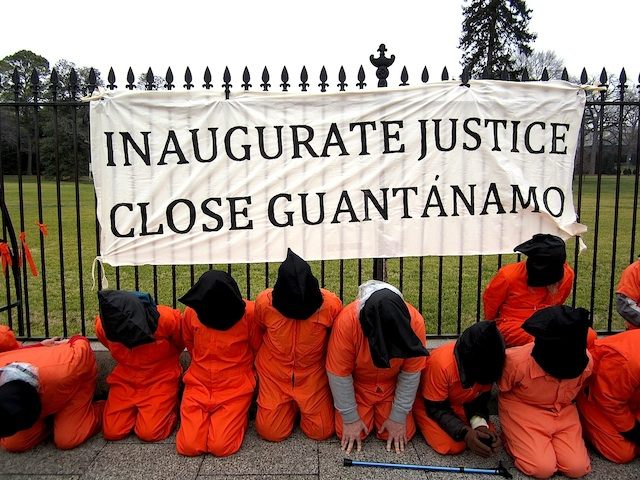 I wrote the following article for the “Close Guantánamo” website, which I established in January 2012 with US attorney Tom Wilner. Please join us — just an email address is required to be counted amongst those opposed to the ongoing existence of Guantánamo, and to receive updates of our activities by email.
Here at “Close Guantánamo,” we are deeply concerned about the prison-wide hunger strike at Guantánamo, which we first wrote about here, and its effect on prisoners already ground down by what, for the majority of them, is eleven years of indefinite detention without charge or trial, with no end to their imprisonment in sight after President Obama failed to fulfill his promise to close the prison.
The President has been hindered by the intervention of Congress, where lawmakers, for cynical reasons, intervened to impose almost insurmountable restrictions to the release of prisoners, but President Obama is also to blame — through his refusal to make Guantánamo an issue, since that promise to close it on his second day in office, and through his imposition of an unjustifiable ban on releasing Yemenis cleared for release by his own inter-agency Guantánamo Review Task Force.
Of the 166 men still held, 86 were cleared for release by the Task Force, and two-thirds of these men are Yemenis, consigned to Guantánamo, possibly forever, because, over three years ago, a Nigerian man, recruited in Yemen, tried and failed to blow up a plane bound for the US and a moratorium on releasing Yemenis was issued by President Obama. The others are either hostages of Congress, or men in need of third countries to offer them a new home, because they face torture or other ill-treatment their home countries. Read the rest of this entry »
Who Are the 55 Cleared Guantánamo Prisoners on the List Released by the Obama Administration?
 I wrote the following report exclusively for the “Close Guantánamo” campaign and website, which I established in January with US attorney Tom Wilner. Please join us — just an email address is required to be counted amongst those opposed to the ongoing existence of Guantánamo, and to receive updates of our activities by email.
POSTSCRIPT January 2013: The Center for Constitutional Rights has confirmed that a 56th prisoner was added to this list after its initial drafting — Djamel Ameziane, an Algerian mentioned below.
UPDATE March 14, 2014: Please note that this list of 56 men cleared for release by the Guantánamo Review Task Force (plus the 30 other Yemenis cleared for release but held in “conditional detention” until the authorities are satisfied that the security situation in Yemen has improved) reflected the situation at Guantánamo from the time of its publication in October 2012 until August 2013, when two Algerians on the list were released, followed by eight other cleared prisoners in December, and one more in March 2014. I have noted who has been released on the list. As a result of these releases, there are now 76 cleared prisoners (46 plus the 30 Yemenis in “conditional detention”). For a breakdown of who is who (including the identities of the 30 Yemenis in “conditional detention”), see the “Close Guantánamo” prisoner list.
On September 21, lawyers for the Guantánamo prisoners — and others who had been watching Guantánamo closely — were completely taken by surprise when, as part of a court case, the Justice Department released the names of 55 of the 86 prisoners cleared for release from Guantánamo in 2009 by President Obama’s Guantánamo Review Task Force.
The Task Force was made up of officials and lawyers from all the relevant government departments and from the intelligence agencies, and its final report was issued in January 2010. Of the 166 prisoners still held, 86 of those were recommended for release, but are still held, and the list reveals, for the first time ever, 55 of those names. Read the rest of this entry »
Obama Releases Names of Cleared Guantánamo Prisoners; Now It’s Time to Set Them Free
 On Friday, as part of a court case, the Justice Department released the names of 55 of the 86 prisoners cleared for release from Guantánamo in 2009 by President Obama’s Guantánamo Review Task Force, which consisted of officials from key government departments and the intelligence agencies. The Task Force’s final report was issued in January 2010.
Until now, the government has always refused to release the names, hindering efforts by the prisoners’ lawyers — and other interested parties — to publicize their plight.
The rationale for this was explained by Ambassador Daniel Fried, the State Department’s Special Envoy for the Closure of the Guantánamo Bay Detention Facility, in June 2009, when he stated that “indiscriminate public disclosure of the decisions resulting from reviews by Guantánamo Review Task Force will impair the US Government’s ability effectively to repatriate and resettle Guantánamo detainees” under the executive order establishing a review of the prisoners’ cases, which was issued on President Obama’s second day in office in January 2009, at the same time that he promised to close Guantánamo within a year. Read the rest of this entry »
The Syrian People’s Revolution, One Year On: Torture, Disappearances and Exile
 A year ago, when the Arab Spring began — or, as the events were then called, the revolutionary movements in the Middle East (which had already toppled two western-backed dictators in Tunisia and Egypt) — I remember being surprised, and also worried, when Syrian activists held a “Day of Rage” in Damascus on March 15, and, the day after, other protestors in Damascus — mostly well-established human rights activists — called for the release from prison of other human rights activists, many of whom had been held for many years.
I was surprised, because Syria had a reputation for almost unparalleled brutality, torture and disappearances, and worried because I feared the authorities’ response, and sure enough, many of the human rights activists were imprisoned after their protest, although most — though not all — were soon released. However, almost immediately it became apparent that there was another front to Syria’s revolutionary impulses, which was not focused on the capital, but on the town of Daraa, with a population of nearly 100,000, which is in the south east of Syria, near the border with Jordan.
There, a group of schoolchildren had scrawled graffiti on the walls of their school, which stated, “The people want the overthrow of the regime.” The boys, aged between 10 and 15, were taken away by President Bashar al-Assad’s security forces, and tortured and abused, but instead of quelling revolt, the torture of the children, and the subsequent killing of civilians at protests after visits to the mosque on Fridays, and then at funerals for those killed, spread to other towns and cities as the weeks rolled by. Read the rest of this entry »
WikiLeaks and the Guantánamo Prisoners Released from 2002 to 2004 (Part Nine of Ten)

Please support my work!
Freelance investigative journalist Andy Worthington continues his 70-part, million-word series telling, for the first time, the stories of 776 of the 779 prisoners held at Guantánamo since the prison opened on January 11, 2002. Adding information released by WikiLeaks in April 2011 to the existing documentation about the prisoners, much of which was already covered in Andy’s book The Guantánamo Files and in the archive of articles on his website, the project will be completed in time for the 10th anniversary of the prison’s opening on January 11, 2012.
This is Part 14 of the 70-part series.
In late April, WikiLeaks released its latest treasure trove of classified US documents, a set of 765 Detainee Assessment Briefs (DABs) from the US prison at Guantánamo Bay, Cuba. Compiled between 2002 and January 2009 by the Joint Task Force that has primary responsibility for the detention and interrogation of the prisoners, these detailed military assessments therefore provided new information relating to the majority of the 779 prisoners held in the prison at Guantánamo Bay, Cuba throughout its long and inglorious history, including, for the first time, information about 84 of the first 201 prisoners released, which had never been made available before.
Superficially, the Detainee Assessment Briefs appear to contain allegations against numerous prisoners which purport to prove how dangerous they are or were, but in reality the majority of these statements were made by the prisoners’ fellow prisoners, in Kandahar or Bagram in Afghanistan prior to their arrival at Guantánamo, in Guantánamo itself, or in the CIA’s secret prisons, and in all three environments, torture and abuse were rife.
I ran through some of the dubious witnesses responsible for so many of the claims against the prisoners in the introduction to Part One of this new series, and, while this is of enormous importance in the cases of many of the men still held (and also in the cases of some of those released), it is not particularly relevant to the overwhelmingly insignificant prisoners released between 2002 and September 2004, whose detention was so pointless that the authorities didn’t even bother trying to build cases against them through the testimony of their fellow prisoners. Read the rest of this entry »












 Who's still at Guantánamo?
