Ha Ha! The Tories Lose London
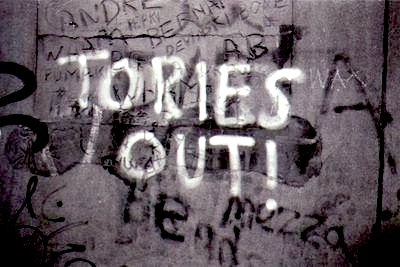 Good news for a change, as the Tories definitively lose control of London (OK, I’m slightly jumping the gun, but the Guardian is reporting that “Sadiq Khan ‘has won’ London mayoral race,” and Jeremy Corbyn has already sent Khan his congratulations). The Tories, who were already down in terms of MPs after last year’s General Election (when 45 of the capital’s 73 Parliamentary seats went to Labour), have now lost the Mayor, with Labour’s Sadiq Khan soundly beating Zac Goldsmith, and in the capital-wide elections for members of the Greater London Assembly, with 14 of the 25 seats counted, Labour had nine seats (a gain of one), and the Tories had five (a loss of one). The BBC reported that 43% of Londoners had voted Labour, 31% had voted Tory, and the Green Party had come third.
This is good news for Sadiq Khan, of course, but also for Jeremy Corbyn, in his first electoral test as Labour Party leader, and for the Labour Party as a whole the results are a vindication of his leadership — especially satisfying after the artificial anti-Semitism row that Labour right-wingers and a throughly unprincipled mainstream media were all too delighted to promote. At the time of writing Labour had held almost all its council seats across England, and had also held 29 seats in Wales (just short of a majority). The only dimmed light is in Scotland, where the SNP continues to replace them as the party of the left — and where, shockingly, the Tories pushed them into third place.
In London, of course, the Tories persistently shot themselves in the foot. Zac Goldsmith failed to connect with people and looked like he didn’t want the job — and it’s interesting to see how people aren’t fooled by a lack of desire for the job. However, his woes multiplied in the last few weeks when he hired the black propagandist Lynton Crosby, the Australian who has been behind the Tories’ relentlessly black propaganda for the last six years, which, it is important to note, is single-handedly responsible for the horrendous increase in the petty hatreds that have come to typify modern Britain — dominated, in particular, by racism, but also targeting anyone vulnerable, as can be seen by the government’s relentless assault on the unemployed and the disabled. Read the rest of this entry »
Breach Theatre On Tour With Acclaimed Theatre/Video Dramatization of the Battle of the Beanfield
 It’s over 30 years since the Battle of the Beanfield, a notoriously dark day in modern British history, when, under the leadership of Margaret Thatcher, 1,400 police from six counties and the Ministry of Defence “decommissioned” a convoy of around 500 new age travellers, free festival goers and environmental activists who were attempting to travel to Stonehenge to set up what would have been the 12th annual free festival in the fields opposite the stones.
The Stonehenge Free Festival was a wild anarchic jamboree, which lasted for the whole of the month of June, and, in its last few years, attracted many tens of thousands of people, myself included — and the effect on me was so profound that I ended up writing about the festival and the Beanfield (and much more besides) in my 2004 counter-cultural history, Stonehenge: Celebration & Subversion and then focused exclusively on the Beanfield in my 2005 book, The Battle of the Beanfield.
The festival’s violent suppression, in a one-sided rout of heartbreaking brutality, was one of the grimmer episodes in Thatcher’s bleak, eleven-year reign, dealing a crippling blow to Britain’s traveller movement, even though dissent refused to go away, as an ecstasy-fuelled rave scene, the road protest movement and the anti-globalization movement emerged to challenge the status quo in the late 80s and the 90s. Read the rest of this entry »
Video: Andy Worthington’s Band The Four Fathers Play ‘Tory Bullshit Blues’ Unplugged
 Yesterday, to coincide with the Conservative Party Conference, at which Jeremy Hunt has been causing anger by telling hard-working lower-paid voters that they need to work harder — like the famously exploited Chinese people, for example — rather than get tax credits to top up their government-defended inadequate pay, I posted ‘Tory Bullshit Blues,’ a new video on the YouTube channel of my band The Four Fathers, which I launched last week with a version of ‘Song for Shaker Aamer,’ about the last British resident in the US prison at Guantánamo, played by myself and my fellow guitarist/singer in the band, Richard Clare.
‘Tory Bullshit Blues’ is my defence of socialism over the selfishness and greed that has typified the Conservative Party since Margaret Thatcher — and it also challenges the racism of UKIP, blaming immigrants, the unemployed and the disabled for the problems caused by the bankers who were responsible for the global economic crash of 2008, but have not been held accountable for their greed and their crimes.
Stonehenge and the Summer Solstice, 30 Years After the Battle of the Beanfield
 Happy summer solstice, everyone! I thought I might visit megalithic Wiltshire this year, for my first solstice visit in 10 years, but the anti-austerity march in London — and my desire to attend it — rather put paid to that plan. My hoped-for destination was Avebury, the village built in the remains of a colossal stone circle, roughly 20 miles north of Stonehenge, which awakened — or rather reawakened — my interest in all things megalithic from 1996, when a chance visit with my new girlfriend (and now wife) Dot led to such enthusiasm on my part that I devoted much of the next ten years to visiting ancient sacred sites all over England, and in Scotland, Malta and Brittany.
I also wrote two books in this period, after my original plan failed to find a publisher. That project was, “Stonehenge and Avebury: Pilgrimages to the Heart of Ancient England,” and it was based on three long-distance walks I made with Dot and other friends in 1997 and 1998, along the Ridgeway from the Thames to Avebury, and then an eight-day trek through Wiltshire to Stonehenge, from Dorchester in Dorset, which I christened “The Stonehenge Way,” and another walk of my devising from Stonehenge to Avebury.
I hope one day to revive that particular project, but what happened in 2002 was that I was encouraged to focus on one particular aspect of the book — the Stonehenge Free Festival, my first inspiration when it came to ancient sacred sites. As a student, I had visited the festival in 1983 and 1984, and had found my view of the world transformed by this gigantic anarchic jamboree that filled the fields opposite Stonehenge every June. The photo above is from 1975, the second festival, and is from the Flickr site of Basil and Tracy Brooks. Basil played with Zorch, who played at both of the first two festivals, in 1974 and 1975. See the albums here and here. Read the rest of this entry »
It’s 30 Years Since Margaret Thatcher Trashed the Travellers’ Movement at the Battle of the Beanfield
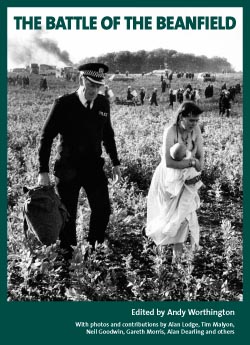 Buy my book, The Battle of the Beanfield, here.
Exactly 30 years ago, on June 1, 1985, a convoy of vehicles trying to get to Stonehenge to establish what would have been the 12th annual free festival in the fields opposite Britain’s most famous ancient monument, was set upon with violence on a scale that has not otherwise been witnessed in peacetime in modern times in the UK.
Around 1,400 police from six counties and the Ministry of Defence were in Wiltshire to “decommission” the convoy, which consisted of around 500 new age travellers, free festival goers and environmental activists. The police were thwarted in their efforts to arrest the majority of the convoy via a roadblock, and the travellers then occupied a pasture field and an adjacent bean field, establishing a stand-off that was only broken late in the afternoon, when, under instructions from on high, the police invaded the fields en masse, and violently assaulted and arrested the travellers — men, women and children — smashing up their vehicles to try and make sure this new nomadic movement would never be able to function again.
Successive waves of legislation — the Public Order Act of 1986 and the Criminal Justice Act of 1994 — largely destroyed Britain’s traveller community, although there were fascinating eruptions of dissent along the way — in particular via the rave scene of the late 80s and early 90s, and the road protest movement that was a direct descendant of the free festival movement. Unable to travel freely, protestors rooted themselves to a fixed spot, occupying land regarded as sacred and, in many noteworthy cases, living in trees in an effort to prevent road-building projects from taking place. Read the rest of this entry »
London’s Insane Housing Bubble – and the Sickening Greed that is Strangling the Capital
 Everywhere I look in London, monstrous new housing developments are rearing up — unaffordable to most working people, and largely bought up by foreign investors. While some take up residence, others leave their investments empty or join the frenzy of home-grown landlords in the buy-to-let market, fleecing an ever-increasing percentage of London’s workforce, who simply cannot afford to buy a property and have no choice but to cough up whatever outrageous amount they are asked to pay by landlords who have been unregulated since the days of Margaret Thatcher, the great liberator of unfettered greed.
This is the new London, in which those involved in new housing developments act as pimps for rich foreigners and for Britain’s own wealthiest property owners, and struggling British workers are preyed on by their fellow citizens, in a market driven by the greedy sense of entitlement that motivates far too many landlords, and a housing bubble kept inflated by the government and the Bank of England, whose refusal to raise interest rates is the primary driver of an economy in which profiteering on housing is seen, by far too many people, as their only viable investment.
However, the situation is now so dire that last week a YouGov poll commissioned by the Evening Standard — normally nothing more than a front for the mortgage industry — revealed that “[h]alf of Londoners want house prices to fall.” Read the rest of this entry »
It’s 29 Years Since the Battle of the Beanfield, and the World Has Changed Immeasurably
Buy my book The Battle of the Beanfield here.
29 years ago, on June 1, 1985, a convoy of around 450 men, women and children — travellers, anarchists, free festival goers and green activists — were ambushed by 1,400 police from six counties and the Ministry of Defence, and decommissioned with a violence that has rarely been paralleled in modern British history.
The convoy was en route to Stonehenge, to set up what would have been the 11th annual free festival in the fields opposite Britain’s most famous ancient monument, but the savage decommissioning of the travellers’ vehicles, their mass arrest, and the raising of a military-style exclusion zone around Stonehenge put paid to that prospect.
The exclusion zone was raised every June for the next 13 years, until the law lords ruled it illegal in 1999, and since then English Heritage have allowed unfettered access to the stones on the summer solstice, with up to 30,000 revellers — everyone from pagan priests to teenage party-goers — availing themselves of the “Managed Open Access” policy. Read the rest of this entry »
Back in Print: The Battle of the Beanfield, Marking Margaret Thatcher’s Destruction of Britain’s Travellers
Buy The Battle of the Beanfield here.
Yesterday, December 1, 2013, was a cheerless anniversary of sorts — 28 and a half years since the Battle of the Beanfield, on June 1, 1985, when 1,300 police from six counties and the MoD trapped and violently decommissioned a convoy of several hundred travellers — men, women and children, the new nomads of the UK, including free festival goers, anarchists, and anti-nuclear activists — en route to Stonehenge to establish what would have been the 12th annual Stonehenge Free Festival. From humble origins in 1974, the festival had grown, by 1984, into a month-long counter-cultural extravaganza attended by tens of thousands of people, and in 1985, fresh from her success in suppressing the miners, Margaret Thatcher turned her attention to the festival and its loose network of organisers, planning to destroy it as ruthlessly as she was destroying British industry.
in 2005, to mark the 20th anniversary of this key event in the modern state’s clampdown on dissent, I compiled and edited a book about the Battle of the Beanfield, drawing on transcripts I made of interviews with travellers and witnesses to the events of the day and the months building up to it that were recorded for a 1991 TV documentary, “Operation Solstice” (screened on Channel 4 and available to buy here); the police log, liberated from a court case brought by some of the victims of the Beanfield; and other relevant information, book-ended with essays putting the Beanfield in context, written by myself and Alan Dearling, whose publishing company, Enabler Publications, launched the book in June 2005.
Eight and a half years later, The Battle of the Beanfield is still in print, and, to slightly contradict the heading of this article, it has never actually been out of print, although in summer, when Alan and I reprinted it, I was down to my last few copies. You can buy it here, in time for Christmas, if you, or anyone you’re hoping to buy a present for, was there, was affected by it, or is simply interested in knowing more about one of the key events that shaped the relationship between the state and those perceived as difficult. I should note that my previous book, Stonehenge: Celebration & Subversion, is also still available, as is my third book, The Guantánamo Files. Read the rest of this entry »
Is the Tide Turning Against the Tories, as Labour Pledges to Scrap the Bedroom Tax and Sack Atos?
 Ever since the Tory-led coalition government got into power and ministers made it clear that they were seeking to do as much damage as possible to the poor, the ill, the unemployed and the disabled, and to dismantle, if possible, every state-owned enterprise, and anything that expresses some notion of communality and doesn’t involve naked profiteering, misery and uncertainty have been on the rise, and with good reason.
As I have stated in numerous articles over the last few years, the assault on the unemployed and disabled has been particularly heart-wrenching, as the Tories, their spin doctors, their Lib Dem accomplices and their cheerleaders in the mainstream media have portrayed the unemployed as skivers, despite there being only one job available for every five of the country’s 2.5 million unemployed, and have portrayed disabled people with similar flint-hearted distortions.
As a result, wave after wave of vile policies have been introduced with very little outrage from people who probably don’t regard themselves as particularly cruel or heartless — the reviews for the disabled, run by Atos Healthcare, which are designed to find people with severe mental and physical disabilities fit for work, so that their benefits can be cut; the workfare programs for the unemployed that are akin to slavery and allow well-off companies to fundamentally undermine the minimum wage; and the overall benefit cap, the most popular policy in this new Cruel Britannia, according to a YouGov poll in April, in which 79 per cent of people, including 71 per cent of Labour voters, supported it. This is forcing tens of thousands of families to uproot themselves — with all the attendant social costs, particularly for their children — and move to cheaper places, which tend to be those with high unemployment, creating ghettoes, as part of a disgraceful process of social cleansing. Read the rest of this entry »
Memories of Youth and the Need for Dissent on the 29th Anniversary of the last Stonehenge Free Festival
 Please note that my books Stonehenge: Celebration and Subversion and The Battle of the Beanfield are both still available, and I also wholeheartedly recommend Travelling Daze: Words and Images from the UK’s New Travellers and Festivals, Late 1960s to the Here and Now, Alan Dearling’s epic review of the traveller scene (to which I was one of many contributors), which was published last year, and is essential reading for anyone interested in Britain’s traveller history.
Every year, on the summer solstice, I am confronted by two particular questions, as, I’m sure, are many people old enough to have spent their youth growing up under Margaret Thatcher, or in the years previously, under Ted Heath’s Tory government, and the Labour governments of Harold Wilson and Jim Callaghan, when an unofficial civil war was taking place in British society.
Those two questions are: what happened to my youth, and what happened to massive, widespread societal dissent?
The former of course, is an existential question, which only young people don’t understand. It’s 29 years since the last Stonehenge Free Festival, an annual anarchic jamboree that lasted for the whole of June, when Britain’s alternative society set up camp in the fields across the road from Stonehenge, and it’s 39 years since the first festival was established, by an eccentric young man named Phil Russell, or, as his friends and admirers remember him, Wally Hope. Read the rest of this entry »










 Who's still at Guantánamo?
