It’s 28 Years Since Margaret Thatcher Crushed Travellers at the Battle of the Beanfield
 It has become something of a tradition that, on June 1 every year, I add another year to the counter and write an article explaining how many years it has been since the Battle of the Beanfield, and why it is important for people of all ages to recall — or to find out about — the day when, in a field in Wiltshire, the late and unlamented Margaret Thatcher sent a militarised army of police from six counties and the MoD to decommission, with outrageous violence, a convoy of new age travellers, free festival goers, green activists, anarchists and — most crucially — those opposed to the establishment of US nuclear weapons based on British soil. Last year, I wrote, “Remember the Battle of the Beanfield: It’s the 27th Anniversary Today of Thatcher’s Brutal Suppression of Traveller Society,” incorporating an article I wrote for the Guardian on June 1, 2009, and I’m pleased to note that my commemoration of the Battle of the Beanfield a year ago has been liked on Facebook by over 6,700 people — the majority, I believe, since Margaret Thatcher’s death in April.
Unlike the women of Greenham Common, opposed to the establishment of a US cruise missile base on UK soil, who couldn’t be truncheoned en masse for PR reasons, the convoy of men, women and children who had set up a second peace camp at Molesworth in Cambridgeshire in the summer of 1984 could be — and were — evicted by 1,500 police and troops on February 6, 1985, with further violence obviously planned. The Molesworth eviction was the single largest mobilisation of police and troops since the war, and, for the Royal Engineers, their largest operation since the bridging of The Rhine in 1944. Afterwards, the travellers were harried around southern England for four months until their annual exodus to Stonehenge, to set up the anarchic festival that had occupied the fields opposite Stonehenge every June since 1974, when the planned opportunity came for them to be violently attacked, the festival stopped, and the travellers’ movement crippled.
To commemorate the anniversary this year, I’m posting below excerpts from the opening chapter of my book The Battle of the Beanfield, published eight years ago, and still in print, in which my analysis bookends transcripts of accounts by many of the major players. You can, if you wish, buy it from me here. Read the rest of this entry »
“Kindness is Better than Greed”: Photos, and a Response to Margaret Thatcher on the Day of Her Funeral


“Kindness is Better than Greed”: A Response to Margaret Thatcher on the Day of Her Funeral, a set on Flickr.
To paraphrase William Shakespeare, I came to bury Margaret Thatcher, not to praise her. However, due to a hospital appointment, I missed the procession and only arrived at St. Paul’s Cathedral after the funeral service, when the guests were leaving, although I was in time to take a few photos as reminders of the day when the woman was laid to rest who, during my lifetime, did more than any other individual to wreck the country that is my home.
My most fervent hope is that I will live to see Margaret Thatcher’s legacy overturned, and for a caring, inclusive society to replace the one based on greed, selfishness and cruelty that was her malignant gift to the people of Britain.
Since her death last week, I have largely avoided the sickening attempts by the Tories to use it for political gain, although I was absolutely delighted that their insistence on providing a lavish funeral at taxpayers’ expense backfired, because only 25 percent of the public thought that a state funeral was appropriate, and 60 percent opposed it. Read the rest of this entry »
Unaffordable London: The Great Housing Rip-Off Continues
 On Monday, a rather unprecedented event occurred. The BBC, in its long-running but generally dumbed-down Panorama slot, broadcast a half-hour programme — Britain on the Brink: Back to the 70s? — which took off the blinkers, or the rose-coloured spectacles, that much of the mainstream media have clamped on Britain’s face since the cruel and incompetent Tories began laying waste to the British economy two years ago.
Those of us with any intelligence — and I don’t count George Osborne and David Cameron or any of the other clowns masquerading as functional ministers in this category — knew that the government’s claims that, despite all evidence to the contrary, savage austerity cuts to the state provision of almost services, accompanied by up to a million job losses, would allow the private sector to ride in on a white charger dispensing new jobs like confetti were the worst sort of fantasy. The truth, of course, is that savage austerity cuts always — always — mean an economic death spiral, and the only way out of a recession is to spend wisely to stimulate demand.
In addition, of course, those not blinded by having studied the propaganda that mostly passes for economics would also have realised that the private sector’s ability to provide answers has come to an end. In truth, the motto that private was better than public was largely a ruse of Margaret Thatcher’s to destroy Britain’s manufacturing, and then plunder the family silver for profit — the nationalised industries and some other necessary state-provided services. Read the rest of this entry »
The Power of Greed: Photos of Canary Wharf
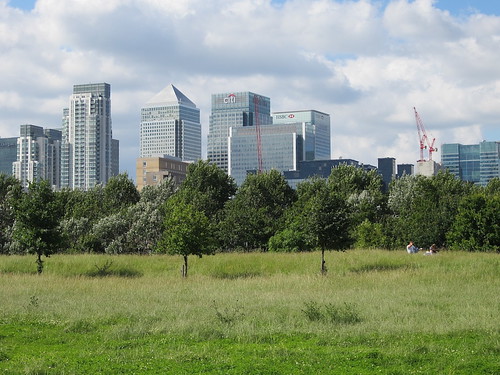


The Power of Greed: Photos of Canary Wharf, a set on Flickr.
I have long had a horror of the unfettered greed signified by the creation, in Margaret Thatcher’s Britain, of Canary Wharf, even though, initially, this “enterprise zone,” dropped onto Millwall and Poplar, on the Isle of Dogs, like a hostile takeover, seemed destined to fail. When the docks closed in 1980 — and were moved to Tilbury — Thatcher’s government established the London Docklands Development Corporation in 1981 and made the Isle of Dogs an enterprise Zone status the year after. In 1988, Olympia and York, a Canadian company, began the construction work that resulted in the opening of the first buildings, including One Canada Square, the pyramid-topped tower that remains the most iconic building on site.
Ironically, the orgy of financial liberalisation that led to the creation of Canary Wharf had already crashed by the time it opened. Olympia and York went bankrupt in 1992, and it was not until 1995 that a new consortium bought Canary Wharf, soon after becoming the Canary Wharf Group.
In a further demonstration of irony, it was not until New Labour assumed office in 1997 that the newly-revived Canary Wharf really took off, as the author and journalist Owen Hatherley explained in an excellent article for the Guardian in May, entitled, “The myth that Canary Wharf did east London any good.” Read the rest of this entry »
The Dale Farm Eviction: How Racism Against Gypsies and Travellers Grips Modern-Day Britain
 As the Gypsy and Traveller community at Dale Farm in Essex continues its long struggle against eviction with another High Court hearing today, seeking a judicial review on a number of grounds, including the absolutely crucial basis that it is “disproportionate” to remove a family from their home when no suitable alternative accommodation exists, a YouGov poll reveals that two-thirds of those asked believe that it is appropriate for Basildon Council to spend £18 million on evicting around 400 people (86 families, including many children) from land they own, but on which they were not given permission to build permanent residences by the council.
Many of those who support the eviction claim to believe that spending £18 million that surely could be spent more usefully elsewhere in the Basildon area is appropriate, because the site the Dale Farm residents own in on green belt land (albeit on the site of a former scrap yard) and it is a necessary principle.
There is some truth in this, to the extent that British people across the political spectrum are obsessed with protecting green belt land from anyone developing it — and not just Gypsies and Travellers — but I find it impossible not to detect the stench of hypocrisy emanating from those taking time out of their otherwise busy lives to obsess about the Dale Farm residents, as I cannot conceive of this happening if the men, women and children to be evicted — at £45,000 a head — were not Travellers and Gypsies.
Racism towards Gypsies is something that settled communities like to pretend doesn’t exist, but it remains virulent and disgraceful, and is clearly at the heart of the conflict over Dale Farm. Read the rest of this entry »












 Who's still at Guantánamo?
