Gaza As a Death Camp, After 1,000 Days of Genocide
Please click on either of the ‘Donate’ or ‘Buy’ buttons below (via PayPal or Stripe) to make a donation towards the $2,500 (£2,000) I’m trying to raise to support my work as a reader-funded investigative journalist, commentator and activist over the next three months. To get links to all my work in your inbox, please also consider taking out a free or paid subscription to my new Substack newsletter.
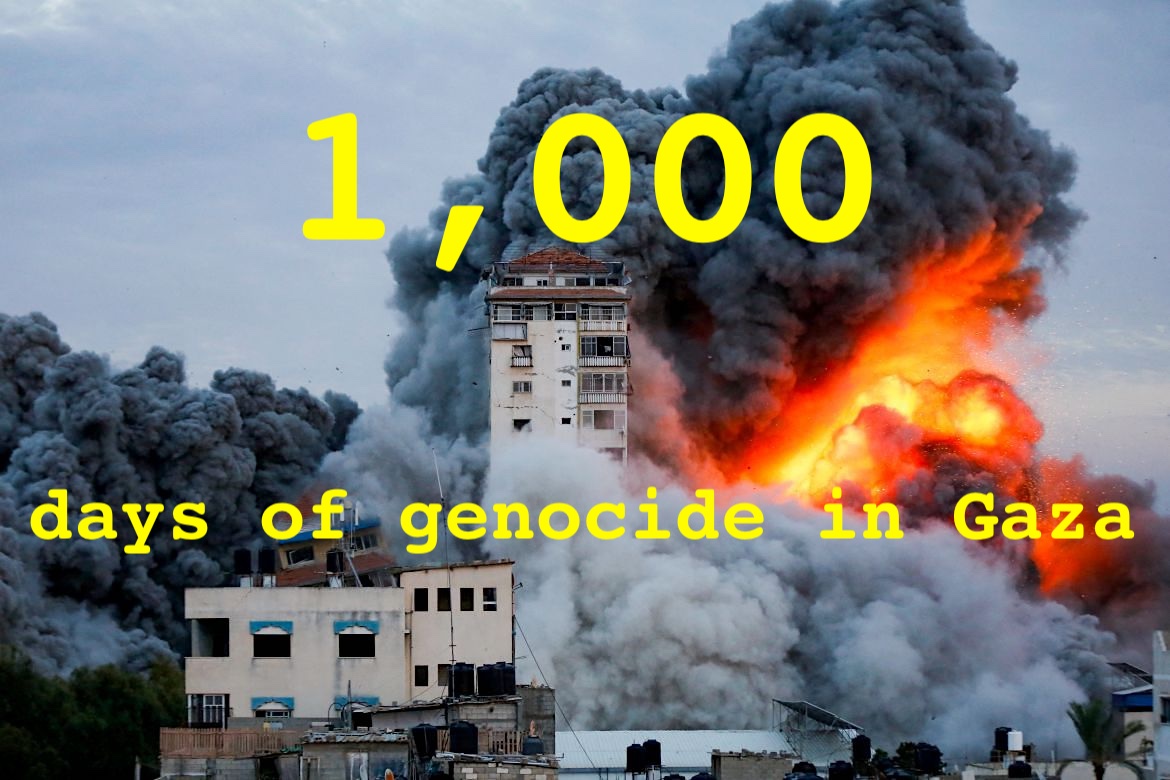
Today marks 1,000 days of Israel’s genocide in the Gaza Strip, in which, at the most conservative estimate, almost a quarter of a million people have been killed or wounded. On June 29, Gaza’s shattered Health Ministry reported that the death toll stood at 73,058, and the numbers of those injured stood at 173,488, many of them gravely so.
These figures are devastating enough, as they constitute a death toll of 73 people every single day over the last 33 months, but they are, without any doubt, a serious undercount. The real death toll is at least double that figure, and maybe more, as I establish in my notes at the end of this article.
In addition, as was revealed last August, an official Israeli military intelligence database, keeping tabs on how many suspected militants had been killed in Gaza, revealed that, according the military’s own figures, only 17% of those killed in Gaza were assessed as having been militants: in other words, 83% were civilians, a figure that, as I discussed in my analysis at the time, could actually be as high as 95%.
Is Hope Still Alive on the Anniversaries of the Genocide and Torture Conventions, and the Universal Declaration of Human Rights?

Please support my work as a reader-funded investigative journalist, commentator and activist. If you can help, please click on the button below to donate via PayPal. Please also consider taking out a free or paid subscription to my new Substack newsletter.
For anyone concerned with human rights and international humanitarian law, two dates in 1948 — December 9 and December 10 — are of crucial importance, as these are the dates when the recently-formed United Nations, via its General Assembly, idealistically and optimistically adopted, on December 9, the Convention on the Prevention and Punishment of the Crime of Genocide (the Genocide Convention), and, the day after, adopted and proclaimed the Universal Declaration of Human Rights (UDHR), which established, for the first time, fundamental human rights to be universally protected, and which, as the UN explains, “inspired, and paved the way for, the adoption of more than seventy human rights treaties.” Ever since, December 10 — today — has been known and celebrated as Human Rights Day, while December 9 is marked as the International Day of Commemoration and Dignity of the Victims of the Crime of Genocide and of the Prevention of this Crime.
One of those subsequent treaties is the Convention against Torture and Other Cruel, Inhuman or Degrading Treatment or Punishment (the Torture Convention), which, after decades of wrangling, was finally adopted by the General Assembly on December 10, 1984, the 36th anniversary of the UDHR, expanding on Article 5 of the Declaration, which states, unequivocally, “No one shall be subjected to torture or to cruel, inhuman or degrading treatment or punishment.”
The Genocide Convention, and the long quest for accountability
The Genocide Convention, drawing on the work of the Polish Jewish lawyer Raphael Lemkin, who first coined the term during the Second World War, defines genocide as “any of the following acts committed with intent to destroy, in whole or in part, a national, ethnical, racial or religious group” — “killing members of the group”, “causing serious bodily or mental harm to members of the group”, “deliberately inflicting on the group conditions of life calculated to bring about its physical destruction in whole or in part”, “imposing measures intended to prevent births within the group”, and “forcibly transferring children of the group to another group.”












 Who's still at Guantánamo?
