Experts Deliver Damning Testimony at Guantánamo Force-Feeding Trial
 For an update on October 9, see below.
This week, a historic and unprecedented trial has been taking place in Washington D.C., as lawyers for Abu Wa’el Dhiab, a Syrian prisoner at Guantánamo, have been challenging the government’s claimed legality for force-feeding prisoners.
Mr. Dhiab has been a frequent hunger striker for the last seven years, and weighs just 152 pounds, despite being six feet five inches tall. Last February, he took part in a hunger strike that involved up to two-thirds of the remaining prisoners, who were in despair at ever being released or given justice, and he has continued his hunger strike, even though throughout this period he has been subjected to painful force-feeding. He is one of 75 of the remaining 149 prisoners who were approved for release by a government task force in 2009 — and four others have had their release approved this year through another review process, the Periodic Review Boards. He is also in a wheelchair as a result of his physical decline during his 12 years in US custody.
Last summer, Mr. Dhiab challenged the legality of his force-feeding in court, and, as I explained in an article on Sunday, in May, after some to-ing and fro-ing, Judge Gladys Kessler, in the District Court in Washington D.C., “briefly ordered the government to stop force-feeding Mr. Dhiab. This order was swiftly rescinded, as Judge Kessler feared for his life, but she also ordered videotapes of his ‘forcible cell extractions’ (FCEs) and his force-feeding to be made available to his lawyers.” Read the rest of this entry »
In Ground-Breaking Ruling, US Judge Gladys Kessler Orders Guantánamo Force-Feeding Videos to be Made Public
 Congratulations to Judge Gladys Kessler of the District Court in Washington D.C., who, yesterday, followed up on a powerful order prohibiting the government from holding a secret hearing in the case of Guantánamo hunger striker Abu Wa’el Dhiab, which I wrote about here, with an even more powerful order calling on the government to prepare for public release eleven hours of videotapes showing Mr. Dhiab being dragged from his cell and force-fed.
This ruling is the latest in a string of powerful rulings by Judge Kessler, who, in May, briefly ordered the government to stop force-feeding Mr. Dhiab. This order was swiftly rescinded, as Judge Kessler feared for his life, but she also ordered videotapes of his “forcible cell extractions” (FCEs) and his force-feeding to be made available to his lawyers, who had to travel to the Pentagon’s secure facility outside Washington D.C. to see them. After viewing them, Cori Crider, his lawyer at Reprieve, said, “While I’m not allowed to discuss the contents of these videos, I can say that I had trouble sleeping after viewing them,” and added, “I have no doubt that if President Obama forced himself to watch them, he would release my client tomorrow.”
In a press release, Reprieve explained that the eleven hours of video footage — consisting of 28 tapes in total — “is to be redacted for ‘all identifiers of individuals’ other than Mr. Dhiab,” and further explained how Judge Kessler’s ruling came in response to a motion submitted in June by 16 major US media organizations, including the New York Times, the Washington Post, McClatchy, the Guardian, the Associated Press and others, seeking to have the videotapes unsealed. Read the rest of this entry »
Judge in Guantánamo Force-Feeding Case Rejects Government’s Call for Secret Hearing
Sometimes, when it comes to Guantánamo, the shamelessness of the US government know no bounds.
The most recent example is in the case of Abu Wa’el Dhiab, a Syrian prisoner, long cleared for release and confined to a wheelchair as a result of his treatment over the last 12 years. In despair at ever being released, Mr. Dhiab embarked on a hunger strike last year, as part of the prison-wide hunger strike that reminded many people of the existence of Guantánamo — and in May he won an unprecedented court victory, when, as I described it recently, a US judge — District Judge Gladys Kessler, in Washington D.C. — ordered the government to stop force-feeding him, and to preserve videotaped evidence of his force-feeding, and his “forcible cell extractions” (FCEs), whereby a team of armored guards drags him out of his cell to take him to be force-fed.
Soon after, Judge Kessler reluctantly dropped her ban on Mr. Dhiab’s force-feeding, fearing that otherwise he would die. However, she also ordered the government to release the videotapes to Mr. Dhiab’s lawyers, which was another unprecedented decision.
On August 12, as I explained in another article, Judge Kessler ordered the authorities at Guantánamo to allow two independent doctors to visit the prison to evaluate Mr. Dhiab’s health. As his lawyers at the legal action charity Reprieve explained in a press release, his health had “deteriorated so much that there are now concerns for his life.” As Reprieve also explained, the doctors will “also testify, along with a force-feeding expert, at a hearing scheduled for October 6, about the medical effects of the force-feedings on Mr Dhiab.” Read the rest of this entry »
The Despair of Guantánamo’s Most Prominent Hunger Striker
 Guantánamo’s most prominent hunger striker is Abu Wa’el Dhiab, a 43-year old Syrian prisoner, married with four children and long cleared for release, who is in a wheelchair as a result of his treatment in US custody, and has been on a hunger strike since last spring.
Others have been on a hunger strike for longer — one man has been refusing food since 2005, and others have been starving themselves since 2007 — but Mr. Dhiab is particularly well-known because, in May, a US judge — District Judge Gladys Kessler, in Washington D.C. — ordered the government to stop force-feeding him, and to preserve videotaped evidence of his force-feeding, and his “forcible cell extractions” (FCEs), when a team of armored guards drags him out of his cell to take him to be force-fed.
Soon after, Judge Kessler reluctantly dropped her ban on Mr. Dhiab’s force-feeding, fearing that otherwise he would die. However, she also ordered the government to release the videotapes to Mr. Dhiab’s lawyers, and, after seeing them, one of his legal team, Cori Crider of the legal action charity Reprieve, said that she “had trouble sleeping after viewing them.” Read the rest of this entry »
Guantánamo Violence: Prisoners Report Shaker Aamer “Beaten,” Another Man Assaulted “For Nearly Two Hours”
 In a recent letter to the British foreign secretary Philip Hammond, Clive Stafford Smith, the founder and director of the legal action charity Reprieve, described how he has “just received a series of unclassified letters from various detainees who we represent in Guantánamo Bay,” which “tell a disturbingly consistent story” — of “a new ‘standard procedure’ where the FCE team [the armored guards responsible for violently removing prisoners from their cells through ‘forcible cell extractions’] is being used to abuse the prisoners with particular severity because of the on-going non-violent hunger strike protest against their unconscionable treatment.”
With particular reference to Shaker Aamer, the last British resident in the prison, who is still held despite being cleared for release since 2007, Stafford Smith noted in his letter, dated August 22, “I have not received a recent letter from Shaker Aamer as I understand that he is seriously depressed — which is not surprising given all that he has been through.”
He added, “However, our other clients have reported that ‘[o]n Sunday, Shaker ISN 239 was beaten when the medical people wanted to draw blood.'”
In a press release, Reprieve noted that Mr. Aamer “has previously described being beaten by the FCE team up to eight times a day,” and added that he “has been held for long periods of solitary confinement since 2005 and is in extremely poor health.” Read the rest of this entry »
“Most of the Hunger Strikers Are Vomiting on the Torture Chairs”: Emad Hassan’s Latest Harrowing Letter from Guantánamo
 In the long-running struggle by prisoners at Guantánamo to get US judges to order the prison authorities to stop force-feeding them when they are on a hunger strike to protest about their indefinite imprisonment without charge or trial, the focus in the last few months has been on Abu Wa’el Dhiab, a Syrian prisoner, cleared for release in 2009 by the high-level, inter-agency Guantánamo Review Task Force that President Obama appointed shortly after taking office, but still held, like 78 other prisoners cleared for release.
In May, in Washington D.C., District Judge Gladys Kessler delivered a powerful and unprecedented ruling in Mr. Dhiab’s case, ordering the government to stop force-feeding him, and also ordering the release, to his lawyers, of videotapes showing his force-feeding and “forcible cell extractions” (FCEs), where prisoners are violently extracted from their cells by a group of armored guards and taken for force-feeding after refusing to voluntarily drink the liquid nutritional supplements given to hunger strikers.
The order regarding Mr. Dhiab’s force-feeding was withdrawn by Judge Kessler shortly after it was issued, as she feared that otherwise Mr. Dhiab would die, but the videotapes have been seen by his lawyers, who described them as profoundly shocking — and 16 US media organizations are currently engaged in trying to get the videotapes released to the public. Read the rest of this entry »
US Judge Orders Guantánamo Authorities to Allow Independent Doctors to Assess Health of Hunger Striker Abu Wa’el Dhiab
Last week there was some good news regarding Guantánamo in the US courts in the long-running case of Abu Wa’el Dhiab, a hunger striker who has spent the last 14 months attempting to get the US courts to stop him being force-fed, and who, in the last three months, briefly secured an order stopping his force-feeding, and also secured access for his lawyers to videotapes of his force-feeding and the “forcible cell extractions” used to remove him from his cell. In response, the authorities have now taken to confiscating his wheelchair, and, as Reprieve put it, “manhandling him to be force-fed.”
On August 12, District Judge Gladys Kessler ordered the authorities at Guantánamo to allow two independent doctors to visit the prison to evaluate Mr. Dhiab’s health. As his lawyers at the legal action charity Reprieve explained in a press release, his health “has deteriorated so much that there are now concerns for his life.” As Reprieve also explained, the doctors will “also testify, along with a force-feeding expert, at a hearing scheduled for October 6, about the medical effects of the force-feedings on Mr Dhiab.”
Mr. Dhiab is one of 75 men still held (out of the remaining 149 prisoners) who were cleared for release by the high-level, inter-agency Guantánamo Review Task Force appointed by President Obama shortly after taking office in January 2009. He has not been released because he cannot be safely repatriated and a third country must be found that will take him. Read the rest of this entry »
For the First Time, A Nurse at Guantánamo Refuses to Take Part in Force-Feedings, Calls Them a “Criminal Act”
 Reprieve, the legal action charity whose lawyers represent a number of prisoners still held at Guantánamo Bay revealed yesterday that a nurse with the US military at the prison “recently refused to force-feed” prisoners “after witnessing the suffering” it caused them.
Abu Wa’el Dhiab, a Syrian prisoner long cleared for release from Guantánamo, who is in a wheelchair as a result of his physical deterioration after 12 years in US custody without charge or trial, told his lawyer Cori Crider during a phone call last week (on July 10) that the male nurse “recently told him he would no longer participate in force-feedings.”
Dhiab reported that the nurse said, “I have come to the decision that I refuse to participate in this criminal act.”
He added that, “after the man made his decision known, he never saw him again,” and Reprieve noted that he had “apparently been assigned elsewhere.” Read the rest of this entry »
“I Had Trouble Sleeping,” Lawyer Says After Viewing Guantánamo Force-Feeding Videos
On the weekend of June 14/15, as I explained in an article last week, lawyers for Abu Wa’el Dhiab, a Syrian prisoner at Guantánamo who is on a hunger strike and being force-fed, began watching videos of their client’s force-feeding and “forcible cell extractions” — when prisoners are violently removed from their cells by a riot squad — which a US judge, District Judge Gladys Kessler, had ordered to be released to the lawyers a month ago. It is important to note that, previously, no lawyer for the prisoners has ever been allowed to view videotapes of force-feeding or violent cell extractions.
Prior to viewing the videos — at a “secure facility” run by the Pentagon in Virginia, where lawyers have to go to view any classified documentation related to their clients — Cori Crider of Reprieve, the legal action charity whose lawyers represent Dhiab, along with Jon B. Eisenberg in the US, described how she expected the content of the tapes “to be upsetting.”
After viewing them, Crider delivered a powerful statement about how disturbing the tapes are. “While I’m not allowed to discuss the contents of these videos, I can say that I had trouble sleeping after viewing them,” she said, adding, “I have no doubt that if President Obama forced himself to watch them, he would release my client tomorrow.” Read the rest of this entry »
“It Is All Theater, It Is All A Game,” Yemeni “Forever Prisoner” Says from Guantánamo
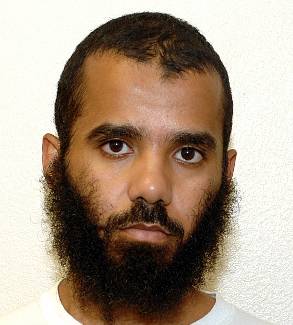 It is, I believe, impossible to argue with the logic of Muaz al-Alawi, a Yemeni prisoner in Guantánamo, who recently told his lawyer, Ramzi Kassem, that, when attempting to make sense of Guantánamo, only one analysis is necessary: “It is all political,” al-Alawi told him. “It is all theater, it is all a game.”
The US has such disdain for the prisoners at Guantánamo that, 12 and a half years on from the prison’s opening, they are still identified by the names given to them at the time of their capture, by personnel unfamiliar with the languages of their home countries — Arabic, for example. As a result, al-Alawi is identified as Moath al-Alwi.
His comments, made to Kassem, an associate professor of law at the City University of New York who directs the Immigrant and Non-Citizen Rights Clinic, which represents prisoners at Guantánamo and elsewhere, were in the context of the manufactured hysteria regarding the release of five Taliban prisoners in exchange for Sgt. Bowe Bergdahl, the sole US prisoner of war in Afghanistan, which I have written about here, here and here (and also see my Democracy Now! appearance). Read the rest of this entry »












 Who's still at Guantánamo?

