Coronavirus and the Meltdown of the Construction Industry: Bloated, Socially Oppressive and Environmentally Ruinous

Please support my work as a reader-funded investigative journalist, commentator and activist. If you can help, please click on the button below to donate via PayPal.
Just for a while there, it was bliss. The roads were almost entirely empty, the air was clean, birds could be heard singing in central London, and, most crucially, the din of huge construction sites was almost entirely silenced. Construction sites not only generate vast amounts of noise and pollution; they also choke the roads with hundreds of lorries carrying material to them, or carrying away the rubble from buildings that, in general, should have been retrofitted rather than destroyed.
This is because the environmental cost of destroying buildings is immense, and we are supposed to have woken up to the environmental implications of our activities over the last few years, because, in 2018, the UN’s Intergovernmental Panel on Climate Change (IPCC) warned us that we only had 12 years to avoid catastrophic climate change unless we started arranging to cut our carbon emissions to zero, and, in response, the activism of Greta Thunberg and Extinction Rebellion helped to persuade central governments and local governments to piously declare “climate emergencies”, and to promise to change their behaviour.
Little has been seen in terms of major changes since these “climate emergencies” were declared last year — until, that is, the coronavirus hit. Since then, global pollution levels have dropped significantly — 17% on average worldwide, by early April, compared with 2019 levels, with a 31% decline recorded in the UK.
Change the World! A Life in Activism: I Discuss Stonehenge, the Beanfield, Guantánamo and Environmental Protest with Alan Dearling

Please support my work as a reader-funded investigative journalist, commentator and activist. If you can help, please click on the button below to donate via PayPal.
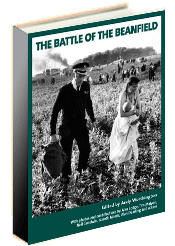
At the start of the year, I was delighted to be asked by an old friend and colleague, Alan Dearling, the publisher of my second book, The Battle of the Beanfield, if I’d like to be interviewed about my history of activism for two publications he’s involved with — the music and counter-culture magazine Gonzo Weekly and International Times, the online revival of the famous counter-cultural magazine of the ‘60s and ‘70s.
In February, after my time- and attention-consuming annual visit to the US to call for the closure of the prison at Guantánamo Bay on the anniversary of its opening, I found the time to give Alan’s questions the attention they deserved, and the interview was finally published on the International Times website on March 21, just two days before the coronavirus lockdown began, changing all our lives, possibly forever. Last week, it was also published in Gonzo Weekly (#387/8, pp. 73-84), and I’m pleased to now be making it available to readers here on my website.
In a wide-ranging interview, Alan asked me about my involvement with the British counter-culture in the ’80s and ‘90s, which eventually led to me writing my first two books, Stonehenge: Celebration & Subversion, and, as noted above, The Battle of the Beanfield. my work on behalf of the prisoners in Guantánamo Bay, which has dominated much of my life for the last 14 years, and my more recent work as a housing activist — with a brief mention also of my photo-journalism project, ‘The State of London’, and my music with The Four Fathers.
The Four Fathers Release New Eco-Anthem, ‘This Time We Win’, Recorded with Charlie Hart

On Earth Day (April 22), The Four Fathers released ‘This Time We Win’, a new online single on Bandcamp, produced by Charlie Hart, who also plays Wurlitzer piano on it.
‘This Time We Win’ is an eco-anthem that I wrote last year in response to the unfolding, man-made, global environmental catastrophe that we all face, and the powerful efforts to highlight it that have been made by the Swedish teenager Greta Thunberg and her Fridays For Future movement of striking schoolchildren, and the campaigning group Extinction Rebellion, who occupied central London a year ago.
We were planning to release it this spring, to coincide with what we anticipated would be renewed environmental activism, but what we couldn’t have foreseen was the arrival of the highly infectious novel coronavirus, COVID-19, and the complete shutdown of all significant gatherings of people, including political protests, to try and stop its spread.
In the Midst of the Coronavirus Lockdown, Environmental Lessons from Extinction Rebellion, One Year On

Please support my work as a reader-funded investigative journalist, commentator and activist. If you can help, please click on the button below to donate via PayPal.
As we all continue to try to make sense of — and live with — the extraordinarily changed world in which we find ourselves, I’m reminded of what a different place we were in a year ago, and also how some of our insights from that time so desperately need to be remembered today.
One year ago, we were five days into Extinction Rebellion’s occupation of four sites in central London (Parliament Square, Waterloo Bridge, Oxford Circus and Marble Arch), which largely brought the traffic to a halt for a week, and enabled anyone paying attention to directly appreciate what a city not dominated by the choking fumes and noise of relentless traffic felt like, and what that, in turn, said about so many of capitalism’s priorities in a major capital city.
It was, to be blunt, something of revelation, as I explained in an article at the time, Extinction Rebellion’s Urgent Environmental Protest Breaks New Ground While Drawing on the Occupy, Anti-Globalisation and Road Protest Movements, in which I also related XR’s efforts to those of earlier protest movements, and noted how we had, it seemed, all become so accustomed to how loud and dirty London was, with its relentless traffic, the incessant din of its numerous building sites, and the lorries servicing those sites, which were the most unpleasant of all the vehicles incessantly filing our streets — other huge lorries, buses, taxis, white vans, and an inexplicable number of cars — that the sudden silence and clean air was astonishing.
The Coronavirus Lockdown, Hidden Suffering, and Delusions of a Rosy Future

Please support my work as a reader-funded investigative journalist, commentator and activist. If you can help, please click on the button below to donate via PayPal.
Nearly a month since the coronavirus lockdown began in the UK, it seems clear that the intentions behind shutting most retail outlets and workplaces, and encouraging everyone to stay at home as much as possible — to keep the death toll to manageable levels, preventing the NHS and the burial industry from being overwhelmed — are working, although no one should be under any illusions that Boris Johnson’s government has managed the crisis well. Nearly 13,000 people have died so far in hospitals in the UK, a figure that seriously underestimates the true death toll, because it cynically ignores those dying in care homes.
However, frontline NHS staff are also dying, and this is because they are still deprived of necessary personal protective equipment (PPE), which is an absolute and unmitigated disgrace, showing how far our current elected officials are from the wartime spirit of the plucky British that they are so intent on selling to the public to cover up their failings.
If they really were who they claim to be, they would have pulled out all the stops to get factories manufacturing PPE in as short a time as possible, but they’re not who they claim to be: they’re incompetent disciples of a neo-liberal project that is interested only in elected officials handing out contracts — and all profit-making ability — to private companies, and that is determined to destroy the state provision of services, something that the Tories have been gleefully doing, not least to the NHS, since they first returned to power almost ten long and dreadful years ago.
Health Not Wealth: The World-Changing Lessons of the Coronavirus

Please support my work as a reader-funded investigative journalist, commentator and activist. If you can help, please click on the button below to donate via PayPal.
Yesterday marked 100 days since the coronavirus (COVID-19, or SARS-CoV-2) was first reported by the Chinese authorities, and, as now seems to be becoming clear, this highly infectious disease, which, in just three months, has reached almost every country on earth, and has so far killed nearly 100,000 people, is changing our lives — and our world — forever.
To put it simply, we have discovered that health is more important than wealth, and in a world dominated by the profit motive of capitalism, this is a profound lesson to learn, and one with consequences that will affect every aspect of our lives from now on.
Just a few weeks ago, we still raised up, and were obsessed by, the pin-ups of the celebrity world, one of capitalism’s many fronts for its almost complete domination of our lives, with its vacuous models, pop stars, footballers and film stars — all obscenely overpaid, and all dutifully obeying the requirement that, for fame and money, they had to allow themselves to be put on pedestals, to dazzle us into subservience.
Imagining a Post-Coronavirus World: Ending Ravenous Capitalism and Our Consumer-Driven Promiscuity

Please support my work as a reader-funded investigative journalist, commentator and activist. If you can help, please click on the button below to donate via PayPal.
It’s too early to begin creating a post-coronavirus world when we’re still in the throes of the crisis, but we can beginning thinking about it, and planning for it; otherwise, the dark forces that led us to this point — helped by many of our least helpful habits — will only return with a vengeance once the worst of the crisis is over.
When we think about the post-coronavirus world, there are, I presume, two camps: those who want everything to go back to how it was before, and those who don’t. The latter camp, for now, contains many more people than it has within living memory — those who recognize that running the world solely for the unfettered profits of the few has been a disaster.
This group includes many environmentalists — those who, in the last year and a half, helped to amplify the messages of Greta Thunberg and Extinction Rebellion to try to alert everyone else to an uncomfortable but vitally necessary truth: that we are facing an unprecedented man-made environmental crisis, which threatens humanity’s very existence.
Coronavirus: How Did 8,900 Deaths Worldwide Lead to the Complete Shutdown of the Global Economy?

Please support my work as a reader-funded investigative journalist, commentator and activist. If you can help, please click on the button below to donate via PayPal.
I don’t mean to sound wilfully contrarian, but, as the UK enters a phase of coronavirus lockdown so surreal that it feels as though we’re all, almost overnight, living in an apocalyptic sci-fi movie, I have found myself struggling to cope with the imminent collapse of the entire global economy because of a virus that, to date, has killed less than 8,900 people worldwide [Note: as of March 21, the global death count was 11,554 people, and by March 22 it had reached a total of 14,444. By March 29, however, it had reached a total of 33,526, and, by April 3, the total had reached 53,458. By April 11, sadly, the total had reached 102,846].
Don’t misunderstand me. I recognise that the coronavirus is infectious, and that in China, where it began, and in Italy, where it subsequently took a sudden hold, the local health services were overwhelmed with the scale of its spread. As a result, I understand why the notion of a total lockdown in response has seemed so necessary. And in the UK, responding to the initial response of the government of Boris Johnson, which was to let the virus spread freely, and to let us, the livestock, develop “herd immunity” or die, I wholeheartedly joined in the cries of outrage of those opposing such an invitation to rates of infection and death that would, it seemed clear from the examples of China and Italy, overwhelm our own health service.
And so, in response, as the notion that people should self-isolate — perhaps for a two-week period, perhaps for a month, or two at the most — took hold, I also remained supportive, but now, suddenly, as the reality of a lockdown becomes apparent, with the prospect of total economic collapse, and the unchecked rise of unprecedented authoritarian impulses on the part of governments, and with isolation now being portrayed as something that may need to be implemented for a much longer period, I suddenly find myself in revolt.
The Four Fathers Release New Song ‘Affordable’, Marking the Anniversary of the Destruction of the Old Tidemill Wildlife Garden’s Trees

Please support my work as a reader-funded investigative journalist, commentator and activist. If you can help, please click on the button below to donate via PayPal.
Last Thursday, February 27, marked a sad anniversary for environmental activists and housing campaigners, as it was the first anniversary of the destruction of the 74 mature and semi-mature trees that made up the magical tree cover of the Old Tidemill Wildlife Garden in Deptford, in south east London, which provided an autonomous green space in a built-up urban area, and also mitigated the worst effects of pollution generated by traffic on nearby Deptford Church Street, where particulate levels have been measured at six times the safety levels recommended by the World Health Organisation.
Unfortunately, the struggle to save the trees, which had been ongoing since 2012, largely took place before environmental activism went mainstream, via the actions of Greta Thunberg and Extinction Rebellion, although this was not just an environmental issue. The destruction of the garden was also part of a proposal by Lewisham Council and housing developers to build a new housing development on the site, one that desperate, dissembling councillors sought to sell to the public as providing much-needed new social homes, when the reality, as with almost all current housing developments, is that a significant number of the new homes are for private sale, existing council housing is to be destroyed, and its replacement will be homes that are described as “affordable”, when they are no such thing.
Instead, the allegedly “affordable” component of the development is a mixture of properties at ‘London Affordable Rent’, which, in Lewisham, is 63% higher for a two-bedroom flat than traditional social rents, and ‘shared ownership’, a notorious scam, whereby, in exchange for a hefty upfront payment, occupants are made to believe that they own a share of the property (typically 25%), whereas, in reality, they are only assured tenants unless they find a way to own the property outright, and, along the way, have to pay rent on the share of the property that they don’t, even nominally, own, and are also often subjected to massive — and unregulated — service charges.
The Significance of the High Court Ruling That the Police’s London-Wide Ban on Extinction Rebellion Was “Unlawful”

Please support my work as a reader-funded investigative journalist, commentator and activist. If you can help, please click on the button below to donate via PayPal.
The news cycle seems so frenetic right now that stories barely get noticed before the media spotlight promiscuously turns to some other topic. A case in point, to my mind, is an important High Court ruling last week — that a decision taken by the Metropolitan Police last month, to impose a blanket ban across the whole of London prohibiting any assembly of more than two people linked to Extinction Rebellion’s ‘Autumn Uprising’, under section 14 of the Public Order Act of 1986, was “unlawful.”
The two High Court judges who issued the ruling — Mr. Justice Dingemans and Mr. Justice Chamberlain — said, as the Guardian described it, that “the Met had been wrong to define Extinction Rebellion’s two-week long ‘autumn uprising’ as a single public assembly on which it could impose the order.”
As Mr. Justice Dingemans stated in the ruling, “Separate gatherings, separated both in time and by many miles, even if coordinated under the umbrella of one body, are not a public assembly under the meaning of section 14(1) of the 1986 act.” He added, “The XR autumn uprising intended to be held from 14 to 19 October was not therefore a public assembly … therefore the decision to impose the condition was unlawful because there was no power to impose it.”










 Who's still at Guantánamo?

