At Council of Europe, Julian Assange Defends the Importance of Journalism, Warns of US Overreach and Acknowledges He “Chose Freedom Over Unrealizable Justice”
1.10.24

Please support my work as a reader-funded investigative journalist, commentator and activist. If you can help, please click on the button below to donate via PayPal.
In moving testimony at a hearing of the Legal Affairs Committee of the Parliamentary Assembly of the Council of Europe (PACE) in Strasbourg this morning, WikiLeaks’ founder Julian Assange — in his first public appearance since his freedom was restored three months ago — spoke eloquently about the continuing importance of journalistic freedom to hold the powerful to account, while conceding that, in his case, he eventually “chose freedom over unrealizable justice” by signing a plea deal in which he was required to admit that he was “guilty” of journalism.
Still visibly shaken by his five-year ordeal in Britain’s maximum security Belmarsh prison, as he sought to challenge a US extradition request for a politically motivated prosecution under the US Espionage Act that carried a maximum 175-year sentence, Assange began by reflecting on his inability, to date, to be able to fully articulate what he described as his “relentless struggle to stay alive, both physically and mentally”, while in Belmarsh, as well as his present inability to speak about “the deaths by hanging, murder and medical neglect” of his fellow prisoners.
He then thanked PACE for their interventions on his behalf, as well as the many organizations and individuals who worked for his freedom, which, he said, should not have been necessary, but was because the legal protections that he should have been able to count on were, sadly, inadequate, in the face of a government — the US government, with the support of the UK in particular — that treated them with contempt, obliging him to sign a plea deal in which he “pled guilty to journalism, to ”seeking information from a source”, to “obtaining information from a source”, and to “informing the public what that information was”, because otherwise he would never have been freed.
Noting a changed media landscape since his isolation began in April 2019, he spoke about seeing “more impunity, more secrecy, more retaliation for telling the truth and more self-censorship”, drawing a line from his own experience to “the chilling climate for freedom of expression that exists now.”
After discussing WikiLeaks’ work, as, fundamentally, a call to “let us stop gagging, torturing, and killing each other for a change”, and also discussing President Obama’s appropriate decision not to seek to prosecute him, and the arrest, prosecution and eventual commuting of Chelsea Manning’s sentence, Assange turned to the “retribution” visited on him under the Trump administration — in particular by Mike Pompeo and William Barr — after WikiLeaks exposed aspects of the CIA’s menacing lawlessness internationally.
This menacing lawlessness was then visited on Assange via the extradition request, spying and even plans for assassination. A stand-out moment was Assange’s declaration that, under Pompeo, “instructions were given to obtain DNA from my six month old son’s nappy”, and it was also chilling to hear him discuss how former CIA officer Joshua Schulte, who was sentenced to 40 years in prison in 2022 for having provided classified CIA files to WikiLeaks in 2017, is being held “under conditions of extreme isolation”, which “are more severe than those found in Guantánamo Bay.”
In his concluding words, Assange spelled out the peril established by his case: that the US has established that it can pursue anyone anywhere in the world beyond its borders, and has “asserted a dangerous new global legal position”, whereby “[o]nly US citizens have free speech rights”, while “Europeans and other nationalities do not have free speech rights, but the US claims its Espionage Act still applies to them, regardless of where they are.”
Below, I’m publishing Assange’s testimony — posted on X by WikiLeaks — although you can also watch it via a video made available on YouTube via SBS News in Australia, which I’ve also embedded below.
The full video of the hearing is available here, on the PACE website, and includes the extensive Q&A session that followed Assange’s testimony, which is well worth watching in its entirety. Amongst the statements that I have noted, in a first, cursory view, is Assange’s poignant analysis of the changed media landscape since WikiLeaks’ heyday. As he said, “Where we once released important war crimes videos that stirred public debate, now every day, there are live-streamed horrors from the war in Ukraine and the war in Gaza. Hundreds of journalists have been killed in Ukraine and Gaza combined. The impunity continues to mount … and it is unclear what we can do about it.”
Notably, western collusion in these crimes — as proxy wars, rather than taking place under direct US or NATO leadership, as was the case in Afghanistan and Iraq — appears to me to present, via Israel’s actions, and western support for it, not only an unprecedented erosion of the post-WWII “rules-based order,” but also a dereliction of mainstream media scrutiny that is also unprecedented in its supine submission to Israel’s genocidal actions, and I hope very much to hear more from Julian Assange in future about how he sees the depraved world that has greeted him after his long isolation.
For now, however, please read or listen to his words today, and share them widely.
Julian Assange’s testimony to the Legal Affairs Committee of the Parliamentary Assembly of the Council of Europe (PACE) in Strasbourg, October 1, 2024
Mr. Chairman, esteemed members of the Parliamentary Assembly of the Council of Europe, ladies and gentlemen.
The transition from years of confinement in a maximum-security prison to standing here before the representatives of 46 nations and 700 million people is a profound and surreal shift.
The experience of isolation for years in a small cell is difficult to convey; it strips away one’s sense of self, leaving only the raw essence of existence.
I am not yet fully equipped to speak about what I have endured — the relentless struggle to stay alive, both physically and mentally, nor can I speak yet about the deaths by hanging, murder, and medical neglect of my fellow prisoners.
I apologize in advance if my words falter or if my presentation lacks the polish you might expect in such a distinguished forum.
Isolation has taken its toll, which I am trying to unwind, and expressing myself in this setting is a challenge.
However, the gravity of this occasion and the weight of the issues at hand compel me to set aside my reservations and speak to you directly.
I have traveled a long way, literally and figuratively, to be before you today.
Before our discussion or answering any questions you might have, I wish to thank PACE for its 2020 resolution, which stated that my imprisonment set a dangerous precedent for journalists and noted that the UN Special Rapporteur on Torture called for my release.
I’m also grateful for PACE’s 2021 statement expressing concern over credible reports that US officials discussed my assassination, again calling for my prompt release.
And I commend the Legal Affairs and Human Rights Committee for commissioning a renowned rapporteur, Sunna Ævarsdóttir, to investigate the circumstances surrounding my detention and conviction and the consequent implications for human rights.
However, like so many of the efforts made in my case — whether they were from parliamentarians, presidents, prime ministers, the Pope, UN officials and diplomats, unions, legal and medical professionals, academics, activists, or citizens — none of them should have been necessary.
None of the statements, resolutions, reports, films, articles, events, fundraisers, protests, and letters over the last 14 years should have been necessary.
But all of them were necessary because without them I never would have seen the light of day.
This unprecedented global effort was needed because of the legal protections that did exist, many existed only on paper or were not effective in any remotely reasonable time frame.
I eventually chose freedom over unrealizable justice, after being detained for years and facing a 175-year sentence with no effective remedy. Justice for me is now precluded, as the US government insisted in writing into its plea agreement that I cannot file a case at the European Court of Human Rights or even a freedom of information act request over what it did to me as a result of its extradition request.
I want to be totally clear. I am not free today because the system worked. I am free today because after years of incarceration because I pled guilty to journalism. I pled guilty to seeking information from a source. I pled guilty to obtaining information from a source. And I pled guilty to informing the public what that information was. I did not plead guilty to anything else. I hope my testimony today can serve to highlight the weaknesses of the existing safeguards and to help those whose cases are less visible but who are equally vulnerable.
As I emerge from the dungeon of Belmarsh, the truth now seems less discernible, and I regret how much ground has been lost during that time period when expressing the truth has been undermined, attacked, weakened, and diminished.
I see more impunity, more secrecy, more retaliation for telling the truth and more self-censorship. It is hard not to draw a line from the US government’s prosecution of me — its crossing the Rubicon by internationally criminalizing journalism — to the chilled climate for freedom of expression now.
When I founded WikiLeaks, it was driven by a simple dream: to educate people about how the world works so that, through understanding, we might bring about something better.
Having a map of where we are lets us understand where we might go.
Knowledge empowers us to hold power to account and to demand justice where there is none.
We obtained and published truths about tens of thousands of hidden casualties of war and other unseen horrors, about programs of assassination, rendition, torture, and mass surveillance.
We revealed not just when and where these things happened but frequently the policies, the agreements, and structures behind them.
When we published ‘Collateral Murder’, the infamous gun camera footage of a US Apache helicopter crew eagerly blowing to pieces Iraqi journalists and their rescuers, the visual reality of modern warfare shocked the world.
But we also used interest in this video to direct people to the classified policies for when the US military could deploy lethal force in Iraq and how many civilians could be killed before gaining higher approval.
In fact, 40 years of my potential 175-year sentence was for obtaining and releasing these policies.
The practical political vision I was left with after being immersed in the world’s dirty wars and secret operations is simple: Let us stop gagging, torturing, and killing each other for a change. Get these fundamentals right and other political, economic, and scientific processes will have space to take care of the rest.
WikiLeaks’ work was deeply rooted in the principles that this Assembly stands for.
Journalism that elevated freedom of information and the public’s right to know found its natural operational home in Europe.
I lived in Paris and we had formal corporate registrations in France and in Iceland. Our journalistic and technical staff were spread throughout Europe.
We published to the world from servers in based in France, Germany, and Norway.
But 14 years ago the United States military arrested one of our alleged whistleblowers, PFC Manning, a US intelligence analyst based in Iraq.
The US government concurrently launched an investigation against me and my colleagues.
The US government illicitly sent planes of agents to Iceland, paid bribes to an informer to steal our legal and journalistic work product, and without formal process pressured banks and financial services to block our subscriptions and freeze our accounts.
The UK government took part in some of this retribution. It admitted at the European Court of Human Rights that it had unlawfully spied on my UK lawyers during this time.
Ultimately this harassment was legally groundless. President Obama’s Justice Department chose not to indict me, recognizing that no crime had been committed.
The United States had never before prosecuted a publisher for publishing or obtaining government information.
To do so would require a radical and ominous reinterpretation of the US Constitution.
In January 2017, Obama also commuted the sentence of Manning, who had been convicted of being one of my sources.
However, in February 2017, the landscape changed dramatically.
President Trump had been elected. He appointed two wolves in MAGA hats: Mike Pompeo, a Kansas congressman and former arms industry executive, as CIA Director, and William Barr, a former CIA officer, as US Attorney General.
By March 2017, WikiLeaks had exposed the CIA’s infiltration of French political parties, its spying on French and German leaders, its spying on the European Central Bank, European economics ministries, and its standing orders to spy on French industry as a whole.
We revealed the CIA’s vast production of malware and viruses, its subversion of supply chains, its subversion of antivirus software, cars, smart TVs and iPhones.
CIA Director Pompeo launched a campaign of retribution.
It is now a matter of public record that under Pompeo’s explicit direction, the CIA drew up plans to kidnap and to assassinate me within the Ecuadorian Embassy in London and authorized going after my European colleagues, subjecting us to theft, hacking attacks, and the planting of false information.
My wife and my infant son were also targeted. A CIA asset was permanently assigned to track my wife and instructions were given to obtain DNA from my six month old son’s nappy.
This is the testimony of more than 30 current and former US intelligence officials speaking to the US press, which has been additionally corroborated by records seized in a prosecution brought against some of the CIA agents involved.
The CIA’s targeting of myself, my family and my associates through aggressive extrajudicial and extraterritorial means provides a rare insight into how powerful intelligence organizations engage in transnational repression. Such repressions are not unique. What is unique is that we know so much about this one due to numerous whistleblowers and to judicial investigations in Spain.
This Assembly is no stranger to extraterritorial abuses by the CIA.
PACE’s groundbreaking report on CIA renditions in Europe exposed how the CIA operated secret detention centres and conducted unlawful renditions on European soil, violating human rights and international law.
In February this year, the alleged source of some of our CIA revelations, former CIA officer Joshua Schulte, was sentenced to forty years in prison under conditions of extreme isolation.
His windows are blacked out, and a white noise machine plays 24 hours a day over his door so that he cannot even shout through it.
These conditions are more severe than those found in Guantánamo Bay.
Transnational repression is also conducted by abusing legal processes.
The lack of effective safeguards against this means that Europe is vulnerable to having its mutual legal assistance and extradition treaties hijacked by foreign powers to go after dissenting voices in Europe.
In Mike Pompeo’s memoirs, which I read in my prison cell, the former CIA Director bragged about how he pressured the US Attorney General to bring an extradition case against me in response to our publications about the CIA.
Indeed, acceding to Pompeo’s efforts, the US Attorney General reopened the investigation against me that Obama had closed and re-arrested Manning, this time as a witness.
Manning was held in prison for over a year and fined a thousand dollars a day in a formal attempt to coerce her into providing secret testimony against me.
She ended up attempting to take her own life.
We usually think of attempts to force journalists to testify against their sources.
But Manning was now a source being forced to testify against their journalist.
By December 2017, CIA Director Pompeo had got his way, and the US government issued a warrant to the UK for my extradition.
The UK government kept the warrant secret from the public for two more years, while it, the US government, and the new president of Ecuador moved to shape the political, legal, and diplomatic ground for my arrest.
When powerful nations feel entitled to target individuals beyond their borders, those individuals do not stand a chance unless there are strong safeguards in place and a state willing to enforce them. Without them no individual has a hope of defending themselves against the vast resources that a state aggressor can deploy.
If the situation were not already bad enough in my case, the US government asserted a dangerous new global legal position. Only US citizens have free speech rights. Europeans and other nationalities do not have free speech rights. But the US claims its Espionage Act still applies to them regardless of where they are. So Europeans in Europe must obey US secrecy law with no defences at all as far as the US government is concerned. An American in Paris can talk about what the US government is up to — perhaps. But for a Frenchman in Paris, to do so is a crime without any defence and he may be extradited just like me.
Now that one foreign government has formally asserted that Europeans have no free speech rights, a dangerous precedent has been set.
Other powerful states will inevitably follow suit.
The war in Ukraine has already seen the criminalization of journalists in Russia, but based on the precedent set in my extradition, there is nothing to stop Russia, or indeed any other state, from targeting European journalists, publishers, or even social media users, by claiming that their secrecy laws have been violated.
The rights of journalists and publishers within the European space are seriously threatened.
Transnational repression cannot become the norm here.
As one of the world’s two great norm-setting institutions, PACE must act.
The criminalization of news-gathering activities is a threat to investigative journalism everywhere.
I was formally convicted, by a foreign power, for asking for, receiving, and publishing truthful information about that power while I was in Europe.
The fundamental issue is simple: Journalists should not be prosecuted for doing their jobs.
Journalism is not a crime; it is a pillar of a free and informed society.
Mr. Chairman, distinguished delegates, if Europe is to have a future where the freedom to speak and the freedom to publish the truth are not privileges enjoyed by a few but rights guaranteed to all then it must act so that what has happened in my case never happens to anyone else.
I wish to express my deepest gratitude to this assembly, to the conservatives, social democrats, liberals, leftists, greens, and independents, who have supported me throughout this ordeal and to the countless individuals who have advocated tirelessly for my release.
It is heartening to know that in a world often divided by ideology and interests, there remains a shared commitment to the protection of essential human liberties.
Freedom of expression and all that flows from it is at a dark crossroad. I fear that unless norm-setting institutions like PACE wake up to the gravity of the situation it will be too late.
Let us all commit to doing our part to ensure that the light of freedom never dims, that the pursuit of truth will live on, and that the voices of the many are not silenced by the interests of the few.
* * * * *
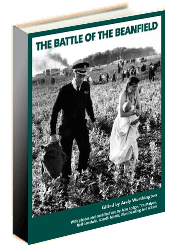
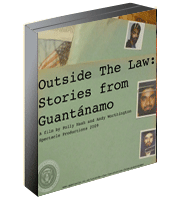
 Andy Worthington is a freelance investigative journalist, activist, author, photographer (of an ongoing photo-journalism project, ‘The State of London’), film-maker and singer-songwriter (the lead singer and main songwriter for the London-based band The Four Fathers, whose music is available via Bandcamp). He is the co-founder of the Close Guantánamo campaign (see the ongoing photo campaign here) and the successful We Stand With Shaker campaign of 2014-15, and the author of The Guantánamo Files: The Stories of the 774 Detainees in America’s Illegal Prison and of two other books: Stonehenge: Celebration and Subversion and The Battle of the Beanfield. He is also the co-director (with Polly Nash) of the documentary film, “Outside the Law: Stories from Guantánamo” (available on DVD here, or you can watch it online here, via the production company Spectacle, for £2.50).
In 2017, Andy became very involved in housing issues. He is the narrator of the documentary film, ‘Concrete Soldiers UK’, about the destruction of council estates, and the inspiring resistance of residents, he wrote a song ‘Grenfell’, in the aftermath of the entirely preventable fire in June 2017 that killed over 70 people, and, in 2018, he was part of the occupation of the Old Tidemill Wildlife Garden in Deptford, to try to prevent its destruction — and that of 16 structurally sound council flats next door — by Lewisham Council and Peabody.
Since 2019, Andy has become increasingly involved in environmental activism, recognizing that climate change poses an unprecedented threat to life on earth, and that the window for change — requiring a severe reduction in the emission of all greenhouse gases, and the dismantling of our suicidal global capitalist system — is rapidly shrinking, as tipping points are reached that are occurring much quicker than even pessimistic climate scientists expected. You can read his articles about the climate crisis here.
To receive new articles in your inbox, please subscribe to Andy’s RSS feed — and he can also be found on Facebook (and here), Twitter, Flickr and YouTube. Also see the six-part definitive Guantánamo prisoner list, The Complete Guantánamo Files, the definitive Guantánamo habeas list, the full military commissions list, and the chronological list of all Andy’s articles.
Please also consider joining the Close Guantánamo campaign, and, if you appreciate Andy’s work, feel free to make a donation.










 Who's still at Guantánamo?

15 Responses
Andy Worthington says...
When I posted this on Facebook, I wrote:
Here’s my latest article, my report about Julian Assange’s powerful testimony at a hearing of the Legal Affairs Committee of the Parliamentary Assembly of the Council of Europe (PACE) in Strasbourg today (October 1, 2024), at what was his first public appearance since his release in June. Also included is a transcript of his testimony, plus a video.
As I explain, he spoke eloquently about the continuing importance of journalistic freedom to hold the powerful to account, while conceding that, in his case, he eventually “chose freedom over unrealizable justice” by signing a plea deal in which he was required to admit that he was “guilty” of journalism because of the manner in which the US government and the CIA had manipulated all notions of fairness and justice.
It was a powerful return to the public eye for Assange – despite him clearly still suffering from the effects of his long isolation – and I hope you have time to either read or watch his testimony.
...on October 1st, 2024 at 9:14 pm
Andy Worthington says...
Natalia Rivera Scott wrote:
What he went through, we fought against so many years, it’s still amazing to see him free and listening to him for the first time in so many years, his words, his pain … I’m just so happy he’s free and recovering. This should have never happened to him or to anyone. Thank you, looking forward to reading your article. Thank you for always standing up for him, for always being on the right side of history, Andy.
...on October 1st, 2024 at 11:24 pm
Andy Worthington says...
Thanks for your empathy with Julian’s plight, Natalia, and for your kind words about my moral compass.
One of the interesting aspects of Julian’s testimony was his recognition of quite how many people were involved in fighting to secure his freedom.
As we approach the first anniversary of the start of the genocide in Gaza, knowing that, around the world, vast numbers of people are preoccupied by it, and suffering because of it, it saddens me that we can’t somehow multiply that power to effect any kind of change at all. We need a multiplier of the ‘Julian effect’ to get people to bring about significant change.
...on October 1st, 2024 at 11:34 pm
Andy Worthington says...
Natalia Rivera Scott wrote:
Yes, Andy, he said “my liberation is your liberation” I think and in the first days of his release it felt so good to know this. We did it, we helped free him and I still cry happy tears and I feel so proud to have fought this fight for more than a decade but it’s so painful to know all the time he lost and the time he’ll need to recover. This is such a tremendous injustice.
On the genocide, amigo, I have no words left. My heart is so broken. Life makes less sense … all this violence and suffering and destruction … Israel seems unstoppable … I just can’t. I’m so angry at the silent people.
...on October 2nd, 2024 at 8:59 am
Andy Worthington says...
It’s such a relief that he was eventually freed, Natalia – and Chelsea Manning before him. As he explained yesterday, he believed in the power of the rule of law, and hadn’t fully realized how that can be so easily brushed aside by those in power when they regard it as inconvenient – as, of course, is the case with Guantanamo, where some of the men held are approaching 23 years of being imprisoned to satisfy the US’s post-9/11 thirst for brutal and unaccountable vengeance.
As for the genocide, yes, the silence is perpetually frustrating, as it is regarding climate collapse. People don’t realize that, by refusing to engage, by trying to maintain their lives as though the grave threats to our existence can be ignored, they’re descending into what the trauma expert Thomas Hübl has called “collective numbness” – a quote from an illuminating article by the novelist Tim Winton, which I came across a few days ago and will be making reference to in a forthcoming article. https://www.theguardian.com/environment/2024/sep/30/our-leaders-are-collaborators-with-fossil-fuel-colonialists-this-is-the-source-of-our-communal-dread
...on October 2nd, 2024 at 9:00 am
Andy Worthington says...
Mary MacGregor Green wrote:
It’s been 14 years … and yet as he says … “Journalism is not a crime; it is a pillar of a free and informed society” … and yet … the situation these days is radically different, isn’t it ? It is true that a dangerous precedent was set. I guess I just didn’t think that all but a few journalists would abandon the task. Thank you, Andy, for staying true.
...on October 2nd, 2024 at 9:21 am
Andy Worthington says...
Thanks for the supportive words, Mary. Having worked with Julian on the release of the Guantanamo files, there was no way that I was going to abandon him, but much of the mainstream media – especially those who also partnered with WikiLeaks over the release of the files leaked by Chelsea Manning – didn’t support him as they should have, even though most eventually came round to recognize the significance of the attack on the First Amendment and the freedom of the press.
I can’t help thinking that some of this was cowardice, but also snobbery, as some of them resented Julian’s approach to journalism, seduced by their prestigious roles and, most importantly, their traditional position as gatekeepers, which has generally involved them collaborating to some extent with the authorities regarding what leaked information is released, and what isn’t. Julian essentially derided that compromised position, as Stefania Maurizi has explained, empowering the people to have the right to information without that establishment filter.
Sadly, Julian’s necessary guilty plea has only confirmed the power of the US government to terrify journalists into silence, although, over the last two and a half years, they’ve done that to themselves anyway – or have been content to let the owners of their newspapers and networks do that. Since the invasion of Ukraine, and even more forcefully since October 7, they have, for the most part, completely abdicated all responsibility to tell anything resembling the truth about the horrors taking place, acting as mere stenographers for governments, the military, the intelligence services, NATO, and, most crucially, the Israeli government and its powerful representatives abroad. It will be interesting to see how Julian responds to this changed, cowed and completely compromised mainstream media landscape as his health improves.
And all of the above, of course, is also true when it comes to climate collapse, the gravest threat any of us have ever faced, which the mainstream media is also ignoring, or has sidelined. I wonder how long that silence – protecting fossil fuel company CEOs above all – can last as events like Hurricane Helene decimate communities, while the government continues to spend money that is desperately needed at home for disaster recovery and climate change mitigation on foreign wars abroad that are dangerous and wrong by every objective measure.
...on October 2nd, 2024 at 9:23 am
Andy Worthington says...
Andy Bungay wrote:
So important to read this as the IDF are doing the number. Conversely, a speech full of humane resilience. People I talk to who object to his aims characterise him as capricious and cavalier, playing with fire, but this is sheer gravitas. Thanks for sharing as ever so meticulously.
...on October 2nd, 2024 at 9:37 am
Andy Worthington says...
You’re welcome, Andy. It was a historic moment – the return of someone both gravely wronged and, as you say, possessing the gravitas needed to reflect on both the significance of his own treatment, and what it means for press freedom in general.
Many people don’t like to recognize that people change. They found Julian annoying when he was younger and more full of combative fire, and they cling to that, not wishing to accept that long experiences with quite profound isolation, as well as the passage of time, can change people quite significantly.
It’s a psychological problem, relating to, firstly, a desire to fuel permanently simmering discontents, and, secondly, and perhaps more importantly, an often obsessive need not to “lose face”, a pride and shame scenario that has littered the world with bloodshed throughout history, all because people don’t want to ever admit that they were wrong, and to publicly change their mind.
The former drives animus towards Julian, but also drives the racism that is such a blight from our borders to the carnage of Gaza, while the latter is most evident via climate change denial. How are we going to get people to recognize that everything they have believed in and championed for 40 years has actually been killing us when that involves such a fundamental recognition that they were wrong, and that everyone they trusted has lied to them?
...on October 2nd, 2024 at 9:38 am
Andy Worthington says...
For anyone interested in a musical commentary on Julian and Chelsea Manning’s ordeal, my song ‘Warriors’, recorded with The Four Fathers, is featured on our new album of protest music, ‘Songs of Loss and Resistance’: https://thefourfathers.bandcamp.com/track/warriors-2
...on October 2nd, 2024 at 9:50 am
Andy Worthington says...
That song was written and recorded with the threat of extradition still hanging over Julian, but in summer I subsequently recorded some amended lyrics reflecting his unexpected release, and that version is here: https://thefourfathers.bandcamp.com/track/warriors-freedom-version
...on October 2nd, 2024 at 9:52 am
Andy Worthington says...
Excellent news. Following Julian’s testimony yesterday, the Council of Europe has passed a resolution condemning the “chilling effects on human rights” of the WikiLeaks’ founder’s five-year imprisonment in Belmarsh, fighting his planned extradition to the US. There were 88 votes in favour, 13 against and 20 abstentions. https://x.com/wikileaks/status/1841408842644476371
...on October 2nd, 2024 at 11:02 am
Andy Worthington says...
The Parliamentary Assembly of the Council of Europe (PACE), consisting of members drawn from each of the 46 member states, has today passed a resolution in which they affirm that he was held as a “political prisoner”, based on a report by Icelandic member Thórhildur Sunna Ævarsdóttir, Julian’s testimony yesterday, and a debate today. In a powerful press release, they state:
“The Parliamentary Assembly of the Council of Europe (PACE) has expressed deep concern at ‘the disproportionately harsh treatment’ faced by Julian Assange and said this has had a ‘dangerous chilling effect’ which undermines the protection of journalists and whistleblowers around the world.
“Approving a resolution based on a report by Thórhildur Sunna Ævarsdóttir (Iceland, SOC), the Assembly said Mr Assange’s treatment warranted his designation as a ‘political prisoner’ under a definition it agreed in 2012, citing the severe charges brought against him by the United States of America, exposing him to possible life imprisonment, combined with his conviction under the US Espionage Act ‘for what was – in essence – newsgathering and publishing.’
“The Assembly – which brings together parliamentarians from the 46 nations of the Council of Europe – also called on the US to investigate the alleged war crimes and human rights violations disclosed by him and Wikileaks. Its failure to do so, combined with the harsh treatment of Mr Assange and Ms Manning, creates a perception that the US government’s purpose in prosecuting Mr Assange was ‘to hide the wrongdoing of state agents rather than to protect national security.’
“The Assembly called on the US, a Council of Europe observer state, to ‘urgently reform’ the 1917 Espionage Act to exclude its application to publishers, journalists and whistleblowers who disclose classified information with the intent to raise public awareness of serious crimes.
“For their part, the UK authorities had failed to effectively protect Assange’s freedom of expression and right to liberty, the parliamentarians said, ‘exposing him to lengthy detention in a high-security prison despite the political nature of the most severe charges against him.’ His detention far exceeded the reasonable length acceptable for extradition, they said.”
https://www.coe.int/en/web/portal/-/pace-recognises-julian-assange-as-a-political-prisoner-and-warns-against-the-chilling-effect-of-his-harsh-treatment
...on October 2nd, 2024 at 3:09 pm
Andy Worthington says...
S Brian Willson wrote:
Such an important role model for courage and truth telling,
...on October 3rd, 2024 at 11:45 am
Andy Worthington says...
Very much so, Brian. Despite everything, Julian retains an unerring focus on the importance of true journalism, and of its ability, through educating people, to mobilize them to change the world for the better.
...on October 3rd, 2024 at 11:46 am