Archive for May, 2023
Join Us on Wednesday June 7 for the Next Monthly Coordinated Global Vigils for the Closure of Guantánamo

Please support my work as a reader-funded journalist! I’m currently trying to raise $2500 (£2000) to support my writing and campaigning on Guantánamo and related issues over the next three months. If you can help, please click on the button below to donate via PayPal.
Since February, on the first Wednesday of every month, campaigners around the world have been holding coordinated vigils calling for the closure of the prison at Guantánamo Bay, which, as of today, has been open for 7,810 days. The next vigils take place next Wednesday, June 7, and we hope you’ll join us, either by joining an existing vigil, or by setting up your own! And please, if you are taking part in a vigil, take photos and send them to me, as the cumulative visual effect of many vigils taking place on the same day is really quite powerful.
Campaigners in London, who had held weekly vigils outside Parliament for many years to call for the release of Shaker Aamer, the last British resident in Guantánamo, who was finally freed in October 2015, resumed vigils (on a monthly basis) last September, largely due to the tenacity of Sara Birch of the Lewes Amnesty Group, who is also the Convenor of the UK Guantánamo Network, comprising members of various Amnesty groups, Close Guantánamo and other organizations.
After global protests for the closure of Guantánamo on and around the 21st anniversary of its opening, on January 11 this year, I thought it would make sense to try to get campaigners in the US and elsewhere to join with us in holding coordinated vigils on the first Wednesday of every month, and so a movement was born.
The Evil Empire Isn’t Russia; It’s Fossil Fuel-Based Capitalism, Waging Apocalyptic War on the Planet and the Whole of Humanity

Please support my work as a reader-funded investigative journalist, commentator and activist. If you can help, please click on the button below to donate via PayPal.
Since Russia invaded Ukraine 15 months ago, the West has been subjected to a pro-war propaganda campaign, on Ukraine’s behalf, on a scale not seen since the run-up to the illegal invasion of Iraq in 2003.
I don’t mean to suggest in any way that we shouldn’t feel sympathy for the people of Ukraine, but the relentless reporting of their suffering, which dominated the news, to the exclusion of almost everything else, for several months after the war began, was so all-pervasive that it was difficult to recognize — or to remember — that, as is powerfully explained in ‘Why Are We in Ukraine?’, a major new article for Harper’s Magazine by Benjamin Schwarz and Christopher Layne, the war didn’t happen because Vladimir Putin is a figure of pure evil, but because of over 30 years of provocation by the US.
Since the fragmentation of the Soviet Union, between 1989 and 1991, the US has sought to erase the reality that its relationship with Russia is, necessarily, one of two vast and different political entities, each bristling with nuclear weapons, and has, instead, increasingly regarded itself as the world’s sole superpower, entitled to use NATO to encroach further and further on Russian territory, despite Secretary of State James Baker, in February 1990, convincing Mikhail Gorbachev to give up East Germany by telling him that, if he did so, NATO would “not shift one inch eastward from its present position.”
The Broken Old Men of Guantánamo

Please support my work as a reader-funded journalist! I’m currently trying to raise $2500 (£2000) to support my writing and campaigning on Guantánamo and related issues over the next three months. If you can help, please click on the button below to donate via PayPal.
I wrote the following article for the “Close Guantánamo” website, which I established in January 2012, on the 10th anniversary of the opening of Guantánamo, with the US attorney Tom Wilner. Please join us — just an email address is required to be counted amongst those opposed to the ongoing existence of Guantánamo, and to receive updates of our activities by email.
In recent months, an often-submerged story at Guantánamo — of aging torture victims with increasingly complex medical requirements, trapped in a broken justice system, and of the US government’s inability to care for them adequately — has surfaced though a number of reports that are finally shining a light on the darkest aspects of a malignant 21-year experiment that, throughout this whole time, has regularly trawled the darkest recesses of American depravity.
Over the years, those of us who have devoted our energies to getting the prison at Guantánamo Bay closed have tended to focus on getting prisoners never charged with a crime released, because, since the Bush years, when, largely without meeting much resistance, George W. Bush released two-thirds of the 779 men and boys rounded up so haphazardly in the years following the 9/11 attacks and the US-led invasion of Afghanistan, getting prisoners out of Guantánamo has increasingly resembled getting blood out of a stone.
Apart from a brief period from 2008 to 2010, when the law finally reached Guantánamo through habeas corpus (before cynical appeals court judges took it away again), getting out of Guantánamo has involved overcoming government inertia (for several years under Obama) or open hostility (under Trump), repeated administrative review processes characterized by extreme caution regarding prisoners never charged with a crime, and against whom the supposed evidence is, to say the least, flimsy (which led to over 60 men being accurately described by the media as “forever prisoners”), and many dozens of cases in which, when finally approved for release because of this fundamental lack of evidence, the men in question have had to wait (often for years) for new homes to be found for them in third countries.
Radio: I Discuss the Coronation, the Tories’ Suppression of Peaceful Protest and Criminalization of Refugees, Plus the Latest on Guantánamo, With Chris Cook on Gorilla Radio

Please support my work as a reader-funded investigative journalist, commentator and activist. If you can help, please click on the button below to donate via PayPal.
For many years, I’ve been honored to be regularly invited to discuss my ongoing work on Guantánamo, as well as many other political concerns of mine, on Gorilla Radio, run by Chris Cook in Victoria, Canada, which is “dedicated to social justice, the environment, community, and providing a forum for people and issues not covered in the corporate media.”
Chris’s latest show is on Substack here, and our interview took place in the second half of the hour-long program, after an interview with whistleblowing activist Ashley Gjøvik, following the publication of her article “Whistleblowers Are the Conscience of Society, Yet Suffer Gravely For Trying to Hold the Rich and Powerful Accountable For Their Sins,” published by Covert Action Magazine.
The trigger for Chris’s interview with me was the Coronation, last Saturday, of King Charles III, which I covered in a post as part of my ongoing photo-journalism project ‘The State of London’, and also recorded a song about, entitled, “You’re Not My King,” also embedded below:
Marking 11 Years of ‘The State of London’, An Appeal for £1000 to Support My Unique Photo-Journalism Project For the Next Three Months

Please click on the ‘Donate’ button below to make a donation to support my photo-journalism project ‘The State of London’.
Dear friends and supporters of ’The State of London’,
Every three months I ask you, if you can, to make a donation to support my unique, reader-funded photo-journalism project ‘The State of London’, which has just reached 6,200 followers on Facebook, and has over 1,550 followers on Twitter. As I have no institutional backing whatsoever, I’m entirely dependent on your generosity to enable me to continue this project, which takes up a considerable amount of otherwise entirely unpaid time.
If you can help out at all, please click on the “Donate” button above to make a payment via PayPal. Any amount will be gratefully received — whether it’s £10, £20, £50 or more!
You can also make a recurring payment on a monthly basis by ticking the box marked, “Make this a monthly donation,” and filling in the amount you wish to donate every month. If you are able to do so, a regular, monthly donation would be very much appreciated.
‘We Can’t Trust the Weather Any More’: My Speech at ‘The Big One’, Extinction Rebellion’s Four-Day Protest in London

Please support my work as a reader-funded investigative journalist, commentator and activist. If you can help, please click on the button below to donate via PayPal.
On April 21, the first day of ‘The Big One’, Extinction Rebellion’s four days of arrest-free, family-friendly protest in Westminster, backed by over 200 other organisations — which I wrote about enthusiastically here, while berating the mainstream media for not taking the climate crisis seriously enough — I also made my first ever public speech about the already unfolding climate catastrophe.
I delivered my speech, written the night before, to a crowd of about a hundred people outside 55-57 Tufton Street, which I described in my article about ‘The Big One’ as being “home to a number of opaquely-funded right-wing ‘libertarian’ think-tanks that are actively committed to maintaining the murderous status quo, defending unfettered big business, and denying the reality of catastrophic climate change.”
Earlier, XR Writers Rebel had held a prominent event featuring Ben Okri, Zadie Smith and many other writers, which was followed by a kind of open mic session, where I followed a great performance by the West Country political collective Seize the Day, who first emerged from the road protest movement of the 1990s.
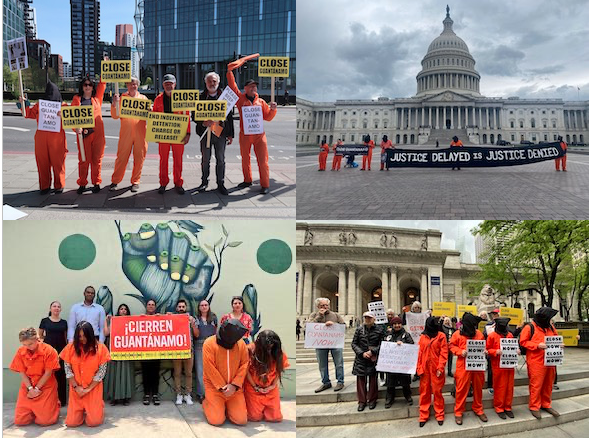
Photos and Report: The Coordinated Global Vigils for the Closure of Guantánamo in London, Washington, D.C., New York, Mexico City, Copenhagen, Brussels and Detroit on May 3, 2023
Please support my work as a reader-funded journalist! I’m currently trying to raise $2500 (£2000) to support my writing and campaigning on Guantánamo and related issues over the next three months. If you can help, please click on the button below to donate via PayPal.
On Wednesday (May 3), the latest coordinated global vigils for the closure of the prison at Guantánamo Bay took place in eight cities across the world — London, Washington, D.C. New York, Mexico City, Copenhagen, Brussels, Detroit and Los Angeles — and with former prisoner Mansoor Adayfi joining us in Belgrade.
The idea for coordinated vigils arose from the monthly vigils that the UK Guantánamo Network (a coalition of various Amnesty groups, Close Guantánamo and other groups) started last September, and I was inspired to try coordinating vigils worldwide after reflecting on the various actions marking the 21st anniversary of the opening of Guantánamo in January.
Fortunately, friends in Washington, D.C. agreed to join in in February, with New York and Mexico City joining in March, and Brussels, Los Angeles, Raleigh, NC and Cobleskill, NY joining last month, and this month we were delighted to also welcome campaigners in Copenhagen and Detroit.
Photos and Report: Guantánamo in the UK – A New Parliamentary Group Meets, and Mohamedou Ould Slahi Visits

Please support my work as a reader-funded journalist! I’m currently trying to raise $2500 (£2000) to support my writing and campaigning on Guantánamo and related issues over the next three months. If you can help, please click on the button below to donate via PayPal.
Last week was a big week for Guantánamo activism in the UK, as the inaugural meeting of the brand-new All-Party Parliamentary Group for Closing the Guantánamo Detention Facility took place in the Houses of Parliament, attended by former prisoner and best-selling author Mohamedou Ould Slahi and his former guard Steve Wood, who then, in the following days, attended three screenings of ‘The Mauritanian’, Kevin Macdonald’s feature film about Mohamedou, followed by Q&A sessions in which I was also involved.
The inaugural meeting of the APPG was attended by six MPs and peers — Chris Law (SNP), who chaired the meeting, and is the co-chair of the APPG, John McDonnell (Lab.), Baroness Helena Kennedy (Lab.), Sir Peter Bottomley (Con.), Richard Burgon (Lab.) and Rachael Maskell (Lab.).
Layla Moran (Lib Dem) is the other co-chair of the APPG, but was unable to attend because of other pressing commitments, although her assistant Emilia Harvey was there to represent her. All were voted in as officers of the APPG.











 Who's still at Guantánamo?
