Archive for July, 2020
3,000 Days of My Photo-Journalism Project ‘The State of London’

Check out all ‘The State of London’ photos here!
Please feel free to support my work on ‘The State of London’, for which I have no institutional funding. If you can help, please click on the button below to donate via PayPal.
My photo-journalism project ’The State of London’ has just reached a noteworthy milestone — 3,000 days since I first consciously went out on my bike, on May 11, 2012, to cycle around London taking photos to chronicle the fabric of London and the many changes wrought upon it, beginning with the upheaval that attended the capital’s role as the host city of the 2012 Olympic Games. I began posting a photo a day on Facebook on the fifth anniversary of that first trip, on May 11, 2017, and have been posting a photo a day for the 1,176 days since.
In the eight years since, I have taken many tens of thousands of photos, covering all 120 of London’s postcodes in the 241 square miles of the London postal district (those beginning EC, WC, W, NW, N, E, SE and SW), with a particular focus on central London — the City (EC1 to EC4) and the West End (WC1, WC2 and W1), and the immediate surrounding postcodes (SE1, SW1, NW1, N1 and E1) — and with other clusters of repeated activity in the whole of south east London, where I live, in east London, most readily accessed via the Greenwich Foot Tunnel, and in parts of south west London — particularly, it seems, Brixton, Vauxhall and Battersea and Chelsea — and west London; especially Paddington, Notting Hill and Ladbroke Grove.
These 3,000 days have not only been a way of keeping physically fit; they have also played a major role in ensuring some sort of mental equilibrium amidst the general chaos of the state of the world — even if some aspects of ‘The State of London’ have added to my sense of rage rather than placating it; in particular, the colossal and colossally expensive construction projects that have transformed the city to an alarming degree over the last eight years.
“I Am Not Even Allowed To Hear My Own Story”: A Letter from Guantánamo by Abdul Latif Nasser, Cleared for Release But Still Held By Donald Trump

Please support my work as a reader-funded journalist! I’m currently trying to raise $2500 (£2000) to support my writing and campaigning on Guantánamo and related issues over the next three months of the Trump administration. If you can help, please click on the button below to donate via PayPal.
I wrote the following article for the “Close Guantánamo” website, which I established in January 2012, on the 10th anniversary of the opening of Guantánamo, with the US attorney Tom Wilner. Please join us — just an email address is required to be counted amongst those opposed to the ongoing existence of Guantánamo, and to receive updates of our activities by email.
Since the vocal British resident Shaker Aamer and the best-selling author and torture victim Mohamedou Ould Salahi were released from Guantánamo, in 2015 and 2016, the prison population has lacked a prominent and well-known face to illuminate its continuing injustice.
This has been particularly unfortunate because, for the last three and a half years, Guantánamo has been largely forgotten by the mainstream media, demonstrating, to anyone paying attention, that a dangerous and unprincipled leader (in this case, Donald Trump) can, in a supposedly liberal democracy, make people forget about a gross and lingering injustice largely by pretending that it doesn’t exist — or, in Guantánamo’s case, by metaphorically sealing it shut and largely ignoring it.
This is particularly shameful because Guantánamo is not just a symbol of injustice; it is also the place where the United States’ notion of itself as a country that respects the rule of law was sent to die on January 11, 2002, and has been dead ever since. At Guantánamo, 40 men are still held, but the majority of those men are still held in the same despicable conditions of lawlessness that first prevailed on that winter morning over 18 and a half years ago when the Bush administration first released photos of the prisoners it intended to hold, without any rights whatsoever, and quite possibly for the rest of their lives.
Is Donald Trump Attempting to Implement A Police State in Portland, Oregon?

Please support my work as a reader-funded journalist! I’m currently trying to raise $2500 (£2000) to support my writing and campaigning on Guantánamo and related issues over the next three months of the Trump administration. If you can help, please click on the button below to donate via PayPal.
I’ve been shocked by the nightly scenes of violence beamed around the world from Portland, Oregon, where Donald Trump has sent in federal law enforcement officers — from the Department of Homeland Security, the US Marshals Service and the border patrol — to bypass Portland’s own police force and to assault and terrify protestors, who, since the murder of George Floyd in Minneapolis two months ago, have been engaged in ongoing protests about racism and police brutality.
As the Guardian explained, Donald Trump sent federal law enforcement officers to “take control” of Portland at the start of July, having decided that it “had been abandoned by its mayor to anarchists and mob rule.” The officers, “often in unmarked uniforms and vehicles”, have been deployed against protesters in Portland since the beginning of the month, “using teargas, stun grenades and munitions to control crowds descending on to federal buildings in Oregon’s largest city.”
As the Guardian also explained, the arrival of the federal officers initially “sent a wave of alarm through the demonstrators after men in camouflage began snatching people off the streets in unmarked vans. Those detained said they were dragged into the courthouse without being told why they were being arrested or by whom and then suddenly let go without any official record of being held. It smacked of police state tactics. So did some of the violence meted out by federal agents who looked more like an occupying army in a war zone.”
Shamima Begum: Appeals Court Tells UK Government It Was Unlawful to Strip Citizenship of ISIS Child Bride

Please support my work as a reader-funded journalist! I’m currently trying to raise $2500 (£2000) to support my writing and campaigning on Guantánamo and related issues over the next three months. If you can help, please click on the button below to donate via PayPal.
It’s a sign of the extent to which commonly accepted standards of justice and decency have fallen that I even have to write the headline for this article, but the sad truth is that, in the UK, government officials, at the highest level, believe that it is entirely appropriate to strip a British citizen of her citizenship, making her stateless, if, as a 15-year old, she took the decision to travel to Syria to become a “jihadi bride.”
On one level, this is completely wrong because all countries that claim to respect the rule of law, Britain included, have signed up to treaties recognising that juveniles (those under 18) should not be held responsible for their actions. In my main line of work over the last 14 years — writing about the US prison at Guantánamo Bay, and campaigning to get it closed — one of the most shocking aspects of that whole sordid story is the way that the US government ignored its obligations to treat juveniles as distinct from adults, and, in fact, denied that such distinctions even existed.
“These are not children”, foreign secretary Donald Rumsfeld claimed when the story first broke that children were being held at Guantánamo. At least 23 of the prisoners were juveniles — under 18 — when they were first seized, including the most famous Guantánamo child of them all, Omar Khadr, the Canadian citizen who was 15 when he was seized after a firefight with US soldiers, and whose rights were not only denied by the US, but also by his own government in Canada, which eventually had to be told by Canada’s Supreme Court that Canadian agents had deprived him of his rights when they visited him at Guantánamo to interrogate him.
The State of London: Marking 120 Days of My London Lockdown Photos with Some Previously Unpublished Images
Please feel free to support ‘The State of London’ with a donation, as I have no institutional backing for it, and it is, instead, a reader-funded project. If you can help, please click on the button below to donate via PayPal.
Check out all ‘The State of London’ photos here.
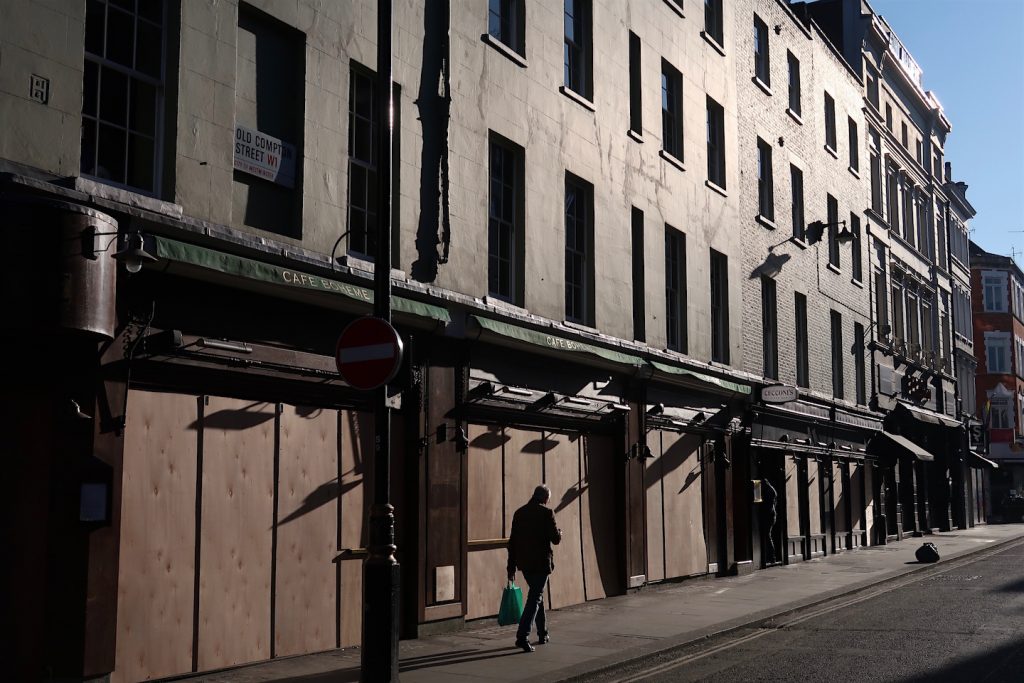
Yesterday marked 120 days straight that I’ve been cycling around London, taking photos of the coronavirus lockdown — and, in recent weeks, its partial easing — and posting a photo a day on ‘The State of London’ Facebook and Twitter pages.
I first began cycling around London on a daily basis, taking photos for a photo-journalism project that I soon named ‘The State of London’, over eight years ago, in May 2012, and on the fifth anniversary I began posting a photo a day on Facebook. Until the coronavirus hit, the photos I posted were drawn from the various years since I began the project — on that particular day, but from any of the years since the project began in 2012.
When the coronavirus hit, however — and particularly after the lockdown officially began on March 23 — the archive suddenly seemed, if not irrelevant, then relating to another, lost time, as the streets of the capital emptied, and economic activity ground almost to a halt.
If Elected in November, Will Joe Biden Close Guantánamo?

Please support my work as a reader-funded journalist! I’m currently trying to raise $2500 (£2000) to support my writing and campaigning on Guantánamo and related issues over the next three months of the Trump administration. If you can help, please click on the button below to donate via PayPal.
I wrote the following article for the “Close Guantánamo” website, which I established in January 2012, on the 10th anniversary of the opening of Guantánamo, with the US attorney Tom Wilner. Please join us — just an email address is required to be counted amongst those opposed to the ongoing existence of Guantánamo, and to receive updates of our activities by email.
With just four months to go until the US Presidential Election, there is hope, in some quarters, that Donald Trump will lose to Joe Biden. The fact that this is not a foregone conclusion shows how broken American politics has become. Openly racist, Trump has been the most incoherent president imaginable, and is currently mired in a COVID-19 crisis of his own making, as the virus continues on its deadly path, largely unchecked, through swathes of the US population. And yet he retains a base of support that doesn’t make it certain that he will lose in November.
His opponent, Joe Biden, Barack Obama’s vice president for eight years, faces problems of his own. 77 years old, he is even older than Trump, and in terms of representing the people of the US, it is somewhat dispiriting that the choice is between two white men in their 70s. Nevertheless, on many fronts — not least on Guantánamo — it is inconceivable that Biden can do a worse job than Trump has over the excruciating three and a half years since he took office in January 2017.
On Guantánamo, Trump announced in a tweet, several weeks before his inauguration, that “there must be no more releases from Gitmo,” and he has been almost entirely true to his word. He inherited 41 prisoners from Obama, and only one of those men has been released — a Saudi citizen who was transferred back to Saudi Arabia for ongoing imprisonment in February 2018, to honor a plea deal agreed in his military commission trial in 2014.
“I Can’t Breathe”: Afghan Prisoner Asadullah Haroon Gul on Black Lives Matter and Violent Oppression in Guantánamo

Please support my work as a reader-funded journalist! I’m currently trying to raise $2500 (£2000) to support my writing and campaigning on Guantánamo and related issues over the next three months of the Trump administration. If you can help, please click on the button below to donate via PayPal.
Over the last few months I’ve cross-posted, on two occasions, articles by Asadullah Haroon Gul, an Afghan prisoner in Guantánamo who is seeking the support of his government in securing his release — A Coronavirus Lament by Guantánamo Prisoner Asadullah Haroon Gul and Asadullah Haroon Gul, a “No-Value Detainee,” and One of the Last Two Afghans in Guantánamo, Asks to Be Freed — and below I’m cross-posting a third, written in response to the reawakening of the Black Lives Matter movement, following the murder of George Floyd in Minneapolis, and originally published in Newsweek. In it, Gul takes George Floyd’s dying words, “I can’t breathe,” and draws parallels with the brutal treatment of prisoners in Guantánamo, himself included, expressing support for Black Lives Matter and hoping that, like the civil rights movement, it will bring significant change.
As he states, “America’s business is not my business but if human beings anywhere are struggling for justice, I must support them even from my cell in Guantánamo Bay. Perhaps my brothers and sisters marching in the streets will turn their eyes on this island prison, and witness our common cause.”
One of the last prisoners to arrive at Guantánamo, in June 2007, Gul was apparently seized because of his alleged involvement with Hezb-e-Islami Gulbuddin (HIG), led by the warlord Gulbuddin Hekmatyar, who had supported Al-Qaeda at the time of the US-led invasion. Gul very clearly had no meaningful connection with HIG, his involvement extending only to having lived, with his wife and family, in a refugee camp that HIG ran, but, as in so many cases of mistaken identity at Guantánamo, the US authorities didn’t care.
The Four Fathers Release New Existential Song ‘The Wheel of Life’, As Bandcamp Waives Its Revenue Share to Help Musicians

My band The Four Fathers have just released the last of three songs we recorded before the coronavirus hit, with the multi-talented musician and producer Charlie Hart, whose illustrious career involves playing with Ian Dury in Kilburn and the High Roads, many years with Ronnie Lane, after he left the Faces, in Slim Chance, and several occasions spent working with the wonderful Congolese singer Samba Mapangala.
The release is ‘The Wheel of Life’, a meditation on aging, and on the importance of living in the moment, which I hope has some resonance right now, as we all try to cope with the impact of the novel coronavirus, COVID-19, which brought our thoughtlessly excessive lifestyles to an abrupt halt three months ago, but which has also precipitated a forthcoming recession of possibly terrifying proportions, as well as silencing all forms of culture that involves live interaction at close quarters.
Live music is just one the casualties of this strange new world, and while we try to work out how to resume entertaining one another in a live context, creative people are suffering. In an attempt to help, Bandcamp, the US online music service, which we use in preference to streaming companies, has been waiving its fees on specific days throughout the coronavirus lockdowns, starting on March 20, when music fans spent “$4.3 million on music and merch — 15x the amount of a normal Friday — helping artists cover rents, mortgages, groceries, medications, and so much more”, and followed by May 1, when fans paid artists $7.1 million, and June 5, when fans paid artists $4.8 million.










 Who's still at Guantánamo?
