Archive for June, 2010
New Report Reveals How Bush Torture Program Involved Human Experimentation
 In a 27-page report, “Experiments in Torture: Human Subject Research and Evidence of Experimentation in the ‘Enhanced’ Interrogation Program” (available here), the organization Physicians for Human Rights has brought into sharp focus the role played by US medical personnel in torture and human experimentation. As the introduction on PHR’s website states, this is “the first report to reveal evidence indicating that CIA medical personnel allegedly engaged in the crime of illegal experimentation after 9/11, in addition to the previously disclosed crime of torture. In their attempt to justify the war crime of torture, the CIA appears to have committed another alleged war crime — illegal experimentation on prisoners.”
This important report, which follows research undertaken by, amongst others, Jeff Kaye and Marcy Wheeler, deserves thorough coverage, and as I don’t have time to write my own analysis, I’m cross-posting below a very useful article published on Truthout by my colleague Jason Leopold, which analyzes the report, puts it in context, links to the work of Jeff Kaye, Marcy Wheeler and others, and also expands on the significance of the human experimentation program in the torture of the supposed “high-value detainee” Abu Zubaydah, about whom both Jason and I have written at length.
Human Experimentation at the Heart of Bush Administration’s Torture Program
By Jason Leopold, Truthout, June 6, 2010
High-value detainees captured during the Bush administration’s “war on terror” who were subjected to brutal torture techniques were part of a Nazi Germany-type program involving illegal human experimentation, the purpose of which was to collect research “data,” according to a disturbing new report that calls on President Barack Obama, Congress and other government agencies to immediately launch inquiries and Attorney General Eric Holder to investigate the allegations.
The findings contained in the 27-page report, “Experiments in Torture: Human Subject Research and Evidence of Experimentation in the ‘Enhanced’ Interrogation Program,” is based on extensive research of previously declassified government documents that shows the crucial role medical personnel played in establishing and justifying the legality of the Bush administration’s torture program.
The report said the research and experimentation of detainees its authors have documented is not only a violation of the Geneva Conventions, but is a grave breach of international laws, such as the Nuremberg Code, established after atrocities committed by Nazis were exposed in the aftermath of World War II.
“Health professionals working for and on behalf of the CIA monitored the interrogations of detainees, collected and analyzed the results of [the] interrogations, and sought to derive generalizable inferences to be applied to subsequent interrogations,” states an executive summary of the report, prepared by Physicians for Human Rights. “Such acts may be seen as the conduct of research and experimentation by health professionals on prisoners, which could violate accepted standards of medical ethics, as well as domestic and international law. These practices could, in some cases, constitute war crimes and crimes against humanity.”
For example, PHR said the drowning method known as waterboarding was monitored in early 2002 by medical personnel who collected data about how detainees responded to the torture technique. The data was then given to Steven Bradbury, the former head of the Justice Department’s Office of Legal Counsel (OLC), who used it to write a legal opinion in 2005 advising CIA interrogators on how to administer the technique, referred to in the PHR report as “Waterboarding 2.0.”
“According to the Bradbury memoranda, [CIA Office of Medical Services] teams, based on their observation of detainee responses to waterboarding, replaced water in the waterboarding procedure with saline solution ostensibly to reduce the detainees’ risk of contracting pneumonia and/or hyponatremia, a condition of low sodium levels in the blood caused by free water intoxication, which can lead to brain edema and herniation, coma, and death,” the report says. In Bradbury’s torture memo, he wrote that “based on advice of medical personnel, the CIA requires that saline solution be used instead of plain water to reduce the possibility of hyponatremia (i.e. reduced concentration of sodium in the blood) if the detainee drinks the water.”
PHR noted that the presence of CIA medical personnel during the waterboarding sessions “could represent evidence of human experimentation” because it underscores “the danger and harm inherent in the practice of waterboarding and the enlistment of medical personnel in an effort to disguise a universally recognized tactic as a ‘safe, legal and effective’ interrogation tactic.”
CIA medical personnel also obtained experimental research data by subjecting more than 25 detainees to a combination of torture techniques, including sleep deprivation, according to the report, as a way of understanding “whether one type of application over another would increase the subjects’ susceptibility to severe pain.” The information derived from the research informed “subsequent [torture] practices.”
“This investigation had no direct clinical health care application, nor was it in the detainees’ personal interest, nor part of their medical management,” the report says. “It appears to have been used primarily to enable the Bush administration to assess the legality of the tactics, and to inform medical monitoring policy and procedure for future application of the techniques.”
The torture methods used on detainees derived from the Army and Air Force survival training program called Survival, Evasion, Resistance and Escape (SERE), which was meant to prepare US soldiers for abuse they might suffer if captured by an outlaw regime.
PHR and other human rights groups plan on filing a complaint this week with the Department of Health and Human Services’ Office for Human Research Protections (OHRP) demanding the agency launch a probe into the CIA’s Office of Medical Services. Additionally, the group wants the Justice Department’s ethics watchdog, the Office of Professional Responsibility, to launch a separate investigation.
OPR recently concluded a four-year long investigation into the legal work former OLC attorneys John Yoo, now a Berkeley law professor, and Jay Bybee, a federal appeals court judge on the 9th Circuit, did when drafting the August 2002 torture memos. [The report] concluded both men violated professional standards when they issued their legal opinions that allowed CIA officers to use brutal methods when interrogating suspected terrorists and recommended [they] be referred to their state bar associations to face possible disbarment.
The judgment was softened by career prosecutor David Margolis, who was put in charge of the final recommendations and who said he was “unpersuaded” by OPR’s “misconduct” conclusion, which faulted Yoo and Bybee for their approval of brutal interrogation techniques that were used against terrorism suspects after the 9/11 attacks.
And despite the new revelations about the Bush administration’s torture program that seem to surface regularly, Obama still refuses to allow for war crimes investigations, saying he still prefers to “look forwards, and not backwards” when it comes to Bush administration’s crimes.
Case in point, last March, during an interview with a reporter for an Indonesian television station, Obama was asked whether he was satisfied with the way Indonesia dealt with its past human rights abuses.
The president’s response was stunning, to say the least.
“We have to acknowledge that those past human rights abuses existed,” Obama said in the interview. “We can’t go forward without looking backwards.”
Stephen Soldz, a psychoanalyst and one of the authors of the PHR report, said “it is important to realize that the logic used by the Obama administration to refuse an investigation of torture claims — that the torture memos allowed the torturers to believe their actions were legally sanctioned — does not apply to potential research on detainees.”
“As far as is publicly known, there exist no ‘torture research’ memos authorizing ignoring laws and regulations prohibiting research on torture techniques,” Soldz said.
Frank Donaghue, PHR’s chief executive officer, said the report released by his organization appears to demonstrate that the CIA violated “all accepted legal and ethical standards put in place since the Second World War to protect prisoners from being the subjects of experimentation.”
“Not only are these alleged acts gross violations of human rights law, they are a grave affront to America’s core values,” he added.
Rev. Richard Killmer, executive director of the the National Religious Campaign Against Torture, said PHR’s findings “recalls some of humanity’s darkest days –charges from which no person of faith can afford to turn away.”
As expected, the CIA denied the report’s assertions. Spokesman Paul Gimigliano said the agency, “as part of its past detention program, [did not] conduct human subject research on any detainee or group of detainees.”
But Gimigliano’s denials are contradicted by dozens of former intelligence and national security officials who, as recently as last March, said detainees were experimented on.
Indeed, the conclusions the report’s authors reached in the area of sleep deprivation confirm several recent investigative reports published by Truthout related to the torture and experimentation the Bush administration’s first high-value detainee, Abu Zubaydah, was subjected to after he was captured in March 2002.
A former National Security official knowledgeable about the Bush administration’s torture program previously told Truthout that Zubaydah was “an experiment … a guinea pig” used so CIA contractors could obtain data. The data was then shared with officials at the CIA and the Justice Department, who used that information to draft the August 2002 torture memos stating what interrogation methods could be legally used, how often the methods could be employed and how it should be administered without crossing the line into torture.
The PHR report does not identify Zubaydah by name.
In March, Truthout reported, based on interviews with more than two dozen intelligence and national security officials, that one of the main reasons Zubaydah’s torture sessions were videotaped was to gain insight into his “physical reaction” to the techniques used against him.
For example, one current and three former CIA officials said some videotapes showed Zubaydah being sleep deprived for more than two weeks. Contractors hired by the CIA studied how he responded psychologically and physically to being kept awake for that amount of time. By looking at videotapes, they concluded that after the 11th consecutive day of being kept awake Zubaydah started to “severely break down.” So, the torture memo signed by Bybee concluded that 11 days of sleep deprivation was legal and did not meet the definition of torture.
PHR’s analysis on sleep deprivation concluded, based on a review of documents, that “government lawyers used observational data collected by health professionals from varying applications of sleep deprivation to inform legal evaluations regarding the risk of inflicting certain levels of harm on the detainee, and to shape policy that would guide further application of the technique.”
The report also determined that the experimentation helped create a framework to protect the torturers from war crimes and other charges.
“OLC lawyers argued that efforts to refine and improve the application of techniques would provide a potential ‘good faith’ defense for interrogators against charges of torture,” the report said. “They argued that such a medical monitoring regime would remove the element of intent to cause harm from the act, which is a necessary requirement for a successful prosecution of a torture charge under US law, and that a ‘good faith belief need not be a reasonable belief; it need only be an honest belief.’ Thus, research on the detainees became a key part of the OLC legal strategy to demonstrate the lack of intent to commit torture.”
Nathaniel Raymond, director of PHR’s Campaign Against Torture, said, “Justice Department lawyers appear to have never assessed the lawfulness of the alleged research on detainees in CIA custody, despite how essential it appears to have been to their legal cover for torture.”
Brent Mickum, Zubaydah’s attorney, said PHR’s report is evidence that there was an “experimental element to the torture program and it was approved at the highest levels of government.”
“I have said literally for years that I believe my client was tortured before any of these enhanced interrogation techniques were approved by the Justice Department,” Mickum told Truthout. “And now we know that not only was my client subjected to torture but he was part of an experiment. This is so ugly, so shameful, so unlawful. If this revelation doesn’t kick in an obligation on the part of the Department of Justice to investigate war crimes than I don’t know what does. The Obama administration has essentially refused to do that. At some point, the Obama administration has to take seriously what their obligations are under the law.”
Mickum said he is preparing to file a series of motions in federal court calling for the preservation of documents based on the conclusions contained in PHR’s report.
For those who have closely followed the details that have surfaced over the years related to the Bush administration’s torture program, a chunk of the information contained in the report related to human experimentation that has already been painstakingly documented by Marcy Wheeler at her blog Emptywheel, and Truthout’s own Jeffrey Kaye on his blog Invictus and in articles published on this website and at Firedoglake.
In her analysis, Wheeler focused on a section of the report dealing with revisions the Bush administration made in 2006 to the War Crimes Act (WCA), which “retroactively changed[d] the law on human experimentation [so] that experimentation no longer needed to have a personal benefit to the research subject, and could instead be justified because of a ‘legitimate’ interest.”
According to PHR’s report, “the new language of the WCA added two qualifications that appear to have lowered the bar on biological experimentation on prisoners.”
“That language requires that the experiment have a ‘legitimate’ purpose, but does not require that it be carried out in the interest of the subject,” the report noted. “It also adds the requirement that the experiment not ‘endanger’ the subject, which appears to raise the threshold for what will be considered illegal biological experimentation.”
PHR has called on Congress to amend the law.
In his coverage of the PHR report, Kaye wrote that one of the “various threads left dangling” he remains most concerned about involves “the links between the SERE research undertaken by investigators led by Dr. Charles A. Morgan and the CIA experimental torture program, as reported in an appendix to PHR’s report.”
“PHR describes the SERE research undertaken during the years prior to the issuance of the OLC memos, and explains that the results of that research demonstrated how the risk of harm was inherent in the SERE techniques,” wrote Kaye, who has reported extensively on Morgan’s connections to the CIA’s “enhanced interrogation techniques.” “In addition, [the report notes], ‘the experimental framework of these studies intentionally or unintentionally laid the groundwork for unethical and illegal human experimentation that would follow.’”
Meanwhile, Obama’s presence in the White House has not resulted in an abandonment of the research side of the interrogation program.
Last March, Director of National Intelligence Dennis Blair, who recently resigned, disclosed that the Obama administration’s High-Value Detainee Interrogation Group (HIG), planned on conducting “scientific research” to determine “if there are better way to get information from people that are consistent with our values.”
“It is going to do scientific research on that long-neglected area,” Blair said during testimony before the House Intelligence Committee. He did not provide additional details as to what the “scientific research” entailed.
Note: For further information, see this BoingBoing interview with Dr. Scott Allen, the lead medical author of the report, who is co-director of the Center For Prisoner Health and Human Rights at Brown University, and Medical Advisor to PHR.
 Andy Worthington is the author of The Guantánamo Files: The Stories of the 774 Detainees in America’s Illegal Prison (published by Pluto Press, distributed by Macmillan in the US, and available from Amazon — click on the following for the US and the UK). To receive new articles in your inbox, please subscribe to my RSS feed (and I can also be found on Facebook and Twitter). Also see my definitive Guantánamo prisoner list, updated in January 2010, details about the new documentary film, “Outside the Law: Stories from Guantánamo” (co-directed by Polly Nash and Andy Worthington, and currently on tour in the UK), my definitive Guantánamo habeas list, and, if you appreciate my work, feel free to make a donation.
For a sequence of articles dealing with the use of torture by the CIA, on “high-value detainees,” and in the secret prisons, see: Guantánamo’s tangled web: Khalid Sheikh Mohammed, Majid Khan, dubious US convictions, and a dying man (July 2007), Jane Mayer on the CIA’s “black sites,” condemnation by the Red Cross, and Guantánamo’s “high-value” detainees (including Khalid Sheikh Mohammed) (August 2007), Waterboarding: two questions for Michael Hayden about three “high-value” detainees now in Guantánamo (February 2008), Six in Guantánamo Charged with 9/11 Murders: Why Now? And What About the Torture? (February 2008), The Insignificance and Insanity of Abu Zubaydah: Ex-Guantánamo Prisoner Confirms FBI’s Doubts (April 2008), Guantánamo Trials: Another Torture Victim Charged (Abdul Rahim al-Nashiri, July 2008), Secret Prison on Diego Garcia Confirmed: Six “High-Value” Guantánamo Prisoners Held, Plus “Ghost Prisoner” Mustafa Setmariam Nasar (August 2008), Will the Bush administration be held accountable for war crimes? (December 2008), The Ten Lies of Dick Cheney (Part One) and The Ten Lies of Dick Cheney (Part Two) (December 2008), Prosecuting the Bush Administration’s Torturers (March 2009), Abu Zubaydah: The Futility Of Torture and A Trail of Broken Lives (March 2009), Ten Terrible Truths About The CIA Torture Memos (Part One), Ten Terrible Truths About The CIA Torture Memos (Part Two), 9/11 Commission Director Philip Zelikow Condemns Bush Torture Program, Who Authorized The Torture of Abu Zubaydah?, CIA Torture Began In Afghanistan 8 Months before DoJ Approval, Even In Cheney’s Bleak World, The Al-Qaeda-Iraq Torture Story Is A New Low (all April 2009), Ibn al-Shaykh al-Libi Has Died In A Libyan Prison , Dick Cheney And The Death Of Ibn al-Shaykh al-Libi, The “Suicide” Of Ibn al-Shaykh al-Libi: Why The Media Silence?, Two Experts Cast Doubt On Ibn al-Shaykh al-Libi’s “Suicide”, Lawrence Wilkerson Nails Cheney On Use Of Torture To Invade Iraq, In the Guardian: Death in Libya, betrayal by the West (in the Guardian here), Lawrence Wilkerson Nails Cheney’s Iraq Lies Again (And Rumsfeld And The CIA) (all May 2009) and WORLD EXCLUSIVE: New Revelations About The Torture Of Ibn al-Shaykh al-Libi (June 2009), The Logic of the 9/11 Trials, The Madness of the Military Commissions (November 2009), UK Judges Compare Binyam Mohamed’s Torture To That Of Abu Zubaydah (November 2009), UN Secret Detention Report Asks, “Where Are The CIA Ghost Prisoners?” (January 2010), Binyam Mohamed: Evidence of Torture by US Agents Revealed in UK (February 2010). Also see the extensive archive of articles about the Military Commissions, and articles detailing findings of torture in the habeas corpus petitions of a number of Guantánamo prisoners.
No Escape from Guantánamo: Uighurs Lose Again in US Court
 In 2002, when Guantánamo opened, 22 Uighurs (Muslims from China’s oppressed Xinjiang province) were held in the prison, even though interrogators in Afghanistan (where the prisoners were processed for Guantánamo) had already realized that they had no connection to al-Qaeda or the Taliban. The men were mostly seized by Pakistani villagers and sold to US forces after fleeing a settlement in Afghanistan, where they had ended up either because they had found it impossible to travel to Turkey, where some had hoped to find work, or because they nursed futile hopes of rising up against the Chinese government, whose oppression of the Uighurs was distressingly revealed to the world last July.
Over the years, the Uighurs became pawns in the Bush administration’s diplomatic relations with the Chinese government, but were mostly cleared for release after military tribunals and review boards concluded that they were innocent men, seized by mistake. Five were released in May 2006, given new homes in a refugee camp in Albania, the only country that would accept them, but the remaining 17 languished until their habeas corpus petitions reached a US court in October 2008, and Judge Ricardo Urbina granted their petitions and ordered their release into the United States. Judge Urbina concluded that their continued detention was unconstitutional, and that the US had an obligation to accept them because there were legitimate fears that they would be tortured if returned to China, and also because no other country had been found that was prepared to take them.
In response, the Bush administration appealed, and when President Obama came to power he maintained the same position. In February 2009, with the backing of Obama’s Justice department, the Court of Appeals refused to accept the implications of Judge Urbina’s position, reversing his ruling and concluding that questions relating to immigration — even those posed by men who had been wrongly imprisoned for eight years, and had won a habeas petition — were for the Executive, and not the court, to decide.
Judge A. Raymond Randolph (who defended every Bush decision about the Guantánamo prisoners that was subsequently overturned by the Supreme Court) and Judge Karen LeCraft Henderson held that it was within “the exclusive power of the political branches to decide which aliens may, and which aliens may not, enter the United States, and on what terms,” despite dissent from the third judge, Judith W. Rogers.
Although Judge Rogers concurred in the judgment (because the government had, at the time of Judge Urbina’s ruling, not stated its position regarding matters relating to immigration), she was deeply critical of her colleagues’ decision to undermine the Supreme Court ruling in Boumediene v. Bush, in June 2008, which granted the prisoners constitutionally guaranteed habeas corpus rights. In her dissenting opinion, Judge Rogers reiterated that the Supreme Court held that prisoners in Guantánamo are “entitled to the privilege of habeas corpus to challenge the legality of their detentions,” and that a “habeas court must have the power to order the conditional release of an individual unlawfully detained.” She also declared:
Today the court nevertheless appears to conclude that a habeas court lacks authority to order that a non-“enemy combatant” alien be released into the country (as distinct from be admitted under the immigration laws) when the Executive can point to no legal justification for detention and to no foreseeable path of release. I cannot join the court’s analysis because it is not faithful to Boumediene and would compromise both the Great Writ as a check on arbitrary detention and the balance of powers over exclusion and admission and release of aliens into the United States recognized by the Supreme Court to reside in the Congress, the Executive and the habeas court.
Within the administration, one man — White House Counsel Greg Craig — recognized that this was not only unjust, but also that hopes of persuading other countries to accept cleared prisoners who, like the Uighurs, feared repatriation because of the risk of torture, would be imperiled if America refused to take any of these men. Last spring, Craig was close to finalizing a plan to bring some of the men to live in the US, but President Obama capitulated to critics and abandoned the plan, and lawmakers — no doubt partly emboldened by the President’s willingness to cave in on matters relating to Guantánamo — subsequently passed legislation preventing Guantánamo prisoners from being brought to the US for any reason other than to face trials.
Following the ruling in the Court of Appeals, the Uighurs’ lawyers appealed to the Supreme Court, prompting a frantic, and, frankly, cynical effort by the administration to find new homes for the men. Four were taken by Bermuda in June last year, another six accepted an offer by the Pacific island state of Palau, arriving there on October 31, and two others were taken in by Switzerland in January this year.
However, the five remaining men had turned down Palau’s offer, because of fears that it was too close to China for comfort, and also because of a recognition that, as the Uighurs in Palau have realized, they would be culturally and socially stranded in Palau, where there is no Uighur community.
Nevertheless, the offer by Palau was enough for the Supreme Court to turn down the Uighurs’ case in March. Although the Court vacated the February 2009 ruling by the Court of Appeals, denying access to the US for any Guantánamo prisoner (even those who have won their habeas petitions), the justices sent the case back to the lower courts, and on May 28, as through time had stood still for 15 months, the same Court of Appeals essentially reinstated its former opinion, ruling (PDF), as SCOTUSblog described it, “that the courts have no role to play in deciding whether any non-citizen will be allowed to enter the United States.” As SCOTUSblog also explained, “Thus, the Circuit Court reinstated without change in substance a prior ruling that the Supreme Court had previously agreed to review.”
In truth, it was always obvious that a second review by the Court of Appeals would fail, because the Uighurs’ circumstances have changed since February 2009. As Judges Randolph and Henderson noted, the men have received three resettlement offers in the last 16 months, including at least one offer from Palau and another from an unidentified country, and their attempts to persuade the court to rule on whether these offers were “appropriate” fell on deaf ears, with the judges pointing out that, as their original opinion indicated, “even if petitioners had good reason to reject the offers they would have no right to be released into the United States,” and reasserting that “it is for the political branches, not the courts, to determine whether a foreign country is appropriate for resettlement.”
This, disturbingly, went further in handing the government the power to decide what to do with the men than the government’s own lawyers asserted, as the Obama administration has always maintained that, “As a matter of course, the United States will obtain petitioners’ consent prior to resettlement,” but it was consistent with a ruling delivered by the court in a second case relating to the Uighurs, which I discussed last September, in an article entitled, “Court Allows Return of Guantánamo Prisoners to Torture.”
The judges also relied on the fact that, since February 2009, when they “had heard only from the Executive Branch … the Legislative Branch has spoken,” and that, “In seven separate enactments — five of which remain in force today — Congress has prohibited the expenditure of any funds to bring any Guantánamo detainee to the United States.” Denying the Uighurs’ claim that the statutes “violate the Suspension Clause of the Constitution” (which guarantees the right to habeas corpus, “unless when in cases of rebellion or invasion the public safety may require it”), the judges reiterated that the right to habeas does not guarantee the remedy of release into the United States, noting that “the statutes suspend nothing; petitioners never had a constitutional right to be brought to this country and released.”
As in February 2009, it was left to Judge Rogers to dissent. Although she again concurred in the judgment, this time because of the offers of “appropriate” places of resettlement, she made a point of asserting that, although the men’s original claim, when no country had offered them resettlement, “has been overtaken by events,” Judges Randolph and Henderson once more went further than was necessary in handing powers to the Executive branch. “[I]t is no longer necessary to opine as broadly as the majority does by reinstating its opinion of February 18, 2009,” Judge Rogers wrote, adding, pointedly, “That opinion was overbroad to begin with, as pointed out in my separate concurrence, which must, as a result, also be reinstated, acknowledging certain new developments.”
Although Judge Rogers’ partial dissent does not necessarily help the Uighurs, because she noted that, as a result of the resettlement offers, they “hold the keys to their release from Guantánamo,” it is nevertheless significant that she reiterated her opposition to the majority’s “overbroad” assertion of Executive power, reminding her fellow judges that the question of whether “a habeas court may have the authority to order release is a separate question from whether that court is obligated to order release.”
What will happen next, however, is at present unknown. With the retirement of Justice John Paul Stevens, it is unlikely that any further attempt to secure Supreme Court review will succeed, because Justice Stevens’ intended successor, Solicitor General Elena Kagan, who has been involved in the case on the government’s side, would have to recuse herself, and the court would therefore split 4-4, handing victory to the government.
As a result, the Court of Appeals ruling hurls the five remaining Uighurs back into a legal limbo that might only be resolved if they decide to revisit Palau’s offer, joining their compatriots, who, as I explained in a recent article, are grateful to Palau for helping them escape from Guantánamo, but are still anxious to find a country where they can truly begin to rebuild their lives, and are hoping that an appeal to Australia — lodged by President Johnson Toribiong, who has asked the Australian government to offer them permanent settlement — will be successful, and will allow them, as their lawyers pointed out to the Court of Appeals, to fulfill their “desire for citizenship, ownership of property, cultural affinity, and employment.”
Nevertheless, eight and a half years after they were first seized by mistake, it is apparent that, in the cases of the Uighurs, political maneuvering — and not justice — dictates what will happen to them, and in this, all of those involved in the United States — the Obama administration, lawmakers in Congress, and the Court of Appeals in Washington D.C., with its penchant for upholding the kind of far-reaching claims for executive power that President Bush embraced — ought to be deeply ashamed. In this whole sordid story, only Special Envoy Daniel Fried, who has worked tirelessly to find new homes for the men, and former White House Counsel Greg Craig, who came close to rehousing the men on the US mainland, emerge with any integrity.
Andy Worthington is the author of The Guantánamo Files: The Stories of the 774 Detainees in America’s Illegal Prison (published by Pluto Press, distributed by Macmillan in the US, and available from Amazon — click on the following for the US and the UK). To receive new articles in your inbox, please subscribe to my RSS feed (and I can also be found on Facebook and Twitter). Also see my definitive Guantánamo prisoner list, updated in January 2010, details about the new documentary film, “Outside the Law: Stories from Guantánamo” (co-directed by Polly Nash and Andy Worthington, and currently on tour in the UK), my definitive Guantánamo habeas list, and, if you appreciate my work, feel free to make a donation.
Cross-posted on Countercurrents and Uruknet.
For a sequence of articles dealing with the Uighurs in Guantánamo, see: The Guantánamo whistleblower, a Libyan shopkeeper, some Chinese Muslims and a desperate government (July 2007), Guantánamo’s Uyghurs: Stranded in Albania (October 2007), Former Guantánamo detainee seeks asylum in Sweden (November 2007), A transcript of Sabin Willett’s speech in Stockholm (November 2007), Support for ex-Guantánamo detainee’s Swedish asylum claim (January 2008), A Chinese Muslim’s desperate plea from Guantánamo (March 2008), Former Guantánamo prisoner denied asylum in Sweden (June 2008), Six Years Late, Court Throws Out Guantánamo Case (June 2008), Guantánamo as Alice in Wonderland (July 2008), From Guantánamo to the United States: The Story of the Wrongly Imprisoned Uighurs (October 2008), Guantánamo Uyghurs’ resettlement prospects skewered by Justice Department lies (October 2008), A Pastor’s Plea for the Guantánamo Uyghurs (October 2008), Guantánamo: Justice Delayed or Justice Denied? (October 2008), Sabin Willett’s letter to the Justice Department (November 2008), Will Europe Take The Cleared Guantánamo Prisoners? (December 2008), A New Year Message to Barack Obama: Free the Guantánamo Uighurs (January 2009), Guantanamo’s refugees (February 2009), Bad News And Good News For The Guantánamo Uighurs (February 2009), A Letter To Barack Obama From A Guantánamo Uighur (March 2009), Obama’s First 100 Days: A Start On Guantánamo, But Not Enough (May 2009), Pain At Guantánamo And Paralysis In Government (May 2009), Guantánamo: A Prison Built On Lies (May 2009), Guantánamo: A Real Uyghur Slams Newt Gingrich’s Racist Stupidity (May 2009), Free The Guantánamo Uighurs! (May 2009), Who Are The Four Guantánamo Uighurs Sent To Bermuda? (June 2009), Guantánamo’s Uighurs In Bermuda: Interviews And New Photos (June 2009), Andy Worthington Discusses Guantánamo on Democracy Now! (June 2009), Guantánamo And The Courts (Part One): Exposing The Bush Administration’s Lies (July 2009), Is The World Ignoring A Massacre of Uighurs In China? (July 2009), Chair Of The American Conservative Union Supports The Guantánamo Uighurs (July 2009), Three Uighurs Talk About Chinese Interrogation At Guantánamo (July 2009), House Threatens Obama Over Chinese Interrogation Of Uighurs In Guantánamo (July 2009), A Profile of Rushan Abbas, The Guantánamo Uighurs’ Interpreter (August 2009), A Plea To Barack Obama From The Guantánamo Uighurs (August 2009), Court Allows Return Of Guantánamo Prisoners To Torture (September 2009), Finding New Homes For 44 Cleared Guantánamo Prisoners (October 2009), Justice At Last? Guantánamo Uighurs Ask Supreme Court For Release Into US (October 2009), Senate Finally Allows Guantánamo Trials In US, But Not Homes For Innocent Men (October 2009), Six Uighurs Go To Palau; Seven Remain In Guantánamo (October 2009), Who Are The Six Uighurs Released From Guantánamo To Palau? (November 2009), Guantánamo Uighurs In Palau: First Interview And Photo (November 2009), Guantánamo: Idealists Leave Obama’s Sinking Ship (December 2009), Swiss Take Two Guantánamo Uighurs, Save Obama from Having to Do the Right Thing (February 2010), Guantánamo Uighurs Back in Legal Limbo (March 2010), More Dark Truths from Guantánamo, as Five Innocent Men Released (April 2010), and the stories in the additional chapters of The Guantánamo Files: Website Extras 1, Website Extras 6 and Website Extras 9.
Palau President Asks Australia to Offer Homes to Guantánamo Uighurs
 On Radio Australia’s show “Pacific Beat,” reporter Sean Dorney traveled to the small Pacific island nation of Palau to discuss an appeal to the Australian government, made by Palau’s President Johnson Toribiong, asking Prime Minister Kevin Rudd to accept for permanent resettlement six Uighurs (Muslims from China’s oppressed Xinjiang province), who were cleared for release from Guantánamo by a US court in October 2008, and given temporary residence in Palau on October 31 last year.
I have written about the Uighurs at length over the last few years (see the links at the foot of this article), and share President Toribiong’s concerns that, although they have been freed from Guantánamo, they are culturally and socially stranded in Palau, where there is no Uighur community. My hope is that the Australian government will indeed offer them permanent resettlement in Australia, where there is a 2,000-strong Uighur community, and will follow the example of Bermuda and Switzerland, which have both given Uighurs from Guantánamo a permanent home, despite opposition from the Chinese government.
I acknowledge, however, that this remains a remote possibility, given that a hundred countries contacted by the US State Department refused to take the Uighurs. Primarily, this is because of the importance of friendly relations with China to the majority of the countries involved, to which Palau — which deals with Taiwan rather than China — is immune.
Sean Dorney (voice-over): Most Australians who go to Palau do so for the spectacular diving around Palau’s hundreds and hundreds of scattered idyllic islets known as the Rock Islands. But a three-year old Australian Uighur girl, Khadecha, and her five-year old sister, Sabeha, have come to Palau to claim a new father. Their late father died in a drowning accident back in Australia.
Their new stepfather is Adham Nabi, who spent eight years in Guantánamo Bay. In recent weeks, though, he has married their mother, an Australian Uighur woman whose uncle brought her to Palau for the wedding. The six Uighurs who have been in Palau since November were keen to hear what the President of Palau, Johnson Toribiong, had told me in an interview a few days earlier.
President Toribiong: When they first arrived I think they felt for the first time after seven or eight years the enjoyment of individual freedom, physical freedom from physical confinement. They are free here but we don’t have a Uighur community here. And as you know being physically free is not enough. You must have social relationships. One just got married recently to a lady from Australia who’s a Uighur. And others are trying to connect with other Uighurs from all over the world and I can understand that. I mean, they lost seven years during the prime of their lives and they want to have families. And they yearn to go to a community where they can enjoy social relations with their own people.
Sean Dorney: Why would you like to go to Australia?
Abdulghappar Abdulrahman: We need to go to Australia because Australia is a big country. If we go to Australia we feel we will be safe. And in Australia there are Muslims and a Uighur community. Palau is a very small country, no Uighurs. There are no Uighurs.
Sean Dorney (voice-over): Abdulghappar Abdulrahman says they fled their homeland into Pakistan because of oppression.
Abdulghappar Abdulrahman: In Turkestan what happens, for example, last year there were more Uighurs killed. China militarists killed them.
Ahmad Abdulahad: You know about our country what happened right now. There are no human rights. Always the government are causing suffering to our people.
Sean Dorney (voice-over): Ahmad Abdulahad tells me they got caught when the Chinese declared dissident Uighurs terrorists and, for a while, the Americans agreed. He found the price on his head in Pakistan was five thousand US dollars.
Ahmad Abdulahad: Unfortunately, what happened was September 11, and they took us. But from 2003 to 2009 the American Government pronounced us innocent people but no country would accept us. And we spent eight years, almost eight years we spent in Guantánamo Bay.
President Toribiong: When the United States Special Envoy for President Obama arrived in Palau in May of 2009 — the Special Envoy is named Ambassador Daniel Fried — he brought a request from President Obama asking for Palau to accept temporary resettlement of the Uighurs from Guantánamo Bay detention facility because they’d been declared non-enemy combatants by the Federal Court but they cannot go to the United States.
Sean Dorney (voice-over): When the Uighurs arrived in Palau, they spoke almost no English.
President Toribiong: So we enrolled them at our Palau Community College where they are taking crash courses in the English language.
Sean Dorney (voice-over): The Uighurs do their English language courses five days a week. Although there were no lessons this day they offered to take me to their classroom. Their translator who was hired from Australia for six months by the Americans has now left. They’ve been broken up into two groups and do three hours of lessons, one group in the morning and the other in the afternoon. And they like their English teacher, although she does not speak any Uighur.
Ahmad Abdulahad: She’s very kind to us.
Sean Dorney: Yeah?
Ahmad Abdulahad: She’s a really good teacher.
Sean Dorney (voice-over): The tropical rain prompts a question or two about Australia.
Sean Dorney: Well, some parts of Australia get very little rain. Other parts get quite a bit. But Australia is a very dry place.
One of the Uighurs: Some rivers?
Sean Dorney: A river runs through the middle of Brisbane. And Sydney is based on a harbour.
One of the Uighurs: Right now, over there: Hot? Hot?
Sean Dorney: No, at the moment in Australia it’s quite cold.
Sean Dorney (voice-over): The Uighurs say they are innocent victims caught up in a power play between two superpowers, China and America. China claims they should be sent back to China to face the law because they are members of a terrorist organization, something they flatly reject.
Abdulghappar Abdulrahman: Not, not terrorists! We are simple people.
Sean Dorney: Should anyone in Australia be afraid?
One of the Uighurs: Afraid?
Sean Dorney: Afraid of you?
Abdulghappar Abdulrahman: (Breaks into a smile) No, we are simple people. Why, why this? In Palau everybody [waves and says], “How are you? Good.”
Ahmad Abdulahad: We are peaceful people and we are not criminals. In 2003 the US government announced we are free men. Not the enemy of Americans or any country. But the Chinese Government needed to put us in jail.
Sean Dorney (voice-over): On a trip to the seashore we hear of another problem they have in Palau.
Uighur driver: No more meat, no more halal food, no more halal Muslim restaurant. Cannot eat food outside. For us, difficult.
Sean Dorney (voice-over): And once we reach the jetty the subject of food comes up again.
Abdulghappar Abdulrahman: Sheep. Every time we eat sheep. That’s our custom. There are, in Palau, no more sheep.
Sean Dorney: No.
Abdulghappar Abdulrahman: No more sheep.
Sean Dorney: In Australia there are plenty of sheep.
One of the Uighurs: Yeah.
President Toribiong: I hope Australia will accept them. They’ve been freed from the Guantánamo Bay detention facility. I think Palau is a stepping stone to a country where they can really be free. Not only free but to enjoy the freedom that we all enjoy to live in the free world, to marry, to have friends, to work, to socialise.
Ahmad Abdulahad: Some of us want to get married. And right now we’re beginning our life like from a zero beginning. Beginning life. We don’t have anything. We only have ourselves. And we want to begin our life, our new life.
Sean Dorney (voice-over): The sea and the tropics are quite foreign to these Turkestani men from China’s Xinjiang Uighur Autonomous Province, who hope the future for them lies far away from here down in Australia. And there are two little Australian girls who want to take their new stepfather home with them.
Note: For more information on the Uighurs in Palau, see this February 2010 article in Foreign Policy.
Andy Worthington is the author of The Guantánamo Files: The Stories of the 774 Detainees in America’s Illegal Prison (published by Pluto Press, distributed by Macmillan in the US, and available from Amazon — click on the following for the US and the UK). To receive new articles in your inbox, please subscribe to my RSS feed (and I can also be found on Facebook and Twitter). Also see my definitive Guantánamo prisoner list, updated in January 2010, details about the new documentary film, “Outside the Law: Stories from Guantánamo” (co-directed by Polly Nash and Andy Worthington, and currently on tour in the UK), my definitive Guantánamo habeas list, and, if you appreciate my work, feel free to make a donation.
For a sequence of articles dealing with the Uighurs in Guantánamo, see: The Guantánamo whistleblower, a Libyan shopkeeper, some Chinese Muslims and a desperate government (July 2007), Guantánamo’s Uyghurs: Stranded in Albania (October 2007), Former Guantánamo detainee seeks asylum in Sweden (November 2007), A transcript of Sabin Willett’s speech in Stockholm (November 2007), Support for ex-Guantánamo detainee’s Swedish asylum claim (January 2008), A Chinese Muslim’s desperate plea from Guantánamo (March 2008), Former Guantánamo prisoner denied asylum in Sweden (June 2008), Six Years Late, Court Throws Out Guantánamo Case (June 2008), Guantánamo as Alice in Wonderland (July 2008), From Guantánamo to the United States: The Story of the Wrongly Imprisoned Uighurs (October 2008), Guantánamo Uyghurs’ resettlement prospects skewered by Justice Department lies (October 2008), A Pastor’s Plea for the Guantánamo Uyghurs (October 2008), Guantánamo: Justice Delayed or Justice Denied? (October 2008), Sabin Willett’s letter to the Justice Department (November 2008), Will Europe Take The Cleared Guantánamo Prisoners? (December 2008), A New Year Message to Barack Obama: Free the Guantánamo Uighurs (January 2009), Guantanamo’s refugees (February 2009), Bad News And Good News For The Guantánamo Uighurs (February 2009), A Letter To Barack Obama From A Guantánamo Uighur (March 2009), Obama’s First 100 Days: A Start On Guantánamo, But Not Enough (May 2009), Pain At Guantánamo And Paralysis In Government (May 2009), Guantánamo: A Prison Built On Lies (May 2009), Guantánamo: A Real Uyghur Slams Newt Gingrich’s Racist Stupidity (May 2009), Free The Guantánamo Uighurs! (May 2009), Who Are The Four Guantánamo Uighurs Sent To Bermuda? (June 2009), Guantánamo’s Uighurs In Bermuda: Interviews And New Photos (June 2009), Andy Worthington Discusses Guantánamo on Democracy Now! (June 2009), Guantánamo And The Courts (Part One): Exposing The Bush Administration’s Lies (July 2009), Is The World Ignoring A Massacre of Uighurs In China? (July 2009), Chair Of The American Conservative Union Supports The Guantánamo Uighurs (July 2009), Three Uighurs Talk About Chinese Interrogation At Guantánamo (July 2009), House Threatens Obama Over Chinese Interrogation Of Uighurs In Guantánamo (July 2009), A Profile of Rushan Abbas, The Guantánamo Uighurs’ Interpreter (August 2009), A Plea To Barack Obama From The Guantánamo Uighurs (August 2009), Court Allows Return Of Guantánamo Prisoners To Torture (September 2009), Finding New Homes For 44 Cleared Guantánamo Prisoners (October 2009), Justice At Last? Guantánamo Uighurs Ask Supreme Court For Release Into US (October 2009), Senate Finally Allows Guantánamo Trials In US, But Not Homes For Innocent Men (October 2009), Six Uighurs Go To Palau; Seven Remain In Guantánamo (October 2009), Who Are The Six Uighurs Released From Guantánamo To Palau? (November 2009), Guantánamo Uighurs In Palau: First Interview And Photo (November 2009), Guantánamo: Idealists Leave Obama’s Sinking Ship (December 2009), Swiss Take Two Guantánamo Uighurs, Save Obama from Having to Do the Right Thing (February 2010), Guantánamo Uighurs Back in Legal Limbo (March 2010), More Dark Truths from Guantánamo, as Five Innocent Men Released (April 2010), and the stories in the additional chapters of The Guantánamo Files: Website Extras 1, Website Extras 6 and Website Extras 9.
What is Obama Doing at Bagram? (Part Two): Executive Detention, Rendition, Review Boards, Released Prisoners and Trials
 In the first of two articles about the Obama administration’s detention policies relating to the US airbase at Bagram, Afghanistan, I examined recent revelations about a secret prison inside the base, apparently run by a shadowy branch of the Pentagon, where Bush-era “enhanced interrogations,” involving sleep deprivation and isolation, are used, as authorized in Appendix M of the US Army Field Manual. This second article examines the Obama administration’s confusing attempts to bring detention policies at the main prison more in line with international accepted standards regarding the treatment of prisoners seized in wartime, with some spectacular failures — the refusal to accept that foreign prisoners rendered to Bagram from other countries should have habeas corpus rights — and some improvements, involving review boards, prisoner releases, and trials, which, nevertheless, betray the kind of confusion that will prevail while the administration insists on accepting its predecessor’s unilateral rewriting of the Geneva Conventions.
A new review process at Bagram — and the Obama administration’s struggle to withhold habeas corpus rights from foreign prisoners
Beyond the growing scandal of the “black prison,” which cries out for further investigation, the US authorities have been attempting, with rather more success, to rebrand the main prison at Bagram, opening a new facility to replace the squalid Russian factory immortalized in the bleak stories of prisoners held there in the early years, releasing the first ever list of prisoners in January, and introducing a new review process designed to release prisoners who, as Max Fisher explained for the Atlantic in March, constitute the “80 to 90 percent” of the prison’s total population — estimated, at the time, as 750 prisoners — who “are non-ideological or ‘accidental’ combatants who pose no long-term threat to the US.”
The introduction of a new review process was initiated for two reasons, one of which was considerably more benign than the other. The first involved the military belatedly learning from mistakes in Iraq, after Gen. David Petraeus, the overall commander in Afghanistan and Iraq, appointed Maj. Gen. Doug Stone to run the detention system in Iraq. As an NPR report explained last August, “He had 21,000 detainees. But he found that most of these Iraqi detainees — as many as two-thirds — were not radicals, but mostly illiterate and jobless young people. Some were innocents and others worked for the insurgency because they just needed the money. And Stone worried that detaining them was only making matters worse, actually turning them into radicals.”
NPR added that, as a result of his success in Iraq, Gen. Petraeus sent Maj. Gen. Stone to review the detention program in Afghanistan, and that he “went to Afghanistan with a team, interviewed detainees, visited detention facilities,” and produced a 700-page report, in which he estimated that “as many as 400 of the 600 held at Bagram can be released,” explaining that “many of these men were swept up in raids” and “have little connection to the insurgency.”
However, the second reason for introducing a new review process was in response to a court challenge in the US, which was regarded with the utmost severity by the Obama administration, as it had been by President Bush. In March 2009, in the District Court in Washington D.C., Judge John Bates granted habeas corpus rights to three foreign prisoners seized in other countries (including Thailand and Pakistan), transferred to Bagram (via secret CIA prisons), and held for up to eight years.
As Judge Bates recognized, the habeas rights granted to the Guantánamo prisoners by the Supreme Court in June 2008 also extended to foreign prisoners rendered to Bagram because “the detainees themselves as well as the rationale for detention are essentially the same,” because the review process at Bagram “falls well short of what the Supreme Court found inadequate at Guantánamo,” and because any “practical obstacles” to a court review of their cases were “not insurmountable,” and were, moreover, “largely of the Executive’s choosing,” because the prisoners were specifically transported to Bagram — in an active war zone — from other locations.
Two weeks ago, the Court of Appeals shamefully overturned Judge Bates’ ruling, hurling the foreign prisoners rendered to Bagram from other countries back into a legal black hole — and moreover, one which, as Al-Jazeera suggested in April, could be swiftly and decisively resolved by transferring them back to the custody of their home countries, thereby avoiding any further calls for accountability. On April 27, Al-Jazeera reported that, when speaking about the foreign prisoners held at Bagram — 32 in total, according to a New York Times article in March — Vice Admiral Robert Harward, the commander in charge of detention operations in Afghanistan, stated that the authorities were “currently co-ordinating” with the foreign prisoners’ home governments, adding, “We’re working to move them back into the legal systems of their countries.”
Reporting from Kabul, James Bays claimed, “The Afghans wouldn’t want to take control of these detainees when [the prison] came under Afghan control, and that’s why America is talking to some of the governments where these prisoners come from to see if they will take these prisoners.” This explanation may well contain a kernel of truth, but it also conveniently overlooks the fact that disposing of the prisoners will enable the US government to avoid having to explain why it seized the men in the first place and what was done to them in secret CIA prisons before they even arrived at Bagram.
As well as prompting panic regarding the extension of habeas rights to foreign prisoners in Bagram, Judge Bates’ ruling last March also prompted the administration to address one of his particular concerns — the inadequacy of the review process at Bagram — by introducing a new review process, which, rather cynically, the government chose to announce as part of its court appeal last September, no doubt in the hope of persuading the Court of Appeals that significant improvements were being made at Bagram.
As I explained last March, Judge Bates was withering in his criticism of the existing review process at Bagram, noting that the Unlawful Enemy Combatant Review Board (UECRB) was both “inadequate” and “more error-prone” than the review process used at Guantánamo in 2004-05 — the Combatant Status Review Tribunals, which were condemned as nothing more than a rubberstamp for executive detention by former officials who worked on them, including, in particular, Lt. Col. Stephen Abraham.
In an analysis of the UECRB process, Judge Bates noted that prisoners were not allowed to have a “personal representative” from the military in place of a lawyer (as at Guantánamo), and were obliged to represent themselves, and also explained, “In addition, Detainees cannot even speak for themselves; they are only permitted to submit a written statement. But in submitting that statement, detainees do not know what evidence the United States relies upon to justify an “enemy combatant” designation — so they lack a meaningful opportunity to rebut that evidence.” He also noted that, unlike at Guantánamo, where Administrative Review Boards were convened on an annual basis, “Bagram detainees receive no review beyond the UECRB itself.”
In the Detainee Review Boards (DRBs) established to replace the UECRBs, prisoners are now given personal representatives and may call witnesses, which is undoubtedly an improvement. However, even beyond the problems inherent in importing from Guantánamo a system that the Supreme Court found “inadequate,” a more fundamental problem is that the prisoners at Bagram are still not being held as prisoners of war according to the Geneva Conventions. If they were, as I also explained recently:
This would have involved them being screened on capture, to determine whether they were combatants or civilians seized by mistake, and would then have involved them being held unmolested until the end of hostilities. It certainly would not have involved them not receiving adequate screening on capture, and then being subjected — at some undetermined point after capture — to a review process conjured up out of thin air.
In March this year, Jonathan Horowitz of One World Research attended five of these hearings, designed to ascertain “whether a detainee should be released, detained until his next review in six months, or transferred to Afghan authorities for prosecution or reconciliation.” He explained how they are indeed an improvement on the UECRBs, but added, “the improvements are relative and the bar was set very low to begin with.”
Horowitz was clearly impressed with the ability to call witnesses, and with the personal representatives’ efforts to act on the prisoners’ behalf, but he worried about the shortage of staff, problems with translators, and a general lack of knowledge about Afghan history and culture, and, in an echo of the problems at Guantánamo, reserved bitter criticism for the use of classified evidence, explaining:
The fact that detainees are not allowed to review classified information seriously jeopardizes the accuracy and legitimacy of the hearings. This classification procedure, though important for protecting identities of informants, makes it nearly impossible for the detainee to effectively challenge the veracity of the allegations. To solve this problem, the US military and intelligence agencies need to end their culture of over-classification and give greater priority to improving their evidence gathering capacity, as opposed to their intelligence gathering capacity. Without a shift from reliance on secret sources to greater transparency, US detention operations and its detainee review system are doomed.
Horowitz also complained about repeated failures in intelligence gathering, which, of course, have plagued US operations in Afghanistan from the very beginning, as was demonstrated repeatedly with the Afghan prisoners in Guantánamo. In his article, he explained that the military “needs to review its intelligence sources and eliminate those who repeatedly provide false and inaccurate information. One of the biggest complaints Afghans have of the US detention policy is that informants aren’t held accountable” — or, he might have added, that the military is all too easily duped by unreliable informants, as the accounts below reveal.
Prisoners released from Bagram
As a result of the DRBs, dozens of prisoners have been released from Bagram since the start of the year. There have been releases before, of course, but the process was devoid of outside scrutiny, and often, it seemed, involved transfers to Afghan custody despite fears that doing so was consigning the prisoners in question to a brutal system where there was even less opportunity for the US rationale for capture to be adequately tested.
 In March, as the Associated Press explained, four men were released in an official ceremony — a “shura” — which involved “the provincial governor and dozens of local elders brought in from Logar, the province immediately south of Kabul … pick[ing] at the chocolate cake and fruit laid out for them at [a] conference table,” while listen[ing] to speeches touting a new program to release detainees from [Bagram] if community leaders vouch for them.” As the AP explained, under the program, which began in January, “local Afghan leaders can petition for and win release of Bagram prisoners not deemed a threat if area chiefs pledge to monitor them for signs they are aiding the insurgency.”
 Nevertheless, complaints persisted. Haji Katel, a 67-year old (released along with three other men in their 30s), said on his release, “We didn’t do anything wrong, and they arrested us,” but pledged that he would fulfill the conditions attached to his release. “Now I’m free. I don’t care,” he said. “I didn’t do anything against the government before and I won’t do anything now.” However, one of the men who had gathered to greet him, Walir Wakil, a community leader, criticized US policy in a manner that is grimly familiar from the prison’s long history, and which surfaced, again and again, in the accounts of the Afghans transferred to Guantánamo in 2002 and 2003.
“Why were the four men who were being released detained for months at the facility outside Bagram Air Field with no evidence?” he asked. “Why do American soldiers still raid homes without consulting local leaders?” Pouring scorn on Gen. McChrystal’s stated policy of “consult[ing] local representatives as part of a counterinsurgency policy to win hearts and minds away from the Taliban,” he added, “The Afghan people are hearing a lot of talk.”
A week later, the New York Times attended a more stormy release session, which inadvertently revealed the ad hoc nature of US policy in Afghanistan, providing, to those watching closely, an insight into how unilaterally rewriting the Geneva Conventions leads only to chaos
 This time around, the tribal elders who had come to vouch for their compatriot were rather less charitable towards the US military. As the release document was read out, “Cmdr. Dawood Zazai, a towering Pashtun tribal leader from Paktia Province who fought the Soviets, thumped his crutch for attention. Along with other elders, he did not like a clause in the document that said the detainees had been reasonably held based on intelligence. ‘I cannot sign this,’ Commander Zazai said, thumping his crutch again. ‘I don’t know what that intelligence said; we did not see that intelligence. It is right that we are illiterate, but we are not blind. Who proved that these men were guilty?’”
As the Times noted, “No one answered because Commander Zazai had just touched on the crux of the legal debate that has raged for nearly a decade in the United States: Does the United States have the legal right to hold, indefinitely without charge or trial, people captured on the battlefield?”
Or, the Times should have added, people who were not even “captured on the battlefield” at all. In interviews with former prisoners, the Times’ reporter, Alissa J. Rubin, actually touched on an even more fundamental problem, noting that a recurring theme was that “the Americans were routinely misled by informants who either had personal grudges against them or were paid by others to give information to the Americans that would put the person in jail.”
By way of explanation, Hajji Azizullah, 54, a leader of the Andar tribe in Ghazni, who had come to sign for two prisoners, said, “The information you had about these men was wrong in the first place. We are confident they were not involved with insurgents. If they were, we wouldn’t be here to sign for them.” One of the released men, Pacha Khan, described as an illiterate baker from Kunar Province, said he was “still puzzled about why he had been detained in the first place, let alone held for three years,” and stated, “I was innocent. Spies took money and sold me to the Americans. The Americans treated us very well, but as you know, jail is a big thing — to be away from your family, your relatives.” His brother, Gul Ahmed Dindar, reinforced the human cost of detention, explaining that he “had to support his brother’s family of eight children and a wife on the meager salary of a local police officer,” and telling the reporter, “They were about to sell their children. They had very little to live on. They sold their one goat, their one sheep and their cow. Then they sold the furniture — it was not much. They have had a very tough life.”
The ad hoc nature of the release process was explicitly revealed at the end of the session. As the Times explained, although Vice Admiral Robert Harward, the commander in charge of detention operations in Afghanistan, “insisted that the American intelligence was good and that these were insurgents,” he swiftly capitulated to complaints from the Afghan elders, who objected to the fact that the release form required them to agree with the US view that the men to be released had a “link to the insurgency.” To nods of assent from the elders, the form was changed to read that the men had “no link to the insurgency.” The Times noted that ‘[t]he new language will be used on future sponsor forms,” and quoted Harward saying, “We learn something every time we do this.”
 The most recently reported release session took place on May 15, when ten men were freed, bringing the total this year, according to a McClatchy report, to 200. Again, however, it was a stormy episode for the US military, when Haji Ghulam Farooq (number 1442 on the Bagram prisoner list released in January), who was held for three years, took the opportunity to tell the assembled officials — including Marine Lt. Gen. John R. Allen, the number two at US Central Command in Florida — that “he was afraid he was forever tarnished as a suspect who could be scooped up again at any time,” as McClatchy described it.
Accused of working with Taliban insurgents, Farooq told Lt. Gen. Allen, “I was a mujahideen commander. It didn’t make sense for me to be against this government.” Another of the released men, 38-year old Azzimuddin, a father of four, also complained about his detention. He said that he “spent more than two weeks in the ‘black prison’ where he was held in a small, isolated cell,” and was then sent to the main prison where he was “interrogated every day for nearly three months about accusations that he’d helped arm the Taliban,” and he asked, “Why was I detained? At the end of the day, they said, ‘You are innocent.’”
In response, Capt. Jack Hanzlik, director of public affairs at US Central Command, reiterated the official line about secret prisons, as discussed in Part One of this article. “We don’t operate any secret detention centers,” he said. However, responding to the men’s detention, Lt. Gen Allen, at least, was contrite. “If we detained you unfairly, I am sorry,” he said. “I hope this is a great day for you to return to your families.”
This was some sort of gesture towards reconciliation, but as was explained by tribal leader Dawood Zazai, who had attended the release session in March and was present at this ceremony as well, it may have been too little, too late. Indicating once more that the Americans “were being duped by bad intelligence and being used by malicious Afghans who falsely accused rivals of being Taliban fighters to settle scores,” he pointed out how ruinous false imprisonment was in the struggle to win the hearts and minds of the Afghan people. “You do an operation, you just made 500,000 enemies,” he said. “One wrong report and you’ve lost an entire district.”
The latest twist: trials begin
While the ongoing program of releases is, in general, to be commended, no review of the current situation would be complete without a mention of the latest front in America’s ongoing attempts to rationalize the Bush administration’s “War on Terror.” On May 26, the Associated Press reported that, as part of its intention to hand over control of the prison facilities at Bagram to the Afghan government by early 2012 at the latest, the US authorities were introducing trials, which would begin on June 1. In these trials, conducted under US supervision, prisoners would appear before Afghan judges and be represented by Afghan lawyers.
As part of what the AP described as a “push to win over a suspicious population by being more open about what happens to the people it captures,” this is seen by some as progress, but it still raises a number of disturbing questions: in particular, whether trials are appropriate at all in a wartime situation, or if they are, yet again, another muddle-headed attempt to dismiss the significance of the Geneva Conventions; whether the Afghan government can be trusted to deal fairly with those subjected to trials; and what input the Americans will maintain regarding the provision of evidence. The extent of these worries — and their very real grounding in demonstrable concerns — can be gleaned from a number of recent reports by Human Rights First. In addition, the timing of the trials — so soon after the Court of Appeals dismissed the foreign prisoners’ habeas petitions — can only strike some observers as suspicious.
It is too early to say whether this latest policy will be successful. As the Associated Press reported on June 1, when the first hearing took place, “the chaotic nature of the first court session … showed that the transition toward an Afghan role will likely be slow and messy.” On trial are four men — 24-year-old Misri Gul, seized in Khost in October 2009; his brother Ghazni, who was detained when he went to visit him at Bagram in March; plus the men’s father, Bismullah, and a third brother, 22-year-old Rahmi, who were seized in a raid on the family home last month.
The men are accused of being involved in bomb attacks. According to the prosecution, their fingerprints matched those found on bombs discovered in Khost province, and Kalashnikov rifles and pistols were found during the raid on their house. However, problems arose immediately, beyond the obvious claim, aired by the four defense lawyers appointed by the government, that “it is common for men in the remote mountains of eastern Afghanistan to keep a stash of weapons to protect their families and not necessarily to fight for the insurgents.”
The hearing was held in Dari, whereas the accused are Pashto speakers, and the men’s lawyers also complained that “they had only had a few days to review the cases.” As the chief judge adjourned the case to give the defense team more time to review the cases, to talk to their clients, and to recruit a translator, no new date was set for the hearing, and it is unclear how smoothly — or openly — the trials will proceed. As the AP explained, “The trials present challenges. Detainees are blocked from hearing some of the evidence against them when it is classified. It’s unclear how much access lawyers and judges will have to this information.”
In addition, other comments — that some of those held “will likely be too high of a security threat or too valuable as intelligence assets to relinquish to the Afghan system” — cast a shadow over the whole operation, and should remind us, once again, how, in the “War on Terror” inherited by the Obama administration, the Geneva Conventions are not only Missing in Action, but behind every attempt to provide transparency and to win hearts and minds lurks a secret detention system in which “security threats” and “intelligence assets” are still held outside the law.
Andy Worthington is the author of The Guantánamo Files: The Stories of the 774 Detainees in America’s Illegal Prison (published by Pluto Press, distributed by Macmillan in the US, and available from Amazon — click on the following for the US and the UK). To receive new articles in your inbox, please subscribe to my RSS feed (and I can also be found on Facebook and Twitter). Also see my definitive Guantánamo prisoner list, updated in January 2010, details about the new documentary film, “Outside the Law: Stories from Guantánamo” (co-directed by Polly Nash and Andy Worthington, and currently on tour in the UK), my definitive Guantánamo habeas list, and, if you appreciate my work, feel free to make a donation.
As published exclusively on Cageprisoners. Cross-posted on The Public Record.
For other articles relating to Bagram, see: Justice extends to Bagram, Guantánamo’s Dark Mirror (April 2009), When Torture Kills: Ten Murders In US Prisons In Afghanistan (July 2009), Judge Rules That Afghan “Rendered” To Bagram In 2002 Has No Rights (July 2009), Bagram Isn’t The New Guantánamo, It’s The Old Guantánamo (August 2009), Obama Brings Guantánamo And Rendition To Bagram (And Not The Geneva Conventions) and Is Bagram Obama’s New Secret Prison? (both September 2009), Andy Worthington Discusses Bagram on al-Jazeera (September 2009), A Letter From Afghanistan: Bagram, Afghan suffering and the futility of war (October 2009), Dark Revelations in the Bagram Prisoner List (January 2010), Bagram: Graveyard of the Geneva Conventions (February 2010), The Black Hole of Bagram (May 2010). Also see: Bagram: The First Ever Prisoner List (The Annotated Version).
Omar Deghayes and Terry Holdbrooks Discuss Guantánamo (Part Three): Deaths at the Prison
 On April 30, 2010, as I explained in Part One and Part Two of this three-part transcript, The UC Davis Center for the Study of Human Rights in the Americas organized an event to mark the fifth anniversary of its excellent Guantánamo Testimonials Project, which, for the first time, enabled a discussion to take place, before an American audience, between a former Guantánamo prisoner (the British resident Omar Deghayes, speaking by video-conference from the UK) and a former Guantánamo guard (Terry Holdbrooks, who converted to Islam and is now known as Mustafa Abdullah).
As I also explained, a video recording of the event is available here (via RealPlayer), as is an audio recording, but in the hope of bringing the words of Omar and Terry to a wider audience I’m cross-posting a transcript of the event here. Part One featured Omar’s story, in which he provided some detailed insights into Guantánamo that many people will never have heard before. In Part Two, Terry told his story, and he and Omar then engaged in discussions that touched on other disturbing aspects of the prison’s history, included the use of menstrual blood by a female interrogator. In this third and final part, Omar and Terry discuss other aspects of Guantánamo, including the deaths of three prisoners in Guantánamo in June 2006, which has a great resonance as the fourth anniversary of that dreadful day approaches, in light of disturbing revelations in an article by Scott Horton for Harper’s Magazine in January this year.
Almerindo Ojeda: A question for Omar: you were there when the three suicides took place in one night [on June 9, 2006]?
Omar Deghayes: Yeah, I was there when that happened. The three suicides and there is another person who died, we don’t know what happened exactly but some people — We know that it was sexual abuse, it did happen because the policy where … they did something sexual really badly to those people. I remember speaking to one of them, the man who died afterwards. Amin, I talked to Amin [perhaps Mani al-Utaybi]. I remember him being very angry and annoyed and he was shouting behind the windows and he said, “Are they doing the same things to your block as what they did to us?” And I said, “Yes, they are,” and after that he died, a couple of days after that.
The three people, Yasser Al-Zahrani and the others [Mani al-Utaybi and Salah Ahmed al-Salami], they hated them so much because of their continuous resistance. They were young men, most of them were very young, like 18, 19 when they were locked up [Yasser al-Zahrani was just 17 years old when he was captured]. They had lots of problems because of interrogation, because, like what Mustafa was saying, when they entered their cell they used to fight back and they really hated them so much and they designated them to [severe] mistreatment.
I remember one of them had problems, he needed an operation on his — He had a very serious problem. They abused him again, because he was so sick, they did the operation and then they used it against him and then they locked him up in very severe, cold conditions, and he was really badly physically affected. And then we had one day, the three of them died. And yeah, I was there and it was a really sad, sad day when that happened. And after that happened, the treatment — people were subjected to even more abuse, and more restricted, very hard conditions. So it was a really bad time, I remember that really well.
Almerindo Ojeda: There’s been recent controversy about that and it was printed [in] a new study [by Scott Horton for Harper’s Magazine], questioning whether it was suicide.
Omar Deghayes: Yeah, that’s right. I also don’t think it was suicide. That’s why I don’t use the word “suicide.” What happened to them is very unclear. These three people, Yasser al-Zahrani, Ali Abdullah Abee [Salah Ahmed al-Salami] and Mani al-Utaybi, were for long time subjected to, designated for specific mistreatment. And what really happened that night, I’m not sure. Because I know one of them, he was hanged and his hands were tied and there was cloth filling his mouth and his hands were tied behind his back. I heard about the article that was written about them and it’s hard to believe some of the stuff [put forward by the authorities].
Terry Holdbrooks: Omar, personally I don’t think that those could have been suicides. Just having worked there, as you touched on earlier, it was a requirement that at least hourly we had to take notes upon what was going on in the block. Me, just being antsy and bored like I am most of the time, I would walk up and down the block probably every three minutes. With the monitoring system that was in place just in the poorly constructed camps, let alone Camp 5 and Camp Echo, which are under constant video surveillance, there’s no way that a suicide could take place. There was a number of suicide attempts while I was there, but we always caught them.
Omar Deghayes: I never said that I believed that these were suicides even though I heard. I was there when it did happen, and I never said it was suicide and I never believed it was suicide. But I can’t say otherwise because I wasn’t completely inside the cell. But as you say, it’s impossible to do anything like that inside the cell.
Almerindo Ojeda: One of the things I noticed is that the three of them were taken to a special camp that hadn’t been described up to that point and the official name of that camp was Camp No because if they asked you if it exists, you had to say no. Have you heard of that camp?
Omar Deghayes: Yeah, I heard about that once.
Amy Goodman: Mustafa, did you hear about that camp?
Terry Holdbrooks: That perhaps might be what I was told was the General’s Cottage. There was a place just past Camp Iguana, along the ridge line when you’re going toward the satellite towers. I probably shouldn’t be that specific … There was another camp that’s down there, you can see it if you use Google Earth and you look really carefully, you can see it. It’s a small camp, very small, couldn’t hold maybe more than four detainees. There was another place that I always suspected that when people disappeared for long periods of time, it’s where they had to go. Shaker Aamer [the last British resident, who is still held] and Ahmed Errachidi [a Moroccan, resident in the UK for 18 years, who was released in 2007] were two of the closest detainees with me. There were points in time where they left, where they weren’t in Camp Delta anymore and they weren’t in Camp Echo. “Where have you been, man? Where did you go?” “I don’t know, they put a blindfold on me and put me in a van and drove around for an hour.” It doesn’t take an hour to get anywhere in the place, it’s 54 square miles and the majority of it is water, so it doesn’t take an hour to get anywhere. They probably drove around in circles for a while, but nonetheless there had to have been somewhere else, that’s probably Camp No, if that’s what it’s called. I was always told it was the General’s Cottage. Kind of a twisted name for a place to torture.
Amy Goodman: Omar Deghayes, describe the day you got out of Guantánamo. What was it like?
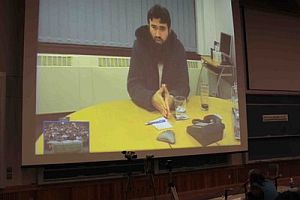 Omar Deghayes: Well, we were very happy, but anything that in Guantánamo [supposedly] happens you disbelieve until it really does happen. So even when I was told that I would be released, I was happy but I wasn’t completely happy, because some people were taken in the planes … It was used psychologically, they were taken in the planes and then they were taken back to prison. They’d say the plane had problems. So until we came back to England I was[n’t] completely happy. And I met my family and it was one of those happy days.
Almerindo Ojeda: Did you meet any other guards that were kind to you?
Omar Deghayes: There were some decent people inside prison and some people who more willing to commit atrocities and they were motivated by their own hatred and feelings. There are a few people inside who didn’t intend to cause harm unless they were commanded to do that, and there was of course the generals, who were leading those. Like Miller that Mustafa was talking about, and others, afterwards, who came. They had a policy where they used the guards against the prisoners. If they saw any, like Mustafa was describing, if they saw any guards speaking to one of the prisoners too much or he’s befriending them, the next thing you know that same guard will be commanded to enter your cell with other groups of guards to beat you up badly. Because they had that mistrust, they didn’t even trust their own guards, I think even the guards were under surveillance and they had videos and they had informers within the guards themselves. So the people who generated Guantánamo itself, I mean, the top people who made Guantánamo were people who used both the guards and prisoners, and that’s why I think those people, not the guards, not the simple guards who were used and abused themselves, but those people who should be brought to accountability for their actions.
Amy Goodman: Mustafa, do you agree?
Terry Holdbrooks: Well that would be an absolutely amazing act if everybody who’s responsible for the atrocity, for the stain that is Guantánamo — it would be quite an amazing accomplishment if everybody responsible could be convicted or tried or even remotely punished in this life. That would be an amazing act. I would love to see it happen, personally.
Like he was saying, with Guantánamo being designed for even the guards to be used as tools … Just before we went to Guantánamo, literally the day that we were going, we stopped, we had this little, you know, lay-over, so to say, in New York City. “Hey, you know, wow, check it out, we got two buses, we’re going to take you to Ground Zero, we’re going to let you read all the comments on the wall and while we’re there we’re going to tell you that it was Muslims that blew this place up and it’s Islam that is the enemy. And remember, we’re going to guard the worst of the worst. Remember that. These are the worst of the worst so when we get there don’t talk to them, don’t be friends with them, they are the worst of the worst.”
I was fed that nonsense, oh God, every day the entire year that I was there was that these are the worst of the worst or they’re dirt farmers; they’re dumb dirt farmers. Don’t talk to them. Well, if they are dumb dirt farmers, why are they lawyers and doctors? And why can they speak seven different languages properly when I can’t even speak English properly and I grew up in America? How are they dumb? How does this correlate here? I don’t understand.
Omar Deghayes: General Miller used to go around and used to say to the guards before they entered your cell and beat you up badly, “Don’t forget September 11th,” and used to go around and incite that kind of hatred. And the same general who afterwards — the top people like Dick Cheney and Bush and whoever was putting those people to work thought he did a good job in Guantánamo, they moved him to Abu Ghraib in Iraq. And he was the same person who said, “Let’s Guantánomize Abu Ghraib,” and then, you know, the pictures that came out from Abu Ghraib and all of this was at the same period that this same general, Miller — who they thought his policies was successful in Guantánamo in breaking people down — they moved him to Iraq to do the same job.
And, you know, probably, as I say, here even Mustafa and some guards don’t know so much about what went on inside some of these prisons. I mean, even interrogators were kept away, there were certain guards who were used, as you said, their job was only to take you to the interrogation cells and then go back and then they come and take you and pick you back up again they didn’t know what happened inside the interrogation cells. Even some of the interrogators that we had — one of the late[r] interrogators, he was a guy from Florida and he was a kind, generous person compared to many of the other interrogators and he tried to help and he tried to and do things different. He said, “I might be in your position one day,” and he was different than other interrogators and even, as I say, even interrogators that I wanted to say were different, they used some of them to do certain acts and some of them didn’t even know that those acts and those things did happen.
That’s why it’s always, the more I speak to people who worked in Guantánamo they were given different jobs to do. There were people who were inside those interrogations, there were people who were sexually, you know, raped and abused, there were four people in Bagram base, four of them were chained in a tent and four of them were sodomized in front of each other for embarrassment. There [was] somebody in the “Dark Prison” [a CIA prison in Afghanistan], an African guy — I don’t want to mention his name — an African guy who was sexually abused, sodomized, and then after that they said to him, “We realize it’s a mistake, you’re not the guy.” They released him. And they said to him, “You’re a brave man.” They said to him, “You’re a brave man” just to psychologically try to amend what they have done to him.
And again, the same thing inside Guantánamo Bay. There were people who were chained down to the floors. I don’t want to mention his name because some of those people told me those stories because of my work with lawyers inside prisons, but they insisted I don’t give their names. This man was a young Yemeni boy, and one day he was held in those prisons, his trousers was pulled back, and — you know, there are lots of abuses like that, sexual abuses. Like, another guy from China, a young boy from China, I’m not going to, you know, detail the horrible stuff that happened to him — and so on.
So there are many stories and, as I say, each prisoner is treated different than the other prisoner. If you’re young, and you come from the Middle East, certain things are done to you more than if you’re [an] older person and come from Europe, for example. You’re subjected to a different kind of torture. It was different. Every torture was engineered to use the most harm that can be done to you psychologically, sometimes physically.
Amy Goodman: What do you mean they told you these stories because you had legal background?
Omar Deghayes: Yeah, I had legal background and when Clive Stafford Smith came in, Clive did lots of good work, he was more brave to publish [information about the prison], he was sensitive to so much of the things [and] he was active in speaking and he did lots of good work. And when we saw the results of his work, people started to confide in him, to me inside the cells. They used to send me messages and letters in different ways and forms. Like Mustafa said, we have different ways to communicate with each other even though we weren’t allowed to communicate with each other. They were starting to send to me confidential things that happened to each one of them on the condition that I wouldn’t mention exactly their names, I could mention who they are like generally. There was another Saudi/Bahraini guy who was chained down to the floor and he was sexually abused by a female interrogator and things like that. So they mention their stories, but because they are so embarrassed to tell this stuff, I myself I am not able even to describe in detail because I feel ashamed and embarrassed of describing the stuff.
Amy Goodman: What has been most difficult thing to adapt to since you’ve been free?
Omar Deghayes: When I was free there was many things I needed to fix and amend. Because we were so many years far away from freedom we had lots of things. Our family was away. We had to try to communicate with my family who was lost, my wife and child was lost. I didn’t know where they were, in Pakistan or Afghanistan borders, and I had to search for them. It was so difficult because every person you communicate with in Pakistan would be under surveillance because of my background. It was so difficult to make communication with them and then you have lots of [other] things.
You have to speak with people again and you have to become normal, because I was locked up more than five years, and most of those years I was in isolation cells. So it was very difficult to learn how to communicate again with people, to talk in a normal way and socialize in a normal way. It was difficult to go back to work, to wake up in a normal way, to sleep in a normal way. We had and we still do experience lots of psychological hardships, dreams, bad dreams. Sometimes some incidents trigger memories, back inside the cells. Our emotions is different, psychologically our feelings, we’re more cold than when we used to be. We can’t express our feelings easily to our families and friends. Suspicion, and we suspect everyone and everything. Many, many things that, as I say, that’s why, when I started in the beginning, the physical damage that was caused to us probably is more apparent and is hard, but the psychological wounds and injuries inside each one of us is more deeper and probably longer than the physical abuse.
Amy Goodman: And Terry Mustafa, how do you actually go through the conversion process and then what was the response of the Guantánamo officers, the military, to your conversion to Islam?
Terry Holdbrooks: When Al-Jazeera interviewed me they asked this question and then off the record they said, “This is really the money question. If you could put a lot of detail in this, this is the money question.” Yeah, well, unfortunately, it’s really not that much of a money answer. To tackle that initially, the process of converting to Islam, I think one should have a full understanding, or at least you know as much as [you] are mentally capable of having, of what Islam is, of what it entails, of the Pillars of Faith [the profession of faith, prayers, fasting, alms, and the pilgrimage to Mecca] and everything that comes along with it. I think that should be there. But it’s a simple process of saying your shahadah [or profession of faith], of declaring that there is no God except for Allah and that Muhammad is his messenger and meaning it, wholeheartedly, you know, meaning it in your heart and full with clear intent and clear mind and good intentions. You should have obviously two other believers present, but it’s a simple process, so to say. Errachidi and I battled about that one for a couple weeks.
Almerindo Ojeda: Ahmed Errachidi, a prisoner…
Terry Holdbrooks: Yeah, sorry, everybody. Ahmed Errachidi was a prisoner in Guantánamo.
Omar Deghayes: He actually lost his mind inside prison. They mistreated him so badly, that he — I don’t know, you left, I think, the prison at the time?
Terry Holdbrooks: No, no, no. I was there for watching his downfall.
Omar Deghayes: Yeah, he lost it completely. He was injected with injections and stuff that he completely lost his mind. I remember looking at him and seeing him, like talk in a garbage way. It was very sad to see that nice man, intelligent man, and then broke down, because of the abuse he was subjected to.
Terry Holdbrooks: Errachidi himself, personally, had a reputation. We called him “The General.” He was the general of the detainees because he was the type of individual that —
Omar Deghayes: It’s crazy how he was being described as being a general and they thought he was somebody very important in [al-]Qaeda, even though he was working as a cook.
Terry Holdbrooks: Right, right, right. It wasn’t so much because of that though. I mean, the military had their ideas that he was a leader, but the reason why we called him “The General” was because you could have a block that was rioting and he could walk into that block and say one sentence and everybody would be calm.
Omar Deghayes: That’s true. But the interrogators really meant it. I mean, like Shaker Aamer, locked up inside prison.
Terry Holdbrooks: Right.
Omar Deghayes: For nine years, Shaker Aamer — the same way. They call him “[The] Professor” because he was loved by people, because he was loved for different reasons, like Errachidi. It’s because they speak good English and good Arabic and they were older in age and they used to translate for people and they used to try to help them.
Terry Holdbrooks: Yeah, yeah, absolutely. They were problem solvers.
Omar Deghayes: And because of that, people respected them and loved them. And just because of [them] showing that they respected him a lot they started calling them names like “Generals” and “Professors” — and really intelligent people inside. The interrogators really did believe that kind of talk. And just because of that, some of them are still in prison. Just because people respect them and how they look at them inside prison. Not because of what they acted and what they’d done before. I have seen Shaker’s accusations and the things that they accused him of in the papers and it was like flimsy stuff. Stuff which they shouldn’t be kept for nine years just because of that.
Terry Holdbrooks: Yeah, we had some colorful and loving pet names for some of the detainees, obviously. Getting back to the question, Errachidi actually didn’t necessarily accept or like the idea, initially, of me approaching Islam. I told him, I was like, “Hey, I think I want to convert, I think I want to actually take up faith.” I had never had faith in my life and Islam is the one and only faith that’s ever made sense to me. He just kind of looked at me the day that I first approached him. He turns his head, he looks at me, and he’s like, “No.” He just waves his hand and wouldn’t say anything else to me for the rest of the day. I was like, “Are you serious? Dude, we sit and talk for like six hours at a time, you’re just gonna wave your hand and say no? Ugh. Come on.” And he wouldn’t talk to me for the rest of the day.
I saw him a week later and asked him about it and he still said no. And finally, one night, I was working a night shift, and I came up on him and I talked to him. I was like, “You know I’ve got my P’s and Q’s, I know about it, I want to take my shahadah. And he sits me down and we talk for about two hours, just discussing all of the stipulations you come across in Islam and in regards to American society and how living as a proper Muslim totally are not going to go hand in hand with each other. But after a long sit-down conversation he eventually gave in and he transliterated the shahadah for me so I was able to say it. And as for the military …
Omar Deghayes: But Mustafa, there’s a number of guards that became Muslim, and people don’t realize that. They think that you’re the only person that did become Muslim inside Guantánamo. There is a number of guards who became Muslim there, and there is one female guard we’re still in contact with. And she sends us messages. She said she is wearing a hijab and that she has become Muslim lately.
Terry Holdbrooks: Al-Hamdulillah!
Omar Deghayes: And she sends messages. But she is so scared to come out in the open. And we asked if it’s possible for her to speak about it and we’re in contact with her. There are a number of people who, inside prisons …
Almerindo Ojeda: We would be happy to have her testimony anonymously.
Omar Deghayes: Yeah, I’ll tell her that because she sends a good message to Moazzam Begg, and she said, “Just tell your friends in London that the things that [I] experienced in Guantánamo changed [my] life completely.” And one of the things she said, she said, “I remember somebody who comes weak to the cells, from another prison, and you have the support you have, and the camaraderie you had inside those prisons was just admirable.” She was impressed by that, and how people helped each other inside those horrible conditions.
Amy Goodman: Omar, we’re about to come to the end of this conversation. The video-conference will close but in the last few days you questioned whether you wanted to participate in this at all. Can you explain why?
Omar Deghayes: It was by coincidence. I was looking at my Facebook and somebody sent me a message on Facebook. And he sent me a videotape where an American soldier — I looked at the videotape and in that videotape there was an American soldier in Iraq who was raping a civilian, a woman, an Iraqi woman, and he filmed that incident, and he was bragging about it. It was so sad to see that these atrocities are still happening inside Iraq. And because American soldiers are doing these things by command, by Generals and others — [as well as] what happened in Abu Ghraib and many other pictures probably they had — I thought it wasn’t acceptable that I should be speaking to people who were still committing these atrocities inside those countries. Especially when we know that Obama has refused to publicize some of those pictures they have in their hand, in their possession. I mean, the Department of Defense has in their possession even worse pictures of American individuals who committed those criminal acts, and Obama, even though he is a lot better than Bush and the previous administration — But these people haven’t been put to accountability.
This man’s picture is in the Internet, and he’s doing those crimes. It’s so horrible if you just look at it, and he is probably at large, nobody has done anything to him. And he is bragging about it. And if America wants to respect itself, this is the message, and if they want people to take them seriously, that this war, it is a moral war — if they want a moral ground, they should prosecute those criminal people who have committed those atrocities. So that was the reason that made me think, maybe I shouldn’t be participating in this.
Amy Goodman: How do you know the video is real?
Omar Deghayes: Yeah, I think it is real because this is not the only video, there are more, I’ve seen a couple of videos before. Some of them were women speaking in Al-Jazeera, like, for example, Sabrina Janadi, an Iraqi young woman who described what happened to her and it is verified fact. And there are many, many others in Iraq. I’ve seen tapes of American guards bragging and speaking, everybody knows of the photographs that the Department of Defense refused to release, because they said if they release them it will cause even more agitation in the Middle East because how much bad those pictures and those videos were, and this means that this was happening inside those prisons and inside observation of offices and people’s superiors, but those people who committed those crimes probably were encouraged to do that. Otherwise we haven’t heard of anyone properly brought to account.
Amy Goodman: So what made you decide to participate then?
Omar Deghayes: When Almerindo talked to me he said it is better to speak to the people about this, about everything. We are not those same people, we are different, we are trying to convince the people in the United States about the atrocities that did happen under this so-called “War on Terror.” We are trying to show the people and explain the truth and, Omar, if you don’t participate in this, all you are doing is disappointing us who are trying to organize this and trying to explain to the people what the reality is and what really is happening on the ground. Because people usually only hear one side of the story. And to make a proper judgment, we need to hear both sides of the story.
Almerindo Ojeda: Omar, is reconciliation possible?
Omar Deghayes: I think definitely it’s possible. Of course. I mean, we humans, nobody wants war. I don’t think that the Afghani people want war. They’ve been badly affected by war. No people in Iraq want their country to be occupied and shelled and tortured and bombed. But reconciliation, we must learn to respect each other, and we must learn to resolve our problems not by might and force. We should respect people’s perspectives. I mean, some people have different ways of looking at things in life. We, as Mustafa was saying about his transformation to Islam, we have different values, we look at things differently, but this doesn’t mean that we have to fight each other. We can sit down and negotiate and we can understand. As I said, you know, things can and will probably get worse when you use might and force to solve problems. All of us have families and we know that even in our own families, when we try to force our children, or force people who are weaker than you in a family to do something, it never succeeds. What it does is it causes rebellion and makes things worse.
Amy Goodman: Omar Deghayes, is there anything else you’d like to add? The video will probably go off at any point.
Omar Deghayes: Yeah, I just really want to thank all of you for coming here. It has been a pleasure. I’m so happy to know people like yourselves who are brave enough to stand by their principles and advocate, I hope, for what is right, and advocate [for] understanding and listening to the other side. It has been a pleasure to participate and I am pleased that I have changed my mind and did participate. I hope you are able to change things to the better in the United States and probably in the world. Thank you very much for having me here, it’s been a pleasure.
Amy Goodman: Mustafa Abdullah, is there anything you would like to say to Omar Deghayes?
Terry Holdbrooks: You really think reconciliation is possible? This could totally turn into an absolutely off conversation. We should probably just have it over Facebook or something, via email. The amount of restructuring that would be required in America, both socially as well as our educational system … There is so much that would have to be done to revamp it, to make any kind of ground work, to lay a bridge of connection between the East and the West. It’s inspiring to me to hear that you have hope that reconciliation could be possible. Quite frankly, I’m always surprised and shocked to hear of another detainee who has gotten out and has not decided to retaliate. I think it is amazing. It is certainly something that I commend all of you for. And in regards to that sister that you were speaking of, just let her know, it’s the responsibility of all of us Muslims, if we know of social injustice and whatnot happening to our brothers and sisters, it’s our responsibility to take some type of action towards it. Even if she speaks anonymously, she’s still speaking and taking action and that’s what is going to help facilitate change.
Amy Goodman: Mustafa, the response of other soldiers, officials, officers to your conversion?
Terry Holdbrooks: I managed to actually keep my religious views and affiliations to myself and relatively quiet. There were only two individuals that were in Guantánamo that had any knowledge of that and they were individuals that I could trust. There were very far and few that I could trust. A lot of the same side-effects that Omar was mentioning from being in Guantánamo, I had as well. I still have nightmares about that place; I suffered mass amounts of alcoholism trying to forget it. It’s awful. But I kept it a secret until we got back to Fort Letterwood. When we got back to Fort Letterwood, nobody cared what I was doing at that point, they were back with their families and they had their beer and their play stations and everything else. They didn’t care what I was doing. So, I became irrelevant at that point and that was the point in time that I became comfortable enough to talk about it. Family and friends haven’t had anything negative to say about it, they’ve been supportive of me and what I do. At least the people I still talk with. If they want to have a conversation with me, then they are my real friends. If they don’t, then they weren’t friends to begin with.
Amy Goodman: So what are your plans now?
Terry Holdbrooks: Hopefully, to get my book out. I have another four drafted in my mind that I would like to write. The next four will be fictitious, however. But I have four more books I would like to write that will point out a lot of comparisons and contrasts between the United States and the Middle East and hopefully help bridge the gap between the East and the West, help try to create some type of understanding.
Amy Goodman: And Omar, your plans now?
Omar Deghayes: Now my plans are simple. Just continue to live my life and try to achieve what is good and try to help those who are left behind in Abu Ghraib and many others in secret prisons and I think it’s a call to mission to help to release them. I graduated — when I was young I always wanted to do human rights law and I did, and now I think I may be in a better position to work as I am working now as a human rights lawyer to help many, many others who are less fortunate. Because in my whole life, I have experienced how oppression can be. When it happened to my father and family in Libya and when I grew up and went to Guantánamo. There is a lot that can be achieved by talking and by advocating for those rights.
Amy Goodman: We want to thank you both for taking this time and really participating in this historic event of a prison guard and prisoner at Guantánamo talking to each other and sharing with all of us your experiences there. Thank you very much.
Terry Holdbrooks: Absolutely.
Almerindo Ojeda: Thank you very much for your attendance. Outside the door there are books by Amy Goodman and books by some other author you might know. Both of them are interesting for people who have attended this meeting. Please look them up. Amy will be signing copies of her book and the other author will be signing copies of his book as well.
Amy Goodman: And maybe next time Mustafa will be sitting next to us, signing his book as well.
Terry Holdbrooks: Inshaallah.
Note: Omar Deghayes features prominently in the new documentary film, “Outside the Law: Stories from Guantánamo” (directed by Polly Nash and Andy Worthington) and has been touring the film with Andy in the UK since February this year. Copies of the DVD of the film are available here, and also see here for clips of Omar discussing the involvement of the British intelligence services in his interrogations in Pakistan, Afghanistan and Guantánamo.
Andy Worthington is the author of The Guantánamo Files: The Stories of the 774 Detainees in America’s Illegal Prison (published by Pluto Press, distributed by Macmillan in the US, and available from Amazon — click on the following for the US and the UK). To receive new articles in your inbox, please subscribe to my RSS feed (and I can also be found on Facebook and Twitter). Also see my definitive Guantánamo prisoner list, updated in January 2010, details about the new documentary film, “Outside the Law: Stories from Guantánamo” (co-directed by Polly Nash and Andy Worthington, and currently on tour in the UK), my definitive Guantánamo habeas list, and, if you appreciate my work, feel free to make a donation.
What is Obama Doing at Bagram? (Part One): Torture and the “Black Prison”
 For eight and a half years, the US prison at Bagram airbase has been the site of a disturbing number of experiments in detention and interrogation, where murders have taken place, the Geneva Conventions have been shredded and the encroachment of the US courts — unlike at Guantánamo — has been thoroughly resisted.
In the last few months, there have been a few improvements — hearings, releases, even the promise of imminent trials — but behind this veneer of respectability, the US government’s unilateral reworking of the Geneva Conventions continues unabated, and evidence has recently surfaced of a secret prison within Bagram, where a torture program that could have been lifted straight from the Bush administration’s rule book is still underway.
From December 2001 to November 2003, the US prison at Bagram airbase was used by the US military to process prisoners for Guantánamo, and in those early days it played host to a murderous regime that, in the last half of 2002, led to the deaths of at least two — and possibly as many as five — prisoners. Throughout this period, and after the transfer of regular prisoners to Guantánamo came to an end, Bagram — or, in some cases, a facility within Bagram — was where prisoners regarded as more significant than the general population, who had mostly passed through a number of other secret prisons run by the CIA, were also held, and for the last six and a half years Bagram has, in addition, been the US military’s frontline prison in the Afghan war zone.
Shining a light on these stories has been immensely difficult, of course. From time to time, reports surfaced of Afghan prisoners released from the facility, who described the abusive regime at the prison, but the stories of the prisoners regarded as more significant have remained mostly hidden, surfacing only in reports from those who were transferred to Guantánamo, through information released by their lawyers (after passing the Pentagon’s censors), and, on the odd occasion, through other means — as, for example, in a handful of habeas corpus petitions, in this report on the multiple renditions of Ibn al-Shaykh al-Libi, who was finally returned to Libya, where he died in a prison last May, and in the leaked report by the International Committee of the Red Cross on the 14 “high-value detainees” transferred to Guantánamo from secret prisons in September 2006 (PDF).
Last August, the New York Times brought Bagram’s secret prison to light, reporting that Special Operations forces were running secret prisons, known, perhaps euphemistically, as “temporary screening sites,” at Bagram, and also in Balad, Iraq (a replacement for the notorious Camp Nama, where abuse was rife). The Times explained that, according to three military officials, “As many as 30 to 40 foreign prisoners have been held at the camp in Iraq at any given time, adding that “they did not provide an estimate for the Afghan camp but suggested that the number was smaller.”
The Times report coincided with an apparent shift in US policy, with the Pentagon announcing that the military would be allowing representatives of the International Committee of the Red Cross to have access to prisoners held in the secret prisons at Bagram and Balad. As the Times described it, “the military must notify the Red Cross of the detainees’ names and identification numbers within two weeks of capture, a notification that before happened only after a detainee was transferred to a long-term prison.”
Under previous rules, those imprisoned in the Special Operations prisons could be held incommunicado for up to two weeks, in defiance of internationally agreed standards governing the detention of prisoners. As the Times explained, “Formerly, the military at that point had to release a detainee; transfer him to a long-term prison in Iraq or Afghanistan, to which the Red Cross has broad access; or seek one-week renewable extensions from Defense Secretary Robert M. Gates or his representative.” Announcing the new policy, a senior Pentagon official added that the “option to seek custody extensions” had been eliminated.
Voices from Bagram’s secret prison
Although the New York Times report was important, it was largely overlooked at the time, and it was not until November that the existence of the secret prison burst out of the shadows, when both the New York Times and the Washington Post interviewed former prisoners. The Times spoke to Hayatullah, a 33-year old pharmacist, who was seized from his shop in Kandahar in July 2007, and released in October 2009; Gulham Khan, a 25-year old sheep delivery man, who was seized by US forces in three helicopters at a village in the desert outside Ghazni in late October 2008, and released in early September 2009; and Hamidullah, a 42-year old spare auto-parts dealer, who was seized from his house in Kandahar in a midnight raid in June 2009 and released in late October. All told similar stories, and this was Hayatullah’s description of the secret prison:
They took me to a place that was completely dark except for one bulb. It was hard to know whether it was night, day or afternoon, I had no idea when to pray because I could not tell the time. There are no windows. That was the Tor jail. I was there for 40 days. At that Tor jail everybody was separate. Each in a concrete room. The walls and ceilings were concrete, but the detainees who had been there a long time told me it had been made of black wood before it was concrete and that’s why they called it the black jail. It’s difficult to know how many of us there were in that place. When you are taken to the interrogation office, you are blindfolded and there is a hood on your head. No one has permission to come to Tor jail. Neither the ICRC [International Committee of the Red Cross] or others.
The Post spoke to three teenagers — 17-year old Issa Mohammad, Abdul Rashid, “who said he is younger than 16,” and Sayid Sardar Ahmad, also 17 — at “the Afghan-run Juvenile Rehabilitation Center in Kabul, where they were transferred after their detention at Bagram and a brief stay in … Pul-i-Charkhi,” the main Afghan prison in Kabul. Rashid, a woodcutter from Khost province, told the Post that he was “arrested in the spring with his cousin and father during a US military raid,” and said of his interrogation, “That was the hardest time I have ever had in my life. It was better to just kill me. But they would not kill me.” He also explained that he “lived in a small concrete cell that was slightly longer than the length of his body. Food was tossed in a plastic bag through a slot in the metal door.” Mohammad, a vegetable farmer from Kandahar province, told the Post that he was also arrested during a US military raid, and spent two weeks in the secret prison, where “interrogation sessions lasted hours, with one man ‘yelling at me and also punching and slapping my face.’”
Both Mohammed and Rashid also explained that, “when they tried to sleep, on the floor, their captors shouted at them and hammered on their cells,” and the Post also spoke to two other former prisoners, Malik Mohammad Hassan, a tribal elder from the Jalalabad area, and Mohammad Mukhtar, a former teacher, who were held “for some time” in the prison, and who described “[s]imilar living conditions, particularly the lengthy sleep deprivation and intense cold.” Hassan told the Post, “This is something nobody can bear. It’s extraordinary. They treated us like wild animals.”
New revelations about the secret prison
On April 15 this year, the BBC followed up on these reports, speaking to a number of former prisoners who confirmed that the prison consists of windowless concrete cells, permanently illuminated, and that prisoners are subjected to sleep deprivation. A man called Sher Agha, who spent six days in the prison in autumn 2009, told the BBC, “They call it the Black Hole,” adding, “When they released us they told us we should not tell our stories to outsiders because that will harm us.” Like all the men interviewed by the BBC, he also explained that the cells were “very cold.”
Describing the process of sleep deprivation, another former prisoner, Mirwais, who said he was held for 24 days in the secret prison, stated, “I could not sleep, nobody could sleep because there was a machine that was making noise. There was a small camera in my cell, and if you were sleeping they’d come in and disturb you.”
On May 11, the BBC explained that the existence of the prison had been confirmed by the International Committee of the Red Cross. An ICRC representative also confirmed the change implemented in August 2009, as described above. Asked about the status of prisoners held “in a separate structure at Bagram,” the spokesman explained, “The ICRC is being notified by the US authorities of detained people within 14 days of their arrest. This has been routine practice since August 2009 and is a development welcomed by the ICRC.”
Despite this, the BBC reported that, although the existence of the facility had been disclosed in the New York Times report last August, a military spokesperson maintained that the main prison at Bagram, now identified as “the Detention Facility in Parwan,” was “the only detention facility on the base.” However, the day after, in a detailed article in the Atlantic, Marc Ambinder thoroughly demolished this claim.
Ambinder began by explaining how it had been previously reported that the secret prison, which is “beige on the outside with a green gate,” was “operated by members of a Joint Special Operations Command (JSOC) group,” which was allegedly outside of the jurisdiction of Vice Admiral Robert Harward, the commander in charge of detention operations in Afghanistan. However, he added, “JSOC, a component command made up of highly secret special mission units and task forces, does not operate the facility. Instead, it is manned by intelligence operatives and interrogators who work for the … Defense Counterintelligence and Human Intelligence Center (DCHC),” a branch of the Defense Intelligence Agency (DIA), the Pentagon’s main military intelligence department.
Complicating matters further, Ambinder also explained that DCHC “perform interrogations for a sub-unit of Task Force 714, an elite counter-terrorism brigade,” which, last year, was described to Spencer Ackerman of the Washington Independent by a National Security Council staffer as “‘small groups of Rangers going wherever the hell they want to go’ in Afghanistan and operating under legal authority granted at the end of the Bush Administration that President Obama has not revoked.”
Describing the process through which prisoners end up at the “black prison,” Ambinder added, “Usually, captives are first detained at one of at least six classified Field Interrogation Sites in Afghanistan, and then dropped off at the DIA facility — and, when the interrogators are finished, transferred to the main prison population at the Bagram Theater Internment Facility.” This provides an additional insight into the web of other secret, frontline facilities feeding into Bagram that I touched upon in an article earlier this year entitled, “Bagram: Graveyard of the Geneva Conventions,” and which were also exposed in an article by Anand Gopal for TomDispatch.com.
Pentagon spokesman Bryan Whitman attempted to dismiss Ambinder’s claim, stating that “DoD does operate some temporary screening detention facilities which are classified to preserve operational security,” but that “both the [Red Cross] and the host nation have knowledge of these facilities.” However, Ambinder’s report painted a bleaker picture, involving torture techniques contained in a little-known appendix to the current Army Field Manual.
Although President Obama issued an executive order on his second day in office, in January 2009, requiring interrogations to conform to the Army Field Manual (PDF), which prohibits physical violence and “enhanced interrogation,” Ambinder reported that, in the “black jail,” prisoners are subjected to sleep deprivation and isolation based on the Field Manual’s Appendix M (which Jeff Kaye has been writing about since last January), and which, under controlled circumstances, allows a range of Bush-era “enhanced interrogation techniques” to be used, including sleep deprivation and isolation. Ambinder also explained that when Appendix M techniques are being used, the man responsible for overseeing them is Gen.James Clapper (Ret.), the undersecretary of defense for intelligence.
Underscoring the difference between the general prison population at Bagram and those held by the DIA’s Defense Counterintelligence and Human Intelligence Center, Ambinder added that prisoners “designated as prisoners of war cannot be subjected to Appendix M measures.” To be strictly accurate, Marc Ambinder should have referred to prisoners “held in conditions that vaguely approximate those of prisoners of war,“ because President Obama has maintained the Bush administration’s unilateral reworking of the Geneva Conventions.
This will be discussed in the second part of this article, but for now the distinction between the general population of Guantánamo and those subjected to torture techniques in Bagram’s “black prison” — based on Marc Ambinder’s disturbing revelations about Appendix M and the activities of the Defense Counterintelligence and Human Intelligence Center — should be sufficient to rouse progressive critics of President Obama’s policies to demand transparency regarding the “black prison,” and to call for an end to this disturbing continuation of the Bush administration’s detention and interrogation policies.
Andy Worthington is the author of The Guantánamo Files: The Stories of the 774 Detainees in America’s Illegal Prison (published by Pluto Press, distributed by Macmillan in the US, and available from Amazon — click on the following for the US and the UK). To receive new articles in your inbox, please subscribe to my RSS feed (and I can also be found on Facebook and Twitter). Also see my definitive Guantánamo prisoner list, updated in January 2010, details about the new documentary film, “Outside the Law: Stories from Guantánamo” (co-directed by Polly Nash and Andy Worthington, and currently on tour in the UK), my definitive Guantánamo habeas list, and, if you appreciate my work, feel free to make a donation.
As published exclusively on Cageprisoners. Cross-posted on Countercurrents, The Public Record, Uruknet, United Progressives and The World Can’t Wait.
For other articles relating to Bagram, see: Justice extends to Bagram, Guantánamo’s Dark Mirror (April 2009), When Torture Kills: Ten Murders In US Prisons In Afghanistan (July 2009), Judge Rules That Afghan “Rendered” To Bagram In 2002 Has No Rights (July 2009), Bagram Isn’t The New Guantánamo, It’s The Old Guantánamo (August 2009), Obama Brings Guantánamo And Rendition To Bagram (And Not The Geneva Conventions) and Is Bagram Obama’s New Secret Prison? (both September 2009), Andy Worthington Discusses Bagram on al-Jazeera (September 2009), A Letter From Afghanistan: Bagram, Afghan suffering and the futility of war (October 2009), Dark Revelations in the Bagram Prisoner List (January 2010), Bagram: Graveyard of the Geneva Conventions (February 2010), The Black Hole of Bagram (May 2010). Also see: Bagram: The First Ever Prisoner List (The Annotated Version).
Omar Deghayes and Terry Holdbrooks Discuss Guantánamo (Part Two): Terry’s Story
 On April 30, 2010, as I explained in Part One of this three-part transcript, The UC Davis Center for the Study of Human Rights in the Americas organized an event to mark the fifth anniversary of its excellent Guantánamo Testimonials Project, which, for the first time, enabled a discussion to take place, before an American audience, between a former Guantánamo prisoner (the British resident Omar Deghayes, speaking by video-conference from the UK) and a former Guantánamo guard (Terry Holdbrooks, who converted to Islam and is now known as Mustafa Abdullah).
As I also explained in Part One, a video recording of the event is available here (via RealPlayer), as is an audio recording, but in the hope of bringing the words of Omar and Terry to a wider audience I’m cross-posting a transcript of the event here. Part One featured Omar’s story, in which he provided some detailed insights into Guantánamo that many people will never have heard before, and in Part Three (to follow) Omar and Terry discuss other aspects of Guantánamo, including the deaths of three prisoners in Guantánamo in June 2006, which has a great resonance as the fourth anniversary of that dreadful day approaches, in light of revelations in an article by Scott Horton for Harper’s Magazine in January this year. In this second part, Terry tells his story, and he and Omar then engage in discussions that touch on other disturbing aspects of the prison’s history, included the use of menstrual blood by a female interrogator.
Amy Goodman: Omar Deghayes, I think this would be a good time to bring in Terry Holdbrooks also. Well, Terry, you said you’d rather be referred to as Mustafa Abdullah. First, tell us about changing your name.
Terry Holdbrooks: It was actually kind of a slow process that took place in Guantánamo. I had developed a reputation with a good number of the detainees as sort of being the good guard, or the nice guard, or maybe even lax — we can go with lax or lenient. Nonetheless, after I started taking interest in the Koran, and studying the Koran, and talking with the detainees about Islam, and just taking more of an interest in that and their lives and the culture and society and history and everything else behind what was going on —
Amy Goodman: Where were you born?
Terry Holdbrooks: In Phoenix, Arizona. After I started taking an interest in all of that, some of the detainees started calling me Istafa, others started calling me Mustafa. And I didn’t have an understanding at this point in time what the relevance was of that name, the significance of that name. I think it was Ahmed Errachidi [a Moroccan, resident in the UK for 18 years, who was released in 2007], as a matter of fact, who told me to go home and to read “Suratul Baqarah” [the longest chapter of the Koran, and a summation of the entire Muslim creed], and that I would find out the relevancy of that name. Evidently it stands for “the chosen one,” it’s one of the names of the prophet Mohammed. So I can only assume, based on being given a name like that, that evidently they held me in high respect.
Amy Goodman: How did you end up at Guantánamo?
Terry Holdbrooks: Where do you want me to start?
Amy Goodman: Wherever you want.
Terry Holdbrooks: Well, that’s a long story. We don’t have enough time for that. That’s kind of like his story, we don’t have enough time for all of it. I graduated high school early, I was kind of bored with high school real quickly. I was probably bored in middle school, actually. In any case, I was bored with high school, and I graduated early and I went to a trade school in a conservatory of recording arts in Arizona, and studied audio engineering. After I finished that, I was kind of starting to go down the same avenue that my parents had both gone down — alcohol and other issues I’d rather not discuss. And I didn’t want to be like them. I wanted to amount to something, and be able to have pride and respect for myself. So I suppose, kind of out of an act of desperation, or perhaps out of an act of boredom, maybe just because I’ve always strived on structure and order — I’m not entirely sure of the reason, there were a number of things that went into it — but I decided to join the Army.
I went to the recruiters, initially, in the beginning of 2002, and I walked into the recruiters, and they said, “Hey! How are you doing today? What can we do for you?” And I said, “I want to get a job. I want to get paid to kill people. And I want the least amount of responsibility.” And I don’t think they took me seriously. They kind of laughed, they talked to me, they gave me a pamphlet and sent me on my way. And I was just sort of, kind of confused. I was just, like, “Wait a second. Hold on. I’ve seen all these movies where the recruiters come to schools and they pick you up at your house and these guys just gave me a pamphlet and sent me on my way. That doesn’t make any sense.”
So I came back a week later and I tried the same thing and I was like, “I want to join the military. What do I have to do?” And eventually, after about two or three months of persistence, they eventually took me to take my ASVAB [Armed Services Vocational Aptitude Battery]. I scored, you know, off the roof with the ASVAB, they offered me any job that I wanted in the military. And that was probably when I made that fatal mistake that got me to Guantánamo. I asked, “What job is giving a bonus?” Right, yeah, not a smart question. So, for $2000 I chose military police. I would have much rather gone like linguistics or journalist or even psi-ops or human intelligence collector — there’s just a lot of other MOS’s [Military Occupation Specialties] that would have been a lot more interesting. But nope, I took military police. So I started the Army in August of 2002, graduated basic training in December, had a two week break between December and January, met my ex-wife, well, soon-to-be wife, but now ex-wife. I met her in that break. We got married in February of ’03 and by March or April of ’03 there were already rumors that we were getting ready to be deployed.
I had just recently gotten married, so I didn’t think to myself, you know, “What’s this Guantánamo place? What’s this about? Why are we going here? What’s going on?” I was more concerned about the idea that I had just gotten married, my wife gave up her entire life to come here and be with me in the middle of Nowhere, Missouri, and now I’m going to be leaving her for a year and she’s got no friends, no family, nothing out here. In any case, I was just spending the last little bit of time I had before I went to Guantánamo, basically just spending time with her. Just trying to get as much family time in as I possibly could. I never even once thought about the possibility of Googling Gitmo. But that’s the journey of the military, that’s how I got into the Army.
Amy Goodman: And what was your first experience of Guantánamo?
Terry Holdbrooks: Why is it so bright? It’s really hot, why is it so bright? Somebody use a dimmer switch for the sun, please? It’s really bright. That place is horrible. Its, oh wow … I’m at a loss of words really to describe Guantánamo. Do you want to perhaps describe Guantánamo a little bit, Omar? I hated it, the actual climate I hated.
 Omar Deghayes: Yes, it’s a bad place, I mean, it’s a bad place. I mean it’s been described so much in the media by many people, people from the CIA, people from the FBI who worked there, people who are former guards, like Mustafa and Chris [Arendt] and others. As described by many people from the United States themselves, because people might disbelieve or not completely believe, but when they hear from you, Mustafa, and from others who are from the other side of the wire, it’s different, it makes a big difference. So probably it’s best to hear you tell them a little bit about how they used the bright lights against us in our cells and how they used us like animals or something.
Terry Holdbrooks: He probably never had a single night’s sleep in the dark in the seven years, or, excuse me, the six years he was there. There was constantly lights on. Daytime, nighttime. At nighttime there was floodlights, as well as there was lights in every individual cell. It wouldn’t make a difference.
Omar Deghayes: It’s the air conditioning that used to be used in Camp 5. It was very cold, it was like living inside a refrigerator. When we were in Moscow isolation in Camp 5, when I was locked up, it was like, it’s not like the cages you’ve seen on television. It’s like isolation, where you have complete iron sheets. I mean the walls are made of iron, completely. Closed. It’s not like we can see anybody and then the whole wall, it’s very small, small even for those small cages, and the floor is made of iron sheets, and the ceiling is iron sheets. And then you have the air conditioner, which is very, very hard inside a small box of iron, and it’s like you feel inside of it, you then forget sometimes, and it’s like living inside a refrigerator. And again under extreme lights. You can imagine six or seven years you’re under a light, you cannot — you’re sleeping for six years, you’re living inside the bright lights. Mustafa, please speak, I’ve been doing most of the talking.
Terry Holdbrooks: Outside of the constant light and obviously the temperature issue, with the cold, there was two species that were on the island that we were not allowed to touch, to do anything with, etc. We had to give them privilege to do what they pleased. There was these giant iguanas that would grow to about six feet in length. They were basically like little dragons. I remember sometimes when they’d go running up and down the blocks, some of the detainees would be frightened, other detainees would just kinda laugh.
Omar Deghayes: They had better protection than the detainees. You weren’t allowed to touch them, but you were allowed to abuse the detainees and do what you like to the detainees. But the iguanas, if you touch one of them you’d be fined, how much? Thousands of pounds?
Terry Holdbrooks: It was something ridiculous like that. It was a thousand or two thousand dollars for touching them or the banana rats. And the banana rats, mind you, these things were maybe like four-month old puppy rotweillers, they’re gigantic rats. You couldn’t touch them, you couldn’t chase them. “It just took off with my lunch, what am I supposed to do about that?” “Well, go buy another one.” That’s not right. In any case, 98 degrees all the time. It’s right on the ocean front obviously, so 98 degrees, 100 percent humidity, the land is burned and barren and miserable. It’s just cactus and dirt, it was awful.
Amy Goodman: Did you see any prisoners tortured?
Terry Holdbrooks: Is this being recorded? Uh, yeah, on a number of occasions I saw what I would consider to be torture. I draw a fine line, personally, between what I say is abuse and what I say is torture. And much like Omar was saying, it’s a great disgrace to myself when I remember some of the things that I saw down there because it was in fact 100 percent torture. It’s not some type of physical or emotional abuse. It’s torture.
Amy Goodman: Like what?
Terry Holdbrooks: How foul do we really wanna get on this? Obviously we’ve had the availability of some of the de-classified memos that that took place. The working canine dogs, those would be put in front of detainees that would be chained to the ground, and these dogs would be riled up and barking and literally within an inch of a detainee’s face. I think sometimes the detainees were bitten. I never saw that, but I saw evidence of it afterward, I never saw it directly.
The stress positions. You know, six, eight, twelve hours of being inside a room that’s 40 degrees with a strobe light in front of you and the same awful Celine Dion song for twelve hours. I hear little rumors of laughter, but I mean, honestly, any song for twelve hours, especially Celine Dion, that’s awful. It’s absolutely awful. The stress positions themselves were specifically designed to induce muscle failure within the victims, as well as bowel failures. And it wouldn’t be uncommon that detainees would have excrement or urinate on themselves while they’re being interrogated. It wasn’t out of fear, it was strictly out of stress.
There was an incident that took place — what I think to be the most frightful of incidences that I saw take place. I kind of caught the beginning of this and the tail end of this. We took a detainee from Sierra Block to interrogation, and what was odd about it was we didn’t take him to interrogation outside of that camp. We took him to interrogation at the camp over by the JIF, which is the Joint Interrogation Force, but that’s where all the individuals who were in charge of interrogation — that’s where all of them kind of have their offices. It’s probably where the majority of the worst interrogation took place. I would imagine it would be there, or the General’s Cottage, one of the two.
But this individual was brought in and he was sat down, and what was odd about it was it was a female interrogator. It wasn’t so much that it was odd that it was a female interrogator, but it was a female interrogator and she was kinda scantily dressed, so to say. You’re in a military uniform, but you don’t have your top on, you’re just running around with your brown undershirt and the pants, and it’s just kinda weird to see anyone out of uniform, especially officers. Officers obviously have certain standards they have to hold themselves to and she wasn’t, you know, wearing her headgear; she didn’t have her top on. It’s just — kind of a little odd. In any case, I saw this detainee and we took him into there and we chained him down, and the linguist came in and the interrogator came in and they asked us to leave, which was obviously standard protocol. MPs weren’t ever usually — I can’t say never, but we weren’t usually present for interrogations. We took ‘em and we brought ‘em back, but we weren’t ever inside.
In any case, we slipped out to have a cigarette. And myself and the friend that I was working with at that point in time, we didn’t necessarily want to go back to work. We didn’t wanna go back to the block or pick up other detainees or anything. So we just kinda hid out there and smoked a few cigarettes and went and had lunch and then came back, smoked a few more cigarettes. And about an hour, hour and a half later, this detainee is being brought out by two other interrogators, and he’s crying. And he’s just screaming and is stark-raving mad, and he’s got what looks like blood on his face. I’m kind of like, wow, I wonder what happened, I haven’t seen anything like that before.
Well, evidently, what had took place was, while he was in interrogation one of the interrogators, the female interrogator, had set something up behind the detainee, either blood capsules, or red marker or something like that. And she, throughout the process of the interrogation, was making sexual comments and sexual advances to him, you know, perhaps touching him in inappropriate means, and talking about certain things. You know, sexual acts that can be performed between a man and a woman and then making references to the prophet Mohammed at the same time. And, evidently, she went behind this detainee and put her hand into her pants and came back around to the front side of this detainee, and the detainee saw her hand come out of her pants, and then she wiped this red liquid across his face. So he was under the impression that —
Omar Deghayes: It’s not a red liquid, I know the man. He was a young kid, His name is Abdul Hadi, he’s from Syria. And after they did this to him, they took him back to the blocks, to the cages, and he had to wash his face. But it wasn’t, sadly, you know, it wasn’t like he described afterwards, she said it was only red liquid. But it wasn’t, it was like dirty blood from herself. She used it on his face. But afterwards when she was interviewed and asked, it came out in the news, she said I was using red liquid. It wasn’t the case, I was there in the cages. He’s a young boy, his name is Abdul Hadi, from Syria. It was really — she used her own stuff.
Terry Holdbrooks: Right, right. How in fact does he know that? I can obviously think of a couple answers, but how in fact did he know? Because I’d hate to think that that actually really did take place.
Omar Deghayes: Say that again?
Terry Holdbrooks: How in fact does he know that that’s what happened? Because I would hate to think that that actually took place.
Omar Deghayes: Because he had to wash it — he went back with it to the cell.
Terry Holdbrooks: Right, I remember, we took him back.
Omar Deghayes: And he had to wash it and, you know, you can tell. The smell and there’s dirt in it and stuff. It’s not like normal red ink or red liquid. It was like — Anyway, I’m sorry.
Terry Holdbrooks: No, no, no. I was always under the impression that it wasn’t true. We were given the instructions to take him back and then turn the water off in his cell. What they were ultimately trying to do was, we weren’t gonna turn the water on for four days. It was basically just to inadvertently stop him from being able to pray. If he wasn’t able to present himself properly, then that was the idea that they were going for.
Almerindo Ojeda: The story was also told by Erik Saar, the translator.
Amy Goodman: Terry, the abuse by psychologists, psychologists. Did you see how they were used?
Terry Holdbrooks: Actually, what’s interesting about that — I’m surprised Omar didn’t bring it up — every time we were going inside or outside of an interrogation building or the visit rooms or anything like that, did you ever happen to read any of those posters that were on the wall? You know like the posters of the little boy, “Where is your dad for this Eid?” Did you ever read any of those? Did they ever have an effect on you?
Omar Deghayes: Which ones you mean — say again?
Terry Holdbrooks: Like, you remember the Eid posters, where they showed the little boy and he didn’t have a family, basically.
Omar Deghayes: Oh yeah, and sometimes they had them in the rec yard, this after 2005. Yeah, posters, yeah I remember, no they didn’t have an effect.
Terry Holdbrooks: You just kind of blindly looked at them and laughed?
Omar Deghayes: Yeah.
Terry Holdbrooks: That’s what I figured was gonna be the overall impression of those. There were these posters that were up over the camp, various places in the camp. They depicted a broken family, or a child without his father, or a woman going through hardship or struggles because, you know, her husband’s gone and there’s no provider. And they’d be written in various languages: Pashto and Urdu and Arabic. I guess the initial design behind them was to get people thinking of a home and longing for a home. But I would imagine wrongly being accused of something, or not being accused, and being taken away from your family, you don’t really need posters to remember home. In any case that was their idea for psychological abuse.
Amy Goodman: What about the use of the Koran?
Terry Holdbrooks: Yeah, wow, that was an awful day. So, one of the biggest problems about Guantánamo — and Omar brought this up — we were both there under General Miller. I served under General Miller the entire time I was there and you had to deal with this whole tyrant. I’m sorry about that, that’s awful.
Omar Deghayes: Yeah.
Terry Holdbrooks: Every time a new commander would come in, whether it was a colonel, lieutenant colonel, or one star, two star general, etc., they would go through the SOP — the Standard Operating Procedures — and they’d basically take out what they didn’t like, and put in what they did want it to be or how they were re-interpreting the laws that were coming. So, every time we learned the rules, that we were finally comfortable and content with the rules, there was new SOP given to us with new rules to learn. So basically there was just never a standing basis upon what the rules were. We were constantly just learning over and over and over the rules. It really made for a very ineffective environment. In any case, I’m sorry.
Amy Goodman: The Koran?
Terry Holdbrooks: Oh, yeah, the Koran. I was trying to avoid that, but you went back. What the rules were in regards to it is we were supposed to wear medical gloves. We were supposed to touch it respectfully, and that when we opened it to look in it for any type of suspicious items — I really can’t imagine what you can hide in a book when you can’t hollow it out — but in any case, you would take it, flip it like this, upside down, you know, flip the pages real fast and set it back down. They were supposed to be putting surgical masks that were supposed to be hanging in the cells [to hold the Korans] and, like I said, we were supposed to use gloves, only one person was supposed to touch it, and we were supposed to use our right hand only. That was the SOP. That was the rules. That’s what some of us followed.
Unfortunately, what made my life a lot harder while I was down there was that some people would decide that they weren’t gonna wear gloves, some people would use their left hand. Some people would intentionally toss it on the ground to try to rile up detainees, or you know, stimulate trouble. I can only think of a number of occasions that I ever saw it kicked or thrown into a toilet. It’s not to say that it didn’t happen. I can just only think of a handful of them. It really wasn’t that many, but when it happened, obviously there was a great reaction, it was a terrible reaction every time. Kind of like flu shot day. You remember that day? Flu shot day?
Omar Deghayes: Yeah.
Terry Holdbrooks: Yeah, I worked 24 hours that day. They had every unit at work, because it was just constant ERF after ERF.
Amy Goodman: What do you mean, ERF?
Terry Holdbrooks: What Omar was speaking about, Emergency Reaction Force, Emergency Response Force. The exact nomenclature eludes me at this point. Basically he described it perfectly. It’s five men who are getting their rocks off by running into a small cell and ransacking and beating a detainee unnecessarily. I was surprised he didn’t touch on the OC spray. There were a number of times the lieutenants were in charge of the OC spray and when the lieutenant would come out, you know, the standard operating procedure is to do the little Zorro “Z” of OC spray across the face. [But instead] I’d see cans, can upon can, drenched on a detainee.
Amy Goodman: OC?
Terry Holdbrooks: OC, I forget what that stands for, it’s a —
Omar Deghayes: It’s a spray, like pepper spray.
Almerindo Ojeda: Oleum Capsicum, pepper spray.
Terry Holdbrooks: Thank you, thank you. It’s a 60 proof spray, it’s very strong.
Omar Deghayes: It’s a blinding pepper spray. If it sprays your eyes, it blinds you.
Terry Holdbrooks: So, you know, having a can of that doused on you, it’s far more than necessary, especially if you’re on Mike, November, or Oscar block. All three of those were isolation blocks. If you’re in a closed room, and you had a can of this stuff doused all over you and then five men come running in while you can’t breathe and you can’t see and you can’t defend yourself, and they beat you, step on you, smash your hand and your feet in the doorway, put your head in the toilet and flush the toilet repeatedly, and then you’d be taken into the rec yard and you’d just be left there, they’d shave your beard and just leave you humiliated. I didn’t really understand the purpose of it, but nonetheless, that was ERFs. And flu shot day, we don’t need to talk about that.
Amy Goodman: What happened at flu shot day?
Terry Holdbrooks: No, we don’t need to talk about that. Flu shot day was just long and drawn out and it had a ridiculous cause and a ridiculous ending.
Amy Goodman: What was the cause?
Terry Holdbrooks: We started this day very simply. We went into the camp, we had our briefing, there was a couple of medical personnel at the briefing, which was a little unusual. Usually it was just the platoon sergeants and the camp leader, but in any case, we had our briefing and these medical personnel said that we were going to be issuing flu shots. We started over in Camp 4, which is the minimum security camp, it’s communal living. That’s actually where I started working when I was in Guantánamo. I was in Camp 4, that was my first two months. It’s a completely different environment, it’s relaxed, it’s open — communal, like I said. They could have breakfast together, they can pray together, they had board games and books and all kinds of other such luxuries, so to say.
Omar Deghayes: We had 100 out of 800 people locked up there, or at the time you were there, about 600 were locked up in the other prisons. And this prison you speak about had 100, more or less.
Terry Holdbrooks: No, less than that. More like 65, 70. But in any case, we started over in Camp 4, issuing these shots. Everything went fine on Uniform and Whiskey and Victor Block. We got to X-Ray block, one of the older men, I guess, fainted from the sight of the blood or getting a shot. I don’t know, he fainted. And you know, a detainee sees this old man faint, he’s like, “Oh my God, they’re poisoning us, they’re going to kill us, they’re going to kill us!” He starts saying it, it spreads through all four of the blocks for Camp 4. Omar, I commend you guys. Still don’t know how you did it but you had an amazing communication system in Camp Delta. In five minutes, you guys could get a message from one side of the camp to the other. We couldn’t accomplish that with the radios and cell phones, so congratulations on that.
Omar Deghayes: Yeah, I remember I told you when we were inside one of the interrogations, they said they would start a rumor from one end of the room and they tried to realize how long would it take for a message to go from one side of the prison to the other side of the prison. They said it took about three minutes to go from one of the lock-ups to the most far away prison.
Terry Holdbrooks: And mind you, that’s going through at least seven different languages as well. It wasn’t like playing telephone, where we’re just playing in English. No, you’re going from Arabic to Urdu to Pashtu to Uyghur to French. It’s just like, really? Wow, that’s amazing. How’d you guys do that?
Omar Deghayes: I don’t know.
Terry Holdbrooks: In any case, he faints and whatnot. And these detainees start preaching, “Oh my God, they’re trying to kill us, the guards are trying to kill us. Don’t get the shot.” And that spread through the entire camp in the course of five minutes. And what started off for me as a simple, eight-hour, 2 o’clock to 10 o’clock shift became a 2 o’clock to noon the next day shift. They called in the two units that were supposed to be sleeping, or off. They called them in as well to provide reinforcements because we had the same — unintelligent is the most nice word I can think of — the same unintelligent individuals running in and smashing detainees over and over and over and eventually you had to give them a break.
And when we realized we were going to be ERFing 38 out of 40 detainees per block, it really just became necessary to have you know, the more soldiers, the more manpower. And when you had people like me, who were going to be constantly dipping out and being like, “Oh yeah, I’m going to go put on my ERF gear,” and just kind of fade to the background, go hide and smoke cigarettes and whatnot — I wasn’t a fan of the ERFing, it just didn’t really strike me as being effective or humane or civil so I did everything I possibly could to get out of that.
And I was very fortunate in the fact that there were always individuals who were ready and willing and excited to volunteer to go and ERF. It wasn’t something you volunteered for. There was five of us that were designated to do it every shift, but people could volunteer, and if they were ready before I was, they were the ones who went in. So when they’d call over the radio that there was going to be an ERF, I’d walk to the other end of the block, as far away as the exit could possibly be and I don’t know, find something else to do.
Note: Omar Deghayes features prominently in the new documentary film, “Outside the Law: Stories from Guantánamo” (directed by Polly Nash and Andy Worthington) and has been touring the film with Andy in the UK since February this year. Copies of the DVD of the film are available here, and also see here for clips of Omar discussing the involvement of the British intelligence services in his interrogations in Pakistan, Afghanistan and Guantánamo.
Andy Worthington is the author of The Guantánamo Files: The Stories of the 774 Detainees in America’s Illegal Prison (published by Pluto Press, distributed by Macmillan in the US, and available from Amazon — click on the following for the US and the UK). To receive new articles in your inbox, please subscribe to my RSS feed (and I can also be found on Facebook and Twitter). Also see my definitive Guantánamo prisoner list, updated in January 2010, details about the new documentary film, “Outside the Law: Stories from Guantánamo” (co-directed by Polly Nash and Andy Worthington, and currently on tour in the UK), my definitive Guantánamo habeas list, and, if you appreciate my work, feel free to make a donation.
Why is a Yemeni Student in Guantánamo, Cleared on Three Occasions, Still Imprisoned?
 On the evening of March 28, 2002, Mohammed Hassen (also identified as Mohammed Hassan Odaini), an 18-year old Yemeni student at Salafia University in Faisalabad, Pakistan, made a decision that was to change his life forever. He had been visiting fellow students in another house connected with the university, had stayed for dinner, and had decided to stay the night rather than traveling back to his own accommodation. Within hours, however, Hassen, along with 15 other people living in the house, was seized in a raid by Pakistani police, transferred to US custody and sent to Guantánamo, where he remains to this day.
In all, 15 men were seized in this house — victims of a mistaken belief on the part of Pakistani and US intelligence that there was a meaningful connection between the house and the supposed “high-value detainee” Abu Zubaydah. Seized on the same night in another house in Faisalabad, Abu Zubaydah then became the first official victim of a torture program approved for use by the CIA and initiated at the highest levels of the Bush administration, even though it has been revealed in the years since that he was not even a member of al-Qaeda, and was, instead, a mentally damaged gatekeeper for a training camp that was closed down by the Taliban because its leader, Ibn al-Shaykh al-Libi (another victim of CIA-directed torture), refused to cooperate with al-Qaeda.
Publicly, neither the Bush administration nor the Obama administration has conceded that those staying at the house were seized by mistake, and that Mohammed Hassen was particularly unfortunate. The lowest point was reached in June 2006, after one of the men seized in the house, Ali al-Salami (also identified as Salah Ahmed al-Salami), died in Guantánamo. Al-Salami was one of three men who allegedly committed suicide on June 9, 2006, and although this narrative was challenged in January this year by Scott Horton in an extraordinary article in Harper’s Magazine, in which it emerged that the men may have been killed, either deliberately, or as part of a torture session, the Pentagon’s response to his death was to wheel out unsubstantiated allegations, based on the untrustworthy interrogations of other prisoners, including Abu Zubaydah, that he was “a mid- to high-level al-Qaeda operative who had key ties to principal facilitators and senior members of the group.”
Despite these deeply disturbing incidents, the truth about the house and its inhabitants has gradually come to light in the last few years, partly as the story of Abu Zubaydah has unraveled, but primarily through statements made by the prisoners’ lawyers, through decisions to release some of the men seized in the house, made by President Obama’s Guantánamo Review Task Force, and through rulings made in the District Court in Washington D.C., where judges have granted the habeas corpus petitions of three of the men, and have concluded that the government failed to establish, by a preponderance of the evidence, that they were connected to al-Qaeda and/or the Taliban.
Objectively, the most significant development in dismissing the government’s claims came last May, when Judge Gladys Kessler granted the habeas corpus petition of Alla Ali Bin Ali Ahmed, one of the 15 prisoners seized in the house. Ali Ahmed was the first of the three prisoners to win their habeas petitions, and in a savage denunciation of the government’s supposed evidence, Judge Kessler dismissed statements made by four other prisoners, concluding that they were all unreliable, and also dismissed the government’s attempts to implicate Ali Ahmed in wrongdoing through a “mosaic” of information drawn from a variety of intelligence reports. Stating, bluntly, that the “mosaic” is “only as persuasive as the tiles which compose it and the glue which binds them together,” she then proceeded, as I explained at the time, “to highlight a catalog of deficiencies in the tiles and the glue.”
Even more significantly, Judge Kessler made a point of casting her net wider than the specific case of Ali Ahmed, noting, “It is likely, based on evidence in the record, that at least a majority of the [redacted] guests were indeed students, living at a guest house that was located close to a university.”
Ali Ahmed was finally released last September, and in the meantime another student in the house, Abdul Aziz al-Noofayee, a Saudi, was released last June, following the deliberations of the Task Force. In addition, two other Yemeni students, Mohammed Tahir and Fayad Yahya Ahmed, were released in December.
As a result, in January this year, on the eighth anniversary of Guantánamo’s opening, ten of the 15 men seized in the house were still at Guantánamo, despite Judge Kessler’s assertions about the majority of these men, and, moreover, despite the fact that it was almost certain that the Task Force had reached the same conclusion.
With bullish insensitivity, the Task Force — comprising representatives of key government departments and the intelligence agencies — announced the results of its year-long review of the prisoners’ cases on the anniversary, dismaying those who believed that Guantánamo would close within a year (as President Obama promised) and that indefinite detention without charge or trial would be thoroughly repudiated. Announcing the results of its investigations, the Task Force declared that 35 prisoners had been designated to face trials, that 48 had been designated for ongoing indefinite detention without charge or trial, and that the rest (97 at the time of writing) had been cleared for transfer or release.
This latter category included 66 of the remaining 97 Yemenis, and it is clear from an analysis of the Task Force’s report, released by the Washington Post on Saturday (PDF), that the 31 Yemenis designated for trials or for ongoing detention without charge or trial include five men regarded as particularly significant (including Ramzi bin al-Shibh, one of the alleged 9/11 plotters), and 26 others (regarded as facilitators for al-Qaeda, bodyguards for Osama bin Laden, or “well-trained operatives who were being groomed by al-Qaeda leaders for future terrorist operations”), and do not, therefore, include the men seized in the guest house in Faisalabad.
Despite this, the remaining ten men seized in the house in Faisalabad — eight Yemenis, including Mohammed Hassen, a Palestinian and a Russian — have continued to languish in Guantánamo, awaiting an opportunity to follow the example of Alla Ali Bin Ali Ahmed and have their habeas petitions granted in the District Court.
Two weeks ago, the Russian, Ravil Mingazov, won his habeas petition, and last Wednesday, Mohammed Hassen also secured a victory. The judge in both cases was Henry H. Kennedy Jr., and although his unclassified opinions have not yet been released, it is obvious that, in both cases, he reached a similar conclusion to Judge Kessler in the case of Alla Ali Bin Ali Ahmed.
Distressingly, however, the ruling means little to either man. In Ravil Mingazov’s case, a third country must be found that is prepared to offer him a new home, as he is at risk of torture if he is repatriated, and in Mohammed Hassen’s case, he is the victim of politically inspired inertia on the part of the Obama administration.
Although seven Yemenis were released last year (including Alla Ali Bin Ali Ahmed and two others seized in the guest house), President Obama capitulated to pressure from critics in Congress in January, following the failed Christmas Day plane bombing by a Nigerian, Umar Farouk Abdulmutallab, who had apparently received training in Yemen, and declared what the Task Force referred to as a “moratorium on the transfer of detainees to Yemen.”
In the Task Force’s words, “The involvement of Al-Qaeda in the Arabian Peninsula — the branch of al-Qaeda based in Yemen — in the recent attempted bombing of an airplane headed to Detroit underscored the continued need for a deliberate approach to any further effort to repatriate Yemeni detainees.” Missing from this analysis was any mention of the fact that the Yemenis cleared for release had been cleared precisely because they had not demonstrated any commitment to terrorist activities, and that the moratorium had largely been declared because President Obama found himself unable to tell critics that a small number of former prisoners from Saudi Arabia, who were reportedly involved with Al-Qaeda in the Arabian Peninsula, had been freed by President Bush, in spite of the recommendations of the intelligence services, as part of a diplomatic deal with the Saudi government.
As a result, Mohammed Hassen finds himself still held despite being cleared for release from Guantánamo on three occasions, the first of which took place nearly four years ago. As one of his lawyers, Marc Falkoff, explained in October 2007, Hassen was first recommended for release in June 2005, although his transfer was not approved by a military review board until the spring of 2006. On June 26, 2006, Gordon England, the deputy secretary of defense, signed off on his transfer, but like dozens of other prisoners approved for transfer under the Bush administration, the decision did not lead to his release.
With the near-certainty that the Task Force also approved his transfer, and with Judge Kennedy’s ruling last week, the full horror of his plight becomes clear. Almost four years after he was first approved for transfer, Mohammed Hassen appears to have no way of being released from Guantánamo.
Concerned readers may wish to use his example to reflect on the continuing injustice of Guantánamo, and to tilt against the prevailing hysteria regarding the prison — manufactured largely by opportunistic lawmakers and media pundits — to ask the administration to find its moral compass and to lift the moratorium on transferring prisoners to Yemen so that Mohammed Hassen can begin to recover from his eight lost years in Guantánamo, and so that others — the remaining men seized with him, two other Yemenis who recently won their habeas petitions, and the dozens of other Yemenis who pose no threat to the United States — can also be freed.
Andy Worthington is the author of The Guantánamo Files: The Stories of the 774 Detainees in America’s Illegal Prison (published by Pluto Press, distributed by Macmillan in the US, and available from Amazon — click on the following for the US and the UK). To receive new articles in your inbox, please subscribe to my RSS feed (and I can also be found on Facebook and Twitter). Also see my definitive Guantánamo prisoner list, updated in January 2010, details about the new documentary film, “Outside the Law: Stories from Guantánamo” (co-directed by Polly Nash and Andy Worthington, and currently on tour in the UK), my definitive Guantánamo habeas list, and, if you appreciate my work, feel free to make a donation.
As published exclusively on the website of the Future of Freedom Foundation. Cross-posted on The Public Record and Campaign for Liberty.
For an overview of all the habeas rulings, including links to all my articles, and to the judges’ unclassified opinions, see: Guantánamo Habeas Results: The Definitive List. For a sequence of articles dealing with the Guantánamo habeas cases, see: Guantánamo and the Supreme Court: the most important habeas corpus case in modern history and Guantánamo and the Supreme Court: What Happened? (both December 2007), The Supreme Court’s Guantánamo ruling: what does it mean? (June 2008), Guantánamo as Alice in Wonderland (Uighurs’ first court victory, June 2008), What’s Happening with the Guantánamo cases? (July 2008), Government Says Six Years Is Not Long Enough To Prepare Evidence (September 2008), From Guantánamo to the United States: The Story of the Wrongly Imprisoned Uighurs (October 2008), Guantánamo Uyghurs’ resettlement prospects skewered by Justice Department lies (October 2008), Guilt By Torture: Binyam Mohamed’s Transatlantic Quest for Justice (November 2008), After 7 Years, Judge Orders Release of Guantánamo Kidnap Victims (November 2008), Is Robert Gates Guilty of Perjury in Guantánamo Torture Case? (December 2008), A New Year Message to Barack Obama: Free the Guantánamo Uighurs (January 2009), The Top Ten Judges of 2008 (January 2009), No End in Sight for the “Enemy Combatants” of Guantánamo (January 2009), Judge Orders Release of Guantánamo’s Forgotten Child (January 2009), How Cooking For The Taliban Gets You Life In Guantánamo (January 2009), Lies, Damned Lies and Statistics (February 2009), Bad News And Good News For The Guantánamo Uighurs (February 2009), The Nobodies Formerly Known As Enemy Combatants (March 2009), Farce at Guantánamo, as cleared prisoner’s habeas petition is denied (April 2009), Obama’s First 100 Days: A Start On Guantánamo, But Not Enough (May 2009), Judge Condemns “Mosaic” Of Guantánamo Intelligence, And Unreliable Witnesses (May 2009), Pain At Guantánamo And Paralysis In Government (May 2009), Guantánamo: A Prison Built On Lies (May 2009), Free The Guantánamo Uighurs! (May 2009), Guantánamo And The Courts (Part One): Exposing The Bush Administration’s Lies (July 2009), Obama’s Failure To Deliver Justice To The Last Tajik In Guantánamo (July 2009), Obama And The Deadline For Closing Guantánamo: It’s Worse Than You Think (July 2009), How Judge Huvelle Humiliated The Government In Guantánamo Case (Mohamed Jawad, July 2009), As Judge Orders Release Of Tortured Guantánamo Prisoner, Government Refuses To Concede Defeat (Mohamed Jawad, July 2009), Guantánamo As Hotel California: You Can Check Out Any Time You Like, But You Can Never Leave (August 2009), Judge Orders Release From Guantánamo Of Kuwaiti Charity Worker (August 2009), Guantánamo And The Courts (Part Two): Obama’s Shame (August 2009), Guantánamo And The Courts (Part Three): Obama’s Continuing Shame (August 2009), No Escape From Guantánamo: The Latest Habeas Rulings (September 2009), First Guantánamo Prisoner To Lose Habeas Hearing Appeals Ruling (September 2009), A Truly Shocking Guantánamo Story: Judge Confirms That An Innocent Man Was Tortured To Make False Confessions (September 2009), 75 Guantánamo Prisoners Cleared For Release; 31 Could Leave Today (September 2009), Resisting Injustice In Guantánamo: The Story Of Fayiz Al-Kandari (October 2009), Justice Department Pointlessly Gags Guantánamo Lawyer (November 2009), Judge Orders Release Of Algerian From Guantánamo (But He’s Not Going Anywhere) (November 2009), Innocent Guantánamo Torture Victim Fouad al-Rabiah Is Released In Kuwait (December 2009), What Does It Take To Get Out Of Obama’s Guantánamo? (December 2009), “Model Prisoner” at Guantánamo, Tortured in the “Dark Prison,” Loses Habeas Corpus Petition (December 2009), Judge Orders Release From Guantánamo Of Unwilling Yemeni Recruit (December 2009), Serious Problems With Obama’s Plan To Move Guantánamo To Illinois (December 2009), Appeals Court Extends President’s Wartime Powers, Limits Guantánamo Prisoners’ Rights (January 2010), Fear and Paranoia as Guantánamo Marks its Eighth Anniversary (January 2010), Rubbing Salt in Guantánamo’s Wounds: Task Force Announces Indefinite Detention (January 2010), The Black Hole of Guantánamo (March 2010), Guantánamo Uighurs Back in Legal Limbo (March 2010), Guantánamo and Habeas Corpus: The Torture Victim and the Taliban Recruit (April 2010), An Insignificant Yemeni at Guantánamo Loses His Habeas Petition (April 2010), With Regrets, Judge Allows Indefinite Detention at Guantánamo of a Medic (April 2010), Mohamedou Ould Salahi: How a Judge Demolished the US Government’s Al-Qaeda Claims (April 2010), Judge Rules Yemeni’s Detention at Guantánamo Based Solely on Torture (April 2010), Why Judges Can’t Free Torture Victims from Guantánamo (April 2010), How Binyam Mohamed’s Torture Was Revealed in a US Court (May 2010), Guantánamo and Habeas Corpus: Consigning Soldiers to Oblivion (May 2010), Judge Denies Habeas Petition of an Ill and Abused Libyan in Guantánamo (May 2010), Judge Orders Release from Guantánamo of Russian Caught in Abu Zubaydah’s Web (May 2010).
Also see: Justice extends to Bagram, Guantánamo’s Dark Mirror (April 2009), Judge Rules That Afghan “Rendered” To Bagram In 2002 Has No Rights (July 2009), Bagram Isn’t The New Guantánamo, It’s The Old Guantánamo (August 2009), Obama Brings Guantánamo And Rendition To Bagram (And Not The Geneva Conventions) and Is Bagram Obama’s New Secret Prison? (both September 2009), Dark Revelations in the Bagram Prisoner List (January 2010), Bagram: Graveyard of the Geneva Conventions (February 2010), The Black Hole of Bagram (May 2010).
Omar Deghayes and Terry Holdbrooks Discuss Guantánamo (Part One): Omar’s Story
 On April 30, 2010, The UC Davis Center for the Study of Human Rights in the Americas organized an event to mark the fifth anniversary of its excellent Guantánamo Testimonials Project. Entitled “Guantánamo: A conversation this side of the wire,” the event enabled, for the first time, a discussion to take place, before an American audience, between a former Guantánamo prisoner (the British resident Omar Deghayes, speaking by video-conference from the UK) and a former Guantánamo guard (Terry Holdbrooks, who converted to Islam and is now known as Mustafa Abdullah), and it was therefore enormously significant.
Facilitated by Amy Goodman of Democracy Now!, the event was hosted by Almerindo Ojeda, the founding director of the Center for the Study of Human Rights in the Americas, and the principal investigator for the Guantánamo Testimonials Project, and took place in a lecture hall on the UC Davis campus. A video recording of the event is available here (via RealPlayer), as is an audio recording, but in the hope of bringing the words of Omar and Terry to a wider audience I’m cross-posting here, in three parts, a transcript of the event, beginning with Omar’s story, in which he provides some detailed insights into Guantánamo that many people will never have heard before. In Part Two and Part Three (to follow), Terry tells his story, and Omar and Terry then discuss other aspects of Guantánamo, including the deaths of three prisoners in Guantánamo in June 2006, which has a great resonance as the fourth anniversary of that dreadful day approaches, in light of revelations in an article by Scott Horton for Harper’s Magazine in January this year.
As Almerindo explained in the introduction to the event, “Omar was imprisoned in Guantánamo from September 2002 to December 2007, [and] Terry served in Guantánamo as a guard from June 2003 to July 2004. So Omar and Terry overlapped in Guantánamo for over a year. They lived though, on opposite sides of the wire, the fence that separates us from them. Today, Omar and Terry are both this side of the wire. And they are willing and able to engage in a conversation about their experiences. This, I should say, is an historic event. For this is the first time a prisoner and a guard will talk before an American audience. Ever.”
Almerindo added, “To facilitate this conversation we have here Amy Goodman … As we all know, she is an award-winning journalist. She is also the producer of Democracy Now!, an independent news program that is now broadcast on over 800 stations. How could she do that? [How can] an independent producer have such a success? Media historians will ponder this question in the future. But I think the answer is pretty simple: She has journalistic integrity.”
Amy Goodman: It’s really a great honor to be here. It’s an honor to be celebrating the Center for the Study of Human Rights in the Americas, to be here on its fifth anniversary and to honor the work of this center in gathering the testimony of prisoners speaking for themselves, of guards speaking for themselves — and tonight, as Almerindo Ojeda said, putting the two together: guard and prisoner for the first time before an American audience. This truly is historic. I don’t want to spend much time talking myself because, well, doing broadcast every day, Monday through Friday, I know how tenuous it is when you make a connection with someone somewhere else and I want to take full advantage of our connection to Omar Deghayes and to be able to hear his description of his own experience and then to speak with Mustafa Abdullah Terry Holdbrooks and hear what he has to say. And also listen to them speak to each other. This truly is a very important moment so without further ado we’re going to begin with Omar Deghayes, who is sitting in a video-conference room in Brighton, England.
Omar Deghayes: Thank you very much for your kind presentation and I would like to first thank everyone that invited me to speak to all of you and especially Almerindo and the people who organized this. It’s a pleasure to speak to all of you today and I’m also happy to see Terry on the other side. Where I’ve seen him before, I was inside the cell and he was on the outside of the cage. And then I met him once here, in England, when he came here and we met and he’s a respectful personality, he’s a very good man that I respect.
I don’t know what to say, I mean, there isn’t much to say how it is in Guantánamo, how it feels in Guantánamo, other than my name is Omar Deghayes. It’s a long story how I was caught up in all this. I traveled to the Far East for many reasons. One of the reasons was [that] I just finished a law graduation and it was hard work and I wanted a break. I wasn’t allowed to go back to my own country. I lived most of my life here in England so I was yearning for going to a place which is similar in culture to my own country, because, before I lived a different life, and when I came to age in this country, I started to think about traveling to countries like mine. I wasn’t able to go back to my own country so I went to the Far East for many reasons. One of the reasons [was that] I had friends who invited me to come to Malaysia and India and I was searching for work in Malaysia with my friends. So when I went there, I went to Pakistan and eventually went to Afghanistan.
They didn’t require any visas to go to Afghanistan. The Taliban at the time were big news and they were always in the news, and the rule of Sharia and how the Sharia law was, and so on. So it interested me because of my background; I am a law graduate. I went to Afghanistan because you didn’t need a visa, you didn’t need anything, you were able to do that just by crossing the border. I went to Afghanistan and met my wife there. I’m married to an Afghani wife. I like the place.
All this happened a long time before September 11. When September 11 happened, people everywhere inside Afghanistan were bombarded by planes and I felt for the safety of my small family. I had a newborn child. So we left Afghanistan to come back here to England. When we were in Pakistan, the American authorities of the government of Bush at the time was paying lots of money to people, any people, who would hand them any Arabs. They were buying Arabs from Pakistan. So [we were] rounded up, in our village and our house, we were captured and then taken to lock-ups where we were mistreated in Pakistan and then sold to the Americans.
Amy Goodman: Omar Deghayes, what happened to your wife and child?
Omar Deghayes: I was very concerned about them, because I did not know what happened to them in the beginning. I was smuggling letters to their father in Afghanistan when I was in prison. They were locked up in another house and I knew afterwards that this is what happened to them, so I smuggled a letter from prison to their father in Afghanistan to come and collect them, which he was able to do. He came and he eventually took them back to Afghanistan.
Amy Goodman: And where were you brought to?
Omar Deghayes: I was kept in prison for a few months in Pakistan, mistreated and then sold — handed [over] — to the Americans in Islamabad airport. Our heads were covered and then we were handed [over] to Americans. We didn’t know at the time, because our heads were covered by black bags. So we [were] handed [over] and two people roughly pulled us out in the airport and then they stopped us in front of a mirror somewhere in the toilet of the airport and they changed the black bag on my head and put another worse bag, more thicker bag where you can’t breathe properly. When they took the bag off I could see in the mirror there were two Americans, so it was another transformation from Pakistan to American abduction. So they took us from Pakistan to Bagram base, where we again were badly treated. Bagram base is now in the news because it was a lot worse than Guantánamo Bay. Treatment in Bagram was — and still is — worse than when we were in Guantánamo Bay. We were badly mistreated in Bagram for another two months and then transferred to Guantánamo Bay.
Amy Goodman: Omar Deghayes, you kept referring to “we.” Who else were you imprisoned with when you were taken from Islamabad airport to Bagram?
Omar Deghayes: We were put in lock-ups, they seemed to be private lock-ups. They were not military prisons nor are they normal police prisons. They were lock-ups and there were a group of people there. Every time they picked up somebody from the streets, an Arab, [they] brought them to this lock-up. They interrogated — the Pakistanis tortured them and then either they gave him or sold him to the Americans, because [there was] an American group of people who we met in Pakistan, who came to meet us first in Pakistan, and they asked certain questions and then they probably decided whether to buy someone or not. And some people they bought, like me, and they took us from there to Guantánamo.
And some people they didn’t buy them, so they weren’t released, but they were sent back to their own countries where some of them were — if they were to be returned to their own countries — they were, as we heard afterwards, some of them died or were killed in prison, some of them are still locked up in prison because they were wanted people, because some of them were, for example, living all their lives in Pakistan for a long time since the very old Russian war against Afghanistan. Some of them participated in that war, and because of that they were considered by their own countries in the Middle East as terrorists and bad people. So they couldn’t go back from Pakistan to their own countries — this was like more than 20 years ago — and because of that they were living in Pakistan and Afghanistan. So when they were picked up by the Pakistanis to sell to the Americans, the Americans realized they didn’t need these people, they didn’t want them. So the Pakistanis sold them to their own Arab countries — some of them to Egypt, some of them to Libya, some of them to Tunisia and so on. So after that we ended up in Guantánamo and everybody knows what happened in Guantánamo.
Amy Goodman: Can you talk about what happened to you first in Bagram and then in Guantánamo? Because of course, you’ve lived this yourself and you’ve retold the story, but for people in the United States, I think we know very little about what actually goes on there.
Omar Deghayes: It starts from Pakistan. In Pakistan when we were locked up we were taken to different, private locations. We were not taken to police stations, but usually we were taken out to private locations, different villas, different hotel rooms, where we were met by American personnel wearing civilian clothes. At one time one of them introduced himself as the head of the CIA, Libyan section, and he said he was in Libya in the 60s, and he even heard about my father and he said he was a noble man — he knew about him when he was in Libya and things like that.
Amy Goodman: Can you explain what your father had done?
Omar Deghayes: My father was a well-known lawyer in Libya and he was fighting for Libyan independence. He was a well-known politician, one of the first lawyers in the country, and afterwards, because of his opposition to Gaddafi’s dictatorship, he was assassinated, and because of that, afterwards, the whole family was harassed and mistreated in Libya, when we were young children. My age was ten. I had younger brothers and a younger sister and older brothers. Some of them were six years old. So we were badly mistreated, we had demonstrations in front of our house and so on. So my mother feared for our safety and she took us all, and she really ran away to come and live in this country, because it was a place where we used to come to learn English.
So this is the story of my father. He was a well-known politician at the time, in the 50s and 60s. So this man, he introduced himself as CIA, he said he knew my father and he asked me a couple of questions about opposition leaders, political opposition leaders, well-known in Libyan opposition, just to start the conversation, and then he started to ask why I was there and what happened and was asking lots of questions. I think he had another person, an assistant, they were finding out whether I was worth the money they’re paying or not. That time the meeting happened twice in Islamabad and they were in control of those lock-ups in Islamabad. Because we were taken to meet them and then if they said something, like if they said, “I want you today to write down this or do this,” they were thinking back to the lock-up and the Pakistanis. You’d think that the Pakistanis didn’t know anything because the Pakistanis were not present in those private meetings. So we would go back to the lock-ups, the Pakistanis came and they gave you the same instructions that the American man gave you, and if you don’t do [that] obviously they will torture you, beat you up, things like that.
Amy Goodman: Were you ever waterboarded?
Omar Deghayes: In Pakistan what happened was, not waterboarding, but it’s like a big bucket of water and then they drown you inside. They put your head down inside it. This happened to me in Pakistan, but the closest I came to something like drowning, waterboarding, in American possession was in Guantánamo.
Everybody in Guantánamo, if you continued to fight back, there were five guards who come to your cell and come in wearing riot gear and they come in and beat you up badly if you just objected to certain orders. Sometimes they make commands which are very humiliating and they expect you to oppose it, like “take off your trousers” or do something really stupid. Or they come out for searches, sometimes they do it sexually, there was some sexual abuse in it. So they realize that you either would object to it and then there’s the chance for them to come in with five guards to beat you up badly. Or if you say yes and you consent to it then you become psychologically disturbed because you didn’t object to it. So we object to those kind of conducts.
So what happens is they come in and beat you up badly, and then they hold you down to the floor, your hands tied behind your back and then they have a tube of water where you drown your face until you suffocate from that. And they say to you, “Stop resisting, stop resisting,” because what they mean by that is if they command you to do something you have to do it. This is something that is always happening in Guantánamo. This is not waterboarding as we know it but it’s something else, the drowning by water in a different way than waterboarding. This is the nearest [thing] to waterboarding.
Amy Goodman: Omar Deghayes, what happened to your eyes?
Omar Deghayes: It’s the same thing. Making the story short, five people came into my cell. We were in an isolation block called Oscar, and they wanted to make an example of us and to frighten other people. There was a big riot going on, it was under General Miller at the time. They came into my cell — five people, I would say. I was fighting back, so when I pushed them in the corridor, it was five people in the corridor. When they held me down they chained me and one guard was holding my head. The other guard sat down and he pushed two of his fingers inside both of my eyes. There was an officer standing above him. And the more he pushed his fingers, because I didn’t scream he thought he wasn’t doing enough so he was pushing more his fingers inside my eyes. The officer was telling him to do more because he couldn’t hear me shouting. After that he pulled his fingers away and I had water coming out from both of my eyes. I lost sight of both of my eyes.
I was taken to the rec yard and then again, this water stuff happened; they put me inside water, suffocating and then they turned me back inside the cell. I couldn’t see from both of my eyes for a couple days, and then I regained sight in the left eye. The right eye, I had a minor injury when I was young so it was weaker than the left eye. I kept losing sight, it went worse and worse until now I can hardly see from my right eye. I can only detect light and things like that.
As I say, I was physically abused, when you say physically abused it’s like my fingers are crushed by an officer to the bones. He closed the beanhole on my finger and then he crushed it. And again because I was trying to stop him spraying pepper on my face. Another incident, I was beaten badly; my nose was broken because they said, “He keeps fighting back, let’s break his f***ing nose,” so they put me down to the floor and start kicking by the boots and punching and broke my nose. My ribs are badly battered because of some of these incidents. This is the physical abuse, but the psychological abuse that went on and the psychological engineered schemes that went on are a lot worse and more deep the wounds than the physical abuse.
Amy Goodman: Can you describe what the psychological abuse was? And also, how long, Omar Deghayes, were you held at Guantánamo?
Omar Deghayes: I was locked up in Guantánamo for about six years, so five years and seven months. But remember, there are people still locked up there, which is now nearly nine years, nearly a decade without being charged with anything and never being convicted of anything. They are not being charged and it’s been nine years. One of them is a colleague of mine who lived here, in London. His name is Shaker Aamer. He hasn’t even seen one of his youngest kids, his name is Faris, he’s never seen his father and now he’s about nine years old. I’m sure that’s hard on people who are imprisoned there.
Amy Goodman: Can you describe what happened to you psychologically in Guantánamo?
Omar Deghayes: Extremes, you see the extreme ugliness of people, the worst things that can happen. Before Guantánamo I never thought that people could be deeply cruel to each other to that extent, even if they were their enemies. Because we kept saying to them, even to the interrogators, we kept saying, even if we were your enemies and if you convicted us of anything — which they haven’t — we don’t see why it is, for six years, your demand for revenge is deeply continuous and you’re doing all these kind of things. We can understand the first year, the second year, we can understand you’re reacting to something deep.
But to continue that kind of treatment for seven years, because what we had, we had a system where every six months they’ll change the guards. The guards won’t stay there, they have to change them every time to change the whole system. Every time they had a new engineered policy to cause really deep harm, like sexual abuse, they came up with some sexual stupid stuff, they came up with something that would really irritate people. And that was continuous. It wasn’t like first year, second year.
We know that even in countries like Libya and Tunisia and Egypt, the Middle East — these are worse prisons than Guantánamo — but we know that [in] these prisons, usually people are tortured for a couple of months and then they live normal lives inside their cells. But under those conditions in Guantánamo, it was continuous for six to seven years. They were relentlessly, continuously subjecting us to those types of abuse and that was — I think it was very ugly to know about, it was very sad, I was very surprised, not because they were Americans, but I was very surprised that any human being can go down to that level. It was an extreme that I had never seen in my life, as I described it before. It was a sadness that I had never experienced in my life before. It was the extremes of feelings, I think.
Amy Goodman: Omar Deghayes, what about the Koran? We heard stories about abuse of the Koran.
Omar Deghayes: I think it’s a stupid thing to do. They had a policy where they thought that they’d use anything and everything to break people down and they thought if they broke you down it would be a better source of information, they could extract more information. So they disrespected the Koran. They used to throw the Koran in toilets, kick it like a football in Bagram, threw it, as I said, in toilets. They used to use it in interrogations, sometimes inside the interrogations if they wanted to irritate people and cause some kind of a riot, they would throw it to the floor in front of someone who was a prisoner, then they trod on it with their feet. Or sometimes even in their cell, like inside those Oscar cells, which were isolation cells, you’d open the Koran, and you’d find writings, abusive writing in it, like “f***ing Koran” and “f***ing this religion.” Or sometimes you’d find somebody’s feet, you know boots, are stamped inside the Koran, and things like that. And they used to use it so much, and they used to, you know, swear against Islam, against our religion, against our prophet, Allah our God, and so on. And we used to say to them, “If you say your fight is against Al-Qaeda, and only that group of people who are, you know, what has Islam got to do with it? Why are you abusing the Koran? Why are you making fun of prayers? Why are you doing all these things?” And, I don’t know, some of the interrogators were so stupid to say, “If I had the power, I would have locked up all the Muslims inside Guantánamo Bay.”
Amy Goodman: So you were held at Guantánamo for more than five years?
Omar Deghayes: Yes, it was about five years and seven months or six months, I think.
Amy Goodman: When did you hear that you might be released?
Omar Deghayes: It was one month, I think, before we were released. I wasn’t even told by the Americans themselves. I was locked up most of the time in Camp 5, which is the worst prison than other prisons. As soon as they built Camp 5, which was about 2005, I was moved to Camp 5, and I was locked up in Camp 5, so I was in complete isolation. Even before that, in the cells, I was usually locked up in Oscar or November, those isolation cells. So I was in isolation, I didn’t know nothing. Then they moved me to another caged prison cell, which is not usual for me to be put in those cages. They put Jamil El-Banna next to me, another prisoner who is from this country [UK], and he told me the news. He said to me that he met the lawyers, and the lawyers told him that we’d be released soon.
Amy Goodman: Did you get to see your lawyer in Guantánamo?
Omar Deghayes: I did meet the lawyers. My lawyer was Clive Stafford Smith, who has done so much for Guantánamo, and he worked so hard and he was hated by many people. I mean, they tried to even accuse him of things when he came to Guantánamo Bay. He endlessly campaigned [against] Guantánamo. So did many other lawyers, really, I mean so many American lawyers. Some of them were honest and brave and they had good conscience to stand by the truth, and they did a lot, like people who were appointed from the CCR [Center for Constitutional Rights] and other organizations, who worked tirelessly, and still [do]. You know there are some lawyers who deserve respect, they’ve worked hard and are brave enough to change some things.
So yes I met the lawyer, but the last year in Guantánamo I had some problems with my lawyer. Even though he worked hard and good, but we had some problems and issues. I told him I won’t work with him inside Guantánamo because it was so difficult for us. Because if he was to do anything outside, even if we objected, we weren’t able to say anything because we were inside prison, our voices weren’t heard outside. So I didn’t meet the lawyers. I stopped meeting with the lawyers until I was released, and now I meet him and work with him closely. Actually one of my jobs is working in Reprieve, which is an organization which Clive Stafford Smith has founded. And I also work with many other organizations in England, like Cageprisoners and Guantánamo Justice Center, and many other law firms.
Almerindo Ojeda: Omar, if I may, this is Almerindo. Can you tell a little bit about the medical personnel there — psychologists, psychiatrists, or physicians?
Omar Deghayes: Yes, you know, that’s another sad side of the story. It’s that, even doctors, which I had never imagined that they went to a level … The doctors were part of the interrogations. The doctors who were working in Guantánamo Bay used to work closely with interrogation. Sometimes people were very sick, they had kidney failures or problems and they would start screaming and shouting. The doctor would come in, and he’d look at him, and he’d give them — well, if he wanted to, he’d give them sometimes relief tablets. But he’d say, “No medicine. I can’t do anything until you cooperate with your interrogation.” This is something that used to be largely — I mean, if you speak to anyone in Guantánamo he could tell you about that.
One of the most frightening things to us when we were locked up in Guantánamo is that we feared that we would catch any disease, or any illness, because that disease would be badly used against you. Because we saw lots of people who had even operations. Sometimes they had young, junior doctors, just — I don’t know why they did that. They probably had somebody in the Army, a family [member] or relative. They came in and made, like, complicated operations on people. They used people like experiments. And most of these operations were failures. This one guy had a heart operation like nearly eight or nine times, and every time they’d say it failed, it failed, it failed. Another person, his name is Abu Saleh, a Yemeni, he’s the heart failure. And Abu Amran Al-Taifi, another man, they amputated his leg, then they said the operation was a failure, then they amputated it again, and then they did something else again. It was like endless. And this wasn’t like once or twice. This was the practice.
If you agreed to have an operation, a serious operation, inside Guantánamo, it was usually junior, inexperienced doctors who are using Guantánamo as a training field, maybe because there was some connection, somebody in the military, or someone like an uncle or someone like that. And because of that, people had serious illnesses, and sometimes, even when they are offered an operation they are scared to take it, because of people who were in front of us who had experienced all these kinds of things. So the doctors were working very closely with interrogators.
Some of them, the psychiatric doctors, would stand there in interrogations, they’d assess what could be said against you, what is not to be said, what is to be revealed. Because every person in Guantánamo was differently treated. That’s why every person, I think, has a lot to say about Guantánamo, because one person was treated completely differently than the other person. They call it phobias, they use phobias. So every person has different, they think, different fears about something in particular. And that thing itself would be used against him more than others, or he would be mistreated in a different way than others.
So that’s why they have guards going all the time round the cages, all the time. like every hour, Terry will tell you, they had to write down what every prisoner was doing each hour. They would say, “He’s sitting down,” “He’s laughing,” “He’s exercising,” “He’s eating,” “He’s depressed.” And they used anything, even your family connections, the letters to your family. For example, me and my wife, I didn’t receive any letters from my wife for seven years inside prison, and neither did she. I wrote a lot to her, and she wrote a lot to me, but we both of us didn’t receive any letters. And when I came out from prison, she said to me, “Why did you not [reply to my letters]?” Our marriage actually completely broke because of that. And many people’s ties and relationships with their families were broken because of the abuse and the censorship. They used everything, every means was lawful to those people in Guantánamo.
Note: Omar Deghayes features prominently in the new documentary film, “Outside the Law: Stories from Guantánamo” (directed by Polly Nash and Andy Worthington) and has been touring the film with Andy in the UK since February this year. Copies of the DVD of the film are available here, and also see here for clips of Omar discussing the involvement of the British intelligence services in his interrogations in Pakistan, Afghanistan and Guantánamo.
Andy Worthington is the author of The Guantánamo Files: The Stories of the 774 Detainees in America’s Illegal Prison (published by Pluto Press, distributed by Macmillan in the US, and available from Amazon — click on the following for the US and the UK). To receive new articles in your inbox, please subscribe to my RSS feed (and I can also be found on Facebook and Twitter). Also see my definitive Guantánamo prisoner list, updated in January 2010, details about the new documentary film, “Outside the Law: Stories from Guantánamo” (co-directed by Polly Nash and Andy Worthington, and currently on tour in the UK), my definitive Guantánamo habeas list, and, if you appreciate my work, feel free to make a donation.
The Battle of the Beanfield 25th Anniversary: An Interview with Phil Shakesby
 Today is the 25th anniversary of the Battle of the Beanfield, a notoriously violent, one-sided confrontation between 450 unarmed travellers and green activists, and a quasi-military police force of over 1,300 police and MoD personnel, which crippled the New traveller movement in the UK, brought to an end the annual Stonehenge Free Festival, and marked the start of a concerted effort to curtail civil liberties in the UK, particular as they related to protests and gatherings without prior consent. To mark the occasion, as I discussed in an article last week, I’m showing the 1991 documentary about the Beanfield, “Operation Solstice,” which features footage that the State tried to suppress, at The Broca coffee shop in Brockley, London SE4, at 7 pm, and there are also screenings in Bradford and Brighton, and the premiere of a new play in Exeter.
To mark the anniversary, I also reproduce below Chapter 2 of The Battle of the Beanfield, the book I compiled and edited for the 20th anniversary in 2005 (copies of which are still available). The interview, with traveller Phil Shakesby (also known as Phil the Beer) was conducted 20 years ago for “Operation Solstice” by Gareth Morris (who directed the documentary with Neil Goodwin) and Caroline Thomas, and was one of several that I transcribed in full for the book, and it covers events from the summer of 1984 through to the Beanfield on June 1, 1985. It has a particular resonance today because Phil passed away on April 26 this year, aged 57.
An Interview with Phil Shakesby
Nostell Priory, 1984
 It was the back end of the summer time. We’d done the normal summer circuit — Stonehenge, Inglestone Common — and then people went on to Cumbria and then down to Nostell Priory. It was a paying do. They had all kinds of bands on, some big name bands. We were all parked up in this big horseshoe affair, and it was all going quite nicely. Then the trouble started.
It was the time of the miners’ strike, and the police had been herding them off into a field and battling it out with them. When the police steamed into Nostell Priory, they were fresh from beating up this bloody mega-wodge of miners. The first we knew of it was about half past eleven, when Alex came steaming past my gaff shouting, ‘The Old Bill’s coming up!’ As I leapt outside and looked up this huge field, there was these great big blocks of bobbies, just like the Roman epics, at least four or five hundred of them. And they came charging across the field towards us, with these batons banging on their riot shields, shouting a war cry. Oh, my goodness!
They surrounded us just right of the marquee. At that point we were well and truly sorted. As I say, they had these mega bloody riot sticks, and wagons chasing through the site running into benders. Now they didn’t know whether there was anybody in these benders, and they’d run into them at high speed, just loving the way that they exploded. The tarp and all the poles would blow out, scattering the contents all over the place. And they did several of these. One of the lads managed to fire up his truck and chase after this thing, and, of course, a few more riot wagons came in then, and they eventually stopped him by ramming him from either side.
The main Super Duper comes over when they’ve actually surrounded us, and he’s asking for Boris and Doris, who are the ring-leaders as far as he’s concerned, because we’d billed ourselves as, ‘The Peace Convoy, backed by Boris and Doris’ — who were two geese that we had on site. So on all the fly-posters it was ‘Boris and Doris proudly presents…’ sort of thing. So they wanted to arrest Boris and Doris. And of course, your arse is tweeting like nobody’s business because there’s all this thing going on. Your gaffs are being wrecked right before you, and you’re surrounded by all this police, and then the Chief Super Duper marches up and says, ‘Right, I want Boris and Doris to step out here now!’ as all 200 of us fell about guffawing. I mean, you couldn’t do anything else. Your arse is tweeting away one moment, and then there’s this loony toon asking for two geese to step forward. It was the funny moment of it all. Wicked!
The other thing that went down: these guys that looked just like us — there was about seven of them. They’d infiltrated us that summer and done a bloody good job. They’d been wheeling and dealing along with some of the other lads that did that kind of thing. As we’re surrounded, people are getting these lumps out of their back pockets and shoving them to one side. They were arresting us — arm up the back — and filing us out through the crowd and pushing us into the main bulk of the bobbies with the tackle.
It came to my turn to hand myself in. As I did, these two bobbies took hold of me and cuffed me up with two lots of cuffs, and quite smartly marched me away down the field. As they marched me down I looked to the right at my home. I had a Pilot Showman’s trailer, and the contents are literally flying out of the windows that they’d broken. They were supposedly looking for drugs but they were systematically smashing up every home in the place. In fact, the trailer next to me, the inside was a total and utter wreck. There was nothing left.
I’ve got down to where they’re photographing us and I’m complaining to this sergeant that my home is being smashed up. They’re not searching it at all –they’re smashing it up. And he just scribbled this number on my forehead and the camera went flash and I was dragged away. I told them what I felt about them. I told them that they were a gorgeous bunch of bastards. And so I was immediately nicked for that, and then they flung me headfirst into the riot wagon.
Anyhow, I slid down across the steely floor of this wagon, and they’ve seen this screwdriver in my back pocket. They pulled me back out by my feet, whipped me round in front of this sergeant, and showed him this screwdriver that I was supposedly going to use on them. And in fact, what the crack was, when they steamed in at half past eleven I was just finishing me fittings. You know, as you do when you’re working, you slip things in your back pocket so you know where it is. It was about five minutes later when the police came in.
We were taken off into the police cells, where we spent three days and nights. And that was pretty wicked. Those that were kicking up, if they didn’t get hosed down, they got a good hiding. I wouldn’t make a statement. When they asked your name it was ‘Joe Clone.’ I wouldn’t let them take me prints, and so they were going to get me sorted. They wanted to sort me there and then, so I offered them, ‘Come on then, let’s have it out now. I’ll have all five of you.’ And they thought that was too cocky for them, so they got these guys in from this borstal training thing, you know, and these guys actually turned up that night.
And there were these guys a few cells down from me who were being, like myself, non-cooperative. You could hear flesh and bone smacking against the brick wall as these borstal types were pummelling them down the way. And the three guys that were in the cells with me, I told them about how they were getting these guys in to sort me later, and these three are literally crying and whimpering away, because you could hear what was happening to the others down there.
I managed to blag their mattresses and put them in front of me, which made it very spongy for these gorillas to stand on, and I was going to be on the bench doing the business, letting fly with everything. I felt that they were going to snuff me out. A bit extreme, I suppose, but you read about people being battered to death in the cells and nothing ever being done about it. And when you heard these bodies being slapped down the way there, my goodness!
They came up to the door, and I was sat meditating on the bed, sort of thing, trying to keep my composure. All I could hear was my cell-mates going wobbly-lip. And one of these borstal types ripped the latch down on the cell door. I opened my eyes and I looked at these two eyeballs peering through, and my heart was thumping away as these manic eyeballs roamed around the cell. But for some reason they never came in. They just carried on down.
We were regularly rioting throughout the day. Then they decided to give us all tea and coffee, and we thought, ‘Oh brilliant!’ We hadn’t had a drink of tea and coffee in days. You only got water and jam sandwiches and that was it. And of course, an hour or so later, after we had these drinks, it went deadly silent for the first time in days. They’d put Largactil — wodges of it — in the tea. Loads of people actually passed out or fell asleep, or they were laying there with their eyes open but couldn’t do anything. The same thing happened to me. There were just one or two people who hadn’t had this chemical cosh, and they sussed out what was going on pretty quick and started creating even more.
On the third or fourth day we were moved to army jail. This was quite a miserable experience for all concerned. You were banged-up 23 out of 24 hours, with only two half-hour exercise times. It was a miserable place. But when we first got out in the exercise yard we were quite chirpy, and John and I tried to crack a few laughs and warm proceedings up a bit.
In dribs and drabs I served ten days. Most people got up to a fortnight before they were taken to court. If you didn’t give your right name they were going to keep you in indefinitely, but after a fortnight they sussed most of our names out. Loads of us were filed into court in front of this magistrate, who systematically went through us all, finding us guilty and nicking us for whatever it was. Myself, I got two lots of suspended sentences, for six months each, for just being at a festival and complaining that these people were smashing my home up. I felt quite bitter about that, really.
When I came out and found my gaff in the state it were in — it were a total wreck. They’d actually ripped the hangings down that I’d just put up, and ripped out all the panels too, so-called looking for drugs. They were just being totally and utterly destructive. They just wanted to smash our homes up, because they still had this strange thing that if they decommissioned the homes they’re decommissioning us, sort of thing.
I hadn’t been on site long when some of the solicitors and barristers turned up that had been dealing with our cases. And they informed us that the police intended to do the very same thing the next day — to come in and arrest everybody there for whatever fairy tale charge they could make up. Well, of course, that sent paranoia charging right through the whole site.
Operation Amethyst
The next morning everybody was up bright and early. We were running and set off down the motorway, and at every exit we came to there were police cars and riot wagons all the way up and across the bridge. A mega-turnout. You couldn’t leave the motorway. And this carried on in every county and at every exit as we charged down the M1 all the way to London. It just didn’t stop until we actually hit London.
We ended up at this lovely place in Kent, and at the end of a month staying there, there was just about ten or so left out of the original convoy, and we moved on from there and we went … well, we couldn’t go any further south without becoming amphibious. We thought they were going to run us straight into the sea, as it were. So we started going up north and ended up on this disused airfield. That was where this particular ‘Operation Amethyst’ took place.
As I say, there was very few of us. We’d had the usual hassle with them. They’d dumped about five tons of this clay on our only route in and out. They’d blocked it good and proper. We spent a couple of days hacking a way through that and eventually shifted it all. And as soon as we’d shifted it, they came along with this reinforced concrete and dumped umpteen tons of that. So we started hacking away at that, but it was almost impossible to get through. Dan, who was with us — The Neck, as he’s known by the London firm — hijacked this JCB that was working just down the way from us, and he set about hacking away at this stuff. There was all this metal intertwined. He had to drive back and charge at it full-pelt with the bucket wide open, sort of thing, and grab into this stuff.
Anyway, we’re working on top of this mound of tackle at the same time with sledgehammers and picks, as this guy, our nearest neighbour, turns out with his shotgun and starts letting go. I was on top of the mound smashing away at this tackle, and all these leaves came floating down from this branch a few feet above my head. I was well impressed by that. People sort of stopped, and I said, ‘No, come on, let’s get on with it. It’s getting to the point when they’re going to have to kill us if they want to stop us. Let’s just carry on.’ And we did. And he fired another shot. The police turned out, and we explained what had happened, and of course they wanted the JCB back. Everything was sorted and sort of fell into place, and we thought things were ok. We finished the work for the night and went back to our homes.
At the crack of dawn the next morning, Special Branch came in with a warrant for guns and drugs. I’d just smoked me last bit of drug as they were banging on the door. I smiled and popped it in the range. It was burning away quite merrily as they steamed in. They had guns under their armpits and guns on their hips, and there was these riflemen set out round about. They were quite frightening, really. It did give you this impression that you were on a short bit of string, that, short of a bullet, some of us are not going to go away. And it seemed that that day was not far off, really, because all of a sudden they’re turning out with guns.
They arrested everyone on site again for whatever it was. As they’re going through my kit for the second time, because they haven’t found anything to arrest me on, Paddy’s being dragged past and he’s saying, ‘You’ll never guess what they’re arresting me for. They’re arresting me for being in possession of my own milk churn.’ These bobbies looked at my milk churn by the door and said, ‘Right, you’re under arrest for being in possession of that milk churn and that tarpaulin.’
When we got down to the local nick there were these blackboards, and all our names are on these blackboards and what cells we were going in. So they knew. They’d already pre-planned to have that particular set of people down the cells, regardless of whether they found anything or not. We were interviewed by Special Branch. As far as they were concerned, we were terrorists. We were to be dealt with as terrorists. They couldn’t find anything to nick us on, and so at the end of the day they’ve said, ‘Psst, if you leave the area we’ll drop the charges — the theft of the milk churn and the tarp.’ And the same with the others. But we dug our heels in and stayed in the area and they never nicked us.
Molesworth
When we got this site established, we pulled off and went up to Molesworth, where the Peace Convoy actually came about then. We’d been told that a few people were up there. We moved on to the Rainbow Village and joined in with the protest. And by just being there you were protesting against these Cruise missiles. I didn’t like Britain being used as a front line defence by some other country. It’s us that’ll get it in the head come the time, so I thought. So I ought to throw my threepence ha’penny’s worth in and see what can be done.
And that’s where I met lots and lots of new faces, and it was all working out pretty well there, though they’d been nicking bods for theft of firewood. It was freezing cold, you know. Winter. So I felt that that was really out of order. I’d never heard of it before. All the years that I’d been on the road, I’d never been nicked for theft of firewood. Being nicked for trying to keep warm, sort of thing.
High-ranking bobbies and officials would regularly come on, and I took them to one side and had a word with them about it. But they weren’t having none of it. I put it to them that we can have it tit-for-tat, if you like. ‘If you’re going to carry on nicking people for collecting firewood, I can always block off your main entrance’, I told them. They sort of said, ‘Go ahead’, so we did. Ten of us moved onto their main road, which only left them the one way in. There was no exit. And it stayed like that all the time, because they carried on nicking people for collecting the firewood. And we told them, when they stopped nicking people or when they dropped the charges, we’d open the road up, but until then it would be tit-for-tat. Well, they never did relent, so we kept the road blocked for three weeks.
It was quite a good do. Loads of Joe Public turning out at weekends, and coming along with old Wellingtons and old sets of work boots, and all kinds of stuff. There was this free food area, where loads of potatoes were done in the ovens, and loads and loads of food was always on the go at weekends. It was quite a good do down there.

A children’s parade at the Rainbow Village, Molesworth, 1984.
But on the night when they came in … It was about half past eleven. There’s this huge trail of motors that you could see in the distance. I’d never seen so many headlights in all my life, sort of Old Bill-wise. You knew who it was straight away. It was the Old Bill and the army, and there were thousands of them coming in. As they came closer and closer, the panic set in. People were running around with lumps of stash and sort of bimbling off in different directions and doing like they do. They steamed in and surrounded us. They had it well-timed. We were promptly ringed by the Old Bill, as these army sappers were running around with coils of barbed wire.
Talk about overkill. There were 1,500 Royal Engineers, 100 military police, and about 500 riot cops. It were the biggest Royal Engineer operation since the war. And Michael Heseltine flew in like Action Man. You know he has this long hair — well, he had this bloody hair-net on as well — quite a cod! Yeah, that was the do — Michael Heseltine.
Long Marston
After Molesworth, this main lump was put up in Bedford, and then on to Long Marston. We had a wodge of jam sandwiches steam in. They were trying to cut us up and slow us down. All you could do was keep going at the same speed and go up their back end and push them along, you know. As we went through the different counties we had jam sandwiches, then we had these riot vans doing the same thing, and then all these motorcycle cops. It was quite a wacky race, if you like, from Bedfordshire to Long Marston. And then, in the last twenty miles, all the Old Bill that had been interfering with us disappeared. Instead of trying to stop us, the local Old Bill in Stratford are going, ‘Yeah, yeah, it’s alright. Just steam on up there.’ They even gave us directions.
When we got to the site, of course, there was the landowner in this bloody great mechanical digger, not letting us in. And the entrance was quite a big entrance. Jed was over one side and I was on the other. He’d come over with this big set of jaws at your windscreen, Jed would inch in a bit, and it would swing over to him and give him loads of grief. I’d inch in and it’d swing back to me. And on the third time, as Jed inched in and was about to go for the gate, he just swung the bucket round and went ‘Wham!’ straight through the roof and through the windscreen. And Jed is just sat there going, ‘Wow!’
Seconds later, Jed’s leapt out the cab, out through the hole where the windscreen went, and chased off up to this huge machine. And, of course, as he’s going up, this landowner has brought the arm in and he’s giving it some. Jed’s running around trying to get to the cab, and he’s following with this bucket affair trying to crush him. I leapt out of the motor and I went over as well, so he had both of us to contend with. And then, as he was having a dig at me, Jed got into his cab round the other side. He’s giving him a punch or two and he’s got him by the throat, and this huge arm sort of fell to the ground and it’s twitching away like a good ‘un, as Jed’s rattling his neck, and I drove my coach and trailer through the middle of this arm — this huge bloody arm — as everybody else followed in.

The convoy at Long Marston, May 1985. Photo © Alan Lodge.
The main bulk of the people came together there and we ended up with this quite large convoy. And it was from there that we set out to move down to the Stones. We’d put the word out. We’d been and seen Spider’s lot in Bristol and Pikey’s lot on the east coast, and our main lump was in the middle of the country, sort of thing, and we’d arranged to meet up on the first large field after Savernake Forest. And of course, Bald-Headed Ray had actually taken Savernake Forest for us, so that’s where our main bulk ended up. Later on, both Spider’s and Pikey’s lot came in, and it was quite a good festival we had going that night.
The Battle of the Beanfield
The next morning came along, and it was about half nine in the morning. I was listening to the local radio and it reported that there were 300 hippies actually at Stonehenge, and of course at that I was quite elated and I rushed off and told people. And it’s, ‘Ali! Ali! Come on, let’s go!’ We had this huge convoy with this carnival-cum-fairy-type atmosphere, you know — flags waving, Bob Marley on the ghetto blaster. It was wicked. And eventually we all set off and slowly meandered down the road towards what we now know as the Beanfield.
As we made our way down there, we were about ten miles or so away from Stonehenge, when these two old boys stopped us and told us of these large council lorries that were preparing to dump quite a few tons of grit on the road, along with this wodge of bobbies that were there. Mick, who was my co-pilot, he had another look at the map and he worked out that we could by-pass this huge roadblock by doing a quick left and then a right and then carrying on down the main A303 to Stonehenge. Which is what we did. Well, as we got to that point, they’d already hacked off a large portion of the back end. These hit squads of police had, you know, steamed in from out the junctions, blocked the road, and busily started setting about people and their homes, you know, smashing in their windows and knocking people about like they do.
And we were carrying on. I didn’t know any of this was going on, myself. I was in the lead vehicle at the front, as Dale came along on his motorbike. Dale was the outrider. He steamed along and told us, as we were going down the road, what had been happening at the back end. Of course, we knew what to expect at the front end any minute. And sure enough, no more than ten seconds had gone by from Dale telling us, when these riot wagons came steaming up the road two abreast. There was no way you could go round them. A quick negotiation started with the police, but they weren’t prepared to let us go on any further, and in fact we were to hand ourselves in or there’d be bother. Well, we told them there and then that there was no way that people were going to hand themselves in. Then the order was sent out by the high-ranking bobby to arrest all the drivers, and of course this line of riot bobbies had shot out along the side of us and started smashing in the windows.
Well, this chap came up from behind in a flat bed and, by the side of me, rammed into the hedge, and got stuck and reversed out, and then rammed through it again. I thought, ‘What a brilliant idea! Let’s pull into the field off the road.’ So I put my wagon into first gear, which was crawler gear, and made my own hole in the hedge and steamed off through. I’d recently fitted a huge bumper — a really big, heavy-duty sort of fuck-off bumper, you know — and I went and punctured ‘x’ amount of holes in the hedgerow for people to get through, because they’d already heard what were going on at the back end, and what were going on at the front, as these bobbies had just stormed down, and they were just wrecking homes as they went, you know, smashing in the windows. And people started quickly filtering in through the holes, and people had got chainsaws out and were cutting their own holes in the hedge. And what was the main bulk of us then moved into the Beanfield. At first there were quite a lot of people driving around who weren’t quite sure what was what, until we all got parked up and things seemed to settle down a bit.
I was hoping myself that we’d be allowed to leave that field and go to the alternative site. We kept waiting on this Chief Super Duper Grundy, who was the man of the time, and of course he did eventually turn up. I asked him if we could go to the alternative site, and he said, ‘No.’ I said, ‘Well, can we go back to Savernake?’ He said, ‘No, you will hand yourself in and be processed’, and he gave us a deadline as to when we should be doing it. And of course, all this time-wasting that had gone on was so they could build up the forces that they felt were necessary to comfortably outnumber us, and do the same business on us that they’d been doing on the miners.
I mean, the police say there were people throwing petrol bombs and stuff like this. I never actually saw any of our lot throwing petrol bombs. What I did see was quite a few people that felt very intimidated, very frightened after having their homes smashed. And quite a few people had been beat up at this stage by the police and arrested and taken away, and some were still with us that had been beaten up. And people were prepared to resist to a degree, as such. There were a few young ones that were actually having a bit of a running battle with the riot police, who kept coming into the field in full gear — with the batons and riot shields — having a dig at us. I suppose they wanted to know if they could just walk in and do as they pleased.
As I say, there was a lot of time-wasting so they could get their forces together. There was ITN reporters and other such reporters there who had been talking with the police, and the police had informed them that they were going to come in and do the business. These reporters were very concerned for our safety and welfare. You could see by the way they were shaking that things were going to take a very drastic turn for the worse. And sure enough, they did.
 When the time came, things were very quiet, and people were just resigned to hanging in the field and hoping that it would all go away. The police came in and they were battering people where they stood, smashing homes up where they were, just going wild. Maybe about two-thirds of the vehicles actually started moving and took off, and they chased us into a field of beans. By this time there were police everywhere, charging along the side of us, and wherever you went there was a strong police presence. Well, they came in with all kinds of things: fire extinguishers and one thing and another. When they’d done throwing the fire extinguishers at us, they were stoning us with these lumps of flint and such.
And in fact, while things had been quiet that afternoon they had been considering whether to use these high-powered single-shot rifles to put a single shot into each engine lock to stop it, because they knew that we’d climb into the vehicles and try and drive off, like you do when somebody’s coming at you with a manic set of eyes and a large lump of something. You want to run away from it.
We’re charging around, and around and around, and of course as the minutes went by there were less and less of us. And as people were stopping, their homes were systematically broken, and the people were battered and taken away and flung into the riot wagons. It came to the point where there’s just Jed and myself left running in the field. Then there was all these bobbies left to deal with us. There didn’t seem much point in going on, so I drove out of the Beanfield. I’d been in and out of the Beanfield several times already. You just had to move away from where the main bulk were, and go for where there was less bobbies, you know, because you had less stuff being thrown at you at that point.
There was a dividing line between the Beanfield and the grassy field, and there was a dip where my front wheel went down. As I tried rocking the vehicle back and forth on my clutch, it wasn’t coming out, and by that time I’d been surrounded by about 40 policemen. In the same moment, every window in the vehicle came inwards. I’d had nothing broken at that point. It had all been bouncing off the bodywork and some of my windows were Perspex, so all the other windows had been left intact, but in that one instance every window came in.
I’d bolted my doors, and put big coach bolts through them so you couldn’t open them, and there were no handles on the front, so they wouldn’t be able to get in, but they ripped these doors open with the coach bolts in. How they did it I don’t know, but they ripped these doors open. And then this one single riot bobby leapt in and stood on my bed and shouted at Third Eye Jim to get out. He let Third Eye Jim out. He shouted at Mick to get out, and, as he got to the side door, this bobby smashed him right between the eyes with this huge riot stick, and of course Mick flew out the door backwards.
Then he told me to do likewise, and of course I realised as soon as I moved over to the door that he was going to hit me with this stick. Which he did. As soon as I got to the door, sure enough, he went to hit me right between the eyes — the same place he’d hit Mick — so I covered my face, and this baton hit me on the elbow and sent me reeling out the door. And just as they’d got me on to the brow of the field there, because that’s where they were taking our particular lot that was left, these bobbies stopped me and forcibly spun me round and made me look. They said, ‘See that’, and I looked at my home, and there was smoke coming out the side doors. They’d gone and set my home on fire, stopped me and turned me round, and made me look at the flames and the smoke coming out the sides.

The Rastabus, one of the last vehicles to be attacked at the Battle of the Beanfield.
Then they turned me back round and whisked me off and bumped me into the riot wagon, where there was a lot of other people that I knew. We’ve all had the same treatment. I don’t think there was anybody in the wagon that hadn’t been thumped with a riot stick. And of course, from there it was down to the police cells in Amesbury. They nicked over 400 of us. I heard of one poor kid who’d swallowed his entire stash before they steamed on, and of course the Old Bill sussed out pretty quickly that he’s tripping, and they’ve got him in the back of a riot wagon. They’re sitting on his chest and digging him in the kidneys, and threatening how they’re going to snuff him out down the cells, sort of thing, and this kid’s screaming. Oh, my goodness!
They really went for it that day. I’d never seen the Old Bill lose it so much. And of course, the TV footage of them doing the business went walkies. All Joe Public got to see of the Beanfield was shots of our kitchen knives and axes — so-called weapons — and various buses supposedly trying to run the Old Bill over.
Note: For further information about the Beanfield and its impact on civil liberties, see this article I wrote for the Guardian last year, and this accompanying article. Also see these articles about Stonehenge here and here (and also see here for information about a book of photos from the 1994 Solsbury Hill road protest). And for tributes to Phil Shakesby, from some of his friends, see the Festival Zone website.
Andy Worthington is the author of Stonehenge: Celebration and Subversion, The Battle of the Beanfield and The Guantánamo Files: The Stories of the 774 Detainees in America’s Illegal Prison (published by Pluto Press, distributed by Macmillan in the US, and available from Amazon — click on the following for the US and the UK). To receive new articles in your inbox, please subscribe to my RSS feed (and I can also be found on Facebook and Twitter). Also see my definitive Guantánamo prisoner list, updated in January 2010, details about the new documentary film, “Outside the Law: Stories from Guantánamo” (co-directed by Polly Nash and Andy Worthington, and currently on tour in the UK), my definitive Guantánamo habeas list, and, if you appreciate my work, feel free to make a donation.










 Who's still at Guantánamo?
