Archive for December, 2009
Please Support My Guantánamo Work: A Fundraising Appeal by Andy Worthington

Please support my work!
It’s that time of the year again — three months since my last quarterly fundraising appeal. For some readers, this may be a terrible time of year to put out a request for financial assistance, but if you can help out at all it would be much appreciated. US readers — or readers anywhere else in the world — can use the “Donate” button, which leads to a PayPal page, at the top of this post. If you’re in the UK and want to help, you can send me a cheque (address here — scroll down to the bottom of the page).
I am now being regularly supported financially by both Truthout and the Future of Freedom Foundation, but much of the work I do is still unpaid, and many of the 80 or so articles I have written in the last three months have been produced without any financial support whatsoever.
In addition, although I received significant support from the Future of Freedom Foundation and The World Can’t Wait for my recent trip to the US to promote the new documentary film, “Outside the Law: Stories from Guantánamo” (co-directed by Polly Nash and myself), and was very well looked after in New York, Fairfax, Washington D.C., Oakland and Berkeley, I also had to cover many expenses myself.
In the last three months, I have assiduously covered the Obama administration’s desperation and confusion when it comes to closing Guantánamo, have repeatedly discussed the spinelessness and/or opportunism of lawmakers, and have reported in unprecedented detail the stories of the handful of prisoners who have been released, as well as continuing to try to cover other stories that are not adequately covered elsewhere, as, for example, in my report about the successful habeas corpus petition of Fouad al-Rabiah, a Kuwaiti who was tortured to produce false confessions in Guantánamo, my profile of another Kuwaiti, Fayiz al-Kandari, who is still waiting for a judge to hear his case, and my report on the Justice Department’s attempts to gag Guantánamo attorney Candace Gorman. I have also tried to keep an eye on Britain’s ailing, but still monstrously unjust anti-terror policies, and have recently examined the dubious circumstances under which two Guantánamo prisoners were transferred to Italy to face trials.
Close scrutiny of the Obama administration and pressure on policy makers remain of the utmost importance over the next few months, as Guantánamo marks its eighth anniversary (on January 11, 2010), and the deadline is missed for President Obama’s promise to close the prison (January 22). I intend to remain focused on these issues — and would, if possible, like to visit the US again to join those campaigning for the closure of Guantánamo.
In conclusion, however, if you can’t help out with a donation, please be aware that my book The Guantánamo Files (and my two previous books, The Battle of the Beanfield and Stonehenge: Celebration and Subversion) are all available to buy from me if you’re in the UK (and are available elsewhere through Amazon and other retailers), and that copies of “Outside the Law: Stories from Guantánamo” are available on DVD, and can be dispatched anywhere in the world.
I wish you a peaceful December, and progress on the issues that are of concern to all of us.
Andy Worthington
London, December 2009
Andy Worthington is the author of The Guantánamo Files: The Stories of the 774 Detainees in America’s Illegal Prison (published by Pluto Press, distributed by Macmillan in the US, and available from Amazon — click on the following for the US and the UK). To receive new articles in your inbox, please subscribe to my RSS feed (and I can also be found on Facebook and Twitter). Also see my definitive Guantánamo prisoner list, published in March 2009, and details about the new documentary film, “Outside the Law: Stories from Guantánamo” (co-directed by Polly Nash and Andy Worthington, and launched in October 2009).
Andy Worthington Discusses Guantánamo And The Obama Administration’s Cowardice With Jeff Farias
 On Monday, I was delighted to talk again with the progressive radio show host Jeff Farias, who has been very supportive of my work, and always appears to be genuinely and almost viscerally appalled by the crimes of the Bush administration, and the difficulties in awakening the American people (even after eight years!) to the brutal practices carried out in their name at Guantánamo and elsewhere in the “War on Terror.”
The three-hour show is available here (my 35-minute interview starts nearly two hours in, at 01:57), and Jeff and I had the opportunity to discuss, at length, the cowardice of the Obama administration in the face of right-wing attacks, which has led to so many of the current difficulties, and which, sadly, is symptomatic of an administration that seems to be unable to take the fight to the Republicans.
This gave me the opportunity to discuss my recent article, “Guantánamo: Idealists Leave Obama’s Sinking Ship,” lamenting the departure of White House counsel Greg Craig, who, whatever his other faults, approached the closure of Guantánamo in a refreshingly robust and principled manner, until he was sidelined by the administration. Along the way, we also discussed the ill-defined and troubling story of how two Tunisians — cleared for release from Guantánamo — were recently sent to Italy to face trials based on evidence which, at least in part, seems to have been extracted from “high-value detainees” in US custody, who, of course, were subjected to torture.
In further discussions of the supposed evidence, Jeff and I talked about the general inadequacy of the material dressed up as evidence — largely extracted through the coercion or bribery of other prisoners — which has been seen through by the judges in the prisoners’ habeas corpus petitions, where, in 80 percent of the cases on which District Court judges have ruled, they have dismissed the government’s supposed evidence for failing to demonstrate that the men in question were connected to either al-Qaeda or the Taliban.
Jeff and I also discussed the recent Seton Hall Law School report (PDF) about the three deaths at Guantánamo in June 2006 (and also see Scott Horton’s article and a Q&A with Mark Denbeaux), which allowed me to mention the outstanding questions regarding the deaths of two other prisoners in May 2007 and in June this year (see here and here). I also talked about the darkness at the heart of Guantánamo, to this day, in which those who work at the prison are still briefed that they are guarding dangerous terrorists, even though the prisoners themselves are unwilling participants in the most extraordinarily cruel and ill-conceived experiment, subjected to what is, to be honest, nothing more than pernicious propaganda, given that they have never been tried or convicted for any crime, and continue to have no idea whether their open-ended detention will ever come to an end.
We also spoke about the mainstream media’s inability to remain focused on issues that should never leave the public eye, and the toothless, if sporadically fascinating Chilcot Inquiry into the Iraq War (which is being largely ignored in the US), and we even managed to find time to talk about the maddening futility of Obama’s Afghan surge, which continues to astound me on two particular points: the phenomenal financial cost, and the human cost of stretching military personnel to the very edge of their endurance.
It was a pleasure, as ever, to talk to Jeff, and I look forward to our next interview, on the basis that the ills of the world are unlikely to be resolved in the next few months.
Andy Worthington is the author of The Guantánamo Files: The Stories of the 774 Detainees in America’s Illegal Prison (published by Pluto Press, distributed by Macmillan in the US, and available from Amazon — click on the following for the US and the UK). To receive new articles in your inbox, please subscribe to my RSS feed (and I can also be found on Facebook and Twitter). Also see my definitive Guantánamo prisoner list, published in March 2009, details about the new documentary film, “Outside the Law: Stories from Guantánamo” (co-directed by Polly Nash and Andy Worthington, and launched in October 2009), and, if you appreciate my work, feel free to make a donation.
Former Guantánamo Prosecutor Loses Job For Criticizing Military Commissions
 So much for the First Amendment. Morris Davis, the retired Air Force Colonel who served as the Chief Prosecutor of the Military Commissions at Guantánamo from September 2005 until his resignation in October 2007, has just lost his job at the Congressional Research Service (a branch of the Library of Congress) for writing, in his personal capacity, an op-ed for the Wall Street Journal, in which he drew on his wealth of experience of the Commissions to criticize the Obama administration for its decision to prosecute some Guantánamo prisoners in federal courts, and others in Military Commissions, and a letter to the Washington Post, in which he criticized former Attorney General Michael Mukasey for scaremongering about the administration’s decision to try Guantánamo prisoners in federal courts.
In a letter dated November 20, Daniel P. Mulhollan, the director of CRS, told Col. Davis that he had not shown “awareness that your poor judgment could do serious harm to the trust and confidence Congress reposes in CRS,” and notified him that he would not be kept on after his one-year probationary period at CRS ends on December 21.
The ACLU immediately stepped in, sending a letter on Friday to Dr. Jim Billington, the Librarian of Congress, arguing that “CRS violated the First Amendment when it fired Davis for speaking as a private citizen about matters having nothing to do with his job there, and that CRS must reinstate Davis to his position in order to avoid litigation.”
Aden Fine, staff attorney with the ACLU First Amendment Working Group, said, “The First Amendment protects Col. Davis’s right to speak and write as a private citizen about issues on which he has personal knowledge. Col. Davis didn’t give up his right to express his opinions and first-hand knowledge about a matter of such public importance when he left the military commissions system and went to work at CRS.”
In correspondence over the weekend, Col. Davis reinforced the ACLU’s views, explaining:
I am the head of the Foreign Affairs, Defense, and Trade Division at the Congressional Research Service (one of five CRS research divisions) at the Library of Congress. My division does not now nor has it ever had responsibility for providing Congress with advice on military commissions; that responsibility resides with the American Law Division … The Library of Congress has a regulation on outside activities for staff and it “encourages” outside writing and speaking on topics outside the staff member’s area of responsibility and the Congressional Research Service has a similar policy … In short, it was clear that I was prohibited from expressing my opinions publicly on matters within my area of responsibility, but I believe I retained the same right as all citizens to express opinions on matter outside the scope of my official duties.
He added:
The First Amendment guarantees the right of free speech and the Supreme Court has long recognized that public employment does not override that right (although regulation of speech is permissible when related to an employee’s official duty … and as noted, I have absolutely no official duty connected to military commissions). It is ironic that our offices are located in the James Madison Building, which is named for the “Father of the Constitution” and the primary architect of the Bill of Rights who led the effort to secure the right of free speech. I suspect Mr. Madison would be surprised to learn that the right he cherished is denied those working in the building that bears his name.
Morris Davis and the ACLU are right, of course, and I hope that Davis is reinstated. Even aside from the fact that he should be entitled to express his personal opinions under his First Amendment rights, it is difficult to see how his published comments could possibly be construed as demonstrating “poor judgment” that “could do serious harm to the trust and confidence Congress reposes in CRS.”
In his Wall Street Journal article on November 10, for example, Col. Davis stated only that the administration’s decision to try some prisoners in federal court and others in Military Commissions was “a mistake.” As he explained, “It will establish a dangerous legal double standard that gives some detainees superior rights and protections, and relegates others to the inferior rights and protections of military commissions. This will only perpetuate the perception that Guantánamo and justice are mutually exclusive.”
And in his letter to the Washington Post, he chided former AG Mukasey for claiming that the decision to try prisoners in federal courts “comes down to a choice between protecting the American people and showcasing American justice,” and also for implying that the Commissions were “essential to keep detainees from returning to terrorism.” As he added, “The Geneva Conventions permit detaining the enemy during armed conflicts to prevent them from causing future harm. Criminal trials punish past misconduct. Suggesting that the choice is either criminal prosecution or freedom is false.”
Ironically (given his subsequent treatment), Col. Davis’s comments about the Commissions were actually rather constructive, as he pointed out that the administration “could legitimately choose to prosecute detainees in either forum — federal courts or military commissions — and satisfy its legal obligations,” noting only that “The problem is trying to have it both ways.” He also explained, “It is not as if double-standard justice is required to keep suspected terrorists off our streets. Those detainees who cannot be prosecuted can still be detained under rules the administration approves — likely in the next several months — for the indefinite detention of those who pose a threat to us during this ongoing armed conflict.”
Jut as ironic is the fact that Davis’s dismissal follows nearly a year at CRS in which he has, in fact, been the soul of discretion regarding his former role as the Chief Prosecutor of the Commissions, the politicization that drove him to resign, and the comments he made in February 2008 that led to the immediate resignation of William J. Haynes II, the Pentagon’s Legal Counsel, even though countless journalists (myself included) would dearly love to talk to him about these matters.
Arguably, no one knew more — or, at least, felt more keenly — the politicization of the Commission process in 2007, after the system was revived by Congress in the fall of 2006 (following a Supreme Court ruling in June 2006, which found that it violated both the Geneva Conventions and the Uniform Code of Military Justice).
Detailed accounts of Davis’ resignation — and his subsequent explanations of his reasons for doing so, which strike at the heart of the Bush administration’s torture regime, and its attempts to prosecute the victims of torture over Davis’s objections — can be found, in particular, in my article, “The Dark Heart of the Guantánamo Trials,” but to conclude this account with a concise explanation, it is worth noting the following passages taken from that article:
[I]n a blistering op-ed in the Los Angeles Times, two months after his resignation, Col. Davis stated, “I was the chief prosecutor for the military commissions at Guantánamo Bay, Cuba, until Oct. 4, the day I concluded that full, fair and open trials were not possible under the current system. I resigned on that day because I felt that the system had become deeply politicized and that I could no longer do my job effectively or responsibly.”
[Col. Davis] explained that the particular trigger for his decision was [a] memo … informing him that he had been placed in a chain of command under Haynes. Stating that he resigned “a few hours after” being informed of this, he mentioned that “Haynes was a controversial nominee for a lifetime appointment to the US 4th Circuit Court of Appeals, but his nomination died in January 2007, in part because of his role in authorizing the use of the aggressive interrogation techniques some call torture.” He added, “I had instructed the prosecutors in September 2005 [shortly after taking the job] that we would not offer any evidence derived by waterboarding, one of the aggressive interrogation techniques the administration has sanctioned.”
In February 2008, Col. Davis told Ross Tuttle of the Nation about a conversation he had with Haynes in August 2005:
“[Haynes] said these trials will be the Nuremberg of our time,” recalled Davis, referring to the Nazi tribunals in 1945, considered the model of procedural rights in the prosecution of war crimes. In response, Davis said he noted that at Nuremberg there had been some acquittals, which had lent great credibility to the proceedings.
“I said to him that if we come up short and there are some acquittals in our cases, it will at least validate the process,” Davis continued. “At which point, [Haynes’s] eyes got wide and he said, ‘Wait a minute, we can’t have acquittals. If we’ve been holding these guys for so long, how can we explain letting them get off? We can’t have acquittals. We’ve got to have convictions.’”
This, I’m sure you’ll agree, is far more explosive than Col. Davis’s op-ed and letter regarding the Military Commissions, but even had he chosen to talk about these matters, he should have been free to do so. The fact that he has not is a loss for those of us who wish to see the Bush administration held accountable for its crimes (and who are keen to follow the chain of command from Haynes, via Susan Crawford, the Commissions’ Convening Authority, to Dick Cheney and David Addington), but it also provides another demonstration that, when it came to exercising his freedom of speech whilst employed by the CRS, Col. Davis had no intention of demonstrating “poor judgment” at all.
Andy Worthington is the author of The Guantánamo Files: The Stories of the 774 Detainees in America’s Illegal Prison (published by Pluto Press, distributed by Macmillan in the US, and available from Amazon — click on the following for the US and the UK). To receive new articles in your inbox, please subscribe to my RSS feed (and I can also be found on Facebook and Twitter). Also see my definitive Guantánamo prisoner list, published in March 2009, details about the new documentary film, “Outside the Law: Stories from Guantánamo” (co-directed by Polly Nash and Andy Worthington, and launched in October 2009), and, if you appreciate my work, feel free to make a donation.
As published on the Huffington Post. Cross-posted on Common Dreams, The Public Record and Campaign for Liberty.
See the following for a sequence of articles dealing with the stumbling progress of the Military Commissions: The reviled Military Commissions collapse (June 2007), A bad week at Guantánamo (Commissions revived, September 2007), The curse of the Military Commissions strikes the prosecutors (September 2007), A good week at Guantánamo (chief prosecutor resigns, October 2007), The story of Mohamed Jawad (October 2007), The story of Omar Khadr (November 2007), Guantánamo trials: where are the terrorists? (February 2008), Six in Guantánamo charged with 9/11 attacks: why now, and what about the torture? (February 2008), Guantánamo’s shambolic trials (ex-prosecutor turns, February 2008), Torture allegations dog Guantánamo trials (March 2008), African embassy bombing suspect charged (March 2008), The US military’s shameless propaganda over 9/11 trials (April 2008), Betrayals, backsliding and boycotts (May 2008), Fact Sheet: The 16 prisoners charged (May 2008), Afghan fantasist to face trial (June 2008), 9/11 trial defendants cry torture (June 2008), USS Cole bombing suspect charged (July 2008), Folly and injustice (Salim Hamdan’s trial approved, July 2008), A critical overview of Salim Hamdan’s Guantánamo trial and the dubious verdict (August 2008), Salim Hamdan’s sentence signals the end of Guantánamo (August 2008), Controversy still plagues Guantánamo’s Military Commissions (September 2008), Another Insignificant Afghan Charged (September 2008), Seized at 15, Omar Khadr Turns 22 in Guantánamo (September 2008), Is Khalid Sheikh Mohammed Running the 9/11 Trials? (September 2008), two articles exploring the Commissions’ corrupt command structure (The Dark Heart of the Guantánamo Trials, and New Evidence of Systemic Bias in Guantánamo Trials, October 2008), The collapse of Omar Khadr’s Guantánamo trial (October 2008), Corruption at Guantánamo (legal adviser faces military investigations, October 2008), An empty trial at Guantánamo (Ali Hamza al-Bahlul, October 2008), Life sentence for al-Qaeda propagandist fails to justify Guantánamo trials (al-Bahlul, November 2008), 20 Reasons To Shut Down The Guantánamo Trials (profiles of all the prisoners charged, November 2008), How Guantánamo Can Be Closed: Advice for Barack Obama (November 2008), More Dubious Charges in the Guantánamo Trials (two Kuwaitis, November 2008), The End of Guantánamo (Salim Hamdan repatriated, November 2008), Torture, Preventive Detention and the Terror Trials at Guantánamo (December 2008), Is the 9/11 trial confession an al-Qaeda coup? (December 2008), The Dying Days of the Guantánamo Trials (January 2009), Former Guantánamo Prosecutor Condemns Chaotic Trials (Lt. Col. Vandeveld on Mohamed Jawad, January 2009), Torture taints the case of Mohamed Jawad (January 2009), Bush Era Ends with Guantánamo Trial Chief’s Torture Confession (Susan Crawford on Mohammed al-Qahtani, January 2009), Chaos and Lies: Why Obama Was Right to Halt The Guantánamo Trials (January 2009), Binyam Mohamed’s Plea Bargain: Trading Torture For Freedom (March 2009).
And for a sequence of articles dealing with the Obama administration’s response to the Military Commissions, see: Don’t Forget Guantánamo (February 2009), Who’s Running Guantánamo? (February 2009), The Talking Dog interviews Darrel Vandeveld, former Guantánamo prosecutor (February 2009), Obama’s First 100 Days: A Start On Guantánamo, But Not Enough (May 2009), Obama Returns To Bush Era On Guantánamo (May 2009), New Chief Prosecutor Appointed For Military Commissions At Guantánamo (May 2009), Pain At Guantánamo And Paralysis In Government (May 2009), My Message To Obama: Great Speech, But No Military Commissions and No “Preventive Detention” (May 2009), Guantánamo And The Many Failures Of US Politicians (May 2009), A Child At Guantánamo: The Unending Torment of Mohamed Jawad (June 2009), A Broken Circus: Guantánamo Trials Convene For One Day Of Chaos (June 2009), Obama Proposes Swift Execution of Alleged 9/11 Conspirators (June 2009), Predictable Chaos As Guantánamo Trials Resume (July 2009), David Frakt: Military Commissions “A Catastrophic Failure” (August 2009),
9/11 Trial At Guantánamo Delayed Again: Can We Have Federal Court Trials Now, Please? (September 2009), Torture And Futility: Is This The End Of The Military Commissions At Guantánamo? (September 2009), Resisting Injustice In Guantánamo: The Story Of Fayiz Al-Kandari (October 2009), Military Commissions Revived: Don’t Do It, Mr. President! (November 2009), The Logic of the 9/11 Trials, The Madness of the Military Commissions (November 2009), Rep. Jerrold Nadler and David Frakt on Obama’s Three-Tier Justice System For Guantánamo (November 2009), Guantánamo: Idealists Leave Obama’s Sinking Ship (November 2009).
116 Guantánamo Prisoners Cleared For Release; 171 Still In Limbo
 In the first detailed announcement about prisoners cleared for release from Guantánamo since September 28, when a military spokesman announced that a list of 78 cleared prisoners had been posted in the prison, defense secretary Robert Gates told a Senate hearing last Thursday that officials were “in the process of identifying detainees that we believe can be transferred to other countries” and “we’ve identified I think 116 at this point.”
This is certainly progress on the part of the administration, as it continues to work out how to close Guantánamo. Since the last announcement, senior officials have also made decisions about who to put forward for trial, announcing on November 13 that five men — including Khalid Sheikh Mohammed — will face federal court trials for their alleged involvement in the 9/11 attacks, and another five will be put forward for trial by Military Commission. Officials also briefed journalists that the number of prisoners expected to face any kind of trial would not exceed 40.
Based on the current population of Guantánamo (211 prisoners), this means that, deducting the 116 prisoners cleared for release and those scheduled to face trials, just 55 men remain in the most contentious category of all: those who will not face a trial, but who are not scheduled to be released either. Back in May, cowed by attacks from ranting Republicans and cowardly members of his own party, President Obama first began to waver dreadfully on Guantánamo, and not only proposed reviving the much-criticized Military Commissions as a parallel (or second-tier) judicial system for the prisoners, but also, to what should be his eternal shame, explained his intention to continue to hold some prisoners without charge or trial.
In a major national security speech, he described these prisoners as those who “cannot be prosecuted yet who pose a clear danger to the American people,” apparently oblivious to the fact that, by doing so, the administration was ignoring an inconvenient truth; namely, that, if senior officials find themselves unable to prosecute someone in Guantánamo, it is because the information they are using does not rise to the level of evidence, or is otherwise tainted by torture, and is therefore inherently unreliable.
As commentators, human rights groups and lawyers tore into Obama for even considering enshrining “preventive detention” in law, following his national security speech, another sub-text also eluded the administration: that officials were only proposing legislation that would, in effect, justify the Bush administration’s central conceit of the “War on Terror,” as a by-product of their difficulties in deciding whether to charge or release prisoners whose predicament had arisen solely because of the Bush administration’s disregard for the law in the first place.
By September, government officials acknowledged that the President would not need to seek legislation to establish a new system of preventive detention for those held in Guantánamo, because existing legislation already allowed the administration to hold prisoners indefinitely. As I explained at the time:
In dropping plans for new legislation … the administration has realized that it can continue to hold prisoners based on the Authorization for Use of Military Force, the Congressional resolution passed the week after the 9/11 attacks, which authorizes the President “to detain persons who he determines planned, authorized, committed, or aided the terrorist attacks that occurred on September 11, 2001, and persons who harbored those responsible” for the attacks.
This is by no means perfect, of course. As the [New York] Times noted, “In concluding that it does not need specific permission from Congress to hold detainees without charges, the Obama administration is adopting one of the arguments advanced by the Bush administration in years of debates about detention policies,” although it added, accurately, that the President’s advisers “are not embracing the more disputed Bush contention that the president has inherent power under the Constitution to detain terrorism suspects indefinitely regardless of Congress.” As the Justice Department explained in a statement, the administration will “rely on authority already provided by Congress” under the AUMF, and “is not currently seeking additional authorization.”
Quite why it took the administration so long to realize this is beyond me, although perhaps it is tied in with the Democrats’ incessant desire to want to appear tough on national security issues. However, it should have been apparent all along, just as it should also have been apparent that, if the administration feared criticism, all it had to do was to leave it to the District Court judges who were ruling on the prisoners’ habeas corpus petitions courts to decide whether those held at Guantánamo met the AUMF’s threshold for detention.
Since June 2008, when the Supreme Court granted the prisoners constitutionally guaranteed habeas corpus rights, District Court judges have been examining the government’s evidence and, in 31 of the 39 cases in which they have reached a ruling, have concluded that the government has failed to establish, by a preponderance of the evidence, that these men were involved with al-Qaeda or the Taliban.
Of the 55 prisoners that the administration currently fears releasing, despite lacking the evidence to put them forward for a trial, eight are those who lost their habeas corpus petitions, and it would, therefore, make sense for the administration to allow the other 47 cases to proceed, secure in the knowledge that, whatever the outcome, the government can blame the courts, rather than accept responsibility itself.
This is no comfort to those who have already lost their habeas petitions, as they are waiting for a new conversation to begin, which, at present, shows no sign of starting up. This, in essence, involves asking whether it is justifiable that the AUMF, which fails to distinguish between al-Qaeda (a terrorist group) and the Taliban (the government of Afghanistan at the time of the US-led invasion in October 2001), can legitimately be used to endorse the indefinite detention of those who may have done nothing more than cook for Arab forces supporting the Taliban, or attend a military training camp in Afghanistan for one day only.
It seems to me that the answer may well be that the AUMF needs to be abandoned, as it is effectively the mechanism that was used to establish Guantánamo in the first place, and that, instead, those responsible for directing US policy need to decide whether those held at Guantánamo who have lost their habeas petitions were soldiers (in which case they should be held as prisoners of war, with the protections of the Geneva Conventions) or terrorists, who should face trials.
At present, however, these are nothing more than thoughts for the future. Right now, the administration needs to reconcile itself to the fact that the only way of dealing with the 47 prisoners about whom it has unverifiable doubts is to let judges test the basis of their detention, as ordered by the Supreme Court 18 months ago, especially as, on that occasion, the justices made a point of stressing that “[T]he cost of delay can no longer be borne by those who are held in custody. The detainees in these cases are entitled to a prompt habeas corpus hearing.”
When it comes to the 116 men who have now been cleared for release from Guantánamo, the administration needs to do more than just send Robert Gates to the Senate to make announcements that sound as though they mean something. Since May, when President Obama personally dropped a plan, engineered by his counsel, Greg Craig, to bring two cleared prisoners from Guantánamo to settle on the US mainland (as ordered by a District Court judge in October 2008), the struggle to close Guantánamo has become noticeably harder, as European countries, pushed to take cleared prisoners themselves, have found themselves unable to resist asking why they are being obliged to clean up America’s mess when America is doing nothing itself.
Being cleared for release means nothing if you remain locked up in Guantánamo forever, and unless the administration has some significant plan up its sleeve, the future of these men is bleak. Since the announcement of the number of cleared prisoners two months ago, it is almost certain that many of the additional prisoners cleared prisoners are Yemenis (as around 95 of the remaining 211 prisoners are Yemeni), so perhaps it is worth reading something into Robert Gates’ refusal to back up the President’s recent admission that Guantánamo will not close by the self-imposed deadline of January 22, 2010, when he told the Senate hearing last Thursday that the President “has every intention of doing this and we will,” and explained, “Principally the logistics of it have proven to be more complicated (than expected).”
A deal on the repatriation of the Yemenis — of whom, I suspect, between 50 and 60 have now been cleared for release — would certainly help fulfill Barack Obama’s ailing promise, and may have been hinted at by Robert Gates. However, I still think that any decent person’s demand — that men cleared for release after their long ordeal should not be held one minute longer than necessary — will not be achieved until the people of the United States accept that it is not enough for Belgium, Bermuda, France, Hungary, Ireland, Palau and Portugal to take the odd cleared prisoner as a favor to President Obama, and for the US to do nothing.
As a result, Congress must be persuaded to drop its opposition to the release of any cleared prisoner into the US (which has complicated the closure of Guantánamo still further), and the American people need to follow the example of the town of Amherst, Massachusetts, which recently voted to accept two prisoners from Guantánamo, and also to tell Congress to drop its ban. The principle is quite simple, and generally well understood, I believe: if you break it, you fix it.
Note: As of December 20, 2009, the number of cleared prisoners stood at 103, because Fouad al-Rabiah, a Kuwaiti who won his habeas corpus petition, was released, as were six Yemenis, four Afghans and two Somalis, who were cleared for release by the Obama administration’s Task Force.
Andy Worthington is the author of The Guantánamo Files: The Stories of the 774 Detainees in America’s Illegal Prison (published by Pluto Press, distributed by Macmillan in the US, and available from Amazon — click on the following for the US and the UK). To receive new articles in your inbox, please subscribe to my RSS feed (and I can also be found on Facebook and Twitter). Also see my definitive Guantánamo prisoner list, published in March 2009, details about the new documentary film, “Outside the Law: Stories from Guantánamo” (co-directed by Polly Nash and Andy Worthington, and launched in October 2009), and, if you appreciate my work, feel free to make a donation.
As published exclusively on the website of the Future of Freedom Foundation (as “Cleared for Release and Still in Limbo”). Cross-posted on The Public Record.
Guantánamo Lawyer Calls Off Talk In Illinois After Receiving Threats Of Violence
 In a disgraceful example of bullying and intimidation, Marc Falkoff, a law professor at Northern Illinois University College of Law, who has been a lawyer for 16 Guantánamo prisoners since 2004, was forced to call off a talk about Guantánamo at a college in Illinois last week after receiving threats of violence to himself and his family. In Sunday’s Northwest Herald (“Local news and video for McHenry County, Illinois), Professor Falkoff wrote a guest column explaining what he would have said had the event not been called off, which I reproduce below, as it is not only a ringing endorsement of the right to free speech, but also a concise explanation of why it remains important for those who see beyond the Bush administration’s rhetoric about Guantánamo — that it holds “the worst of the worst” — to be able to discuss the many reasons that this claim is a blatant lie.
“What I would have said about Gitmo”
By Marc Falkoff
Several months ago, I was invited to speak at McHenry County College about my experience representing Guantánamo detainees.
The event was scheduled to take place last week, but after I received a slew of threats of violence to myself and my family, it’s not going to happen.
In blog postings and expletive-filled messages left on my personal cell phone, I was called a traitor, asked how I slept at night, and told that I would burn in hell. My clients were called murderers, and my family was threatened. After consultation with the Crystal Lake Police Department, the college understandably chose to cancel my talk.
It’s a shame. A handful of people, purporting to be patriots, have silenced the community’s right to hear a different perspective on our national detention policy. So I’d like to tell you some of what I would have said about Guantánamo at MCC last week.
I would have said that my former law firm began working on the Guantánamo cases just after we’d finished representing, pro bono, the families of firefighters and police officers who were killed in the World Trade Center.
I would have explained that we went to court for a dozen men who had been held for years without charge or trial because we felt no inconsistency in representing the victims of terror while also fighting for the rule of law.
I would have said that many — although not all — of the men at Guantánamo are entirely innocent of any wrongdoing. I would have pointed out that most of the men imprisoned at Guantánamo were not picked up on a battlefield and were not taken prisoner by American troops. According to the military’s own records, 86 percent of the men were picked up by Pakistani security forces at the Pakistan border. [Note: I have described the breakdown of these figures as follows: “86 percent of the prisoners were captured not by US forces, but by their Afghan and Pakistani allies, at a time when bounty payments for “al-Qaeda and Taliban suspects,” averaging $5000 a head, were widespread”].
I would have said that there’s a real problem when you capture someone wearing civilian dress, because you don’t know whether he’s a civilian or an enemy soldier. How do you tell the difference? I would have pointed out that Army regulations and the Geneva Conventions give us an answer: Hold a status hearing near in time and place to the capture to determine whether you’ve made a mistake.
I would have said that during the first Gulf War, American troops captured 1,196 men, held status hearings, and concluded that we had made mistakes in 886 cases — a 74 percent error rate.
I would have said that during the Afghan conflict, in contrast, we held no hearings to screen out errors that had been made by Pakistani soldiers.
I would have said that the Bush administration eventually acknowledged most of its mistakes at Guantánamo by releasing more than 500 of the 770 men who were detained there. I would have said that my colleagues and I have won three Supreme Court decisions, affirming that a Guantánamo prisoner’s right to a day in court is a constitutional principle that cannot be taken away by the government.
I would have said that the trial courts have looked at the cases of 38 of the prisoners at Guantánamo, and determined that in 30 of them the prisoner was actually an innocent civilian, not an enemy soldier or terrorist. [Note: Judges have now ruled in favor of the prisoners in 31 out of 39 cases].
I would have said that, as part of my representation of my clients, I wanted to show the public that these men were human beings, not a dozen Muslim variations on Hannibal Lecter.
I would have said that I decided to gather some of the poetry they had written while “inside the wire” at Guantánamo. I would have described my inspiration for the project, which was my experience reading the poems of Brian Turner, an American veteran of the Iraq War, whose poems bridged the cultural gap between civilian and soldier, Iraqi and American.
I would have said that the Guantánamo prisoners wrote their poetry in part to reaffirm their humanity while living in extreme isolation. I would have told my audience that although the prisoners were denied pen and paper, they wrote nonetheless by using a pebble to scratch a line or two onto the Styrofoam cups that they were served with their lunch.
I would have said that my clients were not terrorists. I would have discussed their cases in more detail, explaining why they were in Afghanistan or Pakistan or Egypt when they were taken into custody.
I would have said that it is un-American to deny any person his day in court.
I would have said much more if the lecture had not been shut down, and I would have answered questions from skeptics. Maybe, if we can all remain civil, we’ll have the chance to actually have a discussion soon at MCC.
Andy Worthington is the author of The Guantánamo Files: The Stories of the 774 Detainees in America’s Illegal Prison (published by Pluto Press, distributed by Macmillan in the US, and available from Amazon — click on the following for the US and the UK). To receive new articles in your inbox, please subscribe to my RSS feed (and I can also be found on Facebook and Twitter). Also see my definitive Guantánamo prisoner list, published in March 2009, details about the new documentary film, “Outside the Law: Stories from Guantánamo” (co-directed by Polly Nash and Andy Worthington, and launched in October 2009), and, if you appreciate my work, feel free to make a donation.
Living With A Terror Suspect: Detainee U’s Landlord Tells His Story
 The man identified in legal proceedings in the UK as Detainee U is a 46-year old Algerian, who, as two High Court judges explained on December 1, “has been continuously in custody since March 2001,” held without charge or trial, on the basis of secret evidence, “save for a period from July 2008 until February 2009, when he was on bail.”
The judges’ comments came as part of a ground-breaking ruling establishing that U and another man (XC, a Pakistani student), who are both held as “terror suspects” pending deportation, could not have their bail applications refused or revoked on the basis of secret evidence. The judges drew on an enormously significant ruling by the Law Lords in June, establishing that the imposition of control orders on other “terror suspects” (who are held under a form of house arrest on the basis of secret evidence) breaches Article 6 of the European Convention on Human Rights, which guarantees the right to a fair trial, because a suspect held under a control order is not given “sufficient information about the allegations against him to enable him to give effective instructions to the special advocate assigned to him.”
On Monday November 7, the government will appeal this ruling, and will be obliged to explain openly why the Home office believed that it was justified in revoking U’s bail in February 2009 and returning him to prison. In order to establish some background to this case — and to provide some clues as to the seemingly hysterical and unsubstantiated basis on which U was deprived of bail and sent to Long Lartin prison — I am delighted to reproduce below an account of the surreal and intimidating circumstances under which U was required to live for eight months until his bail was revoked, written by Jack Hazelgrove, the owner of the house in which he stayed.
Maps, wire and fig trees – the Dummies Guide to Revoking Bail
A short piece on Prisoner U by Jack Hazelgrove
“It is ordered that the applicant to be known as U be released on bail …”
I had offered my home to U, a middle-aged Algerian about whom I knew little except that he had been imprisoned without charge or trial for over six years and who his solicitor described as “very studious.” He would effectively be under house arrest on a 24-hour curfew, tagged and monitored with surveillance equipment, his only relief from confinement being access to the back garden. Parts of the interior of the house were forbidden territory, e.g. the computer room, where my computer had new passwords installed and was put in a specially designed steel safe behind a reinforced door and extra window locks.
It was a relief when the posse of Home Office and security people left and U was able to turn his anonymous student room into his first home for seven years. The Home Office had made clear their objection to Brighton as a bail address and refused to pay any rent or subsistence, which they would have paid had he accepted their offer of an isolated one-bedroom flat somewhere in the North.
In Brighton we had a ready established support group with offers of material, social and cultural support. U soon proved to be a delightful guest. Every visitor was offered Sainsbury’s No. 5 coffee or mint tea and between us we set up play-reading sessions, and a course of British history and the causes of the First World War.
Every member of the group had to be cleared by the Home Office and this was painstakingly protracted. The two resident students were dealt a body blow by SIAC [the Special Immigration Appeals Commission], who refused to allow them to keep their computers, even in the excluded part of the house and even with extra security precautions, which our nominated computer expert had explained to the court as effective. Both students gave notice of their intention to leave. It was becoming clear that the Home Office did not want this bail residence to work.
If further proof of this were needed, this came with the first search, when seven individuals arrived unannounced to turn over his room looking for suspicious objects. The room contained a number of my rare books, which were unceremoniously taken out and shaken, no doubt in the hope of finding concealed papers. This was on 25 July 2008, within three weeks of his arrival. The search boss presented two items to me at the end of the search. The first was a one-page printout from Wikipedia on Alastair Crooke, the well-known journalist and advocate of East-West dialogue, and the second, a small piece of wire, about a foot long, unconnected to anything and almost certainly left by a former student.
The following Thursday, U was arrested on alleged breach of bail and taken to the SIAC court with a view to returning him to prison. At 4.25 pm that afternoon, I received a call from Justice Mitting about the printout. I gave evidence line by line and he repeated what I said for the record. I said it was almost certainly a page I had printed and left lying around. As it happened, the stringent bail conditions, whilst denying U access to the computer, did not specifically say he could not be given any printout from it, e.g. the Muslim prayer timetable. So a new bail condition was imposed forbidding anyone from giving him any printout from this or any other computer.
After a tense day, it was a relief when U returned home later that evening. We had survived the first attempt to send him back to prison but there would be more to come. The support was our lifeline: a cycle machine arrived for exercise in the garden and a television was installed in his room; we had visits from Victoria Brittain and Gareth Peirce.
However, on Tuesday 12 August, I opened the front door to a Sussex Police detective. He asked where U was. I said he was exercising in the garden and asked him through. Apparently the control centre had received a signal that U had left the premises. I assured him that I had been with U the whole time. After searching U, he informed the Home office, who needed to investigate this alleged breach of bail. When they arrived, they insisted that the surveillance equipment was working perfectly and also that we had failed to answer the phone that always followed the initial alarm. I said that it was impossible to hear the phone ringing when we were in the garden and that’s why it wasn’t answered. After further conversation, the lead Home Office officer said that, in the light of my assertion that I had been with U at the time of the alarm signal, no further action would be taken.
Our relief was short-lived, as, on 14 August, U was rearrested and taken to SIAC, the claim being that he had left the premises. By now it had become clear that, although U’s bail condition allowed him access to the whole of the back garden, the signal was failing to reach at least part of the patio at the back. The security firm responsible for the equipment was curiously absent from the proceedings and when the Home Office officers agreed with our barrister that they were not capable of dealing with the technical issues, the case collapsed. The Home Office had lost Round Two but they would be back. However, they finally accepted that the monitoring equipment was inadequate and, a week later, installed a ringer for the garden and an extra phone extension.
As the new academic year approached, I had the problem of trying to find two students; hopefully, technophobes, who would not be allowed a computer and whose mobile phones must be switched off in the house. The Home Office would have to be present whenever a prospective student arrived to look over the house and the student would have to sign an agreement to the stringent bail conditions. Amazingly, out of twenty serious enquiries, I found one student who wasn’t bothered by the rules, and a Polish girl who was so desperate that she would come, but would seek to leave as soon as she could find somewhere else.
Meanwhile, we were still trying to alleviate the 24-hour curfew. Perhaps SIAC would allow a one-off escorted outside visit to celebrate Eid. The application was refused but we had a nice party with everyone at home who had been cleared to visit. Later that week the improved surveillance equipment again malfunctioned and we also had the odd random computerised call on the special telephone offering various unwanted services. In desperation, the Home Office claimed my fig tree was the wrong sort of tree since it was interrupting the signal and told him not to use that part of the garden.
In October, I managed to break my hip in Brussels and on return I required daily injections from the nurse, attended, of course, by two Home Office officers. “Am I in danger?” said one of the nurses, observing their looming presence.
As autumn approached, the hours in the garden were reduced and we were engaged in various other battles — to reinstate his Open University degree, to obtain medical treatment and finally, in January, to obtain permission for an escorted walk in the immediate environment. A route was devised through the local park and we trooped up to the hearing on 15 January. The Treasury Solicitor objected to the walks but said that, if Judge Mitting were minded to grant a walk, these should be one a fortnight. In the event he ordered two a week with named escorts.
After a long delay I accompanied U on his first outside walk for seven years on Sunday 22 February, pointing out the various flowers, shrubs and trees in the park. The Home Office trailed us fifteen metres behind and a back-up car was likewise in attendance.
By now the Home Secretary had convinced herself that U and four others were likely to abscond, so it was no surprise when the most intrusive search of all was conducted on 25 February. Astonishingly, some of my maps, which had been looked through several times before, were suddenly placed in sealed polythene bags and numbered, no doubt as evidence that U was planning an escape route. Comically, my Maidstone map got erroneously referred to as Folkestone, perhaps to link it to the non-existent ferry to Dieppe.
And so to the bail hearing on 27 February when, after sitting at home anxiously awaiting U’s return, word got round that U and the others had been released and then rearrested using the Home Secretary’s Executive powers and held in Belmarsh. Needless to say, no representative of the State bothered to inform me of what had happened. The following Thursday, 5 March, U was remanded for a further period and on Friday 20 March, on the basis of “secret evidence,” his bail was revoked and he is currently back in prison at Long Lartin.
Jack Hazelgrove
18 May 2009
Andy Worthington is the author of The Guantánamo Files: The Stories of the 774 Detainees in America’s Illegal Prison (published by Pluto Press, distributed by Macmillan in the US, and available from Amazon — click on the following for the US and the UK). To receive new articles in your inbox, please subscribe to my RSS feed (and I can also be found on Facebook and Twitter). Also see my definitive Guantánamo prisoner list, published in March 2009, details about the new documentary film, “Outside the Law: Stories from Guantánamo” (co-directed by Polly Nash and Andy Worthington, and launched in October 2009), and, if you appreciate my work, feel free to make a donation.
Cross-posted on uruknet and United Progressives.
For other articles dealing with Belmarsh, control orders, deportation bail, deportations and extraditions, see Deals with dictators undermined by British request for return of five Guantánamo detainees (August 2007), Britain’s Guantánamo: the troubling tale of Tunisian Belmarsh detainee Hedi Boudhiba, extradited, cleared and abandoned in Spain (August 2007), Guantánamo as house arrest: Britain’s law lords capitulate on control orders (November 2007), The Guantánamo Britons and Spain’s dubious extradition request (December 2007), Britain’s Guantánamo: control orders renewed, as one suspect is freed (February 2008), Spanish drop “inhuman” extradition request for Guantánamo Britons (March 2008), UK government deports 60 Iraqi Kurds; no one notices (March 2008), Repatriation as Russian Roulette: Will the Two Algerians Freed from Guantánamo Be Treated Fairly? (July 2008), Abu Qatada: Law Lords and Government Endorse Torture (February 2009), Ex-Guantánamo prisoner refused entry into UK, held in deportation centre (February 2009), Home Secretary ignores Court decision, kidnaps bailed men and imprisons them in Belmarsh (February 2009), Britain’s insane secret terror evidence (March 2009), Torture taints all our lives (published in the Guardian’s Comment is free), Britain’s Guantánamo: Calling For An End To Secret Evidence, Five Stories From Britain’s Guantánamo: (1) Detainee Y, Five Stories From Britain’s Guantánamo: (2) Detainee BB, Five Stories From Britain’s Guantánamo: (3) Detainee U, Five Stories From Britain’s Guantánamo: (4) Hussain Al-Samamara, Five Stories From Britain’s Guantánamo: (5) Detainee Z, Britain’s Guantánamo: Fact or Fiction? and URGENT APPEAL on British terror laws: Get your MP to support Diane Abbott’s Early Day Motion on the use of secret evidence (all April 2009), and Taking liberties with our justice system and Death in Libya, betrayal in the West (both for the Guardian), Law Lords Condemn UK’s Use of Secret Evidence And Control Orders (June 2009), Miliband Shows Leadership, Reveals Nothing About Torture To Parliamentary Committee (June 2009), Britain’s Torture Troubles: What Tony Blair Knew (June 2009), Seven years of madness: the harrowing tale of Mahmoud Abu Rideh and Britain’s anti-terror laws, Would you be able to cope?: Letters by the children of control order detainee Mahmoud Abu Rideh, Control order detainee Mahmoud Abu Rideh to be allowed to leave the UK (all June 2009), Testing control orders and Dismantle the secret state (for the Guardian), UK government issues travel document to control order detainee Mahmoud Abu Rideh after horrific suicide attempt (July 2009), Secret evidence in the case of the North West 10 “terror suspects” (August 2009), Letting go of control orders (for the Guardian, September 2009), Another Blow To Britain’s Crumbling Control Order Regime (September 2009), UK Judge Approves Use of Secret Evidence in Guantánamo Case (November 2009).
Four Men Leave Guantánamo; Two Face Ill-Defined Trials In Italy
On Monday, the Obama administration announced that it had transferred four prisoners from Guantánamo: Sabir Lahmar, an Algerian, was transferred to France; an unidentified Palestinian was transferred to Hungary; and two Tunisians, Adel Ben Mabrouk bin Hamida Boughanmi and Mohammed Tahir Riyadh Nasseri, were transferred to the custody of the Italian government.
Sabir Lahmar, an Algerian freed in France
 Sabir Lahmar’s release is long overdue. An Islamic scholar, he was living in Bosnia-Herzegovina and working for a charity, the Saudi High Committee for Relief, when, in October 2001, the US government accused him, and five other Algerians living in Bosnia-Herzegovina as citizens or residents, of plotting to blow up the US embassy in Sarajevo. After a three-month investigation, which the Bosnian authorities were forced to undertake by the US government (human rights activist Srdjan Dizdarevic said that “the threats from the Americans were enormous,” and that there “was a hysteria in their behavior”), the men were cleared of all charges. However, on January 18, 2002, as they were released from custody, they were kidnapped by US agents and sent to Guantánamo, where they endured brutal treatment and discovered that the US authorities had no interest in the supposed bomb plot, and were, instead, using them in an attempt to secure intelligence about Arabs who had settled in Bosnia-Herzegovina after the ethnic war of 1992-95.
In November 2008, the six men finally had the opportunity to challenge the basis of their detention in a US court. Their hearing took place five months after the Supreme Court granted the prisoners constitutionally guaranteed habeas corpus rights, after ruling that legislation passed by Congress in 2005 and 2006, which purported to strip the prisoners of the habeas rights that the Supreme Court had first granted them in June 2004, was unconstitutional.
District Court Judge Richard Leon, a no-nonsense appointee of President George W. Bush, granted the habeas corpus petitions of five of the six men, including Lahmar, after concluding that the government had provided no credible evidence that, as was alleged in place of the bomb plot, they intended to travel to Afghanistan to take up arms against US forces. The sixth man, Belkacem Bansayah, was ruled to be legally detained as an “enemy combatant,” based on the government’s claims that he was “link[ed] to al-Qaeda and, more specifically, to a senior al-Qaeda facilitator,” although he is currently appealing the ruling.
In his ruling, Judge Leon also implored the Justice Department, the Defense Department and the intelligence agencies not to appeal his verdict, which would “at a minimum, constitute another 18 months to two years of their lives.” As he explained, “It seems to me that there comes a time when the desire to resolve novel, legal questions and decisions which are not binding on my colleagues pales in comparison to effecting a just result based on the state of the record.”
Nevertheless, although three of the five men — Mustafa Ait Idr, Hadj Boudella and Mohammed Nechla — were released within weeks of the decision, the fourth, Lakhdar Boumediene, had to wait until May to be freed, when he was accepted by the French government, and Lahmar has had to wait for another six months before he too has been given a new home in France.
Speaking to AFP, Rob Kirsch, Lahmar’s attorney, said that his client, who is now 39 years old, will be allowed “to rebuild his life as a free man after nearly eight years of illegal detention. Mr. Lahmar suffered years of inhumane, isolating imprisonment. He was separated from other human contact until one month after Judge Leon ruled that the detention of Mr. Lahmar was illegal.” He also praised French President Nicolas Sarkozy and Foreign Minister Bernard Kouchner as “straight shooters throughout this process,” adding, “We appreciate the opportunities they have given to Sabir Lahmar and Lakhdar Boumediene.”
A Palestinian freed in Hungary
Little news has yet emerged about the prisoner released in Hungary. On September 16, Prime Minister Gordon Bajnai announced that Hungary “would take in one former prisoner, likely to be a Palestinian national,” and last week Gabor Juhasz, the minister in charge of the civilian secret services, confirmed that the Hungarian government had “given its official consent to the Hungary-US agreement on accepting a detainee from Guantánamo.” He added, however, that, in common with the other releases in Europe in recent months (in Portugal, Ireland and Belgium), the government had decided “not to disclose the identity of the former prisoner, the person’s time of arrival or place of residence.” He also explained that the government would “provide support to the former detainee for settling in the country, including “access to health-care services, language learning opportunities [and] assist[ance] in finding a job.”
From jail to jail: the Tunisians transferred to Italian custody
This is good news for Sabir Lahmar and the unidentified Palestinian, but for Adel Ben Mabrouk bin Hamida Boughanmi and Mohammed Tahir Riyadh Nasseri, the two Tunisians transferred to Italian custody, the future looks as bleak as the last seven years that they have spent in Guantánamo. As the Justice Department explained in a press release announcing their transfer, “Both detainees are the subject of outstanding arrest warrants in Italy and will be prosecuted there … These transfers were carried out pursuant to a Memorandum of Understanding concluded by Attorney General Eric Holder and Italian Justice Minister Angelino Alfano in September. The United States has coordinated with the government of Italy to ensure the transfers take place under appropriate security measures and will continue to consult with the government of Italy regarding these detainees.”
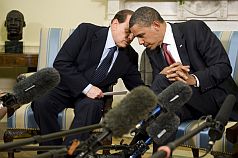 This perhaps sounds relatively innocuous, but as I reported in July, when the rumors first surfaced that Silvio Berlusconi had agreed to take a number of Tunisian prisoners from Guantánamo, there are serious doubts about the circumstances in which the prisoners have been transferred. These are not alleviated by the careful mention of a Memorandum of Understanding, and they hardly warrant the thanks extended by the DoJ — “The United States is grateful to the government of Italy for helping achieve President Obama’s directive to close the Guantánamo Bay detention facility” — unless that sentence were to be followed by the words, “by any means necessary.”
As Daniel Gorevan, a spokesman for Amnesty International, noted in March, after EU Justice Commissioner Jacques Barrot stated that the US government had raised the possibility of a Memorandum of Understanding between the EU and the US on the protection of detainees in Guantánamo, during a meeting on March 17, “Any memorandum of understanding between the USA and Europe on Guantánamo detainees must take into account this fundamental requirement: all detainees who are not charged and tried fairly in US courts must be released safely.”
This is clearly not the case with the two men who have just arrived in Italy from Guantánamo, as I explained in July, when reports in La Repubblica and information obtained from sources in the United States allowed me to confirm that, after the US government informally asked the Italian government in April to take six or seven prisoners from Guantánamo, the Department of Public Security and the Ministry of Justice compiled a list of Guantánamo prisoners who had criminal proceedings pending against them in Italy, and then focused on three prisoners, including Boughanmi and Nasseri, on the basis that they would be transferred from Guantánamo to Italian jails.
As I also noted:
[La Repubblica] suggested that Roberto Maroni, the Minister of the Interior (and a member of Italy’s notoriously right-wing Northern League), only approved their transfer when he received reassurances that they would not be set free, and this was confirmed in an article in the Christian Science Monitor, in which reporter Anna Momigliano wrote that Maroni, whose party was bluntly described as “oppos[ing] the presence of Muslim immigrants” in Italy, stated, “I oppose taking [the prisoners] in, as long as we are not sure they will be kept behind bars.”
La Repubblica added that the prisoners would not receive “credit” for their seven years in Guantánamo, and noted that, in 2007, the Milanese Public Prosecutor’s office had requested extradition of two of the men, but the Ministry of Justice refused to forward the extradition request to the US government because Guantánamo was “not US territory.” As a result, it is understood that the US government’s transfer of the men to Italian custody will not involve extraditing them, but rather expelling them, and the Italian government can therefore treat them not as prisoners who have already served a jail sentence, but as fugitives who are obliged to serve a full term. As a source in the United States explained, this novel approach to disposing of prisoners in Guantánamo is actually a form of “rendition.”
These fears have not been allayed with the transfer, under the cover of a Memorandum of Understanding, of two of the three men mentioned in July. Both were taken into custody on their arrival in Milan, and are currently being questioned, and no indication has yet been provided as to whether they will face a trial, and whether their lost years in Guantánamo will be taken into account should they be sentenced.
The fog of evidence
In the fog of rumors and allegations surrounding the men, it is difficult to know where the truth lies. According to Italian prosecutors, both were involved with an Islamic center in Milan that had connections with al-Qaeda, and arrest warrants for both men were issued while they were in Guantánamo. In 2005, Boughanmi was accused of “international terrorism, falsification of documents, aiding illegal immigration, theft and drug trafficking,” and in 2007 Nasseri was accused of “organizing in Afghanistan the logistics for fighters coming from Italy ‘where they were trained in the use of weapons and in preparation for suicide attacks,’” and was also described as “the head of the Tunisians in Afghanistan, ‘from where he maintained constant relations with the structures in Italy and Milan.’”
However, Boughanmi, who was 31 years old when he was seized crossing from Afghanistan into Pakistan, explained to his lawyers that he worked in restaurants in Naples and Rome, and as a barber in Milan, and stated that he traveled to Afghanistan in early 2001, “because I became a Muslim when I was in Europe. My country was very tough on the Muslims. Afghanistan was a country where they were willing to take anybody, you don’t need any money to live there, and they welcome all the Muslims.”
In addition, as I explained in July:
In Guantánamo, he denied an allegation that he was part of a terrorist network in Italy, and that he “possibly” falsified passports “for fleeing al-Qaeda combatants who make it to Europe” (that use of the word “possibly” generally indicating that even the US military regarded the allegation as unreliable). He also refuted allegations that he was an “extremist” in Bosnia-Herzegovina during the civil war, and, to prove it, showed the tribunal the visa stamps in his passport, which he requested as evidence. The information about his purported activities in the former Yugoslavia was apparently provided by the Tunisian government, which had sentenced him in absentia to 20 years in prison for allegedly being a member of a terrorist organization operating abroad.
Less is known publicly about Nasseri, who was 35 years old at the time of his capture in Afghanistan, because he refused to take part in any of the military review processes at Guantánamo (the Combatant Status Review Tribunals and the annual Administrative Review Boards), although it was noted that he refuted all the allegations against him. Some of these related to the Italian arrest warrant mentioned above, a claim that he fought in Bosnia may have come from the Tunisian government (which gave him a ten-year sentence in absentia for being a member of a terrorist organization operating abroad), and no clue whatsoever was provided to back up an allegation that he “led a band of thieves in Italy and Spain who cooperated with Algerian terrorists.”
Most worrying is the claim that he was “the head of the Tunisians in Afghanistan,” which may, of course, be true, but what makes it suspicious in the context of the intelligence-gathering at Guantánamo is that it comes from an allegation that he was “identified by a senior al-Qaeda lieutenant as having trained at the Khaldan camp and that he eventually took over as the Emir of the Tunisian Group in Afghanistan.”
References to “a senior al-Qaeda lieutenant” in proceedings at Guantánamo invariably refer to “high-value detainees,” who, at the time, were held in secret CIA prisons where they were subjected to “enhanced interrogation techniques” approved by lawyers in the Justice Department’s Office of Legal Counsel; in other words, where they were tortured.
There is, of course, no indication as to who this particular “high-value detainee” was, but as the reference is to the Khaldan training camp, it seems likely that the allegation was made either by Abu Zubaydah (the gatekeeper of the camp, and the CIA’s most well-known torture victim, along with Khalid Sheikh Mohammed) or by Ibn al-Shaykh al-Libi, the CIA’s most famous “ghost prisoner.” Tortured in Egypt in 2002, al-Libi made a false confession about links between al-Qaeda and Saddam Hussein that was used to justify the invasion of Iraq. Rendered to various other prisons run by or on behalf of the CIA in the four years that followed, he was returned to Libya in 2006, where he died in May this year, reportedly by committing suicide.
With al-Libi conveniently out of the picture, and Abu Zubaydah psychologically destroyed (in April this year, one of his attorneys, Joe Margulies, wrote that he “has permanent brain damage,” and that, “In the last two years alone, he has experienced about 200 seizures”), it seems unlikely that any of these doubts about Nasseri will ever be addressed.
For their part, the Italian authorities seem to be relying heavily on an informer, Lazhar Ben Mohamed Tlil, a Tunisian who traveled to Afghanistan to undertake military training, and who is now the main source of information — for US officials as well as the Italian authorities — on the movements of Tunisians and others in Afghanistan and Europe. Three weeks ago, Italian prosecutor Elio Ramondini told the Associated Press that, without Tlil, the prosecution of the Guantánamo suspects in Italy “is not difficult, it is impossible.”
Whether Tlil deserves this star billing is unknown. His testimony may, for example, be unreliable, but perhaps a court can sort that out if he remains cooperative. For now, his lawyer has explained that he is “unhappy with Italy’s witness protection program,” and feels “abandoned,” and that, as a result, he is “threatening to withhold testimony,” both from the Americans, who want him to testify in the United States, and also from the Italian prosecutors.
Just as troubling, given the lack of information about the circumstances of the men’s transfer to Italy, is the fact that the Italian government announced on Tuesday that it was still looking at a number of other cases of prisoners in Guantánamo. Franco Frattini, the Foreign Minister, said that Italy has agreed “to take in others,” but added, “we haven’t pinpointed yet” which prisoners to take.
If trials are justified on the basis of genuine evidence of wrongdoing, then it will presumably be acceptable that extraditions, expulsions or “renditions to justice” are a new tool for a President who has allowed so many doors to shut on his plans to close Guantánamo, but without transparent and reliable assurances that trials will be fair, and that the men will receive credit for their lost years in Guantánamo, I fail to see how this deal between Barack Obama and Silvio Berlusconi can be regarded as a valid step forward in bringing to an end the injustices of Guantánamo and the “War on Terror.”
Andy Worthington is the author of The Guantánamo Files: The Stories of the 774 Detainees in America’s Illegal Prison (published by Pluto Press, distributed by Macmillan in the US, and available from Amazon — click on the following for the US and the UK). To receive new articles in your inbox, please subscribe to my RSS feed (and I can also be found on Facebook and Twitter). Also see my definitive Guantánamo prisoner list, published in March 2009, details about the new documentary film, “Outside the Law: Stories from Guantánamo” (co-directed by Polly Nash and Andy Worthington, and launched in October 2009), and, if you appreciate my work, feel free to make a donation.
As published exclusively on Truthout. Cross-posted on Common Dreams and AlterNet.
See the following for articles about the 142 prisoners released from Guantánamo from June 2007 to January 2009, and the 25 prisoners released from February to October 2009, whose stories are covered in more detail than is available anywhere else –- either in print or on the Internet –- although many of them, of course, are also covered in The Guantánamo Files: June 2007 –- 2 Tunisians, 4 Yemenis (here, here and here); July 2007 –- 16 Saudis; August 2007 –- 1 Bahraini, 5 Afghans; September 2007 –- 16 Saudis; September 2007 –- 1 Mauritanian; September 2007 –- 1 Libyan, 1 Yemeni, 6 Afghans; November 2007 –- 3 Jordanians, 8 Afghans; November 2007 –- 14 Saudis; December 2007 –- 2 Sudanese; December 2007 –- 13 Afghans (here and here); December 2007 –- 3 British residents; December 2007 –- 10 Saudis; May 2008 –- 3 Sudanese, 1 Moroccan, 5 Afghans (here, here and here); July 2008 –- 2 Algerians; July 2008 –- 1 Qatari, 1 United Arab Emirati, 1 Afghan; August 2008 –- 2 Algerians; September 2008 –- 1 Pakistani, 2 Afghans (here and here); September 2008 –- 1 Sudanese, 1 Algerian; November 2008 –- 1 Kazakh, 1 Somali, 1 Tajik; November 2008 –- 2 Algerians; November 2008 –- 1 Yemeni (Salim Hamdan) repatriated to serve out the last month of his sentence; December 2008 –- 3 Bosnian Algerians; January 2009 –- 1 Afghan, 1 Algerian, 4 Iraqis; February 2009 — 1 British resident (Binyam Mohamed); May 2009 — 1 Bosnian Algerian (Lakhdar Boumediene); June 2009 — 1 Chadian (Mohammed El-Gharani), 4 Uighurs to Bermuda, 1 Iraqi, 3 Saudis (here and here); August 2009 — 1 Afghan (Mohamed Jawad), 2 Syrians to Portugal; September 2009 — 1 Yemeni, 2 Uzbeks to Ireland (here and here); October 2009 — 1 Kuwaiti, 1 prisoner of undisclosed nationality to Belgium: October 2009 — 6 Uighurs to Palau.
Video: Andy Worthington Discusses Guantánamo, Plus Clips From “Outside the Law: Stories from Guantánamo”
Earlier today I posted a link to a 13-minute video on Truthout, “The Human Cost of Guantánamo,” featuring an interview filmed by Sari Gelzer and Troy Page in San Francisco, during my recent US tour to promote the new documentary, “Outside the Law: Stories from Guantánamo” (directed by Polly Nash and myself), which also includes some powerful excerpts from the film.
The video is available below via Facebook, and DVDs of “Outside the Law: Stories from Guantánamo” are available to buy here.
VIDEO: The Human Cost of GuantanamoInterview with Truthout Reporter Andy Worthington http://www.truthout.org/1203091
Posted by Truthout on Thursday, 3 December 2009
In the interview, conducted at the University of San Francisco School of Law, after a screening of “Outside the Law: Stories from Guantánamo,” I had the opportunity, before President Obama even made his admission that Guantánamo would not close by his self-imposed deadline of January 22, 2010, to talk about how difficult it will be remove this chronic stain on America’s reputation, primarily because the administration has failed to seize the initiative in bringing cleared prisoners to resettle on the US mainland, which would have encouraged other countries to follow suit. Instead, finding new homes for prisoners has been only marginally easier than getting blood out of a stone, and has been further complicated by the refusal of Congress to recognize that its reputation — and that of the United States as a whole — will remain fatally tarnished throughout the word until this icon of injustice is closed.
I also explained — illustrated by clips from the film — the extent of the gulf between the Bush administration’s rhetoric about Guantánamo holding “the worst of the worst” and the rather more distressing reality: that, in their violent haste, and their arrogant dismissal of domestic and international laws designed not only to protect prisoners from abuse, but also to screen them to determine whether they had been seized by mistake, George W. Bush, Dick Cheney and Donald Rumsfeld presided over the creation of a lawless experiment that not only enshrined the use of torture, but that also held no more than 40 prisoners (out of a total of nearly 800), who had any meaningful connection to al-Qaeda or international terrorism.
About the film
“Outside the Law: Stories from Guantánamo” tells the story of Guantánamo (and includes sections on extraordinary rendition and secret prisons) with a particular focus on how the Bush administration turned its back on domestic and international laws, how prisoners were rounded up in Afghanistan and Pakistan without adequate screening (and often for bounty payments), and why some of these men may have been in Afghanistan or Pakistan for reasons unconnected with militancy or terrorism (as missionaries or humanitarian aid workers, for example).
The film is based around interviews with former prisoners (Moazzam Begg and, in his first major interview, Omar Deghayes, who was released in December 2007), lawyers for the prisoners (Clive Stafford Smith in the UK and Tom Wilner in the US), and journalist and author Andy Worthington, and also includes appearances from Guantánamo’s former Muslim chaplain James Yee, Shakeel Begg, a London-based Imam, and the British human rights lawyer Gareth Peirce.
Focusing on the stories of three particular prisoners — Shaker Aamer (who is still held), Binyam Mohamed (who was released in February 2009) and Omar Deghayes — “Outside the Law: Stories from Guantánamo” provides a powerful rebuke to those who believe that Guantánamo holds “the worst of the worst” and that the Bush administration was justified in responding to the terrorist attacks of September 11, 2001 by holding men neither as prisoners of war, protected by the Geneva Conventions, nor as criminal suspects with habeas corpus rights, but as “illegal enemy combatants” with no rights whatsoever.
“Outside the Law: Stories from Guantánamo” is a Spectacle Production (74 minutes, 2009). For further information, interviews, or to inquire about broadcasting, distributing or showing “Outside the Law: Stories from Guantánamo,” please contact Andy Worthington or Polly Nash.
Andy Worthington is the author of The Guantánamo Files: The Stories of the 774 Detainees in America’s Illegal Prison (published by Pluto Press, distributed by Macmillan in the US, and available from Amazon — click on the following for the US and the UK). To receive new articles in your inbox, please subscribe to my RSS feed (and I can also be found on Facebook and Twitter). Also see my definitive Guantánamo prisoner list, published in March 2009, details about the new documentary film, “Outside the Law: Stories from Guantánamo” (co-directed by Polly Nash and Andy Worthington, and launched in October 2009), and, if you appreciate my work, feel free to make a donation.
Truthout Video: The Human Cost of Guantánamo
 Out now on Truthout is a 13-minute video by Sari Gelzer and Troy Page, featuring an interview with Andy Worthington, journalist and author of The Guantánamo Files, which includes excerpts from the new documentary film, “Outside the Law: Stories from Guantánamo” (directed by Polly Nash and Andy Worthington).
The interview was recorded in San Francisco, during Andy’s recent visit to the US to promote “Outside the Law: Stories from Guantánamo,” and includes reflections on the problems facing the Obama administration, as it tries to close the prison, as well as an explanation of some of the key themes discussed in film, illustrated with powerful clips featuring former prisoners Moazzam Begg and, in his first major interview, Omar Deghayes, and lawyers Tom Wilner and Clive Stafford Smith.
The video is below, via Facebook:
VIDEO: The Human Cost of GuantanamoInterview with Truthout Reporter Andy Worthington http://www.truthout.org/1203091
Posted by Truthout on Thursday, 3 December 2009
These key themes include an examination of how the Bush administration turned its back on domestic and international laws, how prisoners were rounded up in Afghanistan and Pakistan without adequate screening (and often for bounty payments), and why some of these men may have been in Afghanistan or Pakistan for reasons unconnected with militancy or terrorism (as missionaries or humanitarian aid workers, for example).
Focusing on the stories of three particular prisoners — Shaker Aamer, who is still held), Binyam Mohamed (who was released in February 2009) and Omar Deghayes (released in December 2007) — “Outside the Law: Stories from Guantánamo” provides a powerful rebuke to those who believe that Guantánamo holds “the worst of the worst” and that the Bush administration was justified in responding to the terrorist attacks of September 11, 2001 by holding men neither as prisoners of war, protected by the Geneva Conventions, nor as criminal suspects with habeas corpus rights, but as “illegal enemy combatants” with no rights whatsoever.
The following passages describe some of Andy’s comments about the Obama administration’s problems when it comes to closing Guantánamo, many of which — as explained in a recent article, “Guantánamo: Idealists Leave Obama’s Sinking Ship” — are self-made, and the result of lamentable cowardice in the face of right-wing pressure:
Recently, Worthington held screenings for “Outside the Law” in the US, which garnered discussion about the future of Guantánamo detainees as President Barack Obama’s self-imposed deadline to close the prison fast approaches. Worthington said that as he toured the US with the film, he noticed something he describes as the “Obama Effect.”
“There seems to be an enormous number of people who are still sitting and thinking that everything’s fine because President Obama’s in and he said he is going to close it and that there is nothing to worry about. Whereas it’s actually not very long until the prison’s supposed to close and there are going to be some real difficulties in achieving that.”
A main difficulty, said Worthington, is finding a place to go to for those who have been cleared of terrorist activities. Even though a handful of European countries have allowed former detainees to resettle, there remain dozens in Guantánamo with nowhere to go. The problem, said Worthington, is that members of Congress on both sides of the aisle are indulging in fearmongering and not allowing prisoners who have been found innocent to resettle in the US.
Worthington said that Congress is the main reason that there is still “no option available for finding new homes in the United States for people who were wrongly imprisoned by the United States, who are not terrorists, who have been cleared by both the Bush administration and the Obama administration of posing a threat.”
“Very simply put,” said Worthington, exasperated at the lack of responsibility by the very country that wrongly imprisoned them, “if something doesn’t happen on this front, I think these men stay and rot in Guantánamo forever.”
For further information, interviews, or to inquire about broadcasting, distributing or showing “Outside the Law: Stories from Guantánamo,” please contact Andy Worthington or Polly Nash.
“Outside the Law: Stories from Guantánamo” is a Spectacle Production (74 minutes, 2009), and copies of the DVD are now available. For excerpts and extras, follow the links on the Spectacle website.
Andy Worthington is the author of The Guantánamo Files: The Stories of the 774 Detainees in America’s Illegal Prison (published by Pluto Press, distributed by Macmillan in the US, and available from Amazon — click on the following for the US and the UK). To receive new articles in your inbox, please subscribe to my RSS feed (and I can also be found on Facebook and Twitter). Also see my definitive Guantánamo prisoner list, published in March 2009, details about the new documentary film, “Outside the Law: Stories from Guantánamo” (co-directed by Polly Nash and Andy Worthington, and launched in October 2009), and, if you appreciate my work, feel free to make a donation.
Andy Worthington Discusses Guantánamo, Torture and the Afghan Surge With Kevin Barrett On No Lies Radio
On Tuesday, I was delighted to have the opportunity to talk for an hour to Kevin Barrett, “9/11 truth advocate” and the author of Questioning the War on Terror, on his show, “Fair and Balanced,” on No Lies Radio. The show is available here (you may have to switch off the live feed on the right of the page), and, although Kevin and I have spoken before, I’d like to thank him for taking the time to talk to me again, and for crossing what sometimes seems to be an unbridgeable chasm between those who regard the events of September 11, 2001 as an inside job, and those who regard it as an actual terrorist attack, which went undetected primarily because of a lack of cooperation between the CIA and the FBI, and which spurred those in charge of the United States at that particular time — essentially, Dick Cheney, his legal counsel David Addington, and a cabal of close advisors — to transform American into a Torture Nation led by an unaccountable President, and also allowed them to realize their long-cherished dream of toppling Saddam Hussein.
I have often thought that both camps have much in common when it comes to the use of torture to extract false information (as, for example, with the torture of Ibn al-Shaykh al-Libi to produce a claim that there were links between al-Qaeda and Saddam Hussein, which was subsequently used to justify the invasion of Iraq), and I also appreciate the opportunity to have different points of view discussed in a civilized and rational manner, rather than having both sides generally behave as though the other doesn’t exist — or, at least, is terminally confused.
Kevin and I also spoke about the domestic impact of the Bush administration’s policies — snooping on US citizens, or, as in the case of Jose Padilla, imprisoning him as an “enemy combatant” in chronic isolation without charge or trial and torturing him until he lost his mind (and we also discussed the case of Ali al-Marri). We also discussed the Obama administration’s recent announcement of federal court trials for Khalid Sheikh Mohammed and four other men accused of involvement in the 9/11 attacks (or “the patsies,” as Kevin refers to them), the revival of the Military Commissions, the continuation of indefinite detention without charge or trial, the failure to close Guantánamo within a year, and the difficulty of finding new homes for cleared prisoners who cannot be repatriated.
I was especially pleased to have the opportunity to talk about the reasons for the administration’s self-destructive cowardice in the face of pressure from the lunatic wing of the Republican party (which I discussed at length in my recent article, “Guantánamo: Idealists Leave Obama’s Sinking Ship”), and we also had the opportunity to mention a word in connection with Obama’s announcement of the Afghan surge that is conspicuously lacking from most mainstream reporting — Vietnam — allowing me to explain how, above and beyond the disastrous failure to close Guantánamo within a year, this decision may well be the black mark that taints the rest of his Presidency.
Andy Worthington is the author of The Guantánamo Files: The Stories of the 774 Detainees in America’s Illegal Prison (published by Pluto Press, distributed by Macmillan in the US, and available from Amazon — click on the following for the US and the UK). To receive new articles in your inbox, please subscribe to my RSS feed (and I can also be found on Facebook and Twitter). Also see my definitive Guantánamo prisoner list, published in March 2009, details about the new documentary film, “Outside the Law: Stories from Guantánamo” (co-directed by Polly Nash and Andy Worthington, and launched in October 2009), and, if you appreciate my work, feel free to make a donation.












 Who's still at Guantánamo?
