Archive for May, 2009
Obama’s First 100 Days: Mixed Messages On Torture
 At a press conference to mark his first 100 days in office, President Obama declared, “We have rejected the false choice between our security and our ideals by closing the detention center at Guantánamo Bay and banning torture without exception.” I have looked at the President’s misleading statement about Guantánamo, and analyzed his progress — or lack of it — in closing the prison in a previous article, and in this second article I’m going to focus on his assertion that the new administration has been responsible for “banning torture without exception.”
On the surface, Obama appears to have been true to his word. In two Executive Orders issued on his second day in office (along with an order relating to the closure of Guantánamo), he established that the questioning of prisoners by any US government agency (including the CIA) must follow the interrogation guidelines laid down in the Army Field Manual, which guarantees humane treatment under the Geneva Conventions, and also required the CIA to close any still-existing secret prisons.
This order also established a Special Interagency Task Force on Interrogation and Transfer Policies, to evaluate “whether the interrogation practices and techniques in the Army Field Manual, when employed by departments or agencies outside the military, provide an appropriate means of acquiring the intelligence necessary to protect the Nation, and, if warranted, to recommend any additional or different guidelines for other departments or agencies.” This task force was also charged with evaluating “the practices of transferring individuals to other nations,” to ensure that they do not face torture.
Allied to this, in some ways, is the other Executive Order establishing another Special Interagency Task Force to provide an overview of detention policy options, which was charged with reviewing the “lawful options” available to government with respect to the “apprehension, detention, trial, transfer, release, or other disposition of individuals captured or apprehended in connection with armed conflicts and counter-terrorism operations.”
These two task forces have until the end of July to deliver their reports, but while the President is undoubtedly to be commended for drawing a clear distinction between himself and his predecessor regarding the broad outlines of detention and interrogation policies, critics have already noted a few worrying signs that certain loopholes may have been left open.
Appendix M of the Army Field Manual
One of these concerns the Army Field Manual. Reintroducing it as the benchmark for military interrogations, for example, is clearly necessary to call a halt to the licensed sadism of the years when Donald Rumsfeld was defense secretary, but Jeff Kaye, psychologist and anti-torture blogger, raised concerns in January about part of the manual, Appendix M, which, as he described it, authorizes the use of specific torture techniques used in the “War on Terror,” including “solitary confinement, perceptual or sensory deprivation, sleep deprivation, the induction of fear and hopelessness, and the likely use of sensory overload, temperature or environmental manipulation.” Kaye’s concerns have been picked up by human rights organizations, including Amnesty International, which mentioned, in its review of Obama’s first 100 days (PDF), its disappointment that the administration was “endorsing without qualification” a document “which permits prolonged sleep deprivation, isolation and manipulation of a detainee’s fears contrary to the international ban on torture.”
 This was certainly not how the military saw it, when the new Army Field Manual was issued in September 2006. At a press conference, Lt. Gen. Jeff Kimmons, the Army G-2 senior intelligence officer, specifically addressed concerns about Appendix M. As Kimmons described it, “Our four-star combatant commanders also specifically requested, based on battlefield experience, that we include one restricted technique called separation, for use on a by-exception basis only with unlawful enemy combatants. That is, it’s not authorized for use on prisoners of war and other protected persons.”
Kimmons proceeded to explain, “Separation allows interrogators to keep unlawful enemy combatants apart from each other as a normal part of the interrogation process, so they can’t coordinate their stories and so that we can compare answers to questions that interrogators have posed to each other without there having been collusion. It’s for the same reason that police keep murder suspects separated while they’re questioning them, although this is within an interrogation context.”
On the surface, Kimmons’s explanation seemed reasonable enough, but Kaye pointed out that it was, in fact, “inconsistent with the explanation for separation given in the current Army Field Manual,” in which the technique is not about the “normal interrogation process,” as the following passage makes clear (emphasis added): “Separation should be used as part of a well-orchestrated strategy involving the innovative application of unrestricted approach techniques. Separation requires special approval, judicious execution, special control measures and rigorous oversight.”
It may be, as a former intelligence officer noted on his blog (Decline and Fall), that “separation” can only be approved by a General, and, “given the political climate” regarding detainee abuse, would be “very hard to obtain,” but I have to admit that I fail to find it reassuring that techniques that bear more than a passing resemblance to those that drowned the “War on Terror” in a morass of torture and abuse should be sanctioned at all, especially as “separation” is so clearly described as only forming part of an unspecified program involving, as I highlighted above, “the innovative application of unrestricted approach techniques,” and, of course, because it is specifically targeted at prisoners regarded as being outside the reach of the Geneva Conventions (“unlawful enemy combatants,” in the Bush administration’s parlance).
Under Obama, we are led to believe that the Geneva Conventions will, henceforth, apply to all prisoners held by US forces, but, as I explain below, there are other reasons for believing that a loophole has been left open for the possible detention of future “illegal enemy combatants.”
“Extraordinary rendition”
 My concerns about this possibility center on the Obama administration’s review of the detention and transfer of prisoners; in other words, those parts of the policy directed towards appraising the system of “extraordinary rendition” developed by the Bush administration. In its review of Obama’s first 100 days, Amnesty International singled out “the possibility of the CIA abducting and detaining people in ‘short-term transitory’ facilities” as an unacceptable loophole. This came from an otherwise laudable announcement a month ago by the CIA’s new director, Leon Panetta, in which Panetta stated, “CIA no longer operates detention facilities or black sites and has proposed a plan to decommission the remaining sites,” but added that the agency “retains the authority to detain individuals on a short-term transitory basis.”
Realistically, it is hard to argue with the agency having the opportunity to hold prisoners on a temporary basis, especially if, as Panetta also stated, “Under the Executive Order, the CIA does not employ any of the enhanced interrogation techniques that were authorized by the Department of Justice from 2002 to 2009.” What is worrying, however, is the suggestion that certain “black sites” were still open just a month ago, and this comment becomes more troublesome when analyzed in connection with Panetta’s additional comments about the agency’s authority to hold prisoners on a short-term basis. Although he wrote that no detentions had occurred “since I have become Director,” he added, “We anticipate that we would quickly turn over any person in our custody to US military authorities or to their country of jurisdiction, depending on the situation.”
I’ve highlighted the phrase that troubles me, as it undoubtedly indicates that, were certain situations to arise in future, the CIA is prepared to transfer prisoners to third countries, where, very possibly, they would face the risk of torture, and the only logical conclusion I can draw is that, essentially, the Obama administration’s only real problem with “extraordinary rendition” is one of scale. The Bush administration’s industrial-scale rendition policies have been banished, but the prospect of limited rendition — to third countries rather than to the US court system, as would surely be more acceptable — is being kept as a possible option.
The Office of Legal Counsel’s torture memos
In some quarters, it has been suggested that the Obama administration’s decision, three weeks ago, to release four previously classified memos issued by the Justice Department’s Office of Legal Counsel in 2002 and 2005 (which purported to justify the use of torture by the CIA) was an important gesture in signaling a break with the previous administration. And in some ways it was, of course, but it should also be remembered that the memos were not released spontaneously, but as the result of a pending lawsuit by the American Civil Liberties Union.
 It was also clear that the President was unsure how to play the memos’ release. Both he and Attorney General Eric Holder went out of their way to pledge that no one would be prosecuted for following orders. Obama said, “In releasing these memos, it is our intention to assure those who carrying out their duties relying in good faith upon the legal advice from the Department of Justice that they will not be subject to prosecution,” and, in a similar vein, Holder added, “It would be unfair to prosecute dedicated men and women working to protect America for conduct that was sanctioned in advance by the Justice Department.”
This was understandable in the sense that operatives cannot necessarily be required to know whether or not the orders they are give are legally sound (although it should also be noted that many people knew when they were crossing a line, regardless of what they were told), but Obama then appeared to over-emphasize the point by visiting CIA headquarters, and telling a group of around 1,000 CIA employees, “What makes the United States special, and what makes you special, is precisely the fact that we are willing to uphold our values and ideals even when it’s hard — not just when it’s easy.” To my mind, this only ended up insulting those brave souls, like the military defense attorneys in the Military Commission trial system, or the prosecutors who resigned, or other officers who broke ranks to complain about the brutality and injustice of the “War on Terror,” and who, as a result, lost their jobs or otherwise endangered their careers.
It was also noticeable that, when polls seemed to indicate a shift towards a belief that a proper investigation of the Bush administration’s activities should take place, the President dropped his “looking forward and not backwards” mantra, and, while maintaining that “For those who carried out some of these operations within the four corners of legal opinions or guidance that had been provided from the White House, I do not think it’s appropriate for them to be prosecuted,” added, significantly, “With respect to those who formulated those legal decisions, I would say that that is going to be more of a decision for the Attorney General within the parameters of various laws, and I don’t want to prejudge that.”
What was particularly disappointing about all of this was that it showed an administration shifting about uneasily in an attempt to avoid confronting the compelling truth that senior Bush officials had admitted that they had been involved in torture, including waterboarding, that both Obama and Holder had stated publicly that waterboarding was torture, and that, as a result, because torture is a crime according to US law, those responsible for implementing it must be held accountable.
However, while the administration’s approach to the release of the torture memos has sent out mixed messages, the President and the Justice Department have failed miserably to differentiate themselves from their predecessors on two other fronts relating to the use of torture in the “War on Terror.”
Blocking habeas corpus at Bagram
The first of these concerns Bagram, the prison at the US airbase north of Kabul, Afghanistan, where an estimated 650 prisoners are held, in conditions that make Guantánamo — still an opaque establishment, despite the publicity surrounding it — look positively transparent. The prisoners at Guantánamo have secured several significant Supreme Court victories between 2004 and 2008 establishing that they have rights (however much the nation’s politicians attempted to remove them in the intervening years), and they have also had access to attorneys for over four years, have been through review processes that, however inadequate, have at least cleared some of them for release, and in recent months have, in a few cases, been ordered to be freed by US courts.
At Bagram, however, none of these rights apply, but in February, when four habeas corpus cases filed on behalf of prisoners in Bagram reached a US court, the Obama administration refused to distance itself from its predecessor’s blanket refusal to open up the prison to any kind of outside scrutiny, stating simply that, “Having considered the matter, the Government adheres to its previously articulated position.”
 At the time, Judge John D. Bates had already suggested that he suspected that this was an unacceptable position to take, because Bagram appeared to be “a ‘black hole’ for detainees in a ‘law-free zone,’” but it was not until a month ago, having reviewed the arguments more comprehensively, that he understood that there were different categories of prisoner in Bagram: foreigners captured in other countries and “rendered” there, Afghans captured in other countries and “rendered” there, and Afghans captured in Afghanistan.
The latter category were (in theory, at least) connected to events in an ongoing war zone (and were, moreover, subject to delicate negotiations between the US and Afghan governments), and Judge Bates reserved judgment about one of the four cases (an Afghan captured in another country and “rendered” back to his home country), but he had no hesitation in declaring that the habeas rights granted by the Supreme Court to the Guantánamo prisoners last June in Boumediene v. Bush also extended to the foreign prisoners in Bagram (who included the other three men in the cases before him), because, as he explained succinctly, “the detainees themselves as well as the rationale for detention are essentially the same.” In fact, as Judge Bates also noted (and as I explained in depth in an article at the time), the review process at Bagram is both “inadequate” and “more error-prone” than the tribunal process used at Guantánamo, and “falls well short of what the Supreme Court found inadequate at Guantánamo.”
This is not, strictly speaking, a story about torture, but it becomes one when the stories of these men are examined in any detail, and it becomes apparent that they were all held in a variety of secret prisons in Afghanistan, which were run by the CIA, or under the agency’s control, before they even arrived at Bagram. This knowledge, plus the implications of Judge Bates’s ruling, made it doubly shocking when, instead of abiding by the decision, the Obama administration appealed, prompting the New York Times to declare that the appeal “signaled that the administration was not backing down in its effort to maintain the power to imprison terrorism suspects for extended periods without judicial oversight.”
Blocking accountability for the CIA torture team’s “travel agent”
The other shock concerned a case initially brought by the ACLU against Jeppesen Dataplan, Inc., a Boeing subsidiary, on behalf of five prisoners subjected to “extraordinary rendition” and torture (Binyam Mohamed, Ahmed Agiza, Abou Elkassim Britel, Mohamed Farag Ahmad Bashmilah and Bisher al-Rawi — profiled here), who were suing the company for damages based on their involvement in their ordeal as the CIA’s “travel agent.” The Bush administration had intervened the first time round, invoking the little-used state secrets doctrine, and requesting a dismissal of the entire action before Jeppesen filed an answer to the complaint, and when the case was revived in February, the Obama administration again followed suit, slavishly copying its predecessor, as it did with Bagram.
 To be fair, if the administration is determined not to hold operatives to account for crimes sanctioned at the highest level, then it was logical that it would intervene to prevent Jeppesen’s contractors from being held to account, but, when the case was reviewed by the Court of Appeals for the 9th Circuit, the judges — led by Judge Michael Daly Hawkins, and also including Judges Mary M. Schroeder and William C. Canby, Jr. — were not concerned with politics, but with the law, and they had no hesitation in demolishing the government’s case.
Jeppesen’s involvement in, and knowledge of the rendition program was actually revealed in an extraordinary declaration by Sean Belcher, a former employee, who stated that the director of Jeppesen International Trip Planning Services, Bob Overby, had told him,
“We do all the extraordinary rendition flights,” which he also referred to as “the torture flights” or “spook flights.” Belcher stated that “there were some employees who were not comfortable with that aspect of Jeppesen’s business” because they knew “some of these flights end up” with the passengers being tortured. He stated that Overby had explained, “that’s just the way it is, we’re doing them” because “the rendition flights paid very well.”
This declaration was cited by the judges, without comment, in a footnote, but when it came the “relatively thin history” of the state secrets doctrine the judges were merciless, dismissing the government’s reliance on the two precedents — one involving a secret agreement between the government and a spy in the nineteenth century, the other (from 1953) with the prevention of “discovery of secret evidence when disclosure would threaten national security” — for their irrelevance to the Jeppesen case.
They did this first by pinpointing the “clear error” the District Court made when it initially dismissed the case, when the court declared, “inasmuch as the case involves ‘allegations’ about the conduct of the CIA, the privilege is invoked to protect information which is properly the subject of state secrets privilege,” and also declared that “the very subject matter of this case is a state secret.” In contrast, the Appeals Court judges insisted that “The subject matter … is not a state secret, and the case should not have been dismissed at the outset.”
Dismissing the government’s arguments, they concluded that, although the government may be entitled to protect certain evidence in the interests of national security, it has no justification for suppressing judicial scrutiny of the case as a whole, particularly because some information relating to the case is already publicly available, and also because what the government is actually trying to do, with no legal precedent whatsoever, is to impose a blanket ban on all discussion of potential government wrongdoing.
The ruling is peppered with passages chastising the government, and I recommend those with an interest to read the full ruling (PDF), but the following is particularly sharp:
At base, the government argues … that state secrets form the subject matter of a lawsuit, and therefore require dismissal, any time a complaint contains allegations, the truth or falsity of which has been classified as secret by a government official. The district court agreed, dismissing the case exclusively because it “involves allegations” about [secret] conduct by the CIA.” This sweeping characterization of the “very subject matter” bar has no logical limit — it would apply equally to suits by US citizens, not just foreign nationals; and to secret conduct committed on US soil, not just abroad. According to the government’s theory, the Judiciary should effectively cordon off all secret government actions from judicial scrutiny, immunizing the CIA and its partners from the demands and limits of the law. (emphasis added)
Elsewhere, the judges drew on Boumediene, in which the Supreme Court stated that, while “[s]ecurity depends upon a sophisticated intelligence apparatus,” it “subsists, too, in fidelity to freedom’s first principles [including] freedom from arbitrary and unlawful restraint and the personal liberty that is secured by the adherence to the separation of powers.” They also drew on Hamdi v. Rumsfeld, another important Guantánamo case in the Supreme Court (in 2004), in which the justices stated, “Separation-of-powers concerns take on an especially important role in the context of secret Executive conduct. As the Founders of this nation knew well, arbitrary imprisonment and torture under any circumstance is a ‘gross and notorious … act of despotism.’”
I was also particularly impressed by the following passage:
If the simple fact that information is classified were enough to bring evidence containing that evidence within the scope of the [state secrets] privilege, then the entire state secrets inquiry — from determining which matters are secret to which disclosures pose a threat to national security — would fall exclusively to the Executive branch, in plain contravention of the Supreme Court’s admonition that “[j]udicial control over the evidence in a case cannot be abdicated to the caprice of executive officers” without “lead[ing] to intolerable abuses.” … A rule that categorically equated “classified” matters with “secret” matters would, for example, perversely encourage the President to classify politically embarrassing information simply to place it beyond the reach of judicial process.
What was notable about this passage was that it succinctly encapsulated the entire approach to “classified” information that was maintained by the Bush administration, and also mentioned invoking national security to prevent embarrassment — or, it could be said, to prevent the disclosure of crimes.
This kind of hyperbole, exercised to prevent embarrassment (or worse), was, I thought, the hidden sub-text of a shrill submission by CIA director Michael Hayden, moving for dismissal of the original complaint, when he claimed that disclosure of information relevant to the Jeppesen case “could be expected to cause serious — and in some instances, exceptionally grave — damage to the national security of the United States,” and the point was rammed home by the judges in a footnote citing a 1953 letter to President Eisenhower from Attorney General Herbert Brownwell, in which Brownwell wrote that classification procedures were then “so broadly drawn … as to make it possible for government officials to cover up their own mistakes and even their wrongdoing under the guise of protecting national security.”
It also brings me neatly to my conclusion. I understand that President Obama doesn’t want to rock the boat, endangering a fragile peace with the Republican party, in order to secure as much consensus as possible when so many other major policy decisions need to be made (and, perhaps, members of his own party need to be shielded from revelations of their knowledge of the grisly details of the “War on Terror”). However, as the 9th Circuit Court of Appeals has just demonstrated so admirably, by setting new rules for appropriate conduct while holding at bay any accountability for the Bush administration’s crimes, he is not only shielding those who are no longer in office from full disclosure of their activities — from the embarrassing to the depraved — but is also allowing himself to be infected by the same disdain for the separation of powers, and the same endorsement of unfettered Executive power, that was the Bush administration’s most toxic legacy for the values on which the republic was founded.
I’m still erring on the side of presuming that this is more to do with pragmatism than it is with deliberate, coldly conceived policy, but, like Judge John D. Bates and the judges of the 9th Circuit Court of Appeals, I’m beginning to run out of patience.
 Andy Worthington is the author of The Guantánamo Files: The Stories of the 774 Detainees in America’s Illegal Prison (published by Pluto Press, distributed by Macmillan in the US, and available from Amazon — click on the following for the US and the UK). To receive new articles in your inbox, please subscribe to my RSS feed, and see here for my definitive Guantánamo prisoner list, published in March 2009.
As published on Antiwar.com, CounterPunch, Common Dreams, the Huffington Post and After Downing Street.
For a sequence of articles dealing with the use of torture by the CIA, on “high-value detainees,” and in the secret prisons, see: Guantánamo’s tangled web: Khalid Sheikh Mohammed, Majid Khan, dubious US convictions, and a dying man (July 2007), Jane Mayer on the CIA’s “black sites,” condemnation by the Red Cross, and Guantánamo’s “high-value” detainees (including Khalid Sheikh Mohammed) (August 2007), Waterboarding: two questions for Michael Hayden about three “high-value” detainees now in Guantánamo (February 2008), Six in Guantánamo Charged with 9/11 Murders: Why Now? And What About the Torture? (February 2008), The Insignificance and Insanity of Abu Zubaydah: Ex-Guantánamo Prisoner Confirms FBI’s Doubts (April 2008), Guantánamo Trials: Another Torture Victim Charged (Abdul Rahim al-Nashiri, July 2008), Secret Prison on Diego Garcia Confirmed: Six “High-Value” Guantánamo Prisoners Held, Plus “Ghost Prisoner” Mustafa Setmariam Nasar (August 2008), Will the Bush administration be held accountable for war crimes? (December 2008), The Ten Lies of Dick Cheney (Part One) and The Ten Lies of Dick Cheney (Part Two) (December 2008), Prosecuting the Bush Administration’s Torturers (March 2009), Abu Zubaydah: The Futility Of Torture and A Trail of Broken Lives (March 2009), Ten Terrible Truths About The CIA Torture Memos (Part One), Ten Terrible Truths About The CIA Torture Memos (Part Two), 9/11 Commission Director Philip Zelikow Condemns Bush Torture Program, Who Authorized The Torture of Abu Zubaydah? and CIA Torture Began In Afghanistan 8 Months before DoJ Approval, Even In Cheney’s Bleak World, The Al-Qaeda-Iraq Torture Story Is A New Low (all April 2009). Also see the extensive archive of articles about the Military Commissions.
For other stories discussing the use of torture in secret prisons, see: An unreported story from Guantánamo: the tale of Sanad al-Kazimi (August 2007), Rendered to Egypt for torture, Mohammed Saad Iqbal Madni is released from Guantánamo (September 2008), A History of Music Torture in the “War on Terror” (December 2008), Seven Years of Torture: Binyam Mohamed Tells His Story (March 2009), and also see the extensive Binyam Mohamed archive. And for other stories discussing torture at Guantánamo and/or in “conventional” US prisons in Afghanistan, see: The testimony of Guantánamo detainee Omar Deghayes: includes allegations of previously unreported murders in the US prison at Bagram airbase (August 2007), Guantánamo Transcripts: “Ghost” Prisoners Speak After Five And A Half Years, And “9/11 hijacker” Recants His Tortured Confession (September 2007), The Trials of Omar Khadr, Guantánamo’s “child soldier” (November 2007), Former US interrogator Damien Corsetti recalls the torture of prisoners in Bagram and Abu Ghraib (December 2007), Guantánamo’s shambolic trials (February 2008), Torture allegations dog Guantánamo trials (March 2008), Sami al-Haj: the banned torture pictures of a journalist in Guantánamo (April 2008), Former Guantánamo Prosecutor Condemns “Chaotic” Trials in Case of Teenage Torture Victim (Lt. Col. Darrel Vandeveld on Mohamed Jawad, January 2009), Judge Orders Release of Guantánamo’s Forgotten Child (Mohammed El-Gharani, January 2009), Bush Era Ends With Guantánamo Trial Chief’s Torture Confession (Susan Crawford on Mohammed al-Qahtani, January 2009), Forgotten in Guantánamo: British Resident Shaker Aamer (March 2009), and the extensive archive of articles about the Military Commissions.
EXCLUSIVE: New Chief Prosecutor Appointed For Military Commissions At Guantánamo
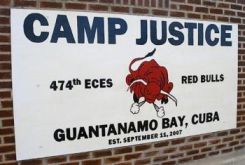 In a development that will only fuel suspicions that the Obama administration is indeed planning to revive the Bush administration’s much-criticized system of trials by Military Commission at Guantánamo (as flagged up by defense secretary Robert Gates in testimony before the Senate Appropriations Committee last week), I have just learned that the Commissions’ Chief Prosecutor, Col. Lawrence Morris, is retiring from active duty, and will be replaced by Capt. John Murphy (US Navy Reserve). No formal turnover date has been announced, but it is expected that the transition will take place over the next two months.
Col. Morris took over as Chief Prosecutor following the resignation, in October 2007, of Col. Morris Davis, who later dealt what should have been a mortal blow to what little credibility the trial system had –- in the face of widespread condemnation by legal experts, the government’s own military defense attorneys, several former prosecutors, and the US Supreme Court –- when he explained that he had resigned specifically because he had been placed in a chain of command under William J. Haynes II, the Pentagon’s General Counsel.
While lambasting the Bush administration for politicizing the entire process, Col. Davis singled out Haynes for particular criticism, because he had been pushing for the Commissions to allow the use of evidence obtained through torture, in spite of his own opposition. He later prompted Haynes’ sudden resignation, when he reported, in February 2008, that, in a discussion with Haynes about the Nuremberg Trials, in which Col. Davis had noted that there had been some acquittals, which had “lent great credibility to the proceedings,” Haynes had responded by saying, “Wait a minute, we can’t have acquittals. If we’ve been holding these guys for so long, how can we explain letting them get off? We can’t have acquittals. We’ve got to have convictions.”
Under Col. Morris, around two dozen cases were put forward for trial, although his tenure was dogged by controversy regarding the role played by Brig. Gen. Thomas Hartmann, the legal advisor to retired judge Susan Crawford, the Commission’s Convening Authority. Crawford, a protégée of Dick Cheney and a close friend of David Addington, Cheney’s Chief of Staff (who remains in her job, despite the change of administration) has the final say on which cases will proceed to trial, and is supposed to provide the entire process with objective oversight.
However, as I discussed in an article last October, “The Dark Heart of the Guantánamo Trials,” it is difficult to have any faith in her objectivity given her close connections to Cheney and Addington (the architects of the Commissions), and the fact that Col. Davis had criticized her for overstepping her administrative role. “[She] had her staff assessing evidence before the filing of charges, directing the prosecution’s pretrial preparation of cases (which began while I was on medical leave), drafting charges against those who were accused and assigning prosecutors to cases,” Col. Davis explained, adding, “Intermingling convening authority and prosecutor roles perpetuates the perception of a rigged process stacked against the accused.”
Last year, when Brig. Gen. Hartmann was repeatedly criticized by judges in the Commissions for pro-prosecution bias (and was ultimately removed from his post, although he was retained in another advisory role), it was difficult to escape the conclusion that, although there was a catalog of complaints about his abrasive personality, he had effectively been a sacrificial shield, set up to prevent scrutiny of the chain of command that led from Crawford to the Pentagon’s Office of Legal Counsel, and on to Cheney and Addington.
In accepting the job as Chief Prosecutor, Capt. Murphy must know that he is taking on a job that is fraught with difficulties, particularly after Lt. Col. Darrel Vandeveld, who resigned as a prosecutor last September, delivered a blistering condemnation of the Commissions after his departure, stating,
My ethical qualms about continuing to serve as a prosecutor relate primarily to the procedures for affording defense counsel discovery. I am highly concerned, to the point that I believe I can no longer serve as a prosecutor at the Commissions, about the slipshod, uncertain “procedure” for affording defense counsel discovery. One would have thought … six years since the Commissions had their fitful start, that a functioning law office would have been set up and procedures and policies not only put into effect, but refined. Instead, what I found, and what I still find, is that discovery in even the simplest of cases is incomplete or unreliable.
In a submission in a court case in January, Lt. Col. Vandeveld further explained that the Commissions’ prosecution department was in a “state of disarray” and “lack[ed] any discernable organization.” He stated that he did not “expect that potential war crimes would be presented, at least initially, in ‘tidy little packages,’” such as those that would be “assembled by civilian police agencies and prosecution offices,” but was dismayed to discover that
the evidence, such as it was, remained scattered throughout an incomprehensible labyrinth of databases … or strewn throughout the prosecution offices in desk drawers, bookcases packed with vaguely-labeled plastic containers, or even simply piled on the tops of desks vacated by prosecutors who had departed the Commissions for other assignments. I further discovered that most physical evidence that had been collected had either disappeared or had been stored in locations that no one with any tenure at, or institutional knowledge of, the Commissions could identify with any degree of specificity or certainty.
However, if Capt. Murphy’s record is anything to do by, this may not disturb him unduly. Last summer, he was the lead prosecutor in the trial of Salim Hamdan, one of Osama bin Laden’s drivers, when he pushed aggressively for the military jury to hand down a 30-year sentence to Hamdan, urging that his “penalty” should be something “so significant that it forecloses any possibility that he reestablishes his ties with terrorists.” In the end, of course, Hamdan was given a sentence of just five and a half years, and, with deductions for time served, was sent home to Yemen in November, to serve out the last month of his sentence.
Undaunted by this failure, Capt. Murphy recently surfaced as part of the prosecution team in the case of Omar Khadr, the Canadian who was just 15 years old when he was seized after a firefight in Afghanistan in July 2002. As Khadr’s case is one that, outside of the Pentagon and the corridors of power in Canada, has attracted universal condemnation –- primarily because of the Bush administration’s neglect and abuse of a juvenile, and because of well-chronicled attempts by the prosecution to suppress evidence vital to his defense –- it may well be that, as a result, Capt. Murphy will pursue an aggressive agenda if the Obama administration decides to ignore all sensible advice to the contrary, and proceeds to revive the Commissions, rather than pursuing those cases worthy of trial (somewhere between 25 and 50, according to the best estimates) in federal courts on the US mainland.
 Andy Worthington is the author of The Guantánamo Files: The Stories of the 774 Detainees in America’s Illegal Prison (published by Pluto Press, distributed by Macmillan in the US, and available from Amazon — click on the following for the US and the UK). To receive new articles in your inbox, please subscribe to my RSS feed, and see here for my definitive Guantánamo prisoner list, published in March 2009.
Cross-posted on AlterNet and Common Dreams.
See the following for a sequence of articles dealing with the stumbling progress of the Military Commissions: The reviled Military Commissions collapse (June 2007), A bad week at Guantánamo (Commissions revived, September 2007), The curse of the Military Commissions strikes the prosecutors (September 2007), A good week at Guantánamo (chief prosecutor resigns, October 2007), The story of Mohamed Jawad (October 2007), The story of Omar Khadr (November 2007), Guantánamo trials: where are the terrorists? (February 2008), Six in Guantánamo charged with 9/11 attacks: why now, and what about the torture? (February 2008), Guantánamo’s shambolic trials (ex-prosecutor turns, February 2008), Torture allegations dog Guantánamo trials (March 2008), African embassy bombing suspect charged (March 2008), The US military’s shameless propaganda over 9/11 trials (April 2008), Betrayals, backsliding and boycotts (May 2008), Fact Sheet: The 16 prisoners charged (May 2008), Four more charged, including Binyam Mohamed (June 2008), Afghan fantasist to face trial (June 2008), 9/11 trial defendants cry torture (June 2008), USS Cole bombing suspect charged (July 2008), Folly and injustice (Salim Hamdan’s trial approved, July 2008), A critical overview of Salim Hamdan’s Guantánamo trial and the dubious verdict (August 2008), Salim Hamdan’s sentence signals the end of Guantánamo (August 2008), High Court rules against UK and US in case of Binyam Mohamed (August 2008), Controversy still plagues Guantánamo’s Military Commissions (September 2008), Another Insignificant Afghan Charged (September 2008), Seized at 15, Omar Khadr Turns 22 in Guantánamo (September 2008), Is Khalid Sheikh Mohammed Running the 9/11 Trials? (September 2008), two articles exploring the Commissions’ corrupt command structure (The Dark Heart of the Guantánamo Trials, and New Evidence of Systemic Bias in Guantánamo Trials, October 2008), Meltdown at the Guantánamo Trials (five trials dropped, October 2008), The collapse of Omar Khadr’s Guantánamo trial (October 2008), Corruption at Guantánamo (legal adviser faces military investigations, October 2008), An empty trial at Guantánamo (Ali Hamza al-Bahlul, October 2008), Life sentence for al-Qaeda propagandist fails to justify Guantánamo trials (al-Bahlul, November 2008), Guilt by Torture: Binyam Mohamed’s Transatlantic Quest for Justice (November 2008), 20 Reasons To Shut Down The Guantánamo Trials (profiles of all the prisoners charged, November 2008), How Guantánamo Can Be Closed: Advice for Barack Obama (November 2008), More Dubious Charges in the Guantánamo Trials (two Kuwaitis, November 2008), The End of Guantánamo (Salim Hamdan repatriated, November 2008), Torture, Preventive Detention and the Terror Trials at Guantánamo (December 2008), Is the 9/11 trial confession an al-Qaeda coup? (December 2008), The Dying Days of the Guantánamo Trials (January 2009), Former Guantánamo Prosecutor Condemns Chaotic Trials (Lt. Col. Vandeveld on Mohamed Jawad, January 2009), Torture taints the case of Mohamed Jawad (January 2009), Bush Era Ends with Guantánamo Trial Chief’s Torture Confession (Susan Crawford on Mohammed al-Qahtani, January 2009), Chaos and Lies: Why Obama Was Right to Halt The Guantánamo Trials (January 2009), Binyam Mohamed’s Plea Bargain: Trading Torture For Freedom (March 2009).
And for a sequence of articles dealing with the Obama administration’s response to the Military Commissions, see: Don’t Forget Guantánamo (February 2009), Who’s Running Guantánamo? (February 2009), The Talking Dog interviews Darrel Vandeveld, former Guantánamo prosecutor (February 2009), Obama’s First 100 Days: A Start On Guantánamo, But Not Enough (May 2009), Obama Returns To Bush Era On Guantánamo (May 2009), New Chief Prosecutor Appointed For Military Commissions At Guantánamo (May 2009), Pain At Guantánamo And Paralysis In Government (May 2009), My Message To Obama: Great Speech, But No Military Commissions and No “Preventive Detention” (May 2009), Guantánamo And The Many Failures Of US Politicians (May 2009), A Child At Guantánamo: The Unending Torment of Mohamed Jawad (June 2009), A Broken Circus: Guantánamo Trials Convene For One Day Of Chaos (June 2009), Obama Proposes Swift Execution of Alleged 9/11 Conspirators (June 2009), Obama’s Confusion Over Guantánamo Terror Trials (June 2009).
Obama Returns To Bush Era On Guantánamo
 Two distressing pieces of news emerged last week regarding the Obama administration’s plans to close Guantánamo, and both were delivered by defense secretary Robert Gates in testimony to the Senate Appropriations Committee.
Discussing what would happen to the remaining 241 prisoners, Gates announced that the question was “still open” as to what the government should do with “the 50 to 100 — probably in that ballpark — who we cannot release and cannot try.” He also announced that the much-criticized Military Commission trial system, suspended for four months by Barack Obama on his first day in office, was “still very much on the table.”
Both admissions indicate that, when it comes to Guantánamo, it is beginning to appear that the much-vaunted change promised by Barack Obama on the campaign trail has actually involved nothing more than imposing a closing date on Guantánamo, but maintaining the Bush administration’s approach to the men still held there.
Back in Bush’s day, for example, those “who we cannot release and cannot try” were sometimes referred to as those who were “too dangerous to release but not guilty enough to prosecute” — essentially because the supposed evidence against them was the fruit of torture or other abuse.
As someone who has studied the story of Guantánamo and its prisoners in detail over the last three years, I’m aware that much of the information compiled by the Bush administration for use against the prisoners at Guantánamo was obtained through torture or coercion, and is therefore unreliable, and that other, equally unreliable information was secured through the bribery of other prisoners.
As a National Journal investigation revealed in 2006, one prisoner, described by the FBI as a notorious liar, made false allegations against 60 prisoners in Guantánamo in exchange for more favorable treatment, and in February this year the Washington Post published the sobering tale of another informant, whose copious confessions should have set alarm bells ringing. In both cases, however, there is no indication that the officials responsible for compiling the information examined by the President’s review team have acknowledged that a substantial number of allegations against the prisoners are actually worthless.
Moreover, the defense secretary’s talk of 50 to 100 suspicious prisoners (above and beyond those regarded as demonstrably dangerous) is at odds with repeated intelligence assessments reported over the years, which have indicated that the total number of prisoners with any meaningful connection to international terrorism is between 35 and 50. To this should be added the recent revelation by Lawrence Wilkerson, Colin Powell’s Chief of Staff, that “no more than a dozen or two of the detainees” held in Guantánamo ever had any worthwhile intelligence.
In addition, the defense secretary’s talk of reviving the Military Commissions is a distressing development for the many critics of the novel trial system invented by Dick Cheney and David Addington, who hoped that the administration would resist all calls to reinstate them, and would, instead, move the relatively few prisoners regarded as genuinely dangerous to the mainland to face trials in federal court.
However, on Saturday, after speaking to Obama administration officials, the New York Times reported that, despite declaring that, as President, he would “reject the Military Commissions Act,” and stating that, “by any measure our system of trying detainees has been an enormous failure,” President Obama was indeed considering reviving the Commissions.
As the Times described it, “administration lawyers have become concerned that they would face significant obstacles to trying some terrorism suspects in federal courts. Judges might make it difficult to prosecute detainees who were subjected to brutal treatment or for prosecutors to use hearsay evidence gathered by intelligence agencies.” As a result, they said, decision-makers were considering whether to tinker with the rules regarding the use of coercive interrogations and hearsay, in what the Times described as “walk[ing] a tightrope of granting the suspects more rights yet stopping short of affording them the rights available to defendants in American courts.”
The “tightrope” analogy, though apt, is also something of an understatement. Almost universally derided in their seven-year history, the Commissions demonstrated, above all, that inventing a legal system from scratch was a poor substitute for respecting the laws which have served the Republic well for over 200 years.
Nor can it be claimed that the federal court system is incapable of dealing with terrorism cases. As was explained in a 2008 report by Human Rights First, “In Pursuit of Justice: Prosecuting Terrorism Cases in the Federal Courts” (PDF), over 100 terrorism cases have been prosecuted successfully in the federal courts in the last 15 years.
Moreover, last Thursday, as Robert Gates was telling the Senate that the Military Commissions were still “on the table,” the Justice Department was taking a very different line in the case of Ali al-Marri, a legal US resident who was held in extreme isolation for nearly six years without charge or trial as an “enemy combatant” in a US naval brig, until he was returned to the federal justice system by the Obama administration.
As al-Marri accepted a plea agreement, and admitted that he had been sent to the US as an al-Qaeda “sleeper agent,” Attorney General Eric Holder announced that the result “reflects what we can achieve when we have faith in our criminal justice system and are unwavering in our commitment to the values upon which this nation was founded and the rule of law.”
To remove the stain that Guantánamo has left on the reputation of the United States as a nation founded on the rule of law, Mr. Holder’s words should be repeated to him every time that the administration attempts to turn back the clock to the days of George W. Bush, with its dangerous talk of finding new ways to justify holding prisoners without charge or trial, and its willingness to revive a trial system despised as nothing more than a “kangaroo court.”
 Andy Worthington is the author of The Guantánamo Files: The Stories of the 774 Detainees in America’s Illegal Prison (published by Pluto Press, distributed by Macmillan in the US, and available from Amazon — click on the following for the US and the UK). To receive new articles in your inbox, please subscribe to my RSS feed, and see here for my definitive Guantánamo prisoner list, published in March 2009.
As published exclusively on the website of the Future of Freedom Foundation.
For a more detailed review of President Obama’s progress — or lack of it — regarding the closure of Guantánamo, please see Obama’s First 100 Days: A Start On Guantánamo, But Not Enough, which looks in more detail at Robert Gates’s proposal to hold 50 to100 prisoners without charge or trial in some form of preventive detention, but only mentions in passing the New York Times story about the administration’s plans to revive the Military Commissions.
See the following for a sequence of articles dealing with the stumbling progress of the Military Commissions: The reviled Military Commissions collapse (June 2007), A bad week at Guantánamo (Commissions revived, September 2007), The curse of the Military Commissions strikes the prosecutors (September 2007), A good week at Guantánamo (chief prosecutor resigns, October 2007), The story of Mohamed Jawad (October 2007), The story of Omar Khadr (November 2007), Guantánamo trials: where are the terrorists? (February 2008), Six in Guantánamo charged with 9/11 attacks: why now, and what about the torture? (February 2008), Guantánamo’s shambolic trials (ex-prosecutor turns, February 2008), Torture allegations dog Guantánamo trials (March 2008), African embassy bombing suspect charged (March 2008), The US military’s shameless propaganda over 9/11 trials (April 2008), Betrayals, backsliding and boycotts (May 2008), Fact Sheet: The 16 prisoners charged (May 2008), Four more charged, including Binyam Mohamed (June 2008), Afghan fantasist to face trial (June 2008), 9/11 trial defendants cry torture (June 2008), USS Cole bombing suspect charged (July 2008), Folly and injustice (Salim Hamdan’s trial approved, July 2008), A critical overview of Salim Hamdan’s Guantánamo trial and the dubious verdict (August 2008), Salim Hamdan’s sentence signals the end of Guantánamo (August 2008), High Court rules against UK and US in case of Binyam Mohamed (August 2008), Controversy still plagues Guantánamo’s Military Commissions (September 2008), Another Insignificant Afghan Charged (September 2008), Seized at 15, Omar Khadr Turns 22 in Guantánamo (September 2008), Is Khalid Sheikh Mohammed Running the 9/11 Trials? (September 2008), two articles exploring the Commissions’ corrupt command structure (The Dark Heart of the Guantánamo Trials, and New Evidence of Systemic Bias in Guantánamo Trials, October 2008), Meltdown at the Guantánamo Trials (five trials dropped, October 2008), The collapse of Omar Khadr’s Guantánamo trial (October 2008), Corruption at Guantánamo (legal adviser faces military investigations, October 2008), An empty trial at Guantánamo (Ali Hamza al-Bahlul, October 2008), Life sentence for al-Qaeda propagandist fails to justify Guantánamo trials (al-Bahlul, November 2008), Guilt by Torture: Binyam Mohamed’s Transatlantic Quest for Justice (November 2008), 20 Reasons To Shut Down The Guantánamo Trials (profiles of all the prisoners charged, November 2008), How Guantánamo Can Be Closed: Advice for Barack Obama (November 2008), More Dubious Charges in the Guantánamo Trials (two Kuwaitis, November 2008), The End of Guantánamo (Salim Hamdan repatriated, November 2008), Torture, Preventive Detention and the Terror Trials at Guantánamo (December 2008), Is the 9/11 trial confession an al-Qaeda coup? (December 2008), The Dying Days of the Guantánamo Trials (January 2009), Former Guantánamo Prosecutor Condemns Chaotic Trials (Lt. Col. Vandeveld on Mohamed Jawad, January 2009), Torture taints the case of Mohamed Jawad (January 2009), Bush Era Ends with Guantánamo Trial Chief’s Torture Confession (Susan Crawford on Mohammed al-Qahtani, January 2009), Chaos and Lies: Why Obama Was Right to Halt The Guantánamo Trials (January 2009), Binyam Mohamed’s Plea Bargain: Trading Torture For Freedom (March 2009).
And for a sequence of articles dealing with the Obama administration’s response to the Military Commissions, see: Don’t Forget Guantánamo (February 2009), Who’s Running Guantánamo? (February 2009), The Talking Dog interviews Darrel Vandeveld, former Guantánamo prosecutor (February 2009), Obama’s First 100 Days: A Start On Guantánamo, But Not Enough (May 2009), New Chief Prosecutor Appointed For Military Commissions At Guantánamo (May 2009), Pain At Guantánamo And Paralysis In Government (May 2009), My Message To Obama: Great Speech, But No Military Commissions and No “Preventive Detention” (May 2009), Guantánamo And The Many Failures Of US Politicians (May 2009), A Child At Guantánamo: The Unending Torment of Mohamed Jawad (June 2009), A Broken Circus: Guantánamo Trials Convene For One Day Of Chaos (June 2009), Obama Proposes Swift Execution of Alleged 9/11 Conspirators (June 2009), Obama’s Confusion Over Guantánamo Terror Trials (June 2009).
Obama’s First 100 Days: A Start On Guantánamo, But Not Enough
 Speaking at a press conference to mark his first 100 days in office, Barack Obama made two bold claims about the policies he has already implemented to tackle the Executive overreach of the Bush administration, with regard to detention and interrogation policies in the “War on Terror.”
“We have rejected the false choice between our security and our ideals by closing the detention center at Guantánamo Bay and banning torture without exception,” the President said.
Unfortunately, neither claim is strictly true, as I aim to demonstrate in two articles, with particular reference to the three Executive Orders that Barack Obama issued as one of his first acts as President.
In the first order, which is the focus of this article, Obama stipulated that Guantánamo would close within a year, and also established an inter-departmental review of the cases of the remaining prisoners, a requirement to assess whether the prison conformed to the standards required by the Geneva Conventions, and a request for the reviled system of trials by Military Commission at Guantánamo (the “dark side” of the law, as envisaged by Dick Cheney and David Addington) to be halted for four months. The second and third orders will be dealt with in the following article, looking at Obama’s progress on “banning torture without exception.”
A misleading statement, and too few released prisoners
While Obama is to be credited for issuing these orders, his decision to state, “We have rejected the false choice between our security and our ideals by closing the detention center at Guantánamo Bay,” rather than, “We have rejected the false choice between our security and our ideals by ordering the closure of Guantánamo by January 20, 2010,” is rather too economical with the truth for my liking.
Moreover, while the review established by Obama, which is being “conducted with the full cooperation and participation” of the Attorney General, the Secretaries of Defense, State and Homeland Security, the Director of National Intelligence and the Chairman of the Joint Chiefs of Staff, got off to a flying start, it has, to date, accomplished very little. Just one prisoner, Binyam Mohamed, has been released, and this, it must be noted, only came about because the story of his “extraordinary rendition” and torture, which was the subject of court cases on both sides of the Atlantic, meant that he was fast-tracked to the top of the list to avoid embarrassment to either government. And beyond Mohamed, only one other prisoner — the Yemeni doctor, Ayman Batarfi — has been cleared for release.
The ongoing problems of clearing prisoners and rehousing them
 At this rate, of course, it will take decades to close Guantánamo, but on Wednesday, on a visit to Europe, Attorney General Eric Holder stated that, as a result of the administration’s ongoing review, around 30 prisoners would soon be ready for release. He added that the Justice Department would be approaching allies about taking specific prisoners “within weeks as opposed to months”, but did not explain whether the 30 prisoners he was referring to were new cases examined as part of the review, or whether they included some, or all of the 60 or so prisoners who have already been cleared for release.
About 40 of these men were approved for release after their cases were reviewed by multiple military review boards at Guantánamo, and the rest were ordered to be freed by courts on the US mainland within the last six months, when, after long delays, the lower courts were finally empowered to review the prisoners’ claims for habeas corpus, following last June’s Supreme Court ruling in Boumediene v. Bush.
The distinction is important, as it would be distressing to discover that the Obama administration felt the need to revisit decisions already made by the US military, but it would not be entirely surprising if this were the case, because the administration has already caused spikes of discontent in the courts, where certain judges appear to be coming to the conclusion that the administration seems to regard its own review process as more significant than the habeas reviews.
Mutiny in the courts
Just three weeks ago, AFP reported that two habeas judges had made a rare public row of their impatience with government prosecutors. Judge Colleen Kollar-Kotelly, appalled by a government lawyer who “repeatedly missed deadlines” in the cases of four Kuwaiti prisoners, wrote that his “compliance was not optional,” and added that the court had “serious concern about counsel’s ability to read and comprehend its orders,” and Judge Emmet G. Sullivan was equally outraged by government lawyers’ “repeated” delays in providing unclassified exculpatory material to the defense in the case of a Yemeni prisoner. Judge Sullivan said, “To hide — and I don’t use that word loosely — to hide relevant and exculpatory evidence from counsel and from the court under any circumstance … is fundamentally unjust, outrageous and will not be tolerated.” Threatening to sanction the government, he added, “How can this court have any confidence whatsoever in the US government to comply with its obligation and to be truthful to the court?”
Speaking to AFP, David Cynamon, a lawyer for the Kuwaitis, stated his belief that the government was “trying to delay these cases until the review team can make decisions without pressure,” and another lawyer said, “The Obama administration would probably prefer that some cases stop for a while.” These were worrying comments, although there seems little reason to doubt them, but an additional assertion by the second lawyer, that “the habeas lawyers have represented these men for four or five years and are not content to wait any longer,” was particularly relevant, because, after the long struggles it took to secure legal rights for the prisoners in Boumediene, and to rein in the Executive over the course of seven years, it was unsurprising that both judges and lawyers would be perturbed to find themselves apparently overridden by the Executive again.
Focus on the Uighurs
These are not the only troubles. When it comes to the prisoners who have already been cleared for release, it has long been known that the majority of these men face enormous problems, because they are from countries including Algeria, China, Libya, Tunisia and Uzbekistan, and there are fears that they will face torture if they are repatriated (as prohibited in the UN Convention Against Torture). However, as I reported in March, six Saudis have been cleared since before Obama came to power, and yet they still languish at Guantánamo, despite a long-established rehabilitation program in Saudi Arabia that has seen the successful return and reeducation of the majority of Guantánamo’s Saudi prisoners.
In addition, the administration has dragged its heels over the Uighurs, Muslims from China’s Xinjiang province, who comprise 17 of the 23 prisoners whose release was ordered after their habeas reviews, but who are still held in Guantánamo. (To date, just three men have been released since being cleared by the courts).
The release of the Uighurs into the United States was ordered last October by District Court Judge Ricardo Urbina, in a ruling that was notable for his assertion that, because the government had accepted that it had no case against them, their continued detention was “unconstitutional,” and that, because no other country could be found that was prepared to enrage China by accepting them, they should be accepted onto the US mainland. Shamefully, the Bush administration appealed, and the new government did nothing in response when, on February 18, a notoriously Conservative appeals court reversed Urbina’s principled ruling.
This impasse, too, may soon be coming to an end, if reports last week are to be believed. According to a report in the Los Angeles Times, the Obama administration was preparing to admit into the United States as many as seven of the Uighurs, even though the decision “is not final and faces challenges from within the government,” in particular from the Department of Homeland Security. As the Times also explained, however, administration officials “believe that settling some of them in American communities will set an example, helping to persuade other nations to accept Guantánamo detainees too.” This is undoubtedly correct, as European countries, still shocked by the brusqueness with which Bush officials — and even the President himself — demanded that they help out, while refusing to do anything themselves, need positive encouragement to help clear up what is widely regarded as America’s mess.
To his credit, Eric Holder noted this in a speech during his European visit, when he stated, “I know that Europe did not open Guantánamo and that in fact, a great many on this continent opposed it, but as we turn the page to a new beginning, it is incumbent on us all to embrace new solutions, free from the rancor and rhetoric that divided us in the past.” However, it still remains the case, as I have been explaining since Obama came to power, that accepting the Uighurs into the US would be the most effective way to break this particular deadlock.
A sleight of hand on detention policies, and further concerns in court
Even if the Uighurs’ resettlement goes ahead, this is still not the end of the Obama administration’s problems with Guantánamo. In March, in a court filing that introduced the “current, novel type of armed conflict” as a replacement for the Bush administration’s “War on Terror,” the government also dropped the use of the term “enemy combatant,” but, crucially, maintained a similar definition for the now nameless prisoners to the one invented by its predecessors. Whereas Bush had insisted that he could hold people outside the law who were “part of, or supporting, Taliban or al-Qaeda forces or associated forces that are engaged in hostilities against the United States or its coalition partners,” the new administration kept this definition largely intact, but added that individuals who supported al-Qaeda or the Taliban were “detainable only if the support was substantial.”
As I wrote at the time, this supposed change was actually worthless, as a close inspection of the government’s assertions revealed that it proposed to detain someone who never even “attempted to commit any act of depredation or entered the theatre or zone of active military operations” and may only have stayed in a house associated with those who did engage in militancy. It was, moreover, noticeable that the government’s whole approach perpetuated the Bush administration’s myth that it was justifiable to equate the Taliban with al-Qaeda, even though one was a government (however reviled) and the other was a small group of terrorists.
In a response filed shortly after the government announced its sleight of hand, lawyers for some of the Guantánamo prisoners argued, as SCOTUSblog described it, that the new government was “still asserting too much authority. The President, they contended, is engaging in ‘impermissible law-making’ by the Executive branch, intruding on Congress’s powers.”
Last week, the habeas cases took another turn, when Judge Reggie B. Walton largely supported the government’s position, but warned that he was laying down some inviolable “limiting principles.” As SCOTUSblog again explained, he “rejected arguments by detainees’ lawyers that only an individual who was taking part in active hostilities against the US at the time of capture could be detained,” although he said he had some “distaste for the government’s reliance on the term ‘support’ at all,” and also made it clear that he was only prepared to accept the terms “substantially supported” and “part of” if they were “interpreted to encompass only individuals who were members of the enemy organization’s armed forces, as that term is intended under the laws of war, at the time of their capture.”
Expanding on his chosen definition, Judge Walton also stated, “Only persons who receive and execute orders from the enemy’s command structure” could be held as members of enemy armed forces, adding, “The key question is whether an individual receives and executes orders from the enemy force’s combat apparatus … The individual must have some sort of ’structured’ role in the ‘hierarchy’ of the enemy force.” This, he stated, could include those who “provided housing, feeding or transporting ‘al-Qaeda fighters,’ such as a cook who was a part of the armed forces but was temporarily assigned only a non-combat role,” but he averred that it did not include “civilians who may have some tangential connections to such organizations,” adding that “[s]ympathizers, propagandists, and financiers” who had “no involvement” with the command structure, even if they were “members of the enemy organization in an abstract sense,” could not be held unless they took “a direct part in hostilities.”
This was sufficiently different from the views of other judges — for example, Judge Richard Leon, who “has been using a detention definition that gives the government more authority than the Obama administration now claims” — for SCOTUSblog to note, “Sooner or later, the Supreme Court may have to sort it all out.”
Nearly a year after Boumediene, this wrangling is doing nothing to address the Supreme Court’s concern that “the costs of delay can no longer be borne by those who are held in custody,” but from my point of view the main problem is not with the courts’ attempts to work out where the lines should be drawn, but with the Obama administration’s close adherence to its predecessor’s rationale, which does not bode well for the outcome of Obama’s review, and makes me wonder if other disturbing developments are in store.
Certainly, there have been other disappointments. In February, the Pentagon’s review of conditions at Guantánamo concluded that they met the standards required by the Geneva Conventions, even though, at the time, a hunger strike was raging and at least 20 percent of the prison’s population was being brutally force-fed, and beaten if they resisted; and the initial expectation that the Military Commissions would not be resuscitated at the end of the four-month review period is now looking a shade more dubious at least.
Will the Military Commissions be revived?
 Also in February, I complained that the Pentagon, under defense secretary Robert Gates (still, unnervingly, the same man employed by George W. Bush), retained other Bush officials in worryingly high places (Susan Crawford, for example, a protégée of Dick Cheney and a close friend of David Addington, who oversees the Military Commissions), and a week after Obama took office the Commissions’ recently appointed chief judge, Army Col. James M. Pohl, refused to suspend the arraignment of the Saudi prisoner Abdul Rahim al-Nashiri, until it was called off by Crawford. In what appeared to be a snub to the new President, Col. Pohl stated that “he found the prosecutors’ arguments, including the assertion that the Obama administration needed time to review its options, to ‘be an unpersuasive basis to delay the arraignment.’”
After this, the Commissions went quiet, but on Wednesday Col. Patrick Parrish, the judge in the case of Omar Khadr, the Canadian who was just 15 years old when he was seized, half-dead, after a firefight in Afghanistan in July 2002, notified his lawyers that pre-trial hearings would recommence on June 1, unless he was notified to the contrary by the government. This means that Col. Parrish is either being somewhat provocative, or that he expects the administration to press ahead with the trials after the four-month freeze expires (as the New York Times suggested in a worrying article on Saturday, in which senior officials, speaking anonymously, said that “administration lawyers have become concerned that they would face significant obstacles to trying some terrorism suspects in federal courts”), but either way it is a troubling development for those who hoped that the administration would shut down the Commissions without hesitation, would resist all calls to reinstate them, amend them or set up another novel and untried system, and would, instead, move the prisoners regarded as genuinely dangerous to the mainland to face trials in federal court.
The dark specter of preventive detention
According to Lawrence Wilkerson, Colin Powell’s former Chief of Staff, “no more than a dozen or two of the detainees” held in Guantánamo ever had any worthwhile intelligence. Wilkerson’s statement, included in a column he wrote in March, was particularly significant, as it should indicate that no more than two dozen prisoners should face a trial, and that the rest — though many were low-level fighters for the Taliban — should be released.
However, within hours of President Obama’s 100 Days speech, in a genuinely disturbing development that mirrors what Robert Gates’s former masters used to say with monotonous regularity, the defense secretary announced to members of the Senate Appropriations Committee that the question was “still open” as to what the government should do with “the 50 to 100 [prisoners] — probably in that ballpark — who we cannot release and cannot try.”
Back in Bush’s day, these same men were sometimes referred to as those who were “too dangerous to release but not guilty enough to prosecute” — essentially because the supposed evidence against them was extracted through the use of torture or coercion. Regardless of how they are described, however, the notion that there is now an acceptable “third way” between the guilty and not guilty verdicts delivered in a courtroom is almost incredibly disturbing, not only because, yet again, it attempts to exert Executive authority over the courts’ ongoing habeas reviews, but also because it will undoubtedly play into the hands of those lawyers — including Neal Katyal, a law professor who helped overthrow the first incarnation of the Military Commissions in June 2006 (in the case of Salim Hamdan) — who have recently taken positions in the government (Katyal is the principal deputy Solicitor General) and are advocating for a system of preventive detention to be established.
Just think about it: These are men against whom the information that purports to be evidence was often gathered by extremely dubious or downright illegal means, including the use of torture. It cannot therefore be used in a US court, although real evidence — such as the kind based on detective work or non-coercive interrogations — can. And yet, because of a suspicion that, if they were to be released, these men would at some point in the future commit an offence, we are told, by those advocating a system of preventive detention, that they should be imprisoned forever on the basis of secret evidence.
As Kenneth Roth, the Executive Director of Human Rights Watch, explained in March, “A regime of preventive detention would be perilous for the liberty of US citizens and others. It would enable the US government to detain individuals for an indeterminate period based on predictions about the danger they might pose in the future, rather than on provable crimes that they had actually committed.”
You can draw whichever dystopian conclusion you wish, so long as it’s one of the following:
- That’s the same as Guantánamo.
- You can’t imprison people, based on evidence that can’t be tested, for what they may or may not do in the future.
- Who will be next? The poor? Political protestors? You and me?
 Andy Worthington is the author of The Guantánamo Files: The Stories of the 774 Detainees in America’s Illegal Prison (published by Pluto Press, distributed by Macmillan in the US, and available from Amazon — click on the following for the US and the UK). To receive new articles in your inbox, please subscribe to my RSS feed, and see here for my definitive Guantánamo prisoner list, published in March 2009.
As published on Antiwar.com, CounterPunch, the Huffington Post and ZNet.
For a sequence of articles dealing with the Guantánamo habeas cases, see: Guantánamo and the Supreme Court: the most important habeas corpus case in modern history and Guantánamo and the Supreme Court: What Happened? (both December 2007), The Supreme Court’s Guantánamo ruling: what does it mean? (June 2008), Guantánamo as Alice in Wonderland (Uighurs’ first court victory, June 2008), What’s Happening with the Guantánamo cases? (July 2008), Government Says Six Years Is Not Long Enough To Prepare Evidence (September 2008), From Guantánamo to the United States: The Story of the Wrongly Imprisoned Uighurs (October 2008), Guantánamo Uyghurs’ resettlement prospects skewered by Justice Department lies (October 2008), Guilt By Torture: Binyam Mohamed’s Transatlantic Quest for Justice (November 2008), After 7 Years, Judge Orders Release of Guantánamo Kidnap Victims (November 2008), Is Robert Gates Guilty of Perjury in Guantánamo Torture Case? (December 2008), A New Year Message to Barack Obama: Free the Guantánamo Uighurs (January 2009), The Top Ten Judges of 2008 (January 2009), No End in Sight for the “Enemy Combatants” of Guantánamo (January 2009), Judge Orders Release of Guantánamo’s Forgotten Child (January 2009), How Cooking For The Taliban Gets You Life In Guantánamo (January 2009), Lies, Damned Lies and Statistics (February 2009), Bad News And Good News For The Guantánamo Uighurs (February 2009), The Nobodies Formerly Known As Enemy Combatants (March 2009), Farce at Guantánamo, as cleared prisoner’s habeas petition is denied (April 2009), Judge Condemns “Mosaic” Of Guantánamo Intelligence, And Unreliable Witnesses (May 2009), Pain At Guantánamo And Paralysis In Government (May 2009), Guantánamo: A Prison Built On Lies (May 2009), Free The Guantánamo Uighurs! (May 2009), Guantánamo And The Courts (Part One): Exposing The Bush Administration’s Lies (July 2009), Obama’s Failure To Deliver Justice To The Last Tajik In Guantánamo (July 2009), Obama And The Deadline For Closing Guantánamo: It’s Worse Than You Think (July 2009), How Judge Huvelle Humiliated The Government In Guantánamo Case (Mohamed Jawad, July 2009), As Judge Orders Release Of Tortured Guantánamo Prisoner, Government Refuses To Concede Defeat (Mohamed Jawad, July 2009), Guantánamo As Hotel California: You Can Check Out Any Time You Like, But You Can Never Leave (August 2009), Judge Orders Release From Guantánamo Of Kuwaiti Charity Worker (August 2009). Also see: Justice extends to Bagram, Guantánamo’s Dark Mirror (April 2009), Judge Rules That Afghan “Rendered” To Bagram In 2002 Has No Rights (July 2009).
Dictatorial Powers Unchallenged As US “Enemy Combatant” Pleads Guilty
 For five years and eight months, the Bush administration held Qatari national and legal US resident Ali Saleh Kahlah al-Marri without charge or trial as an “enemy combatant” in the Naval Consolidated Brig in Charleston, South Carolina. Arrested by the FBI in December 2001, and subsequently charged with crimes including credit card fraud and identity theft, al-Marri, who had arrived in the US with his family on September 10, 2001, to study at Peoria University in Illinois, was subsequently pulled out of the criminal justice system and held as an “enemy combatant,” when further investigation of his computer and other possessions indicated that he had been sent to the US to establish an al-Qaeda “sleeper cell.”
In the last months of his confinement, before the Obama administration swiftly reviewed his case and moved him into the federal court system, al-Marri had been allowed a modicum of personal freedom — such as watching TV and making calls to his family — although he was still held in isolation in a cell block in which all the other cells were unoccupied.
These small kindnesses were, however, not enough to make up for the long years in which his isolation was absolute, and he had, moreover, been subjected to the kind of “enhanced interrogation techniques” authorized by the Office of Legal Counsel in memos released by the Obama administration two weeks ago, which, as confirmed in a Senate Armed Services Committee report (PDF) published last week, migrated to Guantánamo and to Bagram in Afghanistan, and were then adopted in Iraq.
In al-Marri’s case, after a year and a half awaiting a trial in a federal court, following his arrest in December 2001, the first 16 months that he spent as an “enemy combatant” took place in a state of almost unprecedented isolation, which, outside of the horrors endured by the “high-value detainees” in CIA custody, was shared only by the other two US “enemy combatants,” Yasser Hamdi and Jose Padilla, and a handful of prisoners in Guantánamo. His isolation was such that, according to a psychiatric assessment conducted on behalf of his lawyers, he began suffering from “severe damage to his mental and emotional well-being, including hypersensitivity to external stimuli, manic behavior, difficulty concentrating and thinking, obsessional thinking, difficulties with impulse control, difficulty sleeping, difficulty keeping track of time, and agitation.”
As his lawyers also explained in court documents filed last May, during this period interrogators told him that “they would send him to Egypt or to Saudi Arabia to be tortured and sodomized and forced to watch as his wife was raped in front of him,” and threatened to make him “disappear so that no one would know where he was.” They also explained,
He was denied any contact with the world outside, including his family, his lawyers, and the Red Cross. All requests to see, speak to, or communicate with Mr. al-Marri were ignored or refused. Mr. al-Marri’s only regular human contact during that period was with government officials during interrogation sessions, or with guards when they delivered trays of food through a slot in his cell door, escorted him to the shower, or took him to a concrete cage for “recreation.” The guards had duct tape over their name badges and did not speak to Mr. al-Marri except to give him orders.
As a result of this treatment, it was understandable that many commentators — myself included — wondered how much truth there was to the government’s allegations against al-Marri, especially as it was claimed that he had connections to Khalid Sheikh Mohammed, the self-confessed architect of the 9/11 attacks, who had been seized in the months before al-Marri was declared an “enemy combatant,” and who, we now know from the OLC’s torture memos, was subjected to waterboarding (an ancient torture technique that involves controlled drowning) 183 times in March 2003.
Nevertheless, on Thursday, in a federal courtroom in Peoria, Ali al-Marri accepted a plea agreement entered before District Judge Michael Mihm, and “admitted to one count of conspiring to provide material support or resources to a foreign terrorist organization,” as the Los Angeles Times described it, adding, “He spoke softly and smiled occasionally as Mihm read aloud a timeline that described Marri’s attendance at terrorist training camps in Pakistan and his research into cyanide compounds and other chemical agents.”
Under the terms of the plea agreement, al-Marri admitted associating with Khalid Sheikh Mohammed and Mustafa al-Hawsawi, the alleged financier of the 9/11 attacks (including collecting $10,000 from al-Hawsawi in the UAE), before arriving in the US on Sept. 10, 2001. The agreement also stated that, while attending several training camps in Pakistan, “he became an expert with military weapons, he learned to conceal his identity online and he used his computer to research chemical agents that could be used in an attack,” and that a search of his house led to the discovery of “an almanac with pages bookmarked showing US bridges, roads and waterways,” although the Wall Street Journal noted that, in his statement, he “didn’t reveal orders to carry out any specific attacks.”
Al-Marri is due to be sentenced on June 30, and, by all accounts, will receive a sentence of up to 15 years as a result of the plea arrangement, which is half of what he could have been expected to receive had he decided not to negotiate. As news of the agreement was announced, Marjorie Cohen, the President of the National Lawyers Guild, told the Los Angeles Times, “It was done for expediency’s sake.” She explained that by reaching a plea agreement “the Obama administration avoids a lengthy trial where invariably evidence of torture would come out, and that would put even more pressure on the administration to have investigations and prosecutions.”
This, I think, is undoubtedly true, although Matthew Waxman, a Columbia University law professor who was also the Bush administration’s deputy assistant secretary of defense for detainee affairs in 2004-05, nailed another uncomfortable truth when he told the Times, “The Obama administration inherited a tough dilemma: On the one hand, it wants to distance itself from controversial Bush administration positions. But on the other hand it wants to preserve options and executive powers. Given the history of this case, the administration didn’t want to litigate it, and courts will be happy to be rid of it.”
The key phrases here are Waxman’s opinions that the Obama administration “didn’t want to litigate” the case, and that it “wants to preserve options and executive powers.” As I explained in an article in March, “Why The US Under Obama Is Still A Dictatorship,” the new government’s decision to move al-Marri into the federal court system, although just, also enabled it to prevent the Supreme Court from reviewing a terrible 4th Circuit ruling last July, when, as I described it, “a majority of the judges decided that the President was indeed entitled to subject Americans to arbitrary imprisonment, despite the complaints of the dissenting judges, led by Judge Diana Gribbon Motz, who argued that, if the ruling were allowed to stand, it “would effectively undermine all of the freedoms guaranteed by the Constitution,” and despite the valid complaints, made by al-Marri’s lawyers, that
the President lacked the legal authority to designate and hold al-Marri as an “enemy combatant” for two particular reasons: firstly, because the Constitution “prohibits the military imprisonment of civilians arrested in the United States and outside an active battlefield,” and secondly, because, although a district court had previously held that the President was authorized to detain al-Marri under the Authorization for Use of Military Force (the September 2001 law authorizing the President to use “all necessary and appropriate force” against those involved in any way with the 9/11 attacks), Congress explicitly prohibited “the indefinite detention without charge of suspected alien terrorists in the United States” in the Patriot Act, which followed five weeks later.
In March, when the Supreme Court challenge was halted, al-Marri’s lawyers succeeded in persuading the justices to vacate the 4th Circuit ruling, but another ruling supporting the government’s self-proclaimed right to imprison Americans as ”enemy combatants” stills stands in the case of Jose Padilla. In an echo of al-Marri’s case, an appeals court ruled in the government’s favor in September 2005, and Padilla was taken out of the brig and put into the federal court system (where he was later tried, convicted and sentenced) before the Supreme Court could challenge the ruling.
Justice may finally have come knocking in the case of Ali al-Marri — although I believe that his sentence should reflect not just the 18 months he spent in federal prison, as proposed by the government, but also the five years and eight months that he spent in an illegal hellhole of the Bush administration’s own devising — but it remains unacceptable that, as the Justice Department stated when moving him out of the brig in March, “Any future detention — were that hypothetical possibility ever to occur — would require new consideration under then-existing circumstances and procedure.”
With a Presidential license to seize and hold Americans as “enemy combatants” still on the books, this reference to “then-existing circumstances and procedure” suggested — and still suggests — that the Obama administration, in its quest for “flexibility,” would rather keep open a profoundly disturbing loophole inherited from its lawless predecessors, instead of confirming, as Barack Obama stated in a speech in August 2007, that under his watch “We will again set an example to the world that the law is not subject to the whims of stubborn rulers, and that justice is not arbitrary.”
POSTSCRIPT: The full plea agreement is available here (it’s a 20-page PDF).
 Andy Worthington is the author of The Guantánamo Files: The Stories of the 774 Detainees in America’s Illegal Prison (published by Pluto Press, distributed by Macmillan in the US, and available from Amazon — click on the following for the US and the UK). To receive new articles in your inbox, please subscribe to my RSS feed, and see here for my definitive Guantánamo prisoner list, published in March 2009.
As published on the Huffington Post, Antiwar.com and CounterPunch.
For a sequence of articles on Ali al-Marri’s case, see The Ordeal of Ali al-Marri (June 2007), The torture of Ali al-Marri, the last “enemy combatant” on the US mainland (November 2007), Court Confirms President’s Dictatorial Powers in Case of US “Enemy Combatant” Ali al-Marri (July 2008), The Last US Enemy Combatant: The Shocking Story of Ali al-Marri (December 2008), Ending The Cruel Isolation Of Ali al-Marri, The Last US “Enemy Combatant” and Why The US Under Obama Is Still A Dictatorship (both March 2009).
Also see related articles on Jose Padilla: Jose Padilla: More Sinned Against Than Sinning (August 2007), Why Jose Padilla’s 17-year prison sentence should shock and disgust all Americans (January 2008), US Justice Department drops “dirty bomb plot” allegation against Binyam Mohamed (October 2008), Even In Cheney’s Bleak World, The Al-Qaeda-Iraq Torture Story Is A New Low (April 2009).












 Who's still at Guantánamo?
