Never Forget: The Bombing Of Hiroshima, 64 Years Ago Today
6.8.09
I developed a lifelong opposition to war at the age of ten, when “The World At War” was broadcast by ITV, and today’s anniversary of the atomic bombing of Hiroshima has brought those feelings back. To mark this most distressing of anniversaries, I’m posting a commentary from the Boston Globe’s “Big Picture,” plus a few photographs.
From the Boston Globe:
August 6th marks 64 years since the atomic bombing of Hiroshima, Japan by the United States at the end of World War II. Targeted for military reasons and for its terrain (flat for easier assessment of the aftermath), Hiroshima was home to approximately 250,000 people at the time of the bombing. The US B-29 Superfortress bomber “Enola Gay” took off from Tinian Island very early on the morning of August 6th, carrying a single 4,000 kg (8,900 lb) uranium bomb codenamed “Little Boy.” At 8:15 am, “Little Boy” was dropped from 9,400 m (31,000 ft) above the city, freefalling for 57 seconds while a complicated series of fuse triggers looked for a target height of 600 m (2,000 ft) above the ground. At the moment of detonation, a small explosive initiated a super-critical mass in 64 kg (141 lbs) of uranium. Of that 64 kg, only 0.7 kg (1.5 lbs) underwent fission, and of that mass, only 600 milligrams was converted into energy — an explosive energy that seared everything within a few miles, flattened the city below with a massive shockwave, set off a raging firestorm and bathed every living thing in deadly radiation. Nearly 70,000 people are believed to have been killed immediately, with possibly another 70,000 survivors dying of injuries and radiation exposure by 1950. Today, Hiroshima houses a Hiroshima Peace Memorial Museum near ground zero, promoting a hope to end the existence of all nuclear weapons.
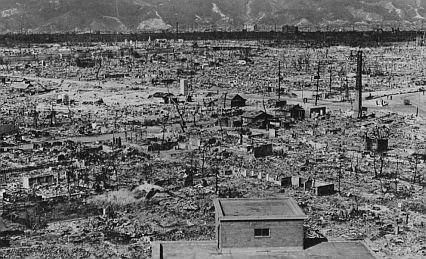
A view of Hiroshima and outlying hills, seen in the autumn of 1945, from the ruins of the Red Cross building, less than one mile from the hypocenter (US National Archives).
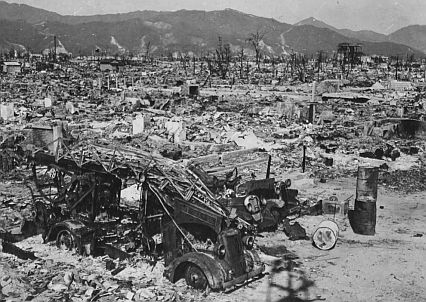
The Hiroshima Fire Department’s main fire station, destroyed by the blast and fire of the atomic bomb, 1,200 m (4,000 ft) from ground zero (US National Archives).
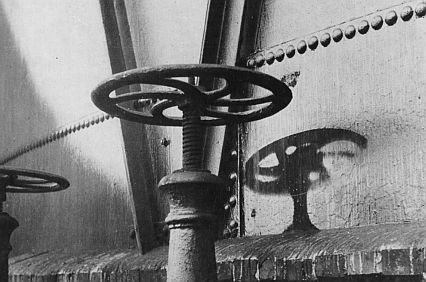
A “shadow” of a hand valve wheel on the painted wall of a gas storage tank after the atomic bombing of Hiroshima. Radiant heat instantly burned paint where the heat rays were not obstructed, 1,920 m (6,300 ft) from ground zero (US National Archives).
Andy Worthington is the author of The Guantánamo Files: The Stories of the 774 Detainees in America’s Illegal Prison (published by Pluto Press, distributed by Macmillan in the US, and available from Amazon — click on the following for the US and the UK). To receive new articles in your inbox, please subscribe to my RSS feed, and also see my definitive Guantánamo prisoner list, published in March 2009.











 Who's still at Guantánamo?

16 Responses
umm maryam says...
thank you for remembering this. not enough people do. until this day i cannot believe that people buy the story that america had to bomb japan to stop the war. how twisted and sick.
isnt it ironic that the nation that bombed hiroshima has put itself as the moral authority of the world and calls others terrorists, calls itself fighting terrorism.
...on November 27th, 2009 at 4:34 pm
Andy Worthington says...
Hi Umm Maryam,
Thanks for the comments. Great to hear from you.
...on November 27th, 2009 at 6:32 pm
jim cleavenger says...
Maryann…you need to get your facts re-checked. You might wish to read Wikipedia’s full account of this global WWII from beginning to end .. how Japan created their mess and in the end was warned by the allies but refused to surrender… read about the relentless attacks on innocents and the unwillingness of war-mongers who refused to surrender. The US resisted this war as long as they could … how many lives would have been lost if those bombs had not been dropped?? I suppose the Japanese attack on Pearl Harbor was just a day in Sunday School? They attacked us, remember? Those military and civilians were people too .. they had loved ones. Further, you have it wrong about the US. It’s people want peace; we help the world survive; always have;.. and yet our civilians were massacred on 09/11..more than 6 thousand..babies and children, too! You must be listening to more propaganda you know nothing about. Stick to what you know … apparently, it isn’t the US.
...on March 16th, 2011 at 6:12 am
Josh says...
I agree wholeheartedly with Jim, go look up operation downfall, The other alternative besides the atomic bomb was an invasion that would have probably wiped out most of the Japanese people in Japan and hundreds of thousands if not millions of American lives. And another thing, the firebombings of other cities were sometimes worse than what happened in Hiroshima. Get your facts strait, some people believe what is written here.
...on May 8th, 2011 at 6:58 pm
Anthony says...
Dear Jim,
…wikipedia is your best resource? please at least read a history book before making this claim. I am not saying I disagree with you at all, but honestly. If you want to hold your own here, you need to build an argument around a better source than wikipedia. Every professor and teacher I have ever had would constantly state how it is not a reliable source. I had a friend that worked for ChaCha, and he got fired for using wikipedia to answer questions because it was not a reliable enough source for them! If ChaCha will not use wikipedia to answer meaningless questions people text to them, I do not think it is appropriate to use it to formulate an argument about WWII.
Like I said, Jim, I do not necessarily disagree with you, but unless you are in middle school wikipedia is a ridiculous source to use to make your claim. Get off Marymam’s case and go read a real encyclopedia.
And another thing, yes I get that the nuclear bombs dropped on these two cities helped to end the war and probably saved America hundreds of thousands of dollars and American lives, but the casualties caused by these bombs were mostly civilian. Now, you can blame the Japanese government and military personnel all you want, but the civilians were innocent. I completely agree that if America had not dropped the bombs, it would have put our own country at risk and that this was an overall good thing to do, but whenever innocent people die, it is a tragedy. That makes these two events very great tragedies.
...on December 14th, 2011 at 6:53 pm
Tom says...
To anyone who still believes the atomic bombs were necessary:
“Japan was already defeated and dropping the bomb was completely unnecessary.”
That was Dwight D Eisenhower who said that.
By June 1945 Japan had been decimated by the US Strategic bombing campaign. Tokyo itself had more than 16 square miles of it burned to the ground and the civilian causalities caused by the bombings that destroyed Tokyo caused far more deaths than the atomic bombs.
The military honestly never stood a chance against the US, simply due to a technology and resource gap that every Japanese person working in heavy industry was well aware of, and by the summer of 1945 all resources had essentially been exhausted. With absolutely no control over their own airspace this was a country that had been thoroughly beaten and knew it. They had already drafted terms of surrender nearly identical to those they ended up signing and the US military itself even admitted that Japan would have surrendered without the bomb.
The real reason the US dropped the bomb was in order to intimidate Russia, who’s power was growing substantially at the time, which scared the US.
As for trying to justify the use of atomic bombs by pointing to Pearl Harbor that’s just absurd.
First of all Pearl Harbor was a military target. Japan never had real interest or capability to bomb US civilian populations; their interest was in stopping the US from meddling in their SE Asia affairs. The atomic bombs however were dropped on civilian populations that were selected for precisely that reason.
Then there’s also the numbers. If you think ~2000 deaths and 68 civilian causalities justifies 200,000 civilian deaths then you have a very warped perception of justice.
Lastly there’s the basic moral point that you can’t justify the use of violence by pointing to more violence.
Both events were tragedies yes, and no one can say that any of the deaths involved were justified. But saying the Japanese in Hiroshima and Nagasaki had it coming because of Pearl Harbor is like saying an entire person’s family and friends deserve to die because he once flicked you in the throat.
...on April 4th, 2012 at 10:10 pm
Andy Worthington says...
Thanks, Tom.
...on April 5th, 2012 at 12:39 am
Justin says...
Tom you are so right.
...on April 17th, 2012 at 8:15 pm
Son of a WWII vet says...
As far as for the Japanese not wishing to attack American soil that is false. They launched weather type ballons that had explosives attached to them which ended up killing I believe between 2-4 people in Washington State. that doesn’t compare to the deaths Japan suffered but it was a planned attack by them on us. Japan was a military society and with the leaders in power and the code by which they lived by there would be no doubt that an invaison of the main islands would result in thousands more killed on both sides.
...on August 6th, 2012 at 6:42 pm
Yes says...
Two words: “Kamikaze pilots”! When you have this mentality, You have Bigger Fish to Fry!
...on August 15th, 2012 at 7:03 pm
Andy Worthington says...
Sorry, but nothing justifies genocide by nuclear bombs.
...on August 15th, 2012 at 7:42 pm
Matt says...
Here is an excerpt from an article Richard B. Frank wrote for the Weekly Standard. Well worth reading:
…right to the very end, the Japanese pursued twin goals: not only the preservation of the imperial system, but also preservation of the old order in Japan that had launched a war of aggression that killed 17 million.
This brings us to another aspect of history that now very belatedly has entered the controversy. Several American historians led by Robert Newman have insisted vigorously that any assessment of the end of the Pacific war must include the horrifying consequences of each continued day of the war for the Asian populations trapped within Japan’s conquests. Newman calculates that between a quarter million and 400,000 Asians, overwhelmingly noncombatants, were dying each month the war continued. Newman et al. challenge whether an assessment of Truman’s decision can highlight only the deaths of noncombatant civilians in the aggressor nation while ignoring much larger death tolls among noncombatant civilians in the victim nations.
There are a good many more points that now extend our understanding beyond the debates of 1995. But it is clear that all three of the critics’ central premises are wrong. The Japanese did not see their situation as catastrophically hopeless. They were not seeking to surrender, but pursuing a negotiated end to the war that preserved the old order in Japan, not just a figurehead emperor. Finally, thanks to radio intelligence, American leaders, far from knowing that peace was at hand, understood–as one analytical piece in the “Magic” Far East Summary stated in July 1945, after a review of both the military and diplomatic intercepts–that “until the Japanese leaders realize that an invasion can not be repelled, there is little likelihood that they will accept any peace terms satisfactory to the Allies.” This cannot be improved upon as a succinct and accurate summary of the military and diplomatic realities of the summer of 1945.
The displacement of the so-called traditionalist view within important segments of American opinion took several decades to accomplish. It will take a similar span of time to displace the critical orthodoxy that arose in the 1960s and prevailed roughly through the 1980s, and replace it with a richer appreciation for the realities of 1945. But the clock is ticking.
...on September 30th, 2012 at 7:37 am
Paul Skinback says...
It still amazes me that our American friends STILL have their heads so far up their own arses, they fail to see the bigger picture. The bombs were not necessary… this was America flexing their muscles to intimidate Russia, plain and simple. Oh well, what do we really expect from a country populated by the outcasts of every other civilised nation on Earth?
...on August 3rd, 2015 at 11:42 am
Andy Worthington says...
Thanks for the comments, Paul. As we approach the 70th anniversary, I note that the Observer published an interesting article at the weekend: http://www.theguardian.com/world/2015/aug/02/hiroshima-bombing-70-years-on-eric-schlosser
It discusses ‘Hiroshima’ by John Hersey, an 18-year-old US soldier stationed outside Hiroshima at the time of the bombing, whose account of the survival of six individuals was published by the New Yorker in 1946 – in ann issue given over entirely to Hersey’s account. Penguin have just reprinted it, but I also found it online here: http://archive.org/stream/hiroshima035082mbp/hiroshima035082mbp_djvu.txt
...on August 3rd, 2015 at 1:10 pm
Paul Skinback says...
This was on BBC today
http://www.bbc.co.uk/news/world-asia-33754931
...on August 5th, 2015 at 11:54 am
Andy Worthington says...
Thanks, Paul. That’s a good article. I also found this article in the Guardian to be very powerful:
The man who survived Hiroshima: ‘I had entered a living hell on earth’
http://www.theguardian.com/world/2015/jul/31/japan-atomic-bomb-survivors-nuclear-weapons-hiroshima-70th-anniversary
An excerpt:
[Sunao] Tsuboi [a retired school principal who has travelled the world to warn of the horrors of nuclear warfare] remembers hearing a loud bang, then being blown into the air and landing 10 metres away. He regained consciousness to find he had been burned over most of his body, his shirtsleeves and trouser legs ripped off by the force of the blast.
“My arms were badly burned and there seemed to be something dripping from my fingertips,” said Tsuboi, who is co-chair of Nihon Hidankyo, a nationwide organisation of atomic and hydrogen bomb sufferers.
“My back was incredibly painful, but I had no idea what had just happened. I assumed I had been close to a very large conventional bomb. I had no idea it was a nuclear bomb and that I’d been exposed to radiation. There was so much smoke in the air that you could barely see 100 metres ahead, but what I did see convinced me that I had entered a living hell on earth.
“There were people crying out for help, calling after members of their family. I saw a schoolgirl with her eye hanging out of its socket. People looked like ghosts, bleeding and trying to walk before collapsing. Some had lost limbs.
“There were charred bodies everywhere, including in the river. I looked down and saw a man clutching a hole in his stomach, trying to stop his organs from spilling out. The smell of burning flesh was overpowering.”
...on August 5th, 2015 at 5:25 pm