Bearing Witness to Unending Injustice: The 40th Global Monthly Close Guantánamo Vigils, May 6, 2026
Please click on either of the ‘Donate’ or ‘Buy’ buttons below (via PayPal or Stripe) to make a donation towards the $2,500 (£2,000) I’m trying to raise to support my work on Guantánamo and on other related topics over the next three months. To get links to all my work in your inbox, please also consider taking out a free or paid subscription to my new Substack newsletter.
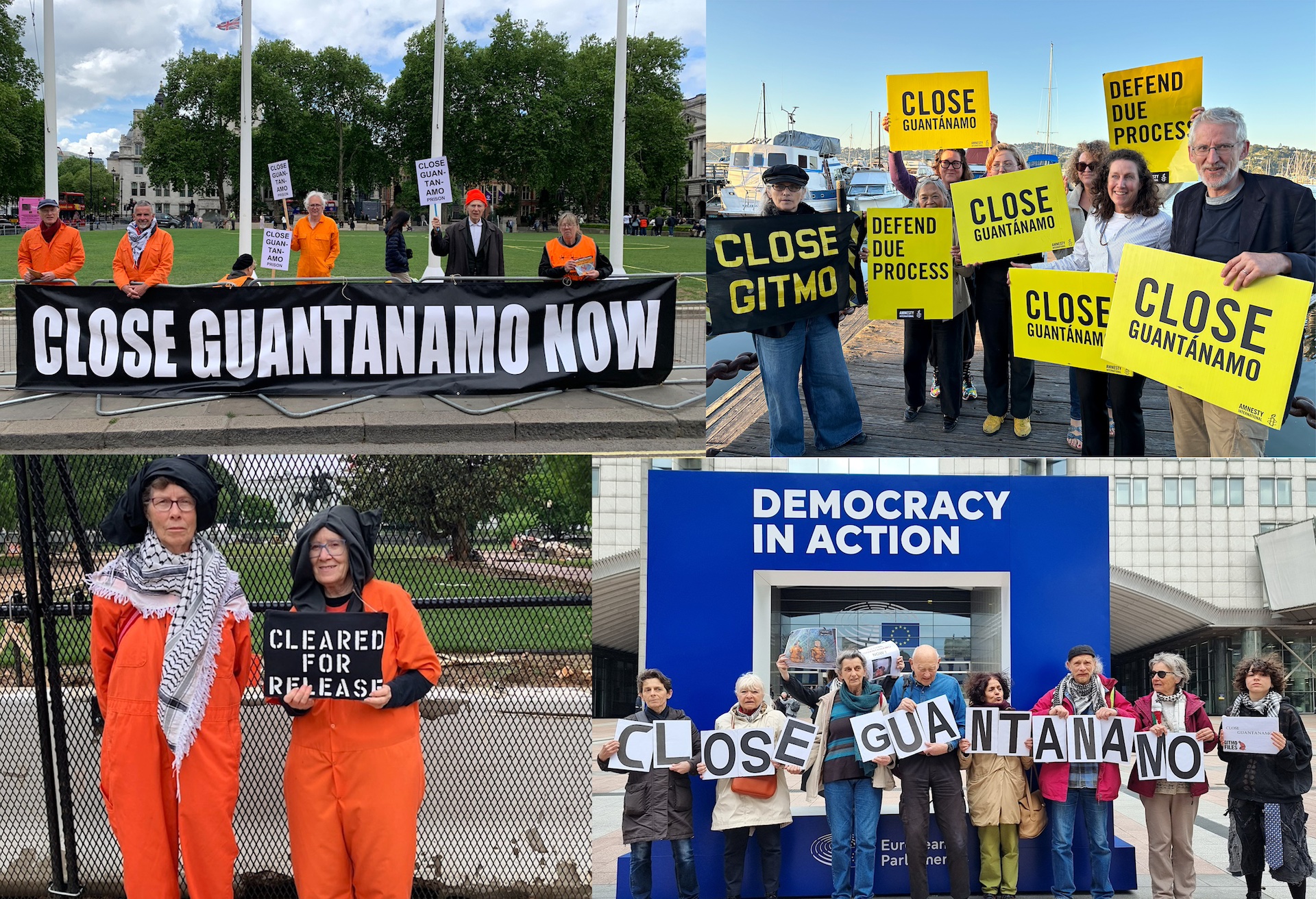
The monthly “First Wednesday” vigils for the closure of the “war on terror” prison at Guantánamo Bay, on Wednesday May 6, marked the 40th successive month that campaigners across the US, in Washington, D.C., New York, Detroit and Los Angeles, and around the world, in London, Brussels and Belgrade, have come together to call for freedom or justice for the 15 men still held — down from 34 when our vigils started — and for the prison to be closed.
Campaigners in San Francisco joined us on Friday May 8, and in Cobleskill, NY on Saturday May 9, and Ed Charles in Oakland, and Lizzy in Arizona, also sent photos. Campaigners in Mexico City had to postpone their vigil, while, in Los Angeles, Jon Krampner held an unrecorded solo vigil, and wrote, “Neither Julie nor Kate could make it, so I was by myself and went to the Downtown LA Federal Building from 10:30 to 11:30 a.m., with my jumpsuit, hood and Amnesty ‘Close Guantánamo’ sign. One young man hurrying into the building said he supported me, but, being in a hurry, declined my request for him to photograph me. Not much interaction beyond that; just a few people pausing to look at me and the sign. This is not much of a report, but at least I showed up.”
Please see below for the photos, and read on for my now monthly reflections on what the vigils mean, and why they continue to be important, followed by further photos. Next month’s vigils will take place on Wednesday June 3, when you’re welcome to join us, and I hope will also take part in the latest phase of Close Guantánamo’s ongoing photo campaign, making every 100 days of the prison’s existence, by taking a photo with the poster marking 8,900 days of Guantánamo’s existence on May 24, and sending it here. All this year’s photos can be found on a dedicated page on the Close Guantánamo website here.
Photos and Report: Amidst Unprecedented Chaos, the Monthly Global Vigils for Guantánamo’s Closure Continue
Please click on either of the ‘Donate’ or ‘Buy’ buttons below (via PayPal or Stripe) to make a donation towards the $2,500 (£2,000) I’m trying to raise to support my work on Guantánamo and on other related topics over the next three months. To get links to all my work in your inbox, please also consider taking out a free or paid subscription to my new Substack newsletter.
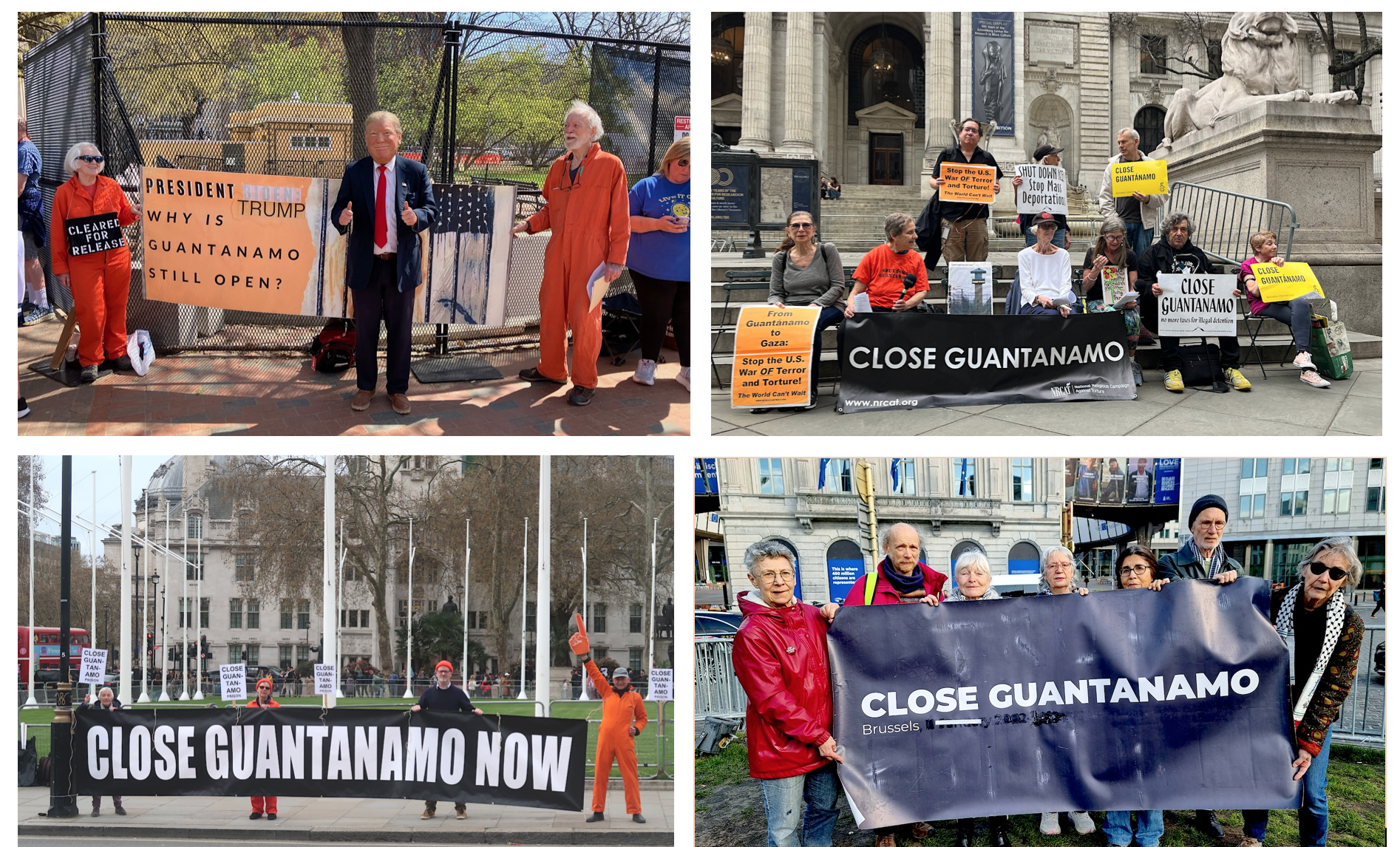
Despite unprecedented global chaos caused by just two rogue nations — the US and Israel — who have wilfully eviscerated all the rules regarding the conduct of warfare over the last two and a half years, and massively increasing the geographical scope of their illegal actions over the last six weeks, campaigners across the US and around the world held their 39th monthly consecutive global vigils for the closure of the US’s “war on terror” prison at Guantánamo Bay last week.
On Wednesday April 1, campaigners gathered outside the White House in Washington, D.C., in New York City and Detroit, while other campaigners were outside the Houses of Parliament in London, the European Parliament in Brussels, and in Mexico City. The Saturday before, on “No Kings Day”, campaigners in San Francisco highlighted the rank injustice of the prison’s continued existence, with other campaigners, in Cobleskill, NY, joining on Saturday April 4, as part of weekly protests reflecting the demands of the times that have been running every Saturday for the last 25 years. There were also solo participants in Oakland, CA and in Liège, Belgium.
Please see below for photos from all of the vigils, and read on for my assessment of the importance of the vigils as part of wider resistance to the collapse into depravity of all notions of any kind of moral order since the start of Israel’s genocide in Gaza 30 achingly long months ago.
Photos and Report: The 38th Monthly Global Vigils for the Closure of Guantánamo on March 4, 2026

Please click on either of the ‘Donate’ or ‘Buy’ buttons below (via PayPal or Stripe) to make a donation towards the $2,500 (£2,000) I’m trying to raise to support my work on Guantánamo and on other related topics over the next three months. To get links to all my work in your inbox, please also consider taking out a free or paid subscription to my new Substack newsletter.
On March 4, the “First Wednesday” monthly global vigils for the closure of the “war on terror” prison at Guantánamo Bay took place in Washington, D.C., New York City, Detroit, London and Brussels, with former prisoner Mansoor Adayfi holding a solo vigil in Belgrade, and with campaigners in Cobleskill, NY joining us on Saturday March 7, when Gavrilah Wells, an Amnesty campaigner from San Francisco, also sent photos from AIUSA’s Human Rights Conference and AGM in Washington, D.C.
These were the 38th successive monthly vigils for the prison’s closure, after I initiated them in February 2023, following the example established by campaigners in London five months before, securing the support of friends and colleagues across the US, and in Brussels and Mexico City, who, ever since, have shown an implacable commitment to keeping Guantánamo and its many injustices visible, in defiance of the tendency of politicians and the mainstream media to behave as though it no longer exists.
I’m hugely impressed that so many vigils took place given the proximity of the date to the all-encompassing horror of the launch of the illegal and unprovoked joint US-Israeli “war” on Iran just four days before, which, like a black hole of injustice, has understandably swallowed up almost everyone’s time and energy.
Photos and Report: Marking Three Years of the Monthly Global Vigils for the Closure of Guantánamo on Feb. 4, 2026

Please click on either of the ‘Donate’ or ‘Buy’ buttons below (via PayPal or Stripe) to make a donation towards the $2,500 (£2,000) I’m trying to raise to support my work on Guantánamo and on other related topics over the next three months. To get links to all my work in your inbox, please also consider taking out a free or paid subscription to my new Substack newsletter.
On Wednesday February 4, campaigners at nine locations across the US and around the world resumed the monthly “First Wednesday” global vigils calling for the closure of the “war on terror” prison at Guantánamo Bay, which I first initiated three years ago, and which have been running continuously ever since.
Last month, as happens every January, the vigils moved to January 11, to mark the 24th anniversary of the opening of the prison, when an unprecedented 19 vigils took place, 12 in the US and seven at other locations worldwide, as can be seen here.
Photos from the vigils in Washington, D.C., London, New York, Brussels, Portland, OR, San Francisco, Detroit and Cobleskill, NY are posted below, and please read on for my reflections on Guantánamo in 2026. Mexico City had to cancel their vigil at the last minute, but will be back next month — on Wednesday March 4 — while, in Los Angeles, Jon Krampner held a solo vigil, because his regular companions were unable to attend, but no one helped him commit the vigil to posterity by taking a photo. As he said, “I went to the Downtown Los Angeles Federal Building. Early on, two young Latinas briefly video’d me, making a few supportive remarks as they did so. Later on, a young guy walked past me, saying that the entire base should be given back to Cuba. Some people looked at me, many didn’t even appear to notice.”
Photos and Report: 19 Global Vigils for the Closure of Guantánamo on the 24th Anniversary of the Prison’s Opening

Please click on either of the ‘Donate’ or ‘Buy’ buttons below (via PayPal or Stripe) to make a donation towards the $2,500 (£2,000) I’m trying to raise to support my work on Guantánamo and on other related topics over the next three months. To get links to all my work in your inbox, please also consider taking out a free or paid subscription to my new Substack newsletter.
Between Saturday January 10 and Monday January 12, an impressive 18 vigils for the closure of the “war on terror” prison at Guantánamo Bay took place across the US and around the world, marking the 24th anniversary of the opening of the prison, with a 19th taking place on January 15.
Eleven of these vigils were by campaigners who have been taking part in the monthly coordinated “First Wednesday” global vigils that I initiated three years ago, and that have been taking place every month ever since.
Seven of these are at locations in the US — outside the White House in Washington, D.C., in New York, San Francisco, Los Angeles, Detroit, Cobleskill, NY, and Portland, OR — while the other four are in London, Brussels and Mexico City, with former Guantánamo prisoner Mansoor Adayfi holding a solo vigil in Belgrade.
Eight more groups also joined us. Five of these were in the US — in Augusta, ME, Cleveland, OH, Greenfield, MA and Raleigh, NC, where annual vigils take place on a regular basis, and in Honolulu in Hawaii, while three others, initiated by Mansoor, took place in Rome, Italy, in Warsaw, Poland and at Shannon Airport in Ireland.
Guantánamo at 23: Global Vigils on January 11 and an Ongoing Photo Campaign Marking 8,400 Days on January 9

Please support my work as a reader-funded journalist! I’m currently trying to raise $2500 (£2000) to support my writing and campaigning on Guantánamo and related issues over the next three months. If you can help, please click on the button below to donate via PayPal. Please also consider taking out a free or paid subscription to my new Substack newsletter.
UPDATE: Just after I posted this article, the news broke that eleven of the 14 men approved for release from Guantánamo have been resettled in Oman. My article celebrating this news will be published tomorrow, but the photo campaign and the vigils will, of course, be proceeding as planned, because 15 men are still held — three who have also long been approved for release, three “forever prisoners”, never charged, but never approved for release either, and nine others in the military commissions trial system. Here’s my article about the release of these eleven men, containing more information than you’ll find in the mainstream media!
With the plight of 14 men who have long been approved for release from Guantánamo but are still held dominating the thoughts of those of us who have spent years — or decades — calling for the prison’s closure, this coming week — which includes the 23rd anniversary of the prison’s opening, on Saturday January 11 — is a crucial time for highlighting the need for urgent action from the Biden administration, in the last few weeks before Donald Trump once more occupies the White House, bringing with him, no doubt, a profound antipathy towards any of the men still held, and a hunger for sealing the prison shut as he did during his first term in office.

This Thursday, January 9, marks 8,400 days since the prison opened, and, as I’ve been doing every 100 days for the last seven years, I’m encouraging people across the US and around the world to show their solidarity with the men still held by taking a photo with the Close Guantánamo campaign’s poster marking this grim milestone, and calling for the prison’s closure. The poster is here, and please send your photo here. If you don’t have a printer, you can bring up the poster on a phone, or on a tablet or laptop, and get someone to take a photo with their phone.

Normally, I also produce a separate poster marking the number of days that Guantánamo has been open on the anniversary of its opening, but this year, because the anniversary falls just two days after 8,400 days, I’m encouraging everyone holding vigils on January 11 to print off the 8,400 days poster and to use that. After 8,400 days, two days really make very little difference at all.
Global Events Marking the 22nd Anniversary of the Opening of Guantánamo on Jan. 11

Please support my work as a reader-funded journalist! I’m currently trying to raise $2500 (£2000) to support my writing and campaigning on Guantánamo and related issues over the next three months. If you can help, please click on the button below to donate via PayPal.
I wrote the following article for the “Close Guantánamo” website, which I established in January 2012, on the 10th anniversary of the opening of Guantánamo, with the US attorney Tom Wilner. Please join us — just an email address is required to be counted amongst those opposed to the ongoing existence of Guantánamo, and to receive updates of our activities by email.
Next Thursday, January 11, the US government’s shameful and disgraceful “war on terror” prison at Guantánamo Bay will have been open for 22 years, and a number of online events, as well as in-person vigils and rallies, are taking place across the US and around the world, which are listed below.
This is an unforgivable anniversary for a prison that should never have existed, where men continue to be held indefinitely without charge or trial, or mired in a broken trial system, the military commissions, that is incapable of delivering justice.
Guantánamo’s continued existence ought to be a source of profound shame for the three branches of the US government — the executive, Congress and the judiciary — who have all failed to close it, for the mainstream US media, who have largely failed to recognize the gravity of the crimes committed there over the last 22 years, and for the majority of the American people, who have failed to take an interest in what is being done in their name in this secretive prison on the grounds of a US naval base on the shore of Cuba’s easternmost bay.
Radio: I Discuss Guantánamo Vigils, “Forever Prisoners” and Genocide in Gaza with Chris Cook on Gorilla Radio

Please support my work as a reader-funded journalist! I’m currently trying to raise $2500 (£2000) to support my writing and campaigning on Guantánamo and related issues over the next three months. If you can help, please click on the button below to donate via PayPal.
My thanks to Chris Cook of Gorilla Radio, in Victoria, Canada, for reaching out to interview me last week about the coordinated monthly vigils for the closure of Guantánamo which take place in London, across the US and around the world on the first Wednesday of every month, and which I initiated in February (following up on monthly vigils in London, which began last September) by reaching out to friends and colleagues elsewhere to join us. Chris and I have spoken many times over the years, and it’s always a pleasure to talk to him.
Our interview takes up the second half of the one-hour show, available on Substack here, and beginning at 28:45, following an interview that is also worth listening to — with William S. Geimer, a peace activist, Professor Emeritus of Law at Washington and Lee University, a military veteran who resigned his 82nd Airborne commission in opposition to the war against Vietnam, the author of the book, ‘Canada: The Case for Staying Out of Other People’s Wars’, and the founder of the Greater Victoria Peace School.
Chris was following up on my recent article, Photos and Report: The Coordinated Global Vigils for the Closure of Guantánamo on November 1, 2023, and as I explained, although the numbers taking part are small — because, fundamentally, so very few people care about the monstrous ongoing injustice of Guantánamo — the effort is worth it because, as I also explained, it’s “one of those things that you do that’s an important reminder that it hasn’t gone away and that not everyone has forgotten”, and that “there’s a huge difference between nobody turning up and a handful of people bothering to make their presence felt.”
Wednesday April 5: The Next Global Coordinated Protests for the Closure of Guantánamo

Please support my work as a reader-funded journalist! I’m currently trying to raise $2500 (£2000) to support my writing and campaigning on Guantánamo and related issues over the next three months. If you can help, please click on the button below to donate via PayPal.
I wrote the following article for the “Close Guantánamo” website, which I established in January 2012, on the 10th anniversary of the opening of Guantánamo, with the US attorney Tom Wilner. Please join us — just an email address is required to be counted amongst those opposed to the ongoing existence of Guantánamo, and to receive updates of our activities by email.
With the release from Guantánamo three weeks ago of the Saudi citizen Ghassan al-Sharbi, the prison now holds just 31 men, out of the 779 held by the US military since it first opened over 21 years ago.
17 of these 31 men have been approved for release, and yet there is no way of knowing when, if ever, they will be released, because they did not have their release ordered by a court, but recommended by administrative review processes, and, as a result, they cannot appeal to a judge to order their release if, as is the case, the government shows no sense of urgency when it comes to freeing them.
Complicating matters, however, we acknowledge that, in the cases of 13 of these men, the US government must find third countries prepared to offer them new homes, because provisions inserted by Republicans into the annual National Defense Authorization Act since the early years of the Obama presidency prevent any repatriations from Guantánamo to countries including Yemen, Libya and Somalia, and eleven of these men are Yemeni, one is a Libyan, and another is a Somali. An additional complication is that none of these men can be resettled in the US, because another provision in the NDAA prevents any Guantánamo prisoner from being brought to the US mainland for any reason.
Photos and Report: Coordinated Protests for the Release of “The Guantánamo 20”, and the Closure of the Prison, in London and Washington, D.C.

Please support my work as a reader-funded journalist! I’m currently trying to raise $2500 (£2000) to support my writing and campaigning on Guantánamo and related issues over the next three months. If you can help, please click on the button below to donate via PayPal.
On Wednesday, February 15, campaigners in London and Washington, D.C. held their first coordinated monthly protest calling for the closure of the prison at Guantánamo Bay, and, specifically, for the release of 20 men (out of the 34 men still held), who have long been approved for release, but who are still held because of a lack of urgency on the part of the US government when it comes to securing their freedom.
I wrote about the plight of the 20 men here, when Majid Khan was released from Guantánamo and resettled in Belize, eleven months after his military commission sentence came to an end, when I noted that, while it was, of course, just and appropriate that Khan had been freed and resettled, because the US government was legally required to freedom at the end of his sentence, it was unforgivable that the Biden administration is dragging its heels when it comes to releasing the 20 other men still held who have been approved for release, because the decisions to release them were taken by administrative review processes that carry no legal weight.
As I stated at the time, “Until they are freed, the message the US government is sending to these 20 men, and to the world, is that it is easier to resettle from Guantánamo someone convicted of terrorism but demonstrably remorseful than it is to resettle someone never charged with a crime at all.”











 Who's still at Guantánamo?
