Can We Have A Discussion About Releasing the Majority of the Guantánamo Prisoners?
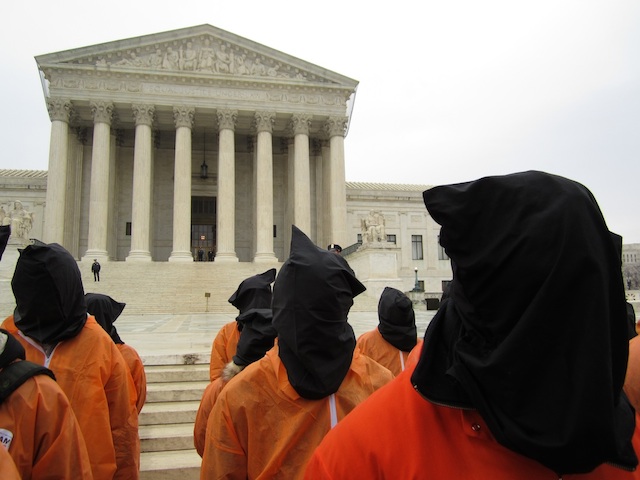 With the prison-wide hunger strike at Guantánamo now entering its third month, conditions at the prison have come under sustained scrutiny for the first time in many years, and media outlets, both domestic and international, have learned, or have been reminded that 166 men remain at the prison.
These men remain imprisoned despite President Obama’s promise to close Guantánamo, which he made when he first took office in January 2009, and despite the fact that over half of them — 86 in total — were cleared for release from the prison in 2009 by an inter-agency Guantánamo Review Task Force, established by the President to decide who should be freed and who should continue to be held.
For those of us who understand that Guantánamo will poison America’s moral standing as long as it remains open, the awakening or reawakening of interest in the prison — and the prisoners — is progress, although there is still some way to go before President Obama or lawmakers understand that they need to release prisoners, or face the very real prospect that everyone still held at Guantánamo will remain there until they die, even though the overwhelming majority have never been charged with any crime, and never will be. Read the rest of this entry »
Revolution Interview: Andy Worthington Discusses the Guantánamo Hunger Strike and the Prison’s Horrendous History
 Last week, Frank Harper, an activist with the campaigning group World Can’t Wait interviewed me by phone (via Skype) for Revolution newspaper. An edited version of the transcript of that interview has been published on Revolution‘s website, and is published in the latest issue of Revolution, cover date April 7.
Below, for readers who want a more detailed analysis of Guantánamo past and present — and, in particular, the prison-wide hunger strike that is about to enter its third month (and which I have written about here, here, here, here and here) — I’m reproducing the full text of the interview, in which I discussed the hunger strike and the reasons for it, as well as, more broadly, the failure of all three branches of the US government to bring anything resembling justice to the 166 prisoners who are still held — the Obama administration and Congress for blocking the release of 86 prisoners cleared for release by the President’s own inter-agency Guantánamo Review Task Force, and the Supreme Court for failing to overturn the ideologically motivated decision by judges in the court of appeals, in Washington D.C., to gut habeas corpus of all meaning for the prisoners, who were granted habeas rights by the Supreme Court on two occasions under President Bush — in 2004 and 2008.
Revolution Interview with Andy Worthington
Hunger Strike at Guantánamo Bay: “Respect us or kill us”
Revolution Newspaper, April 7, 2013
For almost two months now, prisoners at the US’s Guantánamo torture center have been on a hunger strike. Lawyers for some of the prisoners reported that the strike began because of “unprecedented searches and a new guard force.” In particular, prisoners were angry and anguished at the way the guards handled the prisoners’ Korans. Read the rest of this entry »
A Hollow Inauguration
 On January 11, the 11th anniversary of the opening of the “war on terror” prison at Guantánamo, I was in Washington D.C., with various human rights groups, lawyers, mainly religious anti-torture groups, and other concerned individuals, calling on President Obama to fulfill the promise he made to close the prison when he took office in 2009.
It was my third Guantánamo anniversary in the nation’s capital, but unlike in previous years, we were not allowed to protest in front of the White House, as preparations were being made for President Obama’s Inauguration, and, instead, we spoke in the middle of President’s Park South, with the White House in the distance.
It was only after the official event ended that activists with Witness Against Torture, in orange jumpsuits and hoods, dared to make their way to the fence at the back of the White House, to tie 166 orange ribbons to the railings — one for each of the men still held in Guantánamo — and to stage a peaceful sit-in. The activists only narrowly avoided arrest, which would have been particularly ironic, given that they were only reminding President Obama of his failed promise. Read the rest of this entry »
Please Write to the Forgotten Prisoners in Guantánamo on the 11th Anniversary of the Opening of the Prison
 Friday January 11 is the 11th anniversary of the opening of the Bush administration’s “war on terror” prison at Guantánamo Bay, Cuba, an ongoing legal black hole, and an experimental prison for holding Muslim men and boys without rights, and subjecting them to torture and other forms of coercion and abuse, and medical and psychological experimentation.
At Guantánamo, the US authorities manufactured a rationale for holding these men and boys — calling them “the worst of the worst,” and disguising the fact that the majority of them were sold to the US military for substantial bounty payments by their Afghan and Pakistani allies. They did this through the extraction of false statements in which pliant prisoners — whether tortured or otherwise abused, or bribed or pushed until they could take the pressure no longer — made false statements about their fellow prisoners, and/or themselves, which continue to be regarded as something resembling evidence by all three branches of the US government, even though the closest analogy for what this information is in reality can be found in the false statements uttered by the victims of the witch hunts in the 17th century.
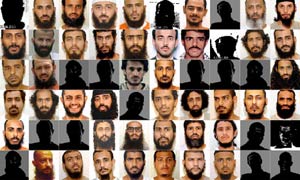
For those who are concerned about the ongoing existence of Guantánamo, this is a worthwhile time to write to the remaining 166 prisoners, to let them know that they have not been forgotten. Disturbingly, they have largely been abandoned by the Obama administration, by Congress, by the courts, by the media and by the American public, even though 86 of them were cleared for release three years ago by an interagency Guantánamo Review Task Force established by President Obama to review the cases of all the prisoners, and even though around half of them were previously cleared for release, between 2004 and 2007, by military review boards established by President Bush. Read the rest of this entry »
Eleven Years of Guantánamo: Andy Worthington Visits the US to Campaign for the Prison’s Closure
 Contact me from 10am Eastern Time on January 9 (until January 16) on 347-581-2677.
It’s over 24 hours since I arrived in the US, with the support of Witness Against Torture, World Can’t Wait and Close Guantánamo, for a series of events to mark the 11th anniversary of the opening of the “war on terror” prison at Guantánamo Bay, Cuba, a shameful anniversary that should not have come to pass. Four years ago, when he took office, President Obama promised to close the prison within a year, but he failed to fulfil that promise. His lack of courage has been matched by opportunistic intervention from Congress, where lawmakers have passed legislation designed to thwart any efforts to close Guantánamo. To complete the failures of all three branches of the US government, the courts too have added their own contribution, with the D.C. Circuit Court gutting the habeas corpus rights of the prisoners, which lawyers spent many years fighting for, and the Supreme Court refusing to revisit the prisoners’ cases, when given the opportunity last year.
As I — and others who still care about the closure of Guantánamo — continue to point out, the ongoing existence of Guantánamo is an affront to all notions of justice and fairness. Distressingly, of the 166 men still held, 86 were cleared for release by President Obama’s interagency Guantánamo Review Task Force, and yet, through the combination of cowardice, indifference, opportunism and scaremongering outlined above, they remain held, even though one long-cleared prisoner, Adnan Farhan Abdul Latif, died at Guantánamo last September, and even though President Obama won reelection in November, and is now free to act to secure his legacy rather than focusing all his attention on campaigning — and not mentioning anything contentious. If he wants a legacy that doesn’t describe him, amongst other things, as the man who promised to close Guantánamo but then failed to do because it was politically inconvenient, he needs to act now. Read the rest of this entry »
President Obama, It’s Time to Fulfill Your Promise to Close Guantánamo

I wrote the following article for the “Close Guantánamo” website, which I established in January with US attorney Tom Wilner. Please join us — just an email address is required to be counted amongst those opposed to the ongoing existence of Guantánamo, and to receive updates of our activities by email.
Now that the dust has settled on last week’s Presidential election, we at “Close Guantánamo” pledge that we will continue to demand that President Obama fulfills his promise to close the “war on terror” prison at Guantánamo Bay, Cuba, which he made on his second day in office in January 2009.
Although we acknowledge that the President has released 71 prisoners since that time, and we accept that Congress has been monstrously obstructive, this is not sufficient to excuse Barack Obama for his failure to fulfill his promise. 166 men still languish in Guantánamo, almost all abandoned by the justice system on which America prides itself.
Particularly galling is the fact that 86 of the men still held were cleared for release by President Obama’s Guantánamo Review Task Force, a sober and responsible collection of officials from the major government departments and the intelligence agencies, who analyzed the cases of all the prisoners throughout 2009. The Task Force concluded that 56 of those men should be released, and 30 others — all Yemenis — should be held in “conditional detention” (a category of detention invented by the Task Force) until it was decided that the security situation in Yemen had improved. Read the rest of this entry »
Conservative Judges Demolish the False Legitimacy of Guantánamo’s Terror Trials
 When is a war crime not a war crime? When it is invented by the executive branch and Congress, and implemented for six years until a profoundly Conservative appeals court strikes it down.
The invented war crime is “providing material support to terrorism,” and on October 16, 2012, a panel of three judges in the D.C. Circuit Court (the Court of Appeals in Washington D.C.) threw out the conviction of Salim Hamdan, a driver for Osama bin Laden, who had received a five and a half year sentence for “providing material support to terrorism” at the end of his trial by military commission in August 2008 (although he was freed just five months later, as his sentence included time already served).
In its ruling, the court stated, “When Hamdan committed the conduct in question, the international law of war proscribed a variety of war crimes, including forms of terrorism. At that time, however, the international law of war did not proscribe material support for terrorism as a war crime.”
For anyone who has followed the history of the military commissions in any depth, the result was not completely unexpected. Revived by the Bush administration in November 2001, specifically for trying prisoners seized in the “war on terror,” the commissions were struck down by the Supreme Court in June 2006, but were then revived by Congress, when “providing material support to terrorism” and “conspiracy” were included as war crimes, even though there was no precedent for doing so. Read the rest of this entry »
Why Does the Government So Desperately Want Indefinite Detention for Terror Suspects?
 What is the government doing? Last year, when Congress passed the National Defense Authorization Act (NDAA), with its contentious passages endorsing the mandatory military detention of terror suspects, there was uproar across the political spectrum from Americans who believed that it would be used on US citizens.
In fact, it was unclear whether or not this was the case. The NDAA was in many ways a follow-up to the Authorization for Use of Military Force, passed by Congress the week after the 9/11 attacks, which authorized the President “to use all necessary and appropriate force against those nations, organizations, or persons he determines planned, authorized, committed, or aided the terrorist attacks that occurred on September 11, 2001, or harbored such organizations or persons, in order to prevent any future acts of international terrorism against the United States by such nations, organizations or persons.”
As confirmed by the Supreme Court in June 2004, in Hamdi v. Rumsfeld, the NDAA also allowed those seized — who were allegedly involved with al-Qaeda and/or the Taliban — to be held until the end of hostilities. The AUMF was, and remains the basis for the detention of prisoners at Guantánamo, but on two occasions President Bush decided that it applied to US citizens — in the cases of Jose Padilla and Yaser Hamdi, who were held on US soil as “enemy combatants” and subjected to torture. Read the rest of this entry »
Obama, the Courts and Congress Are All Responsible for the Latest Death at Guantánamo
 I felt sick when I heard the news: that the man who died at Guantánamo last weekend was Adnan Farhan Abdul Latif, a Yemeni. I had been aware of his case for six years, and had followed it closely. He had been cleared for release under President Bush (in December 2006) and under President Obama (as a result of the Guantánamo Review Task Force’s deliberations in 2009). He had also had his habeas corpus petition granted in a US court, but, disgracefully, he had not been freed.
Instead of being released, Adnan Latif was failed by all three branches of the US government. President Obama was content to allow him to rot in Guantánamo, having announced a moratorium on releasing any Yemenis from Guantánamo after Umar Farouk Abdulmutallab, a Nigerian recruited in Yemen, tried and failed to blow up a plane in December 2009. That ban was still in place when Latif died, and had been put in place largely because of pressure from Congress.
Also to blame are the D.C. Circuit Court and the Supreme Court. Latif had his habeas corpus petition granted in July 2010, but then the D.C. Circuit Court moved the goalposts, ordering the lower court judges to give the government’s alleged evidence — however obviously inadequate — the presumption of accuracy. Latif’s case came before the D.C. Circuit Court in October 2011, when two of the three judges — Judges Janice Rogers Brown and Karen LeCraft Henderson — reversed his successful habeas petition, and only Judge David Tatel dissented, noting that there was no reason for his colleagues to assume that the government’s intelligence report about Latif, made at the time of his capture, was accurate, as it was “produced in the fog of war, by a clandestine method that we know almost nothing about.” In addition, Judge Tatel noted that it was “hard to see what is left of the Supreme Court’s command,” in 2008’s Boumediene v. Bush ruling, granting the prisoners constitutionally guaranteed habeas corpus rights, that the habeas review process be “meaningful.” Read the rest of this entry »
A Premonition of Death at Guantánamo: Adnan Latif’s Hunger Strike Poem
 Note: This image was produced by Amnesty International as part of their letter-writing campaign for this December, featuring Adnan Latif (on the left), a Yemeni prisoner who died at Guantánamo last weekend, and Hussein Almerfedi, another Yemeni who, like Latif, won his habeas corpus petition, but then had it reversed by the malignant rightwing ideologues of the D.C. Circuit Court. Amnesty made the image available to Latif’s attorneys, so please feel free to circulate it widely.
The news cycle is such that we are all trapped like hamsters on a fast-moving wheel, and even when something terrible happens, the media tends to move on after a couple of days — even when that terrible event is the death of a man at Guantánamo who had mental health problems, who was cleared for release in 2006 by a military review board under George W. Bush, and in 2009 by Barack Obama’s interagency Guantánamo Review Task Force, and who had his habeas corpus petition granted by a federal judge in July 2010.
Instead of being released, Latif had his successful habeas petition thrown out by the D.C. Circuit Court last October, not on any factual basis, but because of the application of a twisted ideology, and in June this year the Supreme Court also failed him, refusing to get involved when he — and six others — appealed for them to restore justice to the habeas process. Read the rest of this entry »












 Who's still at Guantánamo?
