Senate Passes Bill to Help Close Guantánamo; Now President Obama Must Act
 I wrote the following article for the “Close Guantánamo” website, which I established in January 2012 with US attorney Tom Wilner. Please join us — just an email address is required to be counted amongst those opposed to the ongoing existence of Guantánamo, and to receive updates of our activities by email.
It’s rare that there is good news about Guantánamo, and even rarer that the good news involves Congress. However, on Tuesday, the Senate accepted a version of the annual National Defense Authorization Act, which originated in the Senate Armed Services Committee, and was put forward by the chair, Sen. Carl Levin, along with Sen. John McCain.
The Levin-McCain version of the NDAA is intended to make it much easier than it has been for the last three years for President Obama to release cleared prisoners from Guantánamo, and to seriously revisit his failed promise to close the prison once and for all, and we note, with thanks, the efforts of Senators and officials in the Obama administration to secure this victory.
This important version of the NDAA contains provisions relating to Guantánamo which allow President Obama to release prisoners to other countries without the onerous restrictions imposed by Congress for the last three years. These restrictions have led to the number of released prisoners dwindling to almost zero, even though 84 of the remaining 164 prisoners were cleared for release from the prison in January 2010 by a high-level, inter-agency task force appointed by President Obama shortly after he took office in 2009. Read the rest of this entry »
Will Carl Levin’s Amendments to the NDAA Help President Obama Close Guantánamo?
 I wrote the following article for the “Close Guantánamo” website, which I established in January 2012 with US attorney Tom Wilner. Please join us — just an email address is required to be counted amongst those opposed to the ongoing existence of Guantánamo, and to receive updates of our activities by email.
Ever since President Obama took office in January 2009, and almost immediately promised to close George W. Bush’s “war on terror” prison at Guantánamo Bay, Cuba, he has faced opposition from Congress. Lawmakers only took four months to begin passing legislation designed to tie his hands, and, in recent years, they have imposed restrictions of increasing severity designed to keep Guantánamo open, and to prevent any more prisoners from being released, for reasons that involve either hysteria, cynical fearmongering or bleak games of political football.
It is to be hoped that this situation is about to come to an end, with some decisive intervention by key lawmakers in Congress, but it is never worth holding one’s breath for justice to be done where Guantánamo is concerned.
Rebellions in Congress, 2009-2012
The first rebellion against the president’s promise to close Guantánamo came in May 2009, when the Senate voted, by 90 votes to 6, to eliminate $80 million from planned legislation intended to fund the closure of Guantánamo, and to specifically prohibit the use of any funding to “transfer, relocate, or incarcerate Guantánamo Bay detainees to or within the United States.” Only six Democrats voted against the legislation, and three others abstained. Read the rest of this entry »
Will the End of War in Afghanistan Spur Obama to Close Guantánamo?
 I wrote the following article for the “Close Guantánamo” website, which I established in January 2012 with US attorney Tom Wilner. Please join us — just an email address is required to be counted amongst those opposed to the ongoing existence of Guantánamo, and to receive updates of our activities by email.
The short answer to the question, “Will the End of War in Afghanistan Spur Obama to Close Guantánamo?” is probably no, for reasons I will explain below, although it is, of course, significant to numerous interested parties that the withdrawal of US troops from Afghanistan next year provides an opportunity for new discussions about the ongoing detention of 164 prisoners at Guantánamo, and, probably, new legal challenges on their behalf.
On October 18, the Washington Post discussed these issues in an article entitled, “Afghan war’s approaching end throws legal status of Guantánamo detainees into doubt,” in which Karen DeYoung suggested, “The approaching end of the US war in Afghanistan could help President Obama move toward what he has said he wanted to do since his first day in office: close the US prison at Guantánamo Bay, Cuba.”
The article described how officials in the Obama administration were “examining whether the withdrawal of US troops at the end of 2014 could open the door” for some of the remaining 164 prisoners “to challenge the legal authority of the United States to continue to imprison them.” Read the rest of this entry »
Tom Wilner: President Obama Could Close Guantánamo Tomorrow If He Wanted To
 The following article was published yesterday on the “Close Guantánamo” website, which I established in January 2012 with US attorney Tom Wilner. Please join us – just an email address is required to be counted amongst those opposed to the ongoing existence of Guantánamo, and to receive updates of our activities by email.
Here at “Close Guantánamo,” we are sad to report that, since the release of two Algerian prisoners two weeks ago, no further prisoners have yet been freed, even though 84 of the remaining 164 prisoners were cleared for release in January 2010 by an inter-agency Guantánamo Review Task Force established by President Obama when he first took office.
Moreover, some of these men were cleared for release many years before, by military review boards under the Bush administration, and yet they are all still held, because of Congressional obstruction, and because President Obama is unwilling to spend political capital to overcome those obstacles, and do what is necessary to show that America can still believe in justice.
Guantánamo has been back in the news this year, because the prisoners, risking their lives, embarked on a prison-wide hunger strike to show their despair at ever being released or given any form of justice, and the world’s media picked up on it. The pressure forced President Obama to promise, in a major speech on national security issues on May 23, to resume releasing prisoners from Guantánamo, but, as is shown by the GTMO Clock we established to show how long it is since the promise, and how many men have been freed, it is now 114 days, and just two men have been released. In Guantánamo, meanwhile, seven months after the hunger strike began, 18 men are still being force-fed. Read the rest of this entry »
Endless Injustice: Newly Announced Guantánamo Review Boards Will Be Toothless Unless Cleared Prisoners Are Freed
 I wrote the following article for the “Close Guantánamo” website, which I established in January 2012 with US attorney Tom Wilner. Please join us – just an email address is required to be counted amongst those opposed to the ongoing existence of Guantánamo, and to receive updates of our activities by email.
As the hunger strike at Guantánamo reaches the six-month mark, it is, sadly, apparent that President Obama has failed to act swiftly to release prisoners following his major speech on national security issues on May 23, when he promised, “To the greatest extent possible, we will transfer detainees who have been cleared to go to other countries.”
Since then, there has been some progress, just not enough. Last week it was announced that President Obama has notified Congress of his intention to release two Algerian prisoners, but 86 of the remaining 166 prisoners have been cleared for release since January 2010, when an inter-agency task force established by the president when he took office issued its report regarding the disposition of the prisoners, and all 86 need to be released.
I understand that Congress has imposed onerous restrictions on the release of prisoners, insisting that the administration must provide assurances that any released prisoner must be unable to engage in terrorist acts against the US. However, Guantánamo must be closed, as President Obama promised when he took office in January 2009, and the hunger strike must be brought to an end. Read the rest of this entry »
Guantánamo Hunger Striker Abu Wa’el Dhiab: “The Mistreatment Now is More Severe than During Bush”
 I wrote the following article for the “Close Guantánamo” website, which I established in January 2012 with US attorney Tom Wilner. Please join us – just an email address is required to be counted amongst those opposed to the ongoing existence of Guantánamo, and to receive updates of our activities by email.
Last week, lawyers for four hunger striking prisoners at Guantánamo asked a judge to order the government to stop their force-feeding and forced medication. The men — Shaker Aamer, the last British resident in the prison, Ahmed Belbacha, and Nabil Hadjarab, both Algerians, and Abu Wa’el Dhiab, a Syrian — are part of a prison-wide hunger strike that began in February 6, and that involves 106 of the remaining 166 prisoners according to the authorities, and at least 120 according to the prisoners.
45 of those men — including Ahmed Belbacha and Nabil Hadjarab — are being force-fed, and all four are amongst the 86 men (out of 166 prisoners in total) who were cleared for release by President Obama’s inter-agency Guantánamo Review Task Force in January 2010, but are still held.
This is partly because of onerous restrictions on the release of prisoners imposed by Congress, but President Obama promised to overcome these restrictions and to resume releasing prisoners in a major speech on national security issues on May 23, and he has the power to do so via a waiver in the legislation that allows him to bypass Congress if he regards it as being “in the national security interests of the United States.”
Sadly, he has not yet exercised that option, and not a single prisoner has been released since his promise was made. Read the rest of this entry »
Close Guantánamo: We Still Have Three Urgent Demands for President Obama
 I wrote the following article for the “Close Guantánamo” website, which I established in January 2012 with US attorney Tom Wilner. Please join us — just an email address is required to be counted amongst those opposed to the ongoing existence of Guantánamo, and to receive updates of our activities by email.
On Monday, President Obama fulfilled the first of three promises he made a month ago to resume releasing prisoners from Guantánamo, by appointing an envoy at the State Department to deal with prisoner transfers.
In a speech on national security issues on May 23, in which the President spoke at length about Guantánamo, he made the following promises: “I am appointing a new, senior envoy at the State Department and Defense Department whose sole responsibility will be to achieve the transfer of detainees to third countries. I am lifting the moratorium on detainee transfers to Yemen, so we can review them on a case by case basis. To the greatest extent possible, we will transfer detainees who have been cleared to go to other countries.”
In fulfilling the first promise, President Obama has appointed Clifford Sloan, described by The Hill as “a veteran Washington attorney and civil servant.” He was “an associate counsel to former President Clinton and an assistant to the solicitor general in the first Bush administration,” and also “worked as associate counsel in the Office of Independent Counsel investigating the Iran-Contra affair and clerked for Supreme Court Justice John Paul Stevens.” More recently, he was the publisher of Slate magazine, and legal counsel for the Washington Post‘s online operations. Read the rest of this entry »
Why We at “Close Guantánamo” Have Cautious Optimism Regarding President Obama’s Plans for the Prison
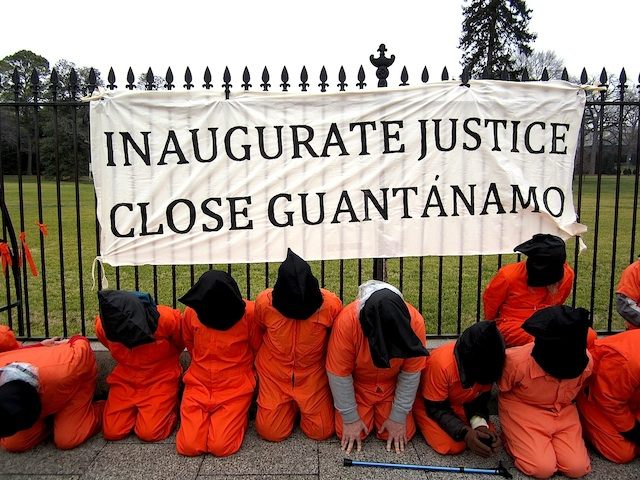 I wrote the following article for the “Close Guantánamo” website, which I established in January 2012 with US attorney Tom Wilner. Please join us — just an email address is required to be counted amongst those opposed to the ongoing existence of Guantánamo, and to receive updates of our activities by email.
Here at “Close Guantánamo,” we are cautiously optimistic about the release of prisoners in the months to come, following promises made by President Obama in a major speech on national security on Thursday.
On Guantánamo, the President made three particular promises.
He said, “I am appointing a new, senior envoy at the State Department and Defense Department whose sole responsibility will be to achieve the transfer of detainees to third countries. I am lifting the moratorium on detainee transfers to Yemen, so we can review them on a case by case basis. To the greatest extent possible, we will transfer detainees who have been cleared to go to other countries.”
We’ve all heard fine words from the President before — when he was running for President, and when he took office in January 2009. On his second day in office, of course, he issued an executive order in which he promised to close Guantánamo within a year. Then, of course, uncomfortable realities arose. The President encountered political opposition, from Republicans and from members of his own party. His close advisers told him the effort to close the prison was not electorally worth the expenditure of political capital. Read the rest of this entry »
Obama on Guantánamo: Yemeni Ban Lifted, Prisoners to Be Released
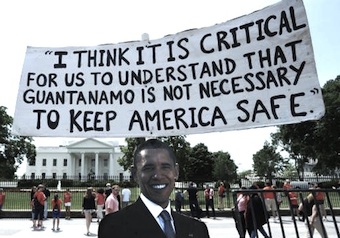 Today, at the National Defense University at Fort McNair, President Obama delivered a major speech on national security issues. I leave it to some of my esteemed colleagues to analyze everything apart from the final section of the speech, in which the President spoke about “the detention of terrorist suspects,” with specific reference to my particular area of expertise, the lamentable “war on terror” prison that still exists at Guantánamo Bay, Cuba.
166 men are still held at Guantánamo, even though 86 of them were cleared for release over three years ago by an interagency task force established by President Obama when he took office in 2009. Failed by all three branches of the US government, the prisoners embarked on a prison-wide hunger strike on February 6, 2013, and it is the unprecedented global response to this hunger strike — domestically and globally — that provoked President Obama to rouse himself from his indifference — or, at best, his refusal to expend political capital on an issue that was not a vote-winner — and make concrete plans for revisiting his failed promise to close the prison, which he made on his first day in office.
Eloquent as ever, he called the prison at Guantánamo Bay “a facility that should never have been opened,” and responded to the tsunami of complaints over the last few months — from Sen. Carl Levin, Sen. Dianne Fenstein, the UN, the ICRC, the European Parliament, the liberal and establishment US media, the more than 215,000 signatories to a Change.org petition, and the more than 560,000 signatories to an Avaaz petition that was launched just yesterday — by apparently meeting two key demands, and hinting at action on a third. Read the rest of this entry »
Eloquent But Unconvincing: President Obama’s Response to the Guantánamo Hunger Strike
 On Tuesday, President Obama gave his first detailed response to the prison-wide hunger strike that has been raging at Guantánamo for twelve weeks, responding to a question posed at a news conference by CBS News correspondent Bill Plante, who asked, “As you’re probably aware, there’s a growing hunger strike at Guantánamo Bay among prisoners. Is it any surprise really that they would prefer death rather than have no end in sight to their confinement?”
The question, presumably, was allowed because the President had decided that he could no longer avoid discussing the hunger strike that, at any moment, could result in the death of one of the many men starving themselves to focus the world’s attention on their plight. According to the government, 100 men of the remaining 166 prisoners are on a hunger strike, although the prisoners say the true number is 130.
Precipitated by the deployment of a new and aggressive guard force at Guantánamo, who manhandled the prisoners’ Korans during searches of the men’s cells that were of unusual intensity, the hunger strike began on February 6 and rapidly became a focal point for the prisoners’ despair at having been abandoned by all three branches of the US government, and by the mainstream media.
Although 86 of the remaining prisoners were cleared for release from Guantánamo by an inter-agency task force that President Obama established when he took office in January 2009 (when he promised to close Guantánamo within a year), they are still held because of obstructions raised by the President himself, and by Congress. Read the rest of this entry »












 Who's still at Guantánamo?
