Photos and Report: Eight Global Vigils for the Closure of Guantánamo on February 7, 2024

Please support my work as a reader-funded journalist! I’m currently trying to raise $2500 (£2000) to support my writing and campaigning on Guantánamo and related issues over the next three months. If you can help, please click on the button below to donate via PayPal.
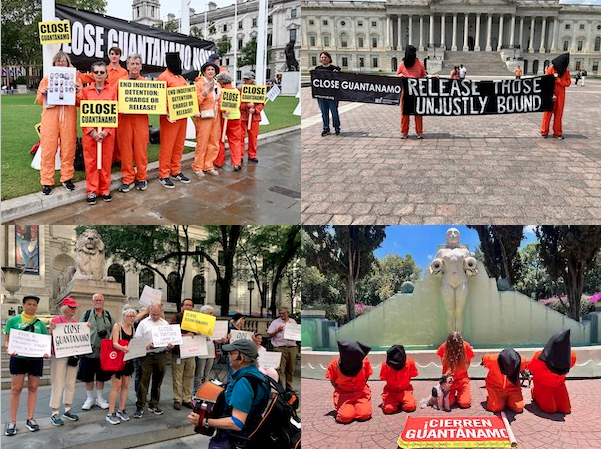
As the prison at Guantánamo Bay continues its miserable existence, now in its 23rd year of denying justice to the men held, and betraying every legal principle that is supposed to distinguish the US from dictatorships, I’m grateful to the campaigners across the US, and around the world, who, following the annual protests for Guantánamo’s closure on January 11, the 22nd anniversary of its opening, have resumed the monthly vigils that I initiated a year ago to try to keep a light shining on Guantánamo once a month rather than just once a year.
Via organizations including numerous Amnesty International groups, the UK Guantánamo Network, Witness Against Torture and The World Can’t Wait, vigils took place on Wednesday (February 7) in Washington, D.C., Cobleskill, NY, Detroit and San Francisco, as well as in Mexico City and London, where I joined fellow campaigners outside the Houses of Parliament, and in Brussels and Copenhagen, where campaigners held their vigils on the preceding days.

Video: Andy Worthington Calls for the Closure of Guantánamo at London Rally on Jan. 20, 2024

Please support my work as a reader-funded journalist! I’m currently trying to raise $2500 (£2000) to support my writing and campaigning on Guantánamo and related issues over the next three months. If you can help, please click on the button below to donate via PayPal.
Two weeks ago, on Saturday January 20, a march and rally for the closure of the prison at Guantánamo Bay was held in London, marking the 22nd anniversary of the the prison’s opening on January 11. The event was organized by the UK Guantánamo Network, a coalition of campaigning groups including numerous Amnesty International members from across London and the south east.
I posted a detailed report about that event, illustrated with photos by myself and by photographer Sinai Noor, two weeks ago, and I’m now following up with the video of the speech I gave at the rally, following the procession of campaigners in orange jumpsuits from Old Palace Yard, by the Houses of Parliament, through Parliament Square, and up Whitehall to Trafalgar Square.
My speech followed a brave and principled speech by Apsana Begum MP, which is available on X here, where, I’m glad to note, it has had nearly 20,000 views, and I was followed by a number of UK Guantánamo Network campaigners — Aaron Humphrey-May, Harry McWhirter, Lise Rossi and Dave Esbester, whose speeches are available on Canva and filmed by Melissa Schweizer, as well as a poem read out by another campaigner.
Photos and Report: The Close Guantánamo March and Rally in Central London, Jan. 20, 2024

Please support my work as a reader-funded journalist! I’m currently trying to raise $2500 (£2000) to support my writing and campaigning on Guantánamo and related issues over the next three months. If you can help, please click on the button below to donate via PayPal.
On Saturday (January 20), a colourful and inspiring march and rally for the closure of the prison at Guantánamo Bay took place in central London, organized by the UK Guantánamo Network, which consists of members of a number of local Amnesty International groups from across London and the south east, plus other campaigners, myself included.
The event was organized to mark the recent 22nd anniversary of the opening of Guantánamo, on January 11, when a handful of campaigners braved bitterly cold weather to stage a vigil outside the US Embassy in Nine Elms, as part of the monthly coordinated global vigils for Guantánamo’s closure that I initiated a year ago. See here for my report about, and photos from the 16 vigils that took place in the US and around the world to mark the anniversary.
Complementing that vigil, the march and rally took place on a Saturday for maximum visibility, and would have taken place on Saturday January 13 had it not been for the fact that a massive March for Palestine was scheduled for that particular date, which I posted photos of — and commentary about — here.
Photos and Report: The Global Vigils for the Closure of Guantánamo on the 22nd Anniversary of the Prison’s Opening

Please support my work as a reader-funded journalist! I’m currently trying to raise $2500 (£2000) to support my writing and campaigning on Guantánamo and related issues over the next three months. If you can help, please click on the button below to donate via PayPal.


8,000 Days of Guantánamo: Vigils Take Place Around the World and 170 Former Prisoners, Lawyers, Politicians and Campaigners Join Photo Campaign

Please support my work as a reader-funded journalist! I’m currently trying to raise $2500 (£2000) to support my writing and campaigning on Guantánamo and related issues over the next three months. If you can help, please click on the button below to donate via PayPal.
Wednesday December 6 was a big day for Guantánamo activism, as it marked 8,000 days since the prison opened, and also coincided with the date for the latest global vigils, calling for the closure of Guantánamo, which I initiated in February, and which have been taking place across the US, in London, Mexico City, and elsewhere, every month since.
To mark 8,000 wretched and unforgivably long days of the prison’s existence, I encouraged anti-Guantánamo campaigners around the world to take a photo with the 8,000 days poster, hosted on the Gitmo Clock website, an initiative of the Close Guantánamo campaign, which I established nearly 12 years ago, on the 10th anniversary of the opening of Guantánamo.
The Gitmo Clock has been counting, in real time, how long Guantánamo has been open for nearly six years, since the 16th anniversary of the prison’s opening, on January 11, 2018, when the lamentable Donald Trump was president, and when the prison had been open for 5,845 days.
A Glimpse of Light in the Darkness, As Former Guantánamo Prisoner Mansoor Adayfi is Welcomed to the UK Parliament

Please support my work as a reader-funded journalist! I’m currently trying to raise $2500 (£2000) to support my writing and campaigning on Guantánamo and related issues over the next three months. If you can help, please click on the button below to donate via PayPal.
Sometimes, when darkness is all around, just one small ray of light is sufficient to keep hope alive.
A week ago, on November 15, amidst the almost all-encompassing darkness of Israel’s genocide in Gaza, that small ray of light was provided when former Guantánamo prisoner Mansoor Adayfi was welcomed into the Palace of Westminster, the home of the British Parliament, by Chris Law, the SNP (Scottish National Party) MP for Dundee East, who is the co-chair of the recently established All-Party Parliamentary Group (APPG) for the Closure of the Guantánamo Detention Facility.
Mansoor — the very definition of human irrepressibility — was held for over 14 years at Guantánamo before being resettled in Serbia in July 2016, where his outspoken nature and complaints about his treatment (which included a ban on travelling outside Serbia) led, for many years, to harassment and intimidation from the Serbian authorities.
This is a situation that only slowly began to change when he started having articles published in the New York Times, related to his involvement in “Ode to the Sea: Art from Guantánamo Bay”, a significant exhibition of artwork by current and former prisoners at John Jay College of Criminal Justice in New York, which ran from October 2017 to January 2018.
Photos and Report: Global Vigils for the Closure of Guantánamo on September 6, 2023

Please support my work as a reader-funded journalist! I’m currently trying to raise $2500 (£2000) to support my writing and campaigning on Guantánamo and related issues over the next three months. If you can help, please click on the button below to donate via PayPal.
On Wednesday September 6, the latest monthly coordinated vigils for the closure of Guantánamo took place in ten locations worldwide — London, Washington, D.C., Mexico City, Detroit, Cobleskill, NY, Brussels and Copenhagen, and with San Francisco and Saratoga Springs, NY joining us for the first time. Aaron Tovo held a solitary vigil in Minneapolis, after some last-minute cancellations, although no one was there to photograph him, and campaigners in New York City have delayed their vigil to September 13.
The vigils take place on the first Wednesday of every month, and began in February, when I asked friends and colleagues across the US, and in Mexico City, Brussels and Copenhagen, to join the monthly vigils for the prison’s closure that campaigners in London had been undertaking since September last year, drawing on a long tradition of Guantánamo vigils outside the Houses of Parliament.
For the development of the vigils, please see my reports from March, April, May, June, July and August, all accompanied by numerous photos.
Photos and Report: Global Vigils for the Closure of Guantánamo on August 2, 2023
Please support my work as a reader-funded journalist! I’m currently trying to raise $2500 (£2000) to support my writing and campaigning on Guantánamo and related issues over the next three months. If you can help, please click on the button below to donate via PayPal.
On Wednesday (August 2), the latest monthly coordinated vigils for the closure of Guantánamo took place in seven locations worldwide — London, Washington, D.C., New York City, Mexico City, Detroit, Cobleskill, NY and Los Angeles — with former prisoner Mansoor Adayfi joining us in a one-man vigil in his apartment in Belgrade.
Because it’s holiday season, campaigners in a few locations — Brussels, Copenhagen and Minneapolis — were unable to join us this month, but they’ll be back next month, on Wednesday September 6, when, we’re glad to hear, many of the campaigners involved around the world are working towards making their vigils as prominent as possible.
The vigils take place on the first Wednesday of every month, and began in February, when I asked friends and colleagues across the US, and in Mexico City, Brussels and Copenhagen, to join the monthly vigils for the prison’s closure that campaigners in London had been undertaking since September last year, drawing on a long tradition of Guantánamo vigils outside the Houses of Parliament.
Photos and Report: The Latest Coordinated Global Vigils for the Closure of Guantánamo on July 5, 2023

Please support my work as a reader-funded journalist! I’m currently trying to raise $2500 (£2000) to support my writing and campaigning on Guantánamo and related issues over the next three months. If you can help, please click on the button below to donate via PayPal.
Last Wednesday, July 5, coordinated vigils took place around the world calling for the closure of the prison at Guantánamo Bay. My apologies for posting the photos and this report so late, but I took a week’s holiday beginning the day of the vigils, which involved a healthy seven days of digital detox, and I’m only just now back online.
The vigils take place on the first Wednesday of every month, and began in February, when I put a call out to friends and colleagues across the US, and in Mexico City, Brussels and Copenhagen, to join the monthly vigils that campaigners in London had been undertaking since September last year, drawing on a long tradition of vigils for the closure of Guantánamo outside the Houses of Parliament.
For the development of the vigils, please see the photos and reports from March, April, May and June.
Photos and Report: The Latest Parliamentary Meeting on Guantánamo and an Amnesty Event I Chaired with Mohamedou Ould Slahi and Mansoor Adayfi

Please support my work as a reader-funded journalist! I’m currently trying to raise $2500 (£2000) to support my writing and campaigning on Guantánamo and related issues over the next three months. If you can help, please click on the button below to donate via PayPal.
Last week was another good week for Guantánamo activity in the UK — on the part of politicians, former prisoners, lawyers and activists — as the All-Party Parliamentary Group for the Closure of the Guantánamo Detention Facility held its second meeting, and Amnesty International hosted an event at its London HQ about former prisoners’ memoirs, and the power of writing.
On Monday June 26 — the 25th anniversary of the establishment of the UN International Day in Support of Victims of Torture — the second meeting of the APPG for Guantánamo’s closure took place in the Palace of Westminster (the Houses of Parliament), following the inaugural meeting in May, which I wrote about here.
That meeting featured former prisoners Mohamedou Ould Slahi, visiting from his home in the Netherlands, and his former guard Steve Wood, visiting from the US, and for this second meeting Mohamedou made a return visit, joined this time by another former prisoner, the British citizen Moazzam Begg, who introduced the members of the APPG to Yusuf Mingazov, the son of another former prisoner, Ravil Mingazov.










 Who's still at Guantánamo?
