“The Banks Got Bailed Out, We Got Sold Out”: Students March in London
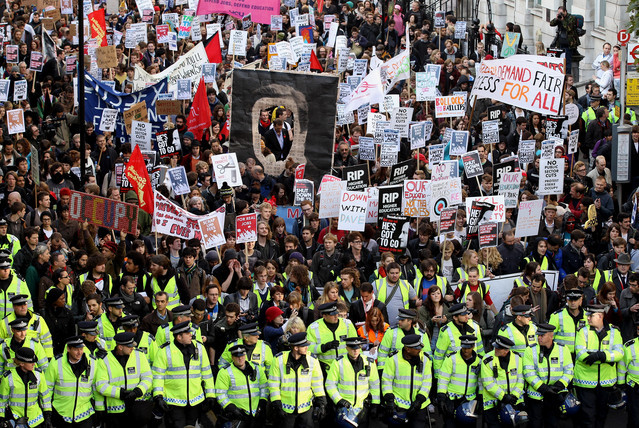 The slogan came from “Occupy Wall Street,” but it was a perfect fit for the thousands of student protestors marching today against the Tory-led government’s assault on students.
It was exactly a year since the first march against the government’s plans to cut funding to universities and to triple tuition fees, and, on that occasion, 50,000 people took to the streets, and the government was given its first notification that it might not be possible to force the people of Britain into submission without them putting up a fight.
That initial fight was lost, as Parliament approved the Tories’ bill in December last year. However, not content with endangering the future of university education and transferring the entire financial burden of arts, humanities and social sciences courses onto students, for nakedly ideological reasons, the government has now proposed further fundamental and damaging changes to the university sector in its white paper, which I discussed in an article last week, and which treats students purely as consumers, completely ignores the public value of higher education, and involves plans to introduce private providers into the university sector. Read the rest of this entry »
National Student-Led Demo Against University Fees, Austerity Cuts and the Planned Privatisation of Higher Education, November 9, 2011
 It’s hard to believe that it’s just a year since 50,000 students, lecturers, university staff, schoolchildren and concerned citizens marched through central London to protest against the Tory-led coalition government’s plans to triple university tuition fees, to cut all funding to arts, humanities and the social sciences courses, and to cut the Education Maintenance Allowance, which supported schoolchildren on lower incomes, but now the time has come for concerned parties to take to the streets once more to show their opposition to the government’s white paper on higher education reform, which focuses on students as consumers, completely ignores the public value of higher education, and points to a privatised future of greater cost and greater inequality.
In September, nearly 400 academic campaigners, members of professional bodies, and concerned individuals published a hugely important response to the government’s plans, a document entitled, “In Defence of Public Higher Education,” in which they provided nine reasons for defending higher education as it currently stands, including a recognition that “higher education has public as well as private benefits and these public benefits require financial support,” a recognition that “public universities have a social mission and help to ameliorate social inequality,” that “public higher education is part of a generational contract in which an older generation invests in the wellbeing of future generations,” and that “education cannot be treated as a simple consumer good.”
They also concluded, appropriately, that the “commodification of higher education” is “the secret heart of the white paper,” and that the government “seeks a differently funded sector, one which can provide new outlets for capital that struggles to find suitable opportunities for investment elsewhere” — a conclusion that applies equally to the government’s malignant plans to privatise the NHS. The authors also concluded that the government’s plans are “based on ideology rather than financial necessity, and will make no lasting savings.” Read the rest of this entry »












 Who's still at Guantánamo?
