Guantánamo, Stonehenge Book Readings and Music: Two Events with Hamja Ahsan – Radio Show on Sunday June 28, and Art Event in Hackney Wick on July 2
 My friends,
If you’re around on Sunday, between 3pm and 5pm GMT, you can listen to me reading from my books and playing some of my favourite music with human rights activist and arts curator Hamja Ahsan (DIY Cultures), who has a show, DIY Sunday Radio, every Sunday afternoon (UK time) on One Harmony Radio, based in Brockley, south east London, where I live.
Hamja became a campaigner because his brother, Talha, a talented poet with Asberger’s Syndrome, was imprisoned without charge or trial in the UK for six years pending extradition to the US, and was then extradited, spending two years in a Supermax prison before a judge sentenced him to time served and sent him home. See the campaign’s Facebook page here.
One Harmony Radio, which mainly plays reggae music, is a community internet radio station, so you can listen to my show from anywhere in the world! The Facebook page is here.
As noted above, I’ll be reading from my books, Stonehenge: Celebration and Subversion, The Battle of the Beanfield and The Guantánamo Files. Read the rest of this entry »
Stonehenge and the Summer Solstice, 30 Years After the Battle of the Beanfield
 Happy summer solstice, everyone! I thought I might visit megalithic Wiltshire this year, for my first solstice visit in 10 years, but the anti-austerity march in London — and my desire to attend it — rather put paid to that plan. My hoped-for destination was Avebury, the village built in the remains of a colossal stone circle, roughly 20 miles north of Stonehenge, which awakened — or rather reawakened — my interest in all things megalithic from 1996, when a chance visit with my new girlfriend (and now wife) Dot led to such enthusiasm on my part that I devoted much of the next ten years to visiting ancient sacred sites all over England, and in Scotland, Malta and Brittany.
I also wrote two books in this period, after my original plan failed to find a publisher. That project was, “Stonehenge and Avebury: Pilgrimages to the Heart of Ancient England,” and it was based on three long-distance walks I made with Dot and other friends in 1997 and 1998, along the Ridgeway from the Thames to Avebury, and then an eight-day trek through Wiltshire to Stonehenge, from Dorchester in Dorset, which I christened “The Stonehenge Way,” and another walk of my devising from Stonehenge to Avebury.
I hope one day to revive that particular project, but what happened in 2002 was that I was encouraged to focus on one particular aspect of the book — the Stonehenge Free Festival, my first inspiration when it came to ancient sacred sites. As a student, I had visited the festival in 1983 and 1984, and had found my view of the world transformed by this gigantic anarchic jamboree that filled the fields opposite Stonehenge every June. The photo above is from 1975, the second festival, and is from the Flickr site of Basil and Tracy Brooks. Basil played with Zorch, who played at both of the first two festivals, in 1974 and 1975. See the albums here and here. Read the rest of this entry »
It’s 30 Years Since Margaret Thatcher Trashed the Travellers’ Movement at the Battle of the Beanfield
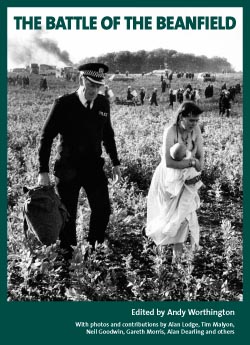 Buy my book, The Battle of the Beanfield, here.
Exactly 30 years ago, on June 1, 1985, a convoy of vehicles trying to get to Stonehenge to establish what would have been the 12th annual free festival in the fields opposite Britain’s most famous ancient monument, was set upon with violence on a scale that has not otherwise been witnessed in peacetime in modern times in the UK.
Around 1,400 police from six counties and the Ministry of Defence were in Wiltshire to “decommission” the convoy, which consisted of around 500 new age travellers, free festival goers and environmental activists. The police were thwarted in their efforts to arrest the majority of the convoy via a roadblock, and the travellers then occupied a pasture field and an adjacent bean field, establishing a stand-off that was only broken late in the afternoon, when, under instructions from on high, the police invaded the fields en masse, and violently assaulted and arrested the travellers — men, women and children — smashing up their vehicles to try and make sure this new nomadic movement would never be able to function again.
Successive waves of legislation — the Public Order Act of 1986 and the Criminal Justice Act of 1994 — largely destroyed Britain’s traveller community, although there were fascinating eruptions of dissent along the way — in particular via the rave scene of the late 80s and early 90s, and the road protest movement that was a direct descendant of the free festival movement. Unable to travel freely, protestors rooted themselves to a fixed spot, occupying land regarded as sacred and, in many noteworthy cases, living in trees in an effort to prevent road-building projects from taking place. Read the rest of this entry »
30 Years On from the Last Stonehenge Free Festival, Where is the Spirit of Dissent?
 As tens of thousands of people gathered at Stonehenge last night and this morning for the summer solstice — and, presumably, more photos were taken than ever before, including, of course, the ubiquitous “selfie,” an example of which can be seen in the photo to the left — I recall that, 30 years ago, in June 1984, the last Stonehenge Free Festival took place in the fields opposite Stonehenge, and I was one of the tens of thousands of people who took part in it.
I had first visited with friends the year before, and had been astonished to discover that, while Margaret Thatcher was embarking on her malevolent plan to create a taxpayer-funded privatised Britain of selfishness, consumerism and unfettered greed, tens of thousands of people were on Salisbury Plain — partying, yes, or just getting wasted, but also sidelining consumerism and embracing communalism and alternative ways of living and looking at the world.
My experiences were central to my book Stonehenge: Celebration and Subversion, a social history of Stonehenge, which I wrote over an 18-month period from 2002 to 2004, and which was published ten years ago. It’s still in print, and you can buy it from me here, or from the publisher, Heart of Albion Press, or, if you must, from Amazon. After ten years, it is also — finally — being stocked at Stonehenge itself, in the new visitors’ centre that opened last December.
From humble beginnings ten years before, the Stonehenge Free Festival had grown to become the definitive counter-cultural expression of hedonism and dissent, a month-long manifestation of an alternative society, which so alarmed the authorities that the following year an advance convoy, travelling to Stonehenge to secure the festival site on June 1, was set upon by 1,400 police from six counties and the MoD, and decommissioned with shocking violence at an event that will forever be known as “The Battle of the Beanfield.” My book, The Battle of the Beanfield, about the terrible events of that day is also still available. For bulk orders, please contact Enabler Publications. Read the rest of this entry »
It’s 29 Years Since the Battle of the Beanfield, and the World Has Changed Immeasurably
Buy my book The Battle of the Beanfield here.
29 years ago, on June 1, 1985, a convoy of around 450 men, women and children — travellers, anarchists, free festival goers and green activists — were ambushed by 1,400 police from six counties and the Ministry of Defence, and decommissioned with a violence that has rarely been paralleled in modern British history.
The convoy was en route to Stonehenge, to set up what would have been the 11th annual free festival in the fields opposite Britain’s most famous ancient monument, but the savage decommissioning of the travellers’ vehicles, their mass arrest, and the raising of a military-style exclusion zone around Stonehenge put paid to that prospect.
The exclusion zone was raised every June for the next 13 years, until the law lords ruled it illegal in 1999, and since then English Heritage have allowed unfettered access to the stones on the summer solstice, with up to 30,000 revellers — everyone from pagan priests to teenage party-goers — availing themselves of the “Managed Open Access” policy. Read the rest of this entry »
Back in Print: The Battle of the Beanfield, Marking Margaret Thatcher’s Destruction of Britain’s Travellers
Buy The Battle of the Beanfield here.
Yesterday, December 1, 2013, was a cheerless anniversary of sorts — 28 and a half years since the Battle of the Beanfield, on June 1, 1985, when 1,300 police from six counties and the MoD trapped and violently decommissioned a convoy of several hundred travellers — men, women and children, the new nomads of the UK, including free festival goers, anarchists, and anti-nuclear activists — en route to Stonehenge to establish what would have been the 12th annual Stonehenge Free Festival. From humble origins in 1974, the festival had grown, by 1984, into a month-long counter-cultural extravaganza attended by tens of thousands of people, and in 1985, fresh from her success in suppressing the miners, Margaret Thatcher turned her attention to the festival and its loose network of organisers, planning to destroy it as ruthlessly as she was destroying British industry.
in 2005, to mark the 20th anniversary of this key event in the modern state’s clampdown on dissent, I compiled and edited a book about the Battle of the Beanfield, drawing on transcripts I made of interviews with travellers and witnesses to the events of the day and the months building up to it that were recorded for a 1991 TV documentary, “Operation Solstice” (screened on Channel 4 and available to buy here); the police log, liberated from a court case brought by some of the victims of the Beanfield; and other relevant information, book-ended with essays putting the Beanfield in context, written by myself and Alan Dearling, whose publishing company, Enabler Publications, launched the book in June 2005.
Eight and a half years later, The Battle of the Beanfield is still in print, and, to slightly contradict the heading of this article, it has never actually been out of print, although in summer, when Alan and I reprinted it, I was down to my last few copies. You can buy it here, in time for Christmas, if you, or anyone you’re hoping to buy a present for, was there, was affected by it, or is simply interested in knowing more about one of the key events that shaped the relationship between the state and those perceived as difficult. I should note that my previous book, Stonehenge: Celebration & Subversion, is also still available, as is my third book, The Guantánamo Files. Read the rest of this entry »
Memories of Youth and the Need for Dissent on the 29th Anniversary of the last Stonehenge Free Festival
 Please note that my books Stonehenge: Celebration and Subversion and The Battle of the Beanfield are both still available, and I also wholeheartedly recommend Travelling Daze: Words and Images from the UK’s New Travellers and Festivals, Late 1960s to the Here and Now, Alan Dearling’s epic review of the traveller scene (to which I was one of many contributors), which was published last year, and is essential reading for anyone interested in Britain’s traveller history.
Every year, on the summer solstice, I am confronted by two particular questions, as, I’m sure, are many people old enough to have spent their youth growing up under Margaret Thatcher, or in the years previously, under Ted Heath’s Tory government, and the Labour governments of Harold Wilson and Jim Callaghan, when an unofficial civil war was taking place in British society.
Those two questions are: what happened to my youth, and what happened to massive, widespread societal dissent?
The former of course, is an existential question, which only young people don’t understand. It’s 29 years since the last Stonehenge Free Festival, an annual anarchic jamboree that lasted for the whole of June, when Britain’s alternative society set up camp in the fields across the road from Stonehenge, and it’s 39 years since the first festival was established, by an eccentric young man named Phil Russell, or, as his friends and admirers remember him, Wally Hope. Read the rest of this entry »
Stonehenge and the Summer Solstice: On the 28th Anniversary of the Last Free Festival, Check Out “Festivals Britannia”
 So today, as 14,000 revellers at Stonehenge faced a rainy summer solstice morning, with some of them, at least, echoing the reverence that those who built this giant sun temple over 4,000 years ago had for the great axis of the solar year, many of those in attendance may not have known of the long struggles that enabled them to party in the world’s most famous stone circle, or of the free festival that sprawled across the fields opposite Stonehenge every June for 11 years from 1974 to 1984, or of the brutal suppression, in 1985, of the convoy of travellers, anarchists and environmental activists heading to Stonehenge to set up what would have been the 12th Stonehenge Free Festival, who were violently set upon and “decommissioned” in what has become known as the Battle of the Beanfield.
Those who want to know more can check out my books Stonehenge: Celebration and Subversion and The Battle of the Beanfield, and can also find out more via my most recent article on the Beanfield, three weeks ago, and my recent radio interview, which I posted yesterday. However, I believe this is also an excellent opportunity for people to watch “Festivals Britannia,” a 90-minute long BBC4 documentary by Sam Bridger, first broadcast in December 2010, which I’m posting below in six parts, as available on YouTube.
This is an important programme, with excellent commentators and some astounding footage (including dreamlike Super-8 footage from the ’70s by Chris Waite, and equally dreamlike images from the last great gathering of the tribes, at Castlemorton in 1992), even though watching it was a rather surreal experience, as its narrative arc seemed to be drawn entirely — but without credit — from Stonehenge: Celebration and Subversion. Read the rest of this entry »
Happy Summer Solstice to the Revellers at Stonehenge — Is it Really 27 Years Since the Last Free Festival?
 This is a bleak summer solstice as far as the weather goes, but no doubt for many of the thousands of revellers at Stonehenge last night (an estimated 18,000 people in total), it was, nevertheless, a memorable occasion, as it remains essentially unprecedented for tens of thousands of people to gather in a field at night, mingling amongst the stones of one of the world’s most famous prehistoric monuments, without some famous rock star or other strutting their stuff on a floodlit stage.
I haven’t been to the solstice for six years, having visited every year from 2001 to 2005 — after the wilderness years, from 1985 to 1999, when a military-style exclusion zone was declared, to keep out those who had not learned that they were unwelcome after the dreadful events of what is known as the Battle of the Beanfield — but every year I think about those converging on the ancient stones, and wait for the first reports and photos, to find out whether the sun shone at dawn, and to hear from those who were there.
My interest, as some of you will know, stems from the visits I made to the Stonehenge Free Festival, an annual riot of anarchy and alternative lifestyles that occupied the fields around Stonehenge for 11 years, from 1974 to 1984, until it was suppressed with unprecedented violence in 1985, when an advance convoy, heading to the stones to set up the festival, was ambushed by the massed forces of Margaret Thatcher’s militarized police, and decommissioned with savage violence at the Battle of the Beanfield. Read the rest of this entry »










 Who's still at Guantánamo?
